

The Holiness of God
       Lesson # 5:
Key Text:

“Exalt the Lord our God, and
worship at his holy hill; for the
Lord our God is holy” (Psalm 99:9).

Key Thought: Scripture gives much attention to God’s
holiness. What does this holiness tell us about what
God is like and what it means to the plan of salvation?
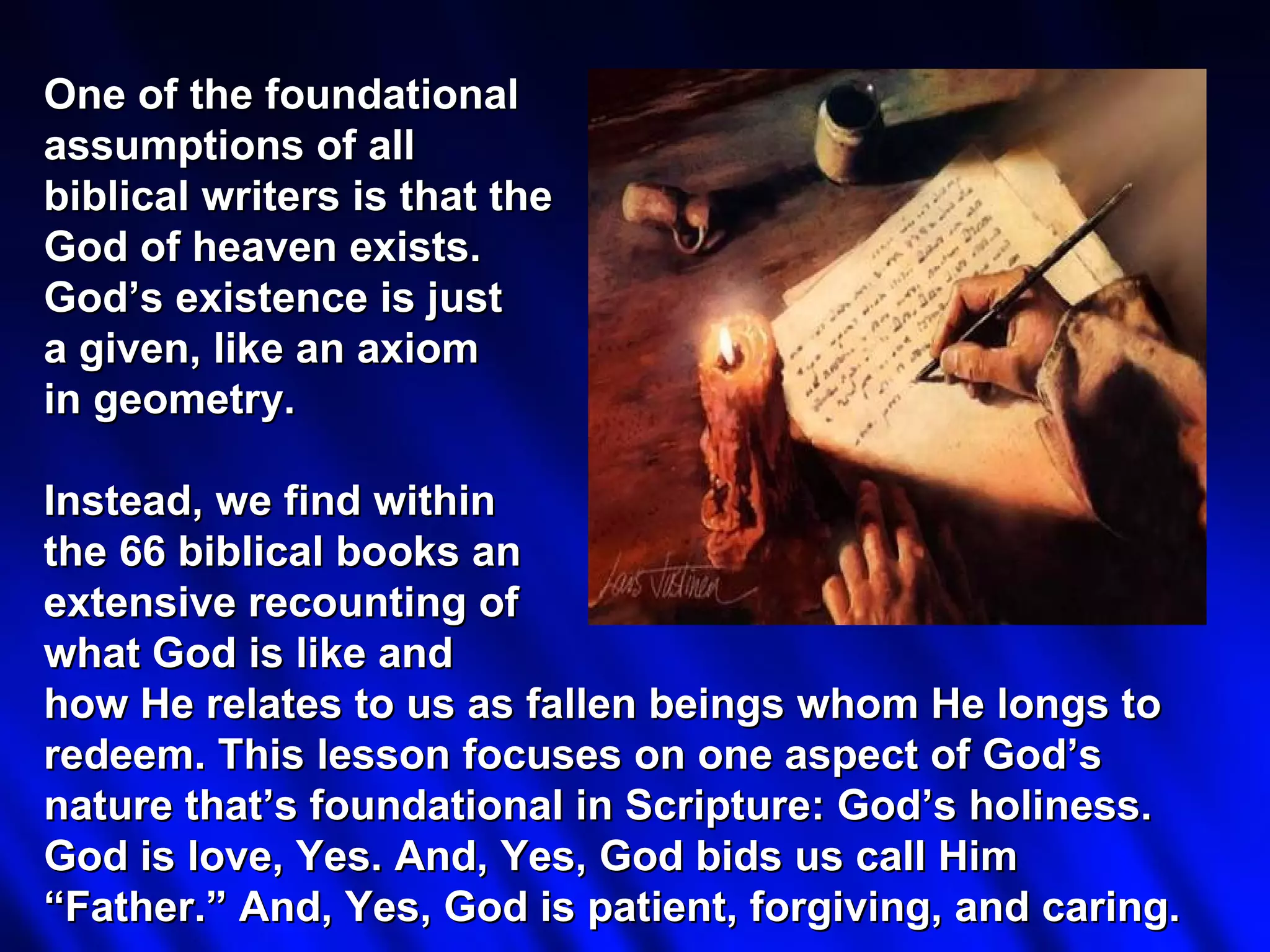
One of the foundational
assumptions of all
biblical writers is that the
God of heaven exists.
God’s existence is just
a given, like an axiom
in geometry.

Instead, we find within
the 66 biblical books an
extensive recounting of
what God is like and
how He relates to us as fallen beings whom He longs to
redeem. This lesson focuses on one aspect of God’s
nature that’s foundational in Scripture: God’s holiness.
God is love, Yes. And, Yes, God bids us call Him
“Father.” And, Yes, God is patient, forgiving, and caring.
But, according to
Scripture, fundamental
to our understanding of
God is His holiness.
Both in the Old and New
Testaments, God’s
holiness undergirds His
revelation of Himself.
This theme appears all
through the Scriptures
in one way or another.

What, though, does it mean to say that God is holy? How
does the Bible depict His holiness? And how do we, as
unholy beings, relate to a God like this?
1. “It Is Written”

Even a superficial study
of church history makes
it clear that it’s all too
easy to develop ideas
about God and then to
worship these ideas
instead of God Himself,
the God revealed in the
Bible.

As the skeptic Voltaire quipped, “God made man in His
image, and man has returned the compliment.” We may
not even realize that we have an incomplete, or even false,
understanding of God.
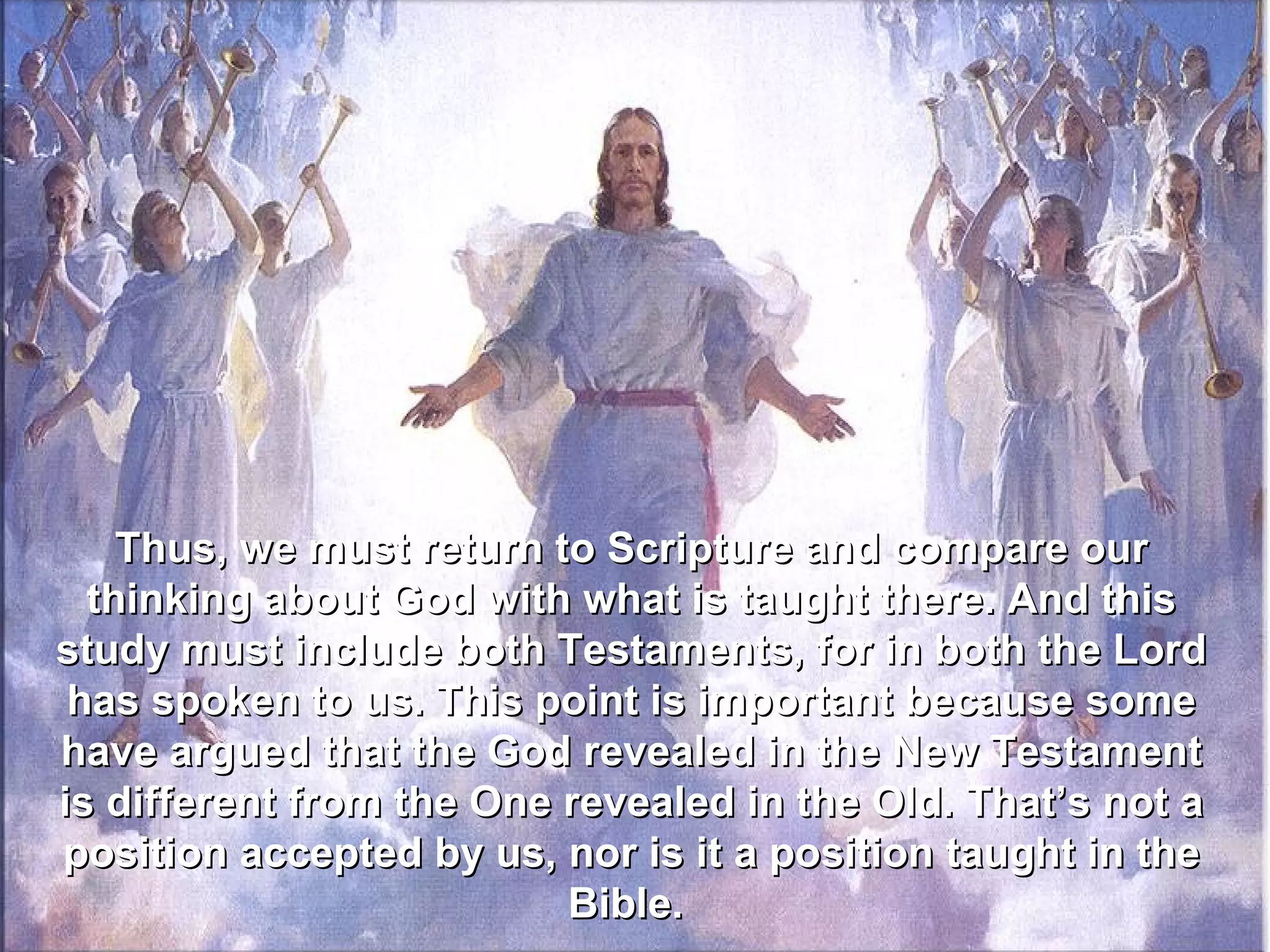
Thus, we must return to Scripture and compare our
  thinking about God with what is taught there. And this
study must include both Testaments, for in both the Lord
 has spoken to us. This point is important because some
have argued that the God revealed in the New Testament
is different from the One revealed in the Old. That’s not a
position accepted by us, nor is it a position taught in the
                          Bible.
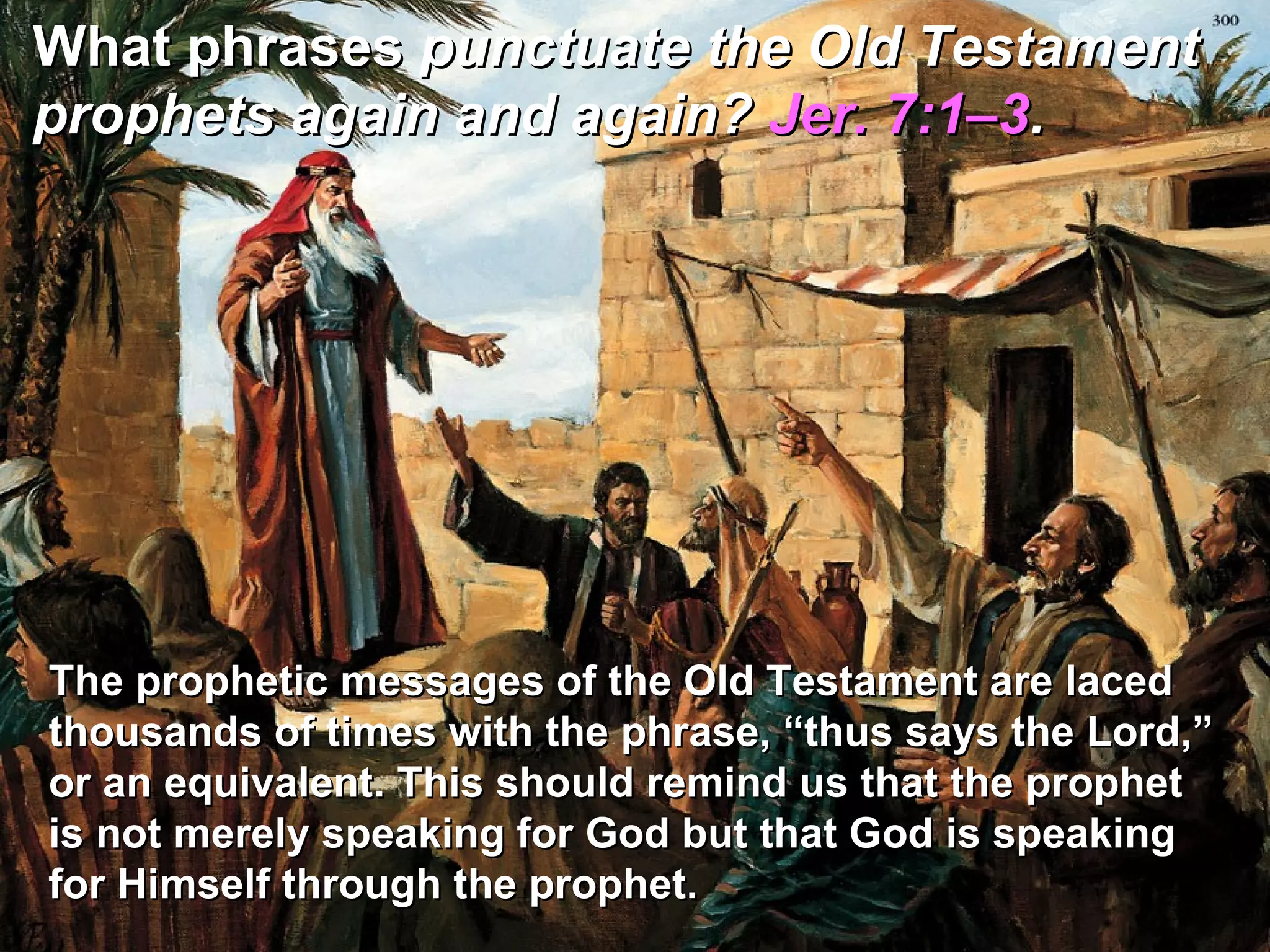
What phrases punctuate the Old Testament
prophets again and again? Jer. 7:1–3.


The prophetic messages of the Old Testament are laced
thousands of times with the phrase, “thus says the Lord,”
or an equivalent. This should remind us that the prophet
is not merely speaking for God but that God is speaking
for Himself through the prophet.
At the same time, the New Testament is filled with reference
after reference to the Old Testament. In fact, the whole
theology of the New Testament is intricately linked to the Old.
How does one, for instance,
make sense of the
sacrifice of Jesus
apart from the entire
sacrificial system
revealed in the
Old Testament?
How many times did
Jesus, as well as the New
Testament writers, refer to
Old Testament passages in order to
buttress their arguments and points? The whole New
Testament corpus finds its theological foundation in the Old.
There’s no justification for any radical division between them.
All Scripture—both Testaments—is inspired by the Lord (2
Tim. 3:16).
Look up the following texts. How do they help us to see
the link between the New Testament and the Old? What
  do they tell us about how Jesus, as well as the New
Testament writers, viewed the Old Testament? Matt. 4:4,
 11:10; Mark 1:2; 7:6; John 12:14, 15; Acts 13:33; Rom.
          3:10; Gal. 3:13; 1 Pet. 1:16; 1 Cor. 5:7.
REFLECTION:

 Mark Twain once said that it’s not the
   parts of the Bible that he doesn’t
  understand that bother him; it’s the
  parts that he does. Who doesn’t, at
    times, find sections of the Bible
bothersome? Given what the Bible says
 about itself (2 Tim. 3:16), how should
   we respond to the parts we don’t
understand, or maybe don’t even like?
         (See also 1 Cor. 13:12.)
2. To Be Set Apart
              Apar


What is the first time
the concept of
“holiness” (from the
same root often
translated as
“sanctified”) is
mentioned in
Scripture? Gen. 2:3.
How significant is the
fact that the first thing
deemed holy in the
Bible is time?
This text gives us our first understanding of holiness. It shows
   that something, in this case time, is “set apart” from that
 which is around it. The seventh day itself is no different from
  any other 24-hour, sunset-to-sunset period; what makes it
  different, “holy,” is that God declared it that way. He set it
  apart from the rest of the week. The Hebrew word there for
   “sancti-fied” means to “make holy” or to “declare holy.”
     Holiness then implies that something is special about
whatever is “holy,” something that sets it apart from what isn’t
                               holy.
To some degree, then, this idea should help us to
  understand the holiness of God. God is set apart from
anything else in creation. He is transcendentally separate,
far above and beyond anything that we can truly grasp. To
be holy is to be “other,” to be different in a special way, as
               with the seventh-day Sabbath.
This concept of holiness should help us better
understand the gap between a God who is holy and a
race of beings who aren’t—a race, in fact, of sinners.
 God is separate from us not only because He is the
 Creator and we are the created but because we are
 fallen beings. All this should, ideally, help us better
    understand that which Christ has done for us.
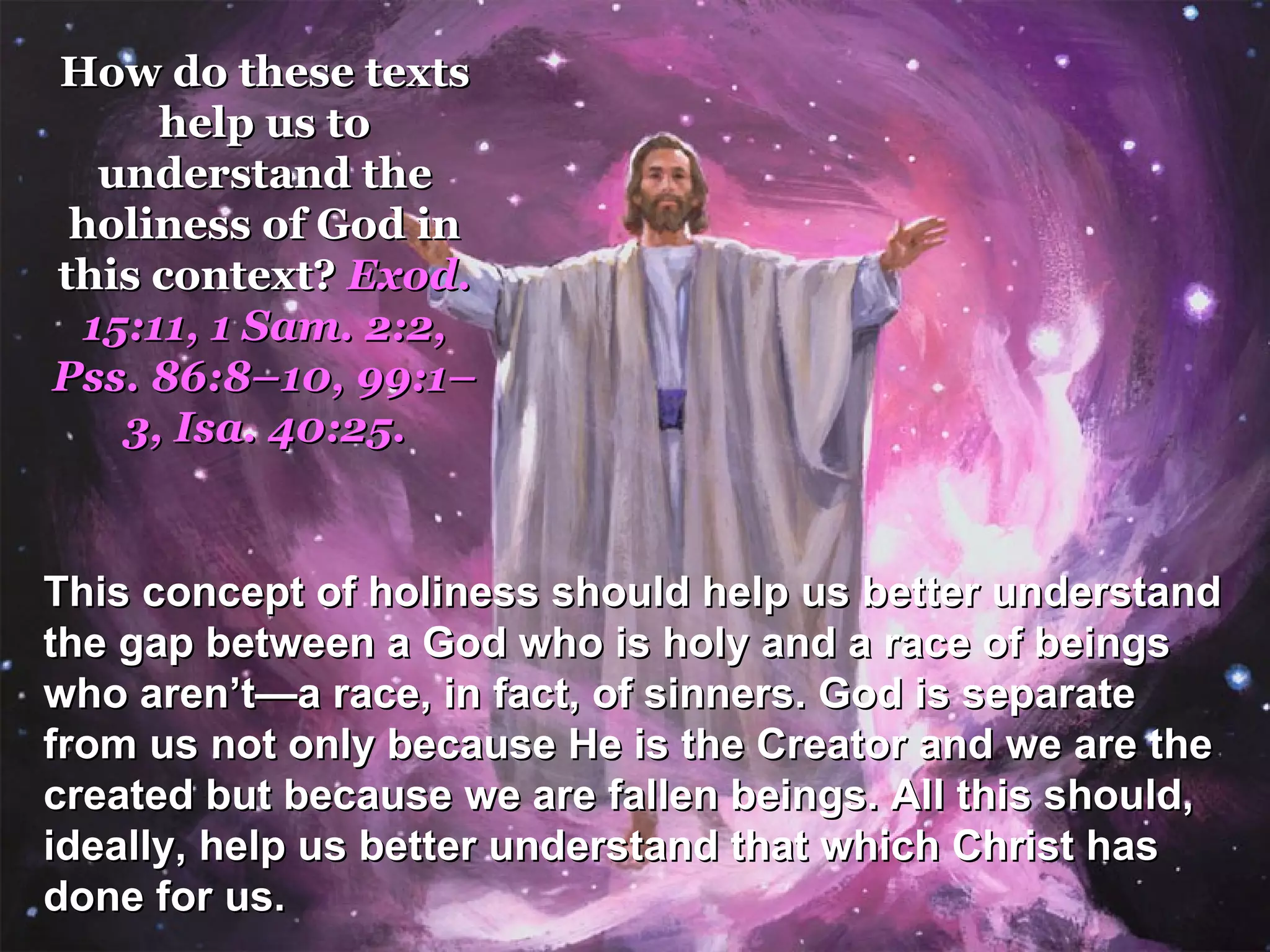
How do these texts
     help us to
  understand the
 holiness of God in
this context? Exod.
 15:11, 1 Sam. 2:2,
Pss. 86:8–10, 99:1–
   3, Isa. 40:25.


This concept of holiness should help us better understand
the gap between a God who is holy and a race of beings
who aren’t—a race, in fact, of sinners. God is separate
from us not only because He is the Creator and we are the
created but because we are fallen beings. All this should,
ideally, help us better understand that which Christ has
done for us.
REFLEXION:


Although we are made in the image
of God, what are the ways in which
  we differ radically from Him?

How do these differences help us to
understand our need of a Savior?
3. To Repent in Dust and Ashes

After enduring inhuman suffering at the hand of Satan,
Job cries out: “I have heard of thee by
the hearing of the ear: but now mine eye
seeth thee. Wherefore I abhor myself,
and repent in dust and ashes”
(Job 42:5, 6).


What does this response tell us about God’s holiness in
contrast to human sinfulness? How is the gospel being
preached in Job’s reaction to what he experienced?
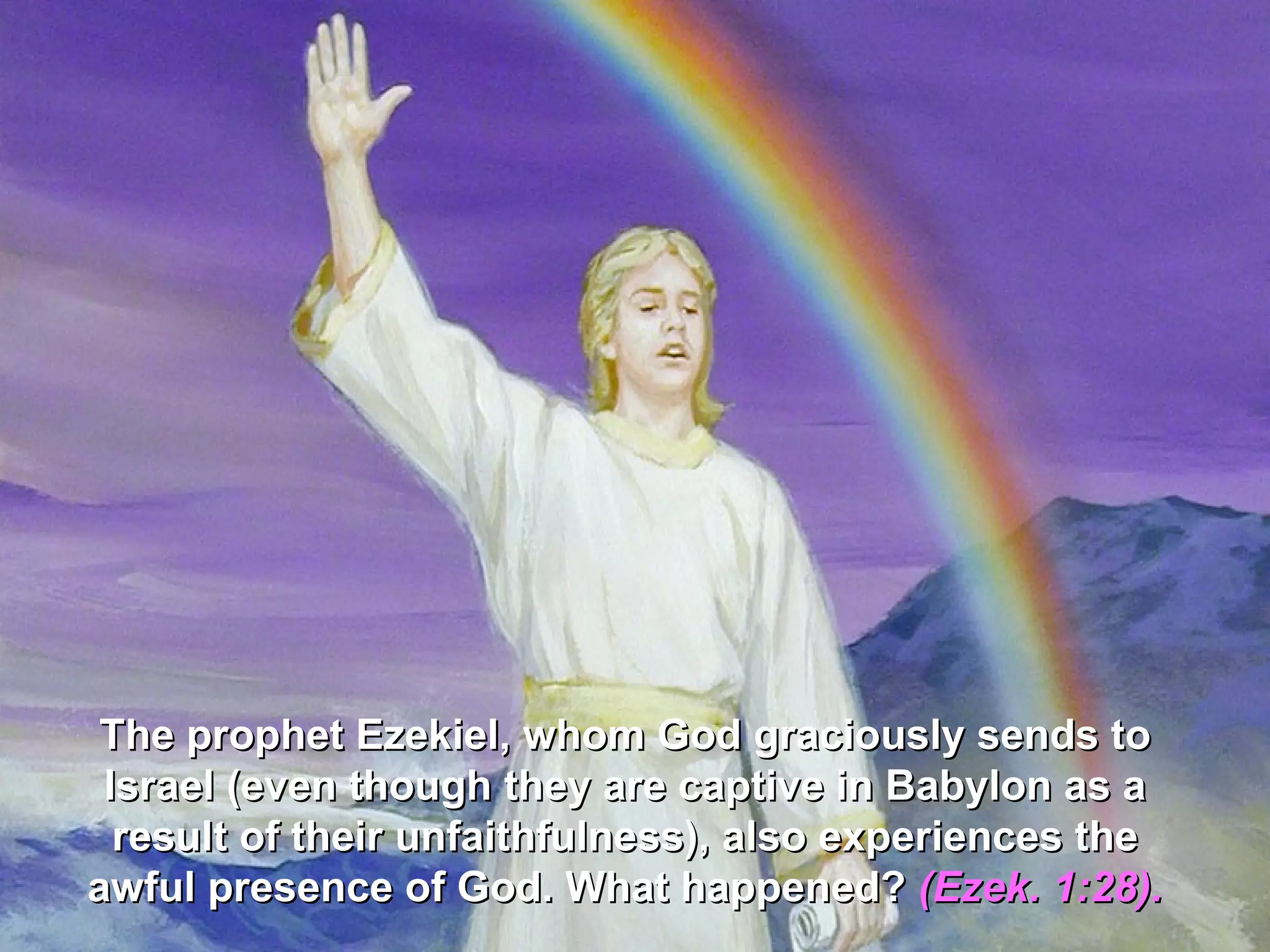
The prophet Ezekiel, whom God graciously sends to
 Israel (even though they are captive in Babylon as a
  result of their unfaithfulness), also experiences the
awful presence of God. What happened? (Ezek. 1:28).
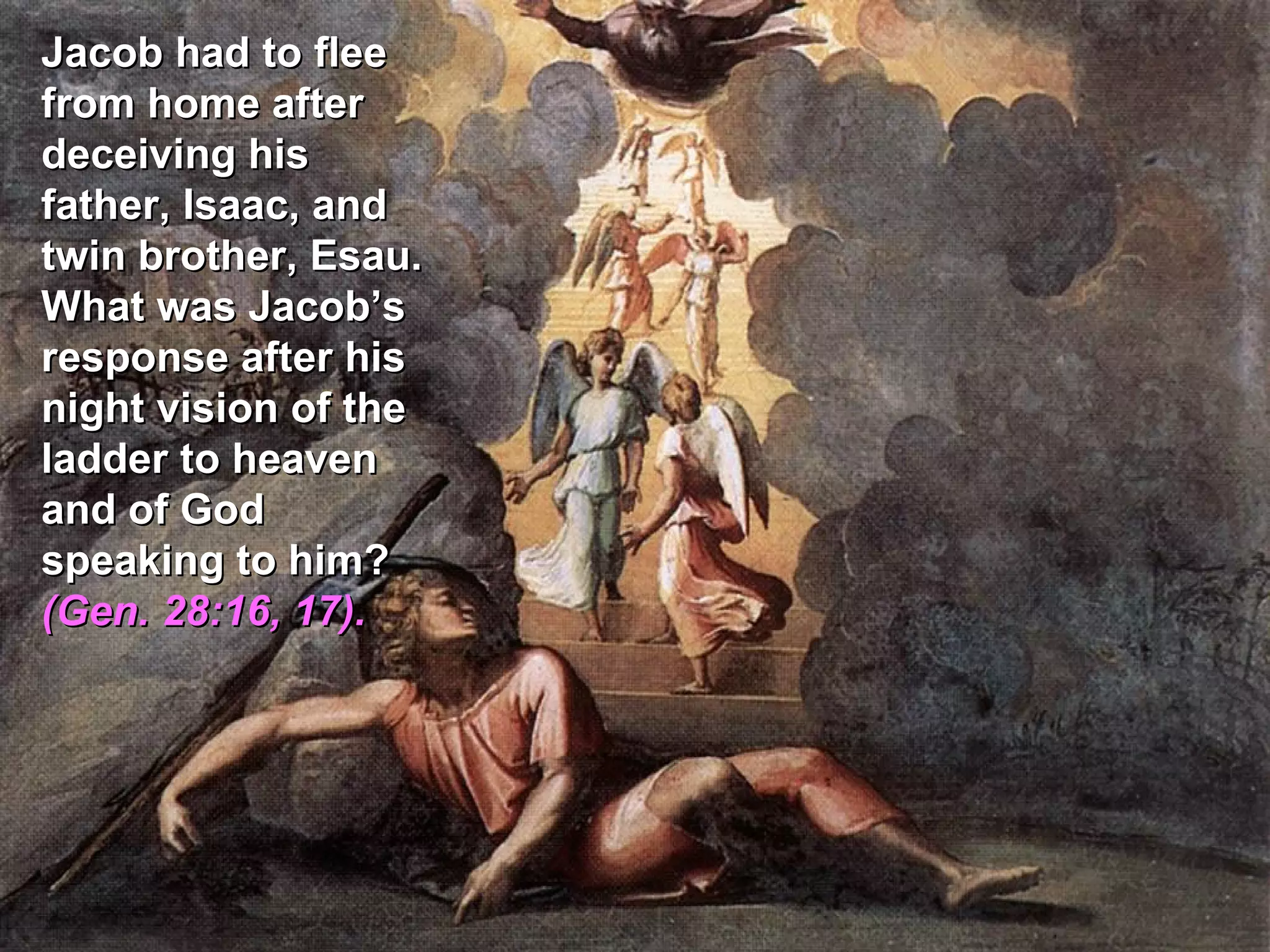
Jacob had to flee
from home after
deceiving his
father, Isaac, and
twin brother, Esau.
What was Jacob’s
response after his
night vision of the
ladder to heaven
and of God
speaking to him?
(Gen. 28:16, 17).
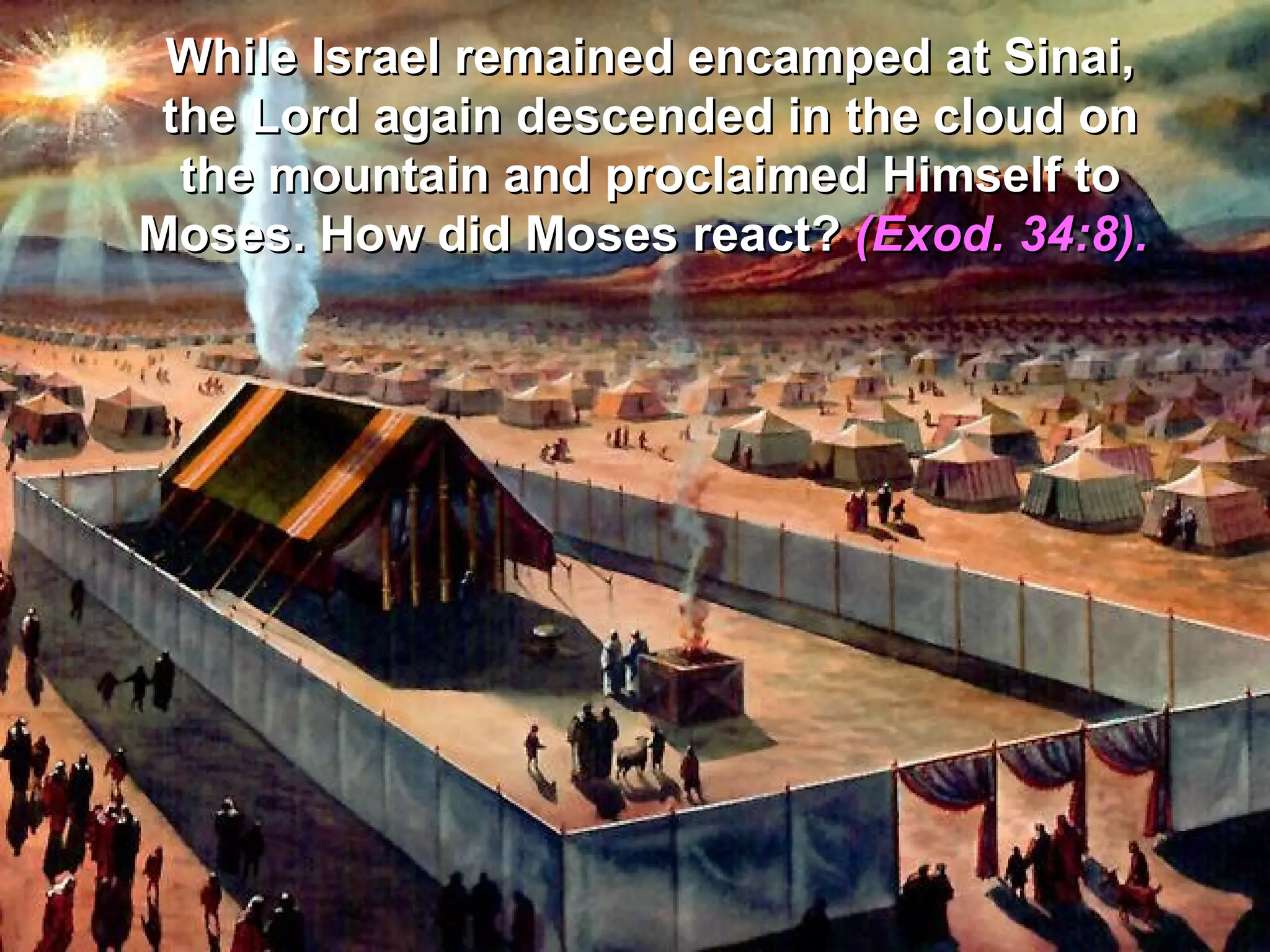
While Israel remained encamped at Sinai,
 the Lord again descended in the cloud on
  the mountain and proclaimed Himself to
Moses. How did Moses react? (Exod. 34:8).
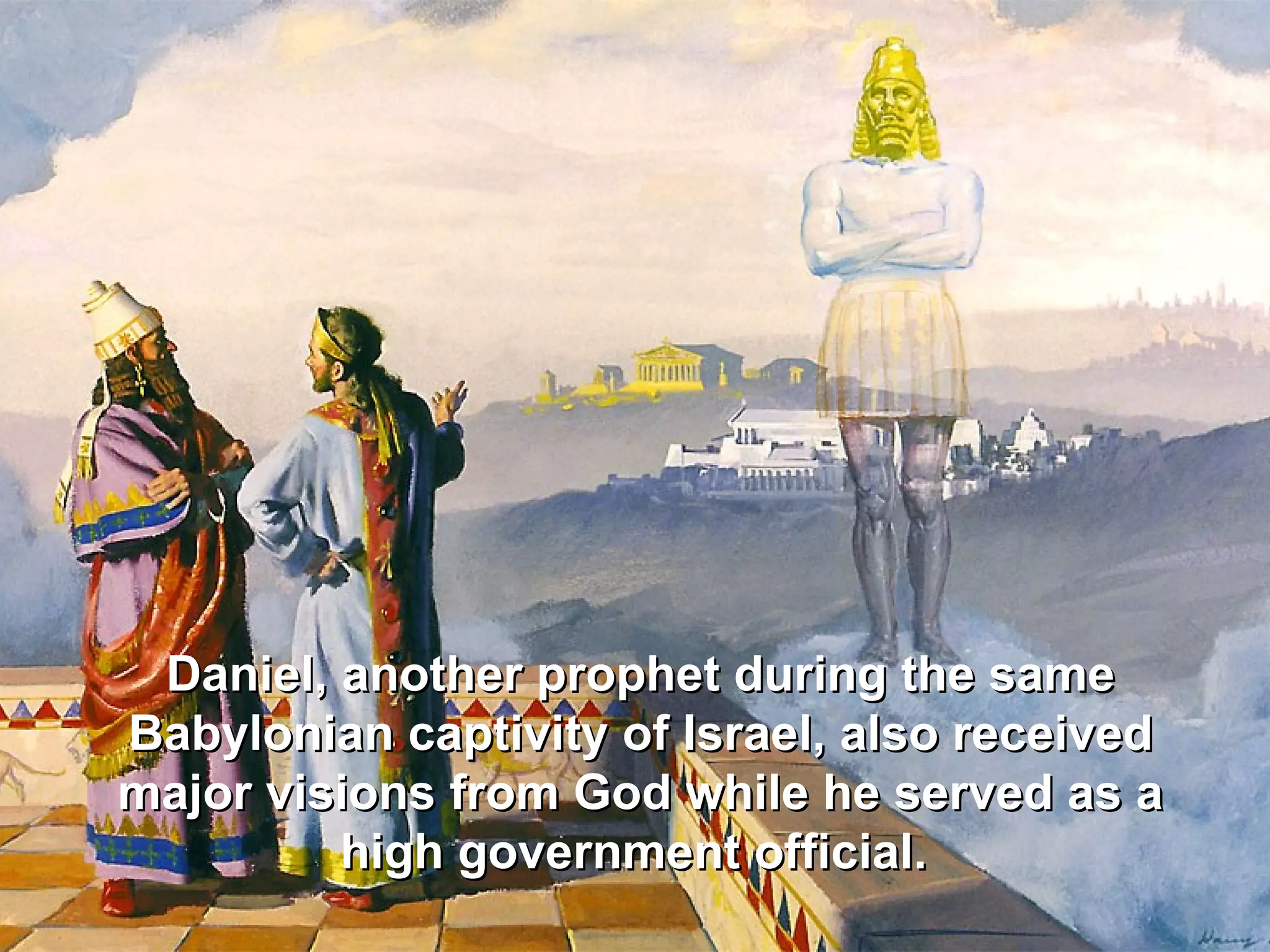
Daniel, another prophet during the same
Babylonian captivity of Israel, also received
major visions from God while he served as a
         high government official.
Although repeatedly told that he was loved in heaven,
 how did Daniel react when given a vision of God? Why
 do you think he reacted as he did? Dan. 10:5–8.


 Even though these men were faithful, godly, and righteous—
 they were prophets, even!—their reactions to the presence of
    God were fear, trembling, and worship. No doubt that was
    because, among other things, they understood their own
unworthiness and sinfulness in contrast to the holiness of God.
In their own way, these passages hint at the need of a Savior, a
Substitute, Someone to bridge the gap between a Holy God and
  fallen sinful creatures like ourselves. Thanks to the Lord, we
                    have that bridge in Jesus.
REFLEXIÓN:


 Imagine yourself having a
similar experience to one of
these men mentioned above.
  How do you suppose you
   would react, and why?
4. Depart From Me!

In the Old Testament, we find a consistent record of human
responses to a God who is holy. What about in the New?
Some modern Christians argue that the Old Testament
presents a primitive and outdated picture of God, a God
who is harsh and very prone to anger.
But when Jesus comes, He is
now the God of grace and love.
We know, of course, that this
is a distorted view of the
Bible and of the character
of a God who does
not change.
What do the New Testament writers teach us about God’s
holiness? Read, for instance, Luke 5:1–11. How does this
show the consistency between the Old and New
Testaments regarding the holiness of God?
                        After these men toiled unsuccess-
                        fully all night as fishermen, Jesus
                           provided a miraculous catch of
                            fish for His hard-working disci-
                              ples. When this occurred, one
                               would think a normal human
                         response would be thankfulness
                           to Jesus for such extraordinary
                                financial assistance. Peter’s
                       response, though, was focused on
                         something else. His reaction was
                                  much like those of the Old
                                  Testament characters who
                                      encountered the Lord.
“But Peter was unmindful now of
boats or lading. This miracle,
above any other he had ever
witnessed, was to him a manifes-
tation of divine power. In Jesus he
saw One who held all nature under
His control. The presence of divi-
nity revealed his own unholiness.
Love for his Master, shame for his
own unbelief, gratitude for the
condescension of Christ, above
all, the sense of his uncleanness
in the presence of infinite purity,
overwhelmed him. While his
companions were securing the
contents of the net, Peter fell at
the Saviour’s feet, exclaiming,
‘Depart from me; for I am a sinful
man, O Lord.’ ”—
EGW, DTG, p. 246.
Why this reaction? It’s because
                       we’re not in the Garden of Eden
                        anymore, where Adam and Eve
                        —before their fall into sin—wel-
                         comed the presence of God in
                           the cool of the evening. This
                        close communion dramatically
                        changed immediately after the
                          Fall, when the couple ran and
                            hid. Not much has changed
                      since then. Indeed, this reaction
                        remains the consistent picture
 throughout Scripture. Whenever a human being truly
encounters the living God, there is the initial horror of
finally seeing the true depth of one’s own sinfulness.
REFLECTION:


When was the last time you got a
  really good look at your own
sinful nature? A horrible sight,
isn’t it? What’s your only hope,
            and why?
Read Luke 4:31–36.
                               5. When Demons Speak
What testimony is given
here about the holiness
of Christ? What is
significant about who
gave that testimony,
too? What lessons can
we draw from this story
about God’s holiness?

Demons, who are fallen angels, remember who Jesus really
is, and even they—in their nastiness, hatefulness, and
rebellion—are constrained to acknowledge Him and that He is
holy. Notice, too, that they feared that He was going to
destroy them. Why so fearful? It must be that, so full of sin,
even demons fear before the presence of God’s holiness,
somewhat in the same manner that sinful humans do.
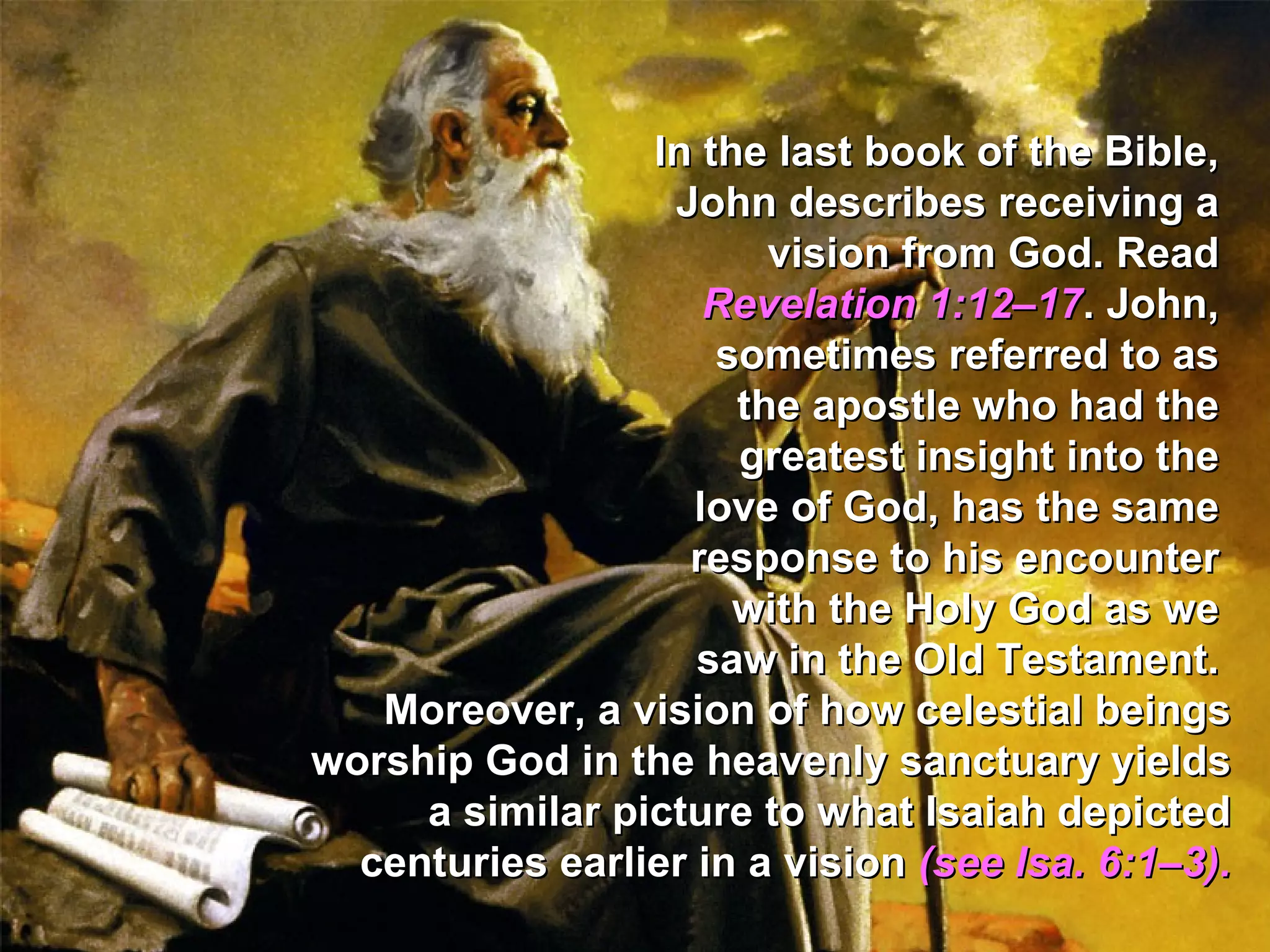
In the last book of the Bible,
                  John describes receiving a
                        vision from God. Read
                     Revelation 1:12–17. John,
                     sometimes referred to as
                      the apostle who had the
                      greatest insight into the
                    love of God, has the same
                   response to his encounter
                      with the Holy God as we
                    saw in the Old Testament.
   Moreover, a vision of how celestial beings
worship God in the heavenly sanctuary yields
     a similar picture to what Isaiah depicted
  centuries earlier in a vision (see Isa. 6:1–3).
What did John hear the heavenly beings around the
¿Qué oyó Juan que decían
throne saying? Rev. 4:8, 9. Although God is love and all
los seres celestiales
heavenly beings adore Him, we can see that, around the
alrededor del Trono? Apoc.
heavenly throne of God, the worship anthem is not “God is
4:8, 9.
love, love, love.” Nor do the heavenly beings cry out, “God
is good, good, good.”


Instead, day and night these mighty beings exclaim, “Holy,
holy, holy, Lord God Almighty.” Although all heaven is
involved in the ministry of God’s love and salvation to this
world, heavenly beings around the throne of God day and
night praise the holiness of God. As sinless beings, they are
awed by His holiness, but they don’t hide in fear of it, as do
fallen beings.
In all of the human encounters of the divine as depicted in
Scripture, one never finds a suggestion that God is frightening.
What we see instead is that, in the piercing light of His
holiness, human beings finally see themselves for who they
really are. And that is scary. In Scripture, when people truly
encounter the God of heaven, we find no hand clapping,
backslapping, and lighthearted singing. Rather, there is abject
personal repentance. All see and admit their personal guilt
without any excuses and without reference to the faults of
anyone else. How different our words, our lives, and our
actions would be were we all to live with the constant sense
not only of God’s presence but of His holiness, as well.
As Christ stands before the trafficking crowd in the temple,
“the confusion is hushed. The sound of traffic and
bargaining has ceased. The silence becomes painful. A
sense of awe overpowers the assembly. It is as if they were
arraigned before the tribunal of God to answer for their
deeds. Looking upon Christ, they behold divinity flash
through the garb of humanity. The Majesty of heaven
stands as the Judge will stand at the last day . . . with the
same power to read the soul. His eye sweeps over the
multitude, taking in every individual.
His form seems to rise above them in commanding
dignity, and a divine light illuminates His countenance. He
speaks, and His clear, ringing voice—the same that upon
Mount Sinai proclaimed the law that priests and rulers are
transgressing—is heard echoing through the arches of the
temple: ‘Take these things hence; make not My Father’s
house an house of merchandise.’
“Slowly descending the steps, and raising the scourge of
cords gathered up on entering the enclosure, He bids the
   bargaining company depart from the precincts of the
   temple. With a zeal and severity He has never before
    manifested, He overthrows the tables of the money-
changers. . . . None presume to question His authority. . . .
 Jesus does not smite them with the whip of cords, but in
 His hand that simple scourge seems terrible as a flaming
sword. Officers of the temple, speculating priests, brokers
  and cattle traders, with their sheep and oxen, rush from
   the place, with the one thought of escaping from the
   condemnation of His presence.”—Ellen G. White, The
                   Desire of Ages, p. 158.
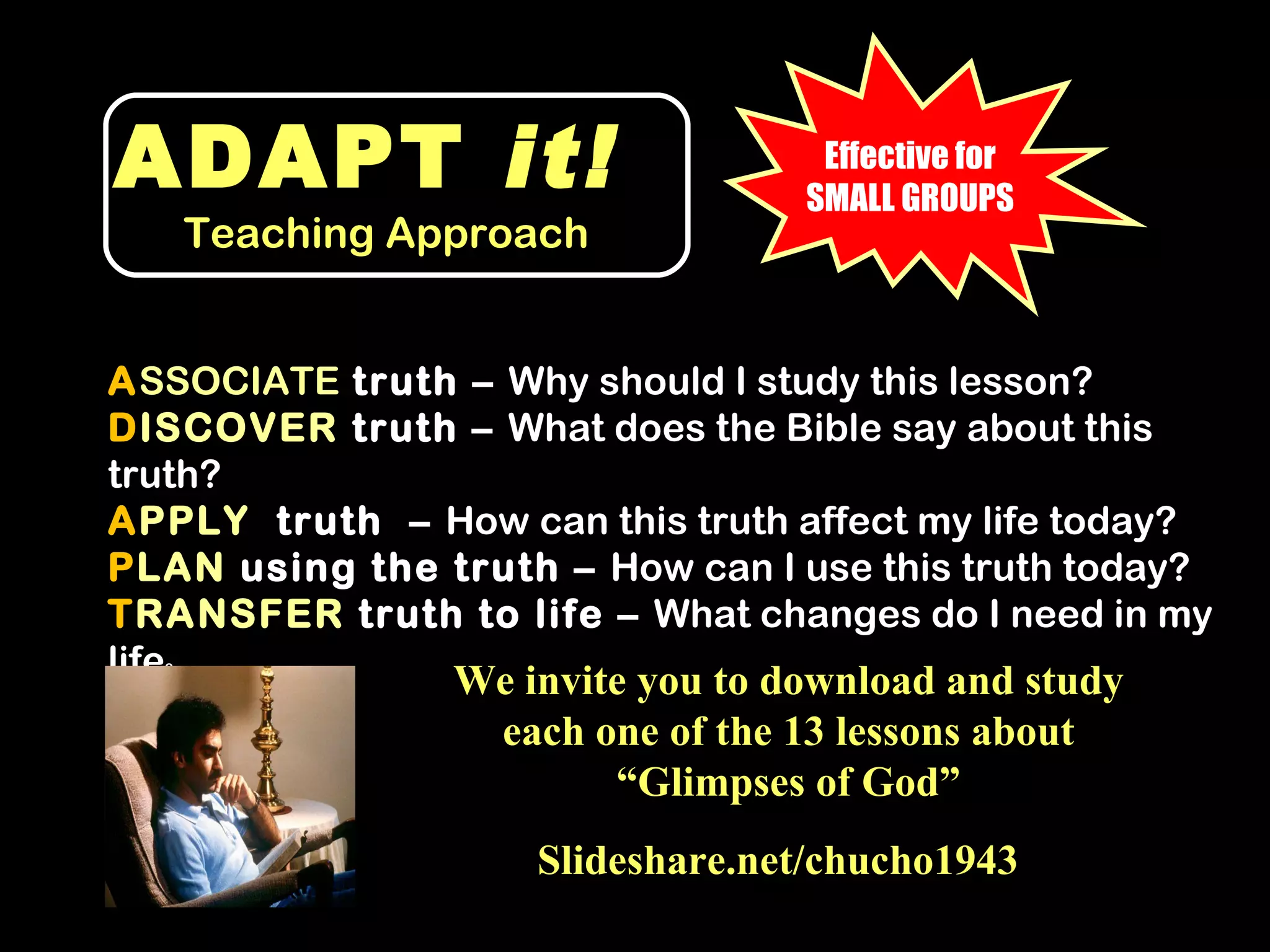
ADAPT it!                           Effective for
                                   SMALL GROUPS
      Teaching Approach


ASSOCIATE truth – Why should I study this lesson?
DISCOVER truth – What does the Bible say about this
truth?
APPLY truth – How can this truth affect my life today?
PLAN using the truth – How can I use this truth today?
TRANSFER truth to life – What changes do I need in my
life
  ?
                 We invite you to download and study
                  each one of the 13 lessons about
                         “Glimpses of God”
                     Slideshare.net/chucho1943

05 holiness of god

  • 1.
    The Holiness ofGod Lesson # 5:
  • 2.
    Key Text: “Exalt theLord our God, and worship at his holy hill; for the Lord our God is holy” (Psalm 99:9). Key Thought: Scripture gives much attention to God’s holiness. What does this holiness tell us about what God is like and what it means to the plan of salvation?
  • 3.
    One of thefoundational assumptions of all biblical writers is that the God of heaven exists. God’s existence is just a given, like an axiom in geometry. Instead, we find within the 66 biblical books an extensive recounting of what God is like and how He relates to us as fallen beings whom He longs to redeem. This lesson focuses on one aspect of God’s nature that’s foundational in Scripture: God’s holiness. God is love, Yes. And, Yes, God bids us call Him “Father.” And, Yes, God is patient, forgiving, and caring.
  • 4.
    But, according to Scripture,fundamental to our understanding of God is His holiness. Both in the Old and New Testaments, God’s holiness undergirds His revelation of Himself. This theme appears all through the Scriptures in one way or another. What, though, does it mean to say that God is holy? How does the Bible depict His holiness? And how do we, as unholy beings, relate to a God like this?
  • 5.
    1. “It IsWritten” Even a superficial study of church history makes it clear that it’s all too easy to develop ideas about God and then to worship these ideas instead of God Himself, the God revealed in the Bible. As the skeptic Voltaire quipped, “God made man in His image, and man has returned the compliment.” We may not even realize that we have an incomplete, or even false, understanding of God.
  • 6.
    Thus, we mustreturn to Scripture and compare our thinking about God with what is taught there. And this study must include both Testaments, for in both the Lord has spoken to us. This point is important because some have argued that the God revealed in the New Testament is different from the One revealed in the Old. That’s not a position accepted by us, nor is it a position taught in the Bible.
  • 7.
    What phrases punctuatethe Old Testament prophets again and again? Jer. 7:1–3. The prophetic messages of the Old Testament are laced thousands of times with the phrase, “thus says the Lord,” or an equivalent. This should remind us that the prophet is not merely speaking for God but that God is speaking for Himself through the prophet.
  • 8.
    At the sametime, the New Testament is filled with reference after reference to the Old Testament. In fact, the whole theology of the New Testament is intricately linked to the Old. How does one, for instance, make sense of the sacrifice of Jesus apart from the entire sacrificial system revealed in the Old Testament? How many times did Jesus, as well as the New Testament writers, refer to Old Testament passages in order to buttress their arguments and points? The whole New Testament corpus finds its theological foundation in the Old. There’s no justification for any radical division between them. All Scripture—both Testaments—is inspired by the Lord (2 Tim. 3:16).
  • 9.
    Look up thefollowing texts. How do they help us to see the link between the New Testament and the Old? What do they tell us about how Jesus, as well as the New Testament writers, viewed the Old Testament? Matt. 4:4, 11:10; Mark 1:2; 7:6; John 12:14, 15; Acts 13:33; Rom. 3:10; Gal. 3:13; 1 Pet. 1:16; 1 Cor. 5:7.
  • 10.
    REFLECTION: Mark Twainonce said that it’s not the parts of the Bible that he doesn’t understand that bother him; it’s the parts that he does. Who doesn’t, at times, find sections of the Bible bothersome? Given what the Bible says about itself (2 Tim. 3:16), how should we respond to the parts we don’t understand, or maybe don’t even like? (See also 1 Cor. 13:12.)
  • 11.
    2. To BeSet Apart Apar What is the first time the concept of “holiness” (from the same root often translated as “sanctified”) is mentioned in Scripture? Gen. 2:3. How significant is the fact that the first thing deemed holy in the Bible is time?
  • 12.
    This text givesus our first understanding of holiness. It shows that something, in this case time, is “set apart” from that which is around it. The seventh day itself is no different from any other 24-hour, sunset-to-sunset period; what makes it different, “holy,” is that God declared it that way. He set it apart from the rest of the week. The Hebrew word there for “sancti-fied” means to “make holy” or to “declare holy.” Holiness then implies that something is special about whatever is “holy,” something that sets it apart from what isn’t holy.
  • 13.
    To some degree,then, this idea should help us to understand the holiness of God. God is set apart from anything else in creation. He is transcendentally separate, far above and beyond anything that we can truly grasp. To be holy is to be “other,” to be different in a special way, as with the seventh-day Sabbath.
  • 14.
    This concept ofholiness should help us better understand the gap between a God who is holy and a race of beings who aren’t—a race, in fact, of sinners. God is separate from us not only because He is the Creator and we are the created but because we are fallen beings. All this should, ideally, help us better understand that which Christ has done for us.
  • 15.
    How do thesetexts help us to understand the holiness of God in this context? Exod. 15:11, 1 Sam. 2:2, Pss. 86:8–10, 99:1– 3, Isa. 40:25. This concept of holiness should help us better understand the gap between a God who is holy and a race of beings who aren’t—a race, in fact, of sinners. God is separate from us not only because He is the Creator and we are the created but because we are fallen beings. All this should, ideally, help us better understand that which Christ has done for us.
  • 16.
    REFLEXION: Although we aremade in the image of God, what are the ways in which we differ radically from Him? How do these differences help us to understand our need of a Savior?
  • 17.
    3. To Repentin Dust and Ashes After enduring inhuman suffering at the hand of Satan, Job cries out: “I have heard of thee by the hearing of the ear: but now mine eye seeth thee. Wherefore I abhor myself, and repent in dust and ashes” (Job 42:5, 6). What does this response tell us about God’s holiness in contrast to human sinfulness? How is the gospel being preached in Job’s reaction to what he experienced?
  • 18.
    The prophet Ezekiel,whom God graciously sends to Israel (even though they are captive in Babylon as a result of their unfaithfulness), also experiences the awful presence of God. What happened? (Ezek. 1:28).
  • 19.
    Jacob had toflee from home after deceiving his father, Isaac, and twin brother, Esau. What was Jacob’s response after his night vision of the ladder to heaven and of God speaking to him? (Gen. 28:16, 17).
  • 20.
    While Israel remainedencamped at Sinai, the Lord again descended in the cloud on the mountain and proclaimed Himself to Moses. How did Moses react? (Exod. 34:8).
  • 21.
    Daniel, another prophetduring the same Babylonian captivity of Israel, also received major visions from God while he served as a high government official.
  • 22.
    Although repeatedly toldthat he was loved in heaven, how did Daniel react when given a vision of God? Why do you think he reacted as he did? Dan. 10:5–8. Even though these men were faithful, godly, and righteous— they were prophets, even!—their reactions to the presence of God were fear, trembling, and worship. No doubt that was because, among other things, they understood their own unworthiness and sinfulness in contrast to the holiness of God. In their own way, these passages hint at the need of a Savior, a Substitute, Someone to bridge the gap between a Holy God and fallen sinful creatures like ourselves. Thanks to the Lord, we have that bridge in Jesus.
  • 23.
    REFLEXIÓN: Imagine yourselfhaving a similar experience to one of these men mentioned above. How do you suppose you would react, and why?
  • 24.
    4. Depart FromMe! In the Old Testament, we find a consistent record of human responses to a God who is holy. What about in the New? Some modern Christians argue that the Old Testament presents a primitive and outdated picture of God, a God who is harsh and very prone to anger. But when Jesus comes, He is now the God of grace and love. We know, of course, that this is a distorted view of the Bible and of the character of a God who does not change.
  • 25.
    What do theNew Testament writers teach us about God’s holiness? Read, for instance, Luke 5:1–11. How does this show the consistency between the Old and New Testaments regarding the holiness of God? After these men toiled unsuccess- fully all night as fishermen, Jesus provided a miraculous catch of fish for His hard-working disci- ples. When this occurred, one would think a normal human response would be thankfulness to Jesus for such extraordinary financial assistance. Peter’s response, though, was focused on something else. His reaction was much like those of the Old Testament characters who encountered the Lord.
  • 26.
    “But Peter wasunmindful now of boats or lading. This miracle, above any other he had ever witnessed, was to him a manifes- tation of divine power. In Jesus he saw One who held all nature under His control. The presence of divi- nity revealed his own unholiness. Love for his Master, shame for his own unbelief, gratitude for the condescension of Christ, above all, the sense of his uncleanness in the presence of infinite purity, overwhelmed him. While his companions were securing the contents of the net, Peter fell at the Saviour’s feet, exclaiming, ‘Depart from me; for I am a sinful man, O Lord.’ ”— EGW, DTG, p. 246.
  • 27.
    Why this reaction?It’s because we’re not in the Garden of Eden anymore, where Adam and Eve —before their fall into sin—wel- comed the presence of God in the cool of the evening. This close communion dramatically changed immediately after the Fall, when the couple ran and hid. Not much has changed since then. Indeed, this reaction remains the consistent picture throughout Scripture. Whenever a human being truly encounters the living God, there is the initial horror of finally seeing the true depth of one’s own sinfulness.
  • 28.
    REFLECTION: When was thelast time you got a really good look at your own sinful nature? A horrible sight, isn’t it? What’s your only hope, and why?
  • 29.
    Read Luke 4:31–36. 5. When Demons Speak What testimony is given here about the holiness of Christ? What is significant about who gave that testimony, too? What lessons can we draw from this story about God’s holiness? Demons, who are fallen angels, remember who Jesus really is, and even they—in their nastiness, hatefulness, and rebellion—are constrained to acknowledge Him and that He is holy. Notice, too, that they feared that He was going to destroy them. Why so fearful? It must be that, so full of sin, even demons fear before the presence of God’s holiness, somewhat in the same manner that sinful humans do.
  • 30.
    In the lastbook of the Bible, John describes receiving a vision from God. Read Revelation 1:12–17. John, sometimes referred to as the apostle who had the greatest insight into the love of God, has the same response to his encounter with the Holy God as we saw in the Old Testament. Moreover, a vision of how celestial beings worship God in the heavenly sanctuary yields a similar picture to what Isaiah depicted centuries earlier in a vision (see Isa. 6:1–3).
  • 31.
    What did Johnhear the heavenly beings around the ¿Qué oyó Juan que decían throne saying? Rev. 4:8, 9. Although God is love and all los seres celestiales heavenly beings adore Him, we can see that, around the alrededor del Trono? Apoc. heavenly throne of God, the worship anthem is not “God is 4:8, 9. love, love, love.” Nor do the heavenly beings cry out, “God is good, good, good.” Instead, day and night these mighty beings exclaim, “Holy, holy, holy, Lord God Almighty.” Although all heaven is involved in the ministry of God’s love and salvation to this world, heavenly beings around the throne of God day and night praise the holiness of God. As sinless beings, they are awed by His holiness, but they don’t hide in fear of it, as do fallen beings.
  • 32.
    In all ofthe human encounters of the divine as depicted in Scripture, one never finds a suggestion that God is frightening. What we see instead is that, in the piercing light of His holiness, human beings finally see themselves for who they really are. And that is scary. In Scripture, when people truly encounter the God of heaven, we find no hand clapping, backslapping, and lighthearted singing. Rather, there is abject personal repentance. All see and admit their personal guilt without any excuses and without reference to the faults of anyone else. How different our words, our lives, and our actions would be were we all to live with the constant sense not only of God’s presence but of His holiness, as well.
  • 33.
    As Christ standsbefore the trafficking crowd in the temple, “the confusion is hushed. The sound of traffic and bargaining has ceased. The silence becomes painful. A sense of awe overpowers the assembly. It is as if they were arraigned before the tribunal of God to answer for their deeds. Looking upon Christ, they behold divinity flash through the garb of humanity. The Majesty of heaven stands as the Judge will stand at the last day . . . with the same power to read the soul. His eye sweeps over the multitude, taking in every individual.
  • 34.
    His form seemsto rise above them in commanding dignity, and a divine light illuminates His countenance. He speaks, and His clear, ringing voice—the same that upon Mount Sinai proclaimed the law that priests and rulers are transgressing—is heard echoing through the arches of the temple: ‘Take these things hence; make not My Father’s house an house of merchandise.’
  • 35.
    “Slowly descending thesteps, and raising the scourge of cords gathered up on entering the enclosure, He bids the bargaining company depart from the precincts of the temple. With a zeal and severity He has never before manifested, He overthrows the tables of the money- changers. . . . None presume to question His authority. . . . Jesus does not smite them with the whip of cords, but in His hand that simple scourge seems terrible as a flaming sword. Officers of the temple, speculating priests, brokers and cattle traders, with their sheep and oxen, rush from the place, with the one thought of escaping from the condemnation of His presence.”—Ellen G. White, The Desire of Ages, p. 158.
  • 36.
    ADAPT it! Effective for SMALL GROUPS Teaching Approach ASSOCIATE truth – Why should I study this lesson? DISCOVER truth – What does the Bible say about this truth? APPLY truth – How can this truth affect my life today? PLAN using the truth – How can I use this truth today? TRANSFER truth to life – What changes do I need in my life ? We invite you to download and study each one of the 13 lessons about “Glimpses of God” Slideshare.net/chucho1943