Session 1: Introduction and the Biblical View of Time
Faith, Hope, and Love: Rediscovering the Essentials of Christianity
Joshua Hawkins – www.joshuahawkins.com
As Christians, the Bible is not only our source of doctrine, a guide to holy living,
or a collection of truths about salvation. The Word of God is one of the deepest
sources of our joy because it brings us into a story that is far bigger than our
mundane, busy, day-to-day lives. Knowing and participating in this story is
what gives meaning and purpose to our lives, and most importantly, brings glory
to God.
Ezra opened the book in the sight of all the people.... [T]he Levites
helped the people to understand the Law.... They read from the book,
from the Law of God, clearly, and they gave the sense, so that the
people understood the reading.... And all the people went their
way...to make great rejoicing, because they had understood the
words that were declared to them.
(Nehemiah 8:5-8,12 ESV)
1. In this passage, there was a reader of the word of God. Then there were
those who explained the words. Then there was true understanding in the
minds of the people. Then there was great rejoicing “because they had
understood the words.”
2. There was joy then. And there is joy today when God’s people see real,
divine meaning in texts that they had not seen before.
3. It is no accident that in this very context the writer says, “The joy of the Lord
is your strength” (Nehemiah 8:10).
4. What joy? The joy of verse 12: “All the people went their way...to make great
rejoicing, because they had understood the words that were declared to
them.”
5. I want to propose that one of the main reasons why the Bible does not bring
us joy as it should is because we do not see it as a dynamic story that we are
invited to participate in. Instead of a coherent story written by God through
the patriarchs, prophets, and saints, we often view most of the Bible as a
boring collection of genealogies, regulations, short songs, and reprimands
towards Israel before the real “meat” of Jesus, the cross, and salvation
comes in the New Testament.
6. As we give ourselves to knowing and loving the Bible’s story, we must not
forget that Jesus came in context to the story of Israel, and Paul wrote in
context to the story of Jesus. We can never expect to understand the climax
of a novel rightly unless we understand the setting, characters, and how the
plot has developed up to that point.
7. In this study, we will look at the Bible’s major themes, characters, and main
events as the means to growing in love for God and living in light of His
story. My hope is that you “will breathe the air of the Bible’s world,
recognize it as the real Narnia, and never want to leave.” (Jim Hamilton Jr.)
“Isn't it a relief that the world's plot is not limited to the brief span of
our lives? We make sense of our days in light of this [the Bible’s]
overarching narrative. The big plot of the Bible, with its guarantee of
resurrection and new creation, gives confidence even in the face of
death. The Bible's big story opens up the windows on stale, stuffy
rooms of deadlines and due dates, deaths and disappointments, and
fresh winds of the creation-to-new-creation breezes blow through.“ –
Jim Hamilton, Jr., “What is Biblical Theology?”
"When we try to fit God into our life movie, the plot is all wrong— and
not just wrong but trivial. When we are pulled out of our own drama
and cast as characters in his unfolding plot, we become part of the
greatest story ever told." -Michael Horton, “Christless Christianity”
Introducing the Bible’s Story – The field and the rules
1. Consider a game or a sport. Each game has rules, goals, players, and fields
upon which to play. Imagine asking soccer players to play on a basketball
court, or tennis players to play on a soccer field. What would happen?
2. If the Bible and its story were to be likened to a game, a particular playing
field and a set of rules would be needed in order for us to play the game. As
we seek to rightly understand the Bible, we must understand its playing field
and rules. If we profess faith in Jesus, this is not optional.
3. Talking about rules like time and eternity and the playing field of the Biblical
worldview may seem like secondary issues, but that’s only because we
largely assume we know the playing field and rules already.
4. The unfortunate truth is that our perception of reality (and the Bible) has been
severely distorted by a Greek philosophical lens.
“See to it that no one takes you captive by philosophy and empty
deceit, according to human tradition, according to the elemental
spirits of the world, and not according to Christ.”
(Colossians 2:8 ESV)
5. Therefore, one of the primary aims of our study is to understand and
embrace the perspective of the Biblical authors. We must know the story
that they take for granted, the connections they see between the events in
that story, and the ways they read the later parts because of what they’ve
seen in the earlier parts.
The Pagan View of Time
When the Father who begat the world saw the image which he had
made of the Eternal Gods moving and living, he rejoiced; and in his
joy resolved, since the archetype was eternal, to make the creature
eternal as far as this was possible. Wherefore he made an image of
eternity which is time, having an uniform motion according to
number, parted into months and days and years, and also having
greater divisions of past, present, and future. These all apply to
becoming in time, and have no meaning in relation to the eternal
nature, which ever is and never was or will be; for the unchangeable
is never older or younger, and when we say that he ‘was’ or ‘will be,’
we are mistaken, for these words are applicable only to becoming,
and not to true being... These are the forms of time which imitate
eternity and move in a circle measured by number. (Plato, Timaeus
37-38 [DP 3:355-56])
For Plato, eternity was a timeless, unchangeable, immaterial reality and time was
a copy of the “form” of eternity.
For Plato, eternity is not endlessly extended time, but something
quite different; it is timelessness. Time in Plato’s view is only the
copy of eternity thus understood. How much the thinking of our days
roots in Hellenism, and how little in Biblical Christianity, becomes
clear to us when we confirm the fact that far and wide the Christian
Church and Christian theology distinguish time and eternity in the
Platonic-Greek manner. This then has important consequences, and
when the New Testament perspective of redemptive history is
thereby affected, it leads to a radical transformation of the Primitive
Christian preaching. (Oscar Cullmann, Christ and Time: The Primitive
Christian Conception of Time and History [Westminster, 1950], 61-62)
The Bible’s View of Time
Behold, he is coming with the clouds, and every eye will see him,
even those who pierced him, and all tribes of the earth will wail on
account of him. Even so. Amen. “I am the Alpha and the Omega,”
says the Lord God, “who is and who was and who is to come, the
Almighty.”
(Revelation 1:7–8 ESV)
“And he said to me, “It is done! I am the Alpha and the Omega, the
beginning and the end.”
(Revelation 21:6 ESV)
1. Why does Jesus identify Himself in this way? Because He is the creator of
everything and the one who will restore the heavens and earth when He
returns to initiate the Day of the Lord. It is thus “the beginning and the end”
(Rev 21:6; 22:13) that define biblical history.
2. It is the beginning and the end that ultimately inform the whole of our
existence. This is why the Bible is so protologically based and
eschatologically oriented.
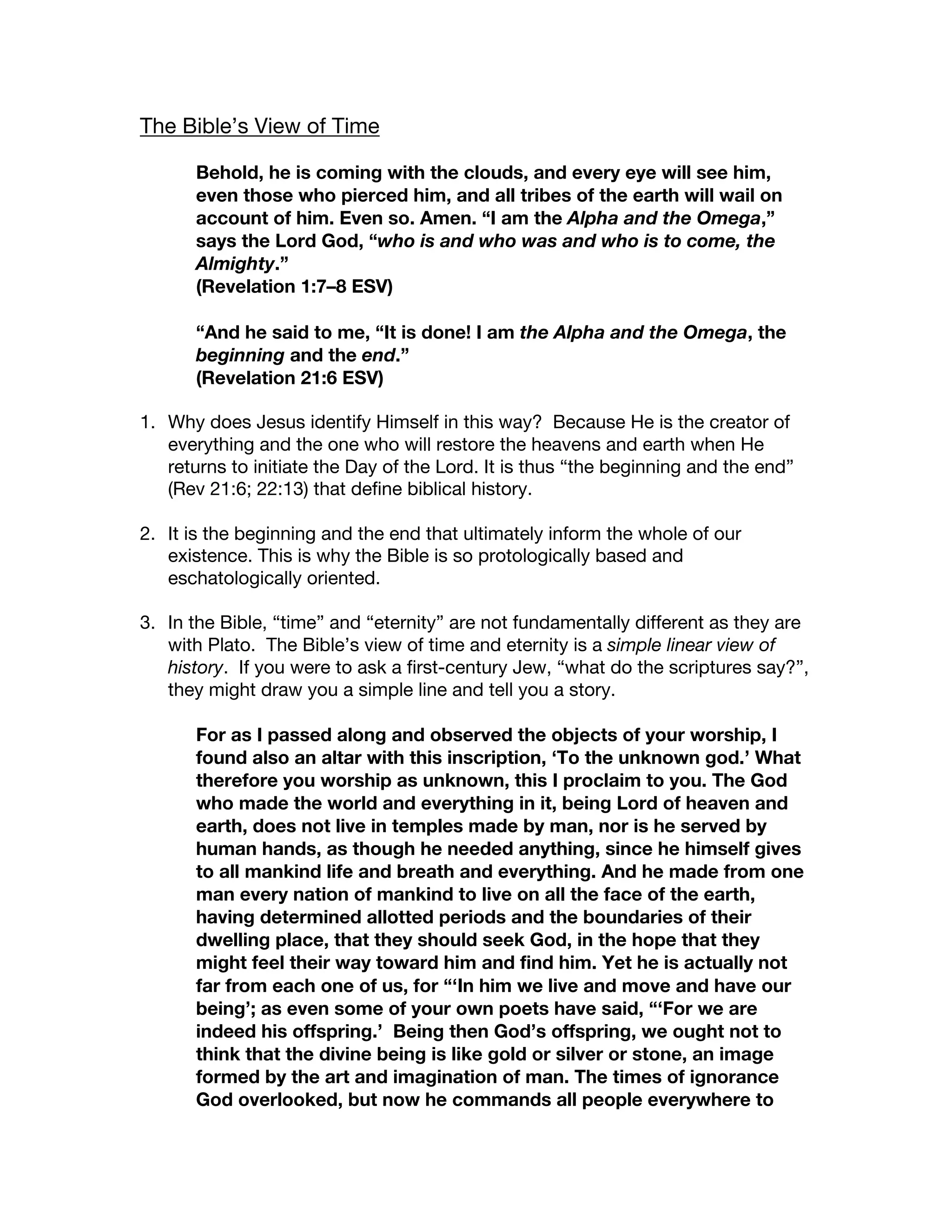
3. In the Bible, “time” and “eternity” are not fundamentally different as they are
with Plato. The Bible’s view of time and eternity is a simple linear view of
history. If you were to ask a first-century Jew, “what do the scriptures say?”,
they might draw you a simple line and tell you a story.
For as I passed along and observed the objects of your worship, I
found also an altar with this inscription, ‘To the unknown god.’ What
therefore you worship as unknown, this I proclaim to you. The God
who made the world and everything in it, being Lord of heaven and
earth, does not live in temples made by man, nor is he served by
human hands, as though he needed anything, since he himself gives
to all mankind life and breath and everything. And he made from one
man every nation of mankind to live on all the face of the earth,
having determined allotted periods and the boundaries of their
dwelling place, that they should seek God, in the hope that they
might feel their way toward him and find him. Yet he is actually not
far from each one of us, for “‘In him we live and move and have our
being’; as even some of your own poets have said, “‘For we are
indeed his offspring.’ Being then God’s offspring, we ought not to
think that the divine being is like gold or silver or stone, an image
formed by the art and imagination of man. The times of ignorance
God overlooked, but now he commands all people everywhere to
repent, because he has fixed a day on which he will judge the world
in righteousness by a man whom he has appointed; and of this he
has given assurance to all by raising him from the dead.”
(Acts 17:23–31 ESV)
In this short sermon, Paul gives several fundamental elements to a simple linear
view of time and history.
The Two Ages
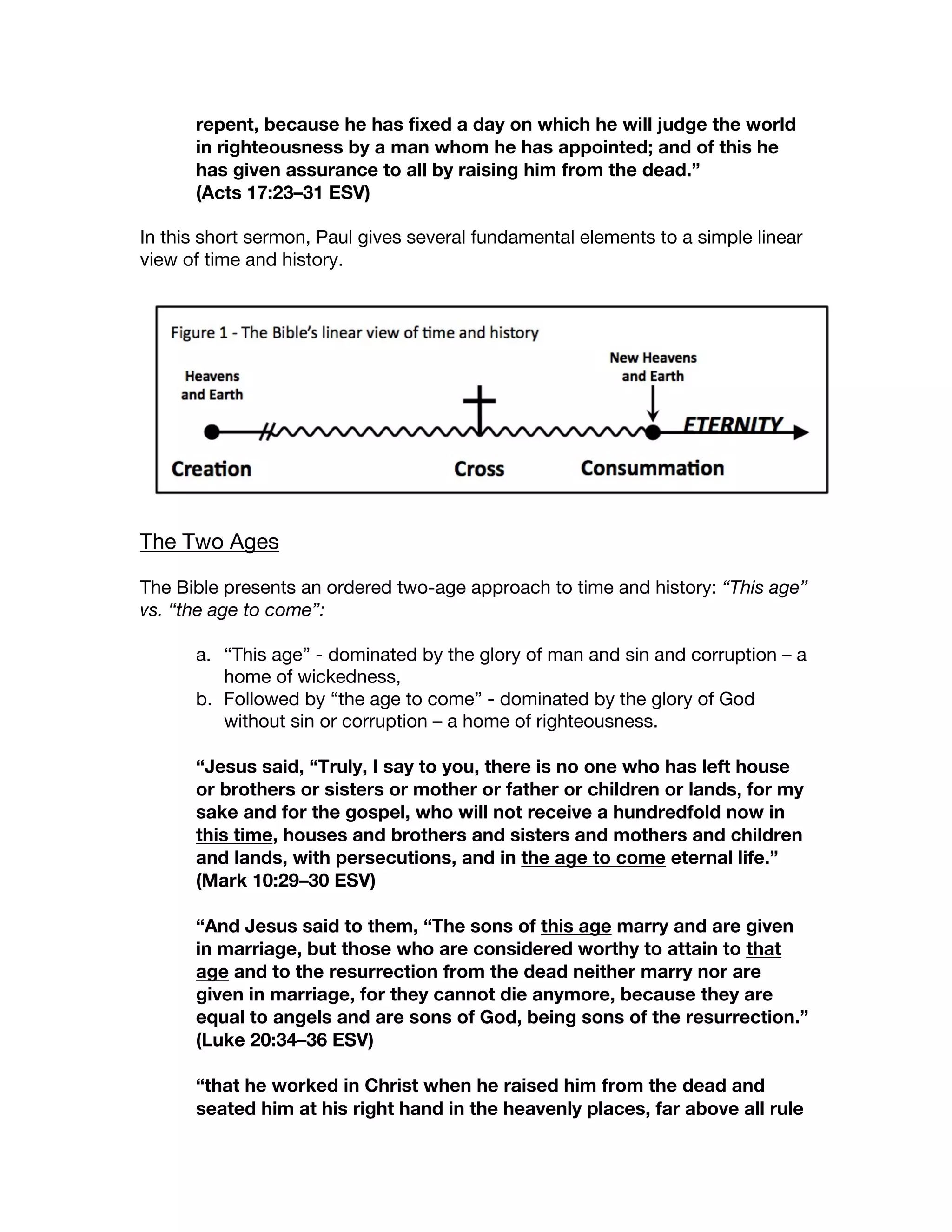
The Bible presents an ordered two-age approach to time and history: “This age”
vs. “the age to come”:
a. “This age” - dominated by the glory of man and sin and corruption – a
home of wickedness,
b. Followed by “the age to come” - dominated by the glory of God
without sin or corruption – a home of righteousness.
“Jesus said, “Truly, I say to you, there is no one who has left house
or brothers or sisters or mother or father or children or lands, for my
sake and for the gospel, who will not receive a hundredfold now in
this time, houses and brothers and sisters and mothers and children
and lands, with persecutions, and in the age to come eternal life.”
(Mark 10:29–30 ESV)
“And Jesus said to them, “The sons of this age marry and are given
in marriage, but those who are considered worthy to attain to that
age and to the resurrection from the dead neither marry nor are
given in marriage, for they cannot die anymore, because they are
equal to angels and are sons of God, being sons of the resurrection.”
(Luke 20:34–36 ESV)
“that he worked in Christ when he raised him from the dead and
seated him at his right hand in the heavenly places, far above all rule
and authority and power and dominion, and above every name that is
named, not only in this age but also in the one to come.”
(Ephesians 1:20–21 ESV)
“Command those who are rich in this present age not to be haughty,
nor to trust in uncertain riches but in the living God, who gives us
richly all things to enjoy. Let them do good, that they be rich in good
works, ready to give, willing to share, storing up for themselves a
good foundation for the time to come, that they may lay hold on
eternal life.”
(1 Timothy 6:17–19 NKJV)
The delineator and culmination point between the two ages is a day called “The
Day of the LORD”.
The End of the Age
Within this basic two-age framework of redemptive history, there is a focus on
the culmination of this age (“the end of this age”).
“So it will be at the end of the age. The angels will come forth,
separate the wicked from among the just, and cast them into the
furnace of fire. There will be wailing and gnashing of teeth.””
(Matthew 13:49–50 NKJV)
And Jesus came and said to them, “All authority in heaven and on
earth has been given to me. Go therefore and make disciples of all
nations, baptizing them in the name of the Father and of the Son and
of the Holy Spirit, teaching them to observe all that I have
commanded you. And behold, I am with you always, to the end of the
age.”
(Matthew 28:18–20 ESV)
Other references
“For I consider that the sufferings of this present time are not worth
comparing with the glory that is to be revealed to us.” (Romans 8:18
ESV)
“Grace to you and peace from God our Father and the Lord Jesus
Christ, who gave himself for our sins to deliver us from the present
evil age, according to the will of our God and Father, to whom be the
glory forever and ever. Amen.” (Galatians 1:3–5 ESV)
“The god of this age has blinded the minds of unbelievers, so that
they cannot see the light of the gospel of the glory of Christ, who is
the image of God.”
(2 Corinthians 4:4 NIV)
It [grace] teaches us to say “No” to ungodliness and worldly
passions, and to live self-controlled, upright and godly lives in this
present age, while we wait for the blessed hope—the glorious
appearing of our great God and Savior, Jesus Christ,” (Titus 2:12–13
NIV)
“But watch yourselves lest your hearts be weighed down with
dissipation and drunkenness and cares of this life, and that day
come upon you suddenly like a trap.” (Luke 21:34 ESV)
“If in Christ we have hope in this life only, we are of all people most
to be pitied.” (1 Corinthians 15:19 ESV)
“for while bodily training is of some value, godliness is of value in
every way, as it holds promise for the present life and also for the life
to come.”
(1 Timothy 4:8 ESV)
Eternity: Unending ages
“Eternity” is rightly understood as “unending ages” in a two-age framework. It is
in continuity with this age – though there is a dynamic event at the Day of the
LORD, there is full continuity between this age and the age to come.
The word used to express eternity, αἰών (‘age’), is the same word
that is also applied to a limited division of time; otherwise expressed,
between what we call eternity and what we call time, that is between
everlasting continuing time and limited time, the New Testament
makes absolutely no difference in terminology. Eternity is the
endless succession of the ages (αἰώνες). (Cullmann, Christ and Time,
62.)
“When the Son of Man comes in his glory, and all the angels with
him, then he will sit on his glorious throne. Before him will be
gathered all the nations, and he will separate people one from
another as a shepherd separates the sheep from the goats… And
these will go away into eternal [Gk: aiōnios] punishment, but the
righteous into eternal [Gk: aiōnios] life.””
(Matthew 25:31–32, 46 ESV)
“For this light momentary affliction is preparing for us an eternal [Gk:
aiōnios] weight of glory beyond all comparison, as we look not to the
things that are seen but to the things that are unseen. For the things
that are seen are transient, but the things that are unseen are eternal
[Gk: aiōnios].”
(2 Corinthians 4:17–18 ESV)
“You therefore, beloved, knowing this beforehand, take care that you
are not carried away with the error of lawless people and lose your
own stability. But grow in the grace and knowledge of our Lord and
Savior Jesus Christ. To him be the glory both now and to the day of
eternity [Gk: aiōn].” Amen.”
(2 Peter 3:17–18 ESV)
The Day of the Lord and the Partitioning of Time
“And whoever speaks a word against the Son of Man will be forgiven,
but whoever speaks against the Holy Spirit will not be forgiven, either
in this age or in the age to come. I tell you, on the day of judgment
people will give account for every careless word they speak,”
(Matthew 12:32, 36 ESV)
“They will suffer the punishment of eternal destruction, away from
the presence of the Lord and from the glory of his might, when he
comes on that day to be glorified in his saints, and to be marveled at
among all who have believed, because our testimony to you was
believed.”
(2 Thessalonians 1:9–10 ESV)

Biblical View of Time

  • 1.
    Session 1: Introductionand the Biblical View of Time Faith, Hope, and Love: Rediscovering the Essentials of Christianity Joshua Hawkins – www.joshuahawkins.com As Christians, the Bible is not only our source of doctrine, a guide to holy living, or a collection of truths about salvation. The Word of God is one of the deepest sources of our joy because it brings us into a story that is far bigger than our mundane, busy, day-to-day lives. Knowing and participating in this story is what gives meaning and purpose to our lives, and most importantly, brings glory to God. Ezra opened the book in the sight of all the people.... [T]he Levites helped the people to understand the Law.... They read from the book, from the Law of God, clearly, and they gave the sense, so that the people understood the reading.... And all the people went their way...to make great rejoicing, because they had understood the words that were declared to them. (Nehemiah 8:5-8,12 ESV) 1. In this passage, there was a reader of the word of God. Then there were those who explained the words. Then there was true understanding in the minds of the people. Then there was great rejoicing “because they had understood the words.” 2. There was joy then. And there is joy today when God’s people see real, divine meaning in texts that they had not seen before. 3. It is no accident that in this very context the writer says, “The joy of the Lord is your strength” (Nehemiah 8:10). 4. What joy? The joy of verse 12: “All the people went their way...to make great rejoicing, because they had understood the words that were declared to them.” 5. I want to propose that one of the main reasons why the Bible does not bring us joy as it should is because we do not see it as a dynamic story that we are invited to participate in. Instead of a coherent story written by God through the patriarchs, prophets, and saints, we often view most of the Bible as a boring collection of genealogies, regulations, short songs, and reprimands towards Israel before the real “meat” of Jesus, the cross, and salvation comes in the New Testament.
  • 2.
    6. As wegive ourselves to knowing and loving the Bible’s story, we must not forget that Jesus came in context to the story of Israel, and Paul wrote in context to the story of Jesus. We can never expect to understand the climax of a novel rightly unless we understand the setting, characters, and how the plot has developed up to that point. 7. In this study, we will look at the Bible’s major themes, characters, and main events as the means to growing in love for God and living in light of His story. My hope is that you “will breathe the air of the Bible’s world, recognize it as the real Narnia, and never want to leave.” (Jim Hamilton Jr.) “Isn't it a relief that the world's plot is not limited to the brief span of our lives? We make sense of our days in light of this [the Bible’s] overarching narrative. The big plot of the Bible, with its guarantee of resurrection and new creation, gives confidence even in the face of death. The Bible's big story opens up the windows on stale, stuffy rooms of deadlines and due dates, deaths and disappointments, and fresh winds of the creation-to-new-creation breezes blow through.“ – Jim Hamilton, Jr., “What is Biblical Theology?” "When we try to fit God into our life movie, the plot is all wrong— and not just wrong but trivial. When we are pulled out of our own drama and cast as characters in his unfolding plot, we become part of the greatest story ever told." -Michael Horton, “Christless Christianity” Introducing the Bible’s Story – The field and the rules 1. Consider a game or a sport. Each game has rules, goals, players, and fields upon which to play. Imagine asking soccer players to play on a basketball court, or tennis players to play on a soccer field. What would happen? 2. If the Bible and its story were to be likened to a game, a particular playing field and a set of rules would be needed in order for us to play the game. As we seek to rightly understand the Bible, we must understand its playing field and rules. If we profess faith in Jesus, this is not optional. 3. Talking about rules like time and eternity and the playing field of the Biblical worldview may seem like secondary issues, but that’s only because we largely assume we know the playing field and rules already. 4. The unfortunate truth is that our perception of reality (and the Bible) has been severely distorted by a Greek philosophical lens.
  • 3.
    “See to itthat no one takes you captive by philosophy and empty deceit, according to human tradition, according to the elemental spirits of the world, and not according to Christ.” (Colossians 2:8 ESV) 5. Therefore, one of the primary aims of our study is to understand and embrace the perspective of the Biblical authors. We must know the story that they take for granted, the connections they see between the events in that story, and the ways they read the later parts because of what they’ve seen in the earlier parts. The Pagan View of Time When the Father who begat the world saw the image which he had made of the Eternal Gods moving and living, he rejoiced; and in his joy resolved, since the archetype was eternal, to make the creature eternal as far as this was possible. Wherefore he made an image of eternity which is time, having an uniform motion according to number, parted into months and days and years, and also having greater divisions of past, present, and future. These all apply to becoming in time, and have no meaning in relation to the eternal nature, which ever is and never was or will be; for the unchangeable is never older or younger, and when we say that he ‘was’ or ‘will be,’ we are mistaken, for these words are applicable only to becoming, and not to true being... These are the forms of time which imitate eternity and move in a circle measured by number. (Plato, Timaeus 37-38 [DP 3:355-56]) For Plato, eternity was a timeless, unchangeable, immaterial reality and time was a copy of the “form” of eternity. For Plato, eternity is not endlessly extended time, but something quite different; it is timelessness. Time in Plato’s view is only the copy of eternity thus understood. How much the thinking of our days roots in Hellenism, and how little in Biblical Christianity, becomes clear to us when we confirm the fact that far and wide the Christian Church and Christian theology distinguish time and eternity in the Platonic-Greek manner. This then has important consequences, and when the New Testament perspective of redemptive history is thereby affected, it leads to a radical transformation of the Primitive Christian preaching. (Oscar Cullmann, Christ and Time: The Primitive Christian Conception of Time and History [Westminster, 1950], 61-62)
  • 4.
    The Bible’s Viewof Time Behold, he is coming with the clouds, and every eye will see him, even those who pierced him, and all tribes of the earth will wail on account of him. Even so. Amen. “I am the Alpha and the Omega,” says the Lord God, “who is and who was and who is to come, the Almighty.” (Revelation 1:7–8 ESV) “And he said to me, “It is done! I am the Alpha and the Omega, the beginning and the end.” (Revelation 21:6 ESV) 1. Why does Jesus identify Himself in this way? Because He is the creator of everything and the one who will restore the heavens and earth when He returns to initiate the Day of the Lord. It is thus “the beginning and the end” (Rev 21:6; 22:13) that define biblical history. 2. It is the beginning and the end that ultimately inform the whole of our existence. This is why the Bible is so protologically based and eschatologically oriented. 3. In the Bible, “time” and “eternity” are not fundamentally different as they are with Plato. The Bible’s view of time and eternity is a simple linear view of history. If you were to ask a first-century Jew, “what do the scriptures say?”, they might draw you a simple line and tell you a story. For as I passed along and observed the objects of your worship, I found also an altar with this inscription, ‘To the unknown god.’ What therefore you worship as unknown, this I proclaim to you. The God who made the world and everything in it, being Lord of heaven and earth, does not live in temples made by man, nor is he served by human hands, as though he needed anything, since he himself gives to all mankind life and breath and everything. And he made from one man every nation of mankind to live on all the face of the earth, having determined allotted periods and the boundaries of their dwelling place, that they should seek God, in the hope that they might feel their way toward him and find him. Yet he is actually not far from each one of us, for “‘In him we live and move and have our being’; as even some of your own poets have said, “‘For we are indeed his offspring.’ Being then God’s offspring, we ought not to think that the divine being is like gold or silver or stone, an image formed by the art and imagination of man. The times of ignorance God overlooked, but now he commands all people everywhere to
  • 5.
    repent, because hehas fixed a day on which he will judge the world in righteousness by a man whom he has appointed; and of this he has given assurance to all by raising him from the dead.” (Acts 17:23–31 ESV) In this short sermon, Paul gives several fundamental elements to a simple linear view of time and history. The Two Ages The Bible presents an ordered two-age approach to time and history: “This age” vs. “the age to come”: a. “This age” - dominated by the glory of man and sin and corruption – a home of wickedness, b. Followed by “the age to come” - dominated by the glory of God without sin or corruption – a home of righteousness. “Jesus said, “Truly, I say to you, there is no one who has left house or brothers or sisters or mother or father or children or lands, for my sake and for the gospel, who will not receive a hundredfold now in this time, houses and brothers and sisters and mothers and children and lands, with persecutions, and in the age to come eternal life.” (Mark 10:29–30 ESV) “And Jesus said to them, “The sons of this age marry and are given in marriage, but those who are considered worthy to attain to that age and to the resurrection from the dead neither marry nor are given in marriage, for they cannot die anymore, because they are equal to angels and are sons of God, being sons of the resurrection.” (Luke 20:34–36 ESV) “that he worked in Christ when he raised him from the dead and seated him at his right hand in the heavenly places, far above all rule
  • 6.
    and authority andpower and dominion, and above every name that is named, not only in this age but also in the one to come.” (Ephesians 1:20–21 ESV) “Command those who are rich in this present age not to be haughty, nor to trust in uncertain riches but in the living God, who gives us richly all things to enjoy. Let them do good, that they be rich in good works, ready to give, willing to share, storing up for themselves a good foundation for the time to come, that they may lay hold on eternal life.” (1 Timothy 6:17–19 NKJV) The delineator and culmination point between the two ages is a day called “The Day of the LORD”. The End of the Age Within this basic two-age framework of redemptive history, there is a focus on the culmination of this age (“the end of this age”). “So it will be at the end of the age. The angels will come forth, separate the wicked from among the just, and cast them into the furnace of fire. There will be wailing and gnashing of teeth.”” (Matthew 13:49–50 NKJV) And Jesus came and said to them, “All authority in heaven and on earth has been given to me. Go therefore and make disciples of all nations, baptizing them in the name of the Father and of the Son and of the Holy Spirit, teaching them to observe all that I have commanded you. And behold, I am with you always, to the end of the age.” (Matthew 28:18–20 ESV)
  • 7.
    Other references “For Iconsider that the sufferings of this present time are not worth comparing with the glory that is to be revealed to us.” (Romans 8:18 ESV) “Grace to you and peace from God our Father and the Lord Jesus Christ, who gave himself for our sins to deliver us from the present evil age, according to the will of our God and Father, to whom be the glory forever and ever. Amen.” (Galatians 1:3–5 ESV) “The god of this age has blinded the minds of unbelievers, so that they cannot see the light of the gospel of the glory of Christ, who is the image of God.” (2 Corinthians 4:4 NIV) It [grace] teaches us to say “No” to ungodliness and worldly passions, and to live self-controlled, upright and godly lives in this present age, while we wait for the blessed hope—the glorious appearing of our great God and Savior, Jesus Christ,” (Titus 2:12–13 NIV) “But watch yourselves lest your hearts be weighed down with dissipation and drunkenness and cares of this life, and that day come upon you suddenly like a trap.” (Luke 21:34 ESV) “If in Christ we have hope in this life only, we are of all people most to be pitied.” (1 Corinthians 15:19 ESV) “for while bodily training is of some value, godliness is of value in every way, as it holds promise for the present life and also for the life to come.” (1 Timothy 4:8 ESV) Eternity: Unending ages “Eternity” is rightly understood as “unending ages” in a two-age framework. It is in continuity with this age – though there is a dynamic event at the Day of the LORD, there is full continuity between this age and the age to come. The word used to express eternity, αἰών (‘age’), is the same word that is also applied to a limited division of time; otherwise expressed, between what we call eternity and what we call time, that is between everlasting continuing time and limited time, the New Testament
  • 8.
    makes absolutely nodifference in terminology. Eternity is the endless succession of the ages (αἰώνες). (Cullmann, Christ and Time, 62.) “When the Son of Man comes in his glory, and all the angels with him, then he will sit on his glorious throne. Before him will be gathered all the nations, and he will separate people one from another as a shepherd separates the sheep from the goats… And these will go away into eternal [Gk: aiōnios] punishment, but the righteous into eternal [Gk: aiōnios] life.”” (Matthew 25:31–32, 46 ESV) “For this light momentary affliction is preparing for us an eternal [Gk: aiōnios] weight of glory beyond all comparison, as we look not to the things that are seen but to the things that are unseen. For the things that are seen are transient, but the things that are unseen are eternal [Gk: aiōnios].” (2 Corinthians 4:17–18 ESV) “You therefore, beloved, knowing this beforehand, take care that you are not carried away with the error of lawless people and lose your own stability. But grow in the grace and knowledge of our Lord and Savior Jesus Christ. To him be the glory both now and to the day of eternity [Gk: aiōn].” Amen.” (2 Peter 3:17–18 ESV) The Day of the Lord and the Partitioning of Time “And whoever speaks a word against the Son of Man will be forgiven, but whoever speaks against the Holy Spirit will not be forgiven, either in this age or in the age to come. I tell you, on the day of judgment people will give account for every careless word they speak,” (Matthew 12:32, 36 ESV) “They will suffer the punishment of eternal destruction, away from the presence of the Lord and from the glory of his might, when he comes on that day to be glorified in his saints, and to be marveled at among all who have believed, because our testimony to you was believed.” (2 Thessalonians 1:9–10 ESV)