Pub 355: Beyond Fans and Followers
Measuring Online Marketing Campaigns

Presented October 26, 2012
Not everything that counts can be measured.
   Not everything that can be measured counts.
   Albert Einstein


We live in a data-driven time. I can go to the gym in the morning and the exercise bike will
benchmark my workout. It will tell me how many other people did this workout. It will
compare my time on the bike today to my time on the bike yesterday.

I feel like I’m meant to do something with this data. But I don’t know what it is.

I feel the same way when I’m tracking my online marketing activities. There is so much data
that I can collect, but I don’t know what to do with it. I feel awash in data but not meaningful
information.

I’m going to share with you my insights into Metrics That Make Money.

We will cover 3 main things:
What you need to measure and why
How to make Google Analytics make sense
And what useful intelligence you can glean from SMM
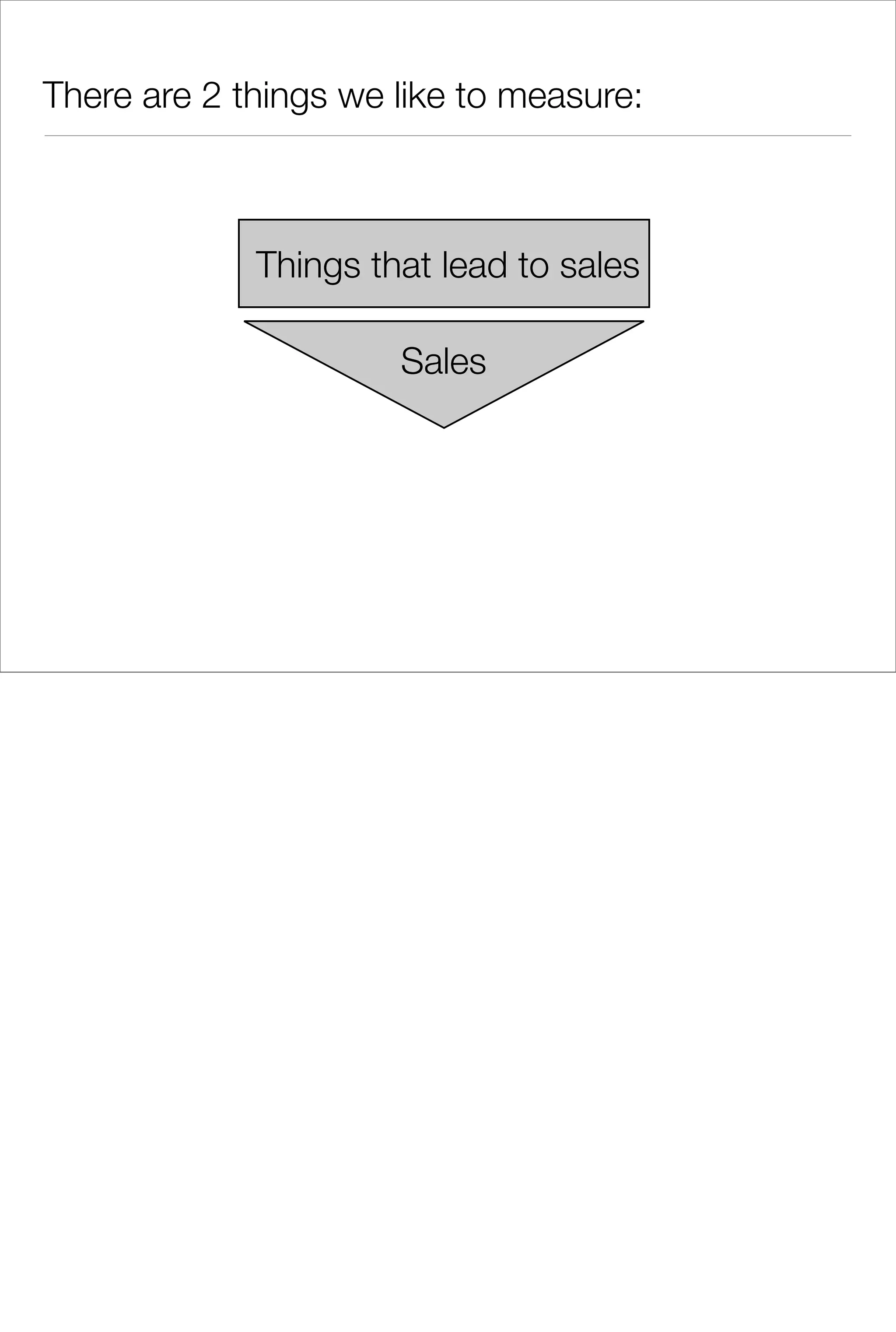
There are 2 things we like to measure:


             Things that lead to sales

                      Sales
Sales


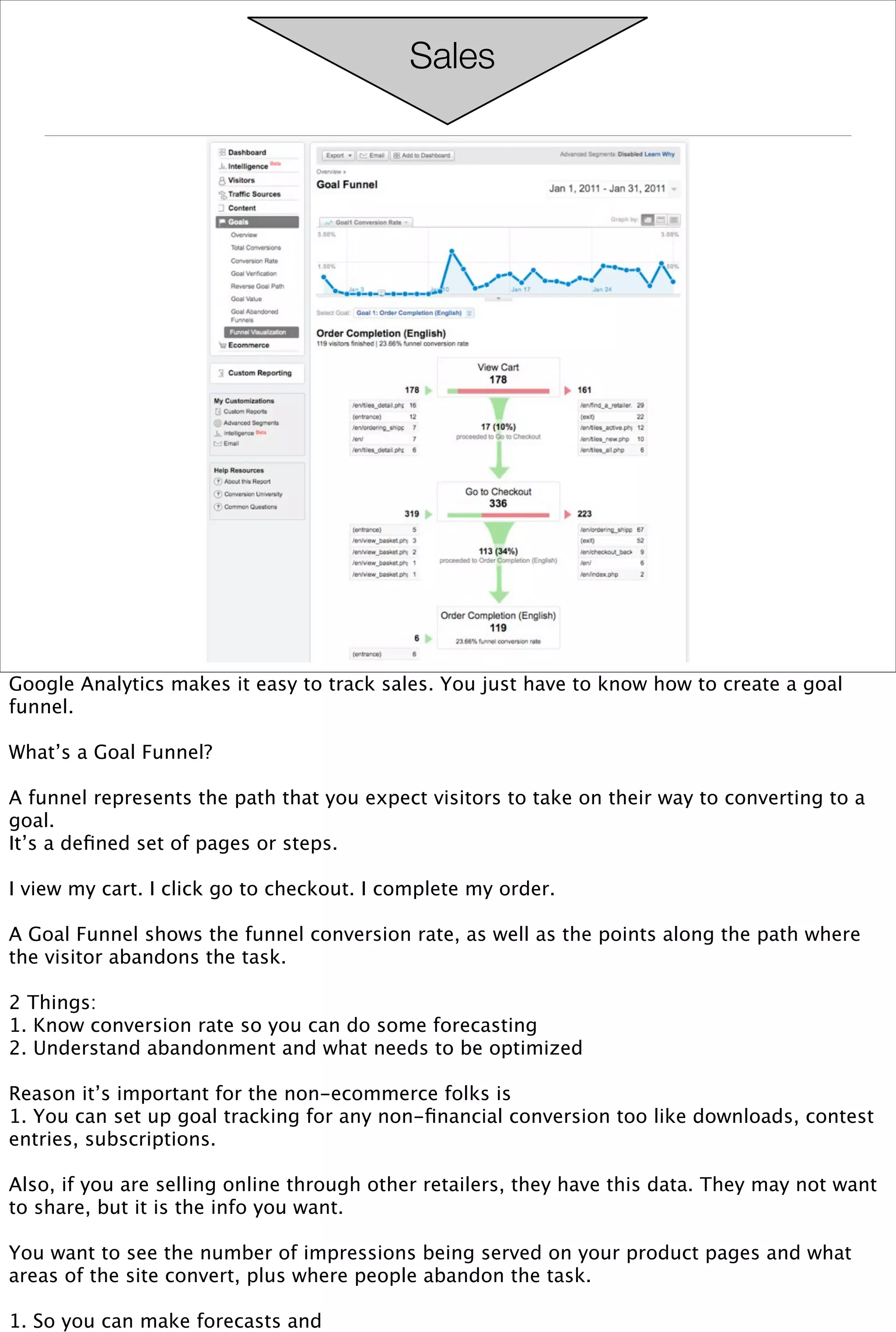
Google Analytics makes it easy to track sales. You just have to know how to create a goal
funnel.

What’s a Goal Funnel?

A funnel represents the path that you expect visitors to take on their way to converting to a
goal.
It’s a defined set of pages or steps.

I view my cart. I click go to checkout. I complete my order.

A Goal Funnel shows the funnel conversion rate, as well as the points along the path where
the visitor abandons the task.

2 Things:
1. Know conversion rate so you can do some forecasting
2. Understand abandonment and what needs to be optimized

Reason it’s important for the non-ecommerce folks is
1. You can set up goal tracking for any non-financial conversion too like downloads, contest
entries, subscriptions.

Also, if you are selling online through other retailers, they have this data. They may not want
to share, but it is the info you want.

You want to see the number of impressions being served on your product pages and what
areas of the site convert, plus where people abandon the task.

1. So you can make forecasts and
Things that lead to sales


       Twitter Followers                    Customer Feedback

                                                                                RTs
                                  Facebook Fans
                                              Email Opens
    Website Visitors
                   Press Mentions


                                            Sales

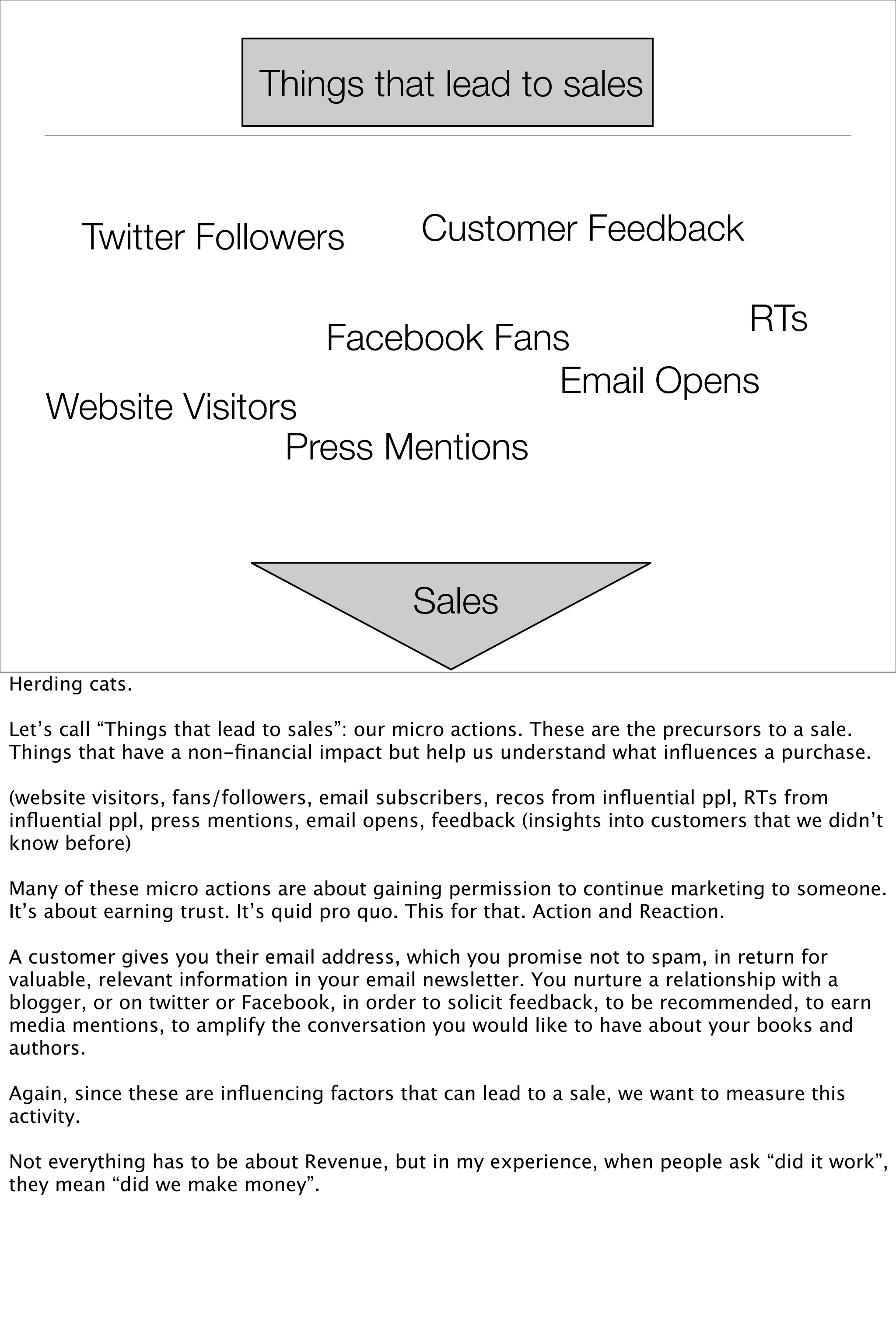
Herding cats.

Let’s call “Things that lead to sales”: our micro actions. These are the precursors to a sale.
Things that have a non-financial impact but help us understand what influences a purchase.

(website visitors, fans/followers, email subscribers, recos from influential ppl, RTs from
influential ppl, press mentions, email opens, feedback (insights into customers that we didn’t
know before)

Many of these micro actions are about gaining permission to continue marketing to someone.
It’s about earning trust. It’s quid pro quo. This for that. Action and Reaction.

A customer gives you their email address, which you promise not to spam, in return for
valuable, relevant information in your email newsletter. You nurture a relationship with a
blogger, or on twitter or Facebook, in order to solicit feedback, to be recommended, to earn
media mentions, to amplify the conversation you would like to have about your books and
authors.

Again, since these are influencing factors that can lead to a sale, we want to measure this
activity.

Not everything has to be about Revenue, but in my experience, when people ask “did it work”,
they mean “did we make money”.
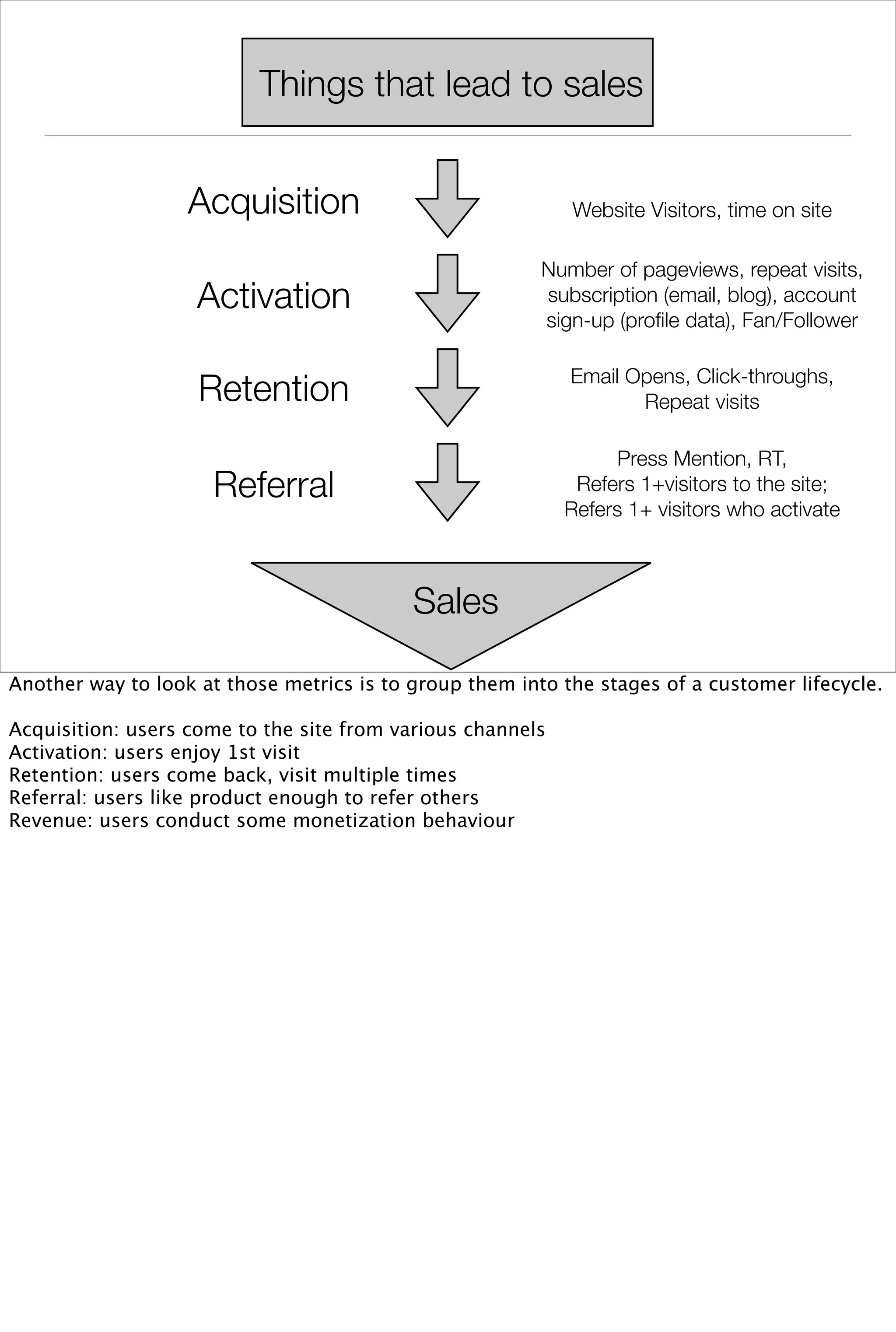
Things that lead to sales


                   Acquisition                              Website Visitors, time on site

                                                         Number of pageviews, repeat visits,
                    Activation                           subscription (email, blog), account
                                                         sign-up (profile data), Fan/Follower

                                                            Email Opens, Click-throughs,
                    Retention                                      Repeat visits

                                                                 Press Mention, RT,
                     Referral                                Refers 1+visitors to the site;
                                                            Refers 1+ visitors who activate


                                           Sales

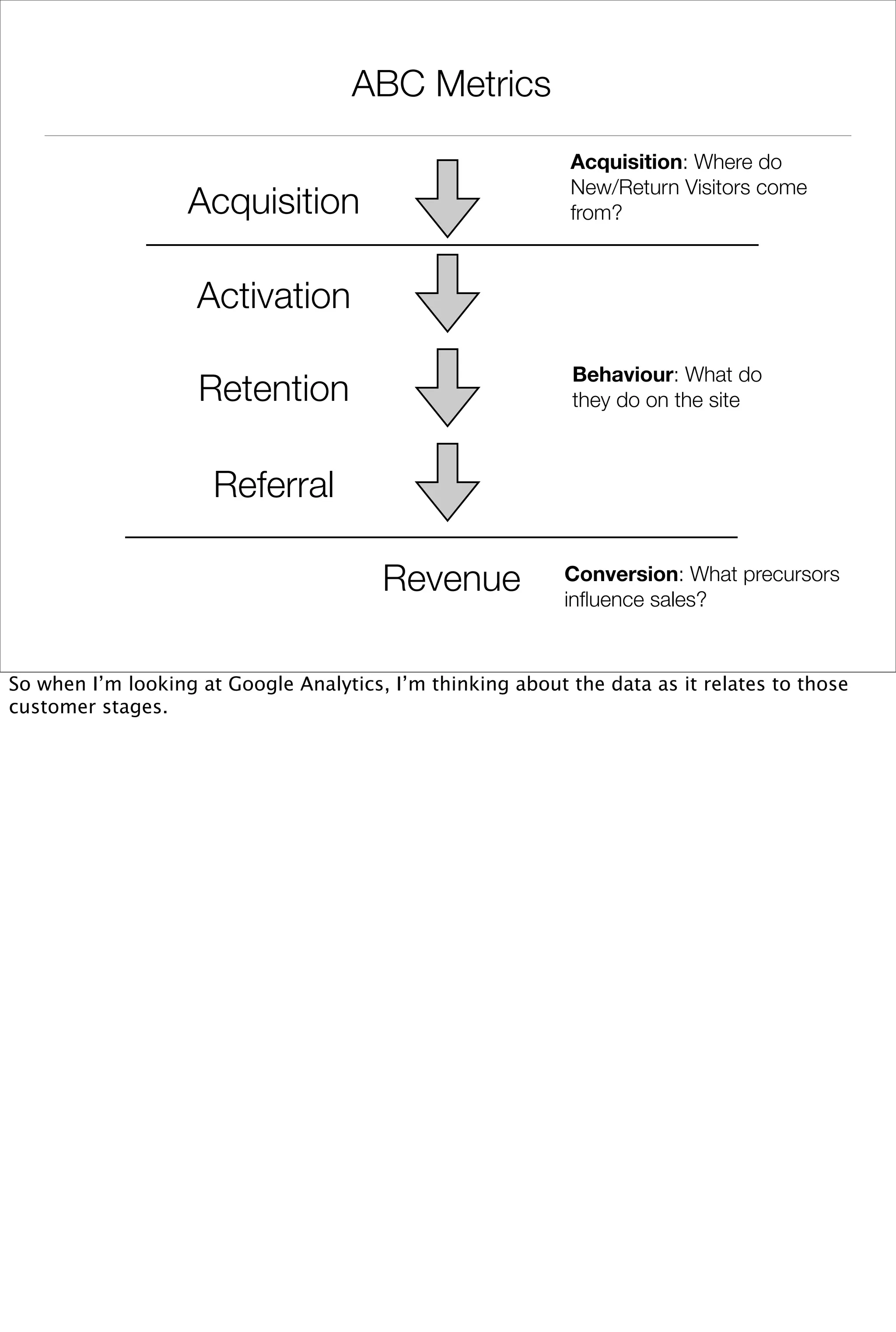
Another way to look at those metrics is to group them into the stages of a customer lifecycle.

Acquisition: users come to the site from various channels
Activation: users enjoy 1st visit
Retention: users come back, visit multiple times
Referral: users like product enough to refer others
Revenue: users conduct some monetization behaviour
If you don’t know where you’re going, any road will
   get you there.

   Misquote from Alice in Wonderland


Are we down the rabbit hole yet?


The #1 reason why we don’t know if our online marketing activities are working or not is
because we have not defined our goals.

Without clearly defined goals we have no criteria for evaluating success.
Your goals outline your intent. Your intent informs what you can measure.
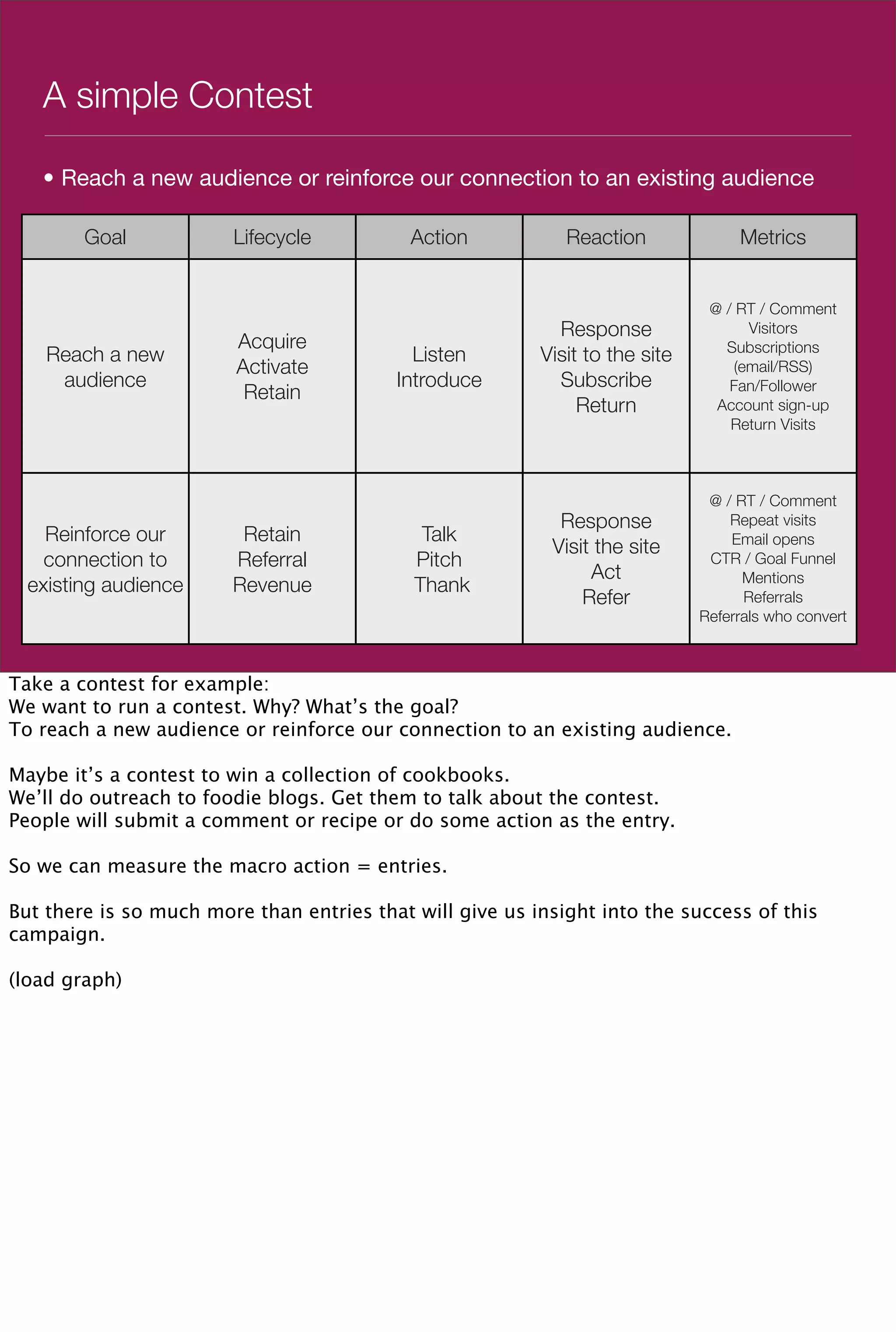
A simple Contest

   • Reach a new audience or reinforce our connection to an existing audience

        Goal            Lifecycle           Action           Reaction              Metrics


                                                                               @ / RT / Comment
                                                            Response                 Visitors
                         Acquire                                                 Subscriptions
    Reach a new                             Listen        Visit to the site
                         Activate                                                  (email/RSS)
     audience                             Introduce         Subscribe             Fan/Follower
                          Retain
                                                               Return           Account sign-up
                                                                                  Return Visits


                                                                               @ / RT / Comment
                                                            Response              Repeat visits
    Reinforce our        Retain              Talk                                 Email opens
                                                           Visit the site
    connection to       Referral            Pitch                              CTR / Goal Funnel
                                                                Act                 Mentions
  existing audience     Revenue             Thank
                                                               Refer                Referrals
                                                                              Referrals who convert


Take a contest for example:
We want to run a contest. Why? What’s the goal?
To reach a new audience or reinforce our connection to an existing audience.

Maybe it’s a contest to win a collection of cookbooks.
We’ll do outreach to foodie blogs. Get them to talk about the contest.
People will submit a comment or recipe or do some action as the entry.

So we can measure the macro action = entries.

But there is so much more than entries that will give us insight into the success of this
campaign.

(load graph)
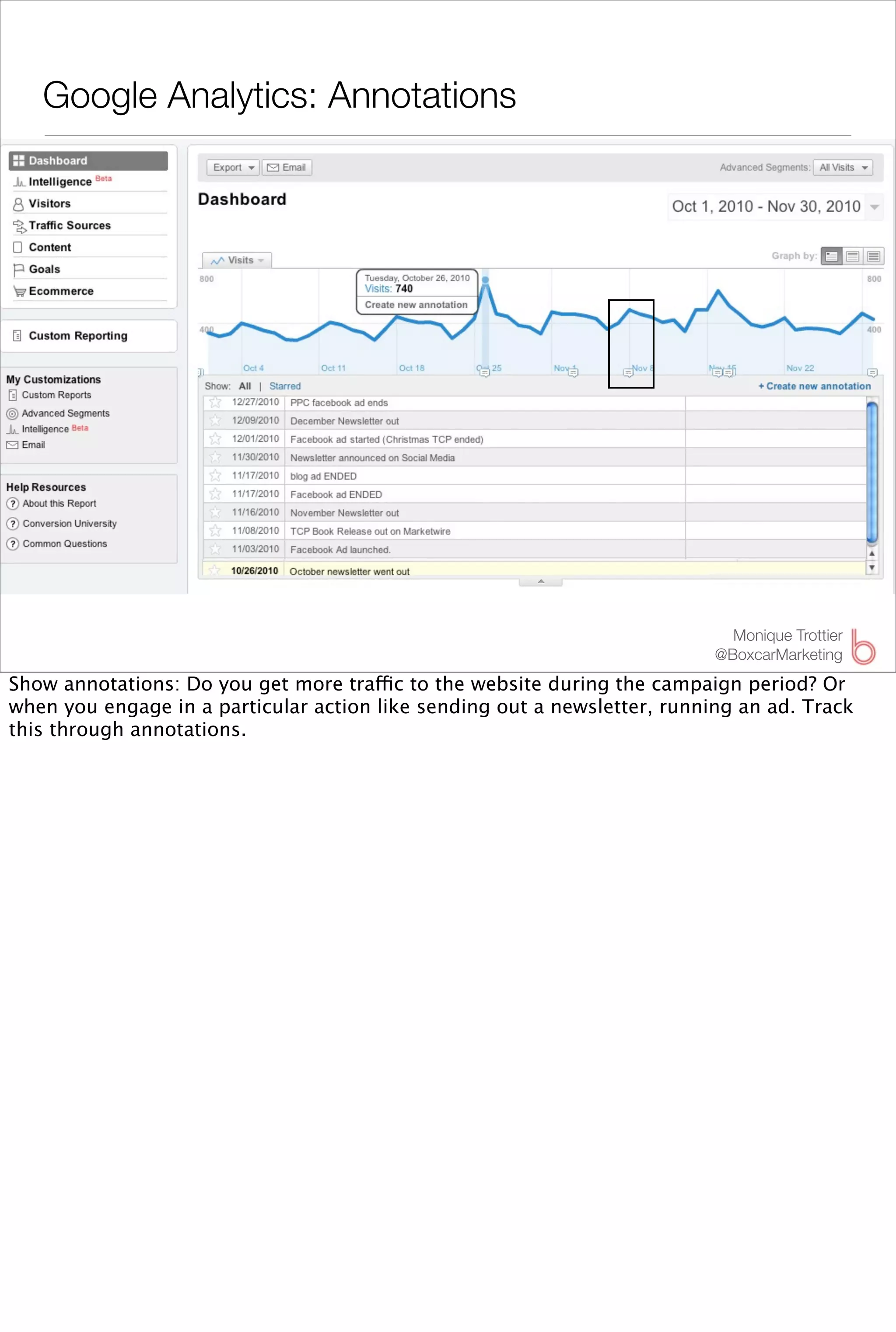
Google Analytics: Annotations


                                                                             Monique Trottier
                                                                           @BoxcarMarketing
Show annotations: Do you get more traffic to the website during the campaign period? Or
when you engage in a particular action like sending out a newsletter, running an ad. Track
this through annotations.
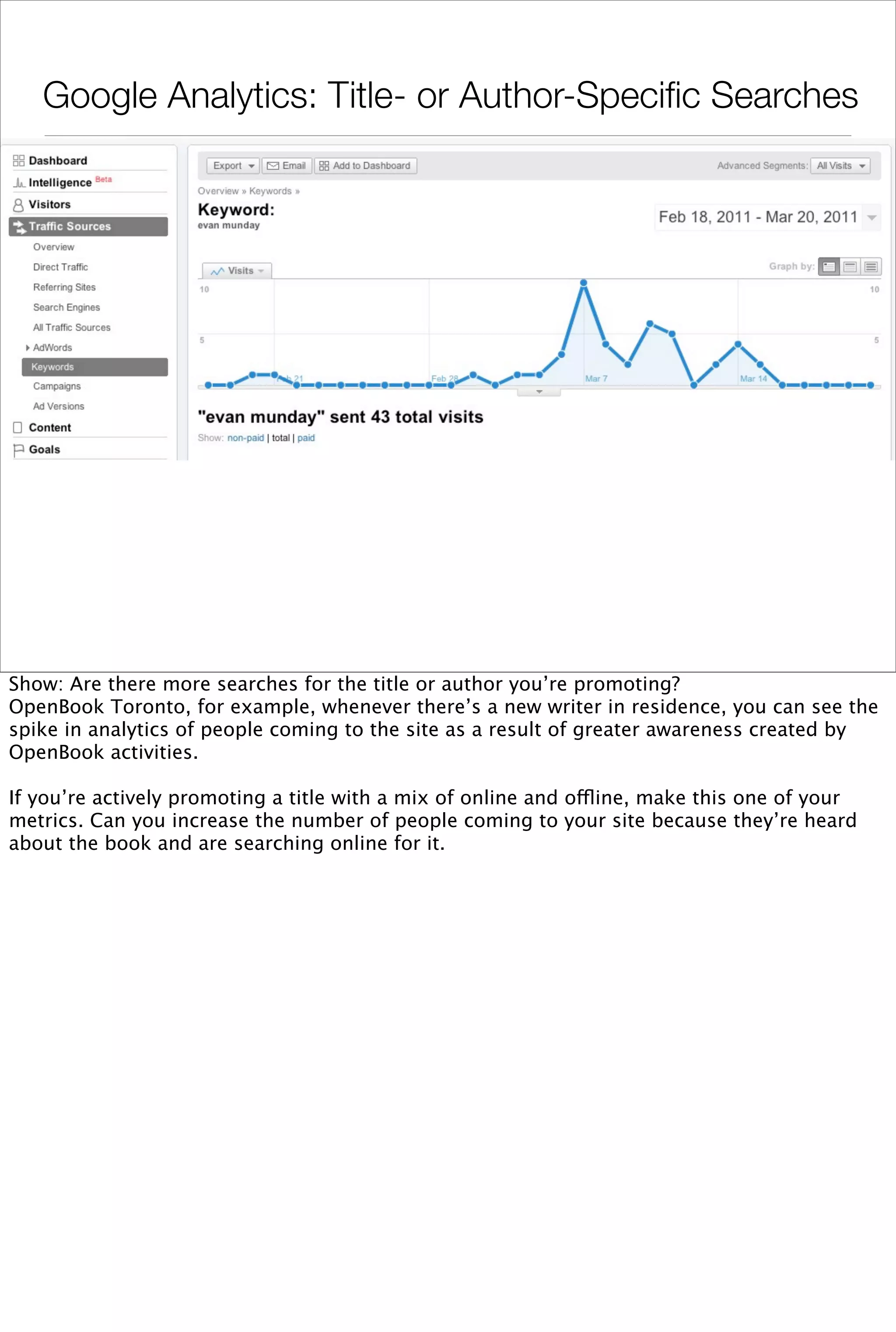
Google Analytics: Title- or Author-Specific Searches


Show: Are there more searches for the title or author you’re promoting?
OpenBook Toronto, for example, whenever there’s a new writer in residence, you can see the
spike in analytics of people coming to the site as a result of greater awareness created by
OpenBook activities.

If you’re actively promoting a title with a mix of online and offline, make this one of your
metrics. Can you increase the number of people coming to your site because they’re heard
about the book and are searching online for it.
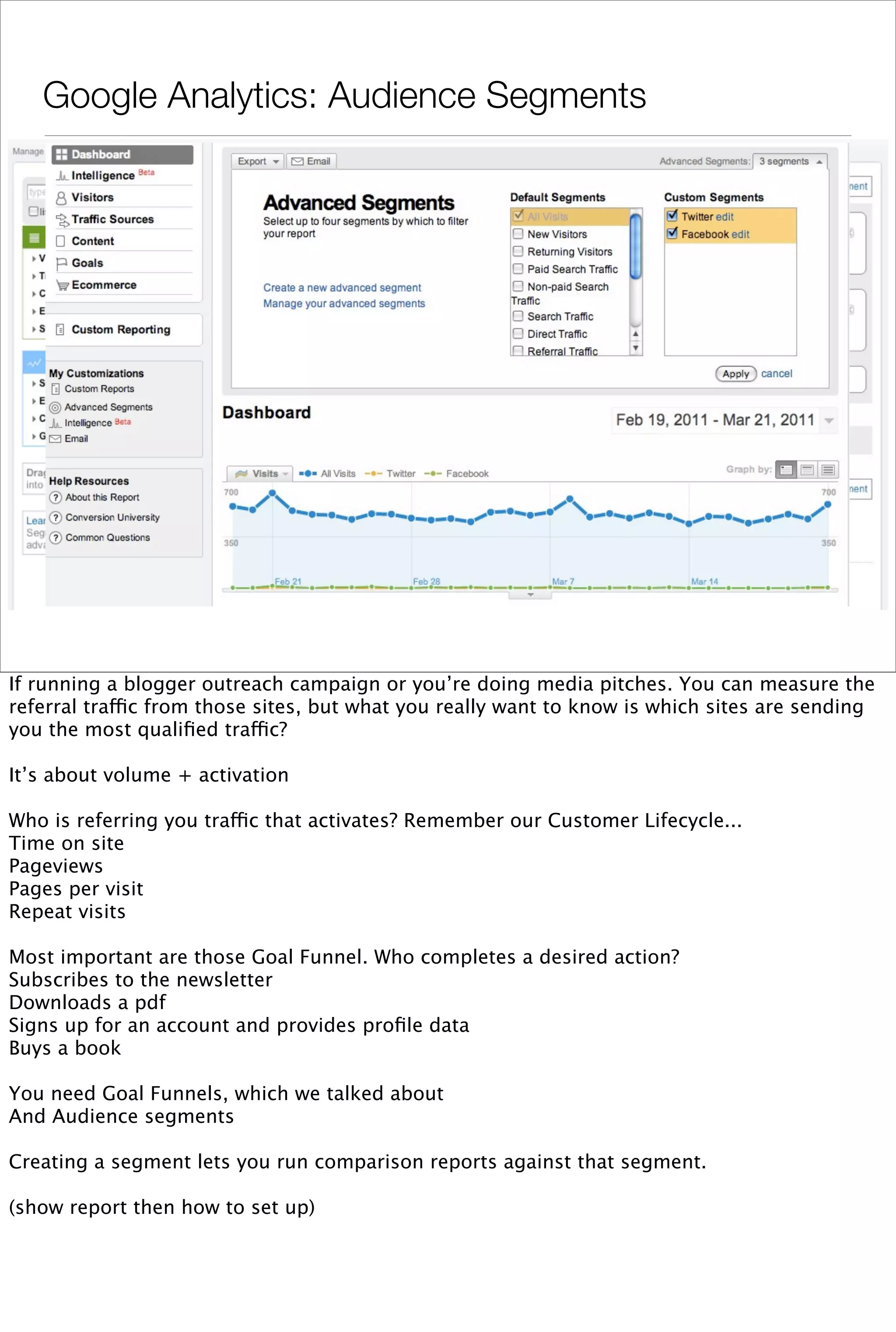
Google Analytics: Audience Segments


If running a blogger outreach campaign or you’re doing media pitches. You can measure the
referral traffic from those sites, but what you really want to know is which sites are sending
you the most qualified traffic?

It’s about volume + activation

Who is referring you traffic that activates? Remember our Customer Lifecycle...
Time on site
Pageviews
Pages per visit
Repeat visits

Most important are those Goal Funnel. Who completes a desired action?
Subscribes to the newsletter
Downloads a pdf
Signs up for an account and provides profile data
Buys a book

You need Goal Funnels, which we talked about
And Audience segments

Creating a segment lets you run comparison reports against that segment.

(show report then how to set up)
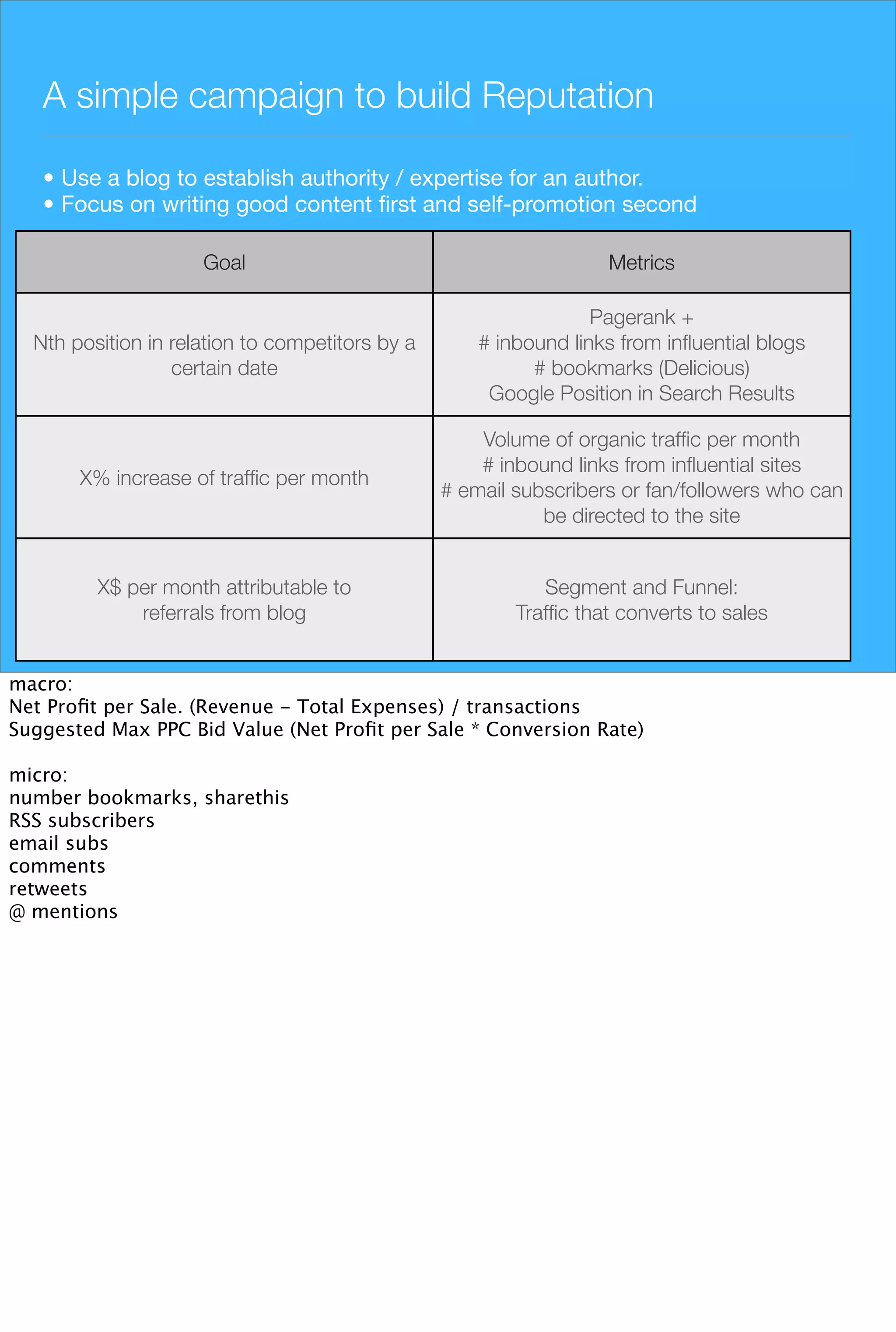
A simple campaign to build Reputation

   • Use a blog to establish authority / expertise for an author.
   • Focus on writing good content first and self-promotion second

                     Goal                                          Metrics

                                                                  Pagerank +
  Nth position in relation to competitors by a       # inbound links from influential blogs
                  certain date                             # bookmarks (Delicious)
                                                      Google Position in Search Results

                                                     Volume of organic traffic per month
                                                     # inbound links from influential sites
       X% increase of traffic per month
                                                 # email subscribers or fan/followers who can
                                                            be directed to the site


         X$ per month attributable to                       Segment and Funnel:
             referrals from blog                         Traffic that converts to sales


macro:
Net Profit per Sale. (Revenue - Total Expenses) / transactions
Suggested Max PPC Bid Value (Net Profit per Sale * Conversion Rate)

micro:
number bookmarks, sharethis
RSS subscribers
email subs
comments
retweets
@ mentions
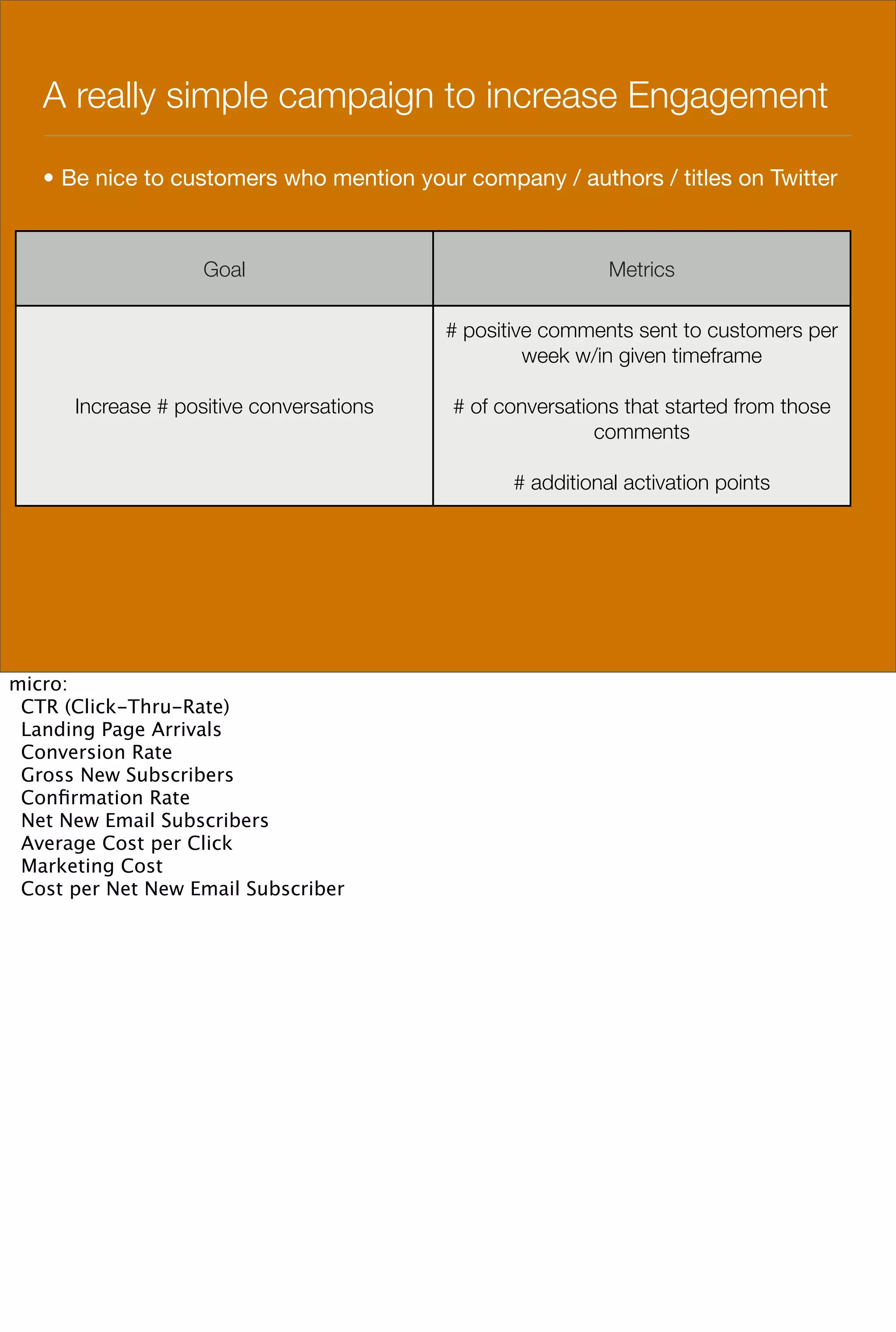
A really simple campaign to increase Engagement

   • Be nice to customers who mention your company / authors / titles on Twitter


                    Goal                                    Metrics

                                          # positive comments sent to customers per
                                                   week w/in given timeframe

      Increase # positive conversations   # of conversations that started from those
                                                          comments

                                                 # additional activation points


micro:
 CTR (Click-Thru-Rate)
 Landing Page Arrivals
 Conversion Rate
 Gross New Subscribers
 Confirmation Rate
 Net New Email Subscribers
 Average Cost per Click
 Marketing Cost
 Cost per Net New Email Subscriber
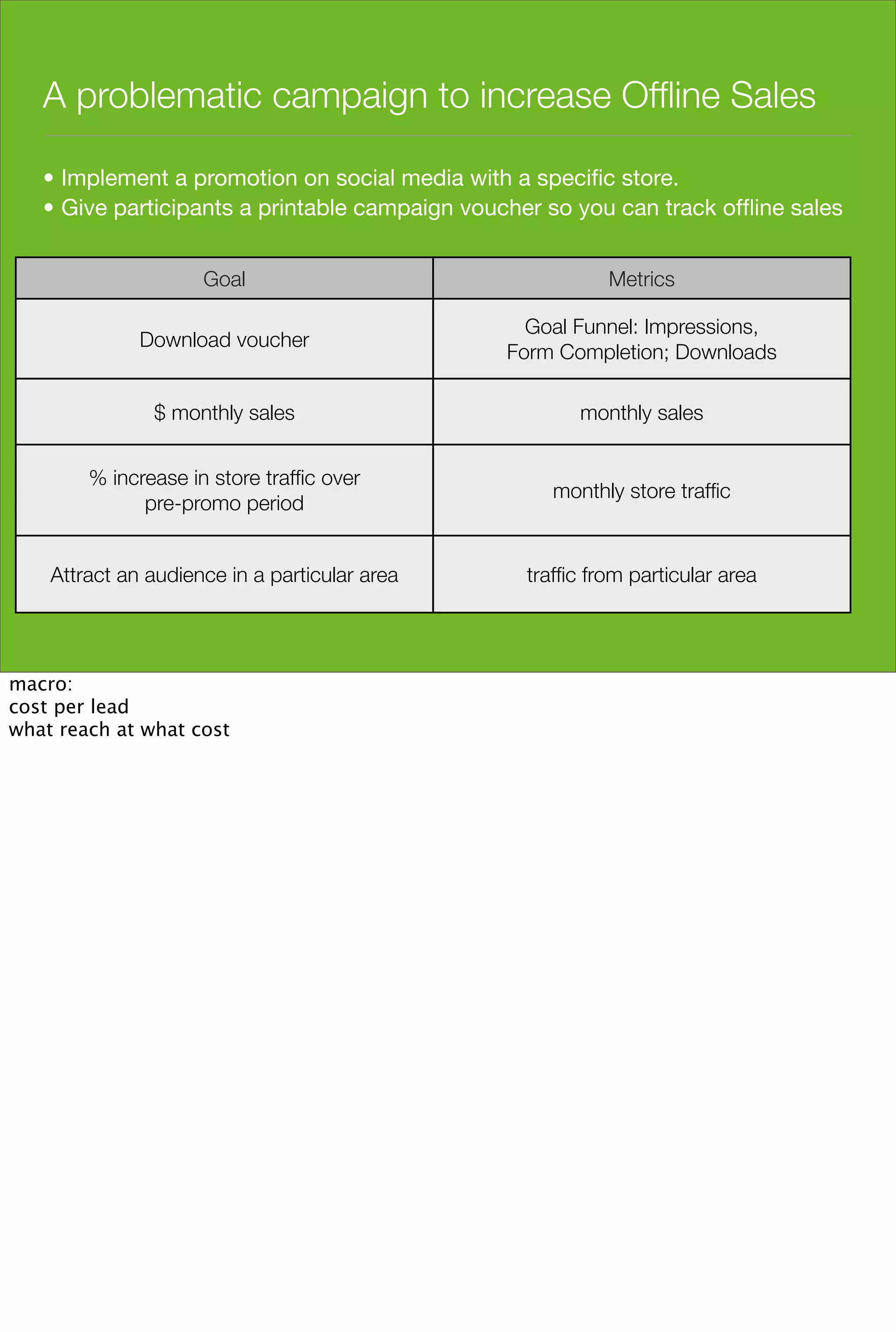
A problematic campaign to increase Offline Sales

   • Implement a promotion on social media with a specific store.
   • Give participants a printable campaign voucher so you can track offline sales

                     Goal                                  Metrics

                                                  Goal Funnel: Impressions,
              Download voucher
                                                Form Completion; Downloads

               $ monthly sales                          monthly sales


        % increase in store traffic over
                                                     monthly store traffic
              pre-promo period


    Attract an audience in a particular area      traffic from particular area


macro:
cost per lead
what reach at what cost
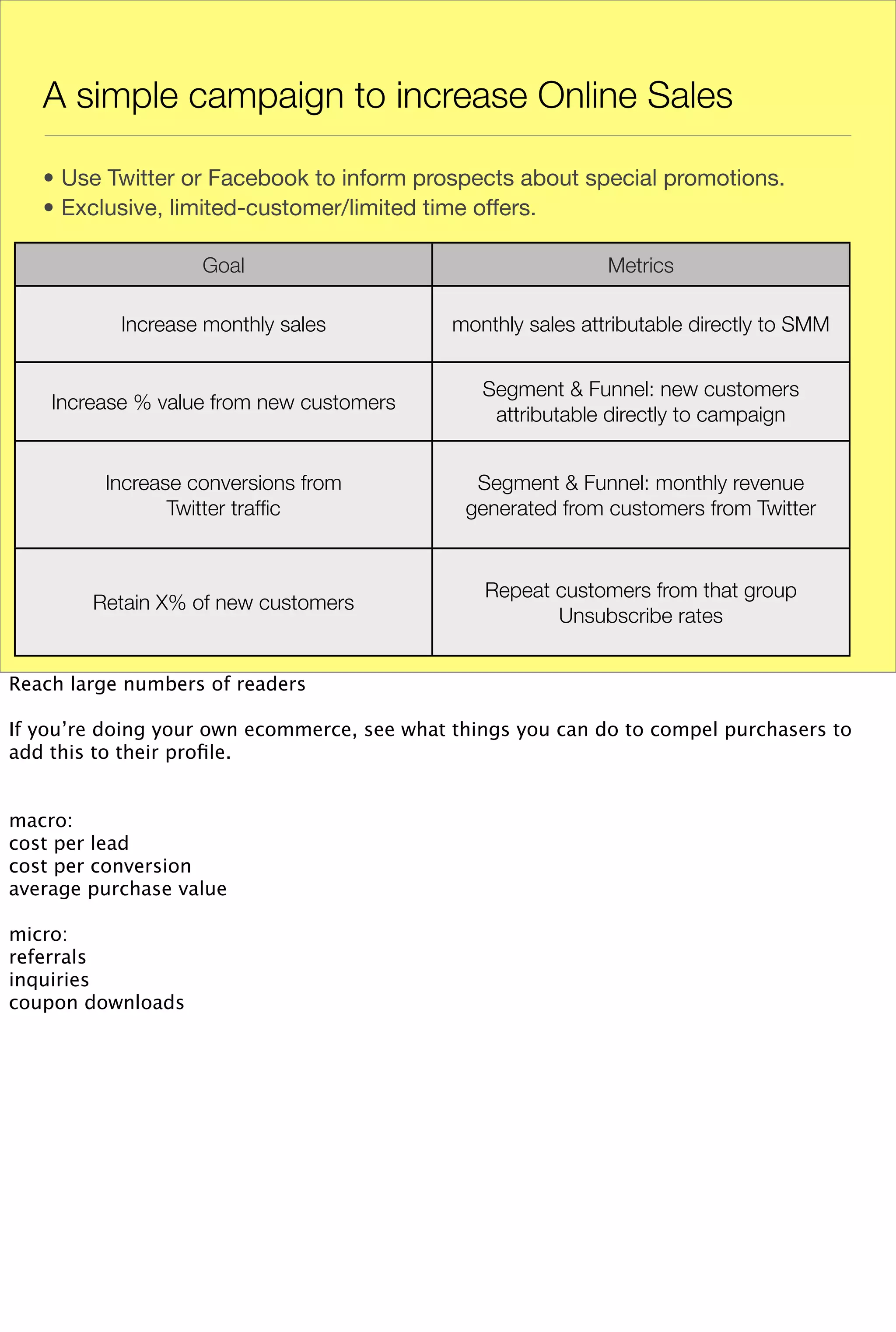
A simple campaign to increase Online Sales

   • Use Twitter or Facebook to inform prospects about special promotions.
   • Exclusive, limited-customer/limited time offers.

                   Goal                                       Metrics

           Increase monthly sales            monthly sales attributable directly to SMM


                                                Segment & Funnel: new customers
    Increase % value from new customers
                                                 attributable directly to campaign


         Increase conversions from             Segment & Funnel: monthly revenue
                Twitter traffic                generated from customers from Twitter


                                                Repeat customers from that group
        Retain X% of new customers
                                                       Unsubscribe rates


Reach large numbers of readers

If you’re doing your own ecommerce, see what things you can do to compel purchasers to
add this to their profile.


macro:
cost per lead
cost per conversion
average purchase value

micro:
referrals
inquiries
coupon downloads
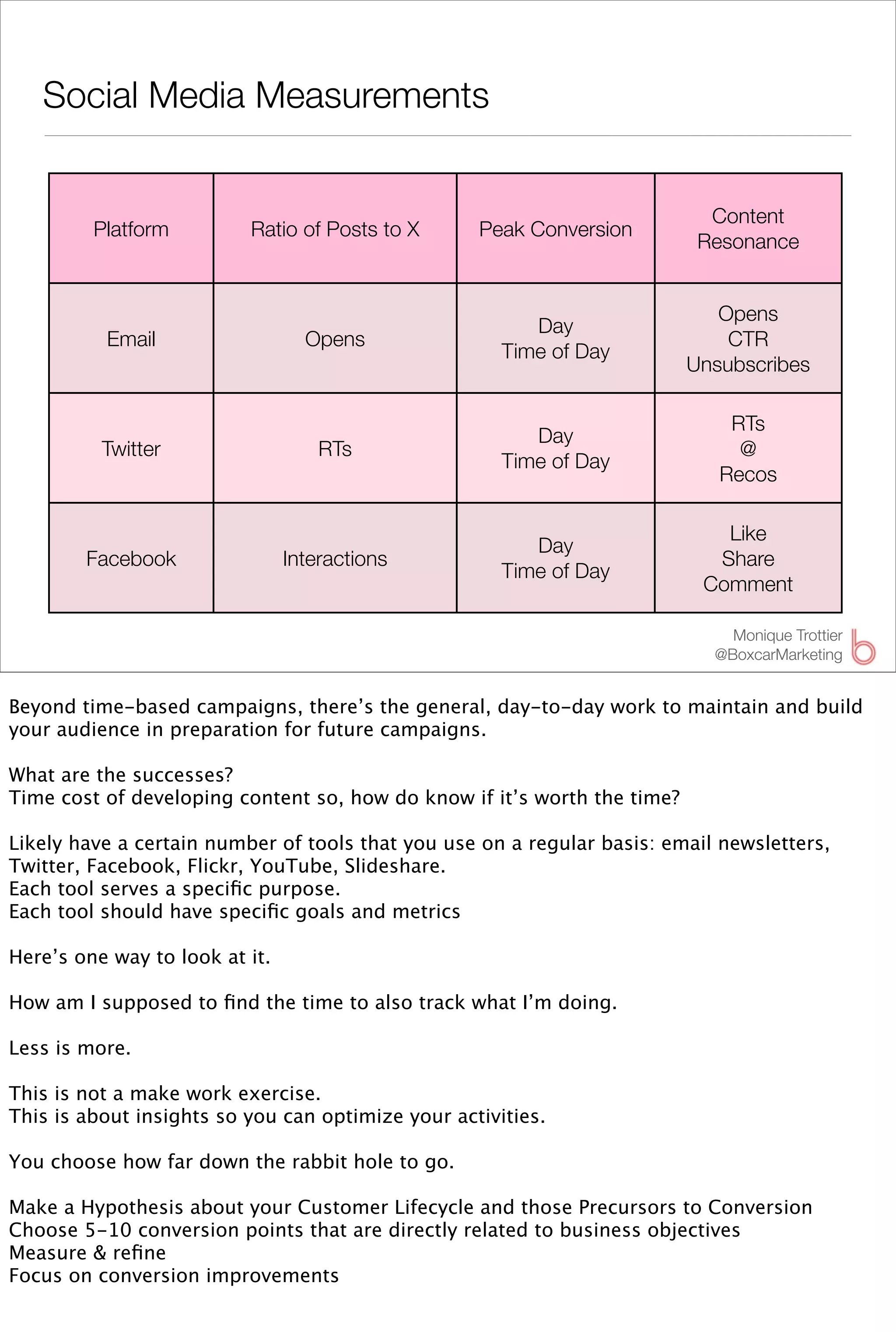
Social Media Measurements


                                                                            Content
         Platform         Ratio of Posts to X      Peak Conversion
                                                                           Resonance


                                                                             Opens
                                                         Day
          Email                   Opens                                       CTR
                                                      Time of Day
                                                                          Unsubscribes

                                                                              RTs
                                                         Day
          Twitter                   RTs                                        @
                                                      Time of Day
                                                                             Recos

                                                                             Like
                                                         Day
        Facebook                Interactions                                Share
                                                      Time of Day
                                                                           Comment

                                                                              Monique Trottier
                                                                            @BoxcarMarketing


Beyond time-based campaigns, there’s the general, day-to-day work to maintain and build
your audience in preparation for future campaigns.

What are the successes?
Time cost of developing content so, how do know if it’s worth the time?

Likely have a certain number of tools that you use on a regular basis: email newsletters,
Twitter, Facebook, Flickr, YouTube, Slideshare.
Each tool serves a specific purpose.
Each tool should have specific goals and metrics

Here’s one way to look at it.

How am I supposed to find the time to also track what I’m doing.

Less is more.

This is not a make work exercise.
This is about insights so you can optimize your activities.

You choose how far down the rabbit hole to go.

Make a Hypothesis about your Customer Lifecycle and those Precursors to Conversion
Choose 5-10 conversion points that are directly related to business objectives
Measure & refine
Focus on conversion improvements
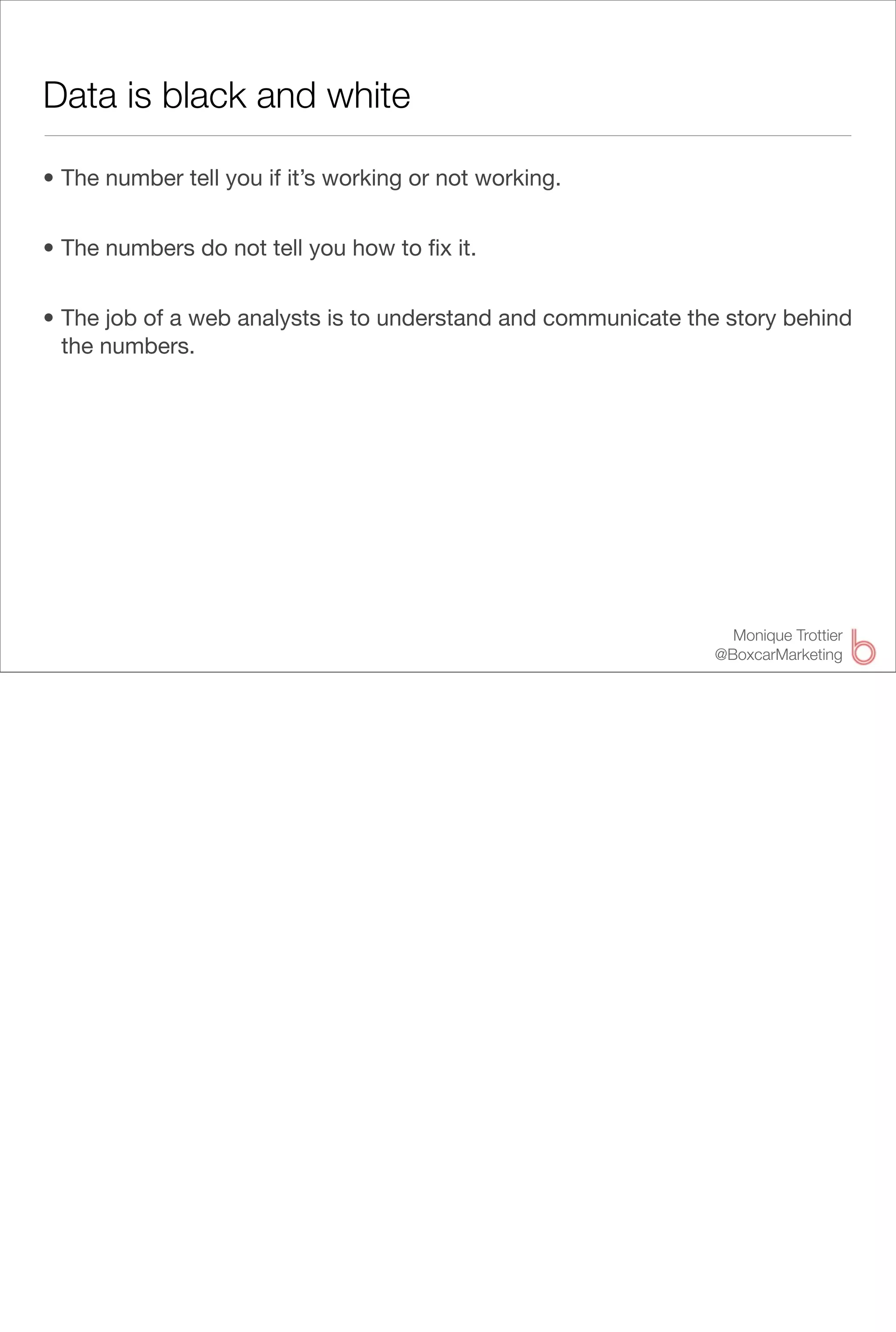
Data is black and white

• The number tell you if it’s working or not working.


• The numbers do not tell you how to fix it.


• The job of a web analysts is to understand and communicate the story behind
  the numbers.


                                                                 Monique Trottier
                                                               @BoxcarMarketing
Let’s take a Breather
ABC Metrics
                                                            Acquisition: Where do
                                                            New/Return Visitors come
                   Acquisition                              from?


                    Activation

                                                             Behaviour: What do
                    Retention                                they do on the site


                      Referral

                                        Revenue             Conversion: What precursors
                                                            influence sales?


So when I’m looking at Google Analytics, I’m thinking about the data as it relates to those
customer stages.
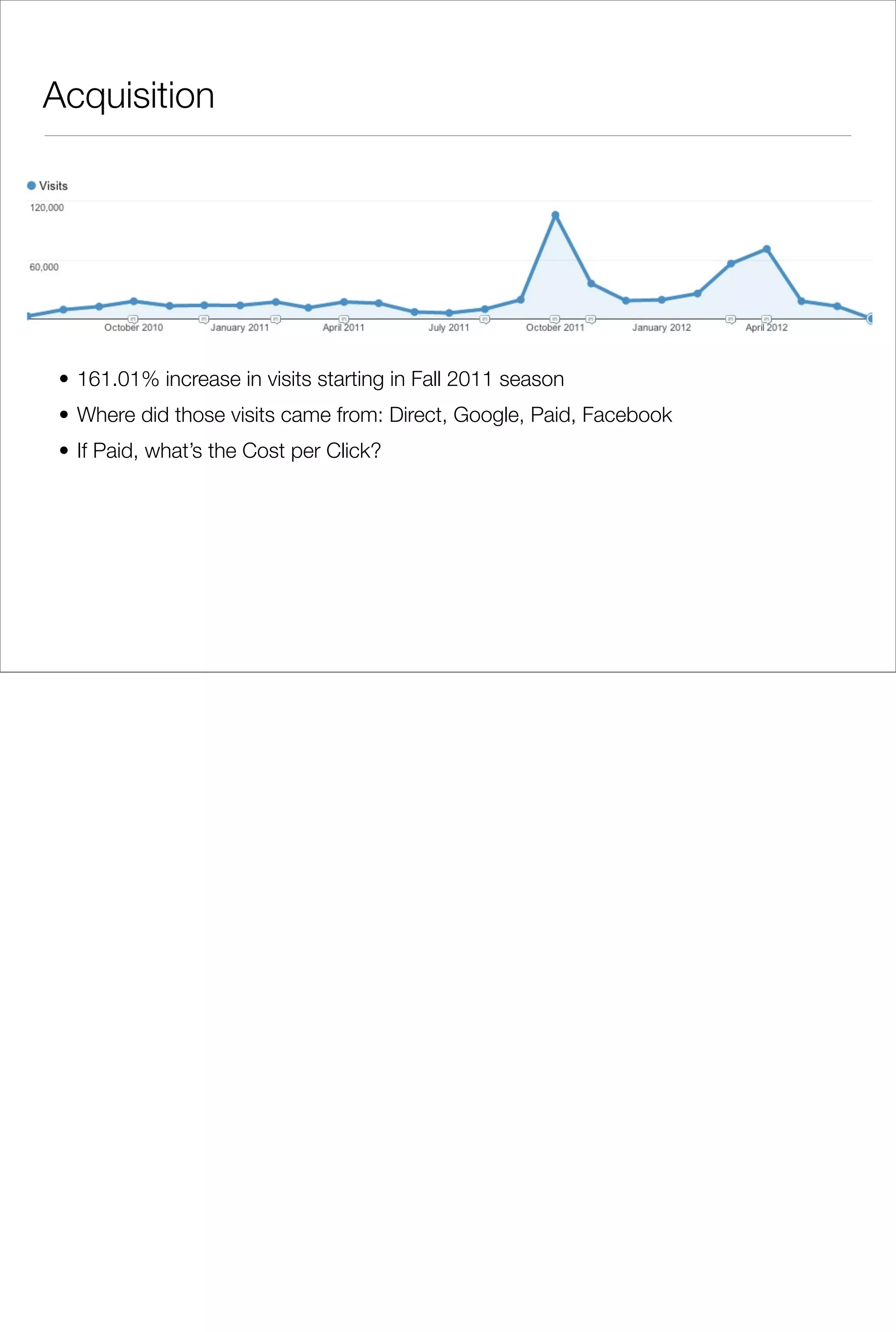
Acquisition


 • 161.01% increase in visits starting in Fall 2011 season
 • Where did those visits came from: Direct, Google, Paid, Facebook
 • If Paid, what’s the Cost per Click?
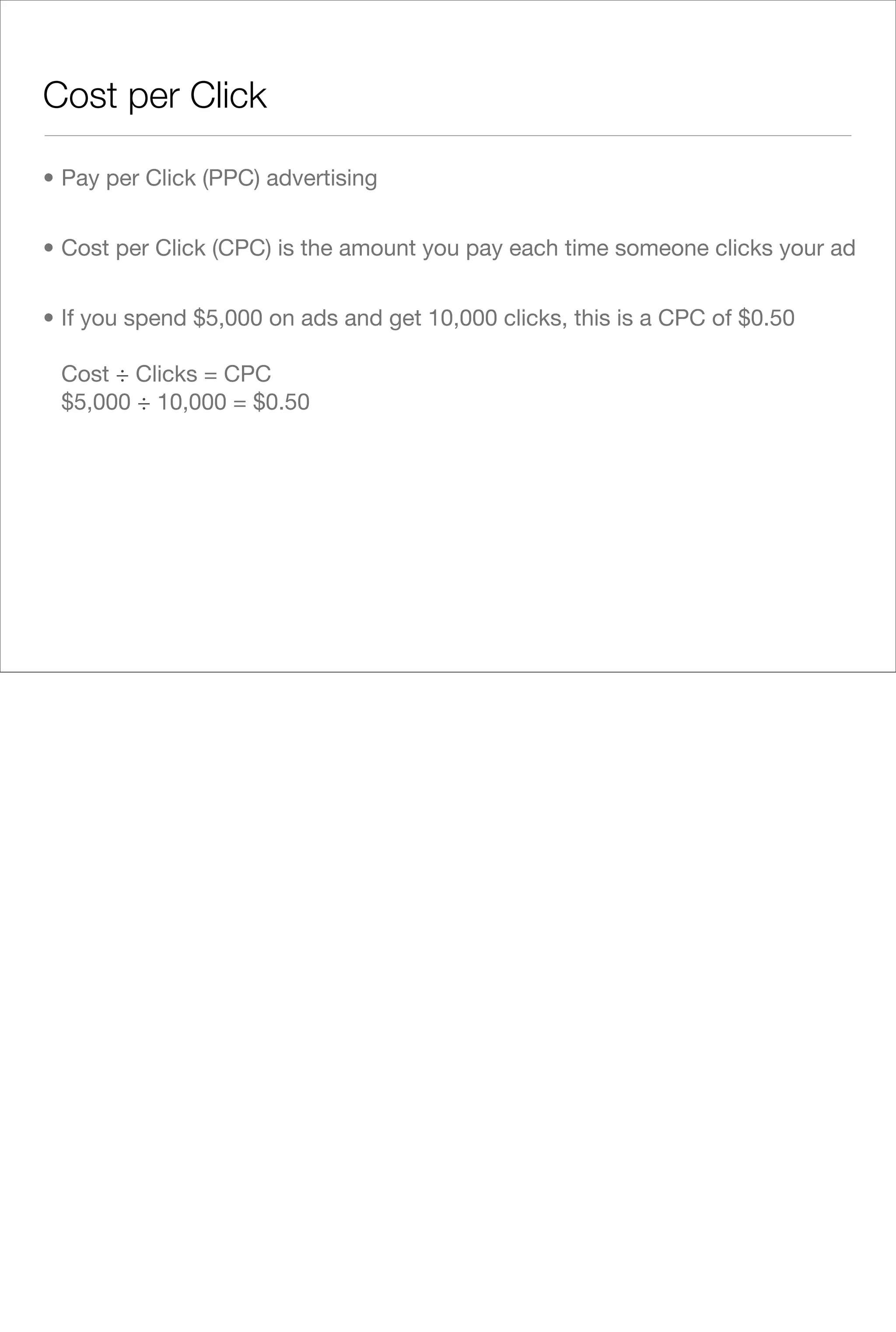
Cost per Click

• Pay per Click (PPC) advertising


• Cost per Click (CPC) is the amount you pay each time someone clicks your ad


• If you spend $5,000 on ads and get 10,000 clicks, this is a CPC of $0.50

 Cost ÷ Clicks = CPC
 $5,000 ÷ 10,000 = $0.50
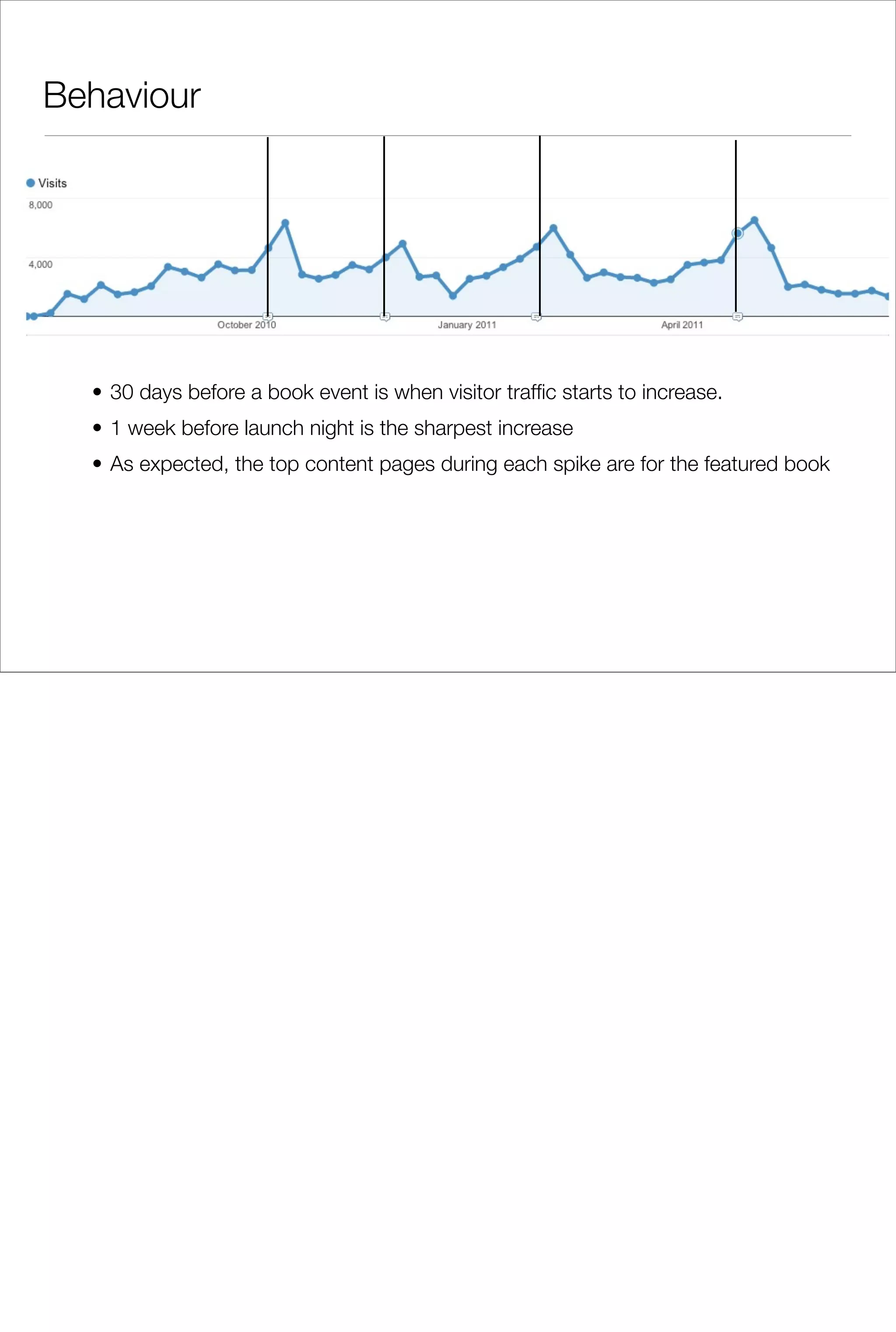
Behaviour


  • 30 days before a book event is when visitor traffic starts to increase.
  • 1 week before launch night is the sharpest increase
  • As expected, the top content pages during each spike are for the featured book
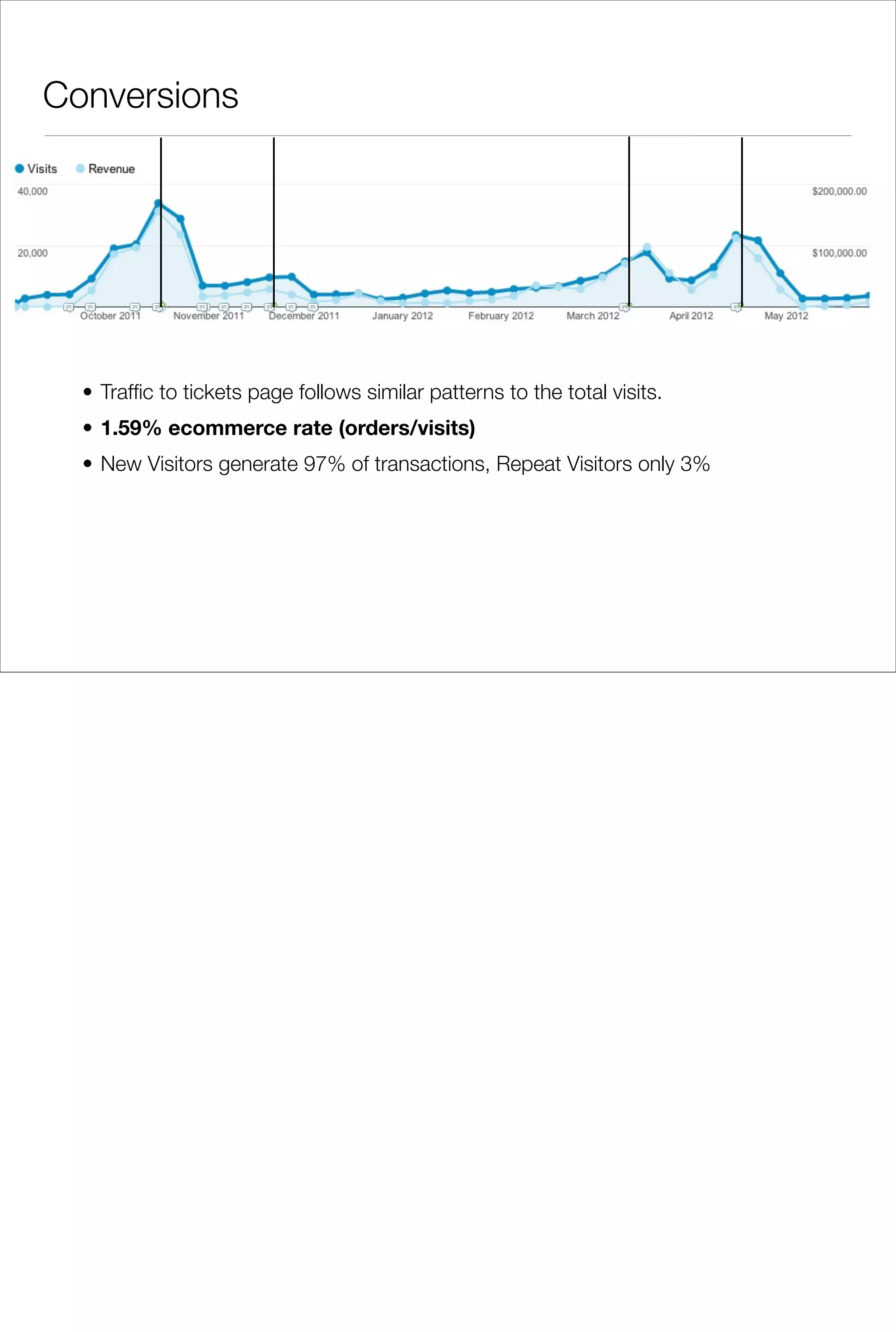
Conversions


  • Traffic to tickets page follows similar patterns to the total visits.
  • 1.59% ecommerce rate (orders/visits)
  • New Visitors generate 97% of transactions, Repeat Visitors only 3%
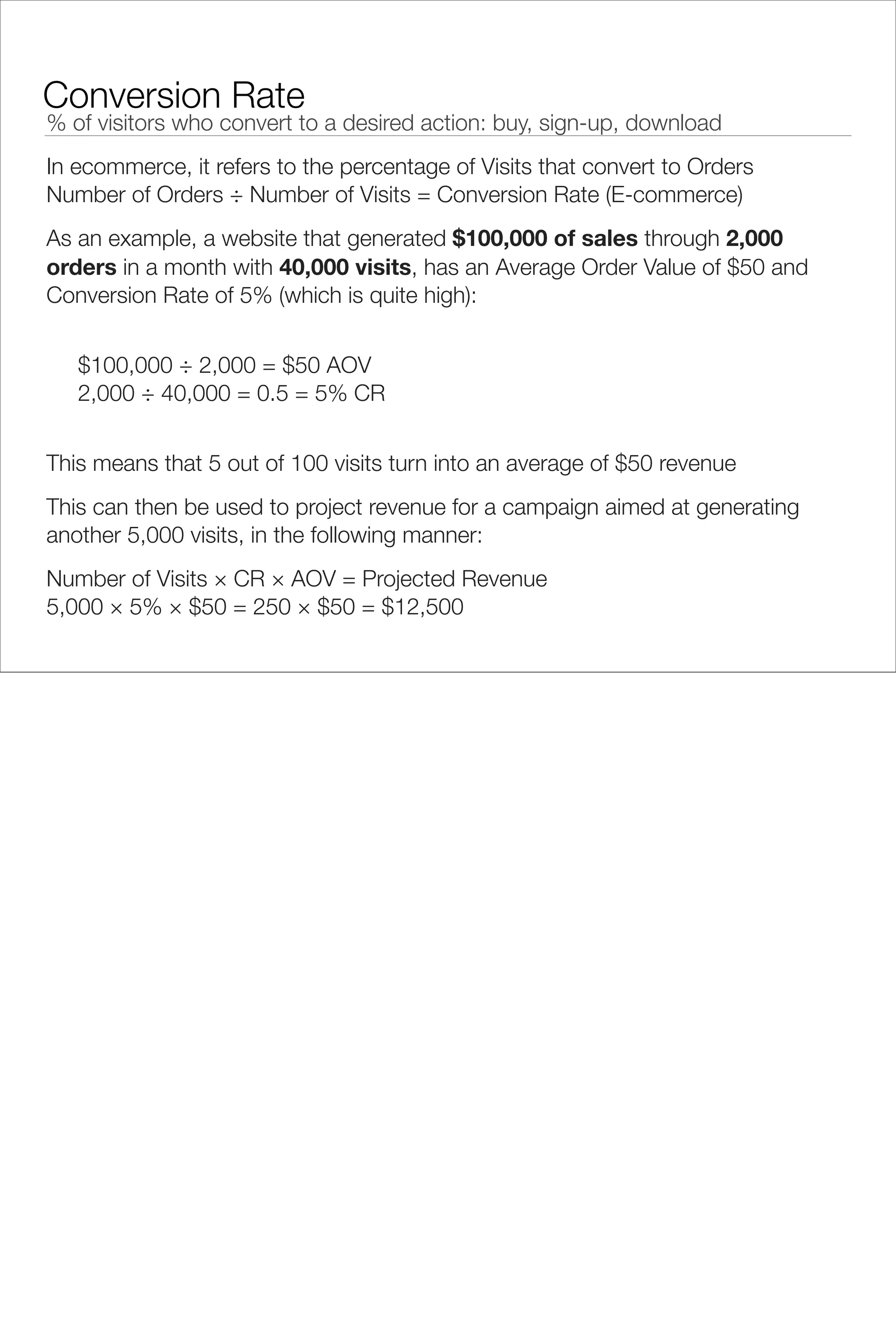
Conversion Rate
% of visitors who convert to a desired action: buy, sign-up, download
In ecommerce, it refers to the percentage of Visits that convert to Orders
Number of Orders ÷ Number of Visits = Conversion Rate (E-commerce)
As an example, a website that generated $100,000 of sales through 2,000
orders in a month with 40,000 visits, has an Average Order Value of $50 and
Conversion Rate of 5% (which is quite high):


   $100,000 ÷ 2,000 = $50 AOV
   2,000 ÷ 40,000 = 0.5 = 5% CR


This means that 5 out of 100 visits turn into an average of $50 revenue
This can then be used to project revenue for a campaign aimed at generating
another 5,000 visits, in the following manner:
Number of Visits × CR × AOV = Projected Revenue
5,000 × 5% × $50 = 250 × $50 = $12,500
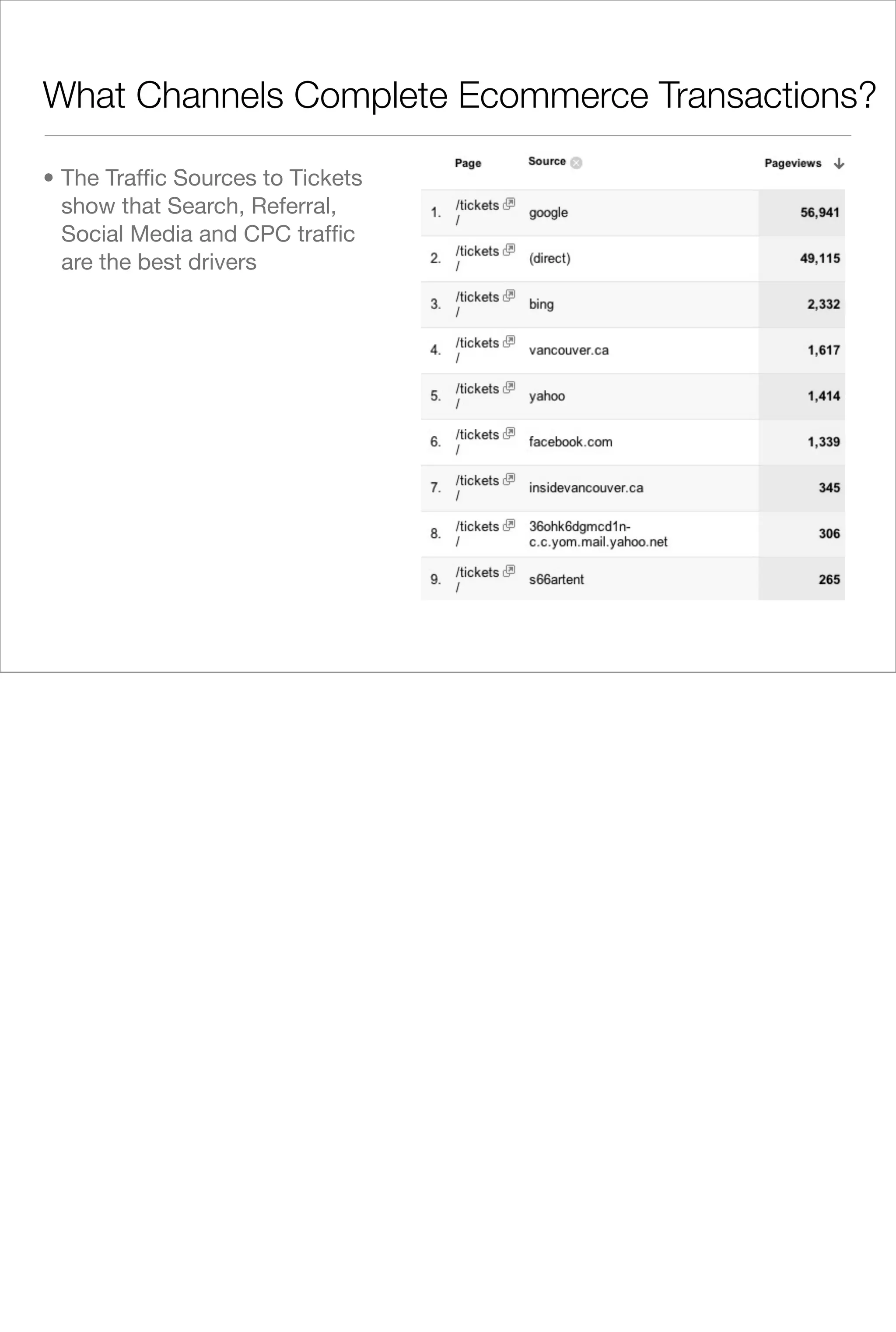
What Channels Complete Ecommerce Transactions?

• The Traffic Sources to Tickets
  show that Search, Referral,
  Social Media and CPC traffic
  are the best drivers
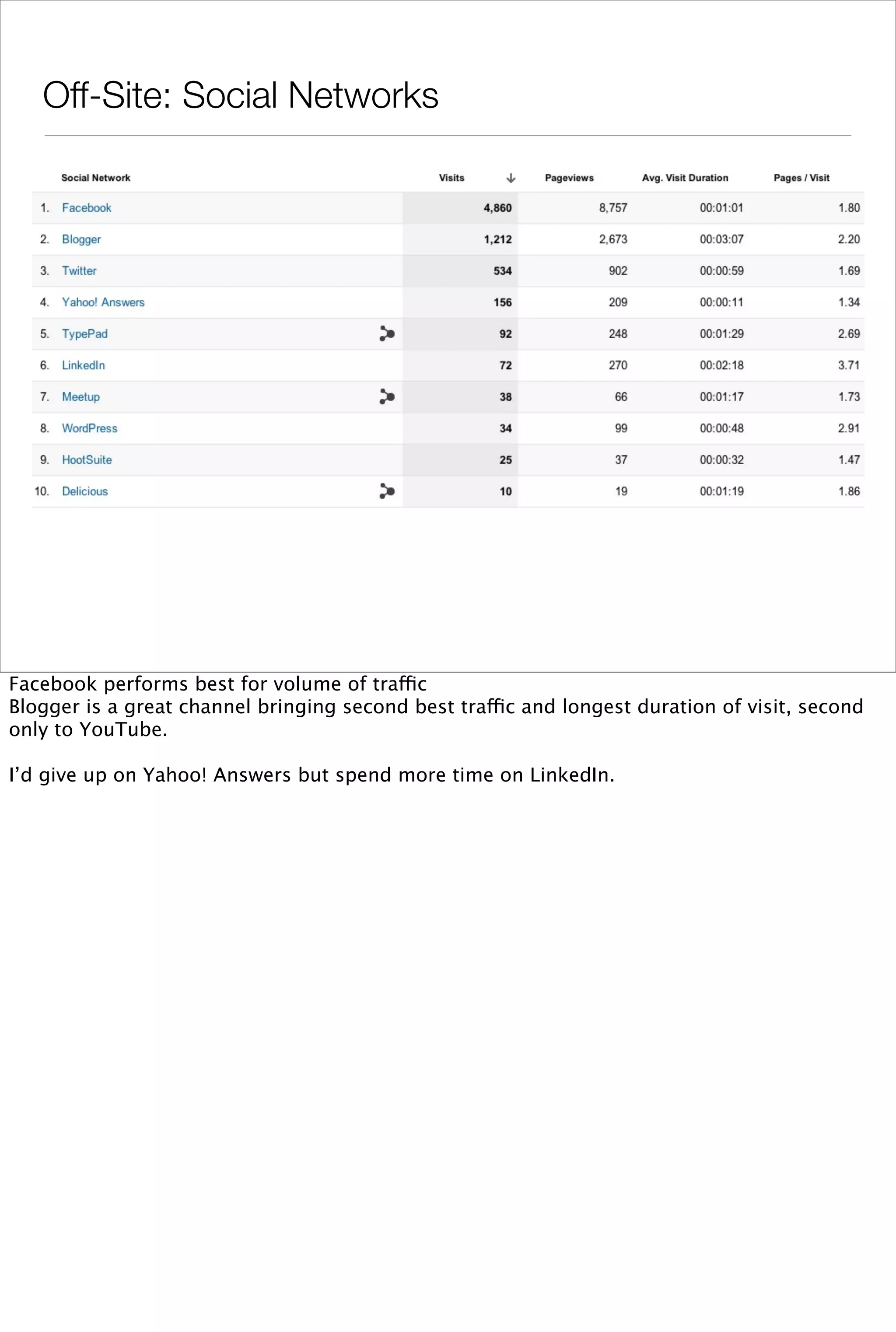
Off-Site: Social Networks


Facebook performs best for volume of traffic
Blogger is a great channel bringing second best traffic and longest duration of visit, second
only to YouTube.

I’d give up on Yahoo! Answers but spend more time on LinkedIn.
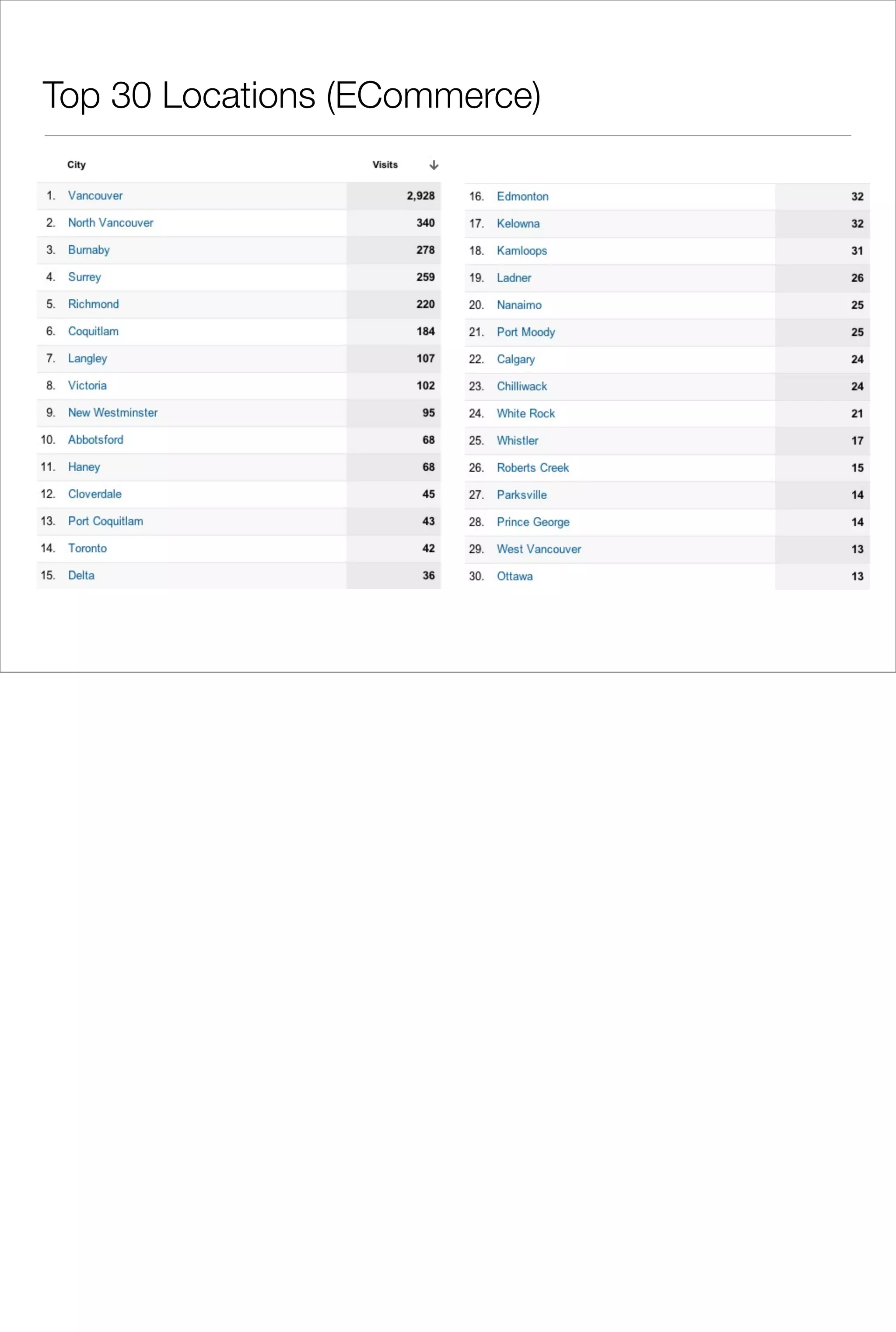
Top 30 Locations (ECommerce)
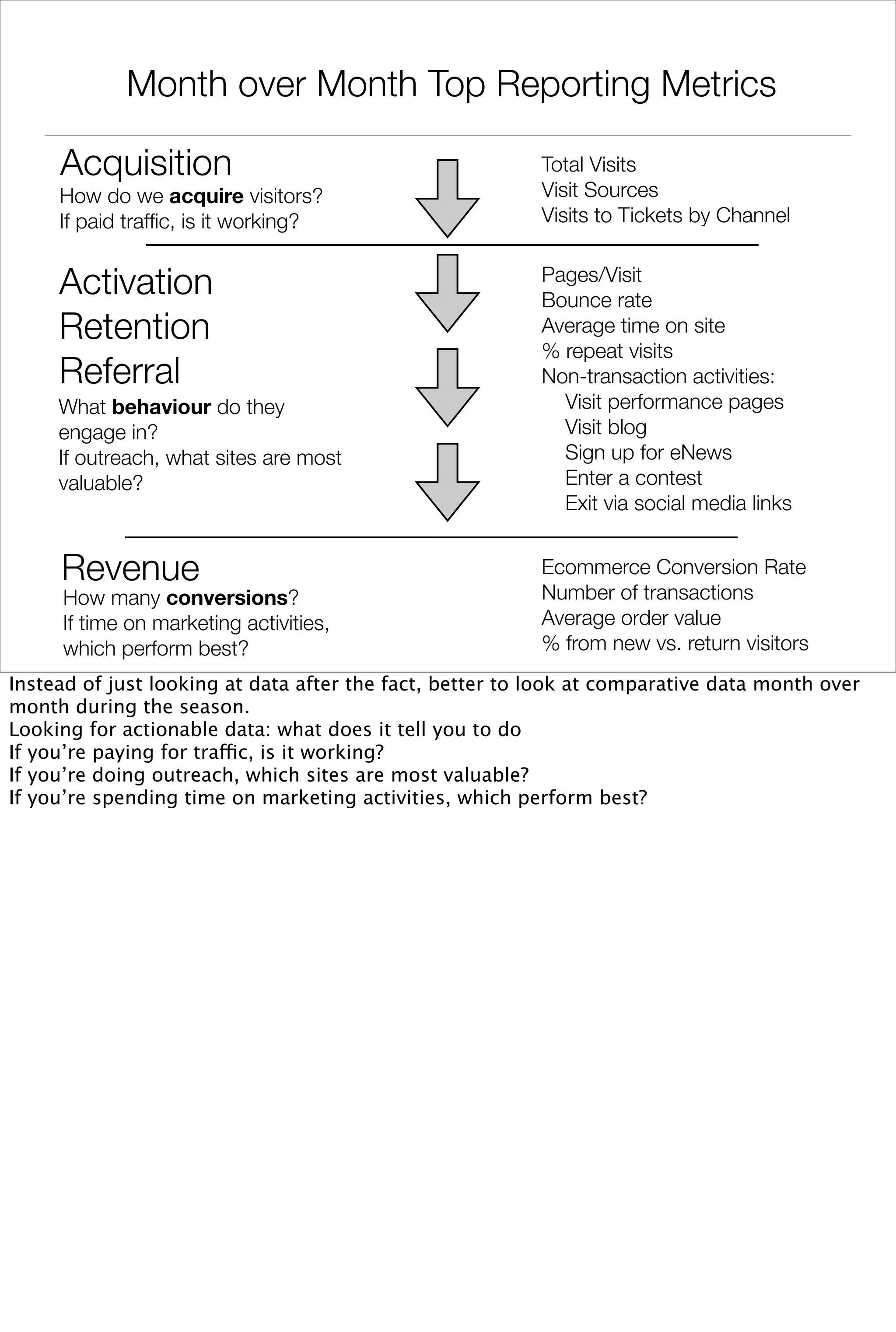
Month over Month Top Reporting Metrics

     Acquisition                                          Total Visits
     How do we acquire visitors?                          Visit Sources
     If paid traffic, is it working?                       Visits to Tickets by Channel


     Activation                                           Pages/Visit
                                                          Bounce rate
     Retention                                            Average time on site
                                                          % repeat visits
     Referral                                             Non-transaction activities:
     What behaviour do they                                 Visit performance pages
     engage in?                                             Visit blog
     If outreach, what sites are most                       Sign up for eNews
     valuable?                                              Enter a contest
                                                            Exit via social media links


     Revenue                                              Ecommerce Conversion Rate
     How many conversions?                                Number of transactions
     If time on marketing activities,                     Average order value
     which perform best?                                  % from new vs. return visitors
Instead of just looking at data after the fact, better to look at comparative data month over
month during the season.
Looking for actionable data: what does it tell you to do
If you’re paying for traffic, is it working?
If you’re doing outreach, which sites are most valuable?
If you’re spending time on marketing activities, which perform best?
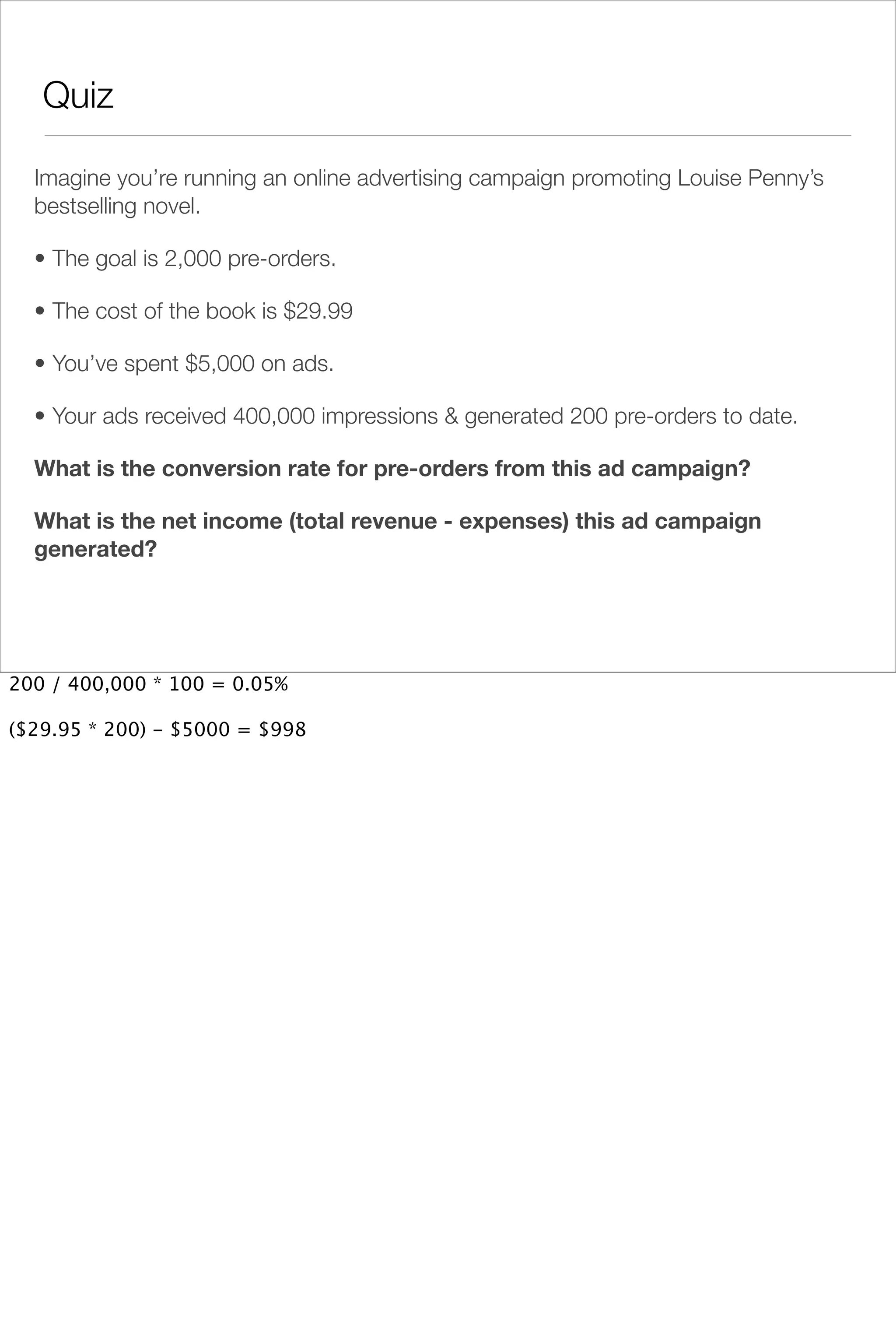
Quiz

  Imagine you’re running an online advertising campaign promoting Louise Penny’s
  bestselling novel.

  • The goal is 2,000 pre-orders.

  • The cost of the book is $29.99

  • You’ve spent $5,000 on ads.

  • Your ads received 400,000 impressions & generated 200 pre-orders to date.

  What is the conversion rate for pre-orders from this ad campaign?

  What is the net income (total revenue - expenses) this ad campaign
  generated?


200 / 400,000 * 100 = 0.05%

($29.95 * 200) - $5000 = $998
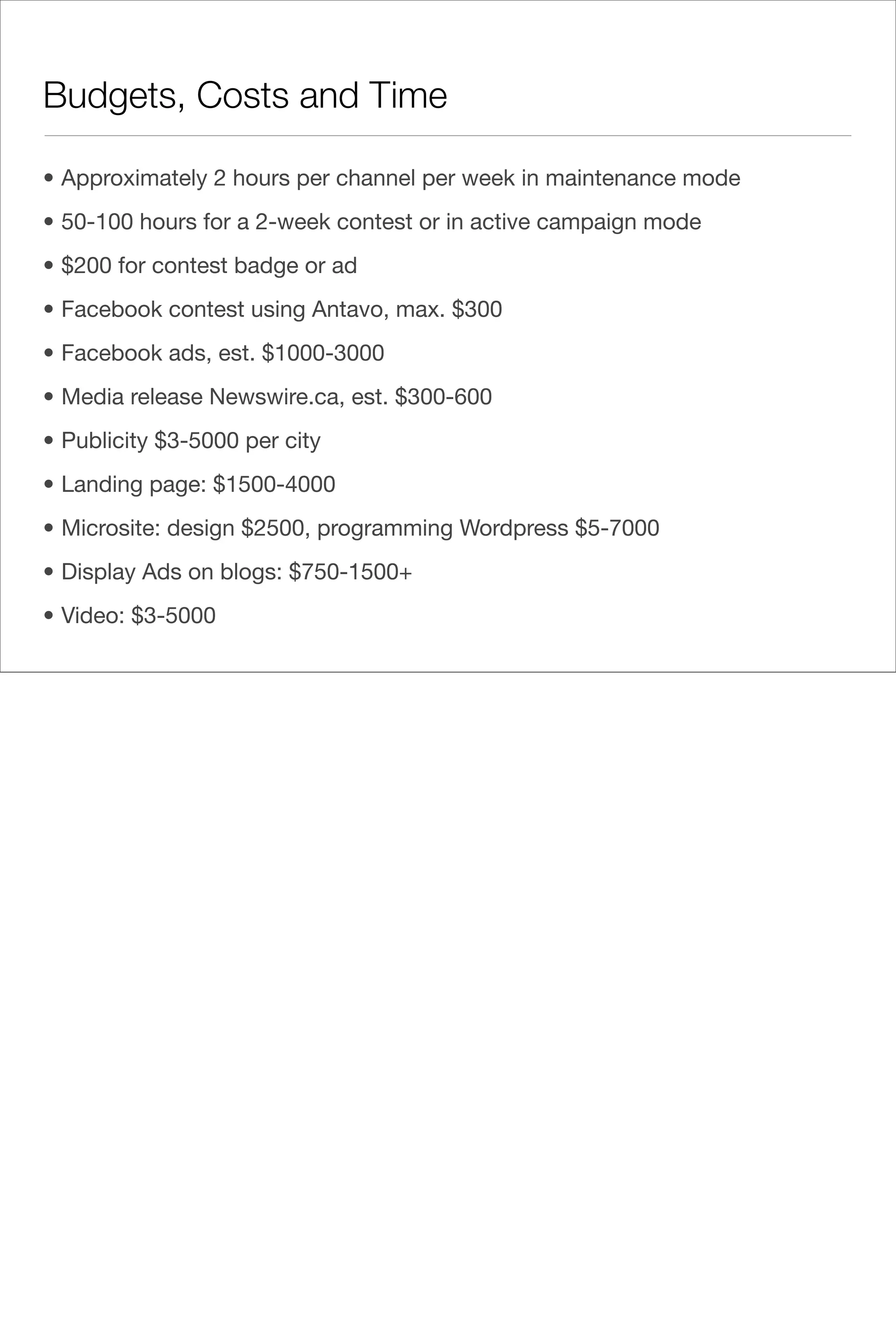
Budgets, Costs and Time

• Approximately 2 hours per channel per week in maintenance mode
• 50-100 hours for a 2-week contest or in active campaign mode
• $200 for contest badge or ad
• Facebook contest using Antavo, max. $300
• Facebook ads, est. $1000-3000
• Media release Newswire.ca, est. $300-600
• Publicity $3-5000 per city
• Landing page: $1500-4000
• Microsite: design $2500, programming Wordpress $5-7000
• Display Ads on blogs: $750-1500+
• Video: $3-5000
Next Class

Darren Barefoot and Julie Szabo, “Chapter 6: Measuring Success: How to Monitor the
Web,” Friends With Benefits, 99-114.


Social Media ROI: Socialnomics, http://youtu.be/QzZyUaQvpdc


Olivier Blanchard, “Basics of Social Media ROI,” http://www.slideshare.net/
thebrandbuilder/olivier-blanchard-basics-of-social-media-roi


Jay Baer, “6 Social Media Success Metrics You Need to Track,” Social Media
Examiner, http://www.socialmediaexaminer.com/6-social-media-success-metrics-you-
need-to-track/
Questions?

Contact Info
Monique Sherrett
monique@boxcarmarkting.com
604-732-6467

Pub 355: What to Measure and Why

  • 1.
    Pub 355: BeyondFans and Followers Measuring Online Marketing Campaigns Presented October 26, 2012
  • 2.
    Not everything thatcounts can be measured. Not everything that can be measured counts. Albert Einstein We live in a data-driven time. I can go to the gym in the morning and the exercise bike will benchmark my workout. It will tell me how many other people did this workout. It will compare my time on the bike today to my time on the bike yesterday. I feel like I’m meant to do something with this data. But I don’t know what it is. I feel the same way when I’m tracking my online marketing activities. There is so much data that I can collect, but I don’t know what to do with it. I feel awash in data but not meaningful information. I’m going to share with you my insights into Metrics That Make Money. We will cover 3 main things: What you need to measure and why How to make Google Analytics make sense And what useful intelligence you can glean from SMM
  • 3.
    There are 2things we like to measure: Things that lead to sales Sales
  • 4.
    Sales Google Analytics makesit easy to track sales. You just have to know how to create a goal funnel. What’s a Goal Funnel? A funnel represents the path that you expect visitors to take on their way to converting to a goal. It’s a defined set of pages or steps. I view my cart. I click go to checkout. I complete my order. A Goal Funnel shows the funnel conversion rate, as well as the points along the path where the visitor abandons the task. 2 Things: 1. Know conversion rate so you can do some forecasting 2. Understand abandonment and what needs to be optimized Reason it’s important for the non-ecommerce folks is 1. You can set up goal tracking for any non-financial conversion too like downloads, contest entries, subscriptions. Also, if you are selling online through other retailers, they have this data. They may not want to share, but it is the info you want. You want to see the number of impressions being served on your product pages and what areas of the site convert, plus where people abandon the task. 1. So you can make forecasts and
  • 5.
    Things that leadto sales Twitter Followers Customer Feedback RTs Facebook Fans Email Opens Website Visitors Press Mentions Sales Herding cats. Let’s call “Things that lead to sales”: our micro actions. These are the precursors to a sale. Things that have a non-financial impact but help us understand what influences a purchase. (website visitors, fans/followers, email subscribers, recos from influential ppl, RTs from influential ppl, press mentions, email opens, feedback (insights into customers that we didn’t know before) Many of these micro actions are about gaining permission to continue marketing to someone. It’s about earning trust. It’s quid pro quo. This for that. Action and Reaction. A customer gives you their email address, which you promise not to spam, in return for valuable, relevant information in your email newsletter. You nurture a relationship with a blogger, or on twitter or Facebook, in order to solicit feedback, to be recommended, to earn media mentions, to amplify the conversation you would like to have about your books and authors. Again, since these are influencing factors that can lead to a sale, we want to measure this activity. Not everything has to be about Revenue, but in my experience, when people ask “did it work”, they mean “did we make money”.
  • 6.
    Things that leadto sales Acquisition Website Visitors, time on site Number of pageviews, repeat visits, Activation subscription (email, blog), account sign-up (profile data), Fan/Follower Email Opens, Click-throughs, Retention Repeat visits Press Mention, RT, Referral Refers 1+visitors to the site; Refers 1+ visitors who activate Sales Another way to look at those metrics is to group them into the stages of a customer lifecycle. Acquisition: users come to the site from various channels Activation: users enjoy 1st visit Retention: users come back, visit multiple times Referral: users like product enough to refer others Revenue: users conduct some monetization behaviour
  • 7.
    If you don’tknow where you’re going, any road will get you there. Misquote from Alice in Wonderland Are we down the rabbit hole yet? The #1 reason why we don’t know if our online marketing activities are working or not is because we have not defined our goals. Without clearly defined goals we have no criteria for evaluating success. Your goals outline your intent. Your intent informs what you can measure.
  • 8.
    A simple Contest • Reach a new audience or reinforce our connection to an existing audience Goal Lifecycle Action Reaction Metrics @ / RT / Comment Response Visitors Acquire Subscriptions Reach a new Listen Visit to the site Activate (email/RSS) audience Introduce Subscribe Fan/Follower Retain Return Account sign-up Return Visits @ / RT / Comment Response Repeat visits Reinforce our Retain Talk Email opens Visit the site connection to Referral Pitch CTR / Goal Funnel Act Mentions existing audience Revenue Thank Refer Referrals Referrals who convert Take a contest for example: We want to run a contest. Why? What’s the goal? To reach a new audience or reinforce our connection to an existing audience. Maybe it’s a contest to win a collection of cookbooks. We’ll do outreach to foodie blogs. Get them to talk about the contest. People will submit a comment or recipe or do some action as the entry. So we can measure the macro action = entries. But there is so much more than entries that will give us insight into the success of this campaign. (load graph)
  • 9.
    Google Analytics: Annotations Monique Trottier @BoxcarMarketing Show annotations: Do you get more traffic to the website during the campaign period? Or when you engage in a particular action like sending out a newsletter, running an ad. Track this through annotations.
  • 10.
    Google Analytics: Title-or Author-Specific Searches Show: Are there more searches for the title or author you’re promoting? OpenBook Toronto, for example, whenever there’s a new writer in residence, you can see the spike in analytics of people coming to the site as a result of greater awareness created by OpenBook activities. If you’re actively promoting a title with a mix of online and offline, make this one of your metrics. Can you increase the number of people coming to your site because they’re heard about the book and are searching online for it.
  • 11.
    Google Analytics: AudienceSegments If running a blogger outreach campaign or you’re doing media pitches. You can measure the referral traffic from those sites, but what you really want to know is which sites are sending you the most qualified traffic? It’s about volume + activation Who is referring you traffic that activates? Remember our Customer Lifecycle... Time on site Pageviews Pages per visit Repeat visits Most important are those Goal Funnel. Who completes a desired action? Subscribes to the newsletter Downloads a pdf Signs up for an account and provides profile data Buys a book You need Goal Funnels, which we talked about And Audience segments Creating a segment lets you run comparison reports against that segment. (show report then how to set up)
  • 12.
    A simple campaignto build Reputation • Use a blog to establish authority / expertise for an author. • Focus on writing good content first and self-promotion second Goal Metrics Pagerank + Nth position in relation to competitors by a # inbound links from influential blogs certain date # bookmarks (Delicious) Google Position in Search Results Volume of organic traffic per month # inbound links from influential sites X% increase of traffic per month # email subscribers or fan/followers who can be directed to the site X$ per month attributable to Segment and Funnel: referrals from blog Traffic that converts to sales macro: Net Profit per Sale. (Revenue - Total Expenses) / transactions Suggested Max PPC Bid Value (Net Profit per Sale * Conversion Rate) micro: number bookmarks, sharethis RSS subscribers email subs comments retweets @ mentions
  • 13.
    A really simplecampaign to increase Engagement • Be nice to customers who mention your company / authors / titles on Twitter Goal Metrics # positive comments sent to customers per week w/in given timeframe Increase # positive conversations # of conversations that started from those comments # additional activation points micro: CTR (Click-Thru-Rate) Landing Page Arrivals Conversion Rate Gross New Subscribers Confirmation Rate Net New Email Subscribers Average Cost per Click Marketing Cost Cost per Net New Email Subscriber
  • 14.
    A problematic campaignto increase Offline Sales • Implement a promotion on social media with a specific store. • Give participants a printable campaign voucher so you can track offline sales Goal Metrics Goal Funnel: Impressions, Download voucher Form Completion; Downloads $ monthly sales monthly sales % increase in store traffic over monthly store traffic pre-promo period Attract an audience in a particular area traffic from particular area macro: cost per lead what reach at what cost
  • 15.
    A simple campaignto increase Online Sales • Use Twitter or Facebook to inform prospects about special promotions. • Exclusive, limited-customer/limited time offers. Goal Metrics Increase monthly sales monthly sales attributable directly to SMM Segment & Funnel: new customers Increase % value from new customers attributable directly to campaign Increase conversions from Segment & Funnel: monthly revenue Twitter traffic generated from customers from Twitter Repeat customers from that group Retain X% of new customers Unsubscribe rates Reach large numbers of readers If you’re doing your own ecommerce, see what things you can do to compel purchasers to add this to their profile. macro: cost per lead cost per conversion average purchase value micro: referrals inquiries coupon downloads
  • 16.
    Social Media Measurements Content Platform Ratio of Posts to X Peak Conversion Resonance Opens Day Email Opens CTR Time of Day Unsubscribes RTs Day Twitter RTs @ Time of Day Recos Like Day Facebook Interactions Share Time of Day Comment Monique Trottier @BoxcarMarketing Beyond time-based campaigns, there’s the general, day-to-day work to maintain and build your audience in preparation for future campaigns. What are the successes? Time cost of developing content so, how do know if it’s worth the time? Likely have a certain number of tools that you use on a regular basis: email newsletters, Twitter, Facebook, Flickr, YouTube, Slideshare. Each tool serves a specific purpose. Each tool should have specific goals and metrics Here’s one way to look at it. How am I supposed to find the time to also track what I’m doing. Less is more. This is not a make work exercise. This is about insights so you can optimize your activities. You choose how far down the rabbit hole to go. Make a Hypothesis about your Customer Lifecycle and those Precursors to Conversion Choose 5-10 conversion points that are directly related to business objectives Measure & refine Focus on conversion improvements
  • 17.
    Data is blackand white • The number tell you if it’s working or not working. • The numbers do not tell you how to fix it. • The job of a web analysts is to understand and communicate the story behind the numbers. Monique Trottier @BoxcarMarketing
  • 18.
  • 19.
    ABC Metrics Acquisition: Where do New/Return Visitors come Acquisition from? Activation Behaviour: What do Retention they do on the site Referral Revenue Conversion: What precursors influence sales? So when I’m looking at Google Analytics, I’m thinking about the data as it relates to those customer stages.
  • 20.
    Acquisition • 161.01%increase in visits starting in Fall 2011 season • Where did those visits came from: Direct, Google, Paid, Facebook • If Paid, what’s the Cost per Click?
  • 21.
    Cost per Click •Pay per Click (PPC) advertising • Cost per Click (CPC) is the amount you pay each time someone clicks your ad • If you spend $5,000 on ads and get 10,000 clicks, this is a CPC of $0.50 Cost ÷ Clicks = CPC $5,000 ÷ 10,000 = $0.50
  • 22.
    Behaviour •30 days before a book event is when visitor traffic starts to increase. • 1 week before launch night is the sharpest increase • As expected, the top content pages during each spike are for the featured book
  • 23.
    Conversions •Traffic to tickets page follows similar patterns to the total visits. • 1.59% ecommerce rate (orders/visits) • New Visitors generate 97% of transactions, Repeat Visitors only 3%
  • 24.
    Conversion Rate % ofvisitors who convert to a desired action: buy, sign-up, download In ecommerce, it refers to the percentage of Visits that convert to Orders Number of Orders ÷ Number of Visits = Conversion Rate (E-commerce) As an example, a website that generated $100,000 of sales through 2,000 orders in a month with 40,000 visits, has an Average Order Value of $50 and Conversion Rate of 5% (which is quite high): $100,000 ÷ 2,000 = $50 AOV 2,000 ÷ 40,000 = 0.5 = 5% CR This means that 5 out of 100 visits turn into an average of $50 revenue This can then be used to project revenue for a campaign aimed at generating another 5,000 visits, in the following manner: Number of Visits × CR × AOV = Projected Revenue 5,000 × 5% × $50 = 250 × $50 = $12,500
  • 25.
    What Channels CompleteEcommerce Transactions? • The Traffic Sources to Tickets show that Search, Referral, Social Media and CPC traffic are the best drivers
  • 26.
    Off-Site: Social Networks Facebookperforms best for volume of traffic Blogger is a great channel bringing second best traffic and longest duration of visit, second only to YouTube. I’d give up on Yahoo! Answers but spend more time on LinkedIn.
  • 27.
    Top 30 Locations(ECommerce)
  • 28.
    Month over MonthTop Reporting Metrics Acquisition Total Visits How do we acquire visitors? Visit Sources If paid traffic, is it working? Visits to Tickets by Channel Activation Pages/Visit Bounce rate Retention Average time on site % repeat visits Referral Non-transaction activities: What behaviour do they Visit performance pages engage in? Visit blog If outreach, what sites are most Sign up for eNews valuable? Enter a contest Exit via social media links Revenue Ecommerce Conversion Rate How many conversions? Number of transactions If time on marketing activities, Average order value which perform best? % from new vs. return visitors Instead of just looking at data after the fact, better to look at comparative data month over month during the season. Looking for actionable data: what does it tell you to do If you’re paying for traffic, is it working? If you’re doing outreach, which sites are most valuable? If you’re spending time on marketing activities, which perform best?
  • 29.
    Quiz Imagineyou’re running an online advertising campaign promoting Louise Penny’s bestselling novel. • The goal is 2,000 pre-orders. • The cost of the book is $29.99 • You’ve spent $5,000 on ads. • Your ads received 400,000 impressions & generated 200 pre-orders to date. What is the conversion rate for pre-orders from this ad campaign? What is the net income (total revenue - expenses) this ad campaign generated? 200 / 400,000 * 100 = 0.05% ($29.95 * 200) - $5000 = $998
  • 30.
    Budgets, Costs andTime • Approximately 2 hours per channel per week in maintenance mode • 50-100 hours for a 2-week contest or in active campaign mode • $200 for contest badge or ad • Facebook contest using Antavo, max. $300 • Facebook ads, est. $1000-3000 • Media release Newswire.ca, est. $300-600 • Publicity $3-5000 per city • Landing page: $1500-4000 • Microsite: design $2500, programming Wordpress $5-7000 • Display Ads on blogs: $750-1500+ • Video: $3-5000
  • 31.
    Next Class Darren Barefootand Julie Szabo, “Chapter 6: Measuring Success: How to Monitor the Web,” Friends With Benefits, 99-114. Social Media ROI: Socialnomics, http://youtu.be/QzZyUaQvpdc Olivier Blanchard, “Basics of Social Media ROI,” http://www.slideshare.net/ thebrandbuilder/olivier-blanchard-basics-of-social-media-roi Jay Baer, “6 Social Media Success Metrics You Need to Track,” Social Media Examiner, http://www.socialmediaexaminer.com/6-social-media-success-metrics-you- need-to-track/
  • 32.