10 Ways To Keep Your Windows 7
Migration On Track


  Eden Technologies’
Carpe Windows 7 Series
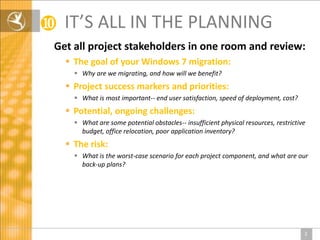
❿   IT’S ALL IN THE PLANNING
Get all project stakeholders in one room and review:
     The goal of your Windows 7 migration:
       Why are we migrating, and how will we benefit?
     Project success markers and priorities:
       What is most important-- end user satisfaction, speed of deployment, cost?
     Potential, ongoing challenges:
       What are some potential obstacles-- insufficient physical resources, restrictive
        budget, office relocation, poor application inventory?
     The risk:
       What is the worst-case scenario for each project component, and what are our
        back-up plans?


                                                                                       2
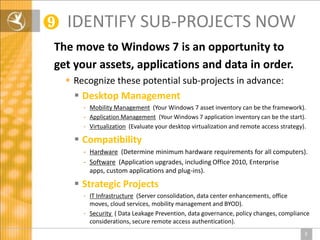
❾ IDENTIFY SUB-PROJECTS NOW
 The move to Windows 7 is an opportunity to
 get your assets, applications and data in order.
    Recognize these potential sub-projects in advance:
      Desktop Management
       - Mobility Management (Your Windows 7 asset inventory can be the framework).
       - Application Management (Your Windows 7 application inventory can be the start).
       - Virtualization (Evaluate your desktop virtualization and remote access strategy).

      Compatibility
       - Hardware (Determine minimum hardware requirements for all computers).
       - Software (Application upgrades, including Office 2010, Enterprise
         apps, custom applications and plug-ins).

      Strategic Projects
       - IT Infrastructure (Server consolidation, data center enhancements, office
         moves, cloud services, mobility management and BYOD).
       - Security ( Data Leakage Prevention, data governance, policy changes, compliance
         considerations, secure remote access authentication).
                                                                                         3
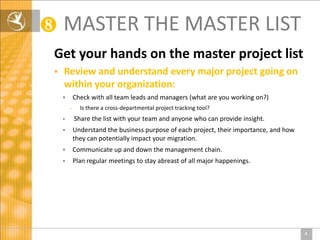
❽   MASTER THE MASTER LIST
Get your hands on the master project list
   Review and understand every major project going on
    within your organization:
           Check with all team leads and managers (what are you working on?)
        -     Is there a cross-departmental project tracking tool?
           Share the list with your team and anyone who can provide insight.
           Understand the business purpose of each project, their importance, and how
            they can potentially impact your migration.
           Communicate up and down the management chain.
           Plan regular meetings to stay abreast of all major happenings.


                                                                                         4
❼       TAKE ME TO YOUR LEADER
    Identify stakeholders, team leads, and PM’s
    for every project.
       Who understands and controls each given project?
         Hint: sometimes it’s engineers or trainers, not necessarily project managers or team leads.
         Introduce yourself, each other, and your projects. Explain why regular communication is
          imperative, and what you can do to help each other.

     Share your Project Plan – ask for theirs.
     Share project deliverables, important milestones, and
      communicate how each project might impact the other.
         Create a calendar for regular project updates.

       TALK TO EACH OTHER!


                                                                                                        5
❻       SEE IT FROM ALL ANGLES
    Understand the project scope and deliverables
    from all points of view.
       Know exactly how every decision will impact your:
         Project team
         Business and finance departments
         Compliance department
         Training and communications
         Helpdesk and support
         Senior executives
         Operations and human resources
         END USERS
       Ask detailed questions about the project impact from those different
        perspectives– get all departments/perspectives involved.


                                                                               6
❺ LEARN FROM YOUR MISTAKES
 Reflect on past projects and previous migrations
    What specific pain points affected your previous migration(s)?
      Desktop design and build
           - Were all the necessary applications included in your core computing platform?
           - Did you identify appropriate minimum hardware standards?
      Application management
           - Were all of your applications compatible with the new OS?
           - Did you leverage your application inventory as the start of an app management strategy?
      Training and communication
           - Did your users know what changes were coming, and why they were necessary?
           - Did your users know how to use the new OS upon day 1 of deployment?
      Desktop and end user migration
           - Did your users have the hardware necessary to fully leverage your OS migration?
           - Did you lose data during a pilot migration?

      Help desk and ongoing support
           - Was there enough floor support to address post-deployment end user problems?
           - Did you create a documented ticket escalation system for fast and efficient problem resolution?

    If you weren’t with your organization during the previous OS migration, find
     someone who was and review how each phase went and was perceived.

                                                                                                               7
❹       PLAN FOR PROBLEMS
    Always have Plans B and C– you’ll need them
       Start by assessing your risk
         What happens if this doesn’t go as planned? How does this impact – the project? The
          business? End users? Other projects?
         Always know what your risks are, and what impact worst-case scenarios will have.
       Understand interdependencies
         How does one project component affect another?
       Plan B and C can be your best friend
         Assume your best-laid plans won’t work. Having contingency plans will ensure that small
          hurdles don’t become major blockades.
       Weigh tolerance for discomfort (workarounds) vs. tolerance for delay
         What is your corporate culture, and what is most important to senior-level executives and
          your end users? Consider your organization’s priorities with every decision you make.
       TEST TEST TEST!
         The longer the pilot, the better. A 2-3 week pilot period with a cross-departmental/location
          reach will make for the least amount of problems upon rollout.


                                                                                                      8
❸ IDENTIFY POTENTIAL GOT-YA’S NOW
  Pinpoint possible sticking points before they arise.
     Some projects that affect deployment
       Upgrades to Desktop Management Tools
       Hardware Procurement
       Printer Upgrades
       Facilities/Operations Projects (moves, build outs, cabling, new apps)
       HR Events (hiring programs)

     Some projects that affect end users
       All of the above
       New Applications/Functionality
       Updated App/Asset request process
       Remote access changes
       Exchange Upgrade
       Desktop Virtualization


                                                                                9
❷       COMMUNICATION IS KEY!
    Effective and regular communication is the
    crux of every successful OS migration
       Communicate before you begin:
         Explain to users why the migration is occurring/how they’ll be impacted.
         Across departments to ensure that there are no upcoming projects that could potentially
          impact your migration.
         Talk to senior executives—find out likes and dislikes of the current IT infrastructure, what
          they’d like to see in a new OS, and what their priorities are.

       Communicate during your migration:
         Keep your users aware of all important activities that can potentially impact them.
         Across departments to report on any bumps in the road.
         With key executives to stay current on all major organizational events/changes.

       Communicate after your migration:
         Keep tabs on your users to make sure they don’t have any problems.
         With all divisions to ensure that a departmental issue doesn’t have a wide-reaching affect.
         To executives to ensure that everyone has what they need.

                                                                                                    10
❶       TALK TO EDEN
    We’ve got 10 years of OS migration experience
    under our belt, and we’ve seen it all…
       Meet with Eden’s founding partners for a free
        Executive Briefing and in as little as 30 minutes, we’ll:
         Assess your project and needs.
         Review the steps you’ve taken so far to make sure you haven’t overlooked anything.
         Offer a project roadmap that will keep you on track and help you avoid common got-ya’s.
         Show you how you can leverage your migration as the start of application, mobility and data
          management.

       SCHEDULE YOUR FREE EXECUTIVE BRIEFING:
         CALL TODAY: 212-273-3267
         EMAIL US: DDILLON@EDENTECHNOLOGIES.COM


                                                                                                    11
ABOUT EDEN TECHNOLOGIES
Eden Technologies is the northeast region’s premiere U.S.-based, enterprise-level IT consulting
and managed services provider. With 10 years’ experience, over 300,000 desktops deployed and
2,000 endpoints under management, Eden stands as the company of choice for over 300
organizations, in a wide range of industries including legal services, financial services,
manufacturing and health care.
For IT professionals facing a Windows 7 migration, Eden has developed fixed-priced, fixed-scope
Windows 7 migration “packages” that are easy to purchase and quick to deploy, with no-
nonsense results and ROI. With more than 17 flexible offerings, Eden provides fast, efficient, just-
where-you-need-it help. More information is available at http://www.edentechnologies.com/it-
consulting/windows-7.html.


                                                                                                 12

10 ways to keep your windows 7 migration on track

  • 1.
    10 Ways ToKeep Your Windows 7 Migration On Track Eden Technologies’ Carpe Windows 7 Series
  • 2.
    IT’S ALL IN THE PLANNING Get all project stakeholders in one room and review:  The goal of your Windows 7 migration:  Why are we migrating, and how will we benefit?  Project success markers and priorities:  What is most important-- end user satisfaction, speed of deployment, cost?  Potential, ongoing challenges:  What are some potential obstacles-- insufficient physical resources, restrictive budget, office relocation, poor application inventory?  The risk:  What is the worst-case scenario for each project component, and what are our back-up plans? 2
  • 3.
    ❾ IDENTIFY SUB-PROJECTSNOW The move to Windows 7 is an opportunity to get your assets, applications and data in order.  Recognize these potential sub-projects in advance:  Desktop Management - Mobility Management (Your Windows 7 asset inventory can be the framework). - Application Management (Your Windows 7 application inventory can be the start). - Virtualization (Evaluate your desktop virtualization and remote access strategy).  Compatibility - Hardware (Determine minimum hardware requirements for all computers). - Software (Application upgrades, including Office 2010, Enterprise apps, custom applications and plug-ins).  Strategic Projects - IT Infrastructure (Server consolidation, data center enhancements, office moves, cloud services, mobility management and BYOD). - Security ( Data Leakage Prevention, data governance, policy changes, compliance considerations, secure remote access authentication). 3
  • 4.
    MASTER THE MASTER LIST Get your hands on the master project list  Review and understand every major project going on within your organization:  Check with all team leads and managers (what are you working on?) - Is there a cross-departmental project tracking tool?  Share the list with your team and anyone who can provide insight.  Understand the business purpose of each project, their importance, and how they can potentially impact your migration.  Communicate up and down the management chain.  Plan regular meetings to stay abreast of all major happenings. 4
  • 5.
    TAKE ME TO YOUR LEADER Identify stakeholders, team leads, and PM’s for every project.  Who understands and controls each given project?  Hint: sometimes it’s engineers or trainers, not necessarily project managers or team leads.  Introduce yourself, each other, and your projects. Explain why regular communication is imperative, and what you can do to help each other.  Share your Project Plan – ask for theirs.  Share project deliverables, important milestones, and communicate how each project might impact the other.  Create a calendar for regular project updates.  TALK TO EACH OTHER! 5
  • 6.
    SEE IT FROM ALL ANGLES Understand the project scope and deliverables from all points of view.  Know exactly how every decision will impact your:  Project team  Business and finance departments  Compliance department  Training and communications  Helpdesk and support  Senior executives  Operations and human resources  END USERS  Ask detailed questions about the project impact from those different perspectives– get all departments/perspectives involved. 6
  • 7.
    ❺ LEARN FROMYOUR MISTAKES Reflect on past projects and previous migrations  What specific pain points affected your previous migration(s)?  Desktop design and build - Were all the necessary applications included in your core computing platform? - Did you identify appropriate minimum hardware standards?  Application management - Were all of your applications compatible with the new OS? - Did you leverage your application inventory as the start of an app management strategy?  Training and communication - Did your users know what changes were coming, and why they were necessary? - Did your users know how to use the new OS upon day 1 of deployment?  Desktop and end user migration - Did your users have the hardware necessary to fully leverage your OS migration? - Did you lose data during a pilot migration?  Help desk and ongoing support - Was there enough floor support to address post-deployment end user problems? - Did you create a documented ticket escalation system for fast and efficient problem resolution?  If you weren’t with your organization during the previous OS migration, find someone who was and review how each phase went and was perceived. 7
  • 8.
    PLAN FOR PROBLEMS Always have Plans B and C– you’ll need them  Start by assessing your risk  What happens if this doesn’t go as planned? How does this impact – the project? The business? End users? Other projects?  Always know what your risks are, and what impact worst-case scenarios will have.  Understand interdependencies  How does one project component affect another?  Plan B and C can be your best friend  Assume your best-laid plans won’t work. Having contingency plans will ensure that small hurdles don’t become major blockades.  Weigh tolerance for discomfort (workarounds) vs. tolerance for delay  What is your corporate culture, and what is most important to senior-level executives and your end users? Consider your organization’s priorities with every decision you make.  TEST TEST TEST!  The longer the pilot, the better. A 2-3 week pilot period with a cross-departmental/location reach will make for the least amount of problems upon rollout. 8
  • 9.
    ❸ IDENTIFY POTENTIALGOT-YA’S NOW Pinpoint possible sticking points before they arise.  Some projects that affect deployment  Upgrades to Desktop Management Tools  Hardware Procurement  Printer Upgrades  Facilities/Operations Projects (moves, build outs, cabling, new apps)  HR Events (hiring programs)  Some projects that affect end users  All of the above  New Applications/Functionality  Updated App/Asset request process  Remote access changes  Exchange Upgrade  Desktop Virtualization 9
  • 10.
    COMMUNICATION IS KEY! Effective and regular communication is the crux of every successful OS migration  Communicate before you begin:  Explain to users why the migration is occurring/how they’ll be impacted.  Across departments to ensure that there are no upcoming projects that could potentially impact your migration.  Talk to senior executives—find out likes and dislikes of the current IT infrastructure, what they’d like to see in a new OS, and what their priorities are.  Communicate during your migration:  Keep your users aware of all important activities that can potentially impact them.  Across departments to report on any bumps in the road.  With key executives to stay current on all major organizational events/changes.  Communicate after your migration:  Keep tabs on your users to make sure they don’t have any problems.  With all divisions to ensure that a departmental issue doesn’t have a wide-reaching affect.  To executives to ensure that everyone has what they need. 10
  • 11.
    TALK TO EDEN We’ve got 10 years of OS migration experience under our belt, and we’ve seen it all…  Meet with Eden’s founding partners for a free Executive Briefing and in as little as 30 minutes, we’ll:  Assess your project and needs.  Review the steps you’ve taken so far to make sure you haven’t overlooked anything.  Offer a project roadmap that will keep you on track and help you avoid common got-ya’s.  Show you how you can leverage your migration as the start of application, mobility and data management.  SCHEDULE YOUR FREE EXECUTIVE BRIEFING:  CALL TODAY: 212-273-3267  EMAIL US: DDILLON@EDENTECHNOLOGIES.COM 11
  • 12.
    ABOUT EDEN TECHNOLOGIES EdenTechnologies is the northeast region’s premiere U.S.-based, enterprise-level IT consulting and managed services provider. With 10 years’ experience, over 300,000 desktops deployed and 2,000 endpoints under management, Eden stands as the company of choice for over 300 organizations, in a wide range of industries including legal services, financial services, manufacturing and health care. For IT professionals facing a Windows 7 migration, Eden has developed fixed-priced, fixed-scope Windows 7 migration “packages” that are easy to purchase and quick to deploy, with no- nonsense results and ROI. With more than 17 flexible offerings, Eden provides fast, efficient, just- where-you-need-it help. More information is available at http://www.edentechnologies.com/it- consulting/windows-7.html. 12