’s of Science

Kimberly Graf
July 15, 2012
  ELED 412
A
Assessing the Science Curriculum

It is essential that teachers monitor and assess
students’ understanding of concepts and skills on a
regular, consistent basis and use this information to
adjust instruction.
       Develop brochures
       Verbal reports
       Story writing
       Concept maps
       Put on a skit
       Create models or drawings
       Essays
B
Bloom’s Taxonomy for Science
• Teacher’s can guide students at various levels of
  development to observe events; and through
  questioning, teachers can help students develop
  high-order thinking skills.
     Knowledge
       -Recall of factual information
     Comprehension
       -Communicate an idea in a different form
     Application
       -Use what is known to find new solutions or apply in new situations
     Analysis
        -Break things & ideas down into component parts & find their unique characteristics
     Synthesis
        -Use what is known to think creatively & divergently; make something new or original;
         pattern ideas or things in a new way
     Evaluation
        -Use what is known to make judgments & ratings; accept or reject ideas; determine
         the worthiness of an idea or thing
C
Cell Structure & Function
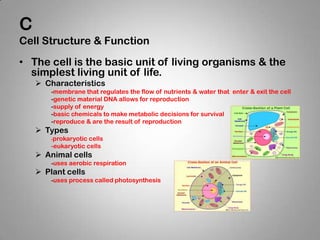
• The cell is the basic unit of living organisms & the
  simplest living unit of life.
     Characteristics
        -membrane that regulates the flow of nutrients & water that enter & exit the cell
        -genetic material DNA allows for reproduction
        -supply of energy
        -basic chemicals to make metabolic decisions for survival
        -reproduce & are the result of reproduction
     Types
        -prokaryotic cells
        -eukaryotic cells
     Animal cells
        -uses aerobic respiration
     Plant cells
        -uses process called photosynthesis
D
DNA

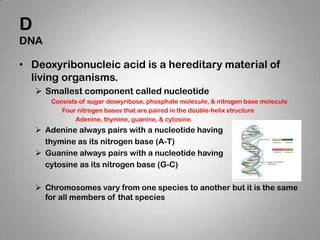
• Deoxyribonucleic acid is a hereditary material of
  living organisms.
     Smallest component called nucleotide
        Consists of sugar deoxyribose, phosphate molecule, & nitrogen base molecule
           Four nitrogen bases that are paired in the double-helix structure
               Adenine, thymine, guanine, & cytosine.
     Adenine always pairs with a nucleotide having
      thymine as its nitrogen base (A-T)
     Guanine always pairs with a nucleotide having
      cytosine as its nitrogen base (G-C)

     Chromosomes vary from one species to another but it is the same
      for all members of that species
E
Energy

• Energy is available in many forms:
     Kinetic
       -ability to move
     Potential
       -energy that an object has as the result of its position
     Activation
       -transfer potential energy into kinetic energy
     Heat transfer
       -conduction, radiation, & convection
     Light
       -travels in waves & in a straight-line path
     Sound
       -travels in waves & caused by vibrations
F
Five (5-E) Model of Science Teaching

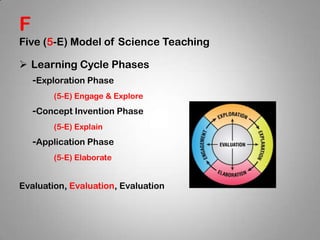
 Learning Cycle Phases
  -Exploration Phase
        (5-E) Engage & Explore
    -Concept Invention Phase
        (5-E) Explain
    -Application Phase
        (5-E) Elaborate


Evaluation, Evaluation, Evaluation
G
Gravity & other universal forces
• Universal forces include gravity, electricity, & magnetism.
     Magnetism is the force of attraction or repulsion between objects
      that results from the positive & negative ionic charges of the
      objects.
          -Objects are metals, such as iron, nickel, & cobalt
     Gravity is the force of attraction that exists between objects.
        -Gravity keeps the Earth in its orbit by establishing a balance between the
           attraction of the sun and the speed at which the Earth travels around it.
     Force is defined as the action of moving an object by pulling or
      pushing.
     Newton’s laws of motion
       -1st law called inertia meaning an object at rest will remain at rest
             & an object in motion will stay in motion.
       -2 nd law is that acceleration is produced when a force acts on

             mass.
       -3 rd law is that for every action there is an equal and opposite

             reaction.
H
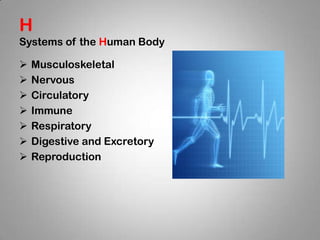
Systems of the Human Body

   Musculoskeletal
   Nervous
   Circulatory
   Immune
   Respiratory
   Digestive and Excretory
   Reproduction
I
Inner Core

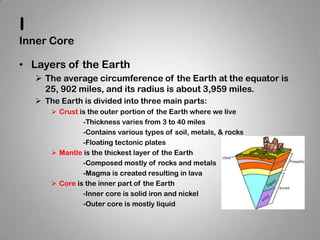
• Layers of the Earth
     The average circumference of the Earth at the equator is
      25, 902 miles, and its radius is about 3,959 miles.
     The Earth is divided into three main parts:
         Crust is the outer portion of the Earth where we live
                 -Thickness varies from 3 to 40 miles
                 -Contains various types of soil, metals, & rocks
                 -Floating tectonic plates
         Mantle is the thickest layer of the Earth
                 -Composed mostly of rocks and metals
                 -Magma is created resulting in lava
         Core is the inner part of the Earth
                 -Inner core is solid iron and nickel
                 -Outer core is mostly liquid
J
Jewelry
Minerals are the most common form of solid material found
in the Earth’s crust. It has never been a part of any living
organism. They can be soft or hard.
 Things we use minerals for:
    Jewelry
      Gemstones such as amethysts, opals, diamonds, emeralds, topazes, &
      garnets are examples of minerals commonly used to create jewelry.
    Construction
      Gypsum boards (drywall) are made of a mineral of the same name-
      gypsum. The windows in homes are made from another mineral,
    Personal Use
      Talc is the softest mineral and it is commonly applied to the body in
      powder form.
K
Kingdoms

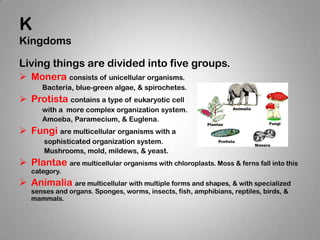
Living things are divided into five groups.
 Monera consists of unicellular organisms.
      Bacteria, blue-green algae, & spirochetes.
 Protista contains a type of eukaryotic cell
      with a more complex organization system.
      Amoeba, Paramecium, & Euglena.
 Fungi are multicellular organisms with a
       sophisticated organization system.
       Mushrooms, mold, mildews, & yeast.
 Plantae are multicellular organisms with chloroplasts. Moss & ferns fall into this
   category.
 Animalia are multicellular with multiple forms and shapes, & with specialized
   senses and organs. Sponges, worms, insects, fish, amphibians, reptiles, birds, &
   mammals.
L
Laboratory Safety
 Use appropriate protective gear.
 Use appropriate procedures for cleaning and disposing of
  materials.
 Substitute less hazardous equivalent materials when possible.
 Use polyethylene or metal containers in place of glass.
 Label containers appropriately.
 Control the use of sharp objects.
 Supervise the use of living organisms and the cleaning of
  instruments.
 Use a safety contract requiring parent/guardian signature.
 Prepare and practice an emergency plan with students.
 Document all accidents.
 Science requires the use of standard measuring devices to be
    sure that the information is clear, accurate, & able to be
               replicated in experimental settings.
M
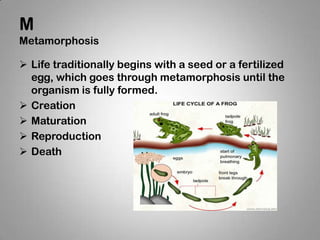
Metamorphosis

 Life traditionally begins with a seed or a fertilized
  egg, which goes through metamorphosis until the
  organism is fully formed.
 Creation
 Maturation
 Reproduction
 Death
N
FitNess

 A significant impact of science on daily life relates
  to student fitness and health.
 Science has brought society many advantages that
  have served to increase health and longevity of
  humans, and to improve the quality of life for all.
 Students need to learn about factors that impact
  physical and psychological health and about how to
  make good choices when it comes to nutrition,
  hygiene, physical exercise, smoking, drugs, &
  alcohol.
O
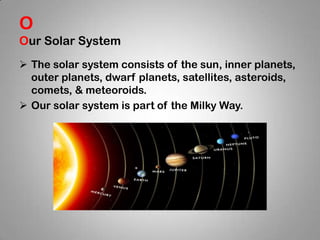
Our Solar System
 The solar system consists of the sun, inner planets,
  outer planets, dwarf planets, satellites, asteroids,
  comets, & meteoroids.
 Our solar system is part of the Milky Way.
P
Planning & Implementing Scientific Inquiry

Scientific inquiry is promoted through students
engaging in hands-on activities & experimentations.
                 Science Thinking Skills
 Observing: using the senses to get information.
 Communicating: talking, drawing, & acting.
 Comparing: pairing & one to one correspondence.
 Organizing: grouping, seriating, & sequencing.
 Relating: cause & effect & classification.
 Inferring: super-ordinate/subordinate classification, if/then
              reasoning, & developing scientific laws.
 Applying: developing strategic plans and inventing.
Q
Questions


               Very Important Process
  Questioning is the hallmark of science inquiry and
  should be used throughout the inquiry instruction.
  It must be designed to lead students toward being
              able to state the concept.
R
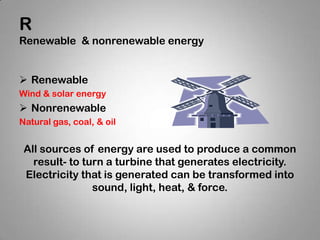
Renewable & nonrenewable energy


 Renewable
Wind & solar energy
 Nonrenewable
Natural gas, coal, & oil


 All sources of energy are used to produce a common
   result- to turn a turbine that generates electricity.
 Electricity that is generated can be transformed into
                sound, light, heat, & force.
S
Survival

 Genetics plays an important role in the ability of organisms
    to be able to survive and thrive in their environment.
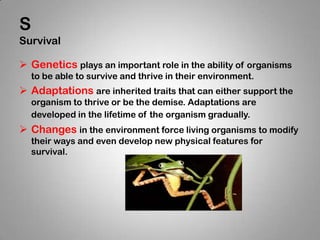
 Adaptations are inherited traits that can either support the
    organism to thrive or be the demise. Adaptations are
    developed in the lifetime of the organism gradually.
 Changes in the environment force living organisms to modify
    their ways and even develop new physical features for
    survival.
T
Tilt

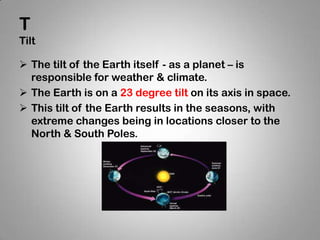
 The tilt of the Earth itself - as a planet – is
  responsible for weather & climate.
 The Earth is on a 23 degree tilt on its axis in space.
 This tilt of the Earth results in the seasons, with
  extreme changes being in locations closer to the
  North & South Poles.
U
Unifying Concepts & Processes in Science
 Science is a way of knowing, a process – it is a
  systematic way of looking at the world and how it
  works.
 Science embraces a broad spectrum of subject
  matter:
      Life science
             Physical science
                   Earth science
 Regardless of location on earth they share unifying
  components & characteristics. Teachers must
  understand this unity.
V
Volcanoes


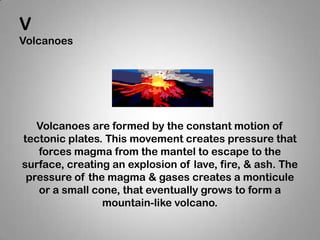
   Volcanoes are formed by the constant motion of
tectonic plates. This movement creates pressure that
   forces magma from the mantel to escape to the
surface, creating an explosion of lave, fire, & ash. The
 pressure of the magma & gases creates a monticule
   or a small cone, that eventually grows to form a
                mountain-like volcano.
W
Weathering

 Weathering is the process of breaking down rocks,
  soils, & minerals through natural, chemical, &
  biological processes.
     Exfoliation
             Desert (high temperatures), expands
             then contracts, stress causes outer
             layers of rock to peel off.
     Freeze-thaw
             Water in rock joints, freezes & expands
             breaking the rock.
X
GalaXies


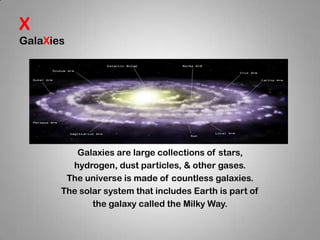
          Galaxies are large collections of stars,
         hydrogen, dust particles, & other gases.
        The universe is made of countless galaxies.
       The solar system that includes Earth is part of
              the galaxy called the Milky Way.
Y
HumiditY
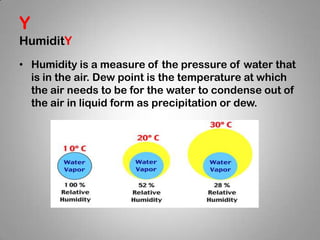
• Humidity is a measure of the pressure of water that
  is in the air. Dew point is the temperature at which
  the air needs to be for the water to condense out of
  the air in liquid form as precipitation or dew.
Z
Zr
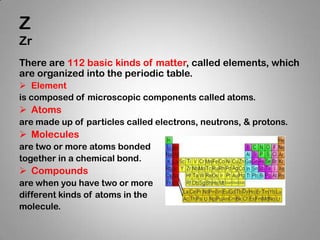
There are 112 basic kinds of matter, called elements, which
are organized into the periodic table.
 Element
is composed of microscopic components called atoms.
 Atoms
are made up of particles called electrons, neutrons, & protons.
 Molecules
are two or more atoms bonded
together in a chemical bond.
 Compounds
are when you have two or more
different kinds of atoms in the
molecule.
Citations

   "Google Advanced Image Search." Google Advanced Image Search. N.p., n.d. Web. 15
    July 2012. <http://images.google.com/advanced_image_search?hl=en>.

   Rosado, Ed.D., Luis A. "Science." The Best Teachers' Test Preparation for the TExes 191
    Generalist EC-6. Piscataway: Research & Education Association, 2010. 261-328. Print.

   "Clip Art." - Word. N.p., n.d. Web. 15 July 2012. <http://office.microsoft.com/en-us/word-
    help/CH010174625.aspx>.