FULL LENGTH ARTICLE
The use of sewage sludge in the production of
ceramic floor tiles
Sh.K. Amin a,*, E.M. Abdel Hamid b
, S.A. El-Sherbiny b
, H.A. Sibak b
, M.F. Abadir b
a
Chemical Engineering and Pilot Plant Department, Engineering Research Division, National Research Centre, Giza, Egypt
b
Chemical Engineering Department, Faculty of Engineering, Cairo University, Egypt
Received 21 August 2016; revised 18 January 2017; accepted 6 February 2017
KEYWORDS
Sewage sludge;
Ceramic;
Floor tiles;
Standards
Abstract Scientists proved that municipal sewage sludge contains many dangerous pathogens,
toxic heavy metals, endocrine disruptors, drains, storm water runoff, hospitals, and industrial
plants. Sewage sludge represents an extremely high ecological hazard to the environment. Due to
the increasing amount of sludge generated from the wastewater treatments plants a strong demand
for environmentally and effective safe reuse has arisen. One potential use of that waste is its incor-
poration in the production of ceramic tiles. The main aim of present work was to study the possi-
bility of usage of this hazardous waste in floor ceramic tiles industry. A dried sludge waste was
added in percentages from 5% up to 35% to a standard floor tile mix, molded, pressed uniaxially
at 30 MPa and then fired at temperatures reaching 1150 °C for 15 min soaking time. The properties
of both green and fired tiles were investigated as function of percent waste added. The vitrification
parameters, which are linear firing shrinkage, water absorption, apparent porosity, and mechanical
property, were determined and compared with ISO standards. Fired samples of the proposed mix-
tures were investigated by scanning electron microscope (SEM). It was possible to obtain tiles that
abided by ISO standards for maximum addition of 7% sludge fired at 1150 °C (for water absorp-
tion < 10%), and 10% sludge or 5% sludge for tiles fired at 1150 °C and 1100 °C, respectively (for
water absorption > 10%), which are recommended for both their economic and environmental
benefits.
Ó 2017 Housing and Building National Research Center. Production and hosting by Elsevier B.V. This is
an open access article under the CC BY-NC-ND license (http://creativecommons.org/licenses/by-nc-nd/4.0/).
* Corresponding author at: Chemical Engineering and Pilot Plant Department, Engineering Research Division, National Research Centre, 33 El
Bohouth St. (Former El Tahrir St.), PO box 12622, Dokki, Giza, Egypt. Affiliation ID: 60014618. Fax: +20 2 33370931.
E-mail addresses: dr.shereenkamel@hotmail.com, sheren51078@yahoo.com (S.K. Amin).
Peer review under responsibility of Housing and Building National Research Center.
Production and hosting by Elsevier
HBRC Journal (2018) 14, 309–315
Housing and Building National Research Center
HBRC Journal
http://ees.elsevier.com/hbrcj
http://dx.doi.org/10.1016/j.hbrcj.2017.02.002
1687-4048 Ó 2017 Housing and Building National Research Center. Production and hosting by Elsevier B.V.
This is an open access article under the CC BY-NC-ND license (http://creativecommons.org/licenses/by-nc-nd/4.0/).
Introduction
Sanitary landfills are commonly used for disposal of sewage
sludge and rapid urbanization and it is difficult to find any
suitable landfill sites so that incineration has become one of
the few alternatives available for disposal sewage sludge [1].
In a comprehensive review, Donatello and Cheeseman [2]
have enumerated actual and potential uses of incinerated sew-
age sludge ash (ISSA). These included, among other uses, their
inclusion in mixes in the brick, tile and paving industry, man-
ufacture of light weight aggregate, glass ceramics, and partial
substitute for cement, beside applications related to their high
phosphate content.
In the clay brick industry, an early work was conducted by
Tay [3] who noticed a slight regular decrease in compressive
strength following addition of ISSA. The same trend was
observed later by Trauner [4] although the drop in compressive
strength on adding 30% ISSA was spectacular. It was con-
cluded that the effect of using ISSA in clay bricks preparation
depends mainly on the chemical composition of the waste, so
that no general trend could be established [5]. A limited num-
ber of studies addressed the use of ISSA as substitute for clay
in the manufacture of ceramic tiles. Jordán et al. [6] investi-
gated the substitution of clay by sewage sludge in different pro-
portions not exceeding 10% in a ceramic wall tile body. They
could not find any clear relation between the values of linear
contraction and the percentage of sludge. However, the
increase in water absorption with the increase in the sludge
percentage was clear. On the other hand, the addition of sludge
gave rise to a decrease in the bending strength. Göl [7] investi-
gated the use of the marine sludge as additives in production of
ceramic tiles. The results of his work indicated that blending
marine sludge into the ceramic powder mixtures in the 20–
50% range was beneficial for tile production. On the other
hand, Baruzzo et al. [8] studied samples using not only dredg-
ing spoils alone, but also mixtures with other waste materials
such as bottom ashes from an incinerator of municipal solid
waste, incinerated sewage sludge from a municipal sewage
treatment plant and steelworks slag. They concluded that the
firing shrinkage was too high for the production of tiles. Also,
Montero et al. [9] investigated the effect of the addition of mar-
ble sludge and urban sewage sludge in different proportions to
clay in a ceramic body. They deduced that incorporation of
these residues has to be limited due to increase in water
absorption and decrease in the bending strength.
In the present work, sewage sludge was taken from the resi-
due of a municipal water plant located in Eastern Cairo and
added in various proportions to ceramic floor tile mixes in a
contribution to limiting their harmful environmental effect
and at the same time realizing a positive economic benefit by
decreasing the amount of clay in the mixes.
Materials and methods
Raw materials characterization
Two components were used. First, the raw mix was used to
manufacture ceramic floor tile bodies (supplied by Ceramica
Royal Company located in a Cairo suburb) the composition
of which is displayed in Table 1, and the sewage sludge that
was collected form a municipal treatment plant located in
Eastern Cairo. It was dried at 110 °C for 24 h in a muffle dryer
before usage.
The mineralogical composition of both materials was
assessed using X-ray diffraction Brukur D8 advanced comput-
erized X-ray diffractometer apparatus with mono-chromatized
Cu Ka radiation, operated at 40 kV and 40 mA.
On the other hand, chemical composition was determined
using X-ray fluorescence technique type. The used machine
was Axios, panalytical 2005, wavelength dispersive (WD–
XRF) sequential spectrometer.
Thermal analyses (TGA – DTG – DTA) were performed on
both materials using Netzsch STA 409 C/CD apparatus at a
heating rate of 10 °C/min. Runs were performed in air.
The grain size distribution was determined according to the
standard sieving procedure described by ASTM D 422 [10].
Finally, the powder densities of basic mixture of floor tiles
(raw mix) and sludge waste were measured using the standard
Pycnometer method (density flask). This method is a very pre-
cise procedure for determining the density of powders, gran-
ules and dispersions that have poor flowability characteristics
[11].
Samples preparation
The dried unfired sludge was blended in different proportions
(up to 35% by weight) with the basic mixture powder in a lab-
oratory horizontal tumbler for two hours. The plasticity of the
different blends was determined using the Pfefferkorn method
[12].
Rectangular tile specimens of approximate dimensions of
110.4  55.4  8 mm3
were prepared from the blends by dry
pressing using automatically laboratory hydraulic press under
uniaxial pressure of 30 MPa and 5% water. Tile specimens
were then dried on a laboratory dryer for 24 h at (110 ± 5) °C.
The following properties for green dried samples were
determined: Linear drying shrinkage and dry modulus of rup-
ture. Each sample consisted of three specimens and the average
value was calculated.
Samples were then fired in a laboratory muffle furnace fol-
lowing a programmed schedule that takes into account the
evolution water from the dehydroxylation of kaolinite by fix-
ing the temperature at 750 °C for 30 min. The maximum tem-
peratures attained had varied from 1050 °C to 1150 °C with a
soaking time of 15 min to simulate fast firing conditions.
The following tests were performed to determine the char-
acteristics of fired samples: Percent of linear firing shrinkage
[13], percent of water absorption and apparent porosity [14],
breaking strength and modulus of rupture [15]. SEM was also
used to provide micrographs of some chosen sections. The
used SEM apparatus was of type JEOL–JSM 6510 apparatus
with maximum zoom magnification power = 300,000.
Table 1 Raw mix tile body composition.
Raw materials Source wt%
Ball clay Aswan (upper Egypt) 35
Aswan clay Aswan 25
Bentonite Burg El – Arab, Alexandria 2
Potash feldspar Eastern desert 28
Glass sand Zaafarana, Suez Gulf 10
310 S.K. Amin et al.
Results and discussions
Raw materials characterization
The XRF results for both raw materials are shown in Table 2.
The high value of LOI for sewage sludge is due to its ele-
vated organic matter content, while most LOI for raw mix is
due to de-hydroxylation and water releasing of clay.
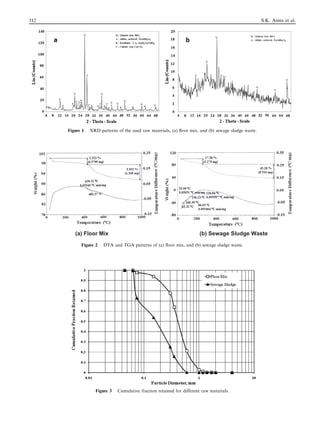
On the other hand, XRD analysis has shown that the main
phases constituting the raw mix were as follows (Fig. 1):
quartz, albite, kaolinite and calcite. The XRD analysis of
sludge displayed low crystallinity and only two phases were
obtained: quartz and albite.
Thermal analyses of both materials disclosed the following
information (Fig. 2a and b): In Fig. 2-a there is a slight early
decrease in weight due to elimination of physical water fol-
lowed by a small exothermic peak at about 425 °C due to oxi-
dation of organic impurities. An extended endothermic peak
follows at about 485 °C presumably due to loss of lattice water
of clays present in the raw mix that is practically completed at
about 650 °C. The percent weight loss accompanying that step
(about 6%) fairly agrees with the expected theoretical loss of
6.19% (Table 1).
Fig. 2-b displays the TG – DTA patterns for the used
sludge. Owing to the absence of any decomposable compounds
except for organic components, there were no definite peaks on
the graph. The endothermic peaks encountered below 136 °C
are probably due to evaporation of physical water. This
accounts for about 17.4% of the floor mix. A larger weight loss
can be seen starting at about 260 °C and practically ending at
about 500 °C associated with oxidation of organic compounds
and accounting for more than 40% of the weight loss over that
range. Above 500 °C, there is a slight gradual loss reaching 5%
at 1000 °C. The overall loss in weight = 62.66% matches with
the measured percent loss on ignition of 65% given in Table 1.
The screen analyses of raw materials (Fig. 3) have shown
that dried sewage sludge is much finer than the raw mix. The
median diameter of the former was 0.13 mm compared to
0.42 mm for the latter.
The powder density of floor tiles mix and sewage sludge
waste is 1.73 and 0.92 g/cm3
, respectively. It appears that the
density of tile mix is significantly higher than that of waste
sludge. This is related to the nature of the organic components
in sludge which have lower densities than their inorganic coun-
terparts present in tile mix.
Characteristics of unfired mixes
Effect of addition of sludge on the plasticity of mixes
The plasticity of the studied tile mixes of different proportions
of sludge was determined using the Pfefferkorn apparatus. The
final results illustrating the effect of waste addition on plastic-
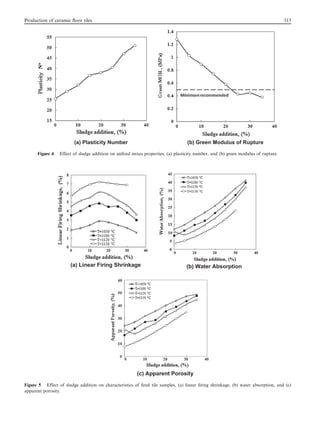
ity are shown in Fig. 4-a. There is an almost linear increase in
plasticity with the addition of sludge. The plasticity number
was practically doubled when the percent sludge was increased
from 0% to 35%. This can be understood in light of the dual
effect of finer particle size and organic matter on plasticity [16].
Effect of addition of sludge on the percent linear drying
shrinkage
Since the moisture content used (5%) is lower than the critical
moisture content of ceramic–water mixtures, which usually
ranges from 10% to 30% [17], then, there will be no shrinkage
for as much as 35% sludge addition [18].
Effect of addition of sludge on the green strength
Although the green strength is by no means a standard require-
ment of ceramic tiles, it nevertheless affects the proportion of
rejected dry tiles due to losses on handling. There is no recom-
mended figure for green strength (or alternatively, modulus of
rupture) although values of MOR lower than 0.5 MPa are
commonly associated with minor losses on handling. It
appears from Fig. 4-b that there is a steady decrease in bending
strength on adding sludge. One possible reason is the low dry-
ing shrinkage associated with adding sludge, as it is known
that shrinkage imparts more cohesive character to the mix. It
hence appears that the recommended percentage of sludge
addition should be less than 20% to avoid serious losses on
handling.
Characteristics of fired tile samples
Effect of addition of the sludge on linear firing shrinkage
Fig. 5-a displays the effect of sludge addition on linear firing
shrinkage. While increasing the firing temperature had a pre-
dictable effect of increasing shrinkage, the effect of adding
sludge was insignificant at all firing temperatures. The main
reason for shrinkage is the elevated amount of feldspar in
the original mix which, by lowering vitrification temperature
enhances liquid phase sintering [19]. As the percentage of
sludge is increased there is a subsequent decrease in raw mix,
meaningless feldspar. This could explain the decrease in
shrinkage observed in all curves when the level of sludge
exceeds 15%. It is to be noted that all samples resulted in fired
tiles of thickness lower than 7.5 mm owing to firing shrinkage.
Effect of addition of the sludge on water absorption
Water absorption is a main property to be considered when
characterizing ceramic tiles of any type. Its percentage reveals
the open porosity of the tile that reflects the degree of vitrifica-
tion. According to the International Standard [19], ceramic
tiles are classified as either having percent water absorption
higher than 10% or lying between 6% and 10%. Floor tiles
Table 2 Chemical analysis of the used raw materials (by wt
%).
Elemental oxides Floor mix Sewage sludge
SiO2 58.53 9.46
Al2O3 22.97 2.62
Fe2O3
tot.
3.68 5.73
TiO2 1.06 0.54
MgO 1.4 0.87
CaO 1.34 6.02
Na2O 2.59 0.31
K2O 1.37 0.53
P2O5 0.21 3.81
SO3 0.41 4.06
Minor oxides 0.404 1.381
L.O.I 6.19 65.00
Total 100.154 100.331
Production of ceramic floor tiles 311
Figure 1 XRD patterns of the used raw materials, (a) floor mix, and (b) sewage sludge waste.
(a) Floor Mix (b) Sewage Sludge Waste
Figure 2 DTA and TGA patterns of (a) floor mix, and (b) sewage sludge waste.
Figure 3 Cumulative fraction retained for different raw materials.
312 S.K. Amin et al.
(a) Plasticity Number (b) Green Modulus of Rupture
Figure 4 Effect of sludge addition on unfired mixes properties, (a) plasticity number, and (b) green modulus of rupture.
Figure 5 Effect of sludge addition on characteristics of fired tile samples, (a) linear firing shrinkage, (b) water absorption, and (c)
apparent porosity.
Production of ceramic floor tiles 313
usually lie in the latter category [20] although cheap articles
commonly have absorption values  10%. As can be seen
from Fig. 5-b, it is clear that water absorption is strongly
affected by the presence of waste, its values reaching 40%
for high level of sludge addition. To abide by ISO standard
for water absorption  10%, it is necessary to add no more
than 15% waste and fire at 1150 °C. If the tiles are categorized
as having a water absorption  10%, then more waste can be
added and lower firing temperatures can be used.
Effect of addition of the sludge on apparent porosity
This property is not a standard requirement although it is
indicative of the percentage of open pores and hence extent
of vitrification in more direct way than water absorption, to
which it is strongly related. As expected, in case of floor tiles,
adding waste caused an increase in open pores following oxi-
dation of organic components present in waste as can be
shown in Fig. 5-c. The SEM micrograph of the surface of a
transversal section in a tile containing 15% sludge fired at
1150 °C is shown in Fig. 6. It indicates a clear reduction in
porosity owing to the apparent glassy phase that has been
formed [21].
Effect of addition of the sludge on mechanical strength
According to the International Standard [20], the mechanical
strength of ceramic tiles has to be formulated as two values:
The breaking strength and the modulus of rupture. The mini-
mum values of breaking strengths and MOR are related to the
tile thickness as shown in Table 3.
The effect of adding waste to floor tiles mix on mechanical
properties was established as being one of the most important
properties governing the viability of using the tiles. In this
respect, the breaking strength and the modulus of rupture
serve to assess the mechanical strength of the tile body. Other
properties such as abrasion resistance and skid resistance are
concerned with the finished glazed surface rather than the
body are were not consequently considered in this work. Actu-
ally, breaking strength and modulus of rupture are closely
Figure 6 SEM micrograph of a specimen containing 15% waste
fired at 1150 °C (1600).
Table 3 Minimum permissible values for breaking strength and MOR [20].
Thickness  7.5 mm Thickness  7.5 mm
6%  WA  10% WA  10% 6%  WA  10% WA  10%
Breaking strength, (N) 500 200 800 600
MOR, N/mm2
(MPa) Minimum 18 15 Minimum 18 12
Individual minimum 16 Individual minimum 16
Figure 7 Effect of sludge addition on mechanical strength, (a) breaking strength, and (b) modulus of rupture.
314 S.K. Amin et al.
related as can be seen in Fig. 7-a and -b. Values of breaking
strength and MOR for floor tiles displayed in the aforemen-
tioned figures show that for floor tiles of thickness  7.5 mm
and water absorption  10%, the minimum breaking strength
of 500 N was achieved for tiles fired at 1150 °C and containing
less than 7% waste. For water absorption higher than 10% the
permissible waste percent can reach 10% or 5% for tiles fired
at 1150 °C and 1100 °C respectively. As for thick tiles, any
addition of waste makes the breaking strength drop below
the minimum standard value of 600 N.
Conclusions
Dried sewage sludge was mixed with a standard mix of ceramic
floor tiles at percentages reaching 35%, molded and pressed
uniaxially at 30 MPa. Firing was performed for a soaking per-
iod of 15 min to simulate industrial fast firing conditions. It
was possible to obtain tiles of thickness around 7.5 mm that
abided by standards for maximum addition of 7% sludge fired
at 1150 °C (for water absorption  10%), and 10% sludge or
5% sludge for tiles fired at 1150 °C and 1100 °C, respectively
(for water absorption  10%).
Conflict of interest
None declared.
References
[1] J. Baeyens, F.V. Puyvelde, Fluidized bed incineration of sewage
sludge: a strategy for the design of the incinerator and the future
for incinerator ash utilization, J. Hazard. Mater. 37 (1) (1994)
179–190.
[2] S. Donatello, C.R. Cheeseman, Recycling and recovery routes
for incinerated sewage sludge ash (ISSA), Waste Manage. 33
(2013) 2328–2340.
[3] J.H. Tay, Bricks manufacture from sludge slime, J. Environ.
Eng. 113 (1987) 278–286.
[4] E.J. Trauner, Sludge ash bricks fired to above and below ash-
vitrifying temperature, J. Environ. Eng. Div. ASCE 119 (1991)
506–519.
[5] B. Wiesbusch, M. Ozaki, H. Watanabe, C.F. Seyfried,
Assessment of leaching tests on construction materials made of
incinerator ash (sewage sludge): investigations in Japan and
Germany, Water Sci. Technol. 38 (1998) 195–205.
[6] M.M. Jordán, M.B. Almendro-Candel, M. Romero, J.M.
Rincón, Application of sewage sludge in the manufacturing of
ceramic tile bodies, Appl. Clay Sci. 30 (3–4) (2005) 219–224.
[7] C. Göl, Production of ceramic tiles by using marine sludge
additives MSc. Thesis, IZTECH, Turkey, 2006.
[8] D. Baruzzo, D. Minicelli, S. Bruckner, L. Fedrizzi, A.
Bachiorrini, S. Maschio, Possible production of ceramic tiles
from marine dredging spoils alone and mixed with other waste
materials, J. Hazard. Mater. 134 (1–3) (2006) 202–210.
[9] M.A. Montero, M.M. Jordán, M.S. Hernández-Crespo, T.
Sanfeliu, The use of sewage sludge and marble residues in the
manufacture of ceramic tile bodies, J. Appl. Clay Sci. 46 (2009)
404–408.
[10] ASTM D 422/1963 (Reapproved 2007), Method for particle–size
analysis of soils, ASTM Annual book, U.S.A., 4(8), 2016.
[11] ASTM B 311/2013, Standard test method for density of powder
metallurgy (pm) materials containing less than two percent
porosity, ASTM Annual book, U.S.A., 2(5), 2016.
[12] F.A. De-Andrade, H.A. Al-Qureishi, D. Hotza, Measuring and
modeling the plasticity of clays, Mater. Res. 13 (3) (2010) 395–
399.
[13] ASTM C 326/2009 (Reapproved 2014), Standard test method
for drying and firing shrinkages of ceramic white–ware clays,
ASTM Annual book, U.S.A., 15(2), 2016.
[14] ASTM C 373/2014, Standard test method for water absorption,
bulk density, apparent porosity, and apparent specific gravity of
fired white ware products, ASTM Annual book, U.S.A., 15(2),
2016.
[15] ISO 10545 – 4 / 2014, Ceramic Tiles – Part 4: Determination of
Modulus of Rupture and Breaking Strength, International
Organization for Standardization (ISO), Geneva, 2014, pp. 1–
16.
[16] M.F. Abadir, O.A. Ibrahim, E.H.H. Sersy, A new proposed
method for the estimation of the plasticity of clay pastes,
Silicates Ind. 69 (9) (2004) 55–60.
[17] W.E. Worrall, Ceramic Raw Materials, second ed., Pergamum
Press, 1982, pp. 61–72.
[18] A.S. Mujumdar, A.S. Menon, Handbook of Industrial Drying –
Drying of Solids, second ed., Marcel Dekker, New York, 1995,
pp. 1–46.
[19] J. Martı́n-Márquez, J.M. Rincón, M. Romero, Effect of firing
temperature on sintering of porcelain stoneware tiles, Ceram.
Int. 34 (2008) 1867–1873.
[20] ISO 13006 / 2012, Ceramic Tiles – Definitions, Classification,
Characteristics and Marking, Annex K and L, International
Organization for Standardization (ISO), Geneva, 2012, pp. 38–43.
[21] J.M. Pérez, J.M. Rincón, M. Romero, Effect of moulding
pressure on microstructure and technological properties of
porcelain stoneware, Ceram. Int. 38 (2012) 317–325.
Production of ceramic floor tiles 315
1 s2.0-s1631074815003343-main

1 s2.0-s1631074815003343-main

  • 1.
    FULL LENGTH ARTICLE Theuse of sewage sludge in the production of ceramic floor tiles Sh.K. Amin a,*, E.M. Abdel Hamid b , S.A. El-Sherbiny b , H.A. Sibak b , M.F. Abadir b a Chemical Engineering and Pilot Plant Department, Engineering Research Division, National Research Centre, Giza, Egypt b Chemical Engineering Department, Faculty of Engineering, Cairo University, Egypt Received 21 August 2016; revised 18 January 2017; accepted 6 February 2017 KEYWORDS Sewage sludge; Ceramic; Floor tiles; Standards Abstract Scientists proved that municipal sewage sludge contains many dangerous pathogens, toxic heavy metals, endocrine disruptors, drains, storm water runoff, hospitals, and industrial plants. Sewage sludge represents an extremely high ecological hazard to the environment. Due to the increasing amount of sludge generated from the wastewater treatments plants a strong demand for environmentally and effective safe reuse has arisen. One potential use of that waste is its incor- poration in the production of ceramic tiles. The main aim of present work was to study the possi- bility of usage of this hazardous waste in floor ceramic tiles industry. A dried sludge waste was added in percentages from 5% up to 35% to a standard floor tile mix, molded, pressed uniaxially at 30 MPa and then fired at temperatures reaching 1150 °C for 15 min soaking time. The properties of both green and fired tiles were investigated as function of percent waste added. The vitrification parameters, which are linear firing shrinkage, water absorption, apparent porosity, and mechanical property, were determined and compared with ISO standards. Fired samples of the proposed mix- tures were investigated by scanning electron microscope (SEM). It was possible to obtain tiles that abided by ISO standards for maximum addition of 7% sludge fired at 1150 °C (for water absorp- tion < 10%), and 10% sludge or 5% sludge for tiles fired at 1150 °C and 1100 °C, respectively (for water absorption > 10%), which are recommended for both their economic and environmental benefits. Ó 2017 Housing and Building National Research Center. Production and hosting by Elsevier B.V. This is an open access article under the CC BY-NC-ND license (http://creativecommons.org/licenses/by-nc-nd/4.0/). * Corresponding author at: Chemical Engineering and Pilot Plant Department, Engineering Research Division, National Research Centre, 33 El Bohouth St. (Former El Tahrir St.), PO box 12622, Dokki, Giza, Egypt. Affiliation ID: 60014618. Fax: +20 2 33370931. E-mail addresses: dr.shereenkamel@hotmail.com, sheren51078@yahoo.com (S.K. Amin). Peer review under responsibility of Housing and Building National Research Center. Production and hosting by Elsevier HBRC Journal (2018) 14, 309–315 Housing and Building National Research Center HBRC Journal http://ees.elsevier.com/hbrcj http://dx.doi.org/10.1016/j.hbrcj.2017.02.002 1687-4048 Ó 2017 Housing and Building National Research Center. Production and hosting by Elsevier B.V. This is an open access article under the CC BY-NC-ND license (http://creativecommons.org/licenses/by-nc-nd/4.0/).
  • 2.
    Introduction Sanitary landfills arecommonly used for disposal of sewage sludge and rapid urbanization and it is difficult to find any suitable landfill sites so that incineration has become one of the few alternatives available for disposal sewage sludge [1]. In a comprehensive review, Donatello and Cheeseman [2] have enumerated actual and potential uses of incinerated sew- age sludge ash (ISSA). These included, among other uses, their inclusion in mixes in the brick, tile and paving industry, man- ufacture of light weight aggregate, glass ceramics, and partial substitute for cement, beside applications related to their high phosphate content. In the clay brick industry, an early work was conducted by Tay [3] who noticed a slight regular decrease in compressive strength following addition of ISSA. The same trend was observed later by Trauner [4] although the drop in compressive strength on adding 30% ISSA was spectacular. It was con- cluded that the effect of using ISSA in clay bricks preparation depends mainly on the chemical composition of the waste, so that no general trend could be established [5]. A limited num- ber of studies addressed the use of ISSA as substitute for clay in the manufacture of ceramic tiles. Jordán et al. [6] investi- gated the substitution of clay by sewage sludge in different pro- portions not exceeding 10% in a ceramic wall tile body. They could not find any clear relation between the values of linear contraction and the percentage of sludge. However, the increase in water absorption with the increase in the sludge percentage was clear. On the other hand, the addition of sludge gave rise to a decrease in the bending strength. Göl [7] investi- gated the use of the marine sludge as additives in production of ceramic tiles. The results of his work indicated that blending marine sludge into the ceramic powder mixtures in the 20– 50% range was beneficial for tile production. On the other hand, Baruzzo et al. [8] studied samples using not only dredg- ing spoils alone, but also mixtures with other waste materials such as bottom ashes from an incinerator of municipal solid waste, incinerated sewage sludge from a municipal sewage treatment plant and steelworks slag. They concluded that the firing shrinkage was too high for the production of tiles. Also, Montero et al. [9] investigated the effect of the addition of mar- ble sludge and urban sewage sludge in different proportions to clay in a ceramic body. They deduced that incorporation of these residues has to be limited due to increase in water absorption and decrease in the bending strength. In the present work, sewage sludge was taken from the resi- due of a municipal water plant located in Eastern Cairo and added in various proportions to ceramic floor tile mixes in a contribution to limiting their harmful environmental effect and at the same time realizing a positive economic benefit by decreasing the amount of clay in the mixes. Materials and methods Raw materials characterization Two components were used. First, the raw mix was used to manufacture ceramic floor tile bodies (supplied by Ceramica Royal Company located in a Cairo suburb) the composition of which is displayed in Table 1, and the sewage sludge that was collected form a municipal treatment plant located in Eastern Cairo. It was dried at 110 °C for 24 h in a muffle dryer before usage. The mineralogical composition of both materials was assessed using X-ray diffraction Brukur D8 advanced comput- erized X-ray diffractometer apparatus with mono-chromatized Cu Ka radiation, operated at 40 kV and 40 mA. On the other hand, chemical composition was determined using X-ray fluorescence technique type. The used machine was Axios, panalytical 2005, wavelength dispersive (WD– XRF) sequential spectrometer. Thermal analyses (TGA – DTG – DTA) were performed on both materials using Netzsch STA 409 C/CD apparatus at a heating rate of 10 °C/min. Runs were performed in air. The grain size distribution was determined according to the standard sieving procedure described by ASTM D 422 [10]. Finally, the powder densities of basic mixture of floor tiles (raw mix) and sludge waste were measured using the standard Pycnometer method (density flask). This method is a very pre- cise procedure for determining the density of powders, gran- ules and dispersions that have poor flowability characteristics [11]. Samples preparation The dried unfired sludge was blended in different proportions (up to 35% by weight) with the basic mixture powder in a lab- oratory horizontal tumbler for two hours. The plasticity of the different blends was determined using the Pfefferkorn method [12]. Rectangular tile specimens of approximate dimensions of 110.4 55.4 8 mm3 were prepared from the blends by dry pressing using automatically laboratory hydraulic press under uniaxial pressure of 30 MPa and 5% water. Tile specimens were then dried on a laboratory dryer for 24 h at (110 ± 5) °C. The following properties for green dried samples were determined: Linear drying shrinkage and dry modulus of rup- ture. Each sample consisted of three specimens and the average value was calculated. Samples were then fired in a laboratory muffle furnace fol- lowing a programmed schedule that takes into account the evolution water from the dehydroxylation of kaolinite by fix- ing the temperature at 750 °C for 30 min. The maximum tem- peratures attained had varied from 1050 °C to 1150 °C with a soaking time of 15 min to simulate fast firing conditions. The following tests were performed to determine the char- acteristics of fired samples: Percent of linear firing shrinkage [13], percent of water absorption and apparent porosity [14], breaking strength and modulus of rupture [15]. SEM was also used to provide micrographs of some chosen sections. The used SEM apparatus was of type JEOL–JSM 6510 apparatus with maximum zoom magnification power = 300,000. Table 1 Raw mix tile body composition. Raw materials Source wt% Ball clay Aswan (upper Egypt) 35 Aswan clay Aswan 25 Bentonite Burg El – Arab, Alexandria 2 Potash feldspar Eastern desert 28 Glass sand Zaafarana, Suez Gulf 10 310 S.K. Amin et al.
  • 3.
    Results and discussions Rawmaterials characterization The XRF results for both raw materials are shown in Table 2. The high value of LOI for sewage sludge is due to its ele- vated organic matter content, while most LOI for raw mix is due to de-hydroxylation and water releasing of clay. On the other hand, XRD analysis has shown that the main phases constituting the raw mix were as follows (Fig. 1): quartz, albite, kaolinite and calcite. The XRD analysis of sludge displayed low crystallinity and only two phases were obtained: quartz and albite. Thermal analyses of both materials disclosed the following information (Fig. 2a and b): In Fig. 2-a there is a slight early decrease in weight due to elimination of physical water fol- lowed by a small exothermic peak at about 425 °C due to oxi- dation of organic impurities. An extended endothermic peak follows at about 485 °C presumably due to loss of lattice water of clays present in the raw mix that is practically completed at about 650 °C. The percent weight loss accompanying that step (about 6%) fairly agrees with the expected theoretical loss of 6.19% (Table 1). Fig. 2-b displays the TG – DTA patterns for the used sludge. Owing to the absence of any decomposable compounds except for organic components, there were no definite peaks on the graph. The endothermic peaks encountered below 136 °C are probably due to evaporation of physical water. This accounts for about 17.4% of the floor mix. A larger weight loss can be seen starting at about 260 °C and practically ending at about 500 °C associated with oxidation of organic compounds and accounting for more than 40% of the weight loss over that range. Above 500 °C, there is a slight gradual loss reaching 5% at 1000 °C. The overall loss in weight = 62.66% matches with the measured percent loss on ignition of 65% given in Table 1. The screen analyses of raw materials (Fig. 3) have shown that dried sewage sludge is much finer than the raw mix. The median diameter of the former was 0.13 mm compared to 0.42 mm for the latter. The powder density of floor tiles mix and sewage sludge waste is 1.73 and 0.92 g/cm3 , respectively. It appears that the density of tile mix is significantly higher than that of waste sludge. This is related to the nature of the organic components in sludge which have lower densities than their inorganic coun- terparts present in tile mix. Characteristics of unfired mixes Effect of addition of sludge on the plasticity of mixes The plasticity of the studied tile mixes of different proportions of sludge was determined using the Pfefferkorn apparatus. The final results illustrating the effect of waste addition on plastic- ity are shown in Fig. 4-a. There is an almost linear increase in plasticity with the addition of sludge. The plasticity number was practically doubled when the percent sludge was increased from 0% to 35%. This can be understood in light of the dual effect of finer particle size and organic matter on plasticity [16]. Effect of addition of sludge on the percent linear drying shrinkage Since the moisture content used (5%) is lower than the critical moisture content of ceramic–water mixtures, which usually ranges from 10% to 30% [17], then, there will be no shrinkage for as much as 35% sludge addition [18]. Effect of addition of sludge on the green strength Although the green strength is by no means a standard require- ment of ceramic tiles, it nevertheless affects the proportion of rejected dry tiles due to losses on handling. There is no recom- mended figure for green strength (or alternatively, modulus of rupture) although values of MOR lower than 0.5 MPa are commonly associated with minor losses on handling. It appears from Fig. 4-b that there is a steady decrease in bending strength on adding sludge. One possible reason is the low dry- ing shrinkage associated with adding sludge, as it is known that shrinkage imparts more cohesive character to the mix. It hence appears that the recommended percentage of sludge addition should be less than 20% to avoid serious losses on handling. Characteristics of fired tile samples Effect of addition of the sludge on linear firing shrinkage Fig. 5-a displays the effect of sludge addition on linear firing shrinkage. While increasing the firing temperature had a pre- dictable effect of increasing shrinkage, the effect of adding sludge was insignificant at all firing temperatures. The main reason for shrinkage is the elevated amount of feldspar in the original mix which, by lowering vitrification temperature enhances liquid phase sintering [19]. As the percentage of sludge is increased there is a subsequent decrease in raw mix, meaningless feldspar. This could explain the decrease in shrinkage observed in all curves when the level of sludge exceeds 15%. It is to be noted that all samples resulted in fired tiles of thickness lower than 7.5 mm owing to firing shrinkage. Effect of addition of the sludge on water absorption Water absorption is a main property to be considered when characterizing ceramic tiles of any type. Its percentage reveals the open porosity of the tile that reflects the degree of vitrifica- tion. According to the International Standard [19], ceramic tiles are classified as either having percent water absorption higher than 10% or lying between 6% and 10%. Floor tiles Table 2 Chemical analysis of the used raw materials (by wt %). Elemental oxides Floor mix Sewage sludge SiO2 58.53 9.46 Al2O3 22.97 2.62 Fe2O3 tot. 3.68 5.73 TiO2 1.06 0.54 MgO 1.4 0.87 CaO 1.34 6.02 Na2O 2.59 0.31 K2O 1.37 0.53 P2O5 0.21 3.81 SO3 0.41 4.06 Minor oxides 0.404 1.381 L.O.I 6.19 65.00 Total 100.154 100.331 Production of ceramic floor tiles 311
  • 4.
    Figure 1 XRDpatterns of the used raw materials, (a) floor mix, and (b) sewage sludge waste. (a) Floor Mix (b) Sewage Sludge Waste Figure 2 DTA and TGA patterns of (a) floor mix, and (b) sewage sludge waste. Figure 3 Cumulative fraction retained for different raw materials. 312 S.K. Amin et al.
  • 5.
    (a) Plasticity Number(b) Green Modulus of Rupture Figure 4 Effect of sludge addition on unfired mixes properties, (a) plasticity number, and (b) green modulus of rupture. Figure 5 Effect of sludge addition on characteristics of fired tile samples, (a) linear firing shrinkage, (b) water absorption, and (c) apparent porosity. Production of ceramic floor tiles 313
  • 6.
    usually lie inthe latter category [20] although cheap articles commonly have absorption values 10%. As can be seen from Fig. 5-b, it is clear that water absorption is strongly affected by the presence of waste, its values reaching 40% for high level of sludge addition. To abide by ISO standard for water absorption 10%, it is necessary to add no more than 15% waste and fire at 1150 °C. If the tiles are categorized as having a water absorption 10%, then more waste can be added and lower firing temperatures can be used. Effect of addition of the sludge on apparent porosity This property is not a standard requirement although it is indicative of the percentage of open pores and hence extent of vitrification in more direct way than water absorption, to which it is strongly related. As expected, in case of floor tiles, adding waste caused an increase in open pores following oxi- dation of organic components present in waste as can be shown in Fig. 5-c. The SEM micrograph of the surface of a transversal section in a tile containing 15% sludge fired at 1150 °C is shown in Fig. 6. It indicates a clear reduction in porosity owing to the apparent glassy phase that has been formed [21]. Effect of addition of the sludge on mechanical strength According to the International Standard [20], the mechanical strength of ceramic tiles has to be formulated as two values: The breaking strength and the modulus of rupture. The mini- mum values of breaking strengths and MOR are related to the tile thickness as shown in Table 3. The effect of adding waste to floor tiles mix on mechanical properties was established as being one of the most important properties governing the viability of using the tiles. In this respect, the breaking strength and the modulus of rupture serve to assess the mechanical strength of the tile body. Other properties such as abrasion resistance and skid resistance are concerned with the finished glazed surface rather than the body are were not consequently considered in this work. Actu- ally, breaking strength and modulus of rupture are closely Figure 6 SEM micrograph of a specimen containing 15% waste fired at 1150 °C (1600). Table 3 Minimum permissible values for breaking strength and MOR [20]. Thickness 7.5 mm Thickness 7.5 mm 6% WA 10% WA 10% 6% WA 10% WA 10% Breaking strength, (N) 500 200 800 600 MOR, N/mm2 (MPa) Minimum 18 15 Minimum 18 12 Individual minimum 16 Individual minimum 16 Figure 7 Effect of sludge addition on mechanical strength, (a) breaking strength, and (b) modulus of rupture. 314 S.K. Amin et al.
  • 7.
    related as canbe seen in Fig. 7-a and -b. Values of breaking strength and MOR for floor tiles displayed in the aforemen- tioned figures show that for floor tiles of thickness 7.5 mm and water absorption 10%, the minimum breaking strength of 500 N was achieved for tiles fired at 1150 °C and containing less than 7% waste. For water absorption higher than 10% the permissible waste percent can reach 10% or 5% for tiles fired at 1150 °C and 1100 °C respectively. As for thick tiles, any addition of waste makes the breaking strength drop below the minimum standard value of 600 N. Conclusions Dried sewage sludge was mixed with a standard mix of ceramic floor tiles at percentages reaching 35%, molded and pressed uniaxially at 30 MPa. Firing was performed for a soaking per- iod of 15 min to simulate industrial fast firing conditions. It was possible to obtain tiles of thickness around 7.5 mm that abided by standards for maximum addition of 7% sludge fired at 1150 °C (for water absorption 10%), and 10% sludge or 5% sludge for tiles fired at 1150 °C and 1100 °C, respectively (for water absorption 10%). Conflict of interest None declared. References [1] J. Baeyens, F.V. Puyvelde, Fluidized bed incineration of sewage sludge: a strategy for the design of the incinerator and the future for incinerator ash utilization, J. Hazard. Mater. 37 (1) (1994) 179–190. [2] S. Donatello, C.R. Cheeseman, Recycling and recovery routes for incinerated sewage sludge ash (ISSA), Waste Manage. 33 (2013) 2328–2340. [3] J.H. Tay, Bricks manufacture from sludge slime, J. Environ. Eng. 113 (1987) 278–286. [4] E.J. Trauner, Sludge ash bricks fired to above and below ash- vitrifying temperature, J. Environ. Eng. Div. ASCE 119 (1991) 506–519. [5] B. Wiesbusch, M. Ozaki, H. Watanabe, C.F. Seyfried, Assessment of leaching tests on construction materials made of incinerator ash (sewage sludge): investigations in Japan and Germany, Water Sci. Technol. 38 (1998) 195–205. [6] M.M. Jordán, M.B. Almendro-Candel, M. Romero, J.M. Rincón, Application of sewage sludge in the manufacturing of ceramic tile bodies, Appl. Clay Sci. 30 (3–4) (2005) 219–224. [7] C. Göl, Production of ceramic tiles by using marine sludge additives MSc. Thesis, IZTECH, Turkey, 2006. [8] D. Baruzzo, D. Minicelli, S. Bruckner, L. Fedrizzi, A. Bachiorrini, S. Maschio, Possible production of ceramic tiles from marine dredging spoils alone and mixed with other waste materials, J. Hazard. Mater. 134 (1–3) (2006) 202–210. [9] M.A. Montero, M.M. Jordán, M.S. Hernández-Crespo, T. Sanfeliu, The use of sewage sludge and marble residues in the manufacture of ceramic tile bodies, J. Appl. Clay Sci. 46 (2009) 404–408. [10] ASTM D 422/1963 (Reapproved 2007), Method for particle–size analysis of soils, ASTM Annual book, U.S.A., 4(8), 2016. [11] ASTM B 311/2013, Standard test method for density of powder metallurgy (pm) materials containing less than two percent porosity, ASTM Annual book, U.S.A., 2(5), 2016. [12] F.A. De-Andrade, H.A. Al-Qureishi, D. Hotza, Measuring and modeling the plasticity of clays, Mater. Res. 13 (3) (2010) 395– 399. [13] ASTM C 326/2009 (Reapproved 2014), Standard test method for drying and firing shrinkages of ceramic white–ware clays, ASTM Annual book, U.S.A., 15(2), 2016. [14] ASTM C 373/2014, Standard test method for water absorption, bulk density, apparent porosity, and apparent specific gravity of fired white ware products, ASTM Annual book, U.S.A., 15(2), 2016. [15] ISO 10545 – 4 / 2014, Ceramic Tiles – Part 4: Determination of Modulus of Rupture and Breaking Strength, International Organization for Standardization (ISO), Geneva, 2014, pp. 1– 16. [16] M.F. Abadir, O.A. Ibrahim, E.H.H. Sersy, A new proposed method for the estimation of the plasticity of clay pastes, Silicates Ind. 69 (9) (2004) 55–60. [17] W.E. Worrall, Ceramic Raw Materials, second ed., Pergamum Press, 1982, pp. 61–72. [18] A.S. Mujumdar, A.S. Menon, Handbook of Industrial Drying – Drying of Solids, second ed., Marcel Dekker, New York, 1995, pp. 1–46. [19] J. Martı́n-Márquez, J.M. Rincón, M. Romero, Effect of firing temperature on sintering of porcelain stoneware tiles, Ceram. Int. 34 (2008) 1867–1873. [20] ISO 13006 / 2012, Ceramic Tiles – Definitions, Classification, Characteristics and Marking, Annex K and L, International Organization for Standardization (ISO), Geneva, 2012, pp. 38–43. [21] J.M. Pérez, J.M. Rincón, M. Romero, Effect of moulding pressure on microstructure and technological properties of porcelain stoneware, Ceram. Int. 38 (2012) 317–325. Production of ceramic floor tiles 315