Factual Research
Jack Hickman
Existing Product Research
• Research existing products/topics for your production and
production methods.
• This could be quite broad to begin with, but should focus
down to relevant examples [in terms of styles, techniques
and content].
• Consider your audience, what do they expect, what
techniques and content will interest them.
• Summarise your findings before generating your own initial
ideas for this project.
• Your summary should consider what your research has
provided and how this is useful to you and your production.
• Add more slides – this is encrouaged!
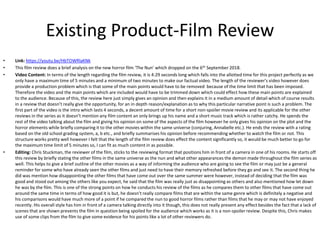
Existing Product-Film Review
• Link: https://youtu.be/HbTOWRlaKNk
• This film review does a brief analysis on the new horror film ‘The Nun’ which dropped on the 6th September 2018.
• Video Content: In terms of the length regarding the film review, it is 4:29 seconds long which falls into the allotted time for this project perfectly as we
only have a maximum time of 5 minutes and a minimum of two minutes to make our factual video. The length of the reviewer's video however does
provide a production problem which is that some of the main points would have to be removed because of the time limit that has been imposed.
Therefore the video and the main points which are included would have to be trimmed down which could effect how these main points are explained
to the audience. Because of this, the review here just simply gives an opinion and then explains it in a medium amount of detail which of course results
in a review that doesn’t really give the opportunity, for an in depth reason/explanation as to why this particular narrative point is such a problem. The
first part of the video is the intro which lasts 4 seconds, a decent amount of time for a short non-spoiler movie review and its applicable for the other
reviews in the series as it doesn’t mention any film content an only brings up his name and a short music track which is rather catchy. He spends the
rest of the video talking about the film and giving his opinion on some of the aspects of the film however he only gives his opinion on the plot and the
horror elements while briefly comparing it to the other movies within the same universe (conjuring, Annabelle etc.). He ends the review with a rating
based on the old school grading system, a, b etc., and briefly summarises his opinion before recommending whether to watch the film or not. This
structure works pretty well however I felt that the length of the film review does effect the content significantly so, it would be much better to go for
the maximum time limit of 5 minutes so, I can fit as much content in as possible.
• Editing: Chris Stuckman, the reviewer of the film, sticks to the reviewing format that positions him in front of a camera in one of his rooms. He starts off
this review by briefly stating the other films in the same universe as the nun and what other appearances the demon made throughout the film series as
well. This helps to give a brief outline of the other movies as a way of informing the audience who are going to see the film or may just be a general
reminder for some who have already seen the other films and just need to have their memory refreshed before they go and see it. The second thing he
did was mention how disappointing the other films that have come out over the same summer were however, instead of deciding that the film was
good and stood out among the others like you expect, he said that the film was really just as disappointing as others and also mentioned how let down
he was by the film. This is one of the strong points on how he conducts his review of the films as he compares them to other films that have come out
around the same time in terms of how good it is but, he doesn’t really compare films that are within the same genre which is definitely a negative and
his comparisons would have much more of a point if he compared the nun to good horror films rather than films that he may or may not have enjoyed
recently. His overall style has him in front of a camera talking directly into it though, this does not really present any effect besides the fact that a lack of
scenes that are shown prevents the film in question being spoiled for the audience which works as it is a non-spoiler review. Despite this, Chris makes
use of some clips from the film to give some evidence for his points like a lot of other reviewers do.
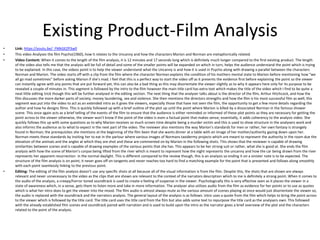
Existing Product-Film Analysis
• Link: https://youtu.be/_FMkGEZP3w0
• This video Analyses the film Psycho(1960), how it relates to the Uncanny and how the characters Marion and Norman are metaphorically related.
• Video Content: When it comes to the length of the film analysis, it is 12 minutes and 17 seconds long which is definitely much longer compared to the first existing product. The length
of the video also tells me that the analysis will be full of detail and some of the smaller points will be expanded on which in turn, helps the audience understand the point which is trying
to be explained. In this case, the videos point is to help the viewer understand what the Uncanny is and how it is used in Psycho along with drawing a parallel between the characters
Norman and Marion. The video starts off with a clip from the film where the character Norman explains the condition of his mothers mental state to Marion before mentioning how “we
all go mad sometimes” before asking Marion if she's mad. I feel that this is a perfect way to start the video off as it presents the evidence first before explaining the point so the viewer
can instantly agree with any points that are put forward yet, this can also be a bad thing as this may disorientate the viewer slightly as to why it appears here only for its purpose to be
revealed a couple of minutes in. This segment is followed by the intro to the film however the main title card has extra text which makes the title of the video which I find to be quite a
neat little editing trick though this will be further analysed in the editing section. The next thing that the analyser talks about is the director of the film, Arthur Hitchcock, and how the
film discusses the more darker parts of society; money laundering, sex and violence. She then mentions the directors strengths and how the film is his most successful film as well; this
segment was put into the video to act as an extended intro as it gives the viewers, especially those that have not seen the film, the opportunity to get a few more details regarding the
author and how he designs films. This is quickly followed up with a brief outline of the plot up until the point where Marion is killed by a dissociated Norman in the famous shower
scene. This once again acts as a brief telling of the events of the film to ensure that the audience is either reminded or informed of these plot points as they are necessary for getting the
point across to the viewer otherwise, the viewer won’t know if the point of the video is even a factual point that makes sense; essentially, it adds coherency to the analysis video. She
quickly follows this up with some questions as to why Marion receives so much screen time despite being a murder victim and this is used to show structure in the analysers work and
also informs the audience as to what to expect in the next part of the video. The reviewer also mentions the way Marion’s standards for men or rather, her own fantasy is strangely
found in Norman; the prerequisites she mentions at the beginning of the film been that she wants dinner at a table with an image of her mother/authority gazing down upon her.
Norman meets these standards by inviting her to eat in the parlour where various images of Normans taxidermy projects which are meant to represent the authority in the room due the
elevation of the animals and the angles at which they are shot and these are commented on by Marion in the following shots. This shows that the reviewer is capable of drawing
similarities between scenes and is capable of drawing examples of the various points that she has. This appears to be her strong suit or rather, what she is good at. She ends the film
analysis with how the scene of Marion’s corpse being lifted from the river which is meant to represent how the night represents the uncanny and how the car being drawn from the river
represents her apparent resurrection in the normal daylight. This is different compared to the review though, this is an analysis so ending it on a sinister note is to be expected. The
structure of the film analysis is on point; it never goes off on tangents and never reaches too hard to find a matching example for the point that is presented and follows along smoothly
with each point seamlessly linking to the previous point.
• Editing: The editing of the film analysis doesn’t use any specific shots at all because all of the visual information is from the film. Despite this, the shots that are shown are always
relevant and never unnecessary to the video as the clips that are shown are relevant to the context of the narrators description which to me is definitely a strong point. When it comes to
the audio of the analysis, a creepy/horror toned soundtrack is used to create a feeling of suspense in the viewer. Psychologically this is very effective seen as it places the viewer in a
state of awareness which, in a sense, gets them to listen more and take in more information. The analyser also utilizes audio from the film as evidence for her points or to use as quotes
which is what her intro does to get the viewer into the mood. The film audio is almost always mute as the various amount of scenes playing at once would just disorientate the viewer so,
the audio is replaced with the soundtrack and the narrators analysis. The general layout of the analysis is as follows: intro uses a quote from the film which helps to bring the point across
to the viewer which is followed by the title card. The title card uses the title card from the film but also adds some text to repurpose the title card as the analysers own. This followed
with the already established film scenes and soundtrack paired with narration and is used to build upon the intro as the narrator gives a brief overview of the plot and the characters
related to the point of the analysis.
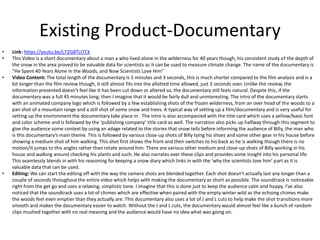
Existing Product-Documentary
• Link: https://youtu.be/L72G8TLtTCk
• This Video is a short documentary about a man a who lived alone in the wilderness for 40 years though, his consistent study of the depth of
the snow in the area proved to be valuable data for scientists as it can be used to measure climate change. The name of the documentary is
“He Spent 40 Years Alone in the Woods, and Now Scientists Love Him”
• Video Content: The total length of the documentary is 5 minutes and 3 seconds, this is much shorter compared to the film analysis and is a
bit longer than the film review though, it still almost fits into the allotted time allowed, just 3 seconds over. Unlike the review, the
information presented doesn’t feel like it has been cut down or altered so, the documentary still feels natural. Despite this, if the
documentary was a full 45 minutes long; then I imagine that it would be fairly dull and uninteresting. The intro of the documentary starts
with an animated company logo which is followed by a few establishing shots of the frozen wilderness, from an over head of the woods to a
pan shot of a mountain range and a still shot of some snow and trees. A typical way of setting up a film/documentary and is very useful for
setting up the environment the documentary take place in. The intro is also accompanied with the title card which uses a yellow/basic font
and color scheme and is followed by the ‘publishing company’ title card as well. The narration also picks up halfway through this segment to
give the audience some context by using an adage related to the stories that snow tells before informing the audience of Billy, the man who
is this documentary’s main theme. This is followed by various close-up shots of Billy tying his shoes and some other gear in his house before
showing a medium shot of him walking. This shot first shows the front and then switches to his back as he is walking though there is no
motion/it jumps to this angles rather than rotate around him. There are various other medium and close-up shots of Billy working in his
house and walking around checking his plants and such. He also narrates over these clips and provides some insight into his personal life.
This seamlessly blends in with his reasoning for keeping a snow diary which links in with the ‘why the scientists love him’ part as it is
valuable data that can be used.
• Editing: We can start the editing off with the way the camera shots are blended together. Each shot doesn’t actually last any longer than a
couple of seconds throughout the entire video which helps with making the documentary as short as possible. The soundtrack is noticeable
right from the get go and uses a relaxing, simplistic tone. I imagine that this is done just to keep the audience calm and happy. I’ve also
noticed that the soundtrack uses a lot of chimes which are effective when paired with the empty winter wild as the echoing chimes make
the woods feel even emptier than they actually are. This documentary also uses a lot of J and L cuts to help make the shot transitions more
smooth and makes the documentary easier to watch. Without the J and L cuts, the documentary would almost feel like a bunch of random
clips mushed together with no real meaning and the audience would have no idea what was going on.
Existing Product Summary
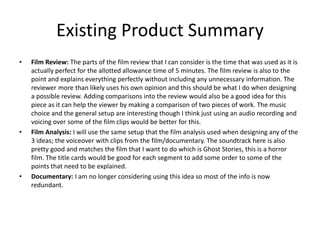
• Film Review: The parts of the film review that I can consider is the time that was used as it is
actually perfect for the allotted allowance time of 5 minutes. The film review is also to the
point and explains everything perfectly without including any unnecessary information. The
reviewer more than likely uses his own opinion and this should be what I do when designing
a possible review. Adding comparisons into the review would also be a good idea for this
piece as it can help the viewer by making a comparison of two pieces of work. The music
choice and the general setup are interesting though I think just using an audio recording and
voicing over some of the film clips would be better for this.
• Film Analysis: I will use the same setup that the film analysis used when designing any of the
3 ideas; the voiceover with clips from the film/documentary. The soundtrack here is also
pretty good and matches the film that I want to do which is Ghost Stories, this is a horror
film. The title cards would be good for each segment to add some order to some of the
points that need to be explained.
• Documentary: I am no longer considering using this idea so most of the info is now
redundant.
Initial Ideas
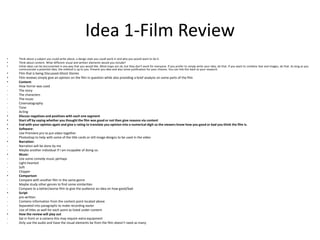
Idea 1-Film Review
• Think about a subject you could write about, a design style you could work in and why you would want to do it.
• Think about content. What different visual and written elements would you include?
• Initial ideas can be documented in any way that you would like. Mind maps are ok, but they don’t work for everyone. If you prefer to simply write your idea, do that. If you want to combine text and images, do that. As long as you
communicate a potential idea, the method is up to you. Present you idea and also some justification for your choices. You can link this back to your research.
• Film that is being Discussed-Ghost Stories
• Film reviews simply give an opinion on the film in question while also providing a brief analysis on some parts of the film
• Content:
- How horror was used
- The story
- The characters
- The music
- Cinematography
- Tone
- Acting
• Discuss negatives and positives with each one segment
• Start off by saying whether you thought the film was good or not then give reasons via content
• End with your opinion again and give a rating to translate you opinion into a numerical digit so the viewers know how you good or bad you think the film is.
• Software:
- Use Premiere pro to put video together
- Photoshop to help with some of the title cards or still image designs to be used in the video
• Narration:
- Narration will be done by me
- Maybe another individual if I am incapable of doing so.
• Music:
- Use some comedy music perhaps
- Light-hearted
- Soft
- Chipper
• Comparison
- Compare with another film in the same genre
- Maybe study other genres to find some similarities
- Compare to a better/worse film to give the audience an idea on how good/bad
• Script
- pre-written
- Contains information from the content point located above
- Separated into paragraphs to make recording easier
- Use of titles as well for each point as listed under content
• How the review will play out
- Sat in front or a camera-this may require extra equipment
- Only use the audio and have the visual elements be from the film-doesn’t need as many
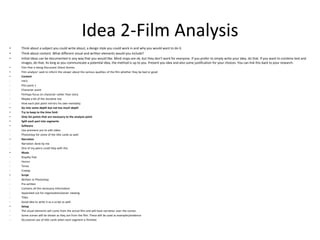
Idea 2-Film Analysis
• Think about a subject you could write about, a design style you could work in and why you would want to do it.
• Think about content. What different visual and written elements would you include?
• Initial ideas can be documented in any way that you would like. Mind maps are ok, but they don’t work for everyone. If you prefer to simply write your idea, do that. If you want to combine text and
images, do that. As long as you communicate a potential idea, the method is up to you. Present you idea and also some justification for your choices. You can link this back to your research.
• Film that is being Discussed: Ghost Stories
• Film analysis’ seek to inform the viewer about the various qualities of the film whether they be bad or good
• Content
- Intro
- Plot point 1
- Character point
- Perhaps focus on character rather than story
- Maybe a bit of the storyline too
- How each plot point mirrors his own mentality.
• Go into some depth but not too much depth
• Try to keep to the time limit
• Only list points that are necessary to the analysis point
• Split each part into segments
• Software
- Use premiere pro to edit video
- Photoshop for some of the title cards as well.
• Narration
- Narration done by me
- One of my peers could help with this
• Music
- Royalty free
- Horror
- Tense
- Creepy
• Script
- Written in Photoshop
- Pre-written
- Contains all the necessary information
- Separated out for organisation/easier viewing
- Titles
- Good idea to write it as a script as well.
• Setup
- The visual elements will come from the actual film and will have narration over the scenes.
- Some scenes will be shown as they are from the film. These will be used as examples/evidence
- Occasional use of title cards when each segment is finished.

1. research + initial ideas unit 9

  • 1.
  • 2.
    Existing Product Research •Research existing products/topics for your production and production methods. • This could be quite broad to begin with, but should focus down to relevant examples [in terms of styles, techniques and content]. • Consider your audience, what do they expect, what techniques and content will interest them. • Summarise your findings before generating your own initial ideas for this project. • Your summary should consider what your research has provided and how this is useful to you and your production. • Add more slides – this is encrouaged!
  • 3.
    Existing Product-Film Review •Link: https://youtu.be/HbTOWRlaKNk • This film review does a brief analysis on the new horror film ‘The Nun’ which dropped on the 6th September 2018. • Video Content: In terms of the length regarding the film review, it is 4:29 seconds long which falls into the allotted time for this project perfectly as we only have a maximum time of 5 minutes and a minimum of two minutes to make our factual video. The length of the reviewer's video however does provide a production problem which is that some of the main points would have to be removed because of the time limit that has been imposed. Therefore the video and the main points which are included would have to be trimmed down which could effect how these main points are explained to the audience. Because of this, the review here just simply gives an opinion and then explains it in a medium amount of detail which of course results in a review that doesn’t really give the opportunity, for an in depth reason/explanation as to why this particular narrative point is such a problem. The first part of the video is the intro which lasts 4 seconds, a decent amount of time for a short non-spoiler movie review and its applicable for the other reviews in the series as it doesn’t mention any film content an only brings up his name and a short music track which is rather catchy. He spends the rest of the video talking about the film and giving his opinion on some of the aspects of the film however he only gives his opinion on the plot and the horror elements while briefly comparing it to the other movies within the same universe (conjuring, Annabelle etc.). He ends the review with a rating based on the old school grading system, a, b etc., and briefly summarises his opinion before recommending whether to watch the film or not. This structure works pretty well however I felt that the length of the film review does effect the content significantly so, it would be much better to go for the maximum time limit of 5 minutes so, I can fit as much content in as possible. • Editing: Chris Stuckman, the reviewer of the film, sticks to the reviewing format that positions him in front of a camera in one of his rooms. He starts off this review by briefly stating the other films in the same universe as the nun and what other appearances the demon made throughout the film series as well. This helps to give a brief outline of the other movies as a way of informing the audience who are going to see the film or may just be a general reminder for some who have already seen the other films and just need to have their memory refreshed before they go and see it. The second thing he did was mention how disappointing the other films that have come out over the same summer were however, instead of deciding that the film was good and stood out among the others like you expect, he said that the film was really just as disappointing as others and also mentioned how let down he was by the film. This is one of the strong points on how he conducts his review of the films as he compares them to other films that have come out around the same time in terms of how good it is but, he doesn’t really compare films that are within the same genre which is definitely a negative and his comparisons would have much more of a point if he compared the nun to good horror films rather than films that he may or may not have enjoyed recently. His overall style has him in front of a camera talking directly into it though, this does not really present any effect besides the fact that a lack of scenes that are shown prevents the film in question being spoiled for the audience which works as it is a non-spoiler review. Despite this, Chris makes use of some clips from the film to give some evidence for his points like a lot of other reviewers do.
  • 4.
    Existing Product-Film Analysis •Link: https://youtu.be/_FMkGEZP3w0 • This video Analyses the film Psycho(1960), how it relates to the Uncanny and how the characters Marion and Norman are metaphorically related. • Video Content: When it comes to the length of the film analysis, it is 12 minutes and 17 seconds long which is definitely much longer compared to the first existing product. The length of the video also tells me that the analysis will be full of detail and some of the smaller points will be expanded on which in turn, helps the audience understand the point which is trying to be explained. In this case, the videos point is to help the viewer understand what the Uncanny is and how it is used in Psycho along with drawing a parallel between the characters Norman and Marion. The video starts off with a clip from the film where the character Norman explains the condition of his mothers mental state to Marion before mentioning how “we all go mad sometimes” before asking Marion if she's mad. I feel that this is a perfect way to start the video off as it presents the evidence first before explaining the point so the viewer can instantly agree with any points that are put forward yet, this can also be a bad thing as this may disorientate the viewer slightly as to why it appears here only for its purpose to be revealed a couple of minutes in. This segment is followed by the intro to the film however the main title card has extra text which makes the title of the video which I find to be quite a neat little editing trick though this will be further analysed in the editing section. The next thing that the analyser talks about is the director of the film, Arthur Hitchcock, and how the film discusses the more darker parts of society; money laundering, sex and violence. She then mentions the directors strengths and how the film is his most successful film as well; this segment was put into the video to act as an extended intro as it gives the viewers, especially those that have not seen the film, the opportunity to get a few more details regarding the author and how he designs films. This is quickly followed up with a brief outline of the plot up until the point where Marion is killed by a dissociated Norman in the famous shower scene. This once again acts as a brief telling of the events of the film to ensure that the audience is either reminded or informed of these plot points as they are necessary for getting the point across to the viewer otherwise, the viewer won’t know if the point of the video is even a factual point that makes sense; essentially, it adds coherency to the analysis video. She quickly follows this up with some questions as to why Marion receives so much screen time despite being a murder victim and this is used to show structure in the analysers work and also informs the audience as to what to expect in the next part of the video. The reviewer also mentions the way Marion’s standards for men or rather, her own fantasy is strangely found in Norman; the prerequisites she mentions at the beginning of the film been that she wants dinner at a table with an image of her mother/authority gazing down upon her. Norman meets these standards by inviting her to eat in the parlour where various images of Normans taxidermy projects which are meant to represent the authority in the room due the elevation of the animals and the angles at which they are shot and these are commented on by Marion in the following shots. This shows that the reviewer is capable of drawing similarities between scenes and is capable of drawing examples of the various points that she has. This appears to be her strong suit or rather, what she is good at. She ends the film analysis with how the scene of Marion’s corpse being lifted from the river which is meant to represent how the night represents the uncanny and how the car being drawn from the river represents her apparent resurrection in the normal daylight. This is different compared to the review though, this is an analysis so ending it on a sinister note is to be expected. The structure of the film analysis is on point; it never goes off on tangents and never reaches too hard to find a matching example for the point that is presented and follows along smoothly with each point seamlessly linking to the previous point. • Editing: The editing of the film analysis doesn’t use any specific shots at all because all of the visual information is from the film. Despite this, the shots that are shown are always relevant and never unnecessary to the video as the clips that are shown are relevant to the context of the narrators description which to me is definitely a strong point. When it comes to the audio of the analysis, a creepy/horror toned soundtrack is used to create a feeling of suspense in the viewer. Psychologically this is very effective seen as it places the viewer in a state of awareness which, in a sense, gets them to listen more and take in more information. The analyser also utilizes audio from the film as evidence for her points or to use as quotes which is what her intro does to get the viewer into the mood. The film audio is almost always mute as the various amount of scenes playing at once would just disorientate the viewer so, the audio is replaced with the soundtrack and the narrators analysis. The general layout of the analysis is as follows: intro uses a quote from the film which helps to bring the point across to the viewer which is followed by the title card. The title card uses the title card from the film but also adds some text to repurpose the title card as the analysers own. This followed with the already established film scenes and soundtrack paired with narration and is used to build upon the intro as the narrator gives a brief overview of the plot and the characters related to the point of the analysis.
  • 5.
    Existing Product-Documentary • Link:https://youtu.be/L72G8TLtTCk • This Video is a short documentary about a man a who lived alone in the wilderness for 40 years though, his consistent study of the depth of the snow in the area proved to be valuable data for scientists as it can be used to measure climate change. The name of the documentary is “He Spent 40 Years Alone in the Woods, and Now Scientists Love Him” • Video Content: The total length of the documentary is 5 minutes and 3 seconds, this is much shorter compared to the film analysis and is a bit longer than the film review though, it still almost fits into the allotted time allowed, just 3 seconds over. Unlike the review, the information presented doesn’t feel like it has been cut down or altered so, the documentary still feels natural. Despite this, if the documentary was a full 45 minutes long; then I imagine that it would be fairly dull and uninteresting. The intro of the documentary starts with an animated company logo which is followed by a few establishing shots of the frozen wilderness, from an over head of the woods to a pan shot of a mountain range and a still shot of some snow and trees. A typical way of setting up a film/documentary and is very useful for setting up the environment the documentary take place in. The intro is also accompanied with the title card which uses a yellow/basic font and color scheme and is followed by the ‘publishing company’ title card as well. The narration also picks up halfway through this segment to give the audience some context by using an adage related to the stories that snow tells before informing the audience of Billy, the man who is this documentary’s main theme. This is followed by various close-up shots of Billy tying his shoes and some other gear in his house before showing a medium shot of him walking. This shot first shows the front and then switches to his back as he is walking though there is no motion/it jumps to this angles rather than rotate around him. There are various other medium and close-up shots of Billy working in his house and walking around checking his plants and such. He also narrates over these clips and provides some insight into his personal life. This seamlessly blends in with his reasoning for keeping a snow diary which links in with the ‘why the scientists love him’ part as it is valuable data that can be used. • Editing: We can start the editing off with the way the camera shots are blended together. Each shot doesn’t actually last any longer than a couple of seconds throughout the entire video which helps with making the documentary as short as possible. The soundtrack is noticeable right from the get go and uses a relaxing, simplistic tone. I imagine that this is done just to keep the audience calm and happy. I’ve also noticed that the soundtrack uses a lot of chimes which are effective when paired with the empty winter wild as the echoing chimes make the woods feel even emptier than they actually are. This documentary also uses a lot of J and L cuts to help make the shot transitions more smooth and makes the documentary easier to watch. Without the J and L cuts, the documentary would almost feel like a bunch of random clips mushed together with no real meaning and the audience would have no idea what was going on.
  • 6.
    Existing Product Summary •Film Review: The parts of the film review that I can consider is the time that was used as it is actually perfect for the allotted allowance time of 5 minutes. The film review is also to the point and explains everything perfectly without including any unnecessary information. The reviewer more than likely uses his own opinion and this should be what I do when designing a possible review. Adding comparisons into the review would also be a good idea for this piece as it can help the viewer by making a comparison of two pieces of work. The music choice and the general setup are interesting though I think just using an audio recording and voicing over some of the film clips would be better for this. • Film Analysis: I will use the same setup that the film analysis used when designing any of the 3 ideas; the voiceover with clips from the film/documentary. The soundtrack here is also pretty good and matches the film that I want to do which is Ghost Stories, this is a horror film. The title cards would be good for each segment to add some order to some of the points that need to be explained. • Documentary: I am no longer considering using this idea so most of the info is now redundant.
  • 7.
  • 8.
    Idea 1-Film Review •Think about a subject you could write about, a design style you could work in and why you would want to do it. • Think about content. What different visual and written elements would you include? • Initial ideas can be documented in any way that you would like. Mind maps are ok, but they don’t work for everyone. If you prefer to simply write your idea, do that. If you want to combine text and images, do that. As long as you communicate a potential idea, the method is up to you. Present you idea and also some justification for your choices. You can link this back to your research. • Film that is being Discussed-Ghost Stories • Film reviews simply give an opinion on the film in question while also providing a brief analysis on some parts of the film • Content: - How horror was used - The story - The characters - The music - Cinematography - Tone - Acting • Discuss negatives and positives with each one segment • Start off by saying whether you thought the film was good or not then give reasons via content • End with your opinion again and give a rating to translate you opinion into a numerical digit so the viewers know how you good or bad you think the film is. • Software: - Use Premiere pro to put video together - Photoshop to help with some of the title cards or still image designs to be used in the video • Narration: - Narration will be done by me - Maybe another individual if I am incapable of doing so. • Music: - Use some comedy music perhaps - Light-hearted - Soft - Chipper • Comparison - Compare with another film in the same genre - Maybe study other genres to find some similarities - Compare to a better/worse film to give the audience an idea on how good/bad • Script - pre-written - Contains information from the content point located above - Separated into paragraphs to make recording easier - Use of titles as well for each point as listed under content • How the review will play out - Sat in front or a camera-this may require extra equipment - Only use the audio and have the visual elements be from the film-doesn’t need as many
  • 9.
    Idea 2-Film Analysis •Think about a subject you could write about, a design style you could work in and why you would want to do it. • Think about content. What different visual and written elements would you include? • Initial ideas can be documented in any way that you would like. Mind maps are ok, but they don’t work for everyone. If you prefer to simply write your idea, do that. If you want to combine text and images, do that. As long as you communicate a potential idea, the method is up to you. Present you idea and also some justification for your choices. You can link this back to your research. • Film that is being Discussed: Ghost Stories • Film analysis’ seek to inform the viewer about the various qualities of the film whether they be bad or good • Content - Intro - Plot point 1 - Character point - Perhaps focus on character rather than story - Maybe a bit of the storyline too - How each plot point mirrors his own mentality. • Go into some depth but not too much depth • Try to keep to the time limit • Only list points that are necessary to the analysis point • Split each part into segments • Software - Use premiere pro to edit video - Photoshop for some of the title cards as well. • Narration - Narration done by me - One of my peers could help with this • Music - Royalty free - Horror - Tense - Creepy • Script - Written in Photoshop - Pre-written - Contains all the necessary information - Separated out for organisation/easier viewing - Titles - Good idea to write it as a script as well. • Setup - The visual elements will come from the actual film and will have narration over the scenes. - Some scenes will be shown as they are from the film. These will be used as examples/evidence - Occasional use of title cards when each segment is finished.

Editor's Notes

  • #9 Think about a subject you could write about, a design style you could work in and why you would want to do it. Think about content. What different visual and written elements would you include? Initial ideas can be documented in any way that you would like. Mind maps are ok, but they don’t work for everyone. If you prefer to simply write your idea, do that. If you want to combine text and images, do that. As long as you communicate a potential idea, the method is up to you. Present you idea and also some justification for your choices. You can link this back to your research.
  • #10 Think about a subject you could write about, a design style could work in and why you would want to do it. Think about content. What different visual and written elements would you include? Initial ideas can be documented in any way that you would like. Mind maps are ok, but they don’t work for everyone. If you prefer to simply write your idea, do that. If you want to combine text and images, do that. As long as you communicate a potential idea, the method is up to you. Present you idea and also some justification for your choices. You can link this back to your research.