MATH 9
WELCOME TO OUR CLASS!
What is
Quadratic
Function?
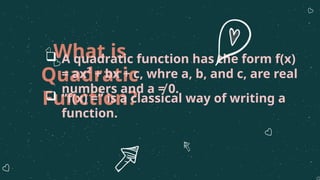
 A quadratic function has the form f(x)
= ax² + bx + c, whre a, b, and c, are real
numbers and a ≠ 0.
 “f(x) =” is a classical way of writing a
function.
Table of
Values
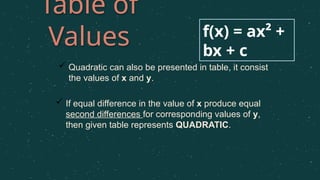
 Quadratic can also be presented in table, it consist
the values of x and y.
 If equal difference in the value of x produce equal
second differences for corresponding values of y,
then given table represents QUADRATIC.
f(x) = ax² +
bx + c
X 0 1 2 3 4
Y
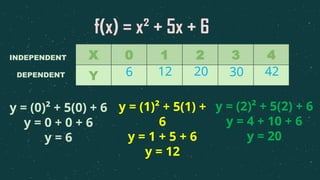
f(x) = x² + 5x + 6
y = (0)² + 5(0) + 6
y = 0 + 0 + 6
y = 6
INDEPENDENT
DEPENDENT 6
y = (1)² + 5(1) +
6
y = 1 + 5 + 6
y = 12
12
y = (2)² + 5(2) + 6
y = 4 + 10 + 6
y = 20
20 30 42
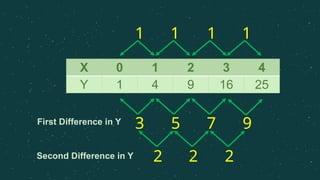
X 0 1 2 3 4
Y 1 4 9 16 25
1 1 1 1
3 5 7 9
2 2 2
First Difference in Y
Second Difference in Y
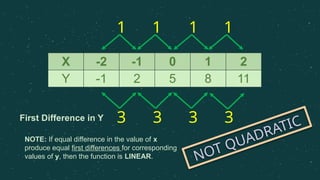
X -2 -1 0 1 2
Y -1 2 5 8 11
1 1 1 1
3 3 3 3
First Difference in Y
NOT QUADRATIC
NOTE: If equal difference in the value of x
produce equal first differences for corresponding
values of y, then the function is LINEAR.
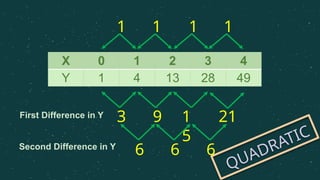
X 0 1 2 3 4
Y 1 4 13 28 49
1 1 1 1
3 9 1
5
21
6 6 6
First Difference in Y
Second Difference in Y
QUADRATIC
Quadratic
Function
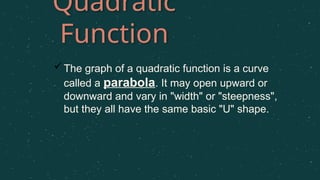
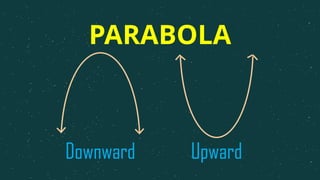
The graph of a quadratic function is a curve
called a parabola. It may open upward or
downward and vary in "width" or "steepness",
but they all have the same basic "U" shape.
PARABOLA
Downward Upward
HOW TO GRAPH A
QUADRATIC
FUNCTION?
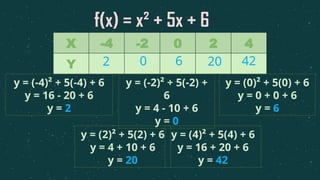
X -4 -2 0 2 4
Y
f(x) = x² + 5x + 6
2 0 6 20 42
y = (-2)² + 5(-2) +
6
y = 4 - 10 + 6
y = 0
y = (0)² + 5(0) + 6
y = 0 + 0 + 6
y = 6
y = (2)² + 5(2) + 6
y = 4 + 10 + 6
y = 20
y = (4)² + 5(4) + 6
y = 16 + 20 + 6
y = 42
y = (-4)² + 5(-4) + 6
y = 16 - 20 + 6
y = 2
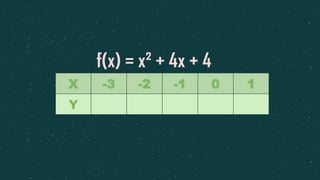
X -3 -2 -1 0 1
Y
f(x) = x² + 4x + 4

1 - Quadratic Function Table of Values.pptx

  • 1.
  • 2.
    What is Quadratic Function?  Aquadratic function has the form f(x) = ax² + bx + c, whre a, b, and c, are real numbers and a ≠ 0.  “f(x) =” is a classical way of writing a function.
  • 3.
    Table of Values  Quadraticcan also be presented in table, it consist the values of x and y.  If equal difference in the value of x produce equal second differences for corresponding values of y, then given table represents QUADRATIC. f(x) = ax² + bx + c
  • 4.
    X 0 12 3 4 Y f(x) = x² + 5x + 6 y = (0)² + 5(0) + 6 y = 0 + 0 + 6 y = 6 INDEPENDENT DEPENDENT 6 y = (1)² + 5(1) + 6 y = 1 + 5 + 6 y = 12 12 y = (2)² + 5(2) + 6 y = 4 + 10 + 6 y = 20 20 30 42
  • 5.
    X 0 12 3 4 Y 1 4 9 16 25 1 1 1 1 3 5 7 9 2 2 2 First Difference in Y Second Difference in Y
  • 6.
    X -2 -10 1 2 Y -1 2 5 8 11 1 1 1 1 3 3 3 3 First Difference in Y NOT QUADRATIC NOTE: If equal difference in the value of x produce equal first differences for corresponding values of y, then the function is LINEAR.
  • 7.
    X 0 12 3 4 Y 1 4 13 28 49 1 1 1 1 3 9 1 5 21 6 6 6 First Difference in Y Second Difference in Y QUADRATIC
  • 8.
    Quadratic Function The graph ofa quadratic function is a curve called a parabola. It may open upward or downward and vary in "width" or "steepness", but they all have the same basic "U" shape.
  • 9.
  • 10.
    HOW TO GRAPHA QUADRATIC FUNCTION?
  • 11.
    X -4 -20 2 4 Y f(x) = x² + 5x + 6 2 0 6 20 42 y = (-2)² + 5(-2) + 6 y = 4 - 10 + 6 y = 0 y = (0)² + 5(0) + 6 y = 0 + 0 + 6 y = 6 y = (2)² + 5(2) + 6 y = 4 + 10 + 6 y = 20 y = (4)² + 5(4) + 6 y = 16 + 20 + 6 y = 42 y = (-4)² + 5(-4) + 6 y = 16 - 20 + 6 y = 2
  • 12.
    X -3 -2-1 0 1 Y f(x) = x² + 4x + 4