INTRODUCTION TO
E-COMMERCE
CS3_ E-commerce Presentation
Learning Objectives:
• To explore how e-business and e-commerce fit
together.
• To identify the impact of e-commerce.
• To recognise the benefits and limitations of e-
commerce.
• To identify the different classification of E-
commerce.
• To identify the main barriers to the growth and
development of e-commerce.
CS3_ E-commerce Presentation
What is Electronic Commerce?
• Electronic commerce is sharing business information, maintaining
business relationships and conducting business transactions by
means of telecommunications networks.
• Electronic Commerce (EC) is where business transactions take
place via telecommunications networks, especially the Internet.
• Electronic commerce describes the buying and selling of products,
services, and information via computer networks including the
Internet.
• Electronic commerce is about doing business electronically.
• E-commerce, ecommerce, or electronic commerce is defined as the
conduct of a financial transaction by electronic means.
CS3_ E-commerce Presentation
What is E-business?
• E-business is the transformation of key business processes
through the use of Internet technologies. E-Business is not only
buying and selling but also servicing customers and collaborating
with business partners.
• An e-business is a company that can adapt to constant and
continual change.
• E-business is everything to do with back-end systems in an
organisation.
CS3_ E-commerce Presentation
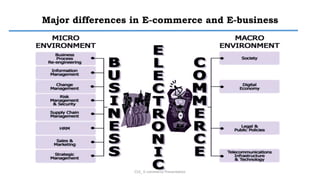
Major differences in E-commerce and E-business
CS3_ E-commerce Presentation
HISTORY OF E-COMMERCE
• E-Commerce started over 40 years ago, and has evolved
over time.
• Before the widespread uptake and commercial use of THE
INTERNET, the Electronic Data Interchange (EDI), was
used as the platform for E-commerce.
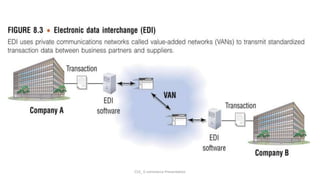
• EDI uses private communications networks (VANs) to
transmit standardized transaction data between business
partners and suppliers
• The EDI system was very expensive, thus uptake was
limited largely to cash-rich multinational corporations.
CS3_ E-commerce Presentation
Key Drivers of E-commerce
• Technological factors
• Political factors
• Social factors
• Economic factors
CS3_ E-commerce Presentation
Key drivers of E-business
• Organisational culture
• Commercial benefits
• Skilled and committed workforce
• Requirements of customers and suppliers
• Competition
CS3_ E-commerce Presentation
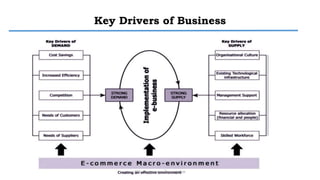
Key Drivers of Business
CS3_ E-commerce Presentation
The Impact of Electronic Commerce
• Marketing
• Computer sciences
• Finance and accounting
• Economics
• Production and operations management
(manufacturing)
• Management information systems
• Human resource management
• Business law and ethics
CS3_ E-commerce Presentation
Benefits and Limitations of E-commerce to
Society
Benefits
• Enables more flexible
working practices
• Connects people.
• Facilitates delivery of
public services.
Limitations
• Breakdown in human interaction.
• Social division.
• Reliance on telecommunications
infrastructure, power and IT skills.
• Wasted resources.
• Difficulty in policing the Internet
CS3_ E-commerce Presentation
Benefits and Limitations of E-commerce to
Consumers
Benefits
• 24/7 access.
• More choices.
• Price comparisons.
• Improved delivery
processes.
• An environment of
competition
Limitations
• Computing equipment.
• A basic technical knowledge.
• Cost of access to the Internet.
• Cost of computing equipment.
• Lack of security and privacy of personal
data.
• Physical contact and relationships are
replaced by electronic processes.
• A lack of trust because they are
interacting with faceless computers.
CS3_ E-commerce Presentation
Benefits and Limitations of E-commerce to Organisations
BENEFITS
• Operational cost savings.
• Mass customisation.
• Enables reduced inventories.
• Lower telecommunications cost.
• Digitisation of products and
processes.
• No more 24-hour-time constraints
LIMITATIONS
• Lack of sufficient system
security, reliability, standards
and communication protocols.
• Rapidly evolving and
changing technology.
• Under pressure to innovate
• Facing increased competition
• Problems with compatibility of
older and ‘newer’ technology.
CS3_ E-commerce Presentation
Classification of E-commerce
The classification is done from different perspective
namely:
• The Macro-Environment Perspective
• The Identification of Transacting Partners
• The Degree of Digitisation
These frameworks help identify the elements of e-
commerce and how businesses can better understand
e-commerce and its practical applicability.
CS3_ E-commerce Presentation
Classifications of E-Commerce:
Macro-environment Perspective
The macro-environment perspective identifies the
interaction of :
• Technology
• People
•Organisations
• Policies and
• Technical standards working together to
enable e-commerce.
CS3_ E-commerce Presentation
Classifications of E-Commerce:
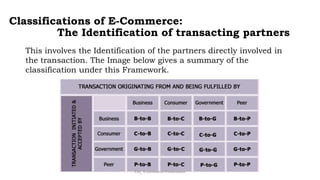
The Identification of transacting partners
This involves the Identification of the partners directly involved in
the transaction. The Image below gives a summary of the
classification under this Framework.
CS3_ E-commerce Presentation
Classifications of E-Commerce:
The Degree of Digitisation
The degree of digitisation categorises E-Commerce
based on the Product or Service Sold, the process
of the transaction and Delivery agents.
Based on these categories, Three main dimensions
can be deduced namely:
•Traditional Ecommerce
•Pure E- Commerce
•Partial Ecommerce
CS3_ E-commerce Presentation
Barriers to E-commerce
 Internet infrastructure.
 Technology infrastructure.
 Security.
 Commercial infrastructure.
 Organisational structure and culture.
 Lack of qualified personnel.
 Lack of proven business models.
 Interoperability of systems
CS3_ E-commerce Presentation
THANK YOU!!!
CS3_ E-commerce Presentation

1 Presentation-on-E-Commerce.pptx

  • 1.
  • 2.
    Learning Objectives: • Toexplore how e-business and e-commerce fit together. • To identify the impact of e-commerce. • To recognise the benefits and limitations of e- commerce. • To identify the different classification of E- commerce. • To identify the main barriers to the growth and development of e-commerce. CS3_ E-commerce Presentation
  • 3.
    What is ElectronicCommerce? • Electronic commerce is sharing business information, maintaining business relationships and conducting business transactions by means of telecommunications networks. • Electronic Commerce (EC) is where business transactions take place via telecommunications networks, especially the Internet. • Electronic commerce describes the buying and selling of products, services, and information via computer networks including the Internet. • Electronic commerce is about doing business electronically. • E-commerce, ecommerce, or electronic commerce is defined as the conduct of a financial transaction by electronic means. CS3_ E-commerce Presentation
  • 4.
    What is E-business? •E-business is the transformation of key business processes through the use of Internet technologies. E-Business is not only buying and selling but also servicing customers and collaborating with business partners. • An e-business is a company that can adapt to constant and continual change. • E-business is everything to do with back-end systems in an organisation. CS3_ E-commerce Presentation
  • 5.
    Major differences inE-commerce and E-business CS3_ E-commerce Presentation
  • 6.
    HISTORY OF E-COMMERCE •E-Commerce started over 40 years ago, and has evolved over time. • Before the widespread uptake and commercial use of THE INTERNET, the Electronic Data Interchange (EDI), was used as the platform for E-commerce. • EDI uses private communications networks (VANs) to transmit standardized transaction data between business partners and suppliers • The EDI system was very expensive, thus uptake was limited largely to cash-rich multinational corporations. CS3_ E-commerce Presentation
  • 7.
  • 8.
    Key Drivers ofE-commerce • Technological factors • Political factors • Social factors • Economic factors CS3_ E-commerce Presentation
  • 9.
    Key drivers ofE-business • Organisational culture • Commercial benefits • Skilled and committed workforce • Requirements of customers and suppliers • Competition CS3_ E-commerce Presentation
  • 10.
    Key Drivers ofBusiness CS3_ E-commerce Presentation
  • 11.
    The Impact ofElectronic Commerce • Marketing • Computer sciences • Finance and accounting • Economics • Production and operations management • Production and operations management (manufacturing) • Management information systems • Human resource management • Business law and ethics CS3_ E-commerce Presentation
  • 12.
    Benefits and Limitationsof E-commerce to Society Benefits • Enables more flexible working practices • Connects people. • Facilitates delivery of public services. Limitations • Breakdown in human interaction. • Social division. • Reliance on telecommunications infrastructure, power and IT skills. • Wasted resources. • Difficulty in policing the Internet CS3_ E-commerce Presentation
  • 13.
    Benefits and Limitationsof E-commerce to Consumers Benefits • 24/7 access. • More choices. • Price comparisons. • Improved delivery processes. • An environment of competition Limitations • Computing equipment. • A basic technical knowledge. • Cost of access to the Internet. • Cost of computing equipment. • Lack of security and privacy of personal data. • Physical contact and relationships are replaced by electronic processes. • A lack of trust because they are interacting with faceless computers. CS3_ E-commerce Presentation
  • 14.
    Benefits and Limitationsof E-commerce to Organisations BENEFITS • Operational cost savings. • Mass customisation. • Enables reduced inventories. • Lower telecommunications cost. • Digitisation of products and processes. • No more 24-hour-time constraints LIMITATIONS • Lack of sufficient system security, reliability, standards and communication protocols. • Rapidly evolving and changing technology. • Under pressure to innovate • Facing increased competition • Problems with compatibility of older and ‘newer’ technology. CS3_ E-commerce Presentation
  • 15.
    Classification of E-commerce Theclassification is done from different perspective namely: • The Macro-Environment Perspective • The Identification of Transacting Partners • The Degree of Digitisation These frameworks help identify the elements of e- commerce and how businesses can better understand e-commerce and its practical applicability. CS3_ E-commerce Presentation
  • 16.
    Classifications of E-Commerce: Macro-environmentPerspective The macro-environment perspective identifies the interaction of : • Technology • People •Organisations • Policies and • Technical standards working together to enable e-commerce. CS3_ E-commerce Presentation
  • 17.
    Classifications of E-Commerce: TheIdentification of transacting partners This involves the Identification of the partners directly involved in the transaction. The Image below gives a summary of the classification under this Framework. CS3_ E-commerce Presentation
  • 18.
    Classifications of E-Commerce: TheDegree of Digitisation The degree of digitisation categorises E-Commerce based on the Product or Service Sold, the process of the transaction and Delivery agents. Based on these categories, Three main dimensions can be deduced namely: •Traditional Ecommerce •Pure E- Commerce •Partial Ecommerce CS3_ E-commerce Presentation
  • 19.
    Barriers to E-commerce Internet infrastructure.  Technology infrastructure.  Security.  Commercial infrastructure.  Organisational structure and culture.  Lack of qualified personnel.  Lack of proven business models.  Interoperability of systems CS3_ E-commerce Presentation
  • 20.