1
Lab 9: Comparison of Two Field Methods in a
Scientific Report/Paper Format
Minimum Content of the Scientific Report
Title
paper. Your title will be what
is most commonly cited and will be the “target” of topical
searches via the internet.
Choose your words carefully. As short and as concise a title as
possible is best.
waiting until after
completing the report to finalize the title.
Abstract
could stand-alone as a
publication. The abstract should include, in order: a summary of
the introduction,
methods, results, and discussion. However, you may include
only key results and key
discussion points in the abstract. Do not include reference to
figures and tables, and
don’t use abbreviations. Don’t include references in the
abstract. This is the hardest
section of the paper to write, and should be written after you
complete the other
sections.
-
paragraph format.
Introduction
why you are doing the
study, i.e., the basis for your study.
previous studies that support
the basis for your study, but not the results or discussion or
conclusions drawn from the
results of your project.
these observations or results from previous studies
with the questions or
hypotheses of your study.
summarizes the setting, scope,
and justification or importance of the study. This is a lead-in
paragraph to the rest of the
paper.
paragraphs.
2
Methods
-by-step, description of how
you did the study.
below).
or other applications used
to input, manage, graph, or analyze the data.
dard or previously published
methods used.
duplicate your study or
conduct a similar study with only your methods section
available.
, and plot
and belt transect in the
sampling area.
paragraphs.
Results
tables and graphs
you have.
and/or results of statistical
analyses.
-es).
h data
set (plot and belt transect)
including the mean, maximum, minimum, variance and standard
deviation.
-es), include the result
of each statistical analysis
that supports a result(s) as below.
o ….there was no statistically significant difference (df=9,
p>0.05, t=3.89) between
mean species diversity scores….
interpretations in this section; only
stating what you found.
at includes summary statistics for
each variable by method.
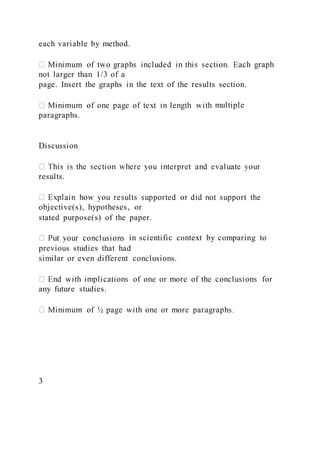
not larger than 1/3 of a
page. Insert the graphs in the text of the results section.
multiple
paragraphs.
Discussion
results.
objective(s), hypotheses, or
stated purpose(s) of the paper.
in scientific context by comparing to
previous studies that had
similar or even different conclusions.
any future studies.
3
References Sited
and only the references you
included in text.
minimum of two references.
l article reference.
o Jones, J. B. and Smith, R. L. 1980. Key findings by The Flat-
Earth Society. Journal
of Alternative Earths, 50, p. 210-244.
Minimum Requirements
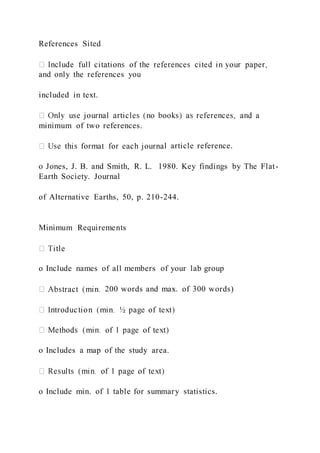
o Include names of all members of your lab group
200 words and max. of 300 words)
o Includes a map of the study area.
o Include min. of 1 table for summary statistics.
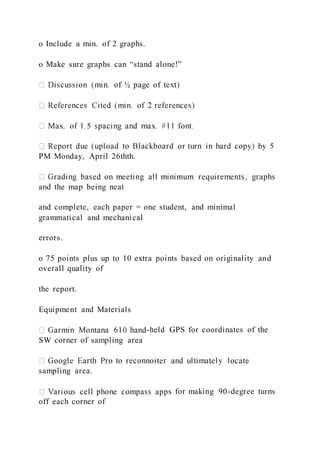
o Include a min. of 2 graphs.
o Make sure graphs can “stand alone!”
PM Monday, April 26thth.
and the map being neat
and complete, each paper = one student, and minimal
grammatical and mechanical
errors.
o 75 points plus up to 10 extra points based on originality and
overall quality of
the report.
Equipment and Materials
-held GPS for coordinates of the
SW corner of sampling area
sampling area.
s for making 90-degree turns
off each corner of
sampling area
-meter calibrated rope for delineating each sampling cell.
for
randomly determining location of
belt transect and plots.
4
DB 5
Sara Rooks
COLLAPSE
Top of Form
It appears that many healthcare administrators/managers join
the career field for many different reasons. After reading
chapter 4 of the textbook it is evident that many are interested
in the career field for different areas of interest. In healthcare,
there is a huge variety of different directions to go. So, while
their may be many common themes it maybe because you can
possibly take it any different direction as one chooses to best fit
their personality and strengths, skills and abilities that best suit
them. (Buchbinder, 2010)
Last week I interviewed my boss, he is a manager of a
dialysis center. I found it interesting to learn more about him.
He was attending school for education and realized that he was
not interested in pursing that as a career. After talking to his
advisor, she suggested he may consider nursing as he was
showing interest in science and anatomy. He did go on to
pursue his education receiving an associate in nursing. While
working as an RN he learned his wife had a kidney disease that
he was eager to learn about. Essentially this drew him to
become an RN in a dialysis clinic and later to become the
manager. He is still unsure of where he wants to go in his
career but one thing, he said is that he wants to be part of
something good.
I noticed that wanting to be part of something “to do
good” is a common theme. Reading through all the interviews
from chapter 4 of the textbook I noticed that most had a purpose
or desire to make a difference or have an impact to better
another’s life. What is means “to do good” greatly varies or
looks different to each person due to their talents, skills, and
abilities. The book discussed non-direct and direct care and
each area can lead to much different paths. Non-direct care can
be closely affiliated with direct care and as some mentioned
while being interviewed, every position has some impact in the
outcome.
Key themes as Identified by Practicing Healthcare
Managers… Buchbinder (2010, pg. 196)
· Interest in the Profession and Satisfaction
-Healthcare managers seem immense satisfaction in their
individual roles.
· Role of Mentors
-Mentors such peers, bosses, professors, parents, and colleagues
have been significant sources of influence and have contributes
to personal managerial success.
· Variation in Preparation, Experiences, and Roles
· Managers have a different variation of roles within an
organization, prior work experiences, and education
preparation. Many different paths lead to the type of career in
healthcare management that may interest you.
· Challenges faced by Healthcare Managers
-Managers face significant professional challenges coming from
internal and external sources.
Four major themes have been identified for
preferences in a favorable nursing work environment. Themes
found were nursing practice/unit characteristics,
managers/leadership, and team relations. To help ensure
desired outcomes, leaders may consider providing adequate
staffing, seeking input regarding pay and benefits, encouraging
self-development, educational opportunities, and mentorship,
and exploring areas of improvement to improve staff
interaction. (Campbell, 2020)
Proverbs 27:16-18 restraining her is like holding back
the wind or grasping oil with one’s right hand. 17 As iron
sharpens iron, so one man sharpens another. 18 Whoever tends a
fig tree will eat its fruit, and he who looks after his master will
be honored…
References
Buchbinder, S. (2010). Career Opportunities in Health Care
Management. Michael Brown
Campbell, C. M., & Patrician, P. A. (2020). Generational
preferences in the nursing work environment: A dimensional
concept analysis. Journal of Nursing Management, 28(4), 927-
937. https://doi.org/10.1111/jonm.13024
ReplyQuoteEmail Author
Bottom of Form
2 hours ago
Kristy Britt
RE: DB 5
COLLAPSE
Top of Form
Dear Sara,
Thank you for your very inciteful discussion post this
week, I really enjoyed reading about the interview between you
and your manager. The factors that influenced him to follow the
career path he is currently in is a beautiful testimony to the
person he is. “Who are those who fear the Lord? He will show
them the path they should choose” (Psalms 25:12, 2006, New
Living Translation).
Experiences throughout one’s life and career journey
play a major role in where a person is led and what they are led
to do. “Many managers began with some exposure to health
services while in high school or college, the military services,
or through personal or family circumstances with health and
disability” (Buchbinder & Thompson, 2010, p. 198) The
combination of these exposures and experiences will guide
individuals through life and may have a significant impact on
their choices. There are so many managerial positions within
the healthcare industry and therefore options are endless with
education and experience, which is one reason why this industry
is very desired. Some managers over the years have had the
opportunity to move into manager positions without furthering
their education while others have obtained higher degrees to
qualify for the same position. Along with experience
influencing a person’s career choices there are also three other
factors that play a role such as intrinsic, extrinsic, and
interpersonal factors and this varies from culture to culture.
Intrinsic factors include personal interests, personality traits,
and professional advancement. Interpersonal factors include
influences throughout a person’s life such as support form
parents, family bond, status, peer influence and interactions
from teachers, counselors through school, and other educators.
Research that Akosah-Twumasi, P. et al (2018), conducted
found that depending on what country a person is from will also
depict what factors are more influential, here in the United
States intrinsic and interpersonal factors have a greater impact
than extrinsic factors in someone’s career choices.
Mentors contribute significantly to the personal and
career success that a person may have. Companies who have
implemented mentor programs for new hires have seen less of a
turnover rate and more employee satisfaction. “Mentoring
programs are widely used by organizations as a key means to
support both employee career development and retention”
(Banerjee-Batist, R., et al, 2018, p. 1). Normally in a work
environment a mentor is there to help support the new hire,
train them, give advice, and encourage them. Adequate training
that is provided in a positive manner is huge for a company and
new employees. As we have learned through this course not all
manager positions are the same and not all require the same
skill set so therefore one may or may not be proficient in one
area does not mean they cannot perform that duty, it may mean
they just need more training in that area.
Job satisfaction is also popular factor among healthcare
managers, “Job satisfaction is a multidimensional response to
work and workplace environment. It depends on many factors,
and affects the behavior of employees that, in turn affects
organizational functioning” (Singh, T. et al, 2019, p. 1). Themes
that have been identified throughout healthcare managers and
their career journeys are all connected at some point, through
their personal interests and the satisfaction of this profession,
from the mentors throughout their lives, through life
experiences, and education all factors play a role in shaping
who we are.
Thank you again Sara for a very well written
discussion, I look forward to reading more throughout this
course.
References
Akosah-Twumasi, P., Emeto, T.I., Lindsay, D., Tsey, K., and
Malau-Aduli, B.S. (2018). A systematic review of factors that
influence youths career choices-the role of culture.
https://www.frontiersin.org/articles/10.3389/feduc.2018
.00058/full
Banerjee-Batist, R., Reio, Jr. T.G., and Rocco, T.S. (2018).
Mentoring functions and outcomes: An integrative literature
review of sociocultural factors and individual differences.
https://journals.sagepub.com/doi/10.1177/15344843188
10267
Buchbinder, S. B. and Thompson, J. M. (2010). Career
Opportunities in Health Care Management: Perspective
from the Field.
New Living Translation. (2006). YouVersion Bible
App. www.YouVersion.com
Singh, T., Kaur, M., Verma, M., and Kumar, R. (2019). Job
satisfaction among health care providers: A cross-
sectional study in public health facilities in Punjab, India.
https://www.ncbi.nlm.nih.gov/pmc/articles/PMC685739
1/
Bottom of Form
Lab Exercise 9_ Comparing Plant Density and Dominance in an
Upland Forest using Two Methods
Methods Summary
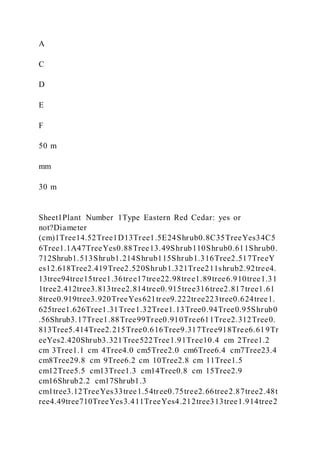
density and dominance in an
upland forest of the Northern Cross Timbers Ecoregion using
two different data-
collection methods.
ridded sampling area
table below)
method in the same sampling
area.
o Measure the diameter (cm) of every woody shrub and tree in
the randomly
selected belt transect below.
o Indicate if the woody plant is a shrub or tree, and if it is a red
cedar.
1 2 3
4 5
Each cell is 5 m x 10 m
B
A
C
D
E
F
50 m
mm
30 m
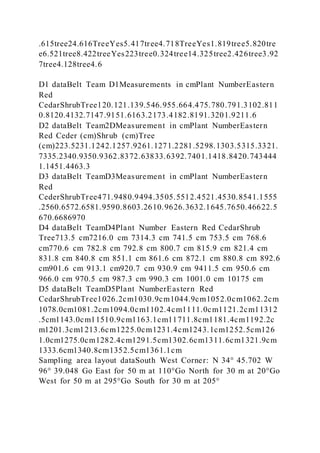
o Measure the diameter of every woody shrub and tree in each
of the randomly
selected cells (plots) below.
o Indicate if the woody plant is a shrub or tree, and if it is a red
cedar.
1 2 3
4 5
Each cell is 5 m x 10 m
B
A
C
D
E
F
50 m
mm
30 m
Sheet1Plant Number 1Type Eastern Red Cedar: yes or
not?Diameter
(cm)1Tree14.52Tree1D13Tree1.5E24Shrub0.8C35TreeYes34C5
6Tree1.1A47TreeYes0.88Tree13.49Shrub110Shrub0.611Shrub0.
712Shrub1.513Shrub1.214Shrub115Shrub1.316Tree2.517TreeY
es12.618Tree2.419Tree2.520Shrub1.321Tree211shrub2.92tree4.
13tree94tree15tree1.36tree17tree22.98tree1.89tree6.910tree1.31
1tree2.412tree3.813tree2.814tree0. 915tree316tree2.817tree1.61
8tree0.919tree3.920TreeYes621tree9.222tree223tree0.624tree1.
625tree1.626Tree1.31Tree1.32Tree1.13Tree0.94Tree0.95Shrub0
.56Shrub3.17Tree1.88Tree99Tree0.910Tree611Tree2.312Tree0.
813Tree5.414Tree2.215Tree0.616Tree9.317Tree918Tree6.619Tr
eeYes2.420Shrub3.321Tree522Tree1.91Tree10.4 cm 2Tree1.2
cm 3Tree1.1 cm 4Tree4.0 cm5Tree2.0 cm6Tree6.4 cm7Tree23.4
cm8Tree29.8 cm 9Tree6.2 cm 10Tree2.8 cm 11Tree1.5
cm12Tree5.5 cm13Tree1.3 cm14Tree0.8 cm 15Tree2.9
cm16Shrub2.2 cm17Shrub1.3
cm1tree3.12TreeYes33tree1.54tree0.75tree2.66tree2.87tree2.48t
ree4.49tree710TreeYes3.411TreeYes4.212tree313tree1.914tree2
.615tree24.616TreeYes5.417tree4.718TreeYes1.819tree5.820tre
e6.521tree8.422treeYes223tree0.324tree14.325tree2.426tree3.92
7tree4.128tree4.6
D1 dataBelt Team D1Measurements in cmPlant NumberEastern
Red
CedarShrubTree120.121.139.546.955.664.475.780.791.3102.811
0.8120.4132.7147.9151.6163.2173.4182.8191.3201.9211.6
D2 dataBelt Team2DMeasurement in cmPlant NumberEastern
Red Ceder (cm)Shrub (cm)Tree
(cm)223.5231.1242.1257.9261.1271.2281.5298.1303.5315.3321.
7335.2340.9350.9362.8372.63833.6392.7401.1418.8420.743444
1.1451.4463.3
D3 dataBelt TeamD3Measurement in cmPlant NumberEastern
Red
CederShrubTree471.9480.9494.3505.5512.4521.4530.8541.1555
.2560.6572.6581.9590.8603.2610.9626.3632.1645.7650.46622.5
670.6686970
D4 dataBelt TeamD4Plant Number Eastern Red CedarShrub
Tree713.5 cm7216.0 cm 7314.3 cm 741.5 cm 753.5 cm 768.6
cm770.6 cm 782.8 cm 792.8 cm 800.7 cm 815.9 cm 821.4 cm
831.8 cm 840.8 cm 851.1 cm 861.6 cm 872.1 cm 880.8 cm 892.6
cm901.6 cm 913.1 cm920.7 cm 930.9 cm 9411.5 cm 950.6 cm
966.0 cm 970.5 cm 987.3 cm 990.3 cm 1001.0 cm 10175 cm
D5 dataBelt TeamD5Plant NumberEastern Red
CedarShrubTree1026.2cm1030.9cm1044.9cm1052.0cm1062.2cm
1078.0cm1081.2cm1094.0cm1102.4cm1111.0cm1121.2cm11312
.5cm1143.0cm11510.9cm1163.1cm11711.8cm1181.4cm1192.2c
m1201.3cm1213.6cm1225.0cm1231.4cm1243.1cm1252.5cm126
1.0cm1275.0cm1282.4cm1291.5cm1302.6cm1311.6cm1321.9cm
1333.6cm1340.8cm1352.5cm1361.1cm
Sampling area layout dataSouth West Corner: N 34° 45.702 W
96° 39.048 Go East for 50 m at 110°Go North for 30 m at 20°Go
West for 50 m at 295°Go South for 30 m at 205°
1  Lab 9 Comparison of Two Field Methods in a Scien

1 Lab 9 Comparison of Two Field Methods in a Scien

  • 1.
    1 Lab 9: Comparisonof Two Field Methods in a Scientific Report/Paper Format Minimum Content of the Scientific Report Title paper. Your title will be what is most commonly cited and will be the “target” of topical searches via the internet. Choose your words carefully. As short and as concise a title as possible is best. waiting until after completing the report to finalize the title. Abstract could stand-alone as a publication. The abstract should include, in order: a summary of the introduction, methods, results, and discussion. However, you may include only key results and key discussion points in the abstract. Do not include reference to
  • 2.
    figures and tables,and don’t use abbreviations. Don’t include references in the abstract. This is the hardest section of the paper to write, and should be written after you complete the other sections. - paragraph format. Introduction why you are doing the study, i.e., the basis for your study. previous studies that support the basis for your study, but not the results or discussion or conclusions drawn from the results of your project. these observations or results from previous studies with the questions or hypotheses of your study. summarizes the setting, scope, and justification or importance of the study. This is a lead-in paragraph to the rest of the paper. paragraphs.
  • 3.
    2 Methods -by-step, description ofhow you did the study. below). or other applications used to input, manage, graph, or analyze the data. dard or previously published methods used. duplicate your study or conduct a similar study with only your methods section available. , and plot and belt transect in the sampling area.
  • 4.
    paragraphs. Results tables and graphs youhave. and/or results of statistical analyses. -es). h data set (plot and belt transect) including the mean, maximum, minimum, variance and standard deviation. -es), include the result of each statistical analysis that supports a result(s) as below. o ….there was no statistically significant difference (df=9, p>0.05, t=3.89) between mean species diversity scores…. interpretations in this section; only stating what you found. at includes summary statistics for
  • 5.
    each variable bymethod. not larger than 1/3 of a page. Insert the graphs in the text of the results section. multiple paragraphs. Discussion results. objective(s), hypotheses, or stated purpose(s) of the paper. in scientific context by comparing to previous studies that had similar or even different conclusions. any future studies. 3
  • 6.
    References Sited and onlythe references you included in text. minimum of two references. l article reference. o Jones, J. B. and Smith, R. L. 1980. Key findings by The Flat- Earth Society. Journal of Alternative Earths, 50, p. 210-244. Minimum Requirements o Include names of all members of your lab group 200 words and max. of 300 words) o Includes a map of the study area. o Include min. of 1 table for summary statistics.
  • 7.
    o Include amin. of 2 graphs. o Make sure graphs can “stand alone!” PM Monday, April 26thth. and the map being neat and complete, each paper = one student, and minimal grammatical and mechanical errors. o 75 points plus up to 10 extra points based on originality and overall quality of the report. Equipment and Materials -held GPS for coordinates of the SW corner of sampling area sampling area. s for making 90-degree turns off each corner of
  • 8.
    sampling area -meter calibratedrope for delineating each sampling cell. for randomly determining location of belt transect and plots. 4 DB 5 Sara Rooks COLLAPSE Top of Form It appears that many healthcare administrators/managers join the career field for many different reasons. After reading chapter 4 of the textbook it is evident that many are interested
  • 9.
    in the careerfield for different areas of interest. In healthcare, there is a huge variety of different directions to go. So, while their may be many common themes it maybe because you can possibly take it any different direction as one chooses to best fit their personality and strengths, skills and abilities that best suit them. (Buchbinder, 2010) Last week I interviewed my boss, he is a manager of a dialysis center. I found it interesting to learn more about him. He was attending school for education and realized that he was not interested in pursing that as a career. After talking to his advisor, she suggested he may consider nursing as he was showing interest in science and anatomy. He did go on to pursue his education receiving an associate in nursing. While working as an RN he learned his wife had a kidney disease that he was eager to learn about. Essentially this drew him to become an RN in a dialysis clinic and later to become the manager. He is still unsure of where he wants to go in his career but one thing, he said is that he wants to be part of something good. I noticed that wanting to be part of something “to do good” is a common theme. Reading through all the interviews from chapter 4 of the textbook I noticed that most had a purpose or desire to make a difference or have an impact to better another’s life. What is means “to do good” greatly varies or looks different to each person due to their talents, skills, and abilities. The book discussed non-direct and direct care and each area can lead to much different paths. Non-direct care can be closely affiliated with direct care and as some mentioned while being interviewed, every position has some impact in the outcome. Key themes as Identified by Practicing Healthcare Managers… Buchbinder (2010, pg. 196) · Interest in the Profession and Satisfaction -Healthcare managers seem immense satisfaction in their individual roles. · Role of Mentors
  • 10.
    -Mentors such peers,bosses, professors, parents, and colleagues have been significant sources of influence and have contributes to personal managerial success. · Variation in Preparation, Experiences, and Roles · Managers have a different variation of roles within an organization, prior work experiences, and education preparation. Many different paths lead to the type of career in healthcare management that may interest you. · Challenges faced by Healthcare Managers -Managers face significant professional challenges coming from internal and external sources. Four major themes have been identified for preferences in a favorable nursing work environment. Themes found were nursing practice/unit characteristics, managers/leadership, and team relations. To help ensure desired outcomes, leaders may consider providing adequate staffing, seeking input regarding pay and benefits, encouraging self-development, educational opportunities, and mentorship, and exploring areas of improvement to improve staff interaction. (Campbell, 2020) Proverbs 27:16-18 restraining her is like holding back the wind or grasping oil with one’s right hand. 17 As iron sharpens iron, so one man sharpens another. 18 Whoever tends a fig tree will eat its fruit, and he who looks after his master will be honored… References Buchbinder, S. (2010). Career Opportunities in Health Care Management. Michael Brown Campbell, C. M., & Patrician, P. A. (2020). Generational preferences in the nursing work environment: A dimensional concept analysis. Journal of Nursing Management, 28(4), 927- 937. https://doi.org/10.1111/jonm.13024
  • 11.
    ReplyQuoteEmail Author Bottom ofForm 2 hours ago Kristy Britt RE: DB 5 COLLAPSE Top of Form Dear Sara, Thank you for your very inciteful discussion post this week, I really enjoyed reading about the interview between you and your manager. The factors that influenced him to follow the career path he is currently in is a beautiful testimony to the person he is. “Who are those who fear the Lord? He will show them the path they should choose” (Psalms 25:12, 2006, New Living Translation). Experiences throughout one’s life and career journey play a major role in where a person is led and what they are led to do. “Many managers began with some exposure to health services while in high school or college, the military services, or through personal or family circumstances with health and disability” (Buchbinder & Thompson, 2010, p. 198) The combination of these exposures and experiences will guide individuals through life and may have a significant impact on their choices. There are so many managerial positions within the healthcare industry and therefore options are endless with education and experience, which is one reason why this industry is very desired. Some managers over the years have had the opportunity to move into manager positions without furthering their education while others have obtained higher degrees to qualify for the same position. Along with experience influencing a person’s career choices there are also three other
  • 12.
    factors that playa role such as intrinsic, extrinsic, and interpersonal factors and this varies from culture to culture. Intrinsic factors include personal interests, personality traits, and professional advancement. Interpersonal factors include influences throughout a person’s life such as support form parents, family bond, status, peer influence and interactions from teachers, counselors through school, and other educators. Research that Akosah-Twumasi, P. et al (2018), conducted found that depending on what country a person is from will also depict what factors are more influential, here in the United States intrinsic and interpersonal factors have a greater impact than extrinsic factors in someone’s career choices. Mentors contribute significantly to the personal and career success that a person may have. Companies who have implemented mentor programs for new hires have seen less of a turnover rate and more employee satisfaction. “Mentoring programs are widely used by organizations as a key means to support both employee career development and retention” (Banerjee-Batist, R., et al, 2018, p. 1). Normally in a work environment a mentor is there to help support the new hire, train them, give advice, and encourage them. Adequate training that is provided in a positive manner is huge for a company and new employees. As we have learned through this course not all manager positions are the same and not all require the same skill set so therefore one may or may not be proficient in one area does not mean they cannot perform that duty, it may mean they just need more training in that area. Job satisfaction is also popular factor among healthcare managers, “Job satisfaction is a multidimensional response to work and workplace environment. It depends on many factors, and affects the behavior of employees that, in turn affects organizational functioning” (Singh, T. et al, 2019, p. 1). Themes that have been identified throughout healthcare managers and their career journeys are all connected at some point, through their personal interests and the satisfaction of this profession, from the mentors throughout their lives, through life
  • 13.
    experiences, and educationall factors play a role in shaping who we are. Thank you again Sara for a very well written discussion, I look forward to reading more throughout this course. References Akosah-Twumasi, P., Emeto, T.I., Lindsay, D., Tsey, K., and Malau-Aduli, B.S. (2018). A systematic review of factors that influence youths career choices-the role of culture. https://www.frontiersin.org/articles/10.3389/feduc.2018 .00058/full Banerjee-Batist, R., Reio, Jr. T.G., and Rocco, T.S. (2018). Mentoring functions and outcomes: An integrative literature review of sociocultural factors and individual differences. https://journals.sagepub.com/doi/10.1177/15344843188 10267 Buchbinder, S. B. and Thompson, J. M. (2010). Career Opportunities in Health Care Management: Perspective from the Field. New Living Translation. (2006). YouVersion Bible App. www.YouVersion.com Singh, T., Kaur, M., Verma, M., and Kumar, R. (2019). Job satisfaction among health care providers: A cross- sectional study in public health facilities in Punjab, India. https://www.ncbi.nlm.nih.gov/pmc/articles/PMC685739 1/ Bottom of Form
  • 14.
    Lab Exercise 9_Comparing Plant Density and Dominance in an Upland Forest using Two Methods Methods Summary density and dominance in an upland forest of the Northern Cross Timbers Ecoregion using two different data- collection methods. ridded sampling area table below) method in the same sampling area. o Measure the diameter (cm) of every woody shrub and tree in the randomly selected belt transect below. o Indicate if the woody plant is a shrub or tree, and if it is a red cedar.
  • 15.
    1 2 3 45 Each cell is 5 m x 10 m B A C D E F 50 m mm 30 m
  • 16.
    o Measure thediameter of every woody shrub and tree in each of the randomly selected cells (plots) below. o Indicate if the woody plant is a shrub or tree, and if it is a red cedar. 1 2 3 4 5 Each cell is 5 m x 10 m B
  • 17.
    A C D E F 50 m mm 30 m Sheet1PlantNumber 1Type Eastern Red Cedar: yes or not?Diameter (cm)1Tree14.52Tree1D13Tree1.5E24Shrub0.8C35TreeYes34C5 6Tree1.1A47TreeYes0.88Tree13.49Shrub110Shrub0.611Shrub0. 712Shrub1.513Shrub1.214Shrub115Shrub1.316Tree2.517TreeY es12.618Tree2.419Tree2.520Shrub1.321Tree211shrub2.92tree4. 13tree94tree15tree1.36tree17tree22.98tree1.89tree6.910tree1.31 1tree2.412tree3.813tree2.814tree0. 915tree316tree2.817tree1.61 8tree0.919tree3.920TreeYes621tree9.222tree223tree0.624tree1. 625tree1.626Tree1.31Tree1.32Tree1.13Tree0.94Tree0.95Shrub0 .56Shrub3.17Tree1.88Tree99Tree0.910Tree611Tree2.312Tree0. 813Tree5.414Tree2.215Tree0.616Tree9.317Tree918Tree6.619Tr eeYes2.420Shrub3.321Tree522Tree1.91Tree10.4 cm 2Tree1.2 cm 3Tree1.1 cm 4Tree4.0 cm5Tree2.0 cm6Tree6.4 cm7Tree23.4 cm8Tree29.8 cm 9Tree6.2 cm 10Tree2.8 cm 11Tree1.5 cm12Tree5.5 cm13Tree1.3 cm14Tree0.8 cm 15Tree2.9 cm16Shrub2.2 cm17Shrub1.3 cm1tree3.12TreeYes33tree1.54tree0.75tree2.66tree2.87tree2.48t ree4.49tree710TreeYes3.411TreeYes4.212tree313tree1.914tree2
  • 18.
    .615tree24.616TreeYes5.417tree4.718TreeYes1.819tree5.820tre e6.521tree8.422treeYes223tree0.324tree14.325tree2.426tree3.92 7tree4.128tree4.6 D1 dataBelt TeamD1Measurements in cmPlant NumberEastern Red CedarShrubTree120.121.139.546.955.664.475.780.791.3102.811 0.8120.4132.7147.9151.6163.2173.4182.8191.3201.9211.6 D2 dataBelt Team2DMeasurement in cmPlant NumberEastern Red Ceder (cm)Shrub (cm)Tree (cm)223.5231.1242.1257.9261.1271.2281.5298.1303.5315.3321. 7335.2340.9350.9362.8372.63833.6392.7401.1418.8420.743444 1.1451.4463.3 D3 dataBelt TeamD3Measurement in cmPlant NumberEastern Red CederShrubTree471.9480.9494.3505.5512.4521.4530.8541.1555 .2560.6572.6581.9590.8603.2610.9626.3632.1645.7650.46622.5 670.6686970 D4 dataBelt TeamD4Plant Number Eastern Red CedarShrub Tree713.5 cm7216.0 cm 7314.3 cm 741.5 cm 753.5 cm 768.6 cm770.6 cm 782.8 cm 792.8 cm 800.7 cm 815.9 cm 821.4 cm 831.8 cm 840.8 cm 851.1 cm 861.6 cm 872.1 cm 880.8 cm 892.6 cm901.6 cm 913.1 cm920.7 cm 930.9 cm 9411.5 cm 950.6 cm 966.0 cm 970.5 cm 987.3 cm 990.3 cm 1001.0 cm 10175 cm D5 dataBelt TeamD5Plant NumberEastern Red CedarShrubTree1026.2cm1030.9cm1044.9cm1052.0cm1062.2cm 1078.0cm1081.2cm1094.0cm1102.4cm1111.0cm1121.2cm11312 .5cm1143.0cm11510.9cm1163.1cm11711.8cm1181.4cm1192.2c m1201.3cm1213.6cm1225.0cm1231.4cm1243.1cm1252.5cm126 1.0cm1275.0cm1282.4cm1291.5cm1302.6cm1311.6cm1321.9cm 1333.6cm1340.8cm1352.5cm1361.1cm Sampling area layout dataSouth West Corner: N 34° 45.702 W 96° 39.048 Go East for 50 m at 110°Go North for 30 m at 20°Go West for 50 m at 295°Go South for 30 m at 205°