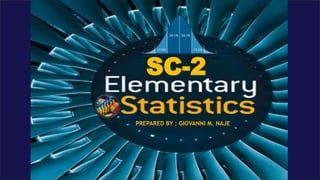
PREPARED BY : GIOVANNI M. NAJE
SC-2
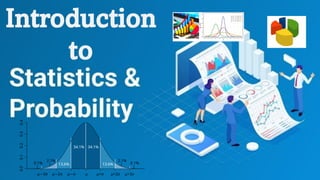
Introduction
to
DEFINITION OF STATISTICS
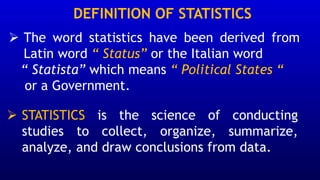
➢ The word statistics have been derived from
Latin word “ Status” or the Italian word
“ Statista” which means “ Political States “
or a Government.
➢ STATISTICS is the science of conducting
studies to collect, organize, summarize,
analyze, and draw conclusions from data.
APPLICATION OF STATISTICS
➢ In Education
➢ In business & economics
➢ In Government
➢ In sociology and population
dynamics
➢ In research
APPLICATION OF STATISTICS
In Education
➢ Statistics gives information about school’s population
change ( statistics in enrollment and dropout rate)
➢ helps in processing certain evaluations and surveys
given to improve the school system
➢ determine the relationship of educational
performance to other factors such as socioeconomic
background
➢ analyzes the achievement, grades and in preparations
of test (proficiency level)
APPLICATION OF STATISTICS
In business & economics/government
➢ Statistics plays an important role in market feasibility studies for
new products
➢ Forecast business trends (potentials of investments).
➢ Helps control and maintenance of quality products
➢ Improves the employer-employee relationship (labor relationship)
➢ Helps financial analyst make investment decisions (human
resources allocation)
➢ Analyzes the return on assets before taxes
➢ Provides organized records on the cost of living, taxes, wages and
material resources which is necessary for intelligent decision
making
APPLICATION OF STATISTICS
In sociology and population dynamics
➢Statistics helps in solving problems involving
man and society through statistical studies on
population movement, mortality, morbidity,
urban planning and labor movement.
➢Statistics is used for survey designed to collect
early returns on election day to forecast the
outcome of an election.
APPLICATION OF STATISTICS
In research
➢Statistics is used to test differences,
effectiveness, impact, relationship or
independence of some variables.
➢Statistics provides the researchers valuable
statistical design of surveys and experiments
which may lead to new discoveries.
DIVISION OF STATISTICS
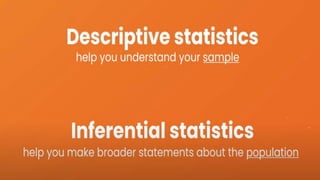
1.DECRIPTIVE STATISTICS – Consist of the collection,
organization, summarization, and presentation of
data.
- It is statistical procedure concerned with
describing the characteristics and properties of a
group of persons, places or things that was based
on easily verifiable facts.
- It organizes the presentation, description, and
interpretation of data gathered. It includes the
study of relationships among variables.
DIVISION OF STATISTICS
2.INFERENTIAL STATISTICS – consist of generalizing
from samples to population, performing estimations
and hypothesis tests, determining relationships
among variables, and making predictions.
- Statistical procedure used to draw inferences for
the population on the basis of information obtained
from the sample using the techniques of descriptive
statistics.
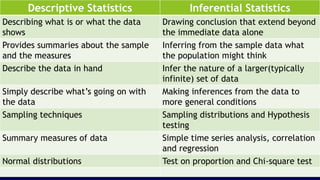
Descriptive Statistics Inferential Statistics
Describing what is or what the data
shows
Drawing conclusion that extend beyond
the immediate data alone
Provides summaries about the sample
and the measures
Inferring from the sample data what
the population might think
Describe the data in hand Infer the nature of a larger(typically
infinite) set of data
Simply describe what’s going on with
the data
Making inferences from the data to
more general conditions
Sampling techniques Sampling distributions and Hypothesis
testing
Summary measures of data Simple time series analysis, correlation
and regression
Normal distributions Test on proportion and Chi-square test
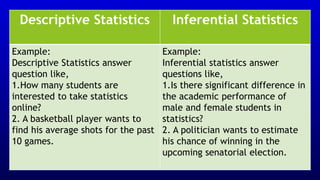
Descriptive Statistics Inferential Statistics
Example:
Descriptive Statistics answer
question like,
1.How many students are
interested to take statistics
online?
2. A basketball player wants to
find his average shots for the past
10 games.
Example:
Inferential statistics answer
questions like,
1.Is there significant difference in
the academic performance of
male and female students in
statistics?
2. A politician wants to estimate
his chance of winning in the
upcoming senatorial election.
"Mathematics is the language with
which God has written the universe.
In our modern world, it helps us
unlock the mysteries of science,
technology, and innovation.“
THANK You!
1. INTRO. TO ELEMENTARY STATISTICS. pdf.pdf

  • 1.
    PREPARED BY :GIOVANNI M. NAJE SC-2
  • 2.
  • 6.
    DEFINITION OF STATISTICS ➢The word statistics have been derived from Latin word “ Status” or the Italian word “ Statista” which means “ Political States “ or a Government. ➢ STATISTICS is the science of conducting studies to collect, organize, summarize, analyze, and draw conclusions from data.
  • 7.
    APPLICATION OF STATISTICS ➢In Education ➢ In business & economics ➢ In Government ➢ In sociology and population dynamics ➢ In research
  • 8.
    APPLICATION OF STATISTICS InEducation ➢ Statistics gives information about school’s population change ( statistics in enrollment and dropout rate) ➢ helps in processing certain evaluations and surveys given to improve the school system ➢ determine the relationship of educational performance to other factors such as socioeconomic background ➢ analyzes the achievement, grades and in preparations of test (proficiency level)
  • 9.
    APPLICATION OF STATISTICS Inbusiness & economics/government ➢ Statistics plays an important role in market feasibility studies for new products ➢ Forecast business trends (potentials of investments). ➢ Helps control and maintenance of quality products ➢ Improves the employer-employee relationship (labor relationship) ➢ Helps financial analyst make investment decisions (human resources allocation) ➢ Analyzes the return on assets before taxes ➢ Provides organized records on the cost of living, taxes, wages and material resources which is necessary for intelligent decision making
  • 10.
    APPLICATION OF STATISTICS Insociology and population dynamics ➢Statistics helps in solving problems involving man and society through statistical studies on population movement, mortality, morbidity, urban planning and labor movement. ➢Statistics is used for survey designed to collect early returns on election day to forecast the outcome of an election.
  • 11.
    APPLICATION OF STATISTICS Inresearch ➢Statistics is used to test differences, effectiveness, impact, relationship or independence of some variables. ➢Statistics provides the researchers valuable statistical design of surveys and experiments which may lead to new discoveries.
  • 12.
    DIVISION OF STATISTICS 1.DECRIPTIVESTATISTICS – Consist of the collection, organization, summarization, and presentation of data. - It is statistical procedure concerned with describing the characteristics and properties of a group of persons, places or things that was based on easily verifiable facts. - It organizes the presentation, description, and interpretation of data gathered. It includes the study of relationships among variables.
  • 13.
    DIVISION OF STATISTICS 2.INFERENTIALSTATISTICS – consist of generalizing from samples to population, performing estimations and hypothesis tests, determining relationships among variables, and making predictions. - Statistical procedure used to draw inferences for the population on the basis of information obtained from the sample using the techniques of descriptive statistics.
  • 14.
    Descriptive Statistics InferentialStatistics Describing what is or what the data shows Drawing conclusion that extend beyond the immediate data alone Provides summaries about the sample and the measures Inferring from the sample data what the population might think Describe the data in hand Infer the nature of a larger(typically infinite) set of data Simply describe what’s going on with the data Making inferences from the data to more general conditions Sampling techniques Sampling distributions and Hypothesis testing Summary measures of data Simple time series analysis, correlation and regression Normal distributions Test on proportion and Chi-square test
  • 15.
    Descriptive Statistics InferentialStatistics Example: Descriptive Statistics answer question like, 1.How many students are interested to take statistics online? 2. A basketball player wants to find his average shots for the past 10 games. Example: Inferential statistics answer questions like, 1.Is there significant difference in the academic performance of male and female students in statistics? 2. A politician wants to estimate his chance of winning in the upcoming senatorial election.
  • 50.
    "Mathematics is thelanguage with which God has written the universe. In our modern world, it helps us unlock the mysteries of science, technology, and innovation.“ THANK You!