Immunization
Biniyam Nigussie , MD
Goal
• To prevent disease in individuals.
(Immediate)
• To eradicate a communicable
disease. (Ultimate)
Definitions…
• Immunity  the ability of the body to
recognize and destroy foreign antigenic
material like bacteria, viruses and proteins
leading to resistance to infection.
• Innate immunity is the natural resistance of
the human being with in his genetic make up
to certain animal infection.
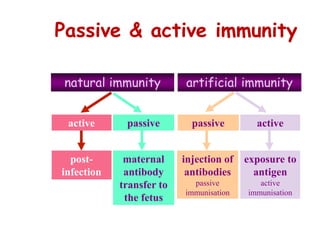
Passive & active immunity
natural immunity artificial immunity
post-
infection
active
maternal
antibody
transfer to
the fetus
passive
exposure to
antigen
active
immunisation
active
injection of
antibodies
passive
immunisation
passive
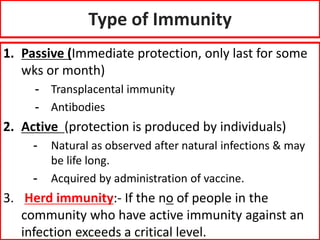
Type of Immunity
1. Passive (Immediate protection, only last for some
wks or month)
- Transplacental immunity
- Antibodies
2. Active (protection is produced by individuals)
- Natural as observed after natural infections & may
be life long.
- Acquired by administration of vaccine.
3. Herd immunity:- If the no of people in the
community who have active immunity against an
infection exceeds a critical level.
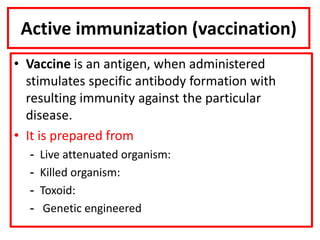
Active immunization (vaccination)
• Vaccine is an antigen, when administered
stimulates specific antibody formation with
resulting immunity against the particular
disease.
• It is prepared from
- Live attenuated organism:
- Killed organism:
- Toxoid:
- Genetic engineered
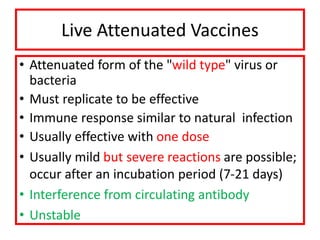
Live Attenuated Vaccines
• Attenuated form of the "wild type" virus or
bacteria
• Must replicate to be effective
• Immune response similar to natural infection
• Usually effective with one dose
• Usually mild but severe reactions are possible;
occur after an incubation period (7-21 days)
• Interference from circulating antibody
• Unstable
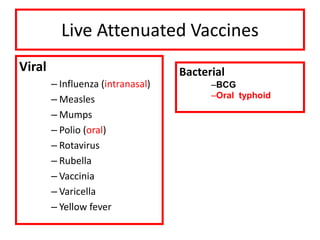
Live Attenuated Vaccines
Viral
‒ Influenza (intranasal)
‒ Measles
‒ Mumps
‒ Polio (oral)
‒ Rotavirus
‒ Rubella
‒ Vaccinia
‒ Varicella
‒ Yellow fever
Bacterial
‒BCG
‒Oral typhoid
Live-attenuated vaccines
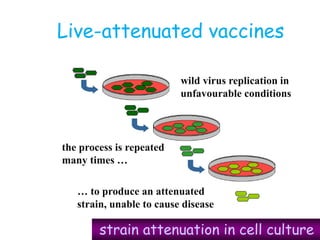
strain attenuation in cell culture
wild virus replication in
unfavourable conditions
the process is repeated
many times …
… to produce an attenuated
strain, unable to cause disease
Live-attenuated vaccines
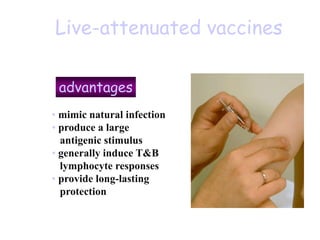
advantages
• mimic natural infection
• produce a large
antigenic stimulus
• generally induce T&B
lymphocyte responses
• provide long-lasting
protection
Live-attenuated vaccines
disadvantages
• may retain some pathogenicity
• may revert to virulence
• may not be safe enough to vaccinate highly
immuno-compromised subjects
• require a good cold chain
Inactivated Vaccines
• Cannot replicate
• Minimal interference from circulating antibody
• Generally not as effective as live vaccines
• Generally require 3-5 doses
• Immune response mostly humoral
• Antibody titer diminishes with time
Inactivated Vaccines
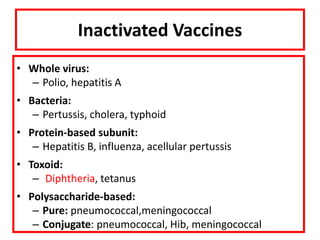
• Whole virus:
– Polio, hepatitis A
• Bacteria:
– Pertussis, cholera, typhoid
• Protein-based subunit:
– Hepatitis B, influenza, acellular pertussis
• Toxoid:
– Diphtheria, tetanus
• Polysaccharide-based:
– Pure: pneumococcal,meningococcal
– Conjugate: pneumococcal, Hib, meningococcal
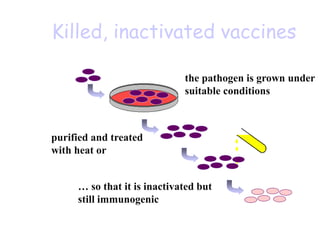
Killed, inactivated vaccines
the pathogen is grown under
suitable conditions
purified and treated
with heat or chemicals
… so that it is inactivated but
still immunogenic
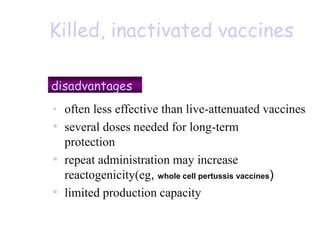
Killed, inactivated vaccines
disadvantages
• often less effective than live-attenuated vaccines
• several doses needed for long-term
protection
• repeat administration may increase
reactogenicity(eg, whole cell pertussis vaccines)
• limited production capacity & higher price
Determinants of the immune
response
• Chemical and physical state of the antigen
• Mode of administration
• Host factors –
– Age,
– Nutrition
– Preexisting antibodies
Advantages of immunization
• Saves the lives of millions of children.
• Very cost- effective.
• Led to global eradication of small pox.
• Elimination of poliomyelitis  some continents.
• More than 95% reduction of Haemophilus
Influenza type B desease.
• In USA it eliminated completely congenital
rubella syndrome, tetanus, polio and diphtheria
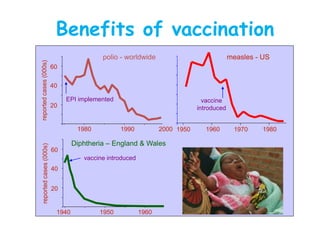
Benefits of vaccination
20
40
60
1980 1990 2000
polio - worldwide
reported
cases
(000s)
EPI implemented
1950 1960 1970 1980
measles - US
vaccine
introduced
20
40
60
1940 1950 1960
Diphtheria – England & Wales
reported
cases
(000s)
vaccine introduced
Expanded Program of
Immunization (EPI)/WHO
• Aims to provide free immunization
• Started in 1974
• Main purpose:
- Prevent childhood diseases
- Provide high quality vaccines
- Surveillance of these diseases
• Schedule of immunization is designed according to
epidemiological terms of diseases together with
sociocultural &economic factors.
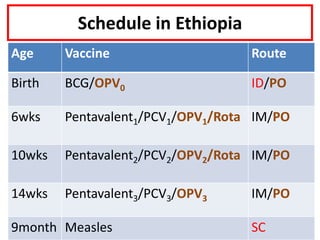
Schedule in Ethiopia
Age Vaccine Route
Birth BCG/OPV0 ID/PO
6wks Pentavalent1/PCV1/OPV1/Rota IM/PO
10wks Pentavalent2/PCV2/OPV2/Rota IM/PO
14wks Pentavalent3/PCV3/OPV3 IM/PO
9month Measles SC
EPI…
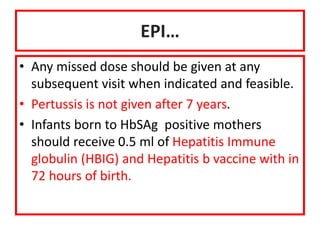
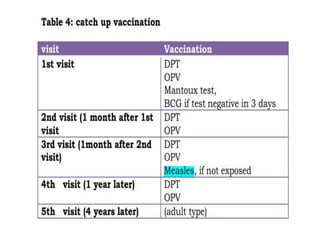
• Any missed dose should be given at any
subsequent visit when indicated and feasible.
• Pertussis is not given after 7 years.
• Infants born to HbSAg positive mothers
should receive 0.5 ml of Hepatitis Immune
globulin (HBIG) and Hepatitis b vaccine with in
72 hours of birth.
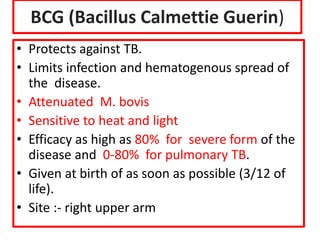
BCG (Bacillus Calmettie Guerin)
• Protects against TB.
• Limits infection and hematogenous spread of
the disease.
• Attenuated M. bovis
• Sensitive to heat and light
• Efficacy as high as 80% for severe form of the
disease and 0-80% for pulmonary TB.
• Given at birth of as soon as possible (3/12 of
life).
• Site :- right upper arm
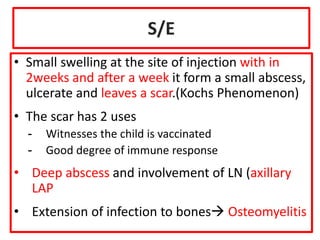
S/E
• Small swelling at the site of injection with in
2weeks and after a week it form a small abscess,
ulcerate and leaves a scar.(Kochs Phenomenon)
• The scar has 2 uses
- Witnesses the child is vaccinated
- Good degree of immune response
• Deep abscess and involvement of LN (axillary
LAP
• Extension of infection to bones Osteomyelitis
Oral Polio Virus
• Live attenuated viruses of the 3 and 2
types(Sabin).
• It produce life long local intestinal & systemic
immunity.
• Damaged by heat but not by freeze(Cryostable).
• 72-98% efficacy in hot climates , lower
protection against type III.
S/E
– Doesn’t have common S/E
– Rarely poliomyelitis has been reported(1:106 va)
Diarrhea give the vaccine and repeat to the
dose because it may not be effective.
Pentavalent Vaccine
• The Pentavalent vaccine combines five
different vaccines in one injection to protect
against
- Haemophilus influenzae type B (Hib) disease
- Diphtheria
- Pertussis
- Tetanus
- Hepatitis-B
Tetanus toxoid
• It is inactivated by heat and freeze.
• If the person has previously suffering from the
disease, he should be vaccinated.
• Booster injection should be given after every
5-10yrs.
• Efficacy:- >95% (>80% after 2 doses)
• S/E :- extremely rare.
Why?
• If the person has previously suffering from the
disease, he should be vaccinated.
Diphteria toxoid
• Damaged by freezing and heat.
• Efficacy:- >80%
• Duration of immunity: variable, probably
around 5 yrs
• S/E :- no significant adverse reaction have
been associated.
Pertussis vaccine
• It is killed B .pertusis
• Sensitive to heat.
• Efficacy:- variable; around 80% for severe
disease
• Duration of immunity:- unknown
• Dtap Vs Tdap
Precaution
• Never give to children >7yrs
S/E
• Fever (high grade), local soreness (3-4days), an
abscess at the site of injection, febrile
convulsion 0.3-9/100,000dose
• Permanent brain damage, encephalitis (0.3-
0.6/100,000dose & shock like state are
common >6months age
C/I
• Convulsion with in 3 days following vaccine.
• Shock like state
• High grade fever (400C)
• Progressive neurologic deficit
Hepatitis B vaccine
• It is inactivated product produced by genetic
engineering.
• It protects the child against hepatitis B.
• S/E= No
Haemophylus Influenzae Type B vaccine
• It consists of a capsular polysaccharide
conjugated to a protein.
• Keep it at +20C -+80C, don’t freeze
Pneumococcal Polysaccharide Vaccine
• Purified capsular polysaccharide antigen from 23
types of pneumococcus
• Account for 88% of bacteremic pneumococcal
disease
• Cross-react with types causing additional 8% of
disease
• Less effective in preventing pneumococcal
pneumonia
Problems with polysaccharide vaccine
• Not effective in children less than 2 years
• No effect on nasal carriage
• No herd effect
• ≈
• Absence of immunologic memory
• Antibody level to several serotypes decline to
pre-vaccination values within 3-7 years ≈ to a
decline of clinical protection
Conjugate Vaccine
• A new generation of pneumococcal vaccines
• Coating removal of the capsular
polysaccharide
• 7 (9, 10 or 13, …) types of saccharide is
separately activated and conjugated to protein
carrier
• Conjugates are mixed to formulate vaccine
Conjugate Vaccine
• Induce a T-cell dependent immune response.
• Protective even in children under two years of
age,
• May reduce pneumococcal transmission
through a herd effect
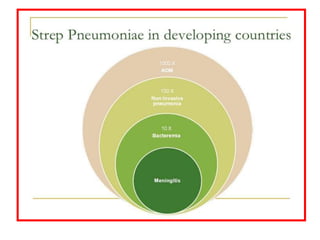
Pneumococcal Conjugate Vaccine
• Highly immunogenic in infants and young
children, including those with high risk medical
conditions
• >90% effective against invasive disease
• Less effective against pneumonia and acute
otitis media
Pneumococcal Conjugate Vaccine
• Routine vaccination of children age <24
months and children 24-59 months with high
risk medical conditions
• Doses at 6, 10 and 14weeks booster dose at
12-15 months
• Unvaccinated children >7 months require
fewer doses
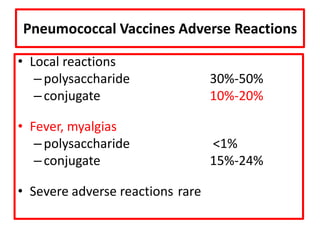
Pneumococcal Vaccines Adverse Reactions
• Local reactions
–polysaccharide 30%-50%
–conjugate 10%-20%
• Fever, myalgias
–polysaccharide <1%
–conjugate 15%-24%
• Severe adverse reactions rare
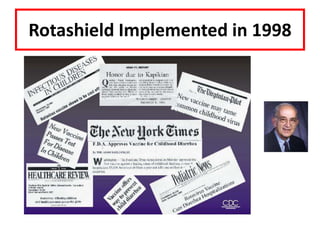
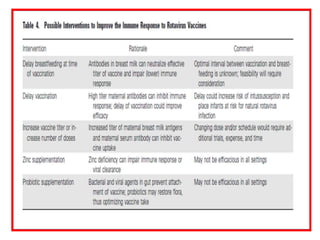
Rotashield Implemented in 1998
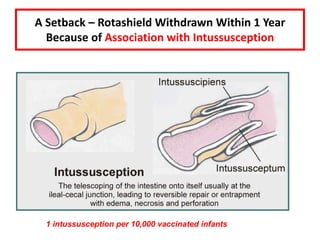
A Setback – Rotashield Withdrawn Within 1 Year
Because of Association with Intussusception
1 intussusception per 10,000 vaccinated infants
Licensed Rotavirus Vaccines
Rotarix® RotaTeq®
Safety = =
Efficacy 90-100% severe
74-85% any severity
90-100% severe
74-85% any severity
Antigen Monovalent HRV
G1P[8]
Pentavalent
bovinehuman
reassortant
Schedule 2 doses 3 doses
Protection against
severe infx
2 years 2 years
Measles
• Live attenuated measles virus.
• Damaged by heat.
• 9month is the age if given earlier the maternal
antibody will damage the vaccine.
• Some recommend the vaccine at the age of 6
month because there is risk of acquiring virus
at the age < 9months.
S/E
• Fever (after 1wk) & a mild measles like rash
self limited.
Causes of failure
a. Destroyed vaccine by improper storage
b. Sustained transplacental immunity that may
remain for up to 15months of age.
N.B
• Practically there are no major CI for
vaccination.
• No BCG for AIDS patient but can be given for
sero positive children.
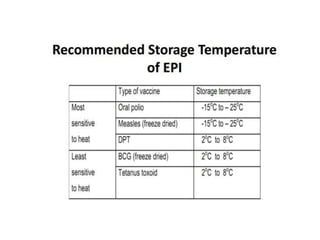
• Potentially depends on the Cold Chain (I.e. a
system of storage
• T0 maintained all the way b/n the site of
production & site of administration (+2oC-
+0.80C)
Strategies to Boost the coverage
• If the child is well enough to go home , he so
after immunized
• Mild or moderate illness, fever, malnutrition
can be vaccinated.
- Vaccinate children who come for other illness.
- Educate mother very well to reduce the no of
defaulters.
Mass Immunizations
• Used in regions or countries where the
immunization rate is low.
• Control an unexpected out-breaks.
• Contraindication
• Anaphylactic reaction, Shock like state
• Moderate to severe illness
• Live-attenuated vaccines for severely
immunosuppressed patients (exception is
measles) C
• Convulsion with in 3 days following vaccine.
• High grade fever (40C)
• Progressive neurologic deficit (GBS)
• The following are not contraindications
Moderate fever after prior vaccine dose
Moderate local reaction after inject able vaccine
Minor illness with fever <38.5⁰c
Prematurity
Malnutrition
Family history of convulsion
Treatment with antibiotics, low dose corticosteroids
or locally acting steroids
Chronic diseases of the heart, lung, kidney and liver
Stable neurological conditions like cerebral palsy and
down syndrome
History of jaundice after birth
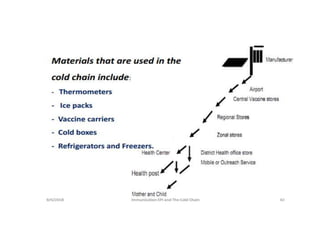
The Cold Chain
• Vaccines are sensitive to heat and freezing.
• They must be kept and transported at the correct
temperature from time of manufacturing to
administration.
• The System used for keeping and distributing
vaccines in good condition is called The Cold Chain
• Its main role is to maintain potency of vaccines.
• It consists of a series of storage and transport links
1 Immunization.pptjjjjjjjhgjfxfffffddddd

1 Immunization.pptjjjjjjjhgjfxfffffddddd

  • 1.
  • 2.
    Goal • To preventdisease in individuals. (Immediate) • To eradicate a communicable disease. (Ultimate)
  • 3.
    Definitions… • Immunity the ability of the body to recognize and destroy foreign antigenic material like bacteria, viruses and proteins leading to resistance to infection. • Innate immunity is the natural resistance of the human being with in his genetic make up to certain animal infection.
  • 4.
    Passive & activeimmunity natural immunity artificial immunity post- infection active maternal antibody transfer to the fetus passive exposure to antigen active immunisation active injection of antibodies passive immunisation passive
  • 5.
    Type of Immunity 1.Passive (Immediate protection, only last for some wks or month) - Transplacental immunity - Antibodies 2. Active (protection is produced by individuals) - Natural as observed after natural infections & may be life long. - Acquired by administration of vaccine. 3. Herd immunity:- If the no of people in the community who have active immunity against an infection exceeds a critical level.
  • 6.
    Active immunization (vaccination) •Vaccine is an antigen, when administered stimulates specific antibody formation with resulting immunity against the particular disease. • It is prepared from - Live attenuated organism: - Killed organism: - Toxoid: - Genetic engineered
  • 7.
    Live Attenuated Vaccines •Attenuated form of the "wild type" virus or bacteria • Must replicate to be effective • Immune response similar to natural infection • Usually effective with one dose • Usually mild but severe reactions are possible; occur after an incubation period (7-21 days) • Interference from circulating antibody • Unstable
  • 8.
    Live Attenuated Vaccines Viral ‒Influenza (intranasal) ‒ Measles ‒ Mumps ‒ Polio (oral) ‒ Rotavirus ‒ Rubella ‒ Vaccinia ‒ Varicella ‒ Yellow fever Bacterial ‒BCG ‒Oral typhoid
  • 9.
    Live-attenuated vaccines strain attenuationin cell culture wild virus replication in unfavourable conditions the process is repeated many times … … to produce an attenuated strain, unable to cause disease
  • 10.
    Live-attenuated vaccines advantages • mimicnatural infection • produce a large antigenic stimulus • generally induce T&B lymphocyte responses • provide long-lasting protection
  • 11.
    Live-attenuated vaccines disadvantages • mayretain some pathogenicity • may revert to virulence • may not be safe enough to vaccinate highly immuno-compromised subjects • require a good cold chain
  • 12.
    Inactivated Vaccines • Cannotreplicate • Minimal interference from circulating antibody • Generally not as effective as live vaccines • Generally require 3-5 doses • Immune response mostly humoral • Antibody titer diminishes with time
  • 13.
    Inactivated Vaccines • Wholevirus: – Polio, hepatitis A • Bacteria: – Pertussis, cholera, typhoid • Protein-based subunit: – Hepatitis B, influenza, acellular pertussis • Toxoid: – Diphtheria, tetanus • Polysaccharide-based: – Pure: pneumococcal,meningococcal – Conjugate: pneumococcal, Hib, meningococcal
  • 14.
    Killed, inactivated vaccines thepathogen is grown under suitable conditions purified and treated with heat or chemicals … so that it is inactivated but still immunogenic
  • 15.
    Killed, inactivated vaccines disadvantages •often less effective than live-attenuated vaccines • several doses needed for long-term protection • repeat administration may increase reactogenicity(eg, whole cell pertussis vaccines) • limited production capacity & higher price
  • 16.
    Determinants of theimmune response • Chemical and physical state of the antigen • Mode of administration • Host factors – – Age, – Nutrition – Preexisting antibodies
  • 17.
    Advantages of immunization •Saves the lives of millions of children. • Very cost- effective. • Led to global eradication of small pox. • Elimination of poliomyelitis  some continents. • More than 95% reduction of Haemophilus Influenza type B desease. • In USA it eliminated completely congenital rubella syndrome, tetanus, polio and diphtheria
  • 18.
    Benefits of vaccination 20 40 60 19801990 2000 polio - worldwide reported cases (000s) EPI implemented 1950 1960 1970 1980 measles - US vaccine introduced 20 40 60 1940 1950 1960 Diphtheria – England & Wales reported cases (000s) vaccine introduced
  • 19.
    Expanded Program of Immunization(EPI)/WHO • Aims to provide free immunization • Started in 1974 • Main purpose: - Prevent childhood diseases - Provide high quality vaccines - Surveillance of these diseases • Schedule of immunization is designed according to epidemiological terms of diseases together with sociocultural &economic factors.
  • 20.
    Schedule in Ethiopia AgeVaccine Route Birth BCG/OPV0 ID/PO 6wks Pentavalent1/PCV1/OPV1/Rota IM/PO 10wks Pentavalent2/PCV2/OPV2/Rota IM/PO 14wks Pentavalent3/PCV3/OPV3 IM/PO 9month Measles SC
  • 21.
    EPI… • Any misseddose should be given at any subsequent visit when indicated and feasible. • Pertussis is not given after 7 years. • Infants born to HbSAg positive mothers should receive 0.5 ml of Hepatitis Immune globulin (HBIG) and Hepatitis b vaccine with in 72 hours of birth.
  • 23.
    BCG (Bacillus CalmettieGuerin) • Protects against TB. • Limits infection and hematogenous spread of the disease. • Attenuated M. bovis • Sensitive to heat and light • Efficacy as high as 80% for severe form of the disease and 0-80% for pulmonary TB. • Given at birth of as soon as possible (3/12 of life). • Site :- right upper arm
  • 24.
    S/E • Small swellingat the site of injection with in 2weeks and after a week it form a small abscess, ulcerate and leaves a scar.(Kochs Phenomenon) • The scar has 2 uses - Witnesses the child is vaccinated - Good degree of immune response • Deep abscess and involvement of LN (axillary LAP • Extension of infection to bones Osteomyelitis
  • 25.
    Oral Polio Virus •Live attenuated viruses of the 3 and 2 types(Sabin). • It produce life long local intestinal & systemic immunity. • Damaged by heat but not by freeze(Cryostable). • 72-98% efficacy in hot climates , lower protection against type III. S/E – Doesn’t have common S/E – Rarely poliomyelitis has been reported(1:106 va) Diarrhea give the vaccine and repeat to the dose because it may not be effective.
  • 26.
    Pentavalent Vaccine • ThePentavalent vaccine combines five different vaccines in one injection to protect against - Haemophilus influenzae type B (Hib) disease - Diphtheria - Pertussis - Tetanus - Hepatitis-B
  • 27.
    Tetanus toxoid • Itis inactivated by heat and freeze. • If the person has previously suffering from the disease, he should be vaccinated. • Booster injection should be given after every 5-10yrs. • Efficacy:- >95% (>80% after 2 doses) • S/E :- extremely rare.
  • 28.
    Why? • If theperson has previously suffering from the disease, he should be vaccinated.
  • 29.
    Diphteria toxoid • Damagedby freezing and heat. • Efficacy:- >80% • Duration of immunity: variable, probably around 5 yrs • S/E :- no significant adverse reaction have been associated.
  • 30.
    Pertussis vaccine • Itis killed B .pertusis • Sensitive to heat. • Efficacy:- variable; around 80% for severe disease • Duration of immunity:- unknown • Dtap Vs Tdap
  • 31.
    Precaution • Never giveto children >7yrs S/E • Fever (high grade), local soreness (3-4days), an abscess at the site of injection, febrile convulsion 0.3-9/100,000dose • Permanent brain damage, encephalitis (0.3- 0.6/100,000dose & shock like state are common >6months age
  • 32.
    C/I • Convulsion within 3 days following vaccine. • Shock like state • High grade fever (400C) • Progressive neurologic deficit
  • 33.
    Hepatitis B vaccine •It is inactivated product produced by genetic engineering. • It protects the child against hepatitis B. • S/E= No Haemophylus Influenzae Type B vaccine • It consists of a capsular polysaccharide conjugated to a protein. • Keep it at +20C -+80C, don’t freeze
  • 35.
    Pneumococcal Polysaccharide Vaccine •Purified capsular polysaccharide antigen from 23 types of pneumococcus • Account for 88% of bacteremic pneumococcal disease • Cross-react with types causing additional 8% of disease • Less effective in preventing pneumococcal pneumonia
  • 36.
    Problems with polysaccharidevaccine • Not effective in children less than 2 years • No effect on nasal carriage • No herd effect • ≈ • Absence of immunologic memory • Antibody level to several serotypes decline to pre-vaccination values within 3-7 years ≈ to a decline of clinical protection
  • 37.
    Conjugate Vaccine • Anew generation of pneumococcal vaccines • Coating removal of the capsular polysaccharide • 7 (9, 10 or 13, …) types of saccharide is separately activated and conjugated to protein carrier • Conjugates are mixed to formulate vaccine
  • 38.
    Conjugate Vaccine • Inducea T-cell dependent immune response. • Protective even in children under two years of age, • May reduce pneumococcal transmission through a herd effect
  • 39.
    Pneumococcal Conjugate Vaccine •Highly immunogenic in infants and young children, including those with high risk medical conditions • >90% effective against invasive disease • Less effective against pneumonia and acute otitis media
  • 40.
    Pneumococcal Conjugate Vaccine •Routine vaccination of children age <24 months and children 24-59 months with high risk medical conditions • Doses at 6, 10 and 14weeks booster dose at 12-15 months • Unvaccinated children >7 months require fewer doses
  • 41.
    Pneumococcal Vaccines AdverseReactions • Local reactions –polysaccharide 30%-50% –conjugate 10%-20% • Fever, myalgias –polysaccharide <1% –conjugate 15%-24% • Severe adverse reactions rare
  • 42.
  • 43.
    A Setback –Rotashield Withdrawn Within 1 Year Because of Association with Intussusception 1 intussusception per 10,000 vaccinated infants
  • 44.
    Licensed Rotavirus Vaccines Rotarix®RotaTeq® Safety = = Efficacy 90-100% severe 74-85% any severity 90-100% severe 74-85% any severity Antigen Monovalent HRV G1P[8] Pentavalent bovinehuman reassortant Schedule 2 doses 3 doses Protection against severe infx 2 years 2 years
  • 47.
    Measles • Live attenuatedmeasles virus. • Damaged by heat. • 9month is the age if given earlier the maternal antibody will damage the vaccine. • Some recommend the vaccine at the age of 6 month because there is risk of acquiring virus at the age < 9months.
  • 48.
    S/E • Fever (after1wk) & a mild measles like rash self limited. Causes of failure a. Destroyed vaccine by improper storage b. Sustained transplacental immunity that may remain for up to 15months of age.
  • 49.
    N.B • Practically thereare no major CI for vaccination. • No BCG for AIDS patient but can be given for sero positive children. • Potentially depends on the Cold Chain (I.e. a system of storage • T0 maintained all the way b/n the site of production & site of administration (+2oC- +0.80C)
  • 50.
    Strategies to Boostthe coverage • If the child is well enough to go home , he so after immunized • Mild or moderate illness, fever, malnutrition can be vaccinated. - Vaccinate children who come for other illness. - Educate mother very well to reduce the no of defaulters.
  • 51.
    Mass Immunizations • Usedin regions or countries where the immunization rate is low. • Control an unexpected out-breaks.
  • 52.
    • Contraindication • Anaphylacticreaction, Shock like state • Moderate to severe illness • Live-attenuated vaccines for severely immunosuppressed patients (exception is measles) C • Convulsion with in 3 days following vaccine. • High grade fever (40C) • Progressive neurologic deficit (GBS)
  • 53.
    • The followingare not contraindications Moderate fever after prior vaccine dose Moderate local reaction after inject able vaccine Minor illness with fever <38.5⁰c Prematurity Malnutrition Family history of convulsion Treatment with antibiotics, low dose corticosteroids or locally acting steroids Chronic diseases of the heart, lung, kidney and liver Stable neurological conditions like cerebral palsy and down syndrome History of jaundice after birth
  • 54.
    The Cold Chain •Vaccines are sensitive to heat and freezing. • They must be kept and transported at the correct temperature from time of manufacturing to administration. • The System used for keeping and distributing vaccines in good condition is called The Cold Chain • Its main role is to maintain potency of vaccines. • It consists of a series of storage and transport links