Our Topics
• Leadgeneration, definition and type
• The Four Laws of Lead Generation
• How to build your database
• How to feed your database every day
• Tools Leads and verification
• What are the Search criteria?
• Who is the Decision maker?
• Who is Close to the Decision maker?
• Which time?
• Assignments?
3.
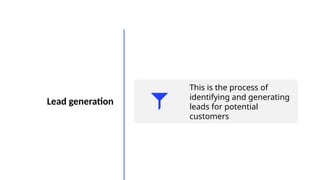
Lead generation
This isthe process of
identifying and generating
leads for potential
customers
4.
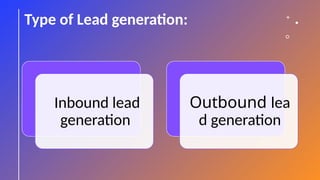
Type of Leadgeneration:
Inbound lead
generation
Outbound lea
d generation
5.
Lead generation isa combination of two
things:
• Prospecting (seeking customers)
• Marketing (attracting customers)
6.
1- Inbound lead
generation
Isthe process of attracting potential
customers to your business through content
marketing, social media marketing, and other
online marketing channels
7.
Inbound lead generation
•Search engine optimization : Optimizing your website and
content so that it ranks higher in search engine results pages
• Content marketing: Creating and publishing high-quality
content, such as blog posts, articles, infographics, and videos,
that is relevant to your target audience
• Pay-per-click advertising: Running paid ads on search
engines and other websites
• Social media marketing: Using social media platforms to
connect with potential customers and promote your business
8.
Type of inboundlead
generation:
• Email marketing: Collecting email addresses
from potential customers and sending them
targeted email messages
Lead magnets: Offering valuable content, such as
e-books, white papers, and webinars, in exchange
for potential customers' contact information
• Gated content: Offering exclusive content, such
as case studies, webinars, and e-books, that
potential customers can only access by providing
their contact information
9.
2- Outbound lead
generation
Isthe process of reaching out to
potential customers directly through
cold calling, email marketing, and
other direct marketing channels
10.
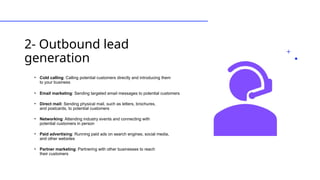
2- Outbound lead
generation
•Cold calling: Calling potential customers directly and introducing them
to your business
• Email marketing: Sending targeted email messages to potential customers
• Direct mail: Sending physical mail, such as letters, brochures,
and postcards, to potential customers
• Networking: Attending industry events and connecting with
potential customers in person
• Paid advertising: Running paid ads on search engines, social media,
and other websites
• Partner marketing: Partnering with other businesses to reach
their customers
11.
Segmentation
1. Identify yourtarget markets. Consider factors such as industry, company
size, geographic location, and language needs.
2. Analyze your target markets. Once you have identified your target markets, take some
time to research them in more detail. What are their needs and pain points? What are their
cultural preferences? What kind of content do they consume?
3. Segment your target markets. Based on your research, divide your target markets into
smaller groups with similar needs and preferences. This will help you to tailor your
translation and localization services to each group more effectively.
4. Develop a segmentation strategy for each group. For each group, identify the specific
needs and preferences that you need to address. This may include the type of content that
you need to translate, the localization services that you need to provide, and the marketing
messages that you need to use.
The Four Lawsof Lead
Generation
• Build a database
• Feed it every day
• Communicate with it in a systematic way.
• Service all the leads that come your way.
14.
1. Build YourDatabase
•Types of Leads
• Mets –The people you know, your sphere of influence, such as friends, family,
doctors, neighbors, or anyone else you have an association with.
• Haven’t Mets –The people you don’t know or haven’t met, but would like to
conduct business with in the future.
15.
2. Feed itEvery Day
•Types of Leads
• Collect 10 to 15 emails by using the Tools (adding 10 people to your
database daily)
• Write 15 notes if any:
• Verify at least 10 emails by using the Tools
• Set aside time every day to feed your database!
16.
Websites for theleads:
•Types of Leads
• Website:
• LinkedIn (Direct and LSPs)
• Proz (LSPs)
• Translator’s cafe (LSPs)
• Translation associations: (LSPs)
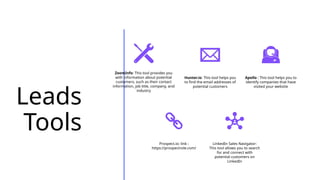
Leads
Tools
ZoomInfo: This toolprovides you
with information about potential
customers, such as their contact
information, job title, company, and
industry
Hunter.io: This tool helps you
to find the email addresses of
potential customers
Apollo : This tool helps you to
identify companies that have
visited your website
Prospect.io: link :
https://prospectrole.com/
LinkedIn Sales Navigator:
This tool allows you to search
for and connect with
potential customers on
LinkedIn
What are theSearch criteria?
• Types of Leads
• Company name: This is the most basic search criterion, but it
can be very effective
• Industry: You can search for prospects by industry to find
companies that are a good fit for your products or services
• Location: You can search for prospects by location to find
companies that are in the same area as you or that serve the
same geographic market
• Job title: You can search for prospects by job title to find people
who are responsible for purchasing your products or services
• Keywords: You can use a variety of keywords to search for
prospects
We have talkedabout…
• The Lead Generation Cycle for prospecting
• The Four Laws of Lead Generation
• How to build your database
• How to feed your database every day
• Tools
• How to service all leads that come your way
26.
Exercise
• Break intopairs.
• Come up with as many ideas as you can for ways to
expand your Mets database starting today.
• Share with the class
• Time: 15 minutes
27.
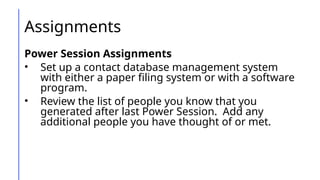
Assignments
Power Session Assignments
•Set up a contact database management system
with either a paper filing system or with a software
program.
• Review the list of people you know that you
generated after last Power Session. Add any
additional people you have thought of or met.
28.
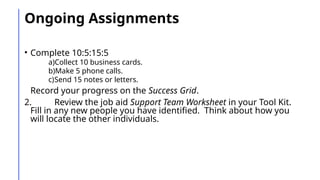
Ongoing Assignments
• Complete10:5:15:5
a)Collect 10 business cards.
b)Make 5 phone calls.
c)Send 15 notes or letters.
Record your progress on the Success Grid.
2. Review the job aid Support Team Worksheet in your Tool Kit.
Fill in any new people you have identified. Think about how you
will locate the other individuals.