THE DEFINITIVE GUIDE TO
LEAD GENERATION WORKBOOK
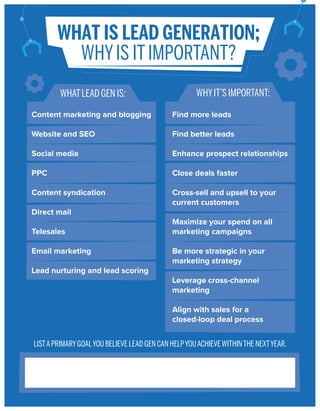
WHAT IS LEAD GENERATION;
WHY IS IT IMPORTANT?
Lead generation describes the marketing process of
stimulating and capturing interest in a product or service
for the purpose of developing a sales pipeline.
WHAT IS LEAD GENERATION;
WHY IS IT IMPORTANT?
WHAT LEAD GEN IS:

WHY IT’S IMPORTANT:

Content marketing and blogging

Find more leads

Website and SEO

Find better leads

Social media

Enhance prospect relationships

PPC

Close deals faster

Content syndication

Cross-sell and upsell to your
current customers

Direct mail
Telesales
Email marketing

Maximize your spend on all
marketing campaigns
Be more strategic in your
marketing strategy

Lead nurturing and lead scoring
Leverage cross-channel
marketing
Align with sales for a
closed-loop deal process
LIST A PRIMARY GOAL YOU BELIEVE LEAD GEN CAN HELP YOU ACHIEVE WITHIN THE NEXT YEAR.
HOW HAS LEAD
GENERATION EVOLVED?
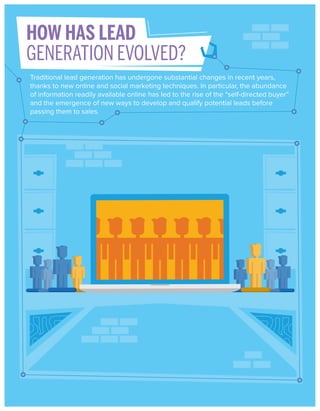
Traditional lead generation has undergone substantial changes in recent years,
thanks to new online and social marketing techniques. In particular, the abundance
of information readily available online has led to the rise of the “self-directed buyer”
and the emergence of new ways to develop and qualify potential leads before
passing them to sales.
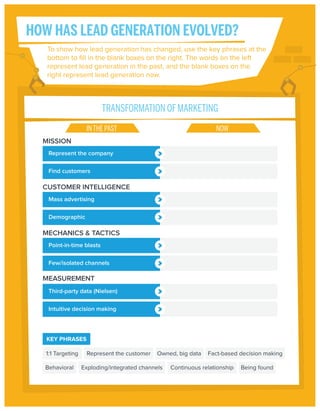
HOW HAS LEAD GENERATION EVOLVED?
To show how lead generation has changed, use the key phrases at the
bottom to fill in the blank boxes on the right. The words on the left
represent lead generation in the past, and the blank boxes on the
right represent lead generation now.

TRANSFORMATION OF MARKETING
IN THE PAST

NOW

MISSION
Represent the company
Find customers

CUSTOMER INTELLIGENCE
Mass advertising
Demographic

MECHANICS & TACTICS
Point-in-time blasts
Few/isolated channels

MEASUREMENT
Third-party data (Nielsen)
Intuitive decision making

KEY PHRASES
1:1 Targeting
Behavioral

Represent the customer

Owned, big data

Exploding/integrated channels

Fact-based decision making

Continuous relationship

Being found
STEPS TO DEFINING A LEAD
To build out your lead generation strategy, you must start with the basics.
Every organization will have its own definition of a “good lead”. If you don’t know
yours, begin with lead generation 101.
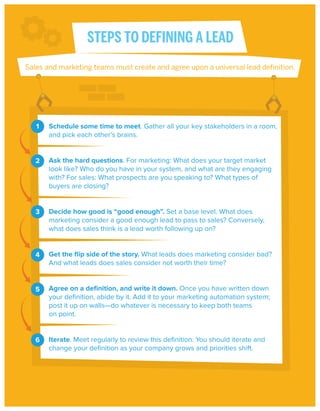
STEPS TO DEFINING A LEAD
Sales and marketing teams must create and agree upon a universal lead definition.

1

Schedule some time to meet. Gather all your key stakeholders in a room,
and pick each other’s brains.

2

Ask the hard questions. For marketing: What does your target market
look like? Who do you have in your system, and what are they engaging
with? For sales: What prospects are you speaking to? What types of
buyers are closing?

3

Decide how good is “good enough”. Set a base level. What does
marketing consider a good enough lead to pass to sales? Conversely,
what does sales think is a lead worth following up on?

4

Get the flip side of the story. What leads does marketing consider bad?
And what leads does sales consider not worth their time?

5

Agree on a definition, and write it down. Once you have written down
your definition, abide by it. Add it to your marketing automation system;
post it up on walls—do whatever is necessary to keep both teams
on point.

6

Iterate. Meet regularly to review this definition. You should iterate and
change your definition as your company grows and priorities shift.
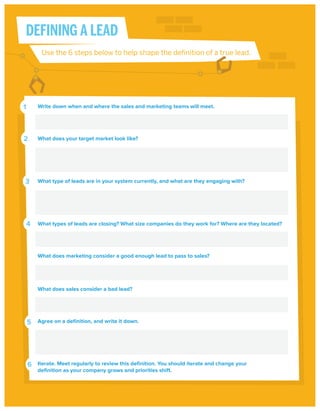
DEFINING A LEAD
Use the 6 steps below to help shape the definition of a true lead.

1

Write down when and where the sales and marketing teams will meet.

2

What does your target market look like?

3

What type of leads are in your system currently, and what are they engaging with?

4

What types of leads are closing? What size companies do they work for? Where are they located?

What does marketing consider a good enough lead to pass to sales?

What does sales consider a bad lead?

5

Agree on a definition, and write it down.

6

Iterate. Meet regularly to review this definition. You should iterate and change your
definition as your company grows and priorities shift.
CREATING YOUR BUYER PERSONAS
Content is the foundation of your inbound marketing efforts, and a great way to
generate leads. The Content Marketing Institute defines content marketing as “the
marketing technique of creating and distributing relevant and valuable content to
attract, acquire, and engage a clearly defined and understood target audience—
with the objective of driving profitable customer action.”
Your content marketing will be what fuels most, if not all, of your lead generation
campaigns, so you need to make sure you get it right.
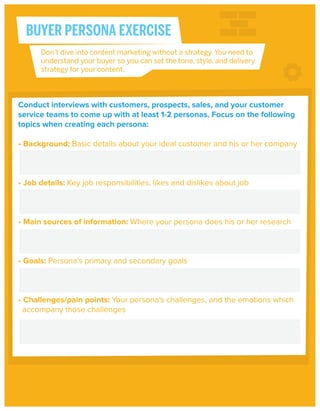
BUYER PERSONA EXERCISE
Don't dive into content marketing without a strategy. You need to
understand your buyer so you can set the tone, style, and delivery
strategy for your content.

Conduct interviews with customers, prospects, sales, and your customer
service teams to come up with at least 1-2 personas. Focus on the following
topics when creating each persona:
• Background: Basic details about your ideal customer and his or her company

• Job details: Key job responsibilities, likes and dislikes about job

• Main sources of information: Where your persona does his or her research

• Goals: Persona’s primary and secondary goals

• Challenges/pain points: Your persona’s challenges, and the emotions which
accompany those challenges
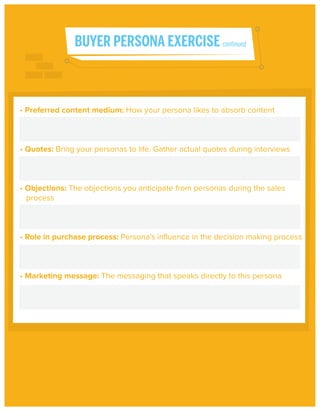
BUYER PERSONA EXERCISE continued

• Preferred content medium: How your persona likes to absorb content

• Quotes: Bring your personas to life. Gather actual quotes during interviews

• Objections: The objections you anticipate from personas during the sales
process

• Role in purchase process: Persona’s influence in the decision making process

• Marketing message: The messaging that speaks directly to this persona
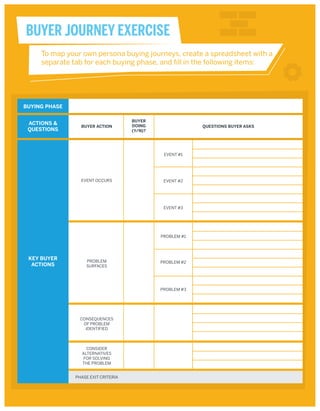
BUYER JOURNEY EXERCISE
To map your own persona buying journeys, create a spreadsheet with a
separate tab for each buying phase, and fill in the following items:

BUYING PHASE
ACTIONS &
QUESTIONS

BUYER ACTION

BUYER
DOING
(Y/N)?

QUESTIONS BUYER ASKS

EVENT #1

EVENT OCCURS

EVENT #2

EVENT #3

PROBLEM #1

KEY BUYER
ACTIONS

PROBLEM
SURFACES

PROBLEM #2

PROBLEM #3

CONSEQUENCES
OF PROBLEM
IDENTIFIED

CONSIDER
ALTERNATIVES
FOR SOLVING
THE PROBLEM
PHASE EXIT CRITERIA
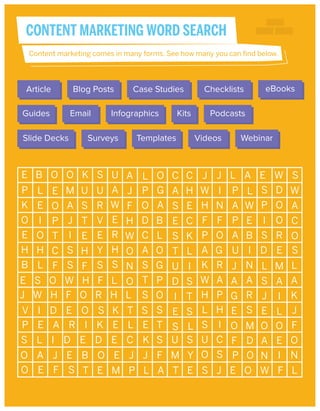
CONTENT MARKETING WORD SEARCH
Content marketing comes in many forms. See how many you can find below.
Article
Guides
Slide Decks
Blog Posts
Email

Case Studies

Infographics

Surveys

Templates

Kits

Checklists

eBooks

Podcasts
Videos

Webinar
WEBSITE OPTIMIZATION
FOR LEAD GENERATION
When it comes to converting leads and making lasting impressions, your website
is where the magic happens. Analytics and testing company KISSmetrics stated it
best on its blog: “Your leads are only as good as the website that produces them.”
WEBSITE OPTIMIZATION
FOR LEAD GENERATION
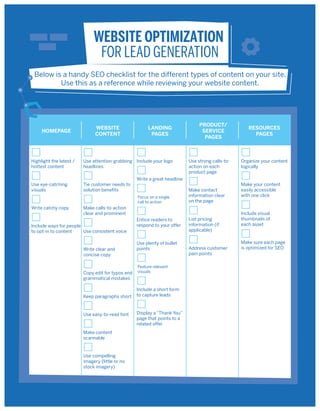
Below is a handy SEO checklist for the different types of content on your site.
Use this as a reference while reviewing your website content.

HOMEPAGE

WEBSITE
CONTENT

LANDING
PAGES

Highlight the latest /
hottest content

Use attention-grabbing Include your logo
headlines

Use eye-catching
visuals

Tie customer needs to
solution benefits

PRODUCT/
SERVICE
PAGES

Use strong calls-toaction on each
product page

RESOURCES
PAGES

Organize your content
logically

Write a great headline

Focus on a single
call to action

Write catchy copy

Make contact
information clear
on the page

Make calls-to-action
clear and prominent

Include ways for people
Use consistent voice
to opt-in to content

Write clear and
concise copy

Copy edit for typos and
grammatical mistakes

Keep paragraphs short

Use easy-to-read font

Make content
scannable

Use compelling
imagery (little or no
stock imagery)

Entice readers to
respond to your offer

Use plenty of bullet
points

Feature relevant
visuals

Include a short form
to capture leads

Display a “Thank You”
page that points to a
related offer

List pricing
information (if
applicable)

Address customer
pain points

Make your content
easily accessible
with one click

Include visual
thumbnails of
each asset

Make sure each page
is optimized for SEO
LANDING PAGES
Landing pages are customized pages that your leads are directed to from social
media pages, received emails, event invitations, paid ads, or search engine results.
For effective lead generation, specifically create new landing pages for each program.
LANDING PAGES
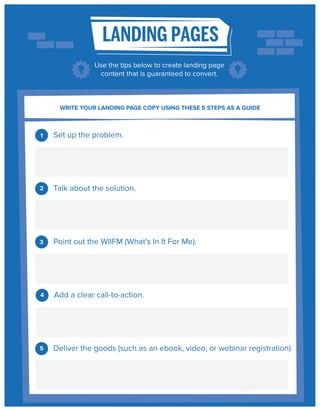
Use the tips below to create landing page
content that is guaranteed to convert.

WRITE YOUR LANDING PAGE COPY USING THESE 5 STEPS AS A GUIDE

1

Set up the problem.

2

Talk about the solution.

3

Point out the WIIFM (What’s In It For Me).

4

Add a clear call-to-action.

5

Deliver the goods (such as an ebook, video, or webinar registration).
SEARCH ENGINE OPTIMIZATION
Your prospects are searching for what you sell, but will they find you? Search
marketing is about prospects discovering you through search results and converting
them into opportunities. The higher you rank in organic searches, the more people
will find you.
SEARCH ENGINE OPTIMIZATION
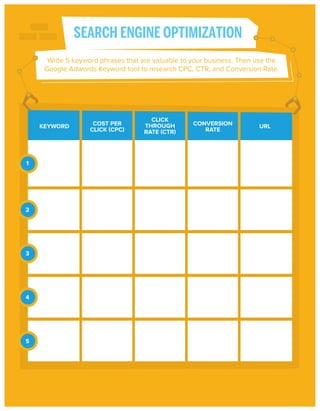
Write 5 keyword phrases that are valuable to your business. Then use the
Google Adwords Keyword tool to research CPC, CTR, and Conversion Rate.

KEYWORD

1

2

3

4

5

COST PER
CLICK (CPC)

CLICK
THROUGH
RATE (CTR)

CONVERSION
RATE

URL
SEARCH ENGINE OPTIMIZATION
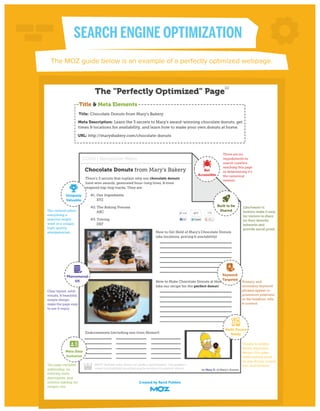
The MOZ guide below is an example of a perfectly optimized webpage.
SEARCH ENGINE OPTIMIZATION
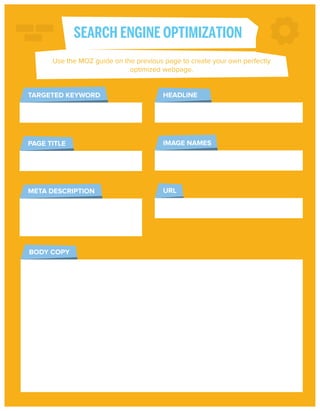
Use the MOZ guide on the previous page to create your own perfectly
optimized webpage.

TARGETED KEYWORD

HEADLINE

PAGE TITLE

IMAGE NAMES

META DESCRIPTION

URL

BODY COPY
SEARCH ENGINE OPTIMIZATION
Use the clues below to find the most important aspects of on-page SEO.

4
2

1
1

3

4
2
3

5

CLUES
DOWN
1. Text supporting the keyword focus for
the page
2. Google uses these to understand
what your webpage is about
3. What shows up in Google SERPs
4. _______ is king

ACROSS
1. The explanation of a webpage;
also shown in SERPs
2. Direct path to a webpage
3. Abbreviation for a link
4. Time it takes to open a page
5. Synonymous with picture
SOCIAL MEDIA &
LEAD GENERATION
Using social media to brand your business isn’t groundbreaking anymore.
Been there, done that. Although social is still important for branding and
generating buzz, it’s also increasingly used for lead generation.
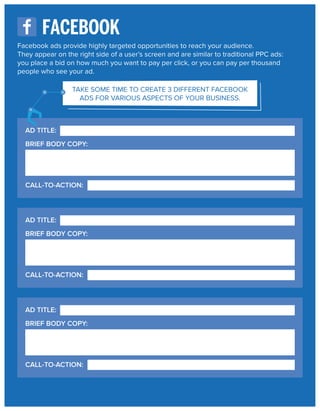
FACEBOOK
Facebook ads provide highly targeted opportunities to reach your audience.
They appear on the right side of a user’s screen and are similar to traditional PPC ads:
you place a bid on how much you want to pay per click, or you can pay per thousand
people who see your ad.
TAKE SOME TIME TO CREATE 3 DIFFERENT FACEBOOK
ADS FOR VARIOUS ASPECTS OF YOUR BUSINESS.

AD TITLE:
BRIEF BODY COPY:

CALL-TO-ACTION:

AD TITLE:
BRIEF BODY COPY:

CALL-TO-ACTION:

AD TITLE:
BRIEF BODY COPY:

CALL-TO-ACTION:
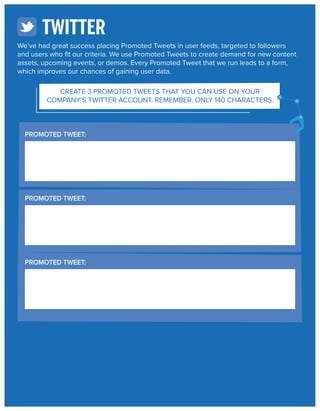
TWITTER
We’ve had great success placing Promoted Tweets in user feeds, targeted to followers
and users who fit our criteria. We use Promoted Tweets to create demand for new content
assets, upcoming events, or demos. Every Promoted Tweet that we run leads to a form,
which improves our chances of gaining user data.
CREATE 3 PROMOTED TWEETS THAT YOU CAN USE ON YOUR
COMPANY’S TWITTER ACCOUNT. REMEMBER, ONLY 140 CHARACTERS.

PROMOTED TWEET:

PROMOTED TWEET:

PROMOTED TWEET:
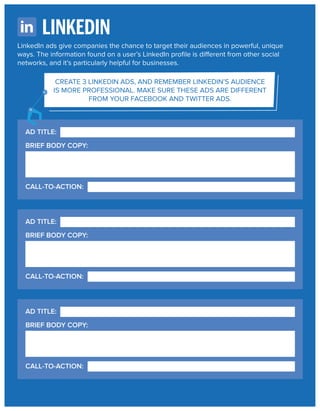
LINKEDIN
LinkedIn ads give companies the chance to target their audiences in powerful, unique
ways. The information found on a user’s LinkedIn profile is different from other social
networks, and it’s particularly helpful for businesses.
CREATE 3 LINKEDIN ADS, AND REMEMBER LINKEDIN’S AUDIENCE
IS MORE PROFESSIONAL. MAKE SURE THESE ADS ARE DIFFERENT
FROM YOUR FACEBOOK AND TWITTER ADS.

AD TITLE:
BRIEF BODY COPY:

CALL-TO-ACTION:

AD TITLE:
BRIEF BODY COPY:

CALL-TO-ACTION:

AD TITLE:
BRIEF BODY COPY:

CALL-TO-ACTION:
EMAIL MARKETING
Email is a cornerstone and key component of many marketing campaigns.
Whether you’re hosting an event, publicizing a new piece of content, or
promoting a new service offering, email can deliver relationship-building
communication at every stage of the funnel, especially to those leads already
in your database.
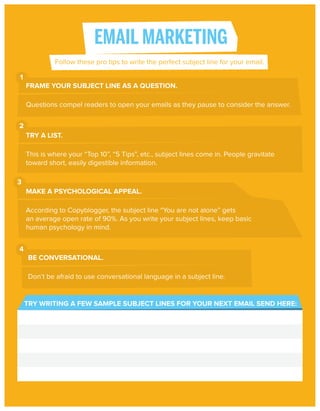
EMAIL MARKETING
Follow these pro tips to write the perfect subject line for your email.
1
FRAME YOUR SUBJECT LINE AS A QUESTION.
Questions compel readers to open your emails as they pause to consider the answer.
2
TRY A LIST.
This is where your “Top 10”, “5 Tips”, etc., subject lines come in. People gravitate
toward short, easily digestible information.
3
MAKE A PSYCHOLOGICAL APPEAL.
According to Copyblogger, the subject line “You are not alone” gets
an average open rate of 90%. As you write your subject lines, keep basic
human psychology in mind.
4
BE CONVERSATIONAL.
Don’t be afraid to use conversational language in a subject line.

TRY WRITING A FEW SAMPLE SUBJECT LINES FOR YOUR NEXT EMAIL SEND HERE:
PAID PROGRAMS
Inbound marketing has been getting a lot of buzz lately, but a well-rounded marketing
mix should include both inbound and paid techniques. Inbound marketing alone can’t
always drive people to buy, so smart marketers use outbound and paid techniques to
introduce their businesses, amplify their messaging, and expose their content to leads.
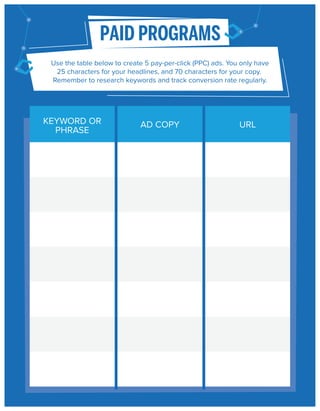
PAID PROGRAMS
Use the table below to create 5 pay-per-click (PPC) ads. You only have
25 characters for your headlines, and 70 characters for your copy.
Remember to research keywords and track conversion rate regularly.

KEYWORD OR
PHRASE

AD COPY

URL
TELEPHONE-BASED
LEAD GENERATION
Telesales, or inside sales reps, can contribute greatly to successful lead generation.
Your sales team qualifies your leads and adds a personal touch.
An important distinction here: Telephone-based lead generation isn’t the same as
telemarketing. Telesales provides the human interaction needed to turn your marketing
leads into opportunities and sales.
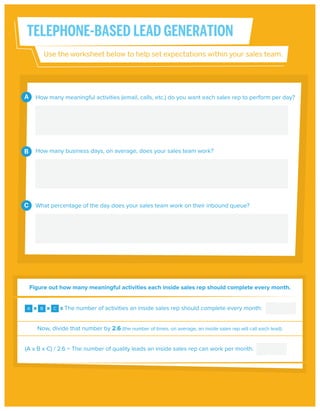
TELEPHONE-BASED LEAD GENERATION
Use the worksheet below to help set expectations within your sales team.

A

How many meaningful activities (email, calls, etc.) do you want each sales rep to perform per day?

B

How many business days, on average, does your sales team work?

C

What percentage of the day does your sales team work on their inbound queue?

Figure out how many meaningful activities each inside sales rep should complete every month.

A

B

C

The number of activities an inside sales rep should complete every month:

Now, divide that number by 2.6 (the number of times, on average, an inside sales rep will call each lead).
(A x B x C) / 2.6 = The number of quality leads an inside sales rep can work per month:
LEAD NURTURING
Once you’ve invested in your lead generation strategy, you’ll want to get the most out of
every lead. Many companies do a great job of generating Top-of-Funnel (TOFU) leads,
but most new leads aren’t yet ready to buy. That’s where a solid Middle-of-Funnel
(MOFU) strategy comes in.
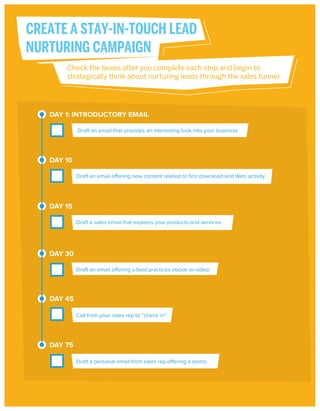
CREATE A STAY-IN-TOUCH LEAD
NURTURING CAMPAIGN
Check the boxes after you complete each step and begin to
strategically think about nurturing leads through the sales funnel.

DAY 1: INTRODUCTORY EMAIL
Draft an email that provides an interesting look into your business.

DAY 10
Draft an email offering new content related to first download and Web activity.

DAY 15
Draft a sales email that explains your products and services.

DAY 30
Draft an email offering a best practices ebook or video.

DAY 45
Call from your sales rep to “check in”.

DAY 75
Draft a personal email from sales rep offering a demo.
TESTING & OPTIMIZATION
When it comes to lead generation, the more you test, the more you know. You can’t
optimize your lead generation without first testing it, but many marketers don’t know
where to start testing. You need a clear plan of attack.
TESTING & OPTIMIZATION
Use the 5 steps below to identify a testing strategy relevant to your
business in order to increase the success of your campaigns.

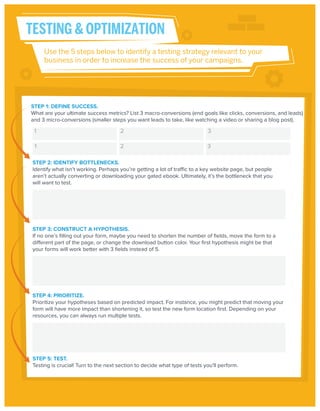
STEP 1: DEFINE SUCCESS.
What are your ultimate success metrics? List 3 macro-conversions (end goals like clicks, conversions, and leads)
and 3 micro-conversions (smaller steps you want leads to take, like watching a video or sharing a blog post).

1

2

3

1

2

3

STEP 2: IDENTIFY BOTTLENECKS.
Identify what isn’t working. Perhaps you’re getting a lot of traffic to a key website page, but people
aren’t actually converting or downloading your gated ebook. Ultimately, it’s the bottleneck that you
will want to test.

STEP 3: CONSTRUCT A HYPOTHESIS.
If no one’s filling out your form, maybe you need to shorten the number of fields, move the form to a
different part of the page, or change the download button color. Your first hypothesis might be that
your forms will work better with 3 fields instead of 5.

STEP 4: PRIORITIZE.
Prioritize your hypotheses based on predicted impact. For instance, you might predict that moving your
form will have more impact than shortening it, so test the new form location first. Depending on your
resources, you can always run multiple tests.

STEP 5: TEST.
Testing is crucial! Turn to the next section to decide what type of tests you'll perform.
TESTING & OPTIMIZATION
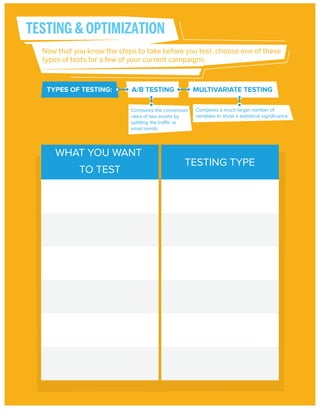
Now that you know the steps to take before you test, choose one of these
types of tests for a few of your current campaigns.

TYPES OF TESTING:

A/B TESTING

MULTIVARIATE TESTING

Compares the conversion
rates of two assets by
splitting the traffic or
email sends.

WHAT YOU WANT
TO TEST

Compares a much larger number of
variables to show a statistical significance.

TESTING TYPE
METRICS
If you can confidently identify how your lead generation campaigns truly deliver
financial returns, you’ll lift your marketing team’s influence and credibility even
further. If you understand how your campaigns perform, you can also make the
right strategic investments to improve results over time.
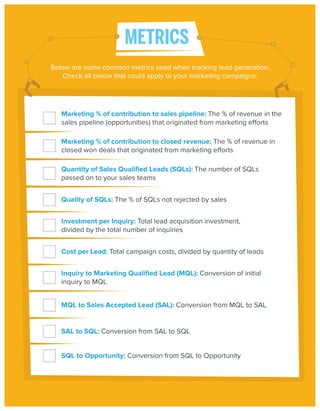
METRICS
Below are some common metrics used when tracking lead generation.
Check all below that could apply to your marketing campaigns.

Marketing % of contribution to sales pipeline: The % of revenue in the
sales pipeline (opportunities) that originated from marketing efforts
Marketing % of contribution to closed revenue: The % of revenue in
closed won deals that originated from marketing efforts
Quantity of Sales Qualified Leads (SQLs): The number of SQLs
passed on to your sales teams
Quality of SQLs: The % of SQLs not rejected by sales
Investment per Inquiry: Total lead acquisition investment,
divided by the total number of inquiries
Cost per Lead: Total campaign costs, divided by quantity of leads
Inquiry to Marketing Qualified Lead (MQL): Conversion of initial
inquiry to MQL
MQL to Sales Accepted Lead (SAL): Conversion from MQL to SAL

SAL to SQL: Conversion from SAL to SQL
SQL to Opportunity: Conversion from SQL to Opportunity
We know that marketing is a tough job—after all, we’re marketers ourselves. Marketing
to marketers is no easy task, but it’s one we love. That’s why we’re happy to share our
knowledge about lead generation via both inbound and outbound marketing. There’s
no perfect, one-size-fits-all approach to lead generation. Just use the channels and
tactics that help you reach and engage your target audience. Keep their challenges,
goals, and concerns top of mind; deliver information and content that solves their pain
points; nurture those relationships, and engage them over time. You’ll soon be filling
your funnel with high-quality leads.
About Marketo:
Marketing Software.
Easy, Powerful, Complete.
Marketo (NASDAQ: MKTO) provides the leading cloud-based marketing software platform
for companies of all sizes to build and sustain engaging customer relationships. Spanning
today’s digital, social, mobile and offline channels, the Marketo® solution includes a
complete suite of applications that help organizations acquire new customers more
efficiently, maximize customer loyalty and lifetime value, improve sales effectiveness, and
provide analytical insight into marketing’s contribution to revenue growth. Marketo’s
applications are known for their breakthrough ease-of-use, and are complemented by the
Marketing Nation™, a thriving network of more than 190 LaunchPoint™ ecosystem partners
and over 40,000 marketers who share and learn from each other to grow their collective
marketing expertise. The result for modern marketers is unprecedented agility and
superior results. Headquartered in San Mateo, CA with offices in Europe and Australia,
Marketo serves as a strategic marketing partner to more than 2,700 large enterprises and
fast-growing small companies across a wide variety of industries. For more information, visit
www.marketo.com. Marketo, the Marketo logo, Marketing Nation and LaunchPoint are
trademarks of Marketo, Inc. All other trademarks are the property of their respective owners.

The Definitive Guide to Lead Generation Workbook

  • 1.
    THE DEFINITIVE GUIDETO LEAD GENERATION WORKBOOK
  • 2.
    WHAT IS LEADGENERATION; WHY IS IT IMPORTANT? Lead generation describes the marketing process of stimulating and capturing interest in a product or service for the purpose of developing a sales pipeline.
  • 3.
    WHAT IS LEADGENERATION; WHY IS IT IMPORTANT? WHAT LEAD GEN IS: WHY IT’S IMPORTANT: Content marketing and blogging Find more leads Website and SEO Find better leads Social media Enhance prospect relationships PPC Close deals faster Content syndication Cross-sell and upsell to your current customers Direct mail Telesales Email marketing Maximize your spend on all marketing campaigns Be more strategic in your marketing strategy Lead nurturing and lead scoring Leverage cross-channel marketing Align with sales for a closed-loop deal process LIST A PRIMARY GOAL YOU BELIEVE LEAD GEN CAN HELP YOU ACHIEVE WITHIN THE NEXT YEAR.
  • 4.
    HOW HAS LEAD GENERATIONEVOLVED? Traditional lead generation has undergone substantial changes in recent years, thanks to new online and social marketing techniques. In particular, the abundance of information readily available online has led to the rise of the “self-directed buyer” and the emergence of new ways to develop and qualify potential leads before passing them to sales.
  • 5.
    HOW HAS LEADGENERATION EVOLVED? To show how lead generation has changed, use the key phrases at the bottom to fill in the blank boxes on the right. The words on the left represent lead generation in the past, and the blank boxes on the right represent lead generation now. TRANSFORMATION OF MARKETING IN THE PAST NOW MISSION Represent the company Find customers CUSTOMER INTELLIGENCE Mass advertising Demographic MECHANICS & TACTICS Point-in-time blasts Few/isolated channels MEASUREMENT Third-party data (Nielsen) Intuitive decision making KEY PHRASES 1:1 Targeting Behavioral Represent the customer Owned, big data Exploding/integrated channels Fact-based decision making Continuous relationship Being found
  • 6.
    STEPS TO DEFININGA LEAD To build out your lead generation strategy, you must start with the basics. Every organization will have its own definition of a “good lead”. If you don’t know yours, begin with lead generation 101.
  • 7.
    STEPS TO DEFININGA LEAD Sales and marketing teams must create and agree upon a universal lead definition. 1 Schedule some time to meet. Gather all your key stakeholders in a room, and pick each other’s brains. 2 Ask the hard questions. For marketing: What does your target market look like? Who do you have in your system, and what are they engaging with? For sales: What prospects are you speaking to? What types of buyers are closing? 3 Decide how good is “good enough”. Set a base level. What does marketing consider a good enough lead to pass to sales? Conversely, what does sales think is a lead worth following up on? 4 Get the flip side of the story. What leads does marketing consider bad? And what leads does sales consider not worth their time? 5 Agree on a definition, and write it down. Once you have written down your definition, abide by it. Add it to your marketing automation system; post it up on walls—do whatever is necessary to keep both teams on point. 6 Iterate. Meet regularly to review this definition. You should iterate and change your definition as your company grows and priorities shift.
  • 8.
    DEFINING A LEAD Usethe 6 steps below to help shape the definition of a true lead. 1 Write down when and where the sales and marketing teams will meet. 2 What does your target market look like? 3 What type of leads are in your system currently, and what are they engaging with? 4 What types of leads are closing? What size companies do they work for? Where are they located? What does marketing consider a good enough lead to pass to sales? What does sales consider a bad lead? 5 Agree on a definition, and write it down. 6 Iterate. Meet regularly to review this definition. You should iterate and change your definition as your company grows and priorities shift.
  • 9.
    CREATING YOUR BUYERPERSONAS Content is the foundation of your inbound marketing efforts, and a great way to generate leads. The Content Marketing Institute defines content marketing as “the marketing technique of creating and distributing relevant and valuable content to attract, acquire, and engage a clearly defined and understood target audience— with the objective of driving profitable customer action.” Your content marketing will be what fuels most, if not all, of your lead generation campaigns, so you need to make sure you get it right.
  • 10.
    BUYER PERSONA EXERCISE Don'tdive into content marketing without a strategy. You need to understand your buyer so you can set the tone, style, and delivery strategy for your content. Conduct interviews with customers, prospects, sales, and your customer service teams to come up with at least 1-2 personas. Focus on the following topics when creating each persona: • Background: Basic details about your ideal customer and his or her company • Job details: Key job responsibilities, likes and dislikes about job • Main sources of information: Where your persona does his or her research • Goals: Persona’s primary and secondary goals • Challenges/pain points: Your persona’s challenges, and the emotions which accompany those challenges
  • 11.
    BUYER PERSONA EXERCISEcontinued • Preferred content medium: How your persona likes to absorb content • Quotes: Bring your personas to life. Gather actual quotes during interviews • Objections: The objections you anticipate from personas during the sales process • Role in purchase process: Persona’s influence in the decision making process • Marketing message: The messaging that speaks directly to this persona
  • 12.
    BUYER JOURNEY EXERCISE Tomap your own persona buying journeys, create a spreadsheet with a separate tab for each buying phase, and fill in the following items: BUYING PHASE ACTIONS & QUESTIONS BUYER ACTION BUYER DOING (Y/N)? QUESTIONS BUYER ASKS EVENT #1 EVENT OCCURS EVENT #2 EVENT #3 PROBLEM #1 KEY BUYER ACTIONS PROBLEM SURFACES PROBLEM #2 PROBLEM #3 CONSEQUENCES OF PROBLEM IDENTIFIED CONSIDER ALTERNATIVES FOR SOLVING THE PROBLEM PHASE EXIT CRITERIA
  • 13.
    CONTENT MARKETING WORDSEARCH Content marketing comes in many forms. See how many you can find below. Article Guides Slide Decks Blog Posts Email Case Studies Infographics Surveys Templates Kits Checklists eBooks Podcasts Videos Webinar
  • 14.
    WEBSITE OPTIMIZATION FOR LEADGENERATION When it comes to converting leads and making lasting impressions, your website is where the magic happens. Analytics and testing company KISSmetrics stated it best on its blog: “Your leads are only as good as the website that produces them.”
  • 15.
    WEBSITE OPTIMIZATION FOR LEADGENERATION Below is a handy SEO checklist for the different types of content on your site. Use this as a reference while reviewing your website content. HOMEPAGE WEBSITE CONTENT LANDING PAGES Highlight the latest / hottest content Use attention-grabbing Include your logo headlines Use eye-catching visuals Tie customer needs to solution benefits PRODUCT/ SERVICE PAGES Use strong calls-toaction on each product page RESOURCES PAGES Organize your content logically Write a great headline Focus on a single call to action Write catchy copy Make contact information clear on the page Make calls-to-action clear and prominent Include ways for people Use consistent voice to opt-in to content Write clear and concise copy Copy edit for typos and grammatical mistakes Keep paragraphs short Use easy-to-read font Make content scannable Use compelling imagery (little or no stock imagery) Entice readers to respond to your offer Use plenty of bullet points Feature relevant visuals Include a short form to capture leads Display a “Thank You” page that points to a related offer List pricing information (if applicable) Address customer pain points Make your content easily accessible with one click Include visual thumbnails of each asset Make sure each page is optimized for SEO
  • 16.
    LANDING PAGES Landing pagesare customized pages that your leads are directed to from social media pages, received emails, event invitations, paid ads, or search engine results. For effective lead generation, specifically create new landing pages for each program.
  • 17.
    LANDING PAGES Use thetips below to create landing page content that is guaranteed to convert. WRITE YOUR LANDING PAGE COPY USING THESE 5 STEPS AS A GUIDE 1 Set up the problem. 2 Talk about the solution. 3 Point out the WIIFM (What’s In It For Me). 4 Add a clear call-to-action. 5 Deliver the goods (such as an ebook, video, or webinar registration).
  • 18.
    SEARCH ENGINE OPTIMIZATION Yourprospects are searching for what you sell, but will they find you? Search marketing is about prospects discovering you through search results and converting them into opportunities. The higher you rank in organic searches, the more people will find you.
  • 19.
    SEARCH ENGINE OPTIMIZATION Write5 keyword phrases that are valuable to your business. Then use the Google Adwords Keyword tool to research CPC, CTR, and Conversion Rate. KEYWORD 1 2 3 4 5 COST PER CLICK (CPC) CLICK THROUGH RATE (CTR) CONVERSION RATE URL
  • 20.
    SEARCH ENGINE OPTIMIZATION TheMOZ guide below is an example of a perfectly optimized webpage.
  • 21.
    SEARCH ENGINE OPTIMIZATION Usethe MOZ guide on the previous page to create your own perfectly optimized webpage. TARGETED KEYWORD HEADLINE PAGE TITLE IMAGE NAMES META DESCRIPTION URL BODY COPY
  • 22.
    SEARCH ENGINE OPTIMIZATION Usethe clues below to find the most important aspects of on-page SEO. 4 2 1 1 3 4 2 3 5 CLUES DOWN 1. Text supporting the keyword focus for the page 2. Google uses these to understand what your webpage is about 3. What shows up in Google SERPs 4. _______ is king ACROSS 1. The explanation of a webpage; also shown in SERPs 2. Direct path to a webpage 3. Abbreviation for a link 4. Time it takes to open a page 5. Synonymous with picture
  • 23.
    SOCIAL MEDIA & LEADGENERATION Using social media to brand your business isn’t groundbreaking anymore. Been there, done that. Although social is still important for branding and generating buzz, it’s also increasingly used for lead generation.
  • 24.
    FACEBOOK Facebook ads providehighly targeted opportunities to reach your audience. They appear on the right side of a user’s screen and are similar to traditional PPC ads: you place a bid on how much you want to pay per click, or you can pay per thousand people who see your ad. TAKE SOME TIME TO CREATE 3 DIFFERENT FACEBOOK ADS FOR VARIOUS ASPECTS OF YOUR BUSINESS. AD TITLE: BRIEF BODY COPY: CALL-TO-ACTION: AD TITLE: BRIEF BODY COPY: CALL-TO-ACTION: AD TITLE: BRIEF BODY COPY: CALL-TO-ACTION:
  • 25.
    TWITTER We’ve had greatsuccess placing Promoted Tweets in user feeds, targeted to followers and users who fit our criteria. We use Promoted Tweets to create demand for new content assets, upcoming events, or demos. Every Promoted Tweet that we run leads to a form, which improves our chances of gaining user data. CREATE 3 PROMOTED TWEETS THAT YOU CAN USE ON YOUR COMPANY’S TWITTER ACCOUNT. REMEMBER, ONLY 140 CHARACTERS. PROMOTED TWEET: PROMOTED TWEET: PROMOTED TWEET:
  • 26.
    LINKEDIN LinkedIn ads givecompanies the chance to target their audiences in powerful, unique ways. The information found on a user’s LinkedIn profile is different from other social networks, and it’s particularly helpful for businesses. CREATE 3 LINKEDIN ADS, AND REMEMBER LINKEDIN’S AUDIENCE IS MORE PROFESSIONAL. MAKE SURE THESE ADS ARE DIFFERENT FROM YOUR FACEBOOK AND TWITTER ADS. AD TITLE: BRIEF BODY COPY: CALL-TO-ACTION: AD TITLE: BRIEF BODY COPY: CALL-TO-ACTION: AD TITLE: BRIEF BODY COPY: CALL-TO-ACTION:
  • 27.
    EMAIL MARKETING Email isa cornerstone and key component of many marketing campaigns. Whether you’re hosting an event, publicizing a new piece of content, or promoting a new service offering, email can deliver relationship-building communication at every stage of the funnel, especially to those leads already in your database.
  • 28.
    EMAIL MARKETING Follow thesepro tips to write the perfect subject line for your email. 1 FRAME YOUR SUBJECT LINE AS A QUESTION. Questions compel readers to open your emails as they pause to consider the answer. 2 TRY A LIST. This is where your “Top 10”, “5 Tips”, etc., subject lines come in. People gravitate toward short, easily digestible information. 3 MAKE A PSYCHOLOGICAL APPEAL. According to Copyblogger, the subject line “You are not alone” gets an average open rate of 90%. As you write your subject lines, keep basic human psychology in mind. 4 BE CONVERSATIONAL. Don’t be afraid to use conversational language in a subject line. TRY WRITING A FEW SAMPLE SUBJECT LINES FOR YOUR NEXT EMAIL SEND HERE:
  • 29.
    PAID PROGRAMS Inbound marketinghas been getting a lot of buzz lately, but a well-rounded marketing mix should include both inbound and paid techniques. Inbound marketing alone can’t always drive people to buy, so smart marketers use outbound and paid techniques to introduce their businesses, amplify their messaging, and expose their content to leads.
  • 30.
    PAID PROGRAMS Use thetable below to create 5 pay-per-click (PPC) ads. You only have 25 characters for your headlines, and 70 characters for your copy. Remember to research keywords and track conversion rate regularly. KEYWORD OR PHRASE AD COPY URL
  • 31.
    TELEPHONE-BASED LEAD GENERATION Telesales, orinside sales reps, can contribute greatly to successful lead generation. Your sales team qualifies your leads and adds a personal touch. An important distinction here: Telephone-based lead generation isn’t the same as telemarketing. Telesales provides the human interaction needed to turn your marketing leads into opportunities and sales.
  • 32.
    TELEPHONE-BASED LEAD GENERATION Usethe worksheet below to help set expectations within your sales team. A How many meaningful activities (email, calls, etc.) do you want each sales rep to perform per day? B How many business days, on average, does your sales team work? C What percentage of the day does your sales team work on their inbound queue? Figure out how many meaningful activities each inside sales rep should complete every month. A B C The number of activities an inside sales rep should complete every month: Now, divide that number by 2.6 (the number of times, on average, an inside sales rep will call each lead). (A x B x C) / 2.6 = The number of quality leads an inside sales rep can work per month:
  • 33.
    LEAD NURTURING Once you’veinvested in your lead generation strategy, you’ll want to get the most out of every lead. Many companies do a great job of generating Top-of-Funnel (TOFU) leads, but most new leads aren’t yet ready to buy. That’s where a solid Middle-of-Funnel (MOFU) strategy comes in.
  • 34.
    CREATE A STAY-IN-TOUCHLEAD NURTURING CAMPAIGN Check the boxes after you complete each step and begin to strategically think about nurturing leads through the sales funnel. DAY 1: INTRODUCTORY EMAIL Draft an email that provides an interesting look into your business. DAY 10 Draft an email offering new content related to first download and Web activity. DAY 15 Draft a sales email that explains your products and services. DAY 30 Draft an email offering a best practices ebook or video. DAY 45 Call from your sales rep to “check in”. DAY 75 Draft a personal email from sales rep offering a demo.
  • 35.
    TESTING & OPTIMIZATION Whenit comes to lead generation, the more you test, the more you know. You can’t optimize your lead generation without first testing it, but many marketers don’t know where to start testing. You need a clear plan of attack.
  • 36.
    TESTING & OPTIMIZATION Usethe 5 steps below to identify a testing strategy relevant to your business in order to increase the success of your campaigns. STEP 1: DEFINE SUCCESS. What are your ultimate success metrics? List 3 macro-conversions (end goals like clicks, conversions, and leads) and 3 micro-conversions (smaller steps you want leads to take, like watching a video or sharing a blog post). 1 2 3 1 2 3 STEP 2: IDENTIFY BOTTLENECKS. Identify what isn’t working. Perhaps you’re getting a lot of traffic to a key website page, but people aren’t actually converting or downloading your gated ebook. Ultimately, it’s the bottleneck that you will want to test. STEP 3: CONSTRUCT A HYPOTHESIS. If no one’s filling out your form, maybe you need to shorten the number of fields, move the form to a different part of the page, or change the download button color. Your first hypothesis might be that your forms will work better with 3 fields instead of 5. STEP 4: PRIORITIZE. Prioritize your hypotheses based on predicted impact. For instance, you might predict that moving your form will have more impact than shortening it, so test the new form location first. Depending on your resources, you can always run multiple tests. STEP 5: TEST. Testing is crucial! Turn to the next section to decide what type of tests you'll perform.
  • 37.
    TESTING & OPTIMIZATION Nowthat you know the steps to take before you test, choose one of these types of tests for a few of your current campaigns. TYPES OF TESTING: A/B TESTING MULTIVARIATE TESTING Compares the conversion rates of two assets by splitting the traffic or email sends. WHAT YOU WANT TO TEST Compares a much larger number of variables to show a statistical significance. TESTING TYPE
  • 38.
    METRICS If you canconfidently identify how your lead generation campaigns truly deliver financial returns, you’ll lift your marketing team’s influence and credibility even further. If you understand how your campaigns perform, you can also make the right strategic investments to improve results over time.
  • 39.
    METRICS Below are somecommon metrics used when tracking lead generation. Check all below that could apply to your marketing campaigns. Marketing % of contribution to sales pipeline: The % of revenue in the sales pipeline (opportunities) that originated from marketing efforts Marketing % of contribution to closed revenue: The % of revenue in closed won deals that originated from marketing efforts Quantity of Sales Qualified Leads (SQLs): The number of SQLs passed on to your sales teams Quality of SQLs: The % of SQLs not rejected by sales Investment per Inquiry: Total lead acquisition investment, divided by the total number of inquiries Cost per Lead: Total campaign costs, divided by quantity of leads Inquiry to Marketing Qualified Lead (MQL): Conversion of initial inquiry to MQL MQL to Sales Accepted Lead (SAL): Conversion from MQL to SAL SAL to SQL: Conversion from SAL to SQL SQL to Opportunity: Conversion from SQL to Opportunity
  • 40.
    We know thatmarketing is a tough job—after all, we’re marketers ourselves. Marketing to marketers is no easy task, but it’s one we love. That’s why we’re happy to share our knowledge about lead generation via both inbound and outbound marketing. There’s no perfect, one-size-fits-all approach to lead generation. Just use the channels and tactics that help you reach and engage your target audience. Keep their challenges, goals, and concerns top of mind; deliver information and content that solves their pain points; nurture those relationships, and engage them over time. You’ll soon be filling your funnel with high-quality leads.
  • 41.
    About Marketo: Marketing Software. Easy,Powerful, Complete. Marketo (NASDAQ: MKTO) provides the leading cloud-based marketing software platform for companies of all sizes to build and sustain engaging customer relationships. Spanning today’s digital, social, mobile and offline channels, the Marketo® solution includes a complete suite of applications that help organizations acquire new customers more efficiently, maximize customer loyalty and lifetime value, improve sales effectiveness, and provide analytical insight into marketing’s contribution to revenue growth. Marketo’s applications are known for their breakthrough ease-of-use, and are complemented by the Marketing Nation™, a thriving network of more than 190 LaunchPoint™ ecosystem partners and over 40,000 marketers who share and learn from each other to grow their collective marketing expertise. The result for modern marketers is unprecedented agility and superior results. Headquartered in San Mateo, CA with offices in Europe and Australia, Marketo serves as a strategic marketing partner to more than 2,700 large enterprises and fast-growing small companies across a wide variety of industries. For more information, visit www.marketo.com. Marketo, the Marketo logo, Marketing Nation and LaunchPoint are trademarks of Marketo, Inc. All other trademarks are the property of their respective owners.