PHYSICAL
EDUCATION 11
1
LESSON
OBJECTIVES:
2
3
4
Set Frequency, Intensity, Time, and Type (FITT) goals based
on training principles to achieve and maintain health-
related fitness (HRF).
Engage in moderate to vigorous physical activities
(MVPAs) for at least 60 minutes on most days of the
week in a variety of settings in and out of school
Analyze physiological indicators such as heart rate, rate of
perceived exertion, and pacing associated with MVPAs to
monitor and adjust participation or effort
Appreciate the importance of personalized exercise
programs for overall health and fitness
ACTIVITY:
01
ACTIVITY
Think about a past workout or
physical activity you participated in. It
could have been a gym workout,
team sport, dance class, or even a
walk in the park
Describe how you felt
during and after the
exercise. Did you feel
breathless?
Write down the frequency,
intensity, time, and type of
the activity
Could you talk while
exercising? How tired were you
after the exercise?
FITT
PRINCIPLE
02
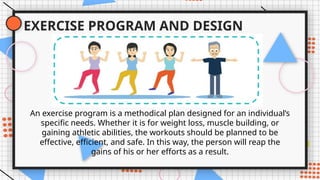
EXERCISE PROGRAM AND DESIGN
An exercise program is a methodical plan designed for an individual’s
specific needs. Whether it is for weight loss, muscle building, or
gaining athletic abilities, the workouts should be planned to be
effective, efficient, and safe. In this way, the person will reap the
gains of his or her efforts as a result.
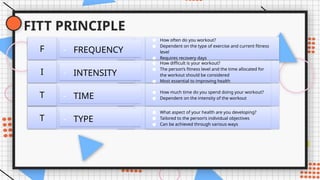
FITT PRINCIPLE
- TYPE
T
● What aspect of your health are you developing?
● Tailored to the person’s individual objectives
● Can be achieved through various ways
- TIME
T
● How much time do you spend doing your workout?
● Dependent on the intensity of the workout
- INTENSITY
I
● How difficult is your workout?
● The person’s fitness level and the time allocated for
the workout should be considered
● Most essential to improving health
- FREQUENCY
F
● How often do you workout?
● Dependent on the type of exercise and current fitness
level
● Requires recovery days
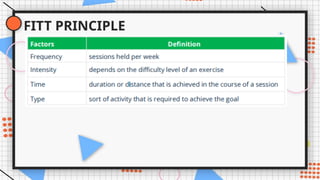
FITT PRINCIPLE
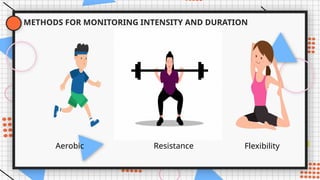
METHODS FOR MONITORING INTENSITY AND DURATION
Aerobic Resistance Flexibility
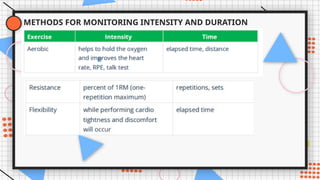
METHODS FOR MONITORING INTENSITY AND DURATION
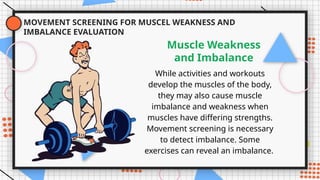
MOVEMENT SCREENING FOR MUSCEL WEAKNESS AND
IMBALANCE EVALUATION
While activities and workouts
develop the muscles of the body,
they may also cause muscle
imbalance and weakness when
muscles have differing strengths.
Movement screening is necessary
to detect imbalance. Some
exercises can reveal an imbalance.
Muscle Weakness
and Imbalance
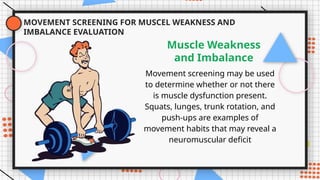
MOVEMENT SCREENING FOR MUSCEL WEAKNESS AND
IMBALANCE EVALUATION
Movement screening may be used
to determine whether or not there
is muscle dysfunction present.
Squats, lunges, trunk rotation, and
push-ups are examples of
movement habits that may reveal a
neuromuscular deficit
Muscle Weakness
and Imbalance
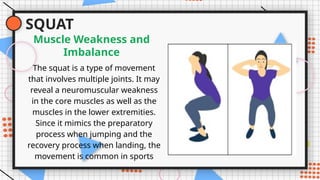
SQUAT
The squat is a type of movement
that involves multiple joints. It may
reveal a neuromuscular weakness
in the core muscles as well as the
muscles in the lower extremities.
Since it mimics the preparatory
process when jumping and the
recovery process when landing, the
movement is common in sports
Muscle Weakness and
Imbalance
SQUAT
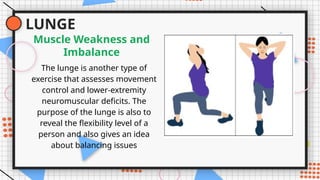
LUNGE
The lunge is another type of
exercise that assesses movement
control and lower-extremity
neuromuscular deficits. The
purpose of the lunge is also to
reveal the flexibility level of a
person and also gives an idea
about balancing issues
Muscle Weakness and
Imbalance
LUNGE
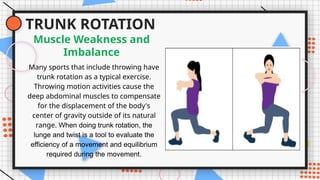
TRUNK ROTATION
Many sports that include throwing have
trunk rotation as a typical exercise.
Throwing motion activities cause the
deep abdominal muscles to compensate
for the displacement of the body's
center of gravity outside of its natural
range. When doing trunk rotation, the
lunge and twist is a tool to evaluate the
efficiency of a movement and equilibrium
required during the movement.
Muscle Weakness and
Imbalance
TRUNK ROTATION
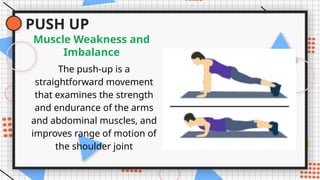
PUSH UP
The push-up is a
straightforward movement
that examines the strength
and endurance of the arms
and abdominal muscles, and
improves range of motion of
the shoulder joint
Muscle Weakness and
Imbalance
PUSH UP
PRINCIPLES OF
EXERCISE
TRAINING
03
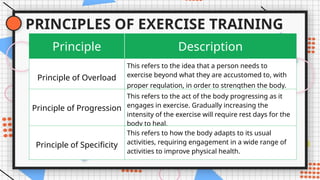
PRINCIPLES OF EXERCISE TRAINING
Principle Description
Principle of Overload
This refers to the idea that a person needs to
exercise beyond what they are accustomed to, with
proper regulation, in order to strengthen the body.
Principle of Progression
This refers to the act of the body progressing as it
engages in exercise. Gradually increasing the
intensity of the exercise will require rest days for the
body to heal.
Principle of Specificity
This refers to how the body adapts to its usual
activities, requiring engagement in a wide range of
activities to improve physical health.
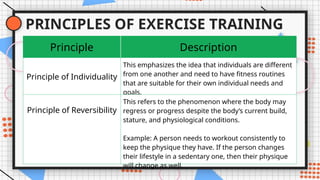
PRINCIPLES OF EXERCISE TRAINING
Principle Description
Principle of Individuality
This emphasizes the idea that individuals are different
from one another and need to have fitness routines
that are suitable for their own individual needs and
goals.
Principle of Reversibility
This refers to the phenomenon where the body may
regress or progress despite the body’s current build,
stature, and physiological conditions.
Example: A person needs to workout consistently to
keep the physique they have. If the person changes
their lifestyle in a sedentary one, then their physique
will change as well.
STEPS IN DESIGNING A FITNESS PROGRAM
1
D
i
v
i
d
e
a
n
d
s
e
t
s
h
o
r
t
-
t
e
r
m
a
n
d
l
o
n
g
-
t
e
r
m
g
o
a
l
s
S
e
t
s
h
o
r
t
-
t
e
r
m
g
o
a
l
s
t
h
a
t
w
i
l
l
h
e
l
p
a
c
h
i
e
v
e
l
o
n
g
-
t
e
r
m
g
o
a
l
s
.
T
h
i
s
w
i
l
l
k
e
e
p
y
o
u
m
o
t
i
v
a
t
e
d
a
n
d
l
o
o
k
i
n
g
f
o
r
w
a
r
d
t
o
s
o
m
e
t
h
i
n
g
.
2
S
e
t
a
t
t
a
i
n
a
b
l
e
o
b
j
e
c
t
i
v
e
s
S
e
t
o
b
j
e
c
t
i
v
e
s
t
h
a
t
y
o
u
t
h
i
n
k
a
r
e
a
c
h
i
e
v
a
b
l
e
a
t
y
o
u
r
c
u
r
r
e
n
t
fi
t
n
e
s
s
c
o
n
d
i
t
i
o
n
.
T
h
i
s
w
i
l
l
h
e
l
p
y
o
u
s
e
e
t
h
e
p
r
o
g
r
a
m
a
s
f
e
a
s
i
b
l
e
a
n
d
c
o
n
c
r
e
t
e
.
3W
r
i
t
e
d
o
w
n
p
r
e
c
i
s
e
g
o
a
l
s
W
r
i
t
e
d
o
w
n
p
r
e
c
i
s
e
g
o
a
l
s
t
h
a
t
w
i
l
l
a
l
l
o
w
y
o
u
t
o
f
o
c
u
s
o
n
t
h
e
t
a
s
k
a
t
h
a
n
d
.
4
M
a
k
e
a
w
e
l
l
n
e
s
s
a
g
r
e
e
m
e
n
t
M
a
k
i
n
g
a
w
e
l
l
n
e
s
s
a
g
r
e
e
m
e
n
t
w
i
l
l
h
o
l
d
y
o
u
a
c
c
o
u
n
t
a
b
l
e
a
n
d
r
e
s
p
o
n
s
i
b
l
e
f
o
r
y
o
u
r
e
n
t
i
r
e
fi
t
n
e
s
s
j
o
u
r
n
e
y
.
ACTIVITY:
DESIGN YOUR FITT: A
PERSONALIZED
EXERCISE PROGRAM
04
EXERCISE PROGRAM AND DESIGN
Create a personalized
exercise program based on
your fitness goals and
current fitness levels.
EXERCISE PROGRAM AND DESIGN
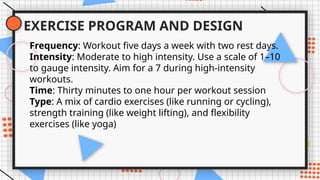
Frequency: Workout five days a week with two rest days.
Intensity: Moderate to high intensity. Use a scale of 1–10
to gauge intensity. Aim for a 7 during high-intensity
workouts.
Time: Thirty minutes to one hour per workout session
Type: A mix of cardio exercises (like running or cycling),
strength training (like weight lifting), and flexibility
exercises (like yoga)
EXERCISE PROGRAM AND DESIGN
FOCUS QUESTIONS:
1. What is the FITT principle, and why is it essential
in designing an exercise program?
2. How did you apply the FITT principle in designing
your exercise program?
3. How does your exercise program align with your
personal fitness goals?
Thank you

1.-FITT-Principle (1).pptx-Second semester

  • 1.
  • 2.
    1 LESSON OBJECTIVES: 2 3 4 Set Frequency, Intensity,Time, and Type (FITT) goals based on training principles to achieve and maintain health- related fitness (HRF). Engage in moderate to vigorous physical activities (MVPAs) for at least 60 minutes on most days of the week in a variety of settings in and out of school Analyze physiological indicators such as heart rate, rate of perceived exertion, and pacing associated with MVPAs to monitor and adjust participation or effort Appreciate the importance of personalized exercise programs for overall health and fitness
  • 3.
  • 4.
    ACTIVITY Think about apast workout or physical activity you participated in. It could have been a gym workout, team sport, dance class, or even a walk in the park Describe how you felt during and after the exercise. Did you feel breathless? Write down the frequency, intensity, time, and type of the activity Could you talk while exercising? How tired were you after the exercise?
  • 5.
  • 6.
    EXERCISE PROGRAM ANDDESIGN An exercise program is a methodical plan designed for an individual’s specific needs. Whether it is for weight loss, muscle building, or gaining athletic abilities, the workouts should be planned to be effective, efficient, and safe. In this way, the person will reap the gains of his or her efforts as a result.
  • 7.
    FITT PRINCIPLE - TYPE T ●What aspect of your health are you developing? ● Tailored to the person’s individual objectives ● Can be achieved through various ways - TIME T ● How much time do you spend doing your workout? ● Dependent on the intensity of the workout - INTENSITY I ● How difficult is your workout? ● The person’s fitness level and the time allocated for the workout should be considered ● Most essential to improving health - FREQUENCY F ● How often do you workout? ● Dependent on the type of exercise and current fitness level ● Requires recovery days
  • 8.
  • 9.
    METHODS FOR MONITORINGINTENSITY AND DURATION Aerobic Resistance Flexibility
  • 10.
    METHODS FOR MONITORINGINTENSITY AND DURATION
  • 11.
    MOVEMENT SCREENING FORMUSCEL WEAKNESS AND IMBALANCE EVALUATION While activities and workouts develop the muscles of the body, they may also cause muscle imbalance and weakness when muscles have differing strengths. Movement screening is necessary to detect imbalance. Some exercises can reveal an imbalance. Muscle Weakness and Imbalance
  • 12.
    MOVEMENT SCREENING FORMUSCEL WEAKNESS AND IMBALANCE EVALUATION Movement screening may be used to determine whether or not there is muscle dysfunction present. Squats, lunges, trunk rotation, and push-ups are examples of movement habits that may reveal a neuromuscular deficit Muscle Weakness and Imbalance
  • 13.
    SQUAT The squat isa type of movement that involves multiple joints. It may reveal a neuromuscular weakness in the core muscles as well as the muscles in the lower extremities. Since it mimics the preparatory process when jumping and the recovery process when landing, the movement is common in sports Muscle Weakness and Imbalance
  • 14.
  • 15.
    LUNGE The lunge isanother type of exercise that assesses movement control and lower-extremity neuromuscular deficits. The purpose of the lunge is also to reveal the flexibility level of a person and also gives an idea about balancing issues Muscle Weakness and Imbalance
  • 16.
  • 17.
    TRUNK ROTATION Many sportsthat include throwing have trunk rotation as a typical exercise. Throwing motion activities cause the deep abdominal muscles to compensate for the displacement of the body's center of gravity outside of its natural range. When doing trunk rotation, the lunge and twist is a tool to evaluate the efficiency of a movement and equilibrium required during the movement. Muscle Weakness and Imbalance
  • 18.
  • 19.
    PUSH UP The push-upis a straightforward movement that examines the strength and endurance of the arms and abdominal muscles, and improves range of motion of the shoulder joint Muscle Weakness and Imbalance
  • 20.
  • 21.
  • 22.
    PRINCIPLES OF EXERCISETRAINING Principle Description Principle of Overload This refers to the idea that a person needs to exercise beyond what they are accustomed to, with proper regulation, in order to strengthen the body. Principle of Progression This refers to the act of the body progressing as it engages in exercise. Gradually increasing the intensity of the exercise will require rest days for the body to heal. Principle of Specificity This refers to how the body adapts to its usual activities, requiring engagement in a wide range of activities to improve physical health.
  • 23.
    PRINCIPLES OF EXERCISETRAINING Principle Description Principle of Individuality This emphasizes the idea that individuals are different from one another and need to have fitness routines that are suitable for their own individual needs and goals. Principle of Reversibility This refers to the phenomenon where the body may regress or progress despite the body’s current build, stature, and physiological conditions. Example: A person needs to workout consistently to keep the physique they have. If the person changes their lifestyle in a sedentary one, then their physique will change as well.
  • 24.
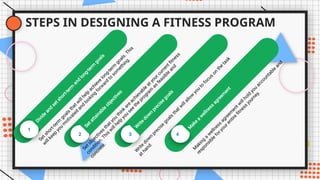
    STEPS IN DESIGNINGA FITNESS PROGRAM 1 D i v i d e a n d s e t s h o r t - t e r m a n d l o n g - t e r m g o a l s S e t s h o r t - t e r m g o a l s t h a t w i l l h e l p a c h i e v e l o n g - t e r m g o a l s . T h i s w i l l k e e p y o u m o t i v a t e d a n d l o o k i n g f o r w a r d t o s o m e t h i n g . 2 S e t a t t a i n a b l e o b j e c t i v e s S e t o b j e c t i v e s t h a t y o u t h i n k a r e a c h i e v a b l e a t y o u r c u r r e n t fi t n e s s c o n d i t i o n . T h i s w i l l h e l p y o u s e e t h e p r o g r a m a s f e a s i b l e a n d c o n c r e t e . 3W r i t e d o w n p r e c i s e g o a l s W r i t e d o w n p r e c i s e g o a l s t h a t w i l l a l l o w y o u t o f o c u s o n t h e t a s k a t h a n d . 4 M a k e a w e l l n e s s a g r e e m e n t M a k i n g a w e l l n e s s a g r e e m e n t w i l l h o l d y o u a c c o u n t a b l e a n d r e s p o n s i b l e f o r y o u r e n t i r e fi t n e s s j o u r n e y .
  • 25.
    ACTIVITY: DESIGN YOUR FITT:A PERSONALIZED EXERCISE PROGRAM 04
  • 26.
    EXERCISE PROGRAM ANDDESIGN Create a personalized exercise program based on your fitness goals and current fitness levels.
  • 27.
    EXERCISE PROGRAM ANDDESIGN Frequency: Workout five days a week with two rest days. Intensity: Moderate to high intensity. Use a scale of 1–10 to gauge intensity. Aim for a 7 during high-intensity workouts. Time: Thirty minutes to one hour per workout session Type: A mix of cardio exercises (like running or cycling), strength training (like weight lifting), and flexibility exercises (like yoga)
  • 28.
    EXERCISE PROGRAM ANDDESIGN FOCUS QUESTIONS: 1. What is the FITT principle, and why is it essential in designing an exercise program? 2. How did you apply the FITT principle in designing your exercise program? 3. How does your exercise program align with your personal fitness goals?
  • 29.