Modals of Deduction
Expressing degrees of Certainty
https://greenforest.com.ua/journal/read/modals-of-deduction-past-present
Definition
Deduction is the process of reaching a decision or answer by
thinking about the known facts.
Well-known Sherlock Holmes used this method to find the
criminals in his cases.
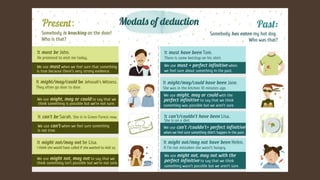
Present Tense Modals of Deduction
We use modals of deduction to say how sure we are about
something. In present modals of deduction are: must, might, may,
could, should can't and couldn’t.
MUST
• We use must when we feel sure that something is true because there’s
very strong evidence:
He must live near here because he comes to work on foot. (We
don’t know where he lives but we’re sure it’s not far away)
You are a computer programmer? You must make a lot of money.
Interpretation=probably: He probably lives here. You probably make a
lot of money.
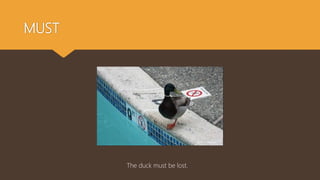
MUST
The duck must be lost.
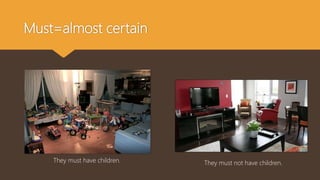
Must=almost certain
They must have children. They must not have children.
Should
 Should expresses one's expectation for something to happen in the
present or near future. We use should to make an assumption based on
personal knowledge, information, or insights. ("inference")
SHOULD
The flight should depart at 11:00.
The flight is departing late, but…
Should=Expected to be True
 John should be at home by now. He left work 30 minutes ago.
(We know that John lives 30 minutes or less from his workplace.)
 The movie should be available online next week. (It has left theaters, so it should go for release
online.)
 The movie should be good. (I've read some good reviews.)
 Movie fans should be excited to see the James Bond movie. (They usually are.)
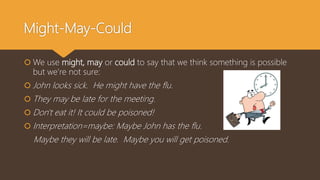
Might-May-Could
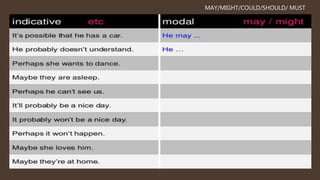
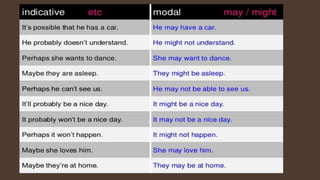
 We use might, may or could to say that we think something is possible
but we’re not sure:
 John looks sick. He might have the flu.
 They may be late for the meeting.
 Don't eat it! It could be poisoned!
 Interpretation=maybe: Maybe John has the flu.
Maybe they will be late. Maybe you will get poisoned.
CAN’T/ COULDN’T
 We use can't/couldn't when we assume that something is not possible:
 She can't be a mother, she's only 14!
 He can't be in prison, I saw him yesterday in the park.
 They couldn't be in the library. It's closed today.
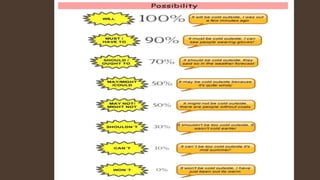
MAY/MIGHT/COULD/SHOULD/ MUST
1 degrees of certainty-present- deduction -new

1 degrees of certainty-present- deduction -new

  • 1.
    Modals of Deduction Expressingdegrees of Certainty https://greenforest.com.ua/journal/read/modals-of-deduction-past-present
  • 2.
    Definition Deduction is theprocess of reaching a decision or answer by thinking about the known facts. Well-known Sherlock Holmes used this method to find the criminals in his cases.
  • 3.
    Present Tense Modalsof Deduction We use modals of deduction to say how sure we are about something. In present modals of deduction are: must, might, may, could, should can't and couldn’t.
  • 4.
    MUST • We usemust when we feel sure that something is true because there’s very strong evidence: He must live near here because he comes to work on foot. (We don’t know where he lives but we’re sure it’s not far away) You are a computer programmer? You must make a lot of money. Interpretation=probably: He probably lives here. You probably make a lot of money.
  • 5.
  • 6.
    Must=almost certain They musthave children. They must not have children.
  • 7.
    Should  Should expressesone's expectation for something to happen in the present or near future. We use should to make an assumption based on personal knowledge, information, or insights. ("inference")
  • 8.
    SHOULD The flight shoulddepart at 11:00. The flight is departing late, but…
  • 9.
    Should=Expected to beTrue  John should be at home by now. He left work 30 minutes ago. (We know that John lives 30 minutes or less from his workplace.)  The movie should be available online next week. (It has left theaters, so it should go for release online.)  The movie should be good. (I've read some good reviews.)  Movie fans should be excited to see the James Bond movie. (They usually are.)
  • 10.
    Might-May-Could  We usemight, may or could to say that we think something is possible but we’re not sure:  John looks sick. He might have the flu.  They may be late for the meeting.  Don't eat it! It could be poisoned!  Interpretation=maybe: Maybe John has the flu. Maybe they will be late. Maybe you will get poisoned.
  • 11.
    CAN’T/ COULDN’T  Weuse can't/couldn't when we assume that something is not possible:  She can't be a mother, she's only 14!  He can't be in prison, I saw him yesterday in the park.  They couldn't be in the library. It's closed today.
  • 14.