Assessing “eXperiences” and “abilities”:
Usability, Communicability, Accessibility,
User eXperience, Customer eXperience
Dr. Cristian Rusu
Pontificia Universidad Católica de Valparaíso, Chile
cristian.rusu@pucv.cl
Dr. Toni Granollers
U. de Lleida, Catalonia, Spain
antoni.granollers@udl.cat
El taller “Evaluando eXperiencias y habilidades:
Usabilidad, Comunicabilidad, Accesibilidad, User
eXperience, Customer eXperience” ha sido impartido
por Cristian Rusu y Toni Granollers en la ciudad de Popayán-
Colombia del 27 al 30 de Septiembre del 2016 durante el
11Congreso Colombiano de Computación.
Este material está sujeto a la licencia
Creative Commons Reconocimiento-NoComercial 4.0 Internacion
Content
1. Usability and User Experience as HCI
Topics
2. Usability, Communicability,
Accessibility, User eXperience,
Customer eXperience
3. Assessing “eXperiences” and “abilities”
4. Conclusions
11CCC, Popayán, Colombia, September,
2016
11CCC, Popayán, Colombia, September,
2016
Usability and User Experience
as HCI Topics
Human – Computer Interaction (HCI):
 Part of the Body of Knowledge in Computer Science
(CS)
 18 CS knowledge areas
 Usability: a compulsory core HCI topic
 User eXperience (UX): NOT explicitly incorporated as a
core HCI topic
 Nothing (yet) about Costumer eXperience (CX)
ACM and IEEE Curricula proposal (CS2013,
2013)
11CCC, Popayán, Colombia, September,
2016
Usability
Usability:
The extent to which a system, product or service
can be used
 by specified users
 to achieve specified goals
 with effectiveness, efficiency and satisfaction
 in a specified context of use.
(ISO 9241-11, 1998)
11CCC, Popayán, Colombia, September,
2016
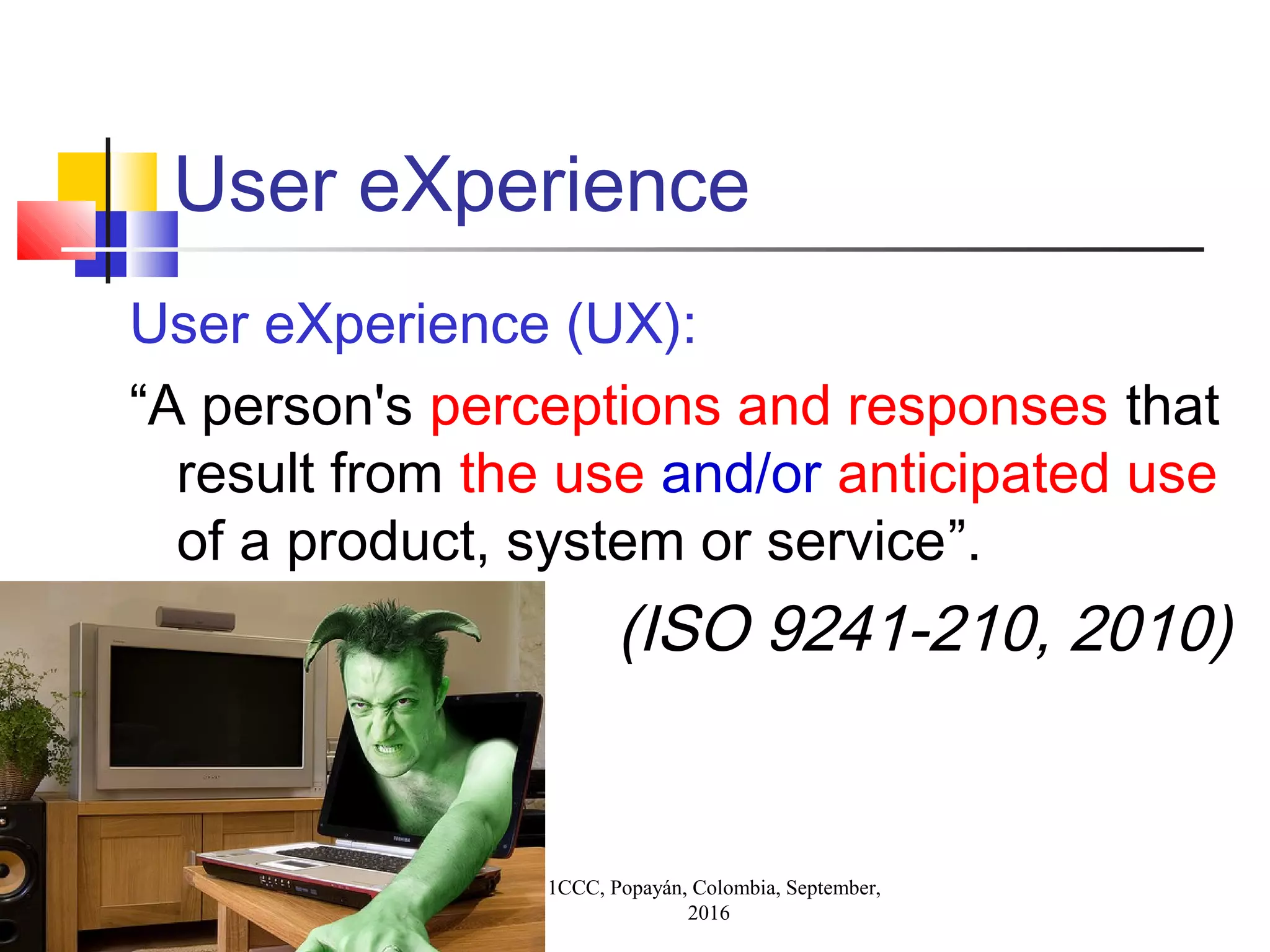
User eXperience
User eXperience (UX):
“A person's perceptions and responses that
result from the use and/or anticipated use
of a product, system or service”.
(ISO 9241-210, 2010)
Usability vs. User eXperience
 Some authors consider UX as an extension of
the usability concept; others use the terms
indistinctly
 “Usability Professionals Association” (UPA)
redefined itself as “User Experience
Professionals Association” (UXPA.org, 2014)
11CCC, Popayán, Colombia,
September, 2016
Usability vs. User eXperience
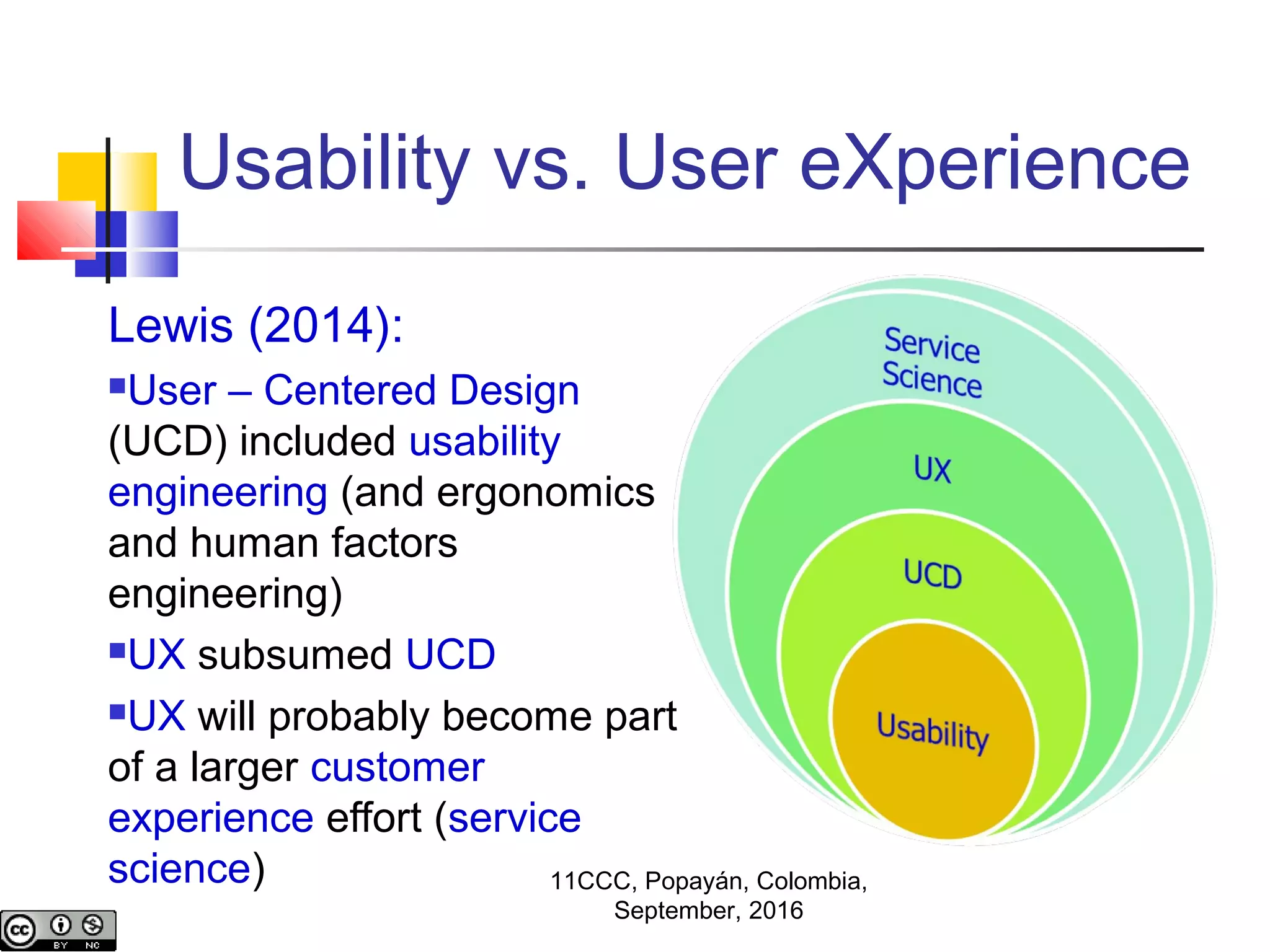
Lewis (2014):
User – Centered Design
(UCD) included usability
engineering (and ergonomics
and human factors
engineering)
UX subsumed UCD
UX will probably become part
of a larger customer
experience effort (service
science) 11CCC, Popayán, Colombia,
September, 2016
11CCC, Popayán, Colombia, September,
2016
Customer eXperience
Customer eXperience (CX):
 The interaction between an organization and a
customer over the duration of their relationship
 Customers’ perceptions, both conscious and
subconscious
 CX includes a series of interactions between
the customer and the company (or companies)
that offer the product and/or service, called
customer “touch-points”
11CCC, Popayán, Colombia, September,
2016
Customer eXperience
11CCC, Popayán, Colombia, September,
2016
Communicability
 The designer’s deputy (software system’s)
capacity to achieve full metacommunication,
conveying to users the essence of the original
designer’s message
de Souza and Leitão (2009)
 Do we really understand designer’s message?
11CCC, Popayán, Colombia, September,
2016
Accessibility
 Usability of a product, service, environment or
facility by people with the widest range of
capabilities
(ISO 9241-171, 2008)
 A usability - oriented definition…
 The concept of accessibility addresses the full
range of user capabilities and is not limited to
users who are formally recognized as having a
disability
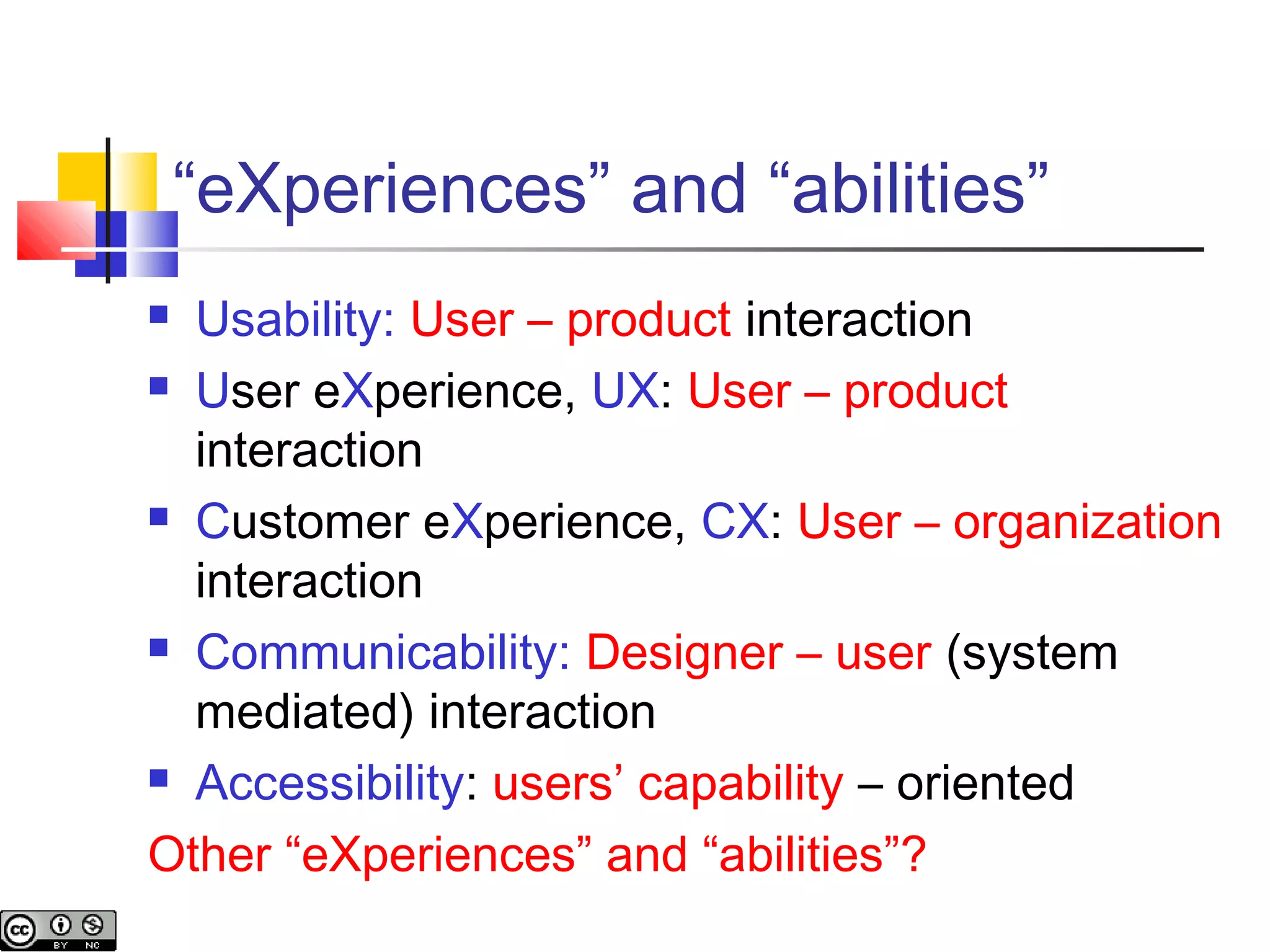
“eXperiences” and “abilities”
 Usability: User – product interaction
 User eXperience, UX: User – product
interaction
 Customer eXperience, CX: User – organization
interaction
 Communicability: Designer – user (system
mediated) interaction
 Accessibility: users’ capability – oriented
Other “eXperiences” and “abilities”?
Assessing “eXperiences” and
“abilities”
 How can we “measure” Usability/UX/CX?
 Well known and new methods to evaluate
usability
 Allboutux.org: more than 80 methods to
evaluate UX…
 Overwhelming for newcomers!
Cristian Rusu: “Assessing eXperiences: Usability, User
eXperience, Customer eXperience”
(www.youtube.com/watch?v=23PjhEIQNW4)
11CCC, Popayán, Colombia,
September, 2016
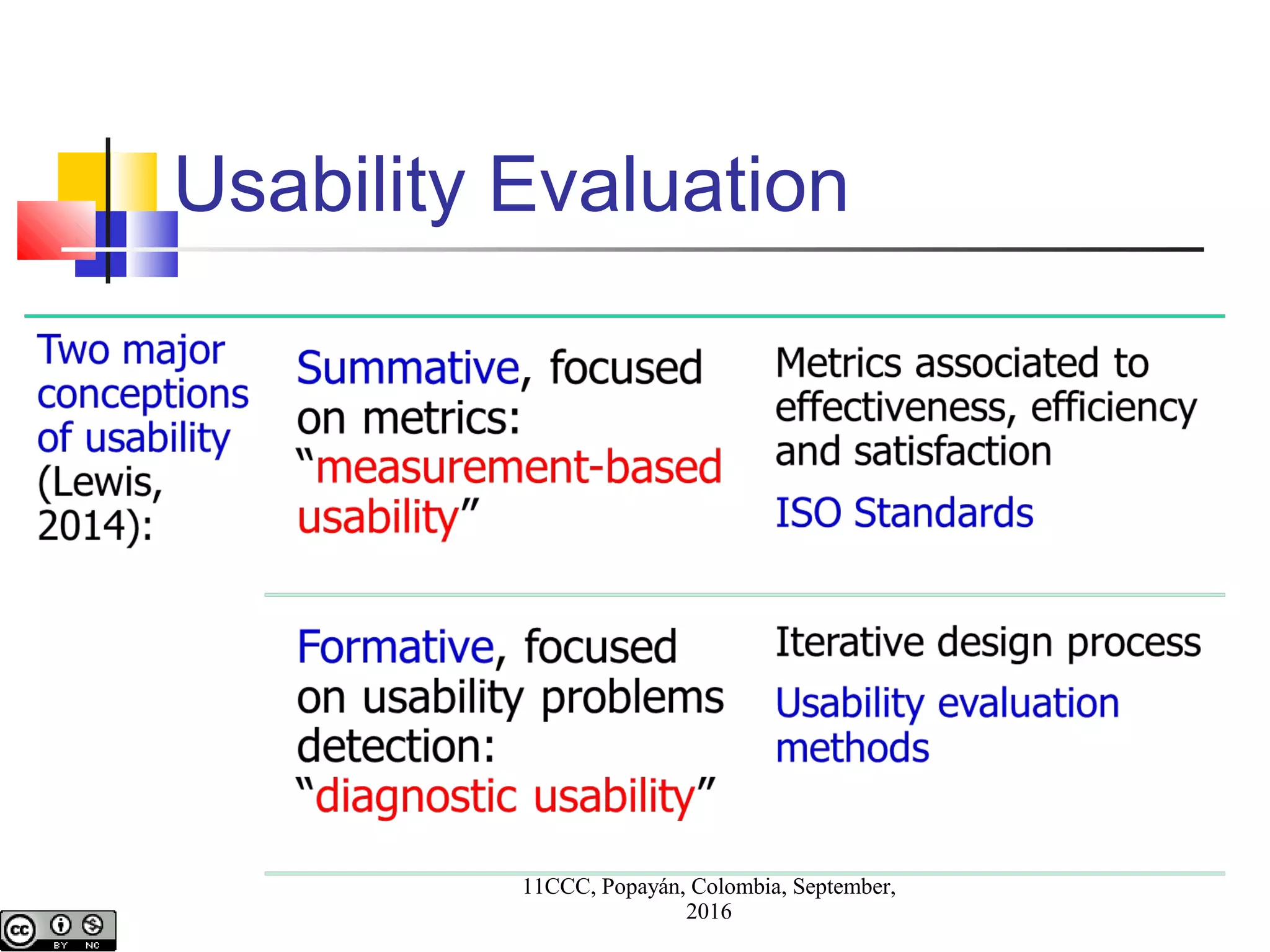
Usability Evaluation
11CCC, Popayán, Colombia, September,
2016
Usability, User eXperience,
Customer eXperience
 What about CX?
 Usability/UX evaluation methods may also
evaluate some CX aspects…
 Evaluating other CX aspects requires specific
methods
 A key indicator is the customer satisfaction
 CX should be assessed at least at each
“touch-point”!
11CCC, Popayán, Colombia,
September, 2016
Heuristic evaluation
 The system is carefully reviewed by several
evaluators (usually 3 to 5), based on usability
heuristics (“principles”) and checklists
 A single evaluator will (probably) detect a low
number of usability problems/issues and will
(probably) be subjective
 Cheap, intuitive, applicable in any stage of the
development process, finds many problems
(both major and minor), but… may miss
domain-specific problems!
11CCC, Popayán, Colombia,
September, 2016
Heuristic evaluation
(1) Individual work:
 Each evaluator detect a set of usability problems (and positive
findings)
(2) Group work:
 Evaluators join the problems in a unique list
(3) Individual work:
 Each evaluator rates all problems: severity, frequency, criticality
(4) Group work:
 Usability report: severity, frequency, criticality averages and
rankings; solutions are proposed
11CCC, Popayán, Colombia,
September, 2016
Heuristic evaluation:
Nielsen’s 10 usability heuristics
 Visibility of system status
 Match between system and the real world
 User control and freedom
 Consistency and standards
 Error prevention
 Recognition rather than recall
 Flexibility and efficiency of use
 Aesthetic and minimalist design
 Help users recognize, diagnose, and recover from errors
 Help and documentation
(www.nngroup.com/articles/ten-usability-heuristics/)
Specific usability heuristics
SMASH12: Physical interaction and ergonomics
 Definition: The device should provide physical buttons or
the equivalent for main functionalities, located in positions
recognizable by the user, which should fit the natural
posture (and reach) of the user’s dominant hand.
 Explanation: Mobile devices are designed as hand-held
devices. From this point of view, ergonomics and comfort
play a very important role in the interaction between user
and device. Any product that does not have a shape,
weight, dimensions or buttons’ position matching the
normal posture of the palm might produce exhaustion…
11CCC, Popayán, Colombia,
September, 2016
Specific usability heuristics
SMASH12: Physical interaction
and ergonomics
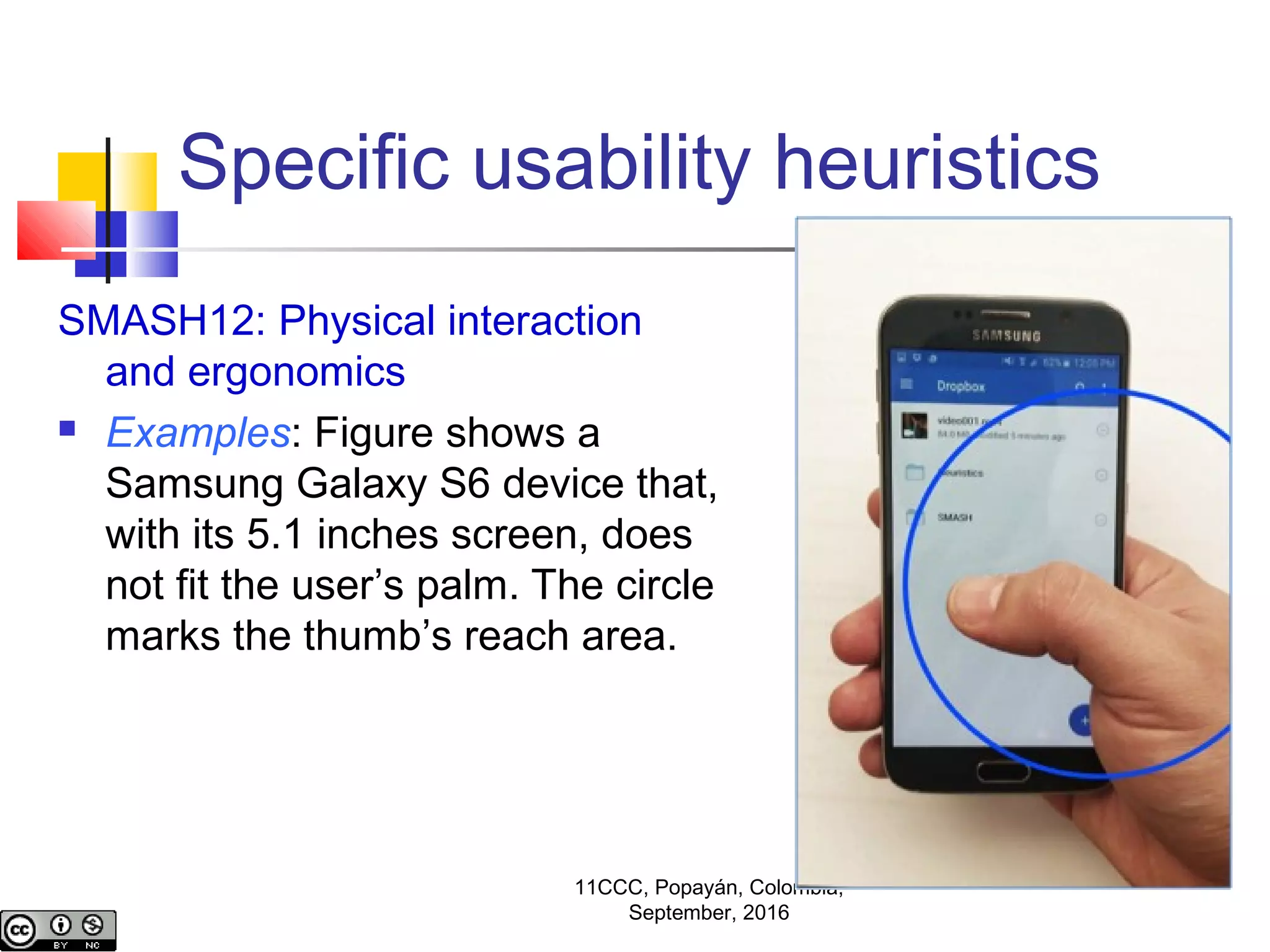
 Examples: Figure shows a
Samsung Galaxy S6 device that,
with its 5.1 inches screen, does
not fit the user’s palm. The circle
marks the thumb’s reach area.
11CCC, Popayán, Colombia,
September, 2016
Conclusions
 Over more than three decades usability was
(re)defined by many authors and standards
 UX is usually considered an extension of usability,
but the terms are sometimes (still) used indistinctly
 CX will probably be the next step…
 The practice is usually more appealing than the
theory
 Usability/UX/CX practice should include
summative and formative approaches, and should
combine qualitative and quantitative methods
11CCC, Popayán, Colombia, September,
2016
References
 Quiñones D., Rusu C., Roncagliolo S., Rusu V., Collazos C. (2016) Developing Usability
Heuristics: A Formal or Informal Process? (to be published in IEEE LA Transactions)
 Collazos C., Ortega M., Granollers A., Rusu C., Gutierrez F. (2016) Human-Computer
Interaction in Ibero-America. Academic, Research, and Professional Issues, IT Professional,
ISSN 1520-9202, IEEE Computer Society, Vol.18 (2), pp. 8-11.
 Inostroza R., Rusu C., Roncagliolo S., Rusu V., Collazos C. (2016). Developing SMASH: A
set of SMArtphone’s uSability Heuristics, Computer Standards & Interfaces, Elsevier, Vol.
43, pp. 40-52.
 Hermawati S., Lawson G. (2016) Establishing usability heuristics for heuristics evaluation in
a specific domain: Is there a consensus?, Applied Ergonomics, Elsevier, Vol. 56, pp. 34-51.
11CCC, Popayán, Colombia, September,
2016
References
 Rusu V., Rusu C., Guzmán D., Espinoza D., Rojas D., Roncagliolo S., Quiñones D. (2016).
Assessing the Customer eXperience Based on Quantitative Data: Virtual Travel Agencies,
LNCS, 9746, pp. 499–508, Springer.
 Rusu C., Rusu V., Roncagliolo S., Quiñones D., Rusu V.Z., Fardoun H., Alghazzawi D.,
Collazos C. (2016). Usability Heuristics: Reinventing the Wheel?, LNCS, 9742, pp. 59–70,
Springer.
 Quiñones D., Rusu C., Roncagliolo S., Rusu V., Collazos C. (2016). Developing Usability
Heuristics for Grid Computing Applications: Lessons Learned, Advances in Intelligent
Systems and Computing, Vol. 448, pp. 485 – 495, Springer.
 Sanz F., Galvez R., Rusu C., Roncagliolo S., Rusu V., Collazos C., Cofré J.P., Campos A.,
Quiñones D. (2016). A Set of Usability Heuristics and Design Recommendations for u-
Learning Applications, Advances in Intelligent Systems and Computing, Vol. 448, pp. 983 –
993, Springer.
 Quiñones D., Rusu C., Roncagliolo S., Rusu V., Collazos C. (2016). Formalizing the Process
of Usability Heuristics Development, Advances in Intelligent Systems and Computing, Vol.
448, pp. 1279 – 1282, Springer.
 Barría C., Rusu C., Cubillos C., Collazos C., Palma M. (2016). Analysis of a Training
Platform for the Digital Battlefield, Based on Semiotics and Simulation, Advances in
Intelligent Systems and Computing, Vol. 448, pp. 1283 – 1286, Springer.
 Campos A., Rusu C., Roncagliolo S., Sanz F., Galvez R., Quiñones D. (2016). Usability
Heuristics and Design Recommendations for Driving Simulators, Advances in Intelligent
Systems and Computing, Vol. 448, pp. 1287 – 1290, Springer.11CCC, Popayán, Colombia, September,
2016
References
 Quiñones, D., Rusu C. & Roncagliolo S. (2014). Redefining Usability Heuristics for
Transactional Web Applications. In Proceedings ITNG2014: 11th International Conference
on Information Technology: New Generations (pp. 260 – 265). IEEE Computer Society
Press.
 Diaz, J., Rusu, C., Pow-Sang, J. & Roncagliolo, S. (2013). A Cultural – Oriented Usability
Heuristics Proposal. In Proceedings ChileCHI2013: First Chilean Conference on Human -
Computer Interaction (pp. 82-87). ACM International Conference Proceeding Series.
 Inostroza, R., Rusu, C., Roncagliolo S. & Rusu V. (2013). Usability Heuristics for
Touchscreen-based Mobile Devices: Update. In Proceedings ChileCHI2013: First Chilean
Conference on Human - Computer Interaction (pp. 24-29). ACM International Conference
Proceeding Series.
 Solano, A., Rusu, C., Collazos, C. & Arciniegas, J. (2013). Evaluating interactive digital
television applications through usability heuristics. Ingeniare, 21 (1), pp. 16-29.
 Roncagliolo, S., Rusu, V., Rusu, C., Tapia, G., Hayvar, D. & Gorgan D. (2011). Grid
Computing Usability Heuristics in Practice, In Proceedings ITNG2011: 8th International
Conference on Information Technology: New Generations (pp. 145-150). IEEE Computer
Society Press.
 Rusu, C., Muñoz, R., Roncagliolo, S., Rudloff, S., Rusu, V. & Figueroa A. (2011). Usability
Heuristics for Virtual Worlds, In Proceedings AFIN2011: The Third International Conference
on Advances in Future Internet (pp. 16-19). International Academy, Research, and Industry
Association (IARIA). 11CCC, Popayán, Colombia, September,
2016
References
 Rusu, C., Roncagliolo, S., Rusu, V. & Collazos C. (2011). A Methodology to Establish
Usability Heuristics. In Proceedings ACHI2011: The Fourth International Conference on
Advances in Computer-Human Interactions (pp. 59-62). International Academy, Research,
and Industry Association (IARIA).
 Collazos, C., Granollers, T. & Rusu C. (2011). A Survey of Human-Computer Interaction into
the Computer Science Curricula in Iberoamerica. In Proceedings ITNG2011: 8th
International Conference on Information Technology: New Generations (pp. 151-156). IEEE
Computer Society Press.
 Rusu, C. & Rusu V. (2007). Teaching HCI: A Challenging Intercultural, Interdisciplinary,
Cross-field Experience. In Ishida, T., Fussell, S.. & Vossen, P (Ed.): Intercultural
Collaboration, Proceedings IWIC2007 (pp. 344-354). Lecture Notes in Computer Science
4568: Springer.
 Rusu, C., Rusu, V. & Roncagliolo, S. (2008). Usability Practice: The Appealing Way to HCI.
In Proceedings ACHI 2008: The First International Conference on Advances in Computer-
Human Interactions (pp. 265-270). IEEE Computer Society Press.
11CCC, Popayán, Colombia, September,
2016
References
 ACM SIGCHI (2009). ACM SIGCHI Curricula for Human-Computer Interaction. Retrieved
August 12, 2014, from http://old.sigchi.org/cdg/cdg2.html#2_1.
 CS2013 (2013). Computer Science Curricula 2013. Curriculum Guidelines for Undergraduate
Degree Programs in Computer Science (Final Report). ACM/IEEE-CS Joint Task Force on
Computing Curricula, ACM/IEEE Computer Society, USA.
 ISO 9241-11 (1998). Ergonomic requirements for office work with visual display terminals
(VDTs) -- Part 11: Guidance on usability. International Organization for Standardization,
Geneva, Switzerland.
 ISO 9241-210 (2010). Ergonomics of human-system interaction — Part 210: Human-centred
design for interactive systems. International Organization for Standardization, Geneva,
Switzerland.
 ISO 13407 (1999). Human-centered design processes for interactive systems. International
Organization for Standardization, Geneva, Switzerland.
 ISO/IEC 9126 (2001). Software engineering — Product quality. International Organization for
Standardization, Geneva, Switzerland.
 ISO/IEC 25010 (2011). Systems and software engineering — Systems and software Quality
Requirements and Evaluation (SQuaRE) — System and software quality models.
International Organization for Standardization, Geneva, Switzerland.
11CCC, Popayán, Colombia, September,
2016
References
 Allaboutux.org (2011). All About UX. Retrieved August 20, 2014, from
http://www.allaboutux.org/.
 Usability.gov (2014). Improving the User Experience. U.S. Department of Health & Human
Services. Retrieved August 20, 2014, from http://www.usability.gov/.
 UXPA.org (2014). User Experience Professionals Association. Retrieved August 20, 2014,
from http://uxpa.org/.
 www.sigchi.org - ACM SIGCHI
 www.aipo.es –Asociación Interacción Persona-Ordenador
11CCC, Popayán, Colombia, September,
2016

1 (de 3). Assessing e xperiences and abilities

  • 1.
    Assessing “eXperiences” and“abilities”: Usability, Communicability, Accessibility, User eXperience, Customer eXperience Dr. Cristian Rusu Pontificia Universidad Católica de Valparaíso, Chile cristian.rusu@pucv.cl Dr. Toni Granollers U. de Lleida, Catalonia, Spain antoni.granollers@udl.cat El taller “Evaluando eXperiencias y habilidades: Usabilidad, Comunicabilidad, Accesibilidad, User eXperience, Customer eXperience” ha sido impartido por Cristian Rusu y Toni Granollers en la ciudad de Popayán- Colombia del 27 al 30 de Septiembre del 2016 durante el 11Congreso Colombiano de Computación. Este material está sujeto a la licencia Creative Commons Reconocimiento-NoComercial 4.0 Internacion
  • 2.
    Content 1. Usability andUser Experience as HCI Topics 2. Usability, Communicability, Accessibility, User eXperience, Customer eXperience 3. Assessing “eXperiences” and “abilities” 4. Conclusions 11CCC, Popayán, Colombia, September, 2016
  • 3.
    11CCC, Popayán, Colombia,September, 2016 Usability and User Experience as HCI Topics Human – Computer Interaction (HCI):  Part of the Body of Knowledge in Computer Science (CS)  18 CS knowledge areas  Usability: a compulsory core HCI topic  User eXperience (UX): NOT explicitly incorporated as a core HCI topic  Nothing (yet) about Costumer eXperience (CX) ACM and IEEE Curricula proposal (CS2013, 2013)
  • 4.
    11CCC, Popayán, Colombia,September, 2016 Usability Usability: The extent to which a system, product or service can be used  by specified users  to achieve specified goals  with effectiveness, efficiency and satisfaction  in a specified context of use. (ISO 9241-11, 1998)
  • 5.
    11CCC, Popayán, Colombia,September, 2016 User eXperience User eXperience (UX): “A person's perceptions and responses that result from the use and/or anticipated use of a product, system or service”. (ISO 9241-210, 2010)
  • 6.
    Usability vs. UsereXperience  Some authors consider UX as an extension of the usability concept; others use the terms indistinctly  “Usability Professionals Association” (UPA) redefined itself as “User Experience Professionals Association” (UXPA.org, 2014) 11CCC, Popayán, Colombia, September, 2016
  • 7.
    Usability vs. UsereXperience Lewis (2014): User – Centered Design (UCD) included usability engineering (and ergonomics and human factors engineering) UX subsumed UCD UX will probably become part of a larger customer experience effort (service science) 11CCC, Popayán, Colombia, September, 2016
  • 8.
    11CCC, Popayán, Colombia,September, 2016 Customer eXperience Customer eXperience (CX):  The interaction between an organization and a customer over the duration of their relationship  Customers’ perceptions, both conscious and subconscious  CX includes a series of interactions between the customer and the company (or companies) that offer the product and/or service, called customer “touch-points”
  • 9.
    11CCC, Popayán, Colombia,September, 2016 Customer eXperience
  • 10.
    11CCC, Popayán, Colombia,September, 2016 Communicability  The designer’s deputy (software system’s) capacity to achieve full metacommunication, conveying to users the essence of the original designer’s message de Souza and Leitão (2009)  Do we really understand designer’s message?
  • 11.
    11CCC, Popayán, Colombia,September, 2016 Accessibility  Usability of a product, service, environment or facility by people with the widest range of capabilities (ISO 9241-171, 2008)  A usability - oriented definition…  The concept of accessibility addresses the full range of user capabilities and is not limited to users who are formally recognized as having a disability
  • 12.
    “eXperiences” and “abilities” Usability: User – product interaction  User eXperience, UX: User – product interaction  Customer eXperience, CX: User – organization interaction  Communicability: Designer – user (system mediated) interaction  Accessibility: users’ capability – oriented Other “eXperiences” and “abilities”?
  • 13.
    Assessing “eXperiences” and “abilities” How can we “measure” Usability/UX/CX?  Well known and new methods to evaluate usability  Allboutux.org: more than 80 methods to evaluate UX…  Overwhelming for newcomers! Cristian Rusu: “Assessing eXperiences: Usability, User eXperience, Customer eXperience” (www.youtube.com/watch?v=23PjhEIQNW4) 11CCC, Popayán, Colombia, September, 2016
  • 14.
    Usability Evaluation 11CCC, Popayán,Colombia, September, 2016
  • 15.
    Usability, User eXperience, CustomereXperience  What about CX?  Usability/UX evaluation methods may also evaluate some CX aspects…  Evaluating other CX aspects requires specific methods  A key indicator is the customer satisfaction  CX should be assessed at least at each “touch-point”! 11CCC, Popayán, Colombia, September, 2016
  • 16.
    Heuristic evaluation  Thesystem is carefully reviewed by several evaluators (usually 3 to 5), based on usability heuristics (“principles”) and checklists  A single evaluator will (probably) detect a low number of usability problems/issues and will (probably) be subjective  Cheap, intuitive, applicable in any stage of the development process, finds many problems (both major and minor), but… may miss domain-specific problems! 11CCC, Popayán, Colombia, September, 2016
  • 17.
    Heuristic evaluation (1) Individualwork:  Each evaluator detect a set of usability problems (and positive findings) (2) Group work:  Evaluators join the problems in a unique list (3) Individual work:  Each evaluator rates all problems: severity, frequency, criticality (4) Group work:  Usability report: severity, frequency, criticality averages and rankings; solutions are proposed 11CCC, Popayán, Colombia, September, 2016
  • 18.
    Heuristic evaluation: Nielsen’s 10usability heuristics  Visibility of system status  Match between system and the real world  User control and freedom  Consistency and standards  Error prevention  Recognition rather than recall  Flexibility and efficiency of use  Aesthetic and minimalist design  Help users recognize, diagnose, and recover from errors  Help and documentation (www.nngroup.com/articles/ten-usability-heuristics/)
  • 19.
    Specific usability heuristics SMASH12:Physical interaction and ergonomics  Definition: The device should provide physical buttons or the equivalent for main functionalities, located in positions recognizable by the user, which should fit the natural posture (and reach) of the user’s dominant hand.  Explanation: Mobile devices are designed as hand-held devices. From this point of view, ergonomics and comfort play a very important role in the interaction between user and device. Any product that does not have a shape, weight, dimensions or buttons’ position matching the normal posture of the palm might produce exhaustion… 11CCC, Popayán, Colombia, September, 2016
  • 20.
    Specific usability heuristics SMASH12:Physical interaction and ergonomics  Examples: Figure shows a Samsung Galaxy S6 device that, with its 5.1 inches screen, does not fit the user’s palm. The circle marks the thumb’s reach area. 11CCC, Popayán, Colombia, September, 2016
  • 21.
    Conclusions  Over morethan three decades usability was (re)defined by many authors and standards  UX is usually considered an extension of usability, but the terms are sometimes (still) used indistinctly  CX will probably be the next step…  The practice is usually more appealing than the theory  Usability/UX/CX practice should include summative and formative approaches, and should combine qualitative and quantitative methods 11CCC, Popayán, Colombia, September, 2016
  • 22.
    References  Quiñones D.,Rusu C., Roncagliolo S., Rusu V., Collazos C. (2016) Developing Usability Heuristics: A Formal or Informal Process? (to be published in IEEE LA Transactions)  Collazos C., Ortega M., Granollers A., Rusu C., Gutierrez F. (2016) Human-Computer Interaction in Ibero-America. Academic, Research, and Professional Issues, IT Professional, ISSN 1520-9202, IEEE Computer Society, Vol.18 (2), pp. 8-11.  Inostroza R., Rusu C., Roncagliolo S., Rusu V., Collazos C. (2016). Developing SMASH: A set of SMArtphone’s uSability Heuristics, Computer Standards & Interfaces, Elsevier, Vol. 43, pp. 40-52.  Hermawati S., Lawson G. (2016) Establishing usability heuristics for heuristics evaluation in a specific domain: Is there a consensus?, Applied Ergonomics, Elsevier, Vol. 56, pp. 34-51. 11CCC, Popayán, Colombia, September, 2016
  • 23.
    References  Rusu V.,Rusu C., Guzmán D., Espinoza D., Rojas D., Roncagliolo S., Quiñones D. (2016). Assessing the Customer eXperience Based on Quantitative Data: Virtual Travel Agencies, LNCS, 9746, pp. 499–508, Springer.  Rusu C., Rusu V., Roncagliolo S., Quiñones D., Rusu V.Z., Fardoun H., Alghazzawi D., Collazos C. (2016). Usability Heuristics: Reinventing the Wheel?, LNCS, 9742, pp. 59–70, Springer.  Quiñones D., Rusu C., Roncagliolo S., Rusu V., Collazos C. (2016). Developing Usability Heuristics for Grid Computing Applications: Lessons Learned, Advances in Intelligent Systems and Computing, Vol. 448, pp. 485 – 495, Springer.  Sanz F., Galvez R., Rusu C., Roncagliolo S., Rusu V., Collazos C., Cofré J.P., Campos A., Quiñones D. (2016). A Set of Usability Heuristics and Design Recommendations for u- Learning Applications, Advances in Intelligent Systems and Computing, Vol. 448, pp. 983 – 993, Springer.  Quiñones D., Rusu C., Roncagliolo S., Rusu V., Collazos C. (2016). Formalizing the Process of Usability Heuristics Development, Advances in Intelligent Systems and Computing, Vol. 448, pp. 1279 – 1282, Springer.  Barría C., Rusu C., Cubillos C., Collazos C., Palma M. (2016). Analysis of a Training Platform for the Digital Battlefield, Based on Semiotics and Simulation, Advances in Intelligent Systems and Computing, Vol. 448, pp. 1283 – 1286, Springer.  Campos A., Rusu C., Roncagliolo S., Sanz F., Galvez R., Quiñones D. (2016). Usability Heuristics and Design Recommendations for Driving Simulators, Advances in Intelligent Systems and Computing, Vol. 448, pp. 1287 – 1290, Springer.11CCC, Popayán, Colombia, September, 2016
  • 24.
    References  Quiñones, D.,Rusu C. & Roncagliolo S. (2014). Redefining Usability Heuristics for Transactional Web Applications. In Proceedings ITNG2014: 11th International Conference on Information Technology: New Generations (pp. 260 – 265). IEEE Computer Society Press.  Diaz, J., Rusu, C., Pow-Sang, J. & Roncagliolo, S. (2013). A Cultural – Oriented Usability Heuristics Proposal. In Proceedings ChileCHI2013: First Chilean Conference on Human - Computer Interaction (pp. 82-87). ACM International Conference Proceeding Series.  Inostroza, R., Rusu, C., Roncagliolo S. & Rusu V. (2013). Usability Heuristics for Touchscreen-based Mobile Devices: Update. In Proceedings ChileCHI2013: First Chilean Conference on Human - Computer Interaction (pp. 24-29). ACM International Conference Proceeding Series.  Solano, A., Rusu, C., Collazos, C. & Arciniegas, J. (2013). Evaluating interactive digital television applications through usability heuristics. Ingeniare, 21 (1), pp. 16-29.  Roncagliolo, S., Rusu, V., Rusu, C., Tapia, G., Hayvar, D. & Gorgan D. (2011). Grid Computing Usability Heuristics in Practice, In Proceedings ITNG2011: 8th International Conference on Information Technology: New Generations (pp. 145-150). IEEE Computer Society Press.  Rusu, C., Muñoz, R., Roncagliolo, S., Rudloff, S., Rusu, V. & Figueroa A. (2011). Usability Heuristics for Virtual Worlds, In Proceedings AFIN2011: The Third International Conference on Advances in Future Internet (pp. 16-19). International Academy, Research, and Industry Association (IARIA). 11CCC, Popayán, Colombia, September, 2016
  • 25.
    References  Rusu, C.,Roncagliolo, S., Rusu, V. & Collazos C. (2011). A Methodology to Establish Usability Heuristics. In Proceedings ACHI2011: The Fourth International Conference on Advances in Computer-Human Interactions (pp. 59-62). International Academy, Research, and Industry Association (IARIA).  Collazos, C., Granollers, T. & Rusu C. (2011). A Survey of Human-Computer Interaction into the Computer Science Curricula in Iberoamerica. In Proceedings ITNG2011: 8th International Conference on Information Technology: New Generations (pp. 151-156). IEEE Computer Society Press.  Rusu, C. & Rusu V. (2007). Teaching HCI: A Challenging Intercultural, Interdisciplinary, Cross-field Experience. In Ishida, T., Fussell, S.. & Vossen, P (Ed.): Intercultural Collaboration, Proceedings IWIC2007 (pp. 344-354). Lecture Notes in Computer Science 4568: Springer.  Rusu, C., Rusu, V. & Roncagliolo, S. (2008). Usability Practice: The Appealing Way to HCI. In Proceedings ACHI 2008: The First International Conference on Advances in Computer- Human Interactions (pp. 265-270). IEEE Computer Society Press. 11CCC, Popayán, Colombia, September, 2016
  • 26.
    References  ACM SIGCHI(2009). ACM SIGCHI Curricula for Human-Computer Interaction. Retrieved August 12, 2014, from http://old.sigchi.org/cdg/cdg2.html#2_1.  CS2013 (2013). Computer Science Curricula 2013. Curriculum Guidelines for Undergraduate Degree Programs in Computer Science (Final Report). ACM/IEEE-CS Joint Task Force on Computing Curricula, ACM/IEEE Computer Society, USA.  ISO 9241-11 (1998). Ergonomic requirements for office work with visual display terminals (VDTs) -- Part 11: Guidance on usability. International Organization for Standardization, Geneva, Switzerland.  ISO 9241-210 (2010). Ergonomics of human-system interaction — Part 210: Human-centred design for interactive systems. International Organization for Standardization, Geneva, Switzerland.  ISO 13407 (1999). Human-centered design processes for interactive systems. International Organization for Standardization, Geneva, Switzerland.  ISO/IEC 9126 (2001). Software engineering — Product quality. International Organization for Standardization, Geneva, Switzerland.  ISO/IEC 25010 (2011). Systems and software engineering — Systems and software Quality Requirements and Evaluation (SQuaRE) — System and software quality models. International Organization for Standardization, Geneva, Switzerland. 11CCC, Popayán, Colombia, September, 2016
  • 27.
    References  Allaboutux.org (2011).All About UX. Retrieved August 20, 2014, from http://www.allaboutux.org/.  Usability.gov (2014). Improving the User Experience. U.S. Department of Health & Human Services. Retrieved August 20, 2014, from http://www.usability.gov/.  UXPA.org (2014). User Experience Professionals Association. Retrieved August 20, 2014, from http://uxpa.org/.  www.sigchi.org - ACM SIGCHI  www.aipo.es –Asociación Interacción Persona-Ordenador 11CCC, Popayán, Colombia, September, 2016