Classification of
manufacturing processes
Presented by
SALUNKE M.D.
Presented to
J.S.P.M.’S
B.I.T.BARSHI
Introduction
 Classification of manufacturing process
 Classification based on Function of Process
 Classification based on quantity of production
 Selection of manufacturing process
aKhTaR kAmAl
2
Classification Based On Function of
Process
 Manufacturing process used in industry
basically performed following purpose…
 Changed the physically properties of work piece.
 Change the shape and size of the work piece.
 Produced desired dimensional accuracy and
surface finish.
aKhTaR kAmAl
3
Classification Based On Function of Process:
1) Process for changing Physical properties of
work piece.
2) Casting process
3) Primary metal working processes.
4) Shearing and Forming processes.
5) Joining processes.
6) Machining processes.
7) Surface finishing processes.
aKhTaR kAmAl
4
Changing Physical
Properties
 Physical properties of material can be change by heat
treatment like
1) Carbonizing
2) tempering
3) Hardening
By hammering, bending and cold rolling of iron materials and
nonferrous metals a strengthening of the metal structure is changed
systematically. This kind of heat treatment is used for making the
steels hard and wear-resistant for certain purposes.
4) Annealing
The hardness for an annealing process is usually listed on the HRB
scale as a maximum value. It is a process to refine grain size,
improve strength, remove residual stress and affect the
electromagnetic properties.
5) Stress relieving
is a technique to remove or reduce the internal stresses created in
a metal. Stress relieving is usually accomplished by heating a metal
aKhTaR kAmAl
5
Casting Process
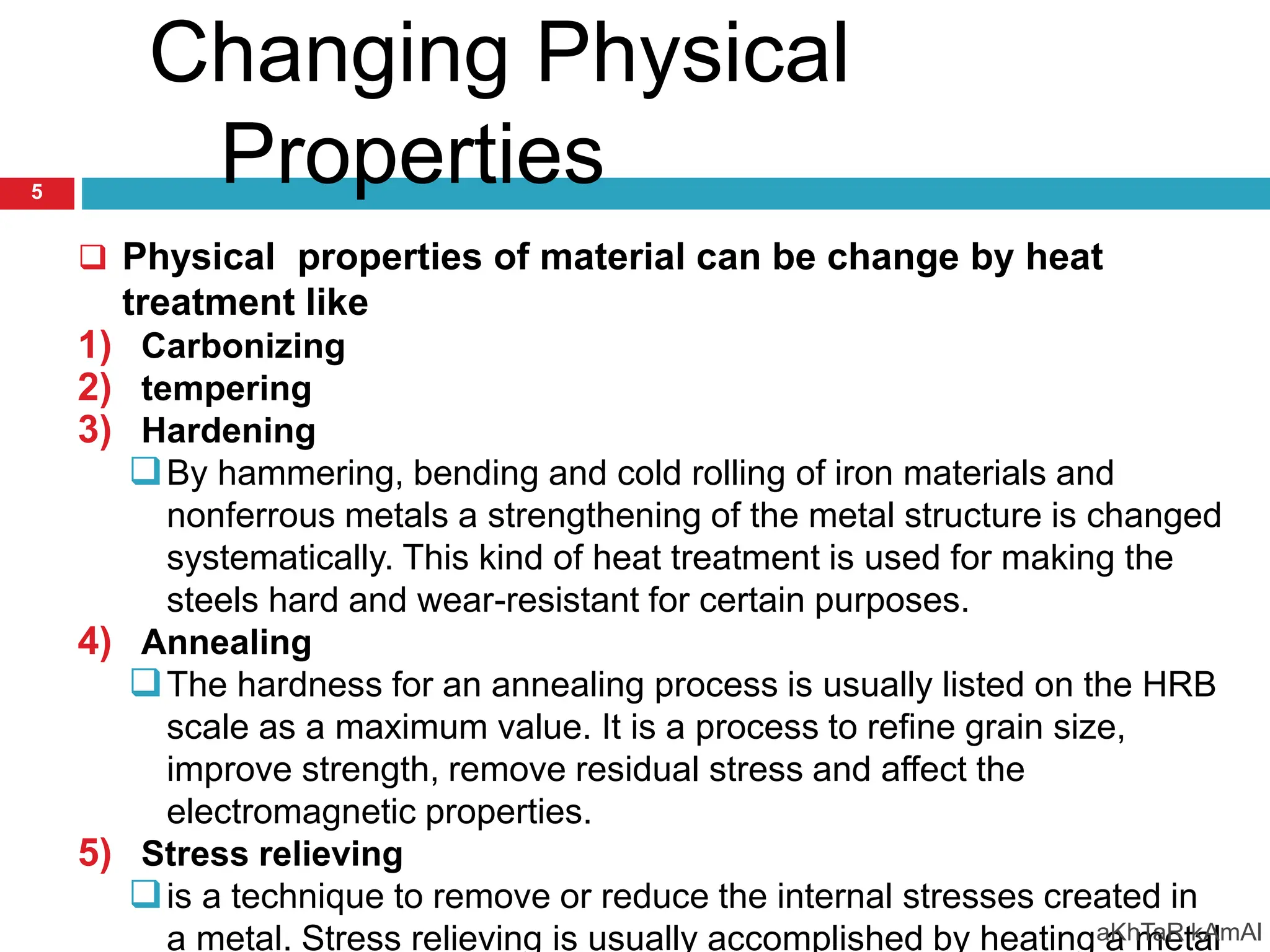
 Casting processes basically involve the introduction of a
molten metal in to a mould cavity, where up on solidification,
the metal takes on the shape of the mould cavity.
 Simple and complicated shapes can be made from any metal
that can be melted.
 Example of cast parts : frames, structural parts, machine
components, engine blocks, valves, pipes, statues, ornamental
artefacts…..
aKhTaR kAmAl
6
Joining Processes
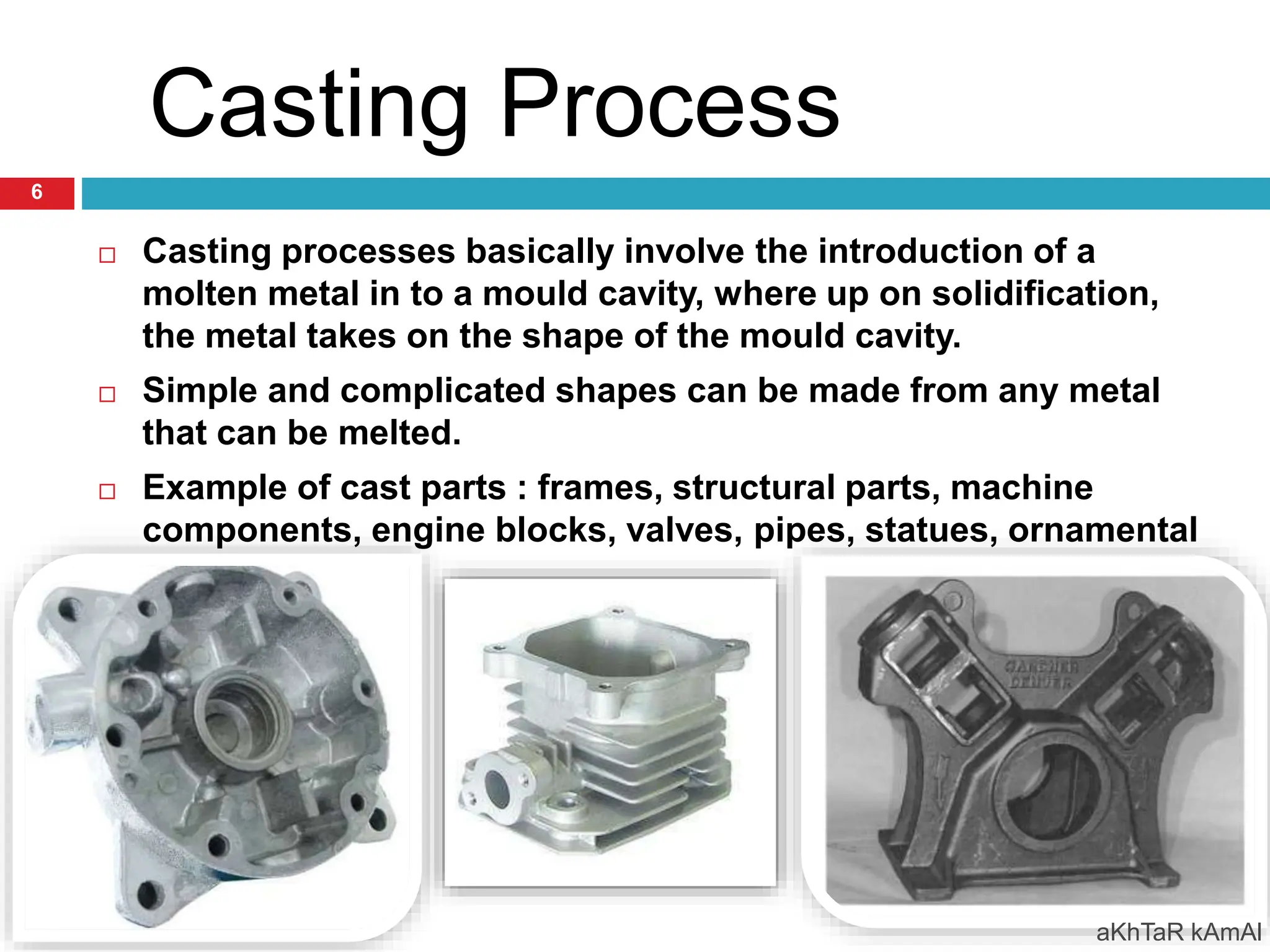
 In this process; two or more metals are joint to each other. Or
repair/join the broken parts.
 The joints are may be permanent like welding OR may be
temporary like Riveting, brazing, soldering…
 Joining process are….
 Screw-Fastening
 Welding
 Riveting
 Brazing
 Soldering
aKhTaR kAmAl
7
Machining Processes
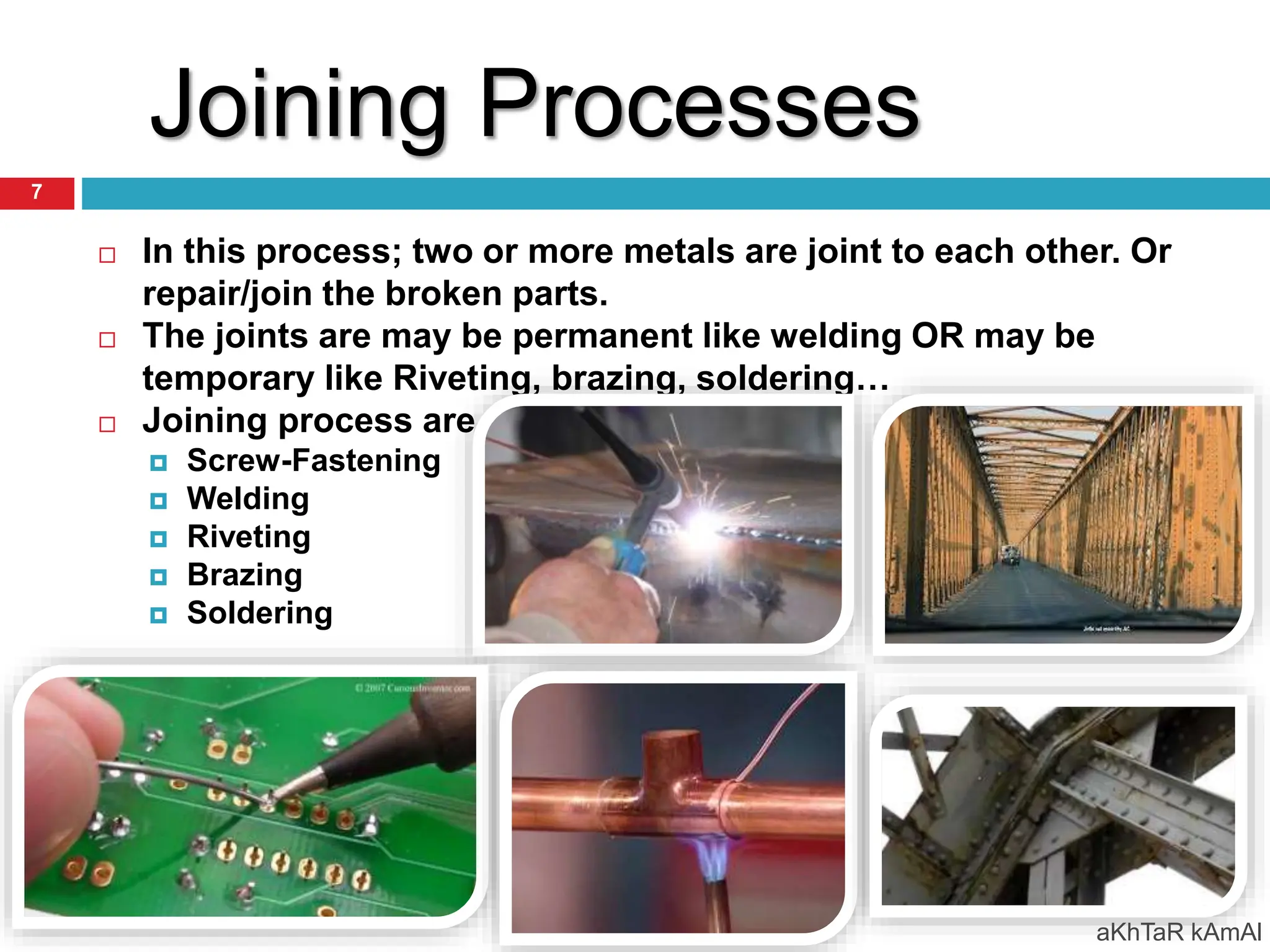
 Machining consist of forcing cutting tool with one or more edges
through the excess materials on a work piece and removing this
excess material in the form of chip.
Knurling
aKhTaR kAmAl
8
Surface Finishing
Processes
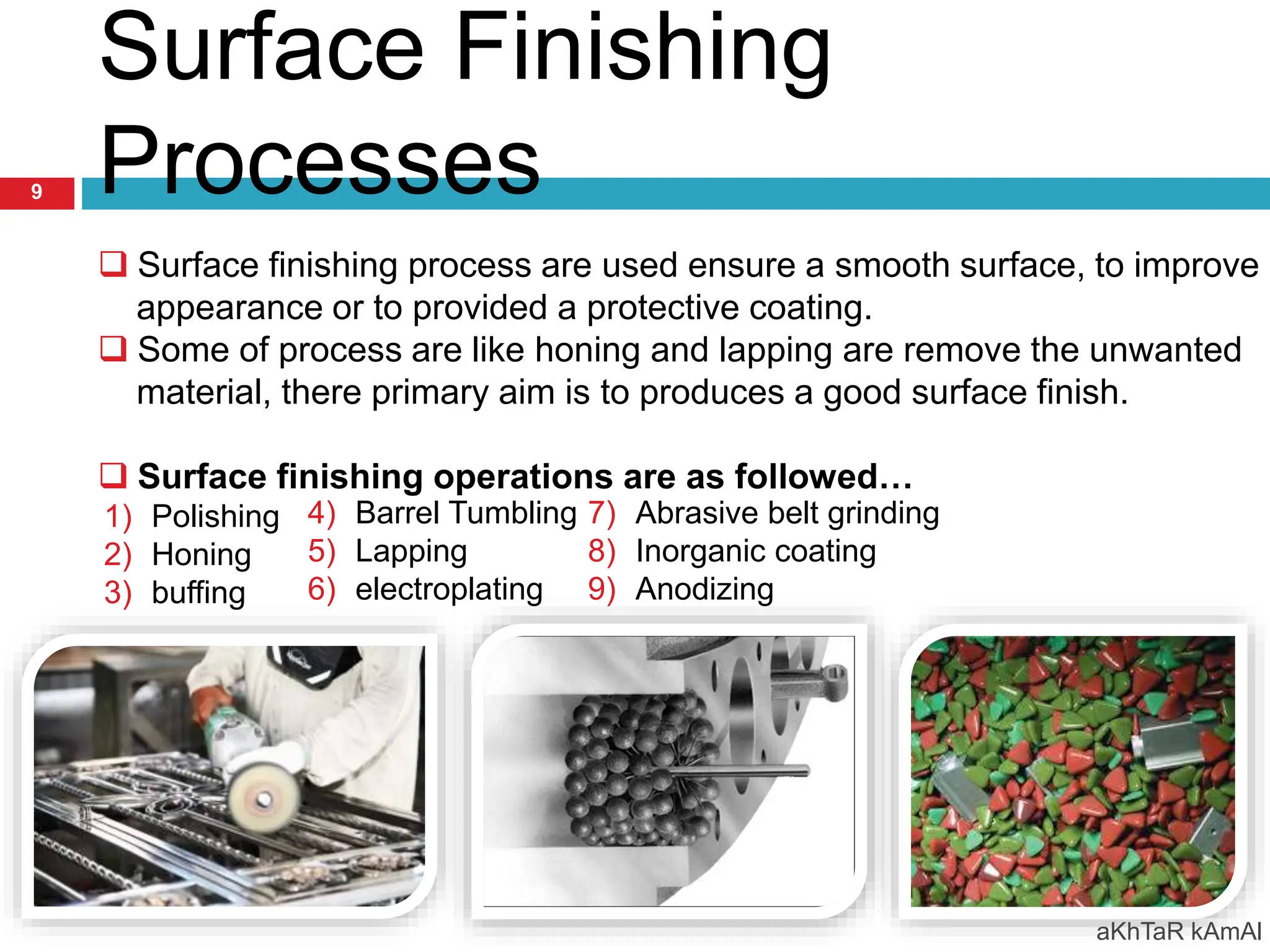
 Surface finishing process are used ensure a smooth surface, to improve
appearance or to provided a protective coating.
 Some of process are like honing and lapping are remove the unwanted
material, there primary aim is to produces a good surface finish.
 Surface finishing operations are as followed…
1) Polishing
2) Honing
3) buffing
4) Barrel Tumbling
5) Lapping
6) electroplating
7) Abrasive belt grinding
8) Inorganic coating
9) Anodizing
aKhTaR kAmAl
9
Thank You
aKhTaR kAmAl
10

1 chaptorcla of manufacturing process p.pptx

  • 1.
    Classification of manufacturing processes Presentedby SALUNKE M.D. Presented to J.S.P.M.’S B.I.T.BARSHI
  • 2.
    Introduction  Classification ofmanufacturing process  Classification based on Function of Process  Classification based on quantity of production  Selection of manufacturing process aKhTaR kAmAl 2
  • 3.
    Classification Based OnFunction of Process  Manufacturing process used in industry basically performed following purpose…  Changed the physically properties of work piece.  Change the shape and size of the work piece.  Produced desired dimensional accuracy and surface finish. aKhTaR kAmAl 3
  • 4.
    Classification Based OnFunction of Process: 1) Process for changing Physical properties of work piece. 2) Casting process 3) Primary metal working processes. 4) Shearing and Forming processes. 5) Joining processes. 6) Machining processes. 7) Surface finishing processes. aKhTaR kAmAl 4
  • 5.
    Changing Physical Properties  Physicalproperties of material can be change by heat treatment like 1) Carbonizing 2) tempering 3) Hardening By hammering, bending and cold rolling of iron materials and nonferrous metals a strengthening of the metal structure is changed systematically. This kind of heat treatment is used for making the steels hard and wear-resistant for certain purposes. 4) Annealing The hardness for an annealing process is usually listed on the HRB scale as a maximum value. It is a process to refine grain size, improve strength, remove residual stress and affect the electromagnetic properties. 5) Stress relieving is a technique to remove or reduce the internal stresses created in a metal. Stress relieving is usually accomplished by heating a metal aKhTaR kAmAl 5
  • 6.
    Casting Process  Castingprocesses basically involve the introduction of a molten metal in to a mould cavity, where up on solidification, the metal takes on the shape of the mould cavity.  Simple and complicated shapes can be made from any metal that can be melted.  Example of cast parts : frames, structural parts, machine components, engine blocks, valves, pipes, statues, ornamental artefacts….. aKhTaR kAmAl 6
  • 7.
    Joining Processes  Inthis process; two or more metals are joint to each other. Or repair/join the broken parts.  The joints are may be permanent like welding OR may be temporary like Riveting, brazing, soldering…  Joining process are….  Screw-Fastening  Welding  Riveting  Brazing  Soldering aKhTaR kAmAl 7
  • 8.
    Machining Processes  Machiningconsist of forcing cutting tool with one or more edges through the excess materials on a work piece and removing this excess material in the form of chip. Knurling aKhTaR kAmAl 8
  • 9.
    Surface Finishing Processes  Surfacefinishing process are used ensure a smooth surface, to improve appearance or to provided a protective coating.  Some of process are like honing and lapping are remove the unwanted material, there primary aim is to produces a good surface finish.  Surface finishing operations are as followed… 1) Polishing 2) Honing 3) buffing 4) Barrel Tumbling 5) Lapping 6) electroplating 7) Abrasive belt grinding 8) Inorganic coating 9) Anodizing aKhTaR kAmAl 9
  • 10.