BM Unit 1 - LO1 1
Learning Intention
Understanding the
Role of Business in
Society
By the end of this lesson you will understand
the following terms:
• The terms goods/services/tangible/intangible
• The importance of Factors of Production
• The Cycle of Production
• The Sectors of Industrial Activity
Course Content
Three Units in this NQ Course = 3 NABs
 Unit 1 Business Enterprise
 LO 1 – Business in Contemporary Society
 LO 2 – Business Information and ICT
 LO 3 – Decision-Making in Business
 LO 4 – Internal Organisation
 Unit 2 Business Decision Areas I
 LO 5 - Operations
 LO 6 - Marketing
 Unit 3 Business Decision Areas II
 LO 7 - Human Resource Management
 LO 8 - Finance
Time Line
June – Oct
Unit 1 & NAB
Oct – Jan
Unit 2 & NAB
Jan – Feb
Unit 3 (HRM only)
Revision for Prelim
Feb - Mar
Unit 3 (Finance)
& NAB
April
Revision – Case Studies
Past Paper Questions
Command
Words
BM Unit 1 - LO1 4
UNIT 1 LO1 - BUSINESS IN
CONTEMPORARY SOCIETY
1. Role of Business in
Society
7. Factors affecting
Operation of Business 6. Methods of
Obtaining Finance
3. Business Objectives
4. Role of Enterprise
and the Entrepreneur
2. Types of Business
Organisations
5. Stakeholders
8. Business as a
Dynamic Activity
9. Changes in the
Business Environment
• Creation of wealth
• Production & consumption of goods
and services
• Satisfaction of wants
• Sectors of activity
• Self employed
• Private limited company
• Public limited company
• Voluntary organisation
• Charity
• Publicly-funded organisation
• Multinationals
• Profit maximisation
• Survival
• Sales maximisation
• Growth
• Social responsibility
• Managerial objectives
• Provision of a service
• Identifying business
opportunities
• Franchising
• Combining factors
of production
• Innovation
• Risk taking
• Shareholders
• Customers
• Employees
• Donors
• Management
• Government
• Suppliers
• Banks/lenders
• Tax Payers
• Community
• Internal & external factors
which cause change
• Changes in size of firm
• Need to respond to survive
• Internal & external
• Short & long term
• Share issue
• Loans / banks
• Local Enterprise
Companies (LECs)
• Government
• Finance & other
assistance available
• LECs, banks, local
authorities
• Subsidised premises,
grants, allowances, trade
fairs
• Methods of growth /
downsizing
• Changes in demand
• Demographics
• Competition
• Regional policies
•Labour market
• Privatisation
• EU * Technology
• Environment * ICT
BM Unit 1 - LO1 5
What is a ‘Business’?
 Any organisation set up to achieve a
set of objectives
Why are Businesses Important?
 They create wealth for a country
 They provide goods or services which
satisfy our wants and needs
BM Unit 1 - LO1 6
Goods and Services
 Goods are tangible (ie can be
touched) and services are intangible
 Services are things done for us e.g.
banking, hairdressing
 Goods sold to individuals are called
consumer goods
 Goods can be durable (last a long
period of time) and most services
and some goods are non-durable
(consumed over a short period)
BM Unit 1 - LO1 7
Description Goods (G) or
Service (S)
Durable (D) or
Non-Durable (N)
1. Volkswagen Golf GTI
2. Walkers Crisps
3. Hire of limo to S6 prom
4. The Herald Newspaper
5. Nail manicure
6. Dell Laptop
7. Kentucky Fried Chicken Meal
8. Higher Bus. Mgt. Lessons
9. Trip to the cinema
10. New shoes
G D
S N
G N
G N
S N
G D
G N
S N
S N
G D
Using the sheet issued to you complete the table:
BM Unit 1 - LO1 8
What is Business Activity?
 Using “resources” to produce
goods and services which people
require in order to satisfy their
“wants”.
 Any kind of activity that results
in the provision of goods and
services which satisfy human
“wants”.
BM Unit 1 - LO1 9
The Entrepreneur
 Develops a business idea – perhaps by
seeing a gap in market or desire to
innovate
 Acquires and then combines other
factors of production e.g. finds ways to
raise finance
 Undertakes most of the start-up decision
making
 Carries the risk of losing the money they
invested
Anita Roddick, Richard Branson,
James Dyson, Marth Lane Fox
BM Unit 1 - LO1 10
Factors of Production
 Land - raw materials, factory site
 Labour - people with required skills
 Capital - finance to buy equipment,
machinery, computers, etc
 Enterprise – the idea behind the
business, the person willing to take
a risk
BM Unit 1 - LO1 11
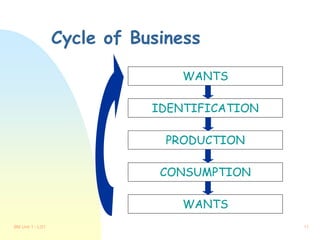
Cycle of Business
WANTS
IDENTIFICATION
PRODUCTION
CONSUMPTION
WANTS
BM Unit 1 - LO1 12
Sectors of Industrial Activity
PRIMARY
(Extractive)
Mining
Fishing
Farming
Oil
SECONDARY
(Making goods)
Manufacturing
Construction
Durables
Non-durables
TERTIARY
(Services)
Banking
Insurance
Tourism
Distribution
Third world
economies
Developing
economies
Fully developed
economies

1. bics lesson 1 - 2011

  • 1.
    BM Unit 1- LO1 1 Learning Intention Understanding the Role of Business in Society By the end of this lesson you will understand the following terms: • The terms goods/services/tangible/intangible • The importance of Factors of Production • The Cycle of Production • The Sectors of Industrial Activity
  • 2.
    Course Content Three Unitsin this NQ Course = 3 NABs  Unit 1 Business Enterprise  LO 1 – Business in Contemporary Society  LO 2 – Business Information and ICT  LO 3 – Decision-Making in Business  LO 4 – Internal Organisation  Unit 2 Business Decision Areas I  LO 5 - Operations  LO 6 - Marketing  Unit 3 Business Decision Areas II  LO 7 - Human Resource Management  LO 8 - Finance
  • 3.
    Time Line June –Oct Unit 1 & NAB Oct – Jan Unit 2 & NAB Jan – Feb Unit 3 (HRM only) Revision for Prelim Feb - Mar Unit 3 (Finance) & NAB April Revision – Case Studies Past Paper Questions Command Words
  • 4.
    BM Unit 1- LO1 4 UNIT 1 LO1 - BUSINESS IN CONTEMPORARY SOCIETY 1. Role of Business in Society 7. Factors affecting Operation of Business 6. Methods of Obtaining Finance 3. Business Objectives 4. Role of Enterprise and the Entrepreneur 2. Types of Business Organisations 5. Stakeholders 8. Business as a Dynamic Activity 9. Changes in the Business Environment • Creation of wealth • Production & consumption of goods and services • Satisfaction of wants • Sectors of activity • Self employed • Private limited company • Public limited company • Voluntary organisation • Charity • Publicly-funded organisation • Multinationals • Profit maximisation • Survival • Sales maximisation • Growth • Social responsibility • Managerial objectives • Provision of a service • Identifying business opportunities • Franchising • Combining factors of production • Innovation • Risk taking • Shareholders • Customers • Employees • Donors • Management • Government • Suppliers • Banks/lenders • Tax Payers • Community • Internal & external factors which cause change • Changes in size of firm • Need to respond to survive • Internal & external • Short & long term • Share issue • Loans / banks • Local Enterprise Companies (LECs) • Government • Finance & other assistance available • LECs, banks, local authorities • Subsidised premises, grants, allowances, trade fairs • Methods of growth / downsizing • Changes in demand • Demographics • Competition • Regional policies •Labour market • Privatisation • EU * Technology • Environment * ICT
  • 5.
    BM Unit 1- LO1 5 What is a ‘Business’?  Any organisation set up to achieve a set of objectives Why are Businesses Important?  They create wealth for a country  They provide goods or services which satisfy our wants and needs
  • 6.
    BM Unit 1- LO1 6 Goods and Services  Goods are tangible (ie can be touched) and services are intangible  Services are things done for us e.g. banking, hairdressing  Goods sold to individuals are called consumer goods  Goods can be durable (last a long period of time) and most services and some goods are non-durable (consumed over a short period)
  • 7.
    BM Unit 1- LO1 7 Description Goods (G) or Service (S) Durable (D) or Non-Durable (N) 1. Volkswagen Golf GTI 2. Walkers Crisps 3. Hire of limo to S6 prom 4. The Herald Newspaper 5. Nail manicure 6. Dell Laptop 7. Kentucky Fried Chicken Meal 8. Higher Bus. Mgt. Lessons 9. Trip to the cinema 10. New shoes G D S N G N G N S N G D G N S N S N G D Using the sheet issued to you complete the table:
  • 8.
    BM Unit 1- LO1 8 What is Business Activity?  Using “resources” to produce goods and services which people require in order to satisfy their “wants”.  Any kind of activity that results in the provision of goods and services which satisfy human “wants”.
  • 9.
    BM Unit 1- LO1 9 The Entrepreneur  Develops a business idea – perhaps by seeing a gap in market or desire to innovate  Acquires and then combines other factors of production e.g. finds ways to raise finance  Undertakes most of the start-up decision making  Carries the risk of losing the money they invested Anita Roddick, Richard Branson, James Dyson, Marth Lane Fox
  • 10.
    BM Unit 1- LO1 10 Factors of Production  Land - raw materials, factory site  Labour - people with required skills  Capital - finance to buy equipment, machinery, computers, etc  Enterprise – the idea behind the business, the person willing to take a risk
  • 11.
    BM Unit 1- LO1 11 Cycle of Business WANTS IDENTIFICATION PRODUCTION CONSUMPTION WANTS
  • 12.
    BM Unit 1- LO1 12 Sectors of Industrial Activity PRIMARY (Extractive) Mining Fishing Farming Oil SECONDARY (Making goods) Manufacturing Construction Durables Non-durables TERTIARY (Services) Banking Insurance Tourism Distribution Third world economies Developing economies Fully developed economies

Editor's Notes