APPLIED
ECONOMICS
Week 1
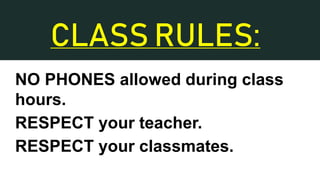
CLASS RULES:
NO PHONES allowed during class
hours.
RESPECT your teacher.
RESPECT your classmates.
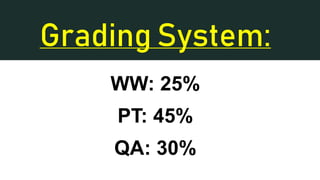
Grading System:
WW: 25%
PT: 45%
QA: 30%
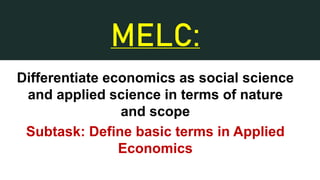
MELC:
Differentiate economics as social science
and applied science in terms of nature
and scope
Subtask: Define basic terms in Applied
Economics
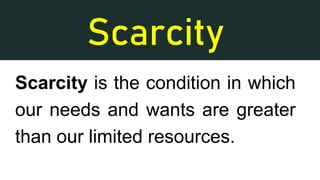
Scarcity
Scarcity is the condition in which
our needs and wants are greater
than our limited resources.
Why is SCARCITY linked to
Economics?
Scarcity is the reason why people have to study and
practice economics.
Economics studies how people distribute or divide their
limited resources in order to satisfy their unlimited
wants. Or simply, it is the study of how individuals and
societies deal with scarcity.
NEED vs. WANT
Needs are the things we can’t live
without.
Wants are the things we can live
without.
Trade-offs
When making choices, there are things
that we need to give up.
Trade-offs consist of all the options that
we give up when we make a choice.
Opportunity Costs
Among all your trade-offs, the most desirable
alternative that you gave up is called the opportunity
cost.
The key to making the best possible decision is to
minimize your opportunity cost by selecting the
option that gives you the largest benefit.
The Branches of Economics
Microeconomics is a branch of economics that is
concerned with the decision-making done by smaller
economic units such as individuals or consumers, firms
and industries.
Macroeconomics on the other hand is the study of the
large economy as a whole or the aggregate economy.
SUPPLY
Supply refers to the total number of goods or services available for
sale. These goods or services are produced by making use of the
factors of production consisting of land, labor and capital.
- Land refers to all natural resources or any raw materials coming
from the ground that is used to produce supply.
- Labor is the work done by people or human resources.
- Capital does not only mean money as this can be in the form of
man-made tools or objects that may be used to produce supplies.
DEMAND
Demand refers to the aggregate or the
totality of the needs and wants of the
customers.
NOTE: Balancing supply & demand is one of the
goal of Economics so that scarcity is eliminated.
Applied Economics
It is the application of the principles of supply,
demand, trade-offs, opportunity-costs, and
other economic theories to solve real-world
problems. It may be practiced in the
microeconomic or macroeconomic level.
Review Quiz (1/4)
Category: Multiple Choice
RULE: Any erasure or alteration
will be marked WRONG.
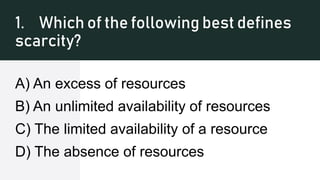
1. Which of the following best defines
scarcity?
A) An excess of resources
B) An unlimited availability of resources
C) The limited availability of a resource
D) The absence of resources
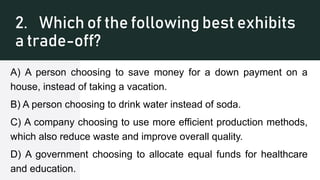
2. Which of the following best exhibits
a trade-off?
A) A person choosing to save money for a down payment on a
house, instead of taking a vacation.
B) A person choosing to drink water instead of soda.
C) A company choosing to use more efficient production methods,
which also reduce waste and improve overall quality.
D) A government choosing to allocate equal funds for healthcare
and education.
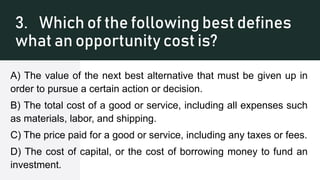
3. Which of the following best defines
what an opportunity cost is?
A) The value of the next best alternative that must be given up in
order to pursue a certain action or decision.
B) The total cost of a good or service, including all expenses such
as materials, labor, and shipping.
C) The price paid for a good or service, including any taxes or fees.
D) The cost of capital, or the cost of borrowing money to fund an
investment.
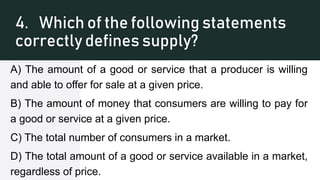
4. Which of the following statements
correctly defines supply?
A) The amount of a good or service that a producer is willing
and able to offer for sale at a given price.
B) The amount of money that consumers are willing to pay for
a good or service at a given price.
C) The total number of consumers in a market.
D) The total amount of a good or service available in a market,
regardless of price.
5. Which of the following correctly
defines demand?
A) The willingness of consumers to buy goods and services at
a specific price
B) The cost of producing goods and services
C) The total value of goods and services produced in a specific
period of time
D) The amount of goods and services that a company is able
to produce

1 APPLIED ECONOMICS.pptx

  • 1.
  • 2.
    CLASS RULES: NO PHONESallowed during class hours. RESPECT your teacher. RESPECT your classmates.
  • 3.
  • 4.
    MELC: Differentiate economics associal science and applied science in terms of nature and scope Subtask: Define basic terms in Applied Economics
  • 5.
    Scarcity Scarcity is thecondition in which our needs and wants are greater than our limited resources.
  • 6.
    Why is SCARCITYlinked to Economics? Scarcity is the reason why people have to study and practice economics. Economics studies how people distribute or divide their limited resources in order to satisfy their unlimited wants. Or simply, it is the study of how individuals and societies deal with scarcity.
  • 7.
    NEED vs. WANT Needsare the things we can’t live without. Wants are the things we can live without.
  • 8.
    Trade-offs When making choices,there are things that we need to give up. Trade-offs consist of all the options that we give up when we make a choice.
  • 9.
    Opportunity Costs Among allyour trade-offs, the most desirable alternative that you gave up is called the opportunity cost. The key to making the best possible decision is to minimize your opportunity cost by selecting the option that gives you the largest benefit.
  • 10.
    The Branches ofEconomics Microeconomics is a branch of economics that is concerned with the decision-making done by smaller economic units such as individuals or consumers, firms and industries. Macroeconomics on the other hand is the study of the large economy as a whole or the aggregate economy.
  • 11.
    SUPPLY Supply refers tothe total number of goods or services available for sale. These goods or services are produced by making use of the factors of production consisting of land, labor and capital. - Land refers to all natural resources or any raw materials coming from the ground that is used to produce supply. - Labor is the work done by people or human resources. - Capital does not only mean money as this can be in the form of man-made tools or objects that may be used to produce supplies.
  • 12.
    DEMAND Demand refers tothe aggregate or the totality of the needs and wants of the customers. NOTE: Balancing supply & demand is one of the goal of Economics so that scarcity is eliminated.
  • 13.
    Applied Economics It isthe application of the principles of supply, demand, trade-offs, opportunity-costs, and other economic theories to solve real-world problems. It may be practiced in the microeconomic or macroeconomic level.
  • 14.
    Review Quiz (1/4) Category:Multiple Choice RULE: Any erasure or alteration will be marked WRONG.
  • 15.
    1. Which ofthe following best defines scarcity? A) An excess of resources B) An unlimited availability of resources C) The limited availability of a resource D) The absence of resources
  • 16.
    2. Which ofthe following best exhibits a trade-off? A) A person choosing to save money for a down payment on a house, instead of taking a vacation. B) A person choosing to drink water instead of soda. C) A company choosing to use more efficient production methods, which also reduce waste and improve overall quality. D) A government choosing to allocate equal funds for healthcare and education.
  • 17.
    3. Which ofthe following best defines what an opportunity cost is? A) The value of the next best alternative that must be given up in order to pursue a certain action or decision. B) The total cost of a good or service, including all expenses such as materials, labor, and shipping. C) The price paid for a good or service, including any taxes or fees. D) The cost of capital, or the cost of borrowing money to fund an investment.
  • 18.
    4. Which ofthe following statements correctly defines supply? A) The amount of a good or service that a producer is willing and able to offer for sale at a given price. B) The amount of money that consumers are willing to pay for a good or service at a given price. C) The total number of consumers in a market. D) The total amount of a good or service available in a market, regardless of price.
  • 19.
    5. Which ofthe following correctly defines demand? A) The willingness of consumers to buy goods and services at a specific price B) The cost of producing goods and services C) The total value of goods and services produced in a specific period of time D) The amount of goods and services that a company is able to produce

Editor's Notes

  • #4 Quick background of what applied economics is: scarcity, trade offs, opportunity costs, factors of production, law of supply and demand, market structures, how to achieve balance or equilibrium in the economy, unemployment, underemployment, competition, etc.
  • #6 Cite instances of scarcity.
  • #7 Since we are unable to have everything we desire, we must make choices on how we will use our limited resources.
  • #8 Who can differentiate. Give examples?
  • #9 you planned to spend your limited allowance to buy 2 pieces of siopao and softdrinks to satisfy your hunger. Your other option is to pay for a heavy value meal at 120 pesos or buy your favorite meal combo at 115 pesos. You gave these options up since you can only afford to pay for the siopao and drinks. The choices that you’ve given up are your trade-offs.
  • #10 No matter what choice you make, there is an opportunity cost, or next- best alternative, that must be sacrificed. Opportunity cost is the highest- valued alternative that must be sacrificed in order to get something else.
  • #16 C
  • #17 A
  • #18 A
  • #19 A
  • #20 A