w

w
ap
eP

m

e
tr
.X

w

0610/01

BIOLOGY
Paper 1 Multiple Choice

May/June 2004
45 minutes
Additional Materials:

Multiple Choice Answer Sheet
Soft clean eraser
Soft pencil (type B or HB is recommended)

READ THESE INSTRUCTIONS FIRST
Write in soft pencil.
Do not use staples, paper clips, highlighters, glue or correction fluid.
Write your name, Centre number and candidate number on the answer sheet in the spaces provided
unless this has been done for you.
There are forty questions on this paper. Answer all questions. For each question there are four possible
answers A, B, C, and D.
Choose the one you consider correct and record your choice in soft pencil on the separate answer sheet.
Read the instructions on the answer sheet very carefully.
Each correct answer will score one mark. A mark will not be deducted for a wrong answer.
Any rough working should be done in this booklet.

This document consists of 16 printed pages.
IB04 06_0610_01/2RP
 UCLES 2004

[Turn over

om
.c

s
er

UNIVERSITY OF CAMBRIDGE INTERNATIONAL EXAMINATIONS
International General Certificate of Secondary Education
2
1

What is a characteristic of all living organisms?
A
B

circulation

C

egestion

D
2

breathing

sensitivity

Which kind of skin do amphibians have?
A
B

dry with scales

C

moist without scales

D
3

dry without scales

moist with scales

The diagram shows how Homo sapiens (modern people) could have evolved from their
ancestors.
Homo sapiens (modern people)

Homo neanderthalensis

Homo erectus

Homo habilis (very early people)

Which statement about modern people and their ancestors is correct?
A
B

They are in the same species but not the same genus.

C

They are in the same genus but not the same species.

D
4

They are in the same species and the same genus.

They are neither the same species nor the same genus.

Which structures are found in a human sperm cell?
cell membrane

cell wall

haploid nucleus

A


B


C


D


 UCLES 2004

0610/01/M/J/04

key
 = present
 = absent
3
5

The diagram shows an animal.
body

Using the key, which animal is it?

body divided
into visible segments

body not divided
into visible segments

tail
present

tail
absent

legs
3 pairs

legs
4 pairs

animal
A

animal
B

animal
C

animal
D

Use the diagram of a section through a leaf to answer questions 6 and 7.

P
Q

S

R
6

Which can perform the most photosynthesis?
A

7

P

B

Q

C

R

D

S

The structures shown are all parts of the same
A

cell.

B

organ.

C

organ system.

D

tissue.

 UCLES 2004

0610/01/M/J/04

[Turn over
4
8

The diagrams show examples of movement of substances in organisms.

alveoli

small intestine

atmosphere

oxygen

amino acids

carbon dioxide

capillaries

capillaries

leaf cells

Which process is taking place in all three examples?
A
B

diffusion

C

osmosis

D
9

assimilation

translocation

Some red blood cells were placed in distilled water and others were placed in three salt solutions
of different concentrations.
Which diagram shows the appearance of a cell has changed after being in the distilled water for a
short time?
A

B

C

D

10 The table shows the conditions in four test-tubes containing equal quantities of starch and
salivary amylase.
In which test-tube is the starch broken down fastest?
pH

temperature

A

2

27

B

2

37

C

7

27

D

7

37

 UCLES 2004

0610/01/M/J/04
5
11 Which graph shows the effect of temperature on the activity of an enzyme?
A

B

enzyme
activity

enzyme
activity

0

50
temperature / oC

100

0

C

100

D

enzyme
activity

enzyme
activity

0

 UCLES 2004

50
temperature / oC

50
temperature / oC

100

0610/01/M/J/04

0

50
temperature / oC

100

[Turn over
6
12 The diagram shows a shoot growing from a potato tuber.
soil level
shoot
X

food store
in potato tuber

What is being transported in the phloem cells at X?
A

starch downwards

B

starch upwards

C

sugars downwards

D

sugars upwards

13 Which substance contains nitrogen?
A

fat

B

glucose

C

protein

D

starch

14 Why is sunlight necessary for photosynthesis?
A

It is a catalyst.

B

It is a source of energy.

C

It provides nutrients.

D

It provides oxygen.

 UCLES 2004

0610/01/M/J/04
7
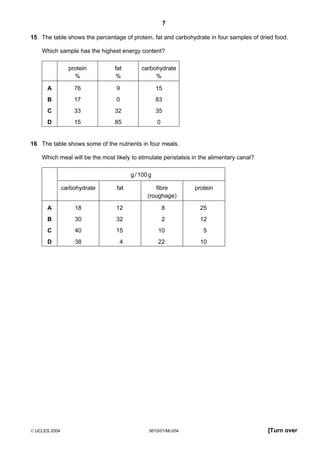
15 The table shows the percentage of protein, fat and carbohydrate in four samples of dried food.
Which sample has the highest energy content?
protein
%

fat
%

carbohydrate
%

A

76

9

15

B

17

0

83

C

33

32

35

D

15

85

0

16 The table shows some of the nutrients in four meals.
Which meal will be the most likely to stimulate peristalsis in the alimentary canal?
g / 100 g
carbohydrate

fat

fibre
(roughage)

protein

A

18

12

8

25

B

30

32

2

12

C

40

15

10

5

D

38

4

22

10

 UCLES 2004

0610/01/M/J/04

[Turn over
8
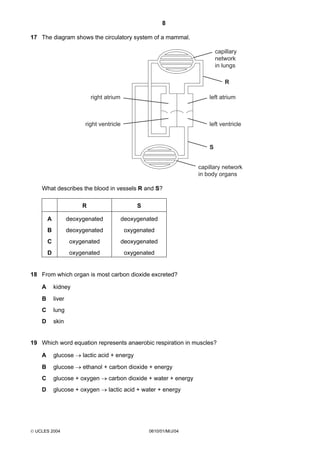
17 The diagram shows the circulatory system of a mammal.

capillary
network
in lungs
R
right atrium

left atrium

right ventricle

left ventricle

S
capillary network
in body organs
What describes the blood in vessels R and S?
R

S

A

deoxygenated

deoxygenated

B

deoxygenated

oxygenated

C

oxygenated

deoxygenated

D

oxygenated

oxygenated

18 From which organ is most carbon dioxide excreted?
A

kidney

B

liver

C

lung

D

skin

19 Which word equation represents anaerobic respiration in muscles?
A

glucose → lactic acid + energy

B

glucose → ethanol + carbon dioxide + energy

C

glucose + oxygen → carbon dioxide + water + energy

D

glucose + oxygen → lactic acid + water + energy

 UCLES 2004

0610/01/M/J/04
9
20 Which process in green plants produces carbon dioxide?
A

photosynthesis

B

respiration

C

translocation

D

transpiration

21 The diagram shows structures associated with the human urinary system.
Which structure is the urethra?

from
heart

to
heart
A

B

C
D

 UCLES 2004

0610/01/M/J/04

[Turn over
10
22 The diagram shows part of the human circulatory system.
In which vessel will absorbed alcohol first be found?
lungs
A
heart
D
liver
C
gut
B
kidney

23 The diagram shows the structures involved in a reflex action.

S
R

P
Q

hot pan

What shows the sequence in which these structures become involved?
A

P→Q→R→S

B

P→S→R→Q

C

Q→R→S→P

D

Q→S→P→R

 UCLES 2004

0610/01/M/J/04
11
24 A person moves from sunlight into a dark room.
How do their eyes respond?
A

The blind spots become larger.

B

The blind spots become smaller.

C

The pupils become larger.

D

The pupils become smaller.

25 Which features are characteristic of insect-pollinated flowers?
A

bright petals, large feathery stigmas

B

bright petals, rough sticky pollen

C

large feathery stigmas, nectaries

D

small light pollen, nectaries

26 Which substance normally passes from a fetus to its mother through the placenta?
A

alcohol

B

glucose

C

oxygen

D

urea

27 What is the best measurement to determine the growth of seedlings?
A

the dry mass of the whole seedling

B

the height and width of the parts above ground

C

the length from the root-tip to the stem-tip

D

the total number of leaves

 UCLES 2004

0610/01/M/J/04

[Turn over
12
28 A plot of land was divided into four. Each part was sown with 100 seeds in the dry season. Two
parts were covered with a net to stop small birds and mammals entering and two were watered,
as shown in the diagram.
In which plot would most seeds germinate?

A

B

covered by net
and watered

no net and
watered

C

D

covered by net
and not watered

no net and
not watered

29 Which shows the sex chromosomes in the body cells and in the sex cells in a man?
body cells

sex cells

A

XX

all X

B

XX

all XX

C

XY

X or Y

D

XY

all XY

30 In humans, which types of variation are shown by blood group and height?
blood group

height

A

continuous

continuous

B

continuous

discontinuous

C

discontinuous

continuous

D

discontinuous

discontinuous

 UCLES 2004

0610/01/M/J/04
13
31 In a certain plant, the allele for white fruit, W, is dominant over the allele for yellow fruit, w.
A white-fruited plant was crossed with a yellow-fruited plant. About half of the offspring were
white-fruited and the other half were yellow-fruited.
Which genotypes did the parent plants have?
A

ww and ww

B

Ww and ww

C

WW and ww

D

WW and Ww

32 The diagram shows a food web.
snakes

squirrels

toads

grasshoppers

birds

lizards

beetles

greenfly

snails

green plants

Which organisms will increase in number, if the number of snakes increases?
A

birds

B

grasshoppers

C

lizards

D

squirrels

 UCLES 2004

0610/01/M/J/04

[Turn over
14
33 Which organism would be a producer in a food chain?

A

B

C

D

34 From which food chain is least energy lost?
A

green plant → human

B

green plant → sheep → human

C

green plant → cow (milk) → human

D

green plant → small fish → large fish → human

35 The diagram shows part of the carbon cycle.
animals

green plants

X

decay by microorganisms
X

carbon dioxide
in the air

What does X represent?
A

death

B

digestion

C

photosynthesis

D

respiration

 UCLES 2004

0610/01/M/J/04
15
36 The diagram represents stages in the water cycle.
At which stage is the water in liquid form?

D
B
A

C

sea

37 In which process is oxygen a waste product?
A

active transport

B

aerobic respiration

C

anaerobic respiration

D

photosynthesis

38 The graph shows the growth of a population of bacteria in a closed jar of nutrient solution.
At which point do limiting factors begin to control the growth of the population?
C

D

bacteria /
unit volume
B
A
0
0

 UCLES 2004

time

0610/01/M/J/04

[Turn over
16
39 Which graph shows the effect of pollution by sewage on the amount of oxygen dissolved in a
river?
A

B

dissolved
oxygen

dissolved
oxygen
distance downstream

distance downstream

sewage enters
the river

sewage enters
the river
D

C
dissolved
oxygen

dissolved
oxygen

distance downstream

distance downstream
sewage enters
the river

sewage enters
the river

40 A gardener planted some water plants in the stream at the bottom of the garden shown on the
diagram. At first the plants grew well but after a while they died.
Which source of pollution is most likely to have caused the death of the plants?

D railway

C farmer spraying fields with
a pesticide to kill insects

am

re
st

factory
waste

A factory

garden
B sewage works

direction of
flow of stream

Every reasonable effort has been made to trace all copyright holders. The publishers would be pleased to hear from anyone whose rights we have unwittingly
infringed.
University of Cambridge International Examinations is part of the University of Cambridge Local Examinations Syndicate (UCLES) which is itself a department of
the University of Cambridge.

 UCLES 2004

0610/01/M/J/04

0610 s04 qp_1

  • 1.
    w w ap eP m e tr .X w 0610/01 BIOLOGY Paper 1 MultipleChoice May/June 2004 45 minutes Additional Materials: Multiple Choice Answer Sheet Soft clean eraser Soft pencil (type B or HB is recommended) READ THESE INSTRUCTIONS FIRST Write in soft pencil. Do not use staples, paper clips, highlighters, glue or correction fluid. Write your name, Centre number and candidate number on the answer sheet in the spaces provided unless this has been done for you. There are forty questions on this paper. Answer all questions. For each question there are four possible answers A, B, C, and D. Choose the one you consider correct and record your choice in soft pencil on the separate answer sheet. Read the instructions on the answer sheet very carefully. Each correct answer will score one mark. A mark will not be deducted for a wrong answer. Any rough working should be done in this booklet. This document consists of 16 printed pages. IB04 06_0610_01/2RP  UCLES 2004 [Turn over om .c s er UNIVERSITY OF CAMBRIDGE INTERNATIONAL EXAMINATIONS International General Certificate of Secondary Education
  • 2.
    2 1 What is acharacteristic of all living organisms? A B circulation C egestion D 2 breathing sensitivity Which kind of skin do amphibians have? A B dry with scales C moist without scales D 3 dry without scales moist with scales The diagram shows how Homo sapiens (modern people) could have evolved from their ancestors. Homo sapiens (modern people) Homo neanderthalensis Homo erectus Homo habilis (very early people) Which statement about modern people and their ancestors is correct? A B They are in the same species but not the same genus. C They are in the same genus but not the same species. D 4 They are in the same species and the same genus. They are neither the same species nor the same genus. Which structures are found in a human sperm cell? cell membrane cell wall haploid nucleus A B C D  UCLES 2004 0610/01/M/J/04 key = present = absent
  • 3.
    3 5 The diagram showsan animal. body Using the key, which animal is it? body divided into visible segments body not divided into visible segments tail present tail absent legs 3 pairs legs 4 pairs animal A animal B animal C animal D Use the diagram of a section through a leaf to answer questions 6 and 7. P Q S R 6 Which can perform the most photosynthesis? A 7 P B Q C R D S The structures shown are all parts of the same A cell. B organ. C organ system. D tissue.  UCLES 2004 0610/01/M/J/04 [Turn over
  • 4.
    4 8 The diagrams showexamples of movement of substances in organisms. alveoli small intestine atmosphere oxygen amino acids carbon dioxide capillaries capillaries leaf cells Which process is taking place in all three examples? A B diffusion C osmosis D 9 assimilation translocation Some red blood cells were placed in distilled water and others were placed in three salt solutions of different concentrations. Which diagram shows the appearance of a cell has changed after being in the distilled water for a short time? A B C D 10 The table shows the conditions in four test-tubes containing equal quantities of starch and salivary amylase. In which test-tube is the starch broken down fastest? pH temperature A 2 27 B 2 37 C 7 27 D 7 37  UCLES 2004 0610/01/M/J/04
  • 5.
    5 11 Which graphshows the effect of temperature on the activity of an enzyme? A B enzyme activity enzyme activity 0 50 temperature / oC 100 0 C 100 D enzyme activity enzyme activity 0  UCLES 2004 50 temperature / oC 50 temperature / oC 100 0610/01/M/J/04 0 50 temperature / oC 100 [Turn over
  • 6.
    6 12 The diagramshows a shoot growing from a potato tuber. soil level shoot X food store in potato tuber What is being transported in the phloem cells at X? A starch downwards B starch upwards C sugars downwards D sugars upwards 13 Which substance contains nitrogen? A fat B glucose C protein D starch 14 Why is sunlight necessary for photosynthesis? A It is a catalyst. B It is a source of energy. C It provides nutrients. D It provides oxygen.  UCLES 2004 0610/01/M/J/04
  • 7.
    7 15 The tableshows the percentage of protein, fat and carbohydrate in four samples of dried food. Which sample has the highest energy content? protein % fat % carbohydrate % A 76 9 15 B 17 0 83 C 33 32 35 D 15 85 0 16 The table shows some of the nutrients in four meals. Which meal will be the most likely to stimulate peristalsis in the alimentary canal? g / 100 g carbohydrate fat fibre (roughage) protein A 18 12 8 25 B 30 32 2 12 C 40 15 10 5 D 38 4 22 10  UCLES 2004 0610/01/M/J/04 [Turn over
  • 8.
    8 17 The diagramshows the circulatory system of a mammal. capillary network in lungs R right atrium left atrium right ventricle left ventricle S capillary network in body organs What describes the blood in vessels R and S? R S A deoxygenated deoxygenated B deoxygenated oxygenated C oxygenated deoxygenated D oxygenated oxygenated 18 From which organ is most carbon dioxide excreted? A kidney B liver C lung D skin 19 Which word equation represents anaerobic respiration in muscles? A glucose → lactic acid + energy B glucose → ethanol + carbon dioxide + energy C glucose + oxygen → carbon dioxide + water + energy D glucose + oxygen → lactic acid + water + energy  UCLES 2004 0610/01/M/J/04
  • 9.
    9 20 Which processin green plants produces carbon dioxide? A photosynthesis B respiration C translocation D transpiration 21 The diagram shows structures associated with the human urinary system. Which structure is the urethra? from heart to heart A B C D  UCLES 2004 0610/01/M/J/04 [Turn over
  • 10.
    10 22 The diagramshows part of the human circulatory system. In which vessel will absorbed alcohol first be found? lungs A heart D liver C gut B kidney 23 The diagram shows the structures involved in a reflex action. S R P Q hot pan What shows the sequence in which these structures become involved? A P→Q→R→S B P→S→R→Q C Q→R→S→P D Q→S→P→R  UCLES 2004 0610/01/M/J/04
  • 11.
    11 24 A personmoves from sunlight into a dark room. How do their eyes respond? A The blind spots become larger. B The blind spots become smaller. C The pupils become larger. D The pupils become smaller. 25 Which features are characteristic of insect-pollinated flowers? A bright petals, large feathery stigmas B bright petals, rough sticky pollen C large feathery stigmas, nectaries D small light pollen, nectaries 26 Which substance normally passes from a fetus to its mother through the placenta? A alcohol B glucose C oxygen D urea 27 What is the best measurement to determine the growth of seedlings? A the dry mass of the whole seedling B the height and width of the parts above ground C the length from the root-tip to the stem-tip D the total number of leaves  UCLES 2004 0610/01/M/J/04 [Turn over
  • 12.
    12 28 A plotof land was divided into four. Each part was sown with 100 seeds in the dry season. Two parts were covered with a net to stop small birds and mammals entering and two were watered, as shown in the diagram. In which plot would most seeds germinate? A B covered by net and watered no net and watered C D covered by net and not watered no net and not watered 29 Which shows the sex chromosomes in the body cells and in the sex cells in a man? body cells sex cells A XX all X B XX all XX C XY X or Y D XY all XY 30 In humans, which types of variation are shown by blood group and height? blood group height A continuous continuous B continuous discontinuous C discontinuous continuous D discontinuous discontinuous  UCLES 2004 0610/01/M/J/04
  • 13.
    13 31 In acertain plant, the allele for white fruit, W, is dominant over the allele for yellow fruit, w. A white-fruited plant was crossed with a yellow-fruited plant. About half of the offspring were white-fruited and the other half were yellow-fruited. Which genotypes did the parent plants have? A ww and ww B Ww and ww C WW and ww D WW and Ww 32 The diagram shows a food web. snakes squirrels toads grasshoppers birds lizards beetles greenfly snails green plants Which organisms will increase in number, if the number of snakes increases? A birds B grasshoppers C lizards D squirrels  UCLES 2004 0610/01/M/J/04 [Turn over
  • 14.
    14 33 Which organismwould be a producer in a food chain? A B C D 34 From which food chain is least energy lost? A green plant → human B green plant → sheep → human C green plant → cow (milk) → human D green plant → small fish → large fish → human 35 The diagram shows part of the carbon cycle. animals green plants X decay by microorganisms X carbon dioxide in the air What does X represent? A death B digestion C photosynthesis D respiration  UCLES 2004 0610/01/M/J/04
  • 15.
    15 36 The diagramrepresents stages in the water cycle. At which stage is the water in liquid form? D B A C sea 37 In which process is oxygen a waste product? A active transport B aerobic respiration C anaerobic respiration D photosynthesis 38 The graph shows the growth of a population of bacteria in a closed jar of nutrient solution. At which point do limiting factors begin to control the growth of the population? C D bacteria / unit volume B A 0 0  UCLES 2004 time 0610/01/M/J/04 [Turn over
  • 16.
    16 39 Which graphshows the effect of pollution by sewage on the amount of oxygen dissolved in a river? A B dissolved oxygen dissolved oxygen distance downstream distance downstream sewage enters the river sewage enters the river D C dissolved oxygen dissolved oxygen distance downstream distance downstream sewage enters the river sewage enters the river 40 A gardener planted some water plants in the stream at the bottom of the garden shown on the diagram. At first the plants grew well but after a while they died. Which source of pollution is most likely to have caused the death of the plants? D railway C farmer spraying fields with a pesticide to kill insects am re st factory waste A factory garden B sewage works direction of flow of stream Every reasonable effort has been made to trace all copyright holders. The publishers would be pleased to hear from anyone whose rights we have unwittingly infringed. University of Cambridge International Examinations is part of the University of Cambridge Local Examinations Syndicate (UCLES) which is itself a department of the University of Cambridge.  UCLES 2004 0610/01/M/J/04