Philippians 4:6
 FATHERS DAY
       June 17, 2012

   First Baptist Church
Jackson, Mississippi USA
Wiersbe's Expository
Outlines on the New

Testament. Copyright ©
1992 by Chariot Victor
Publishing, an imprint of
Cook Communication Min.
*Barclay's Daily Study Bible
 (NT)
*J. Vernon McGee's
 Thru The Bible
*Jamieson-Fausset-Brown
 Bible Commentary
The MacArthur New
Testament Commentary,
Copyright © Moody Press
and John MacArthur, Jr.,
1983-2007.
Philippians 4:6-7
6 “Be anxious for nothing,
but in everything by prayer
and supplication with
thanksgiving let your
requests be made known
unto God.
7 And the peace of God,
which surpasses all
comprehension, will guard
your hearts and your minds
in Christ Jesus.” Phil 4:6-7
The Bible term "be anxious"
means literally:
"to be torn apart."
When the thoughts in our
mind and feelings in our
heart pull in different
directions, “we are torn
apart” and we tend to
worry. What is worry?
Worry is ruminating about
an issue that is plaguing us
without actually making
substantive progress in
addressing the issue. Worry
is a waste of time.
Concern, however, is
solution oriented.

*Concern focuses on solving
the problem, addressing the
issue.
Concern comes up with
options, sets priorities, and
draws conclusions.
God expects us to be
responsible and take care of
the things over which we are
responsible or have
influence.
That is concern.
And we should be
concerned about those
things.
“There is a great difference
between worry and
concern. A worried person
sees a problem, and a
concerned person solves a
problem.” Harold Stephens
Concern leads to action,
worry leads to depression.
Our English word "worry"
comes from a word that
means "to strangle” and it
certainly does strangle us
emotionally, physically and
spiritually.
The mind thinks about
problems, and these
feelings weigh down the
heart, creating a vicious
cycle that wrecks our
emotional & physical states.
Our minds tell us we should
not fret, but we often
cannot control the anxiety
in our hearts!
We have to break this circle
of worry before we can
enjoy peace.

What causes worry?
Wrong thinking and wrong
attitudes toward people,
circumstances, or things.
Notice here in chapter 4
that Paul has no worry
about people (vv. 1-5),
circumstances (vv. 10-13), or
the material things of life
(vv. 14-19).
Paul gives us God's four-fold
remedy for worry:
1. Harmony
2. Joy
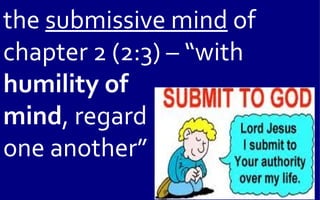
3. Contentment
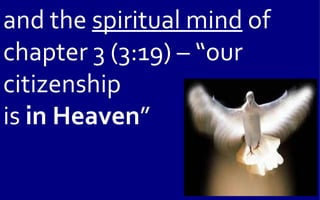
4. God-confidence
Remedy for Worry
1) harmony in the fellowship
2) joy in the Lord
3) contentment in
   circumstances and
4) confident trust in God
These are the first steps on
the path to spiritual
stability (standing firm).
Philippians 4:6-7

“Be anxious for nothing but
in everything by prayer and
supplication with
thanksgiving…”
Paul seems to be making a
play upon two indefinite
pronouns: nothing and
everything.
"Worry about nothing; pray
about everything."
In verse 4 we were given one
of the new commandments

from God: Rejoice!
4 “Rejoice in the Lord
always; again I will say,
rejoice!”
*Now in verse 6 is another
commandment: Don’t worry
do pray (about everything).
* “Nothing” is the most
exclusive word in the
English language.
It leaves out everything.

*But the reason we are to
worry about nothing is
because we are to pray
about everything.
*This means that we are to
talk to the Lord about
everything in our lives.
*Nothing should be left out.
*Can you mention anything
in your life that is big to God?
*When we say that we take
our big problems to God,
what do we mean?
When a wheel comes off
your wagon, it may look like
an impossible problem to
you, but He will always hear
and answer your cry.
*None of our problems are
difficult for Him.

*But what we call “little
things”, He wants us to
bring those to Him also.
"There is nothing too great
for God's power; and
nothing too small for his
Fatherly care.”

            William Barclay
God’s phone #Jeremiah 33:3
3“Call to Me and I will
answer you, and I will tell
you great and mighty
things, which you do not
know.”
As believers we need to get
in the habit of bringing
everything to Him in prayer
-- nothing excluded.
“Pray without ceasing.”
       1 Thessalonians 5:17
Seven basic principles for
developing and maintaining
spiritual stability emerge
from Philippians chapter 4:
1)cultivating harmony in the
  church fellowship,
2)maintaining a spirit of joy,
3)learning to be content,
4)resting on a confident
  faith in the Lord,
5)reacting to problems with
  thankful prayer,
6)thinking on godly virtues,
7)obeying God's standard.
REACTING TO PROBLEMS
WITH THANKFUL PRAYER
“but in everything by prayer
and supplication with
thanksgiving let your
requests be made known…”
*Spiritually stable people
constantly react to trials
with thankful prayer.
*Such prayer is the antidote
to worry and the cure for
anxiety.
*The three synonyms used
in v6: prayer,
       supplication, and
       requests –
all refer to specific, direct
offerings of petition to God.
Philippians 4:6a
6 “Be anxious for nothing,
but in everything by prayer
and supplication with
thanksgiving let your
requests be made known…”
The assumption of the text
is that believers will cry out
to God when we have a
need or a problem, not with
doubting, questioning, or
even blaming God, but with
thanksgiving.
“Devote yourselves to
prayer, keeping alert in it
with an attitude of
thanksgiving;”
              Colossians 4:2
Instead of having a spirit of
rebellion against what God
allows, believers are to
trustingly “cast all our
anxiety on Him, because He
cares for us" (1 Peter 5:7).
When we pray, we must
   always remember three
   things:
2) the love of God
3) the wisdom of God
4) the power of God
•
    The love of God always
    desires what is best for
    us.
•
    The wisdom of God
    always knows what is
    best for us.
3) The power of God can
   always bring to pass
   that which is best for us.
He who prays with a perfect
trust in the
love,
wisdom and
power of God
will find God's peace.
Believers should always be
thankful for:
God’s love (Rom 5:5)
God's power
(Ps 62:11; Rev 4:11), and for
God’s promises (2 Cor 1:20).
“The future is as bright as
the promises of God.”

              William Carey
*God's promises support
the wisdom of gratitude.
*He has promised that no
trial believers face will be
too difficult for them to
handle (1 Cor 10:13).
1 Corinthians 10:13
13 “No temptation has
overtaken you but such as is
common to man; and God is
faithful, who will not allow
you to be tempted beyond
what you are able, but with
the temptation will provide
the way of escape also, so
that you will be able to
endure it.”
        1 Corinthians 10:13
*He has also promised to
use everything that happens
in believers' lives for our
ultimate good (Rom 8:28).
*Even suffering leads to our
ultimate good. 1 Peter 5:10
10 After you have suffered
for a little while, the God of
all grace, Who called you to
His eternal glory in Christ,
will Himself perfect, confirm,
strengthen and establish you.
People become worried,
anxious, and fearful because
they do not trust in:
God's love,
God’s wisdom, or
God’s power.
*They fear that God is not
loving enough, wise
enough, or strong enough
to prevent disaster.
*It may be that this sinful
doubt is because their
knowledge of Him is faulty,
or that sin in their lives has
crippled their faith.
*Thankful prayer brings
release from fear and worry,
because it affirms God's
sovereign control over every
circumstance, and that His
purpose is the believer's
good (Rom 8:28).

“God causes all things to
work together for our good”
Worry is tension between
the mind and heart.
The peace of God will guard
(garrison) our hearts and
minds if we but meet the
conditions He gives.
Not just praying, but right
praying.
The Bible nowhere says that
any kind of praying will
bring peace to our hearts.
What is right praying?
It begins with adoration, for
this is what the word
"prayer" means in v. 6.
This is love, enjoying the
presence of God, honoring
Him in worship.
Rushing into His presence
and begging for peace of
mind will never get results.
We must bow before Him in
worship and let Him search
our hearts and minds.
Next comes supplication,
which means the earnest,
sincere desire of the heart.

True prayer comes from the
heart, not the lips.
What a joy it is to present
our requests to Him!
Hebrews 4:16
16 “Therefore let us draw
near with confidence to the
throne of grace, so that we
may receive mercy and find
grace to help in time of
need.”

            Hebrews 4:16
Finally, there is appreciation
or thanksgiving ( Eph. 5:20
and Col. 3:15-17).
Colossians 3:15-17
15 “Let the peace of Christ
rule in your hearts, to
which indeed you were
called in one body; and be
thankful.
16 Let the word of Christ
richly dwell within you, with
all wisdom teaching and
admonishing one another
with psalms and hymns and
spiritual songs, singing with
thankfulness in your hearts
to God. 17 Whatever you do
in word or deed, do all in the
name of the Lord Jesus,
giving thanks through Him
to God the Father. Col 3
It takes faith to thank Him
for uncomfortable
circumstances or for
requests not yet granted.
How God loves to hear His
children thank Him!

This is the way Daniel
prayed in Daniel 6:10.
Daniel 6:10
10 “Now when Daniel knew
that the document was
signed, he entered his house
(now in his roof chamber he
had windows open toward
Jerusalem); and he
continued kneeling on his
knees three times a day,
praying and giving thanks
before his God, as he had
been doing previously.”
No wonder he had such
peace in that lions' den!

*The lions did not want to
eat something with that
much backbone!
The result of believing
prayer is that the peace of
God will stand like a sentinel
on guard upon our hearts.
Philippians 4:7
7 “And the peace of God,
which surpasses all
understanding, will guard
your hearts and your minds
in Christ Jesus.”
"Peace with God" is the
result of faith in Christ (
Rom. 5:1); "the peace of
God" and the presence of
"the God of peace" will
come when the believer
Practices:
right thinking,
right praying, and
right living.
Worry, worry, worry!
How many Christians lose
their joy and peace because
of worry?
In chapter 4, Paul tells us
that the secure mind—the
mind that is guarded by the
peace of God—frees us from
worry.
Of course, the believer who
does not have the single
mind from chapter 1,
the single mind of chapter 1
(1:27) –
“you are standing
firm in one spirit,
 with one mind”
the submissive mind of
chapter 2 (2:3) – “with
humility of
mind, regard
one another”
and the spiritual mind of
chapter 3 (3:19) – “our
citizenship
is in Heaven”
can never have the secure
mind of chapter 4 (4:7) –
“the peace of God
shall guard your
minds”.
We must first live what Paul
describes in the previous
three chapters before we
can claim the promises and
provisions of this final
chapter.
As M. R. Vincent puts it:

"Peace is the fruit of
believing prayer."
The peace of God is so
precious that man's mind,
with all its skill and all its
knowledge, can never
produce it, it surpasses all
understanding!
The Scripture speaks of
other kinds of peace which
we can understand.
*There is world peace.
We have the assurance that
someday peace will cover
the earth as the waters
cover the sea.
It will come through the
person of Christ, the Prince
of Peace.
Also there is the peace that
comes when sins are
forgiven. Romans 5:1
"Therefore being justified by
faith, we have peace with
God through our Lord Jesus”
Then there is the peace that
is tranquility.
The Lord Jesus said, "Peace I
leave with you, my peace I
give unto you..."
(John 14:27).
That is a marvelous peace,
but it is not "the peace...
which passeth all
understanding."
But there is a peace that
sweeps over our souls at
certain times.
*If you look out at a sunset
beyond a great snowcapped
mountain and take in the
majesty of God's creation, a
peace comes over you that
"passeth all understanding."
And that same peace may
come when your heavenly
Father allows you to have
cancer and go to the
hospital frightened to
death, and then that night
when you commit it all to
Him and tell Him that you
want to know He is real;
He makes Himself real to
you and that peace that
"passeth all understanding"
floods your soul.
*You can only say that it is a
wonderful peace!
With the God of peace to
guide us and the peace of
God to guard us, what do
we have to be anxious
about?

06 June 17, 2012 Philippians, Chapter 4, Verse 6

  • 1.
    Philippians 4:6 FATHERSDAY June 17, 2012 First Baptist Church Jackson, Mississippi USA
  • 2.
    Wiersbe's Expository Outlines onthe New Testament. Copyright © 1992 by Chariot Victor Publishing, an imprint of Cook Communication Min.
  • 3.
    *Barclay's Daily StudyBible (NT) *J. Vernon McGee's Thru The Bible *Jamieson-Fausset-Brown Bible Commentary
  • 4.
    The MacArthur New TestamentCommentary, Copyright © Moody Press and John MacArthur, Jr., 1983-2007.
  • 5.
    Philippians 4:6-7 6 “Beanxious for nothing, but in everything by prayer and supplication with thanksgiving let your requests be made known
  • 6.
    unto God. 7 Andthe peace of God, which surpasses all comprehension, will guard your hearts and your minds in Christ Jesus.” Phil 4:6-7
  • 7.
    The Bible term"be anxious" means literally: "to be torn apart."
  • 9.
    When the thoughtsin our mind and feelings in our heart pull in different directions, “we are torn apart” and we tend to worry. What is worry?
  • 10.
    Worry is ruminatingabout an issue that is plaguing us without actually making substantive progress in addressing the issue. Worry is a waste of time.
  • 11.
    Concern, however, is solutionoriented. *Concern focuses on solving the problem, addressing the issue.
  • 12.
    Concern comes upwith options, sets priorities, and draws conclusions. God expects us to be responsible and take care of the things over which we are
  • 13.
    responsible or have influence. Thatis concern. And we should be concerned about those things.
  • 14.
    “There is agreat difference between worry and concern. A worried person sees a problem, and a concerned person solves a problem.” Harold Stephens
  • 15.
    Concern leads toaction, worry leads to depression.
  • 16.
    Our English word"worry" comes from a word that means "to strangle” and it certainly does strangle us emotionally, physically and spiritually.
  • 19.
    The mind thinksabout problems, and these feelings weigh down the heart, creating a vicious cycle that wrecks our emotional & physical states.
  • 20.
    Our minds tellus we should not fret, but we often cannot control the anxiety in our hearts! We have to break this circle of worry before we can
  • 21.
    enjoy peace. What causesworry? Wrong thinking and wrong attitudes toward people, circumstances, or things.
  • 22.
    Notice here inchapter 4 that Paul has no worry about people (vv. 1-5), circumstances (vv. 10-13), or the material things of life (vv. 14-19).
  • 23.
    Paul gives usGod's four-fold remedy for worry: 1. Harmony 2. Joy 3. Contentment 4. God-confidence
  • 24.
    Remedy for Worry 1)harmony in the fellowship 2) joy in the Lord 3) contentment in circumstances and 4) confident trust in God
  • 25.
    These are thefirst steps on the path to spiritual stability (standing firm).
  • 26.
    Philippians 4:6-7 “Be anxiousfor nothing but in everything by prayer and supplication with thanksgiving…”
  • 27.
    Paul seems tobe making a play upon two indefinite pronouns: nothing and everything. "Worry about nothing; pray about everything."
  • 28.
    In verse 4we were given one of the new commandments from God: Rejoice! 4 “Rejoice in the Lord always; again I will say, rejoice!”
  • 29.
    *Now in verse6 is another commandment: Don’t worry do pray (about everything). * “Nothing” is the most exclusive word in the English language.
  • 30.
    It leaves outeverything. *But the reason we are to worry about nothing is because we are to pray about everything.
  • 31.
    *This means thatwe are to talk to the Lord about everything in our lives. *Nothing should be left out. *Can you mention anything in your life that is big to God?
  • 32.
    *When we saythat we take our big problems to God, what do we mean?
  • 37.
    When a wheelcomes off your wagon, it may look like an impossible problem to you, but He will always hear and answer your cry.
  • 39.
    *None of ourproblems are difficult for Him. *But what we call “little things”, He wants us to bring those to Him also.
  • 40.
    "There is nothingtoo great for God's power; and nothing too small for his Fatherly care.” William Barclay
  • 42.
    God’s phone #Jeremiah33:3 3“Call to Me and I will answer you, and I will tell you great and mighty things, which you do not know.”
  • 43.
    As believers weneed to get in the habit of bringing everything to Him in prayer -- nothing excluded. “Pray without ceasing.” 1 Thessalonians 5:17
  • 44.
    Seven basic principlesfor developing and maintaining spiritual stability emerge from Philippians chapter 4: 1)cultivating harmony in the church fellowship,
  • 45.
    2)maintaining a spiritof joy, 3)learning to be content, 4)resting on a confident faith in the Lord, 5)reacting to problems with thankful prayer,
  • 46.
    6)thinking on godlyvirtues, 7)obeying God's standard.
  • 47.
    REACTING TO PROBLEMS WITHTHANKFUL PRAYER “but in everything by prayer and supplication with thanksgiving let your requests be made known…”
  • 49.
    *Spiritually stable people constantlyreact to trials with thankful prayer. *Such prayer is the antidote to worry and the cure for anxiety.
  • 50.
    *The three synonymsused in v6: prayer, supplication, and requests – all refer to specific, direct offerings of petition to God.
  • 51.
    Philippians 4:6a 6 “Beanxious for nothing, but in everything by prayer and supplication with thanksgiving let your requests be made known…”
  • 52.
    The assumption ofthe text is that believers will cry out to God when we have a need or a problem, not with doubting, questioning, or even blaming God, but with
  • 53.
    thanksgiving. “Devote yourselves to prayer,keeping alert in it with an attitude of thanksgiving;” Colossians 4:2
  • 54.
    Instead of havinga spirit of rebellion against what God allows, believers are to trustingly “cast all our anxiety on Him, because He cares for us" (1 Peter 5:7).
  • 56.
    When we pray,we must always remember three things: 2) the love of God 3) the wisdom of God 4) the power of God
  • 57.
    The love of God always desires what is best for us. • The wisdom of God always knows what is best for us.
  • 58.
    3) The powerof God can always bring to pass that which is best for us.
  • 59.
    He who prayswith a perfect trust in the love, wisdom and power of God will find God's peace.
  • 60.
    Believers should alwaysbe thankful for: God’s love (Rom 5:5) God's power (Ps 62:11; Rev 4:11), and for God’s promises (2 Cor 1:20).
  • 63.
    “The future isas bright as the promises of God.” William Carey
  • 65.
    *God's promises support thewisdom of gratitude. *He has promised that no trial believers face will be too difficult for them to handle (1 Cor 10:13).
  • 66.
    1 Corinthians 10:13 13“No temptation has overtaken you but such as is common to man; and God is faithful, who will not allow you to be tempted beyond
  • 67.
    what you areable, but with the temptation will provide the way of escape also, so that you will be able to endure it.” 1 Corinthians 10:13
  • 68.
    *He has alsopromised to use everything that happens in believers' lives for our ultimate good (Rom 8:28). *Even suffering leads to our ultimate good. 1 Peter 5:10
  • 69.
    10 After youhave suffered for a little while, the God of all grace, Who called you to His eternal glory in Christ, will Himself perfect, confirm, strengthen and establish you.
  • 70.
    People become worried, anxious,and fearful because they do not trust in: God's love, God’s wisdom, or God’s power.
  • 71.
    *They fear thatGod is not loving enough, wise enough, or strong enough to prevent disaster.
  • 73.
    *It may bethat this sinful doubt is because their knowledge of Him is faulty, or that sin in their lives has crippled their faith.
  • 74.
    *Thankful prayer brings releasefrom fear and worry, because it affirms God's sovereign control over every circumstance, and that His purpose is the believer's
  • 75.
    good (Rom 8:28). “Godcauses all things to work together for our good”
  • 76.
    Worry is tensionbetween the mind and heart. The peace of God will guard (garrison) our hearts and minds if we but meet the conditions He gives.
  • 77.
    Not just praying,but right praying. The Bible nowhere says that any kind of praying will bring peace to our hearts. What is right praying?
  • 78.
    It begins withadoration, for this is what the word "prayer" means in v. 6. This is love, enjoying the presence of God, honoring Him in worship.
  • 79.
    Rushing into Hispresence and begging for peace of mind will never get results. We must bow before Him in worship and let Him search our hearts and minds.
  • 80.
    Next comes supplication, whichmeans the earnest, sincere desire of the heart. True prayer comes from the heart, not the lips.
  • 81.
    What a joyit is to present our requests to Him! Hebrews 4:16 16 “Therefore let us draw near with confidence to the throne of grace, so that we
  • 82.
    may receive mercyand find grace to help in time of need.” Hebrews 4:16
  • 83.
    Finally, there isappreciation or thanksgiving ( Eph. 5:20 and Col. 3:15-17).
  • 84.
    Colossians 3:15-17 15 “Letthe peace of Christ rule in your hearts, to which indeed you were called in one body; and be thankful.
  • 85.
    16 Let theword of Christ richly dwell within you, with all wisdom teaching and admonishing one another with psalms and hymns and spiritual songs, singing with
  • 86.
    thankfulness in yourhearts to God. 17 Whatever you do in word or deed, do all in the name of the Lord Jesus, giving thanks through Him to God the Father. Col 3
  • 88.
    It takes faithto thank Him for uncomfortable circumstances or for requests not yet granted.
  • 90.
    How God lovesto hear His children thank Him! This is the way Daniel prayed in Daniel 6:10.
  • 92.
    Daniel 6:10 10 “Nowwhen Daniel knew that the document was signed, he entered his house (now in his roof chamber he had windows open toward
  • 93.
    Jerusalem); and he continuedkneeling on his knees three times a day, praying and giving thanks before his God, as he had been doing previously.”
  • 95.
    No wonder hehad such peace in that lions' den! *The lions did not want to eat something with that much backbone!
  • 97.
    The result ofbelieving prayer is that the peace of God will stand like a sentinel on guard upon our hearts.
  • 99.
    Philippians 4:7 7 “Andthe peace of God, which surpasses all understanding, will guard your hearts and your minds in Christ Jesus.”
  • 102.
    "Peace with God"is the result of faith in Christ ( Rom. 5:1); "the peace of God" and the presence of "the God of peace" will come when the believer
  • 103.
  • 104.
    Worry, worry, worry! Howmany Christians lose their joy and peace because of worry? In chapter 4, Paul tells us that the secure mind—the
  • 105.
    mind that isguarded by the peace of God—frees us from worry. Of course, the believer who does not have the single mind from chapter 1,
  • 106.
    the single mindof chapter 1 (1:27) – “you are standing firm in one spirit, with one mind”
  • 107.
    the submissive mindof chapter 2 (2:3) – “with humility of mind, regard one another”
  • 108.
    and the spiritualmind of chapter 3 (3:19) – “our citizenship is in Heaven”
  • 109.
    can never havethe secure mind of chapter 4 (4:7) – “the peace of God shall guard your minds”.
  • 110.
    We must firstlive what Paul describes in the previous three chapters before we can claim the promises and provisions of this final chapter.
  • 111.
    As M. R.Vincent puts it: "Peace is the fruit of believing prayer."
  • 112.
    The peace ofGod is so precious that man's mind, with all its skill and all its knowledge, can never produce it, it surpasses all understanding!
  • 114.
    The Scripture speaksof other kinds of peace which we can understand. *There is world peace. We have the assurance that someday peace will cover
  • 115.
    the earth asthe waters cover the sea.
  • 116.
    It will comethrough the person of Christ, the Prince of Peace.
  • 117.
    Also there isthe peace that comes when sins are forgiven. Romans 5:1 "Therefore being justified by faith, we have peace with God through our Lord Jesus”
  • 119.
    Then there isthe peace that is tranquility. The Lord Jesus said, "Peace I leave with you, my peace I give unto you..." (John 14:27).
  • 121.
    That is amarvelous peace, but it is not "the peace... which passeth all understanding."
  • 122.
    But there isa peace that sweeps over our souls at certain times. *If you look out at a sunset beyond a great snowcapped mountain and take in the
  • 123.
    majesty of God'screation, a peace comes over you that "passeth all understanding."
  • 124.
    And that samepeace may come when your heavenly Father allows you to have cancer and go to the hospital frightened to death, and then that night
  • 125.
    when you commitit all to Him and tell Him that you want to know He is real; He makes Himself real to you and that peace that "passeth all understanding"
  • 126.
    floods your soul. *Youcan only say that it is a wonderful peace!
  • 127.
    With the Godof peace to guide us and the peace of God to guard us, what do we have to be anxious about?