CHAPTER# 04
CORPORATE INFORMATION
STRUCTURE AND COMPETITIVE
STRATEGY
Making the Case for Networked Business
Presenters
Kamran Iqbal Siddiqui
Syed Hamid Jamal
Yahya Vana (Out of town)
Major Topics of the Chapter
 Changing Economies
 Linking strategies to Execution to Results
 Developing the Business case for IT
Presented by: Kamran Iqbal
 Changing Economics
 Linking Strategy to Execution and Results
Presented by: Hamid Jamal
 Developing the Business Case for IT
CHANGING ECONOMICS
 Comparing Industrial and Networked
Economies
 The Successful Organizations of the past century
differentiated themselves from others by creating
economies of scale and scope
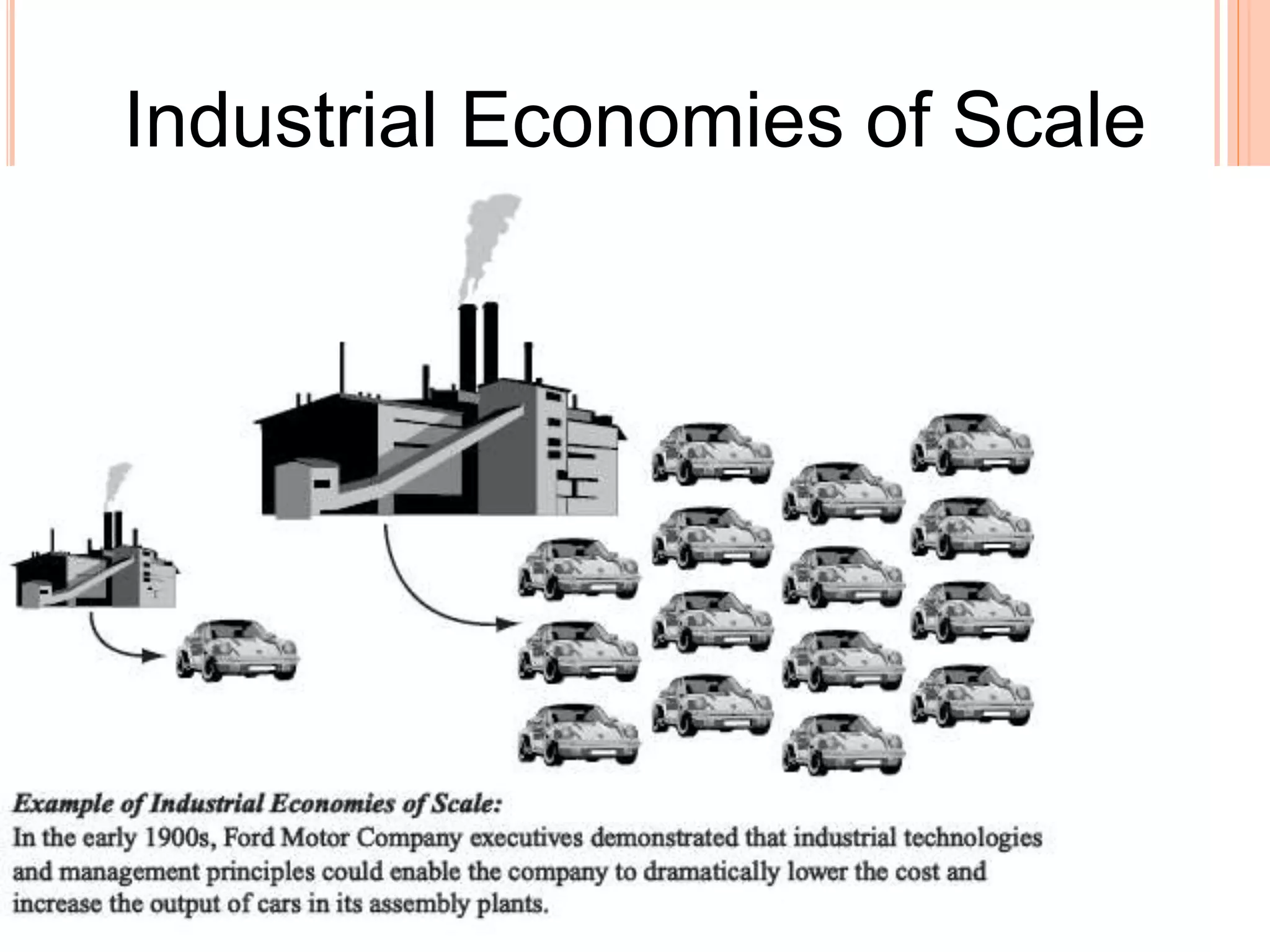
 Economies of Scale
 The ability to produce better, faster and cheaper by
building specialized plants, creating specialized jobs.
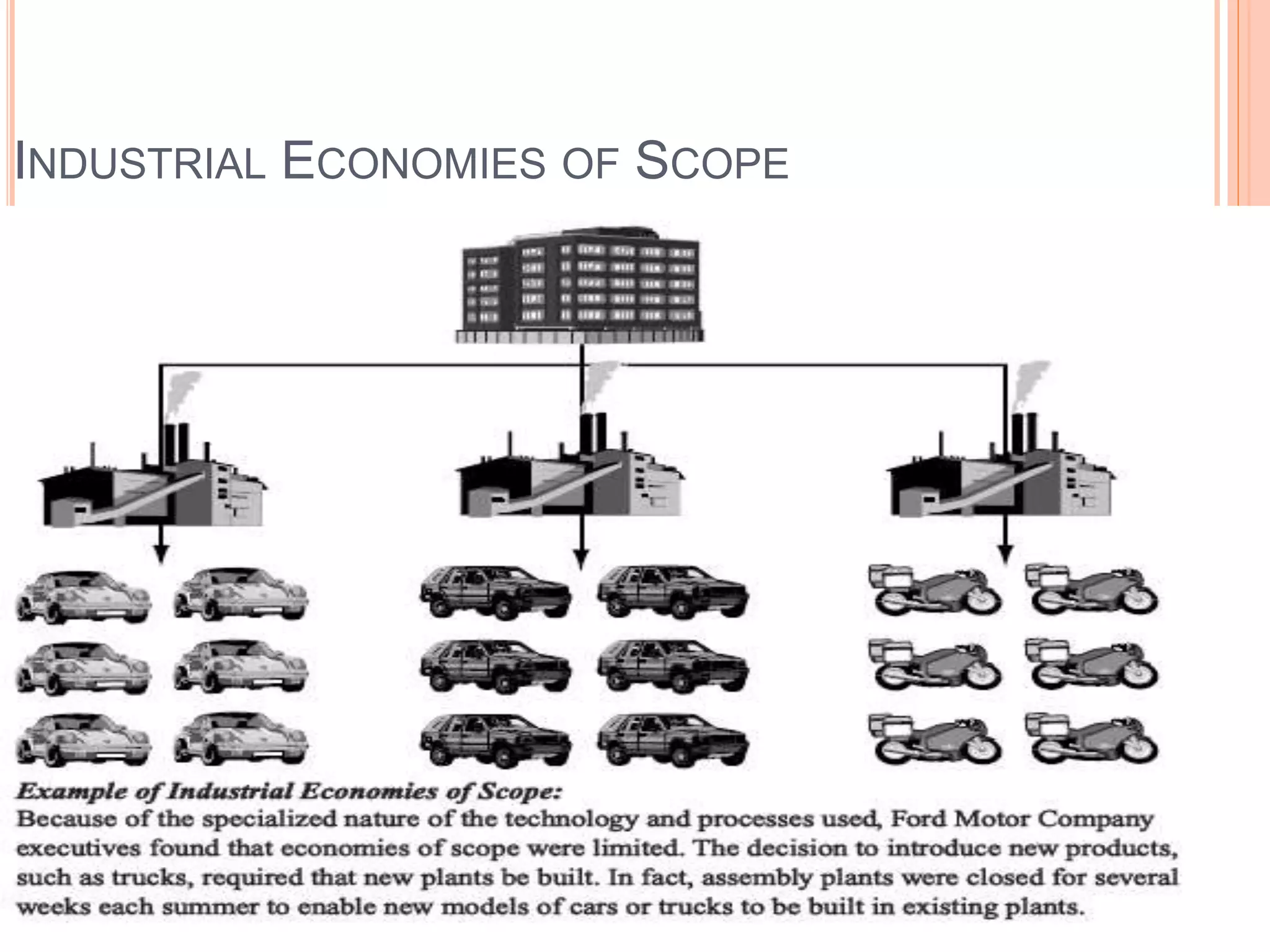
 Economies of Scope
 The ability to leverage an existing infrastructure to
produce and distribute new products
Industrial Economies of Scale
INDUSTRIAL ECONOMIES OF SCOPE
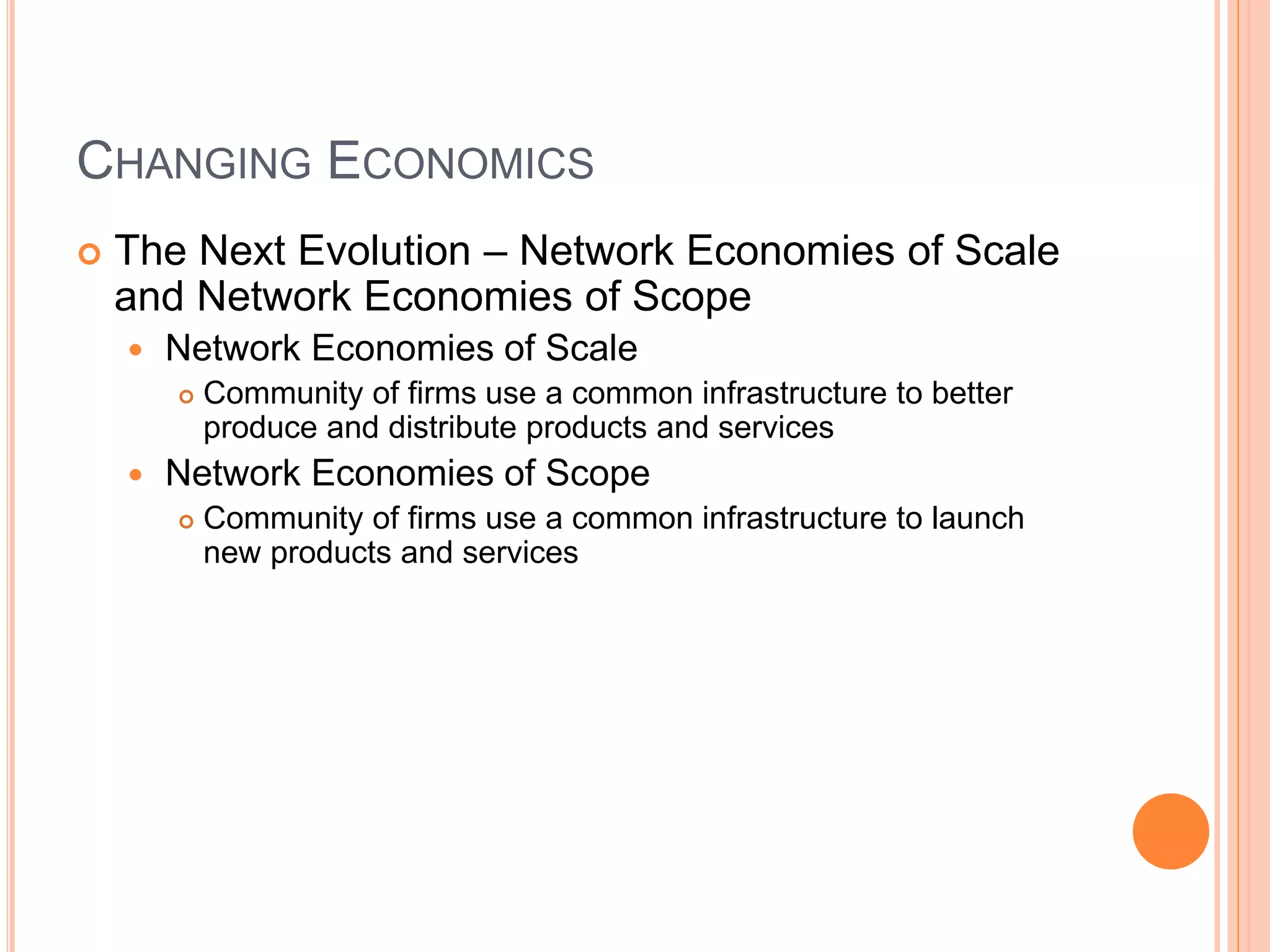
CHANGING ECONOMICS
 The Next Evolution – Network Economies of Scale
and Network Economies of Scope
 Network Economies of Scale
 Community of firms use a common infrastructure to better
produce and distribute products and services
 Network Economies of Scope
 Community of firms use a common infrastructure to launch
new products and services
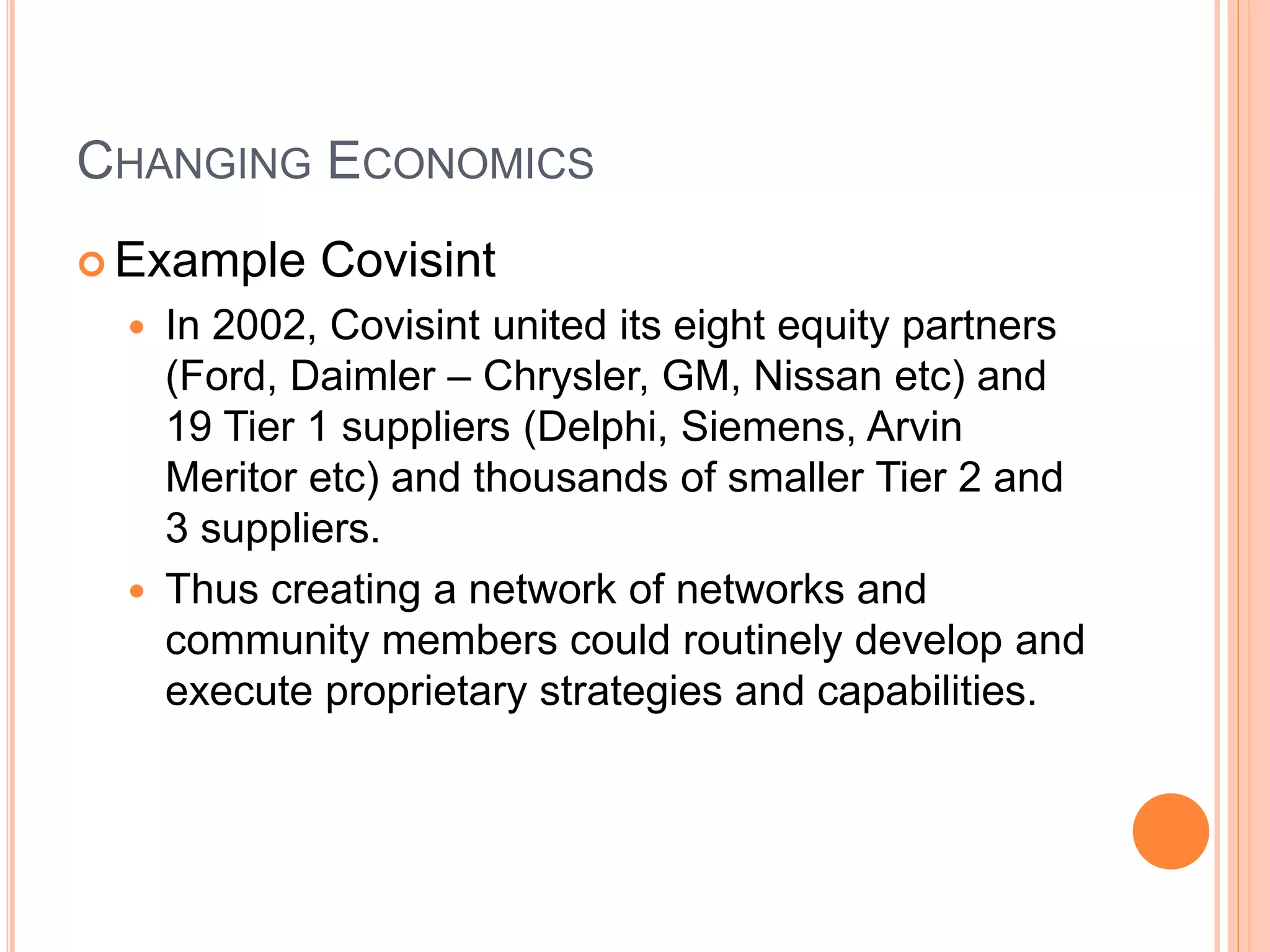
CHANGING ECONOMICS
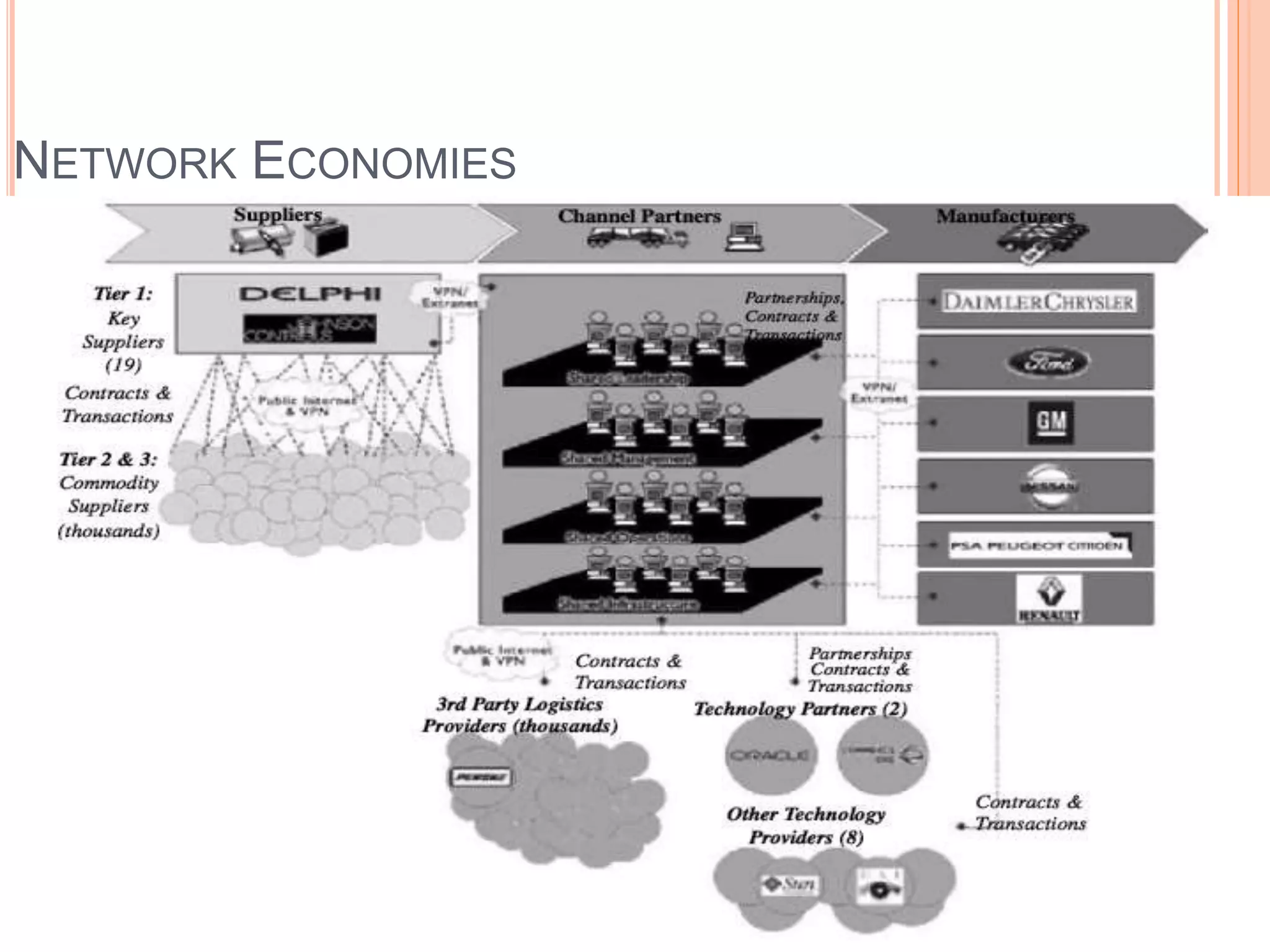
 Example Covisint
 In 2002, Covisint united its eight equity partners
(Ford, Daimler – Chrysler, GM, Nissan etc) and
19 Tier 1 suppliers (Delphi, Siemens, Arvin
Meritor etc) and thousands of smaller Tier 2 and
3 suppliers.
 Thus creating a network of networks and
community members could routinely develop and
execute proprietary strategies and capabilities.
NETWORK ECONOMIES
CHANGING ECONOMICS
 Dave Perry and Ventro
 B2B e-commerce is all about getting in between the
existing buyers and sellers and creating an internet
solution which helps them in doing business more
effectively.
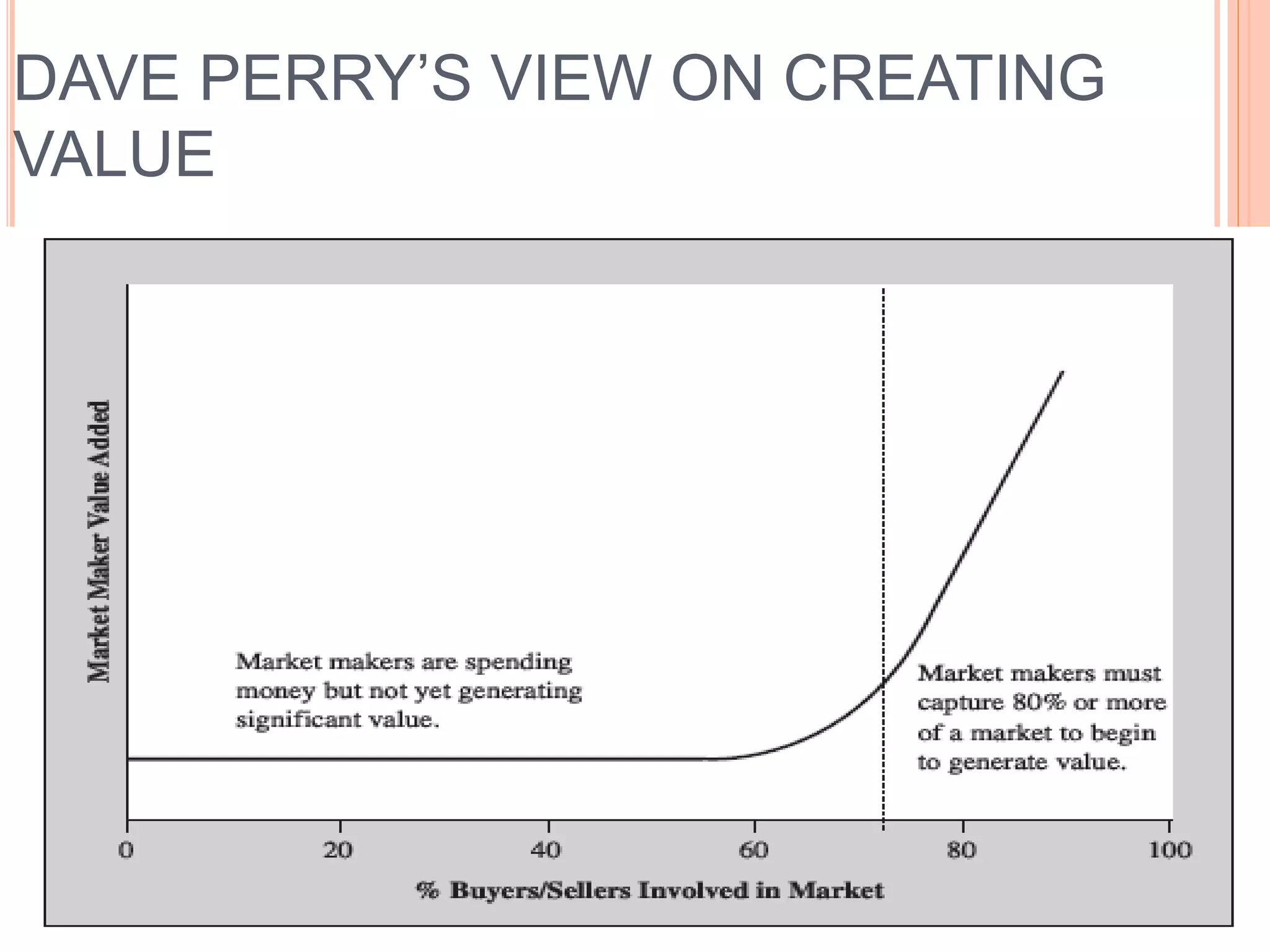
 You need to have a critical mass of both buyers and
sellers.
DAVE PERRY’S VIEW ON CREATING
VALUE
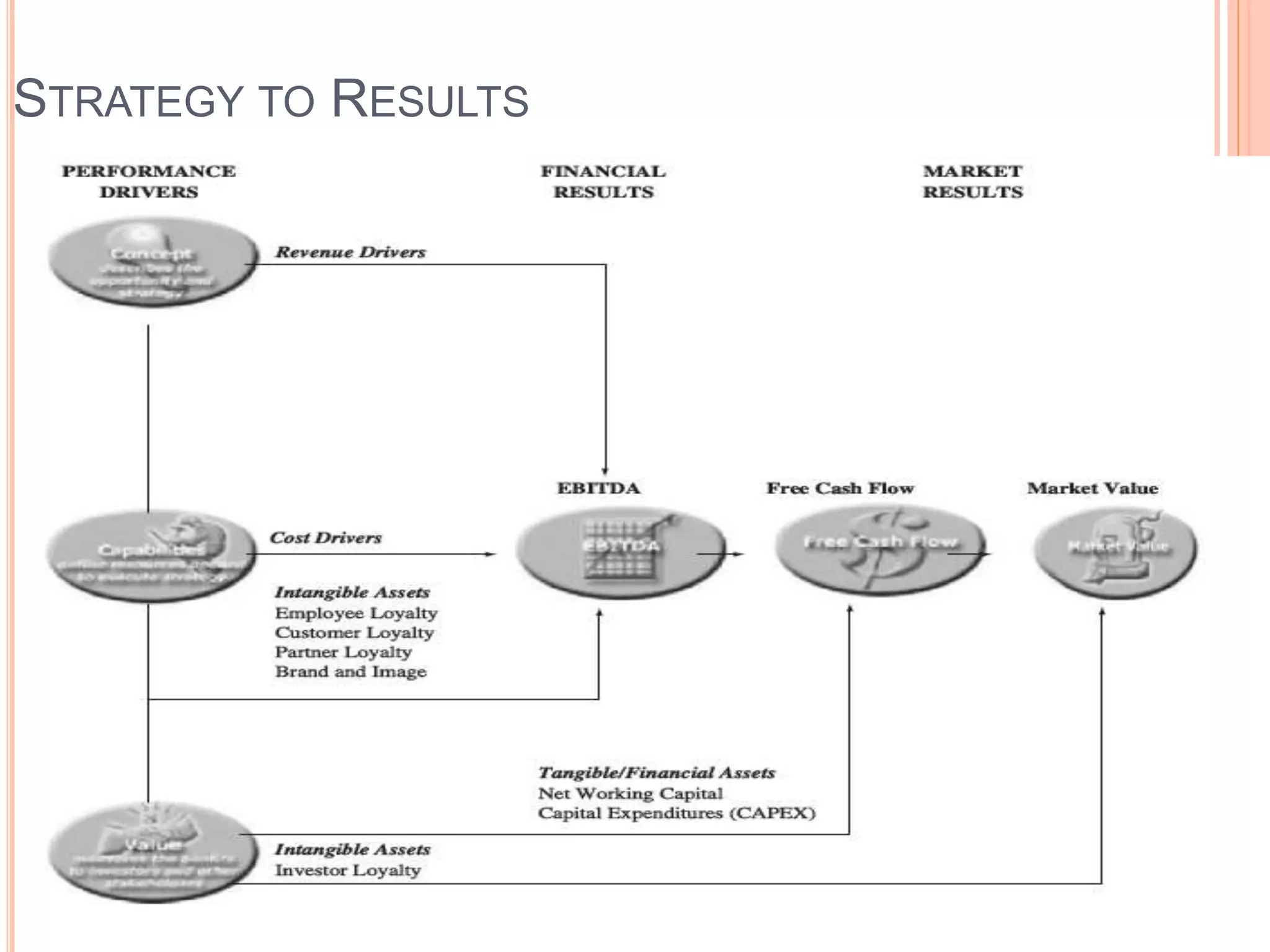
LINKING STRATEGY TO RESULTS
 Analyzing Performance Drivers
 Analysis of Business Concept, business capabilities and
value created.
 These three categories links directly to revenues costs
and assets which in turn drive your market valuation.
LINKING STRATEGY TO RESULTS
 Business Concept
 Opportunities a firm will pursue and its strategy to
achieve a dominant position
 The business concept is used to frame the assumptions
used to forecast revenues.
LINKING STRATEGY TO RESULTS
 Capabilities
 Once the business concept is defined then capabilities
must be built to execute this strategy
 Analysis of an organizations capabilities frames the
assumptions used to forecast costs.
 Operating and Innovating Capabilities
 Managing and Learning Capabilities
 Leading and Engaging Capabilities
LINKING STRATEGY TO RESULTS
 Value
 Value analysis begins with assessment of benefits
delivered to customers, suppliers, partners and
employees.
 These benefits together with organization’s concept
and capabilities create the assets that drive the financial
and market performance.
STRATEGY TO RESULTS
DEVELOPING THE BUSINESS CASE FOR IT
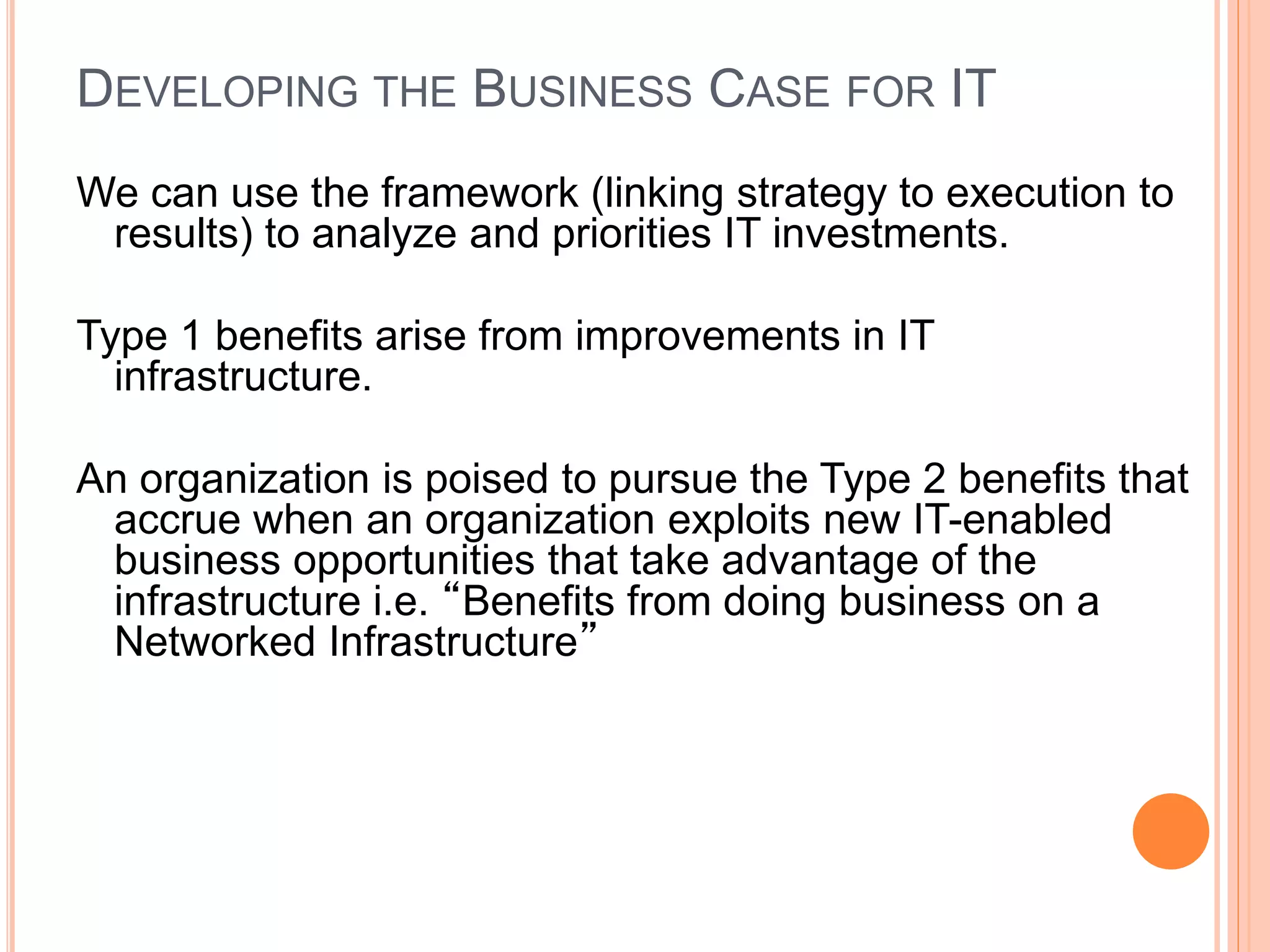
We can use the framework (linking strategy to execution to
results) to analyze and priorities IT investments.
Type 1 benefits arise from improvements in IT
infrastructure.
An organization is poised to pursue the Type 2 benefits that
accrue when an organization exploits new IT-enabled
business opportunities that take advantage of the
infrastructure i.e. “Benefits from doing business on a
Networked Infrastructure”
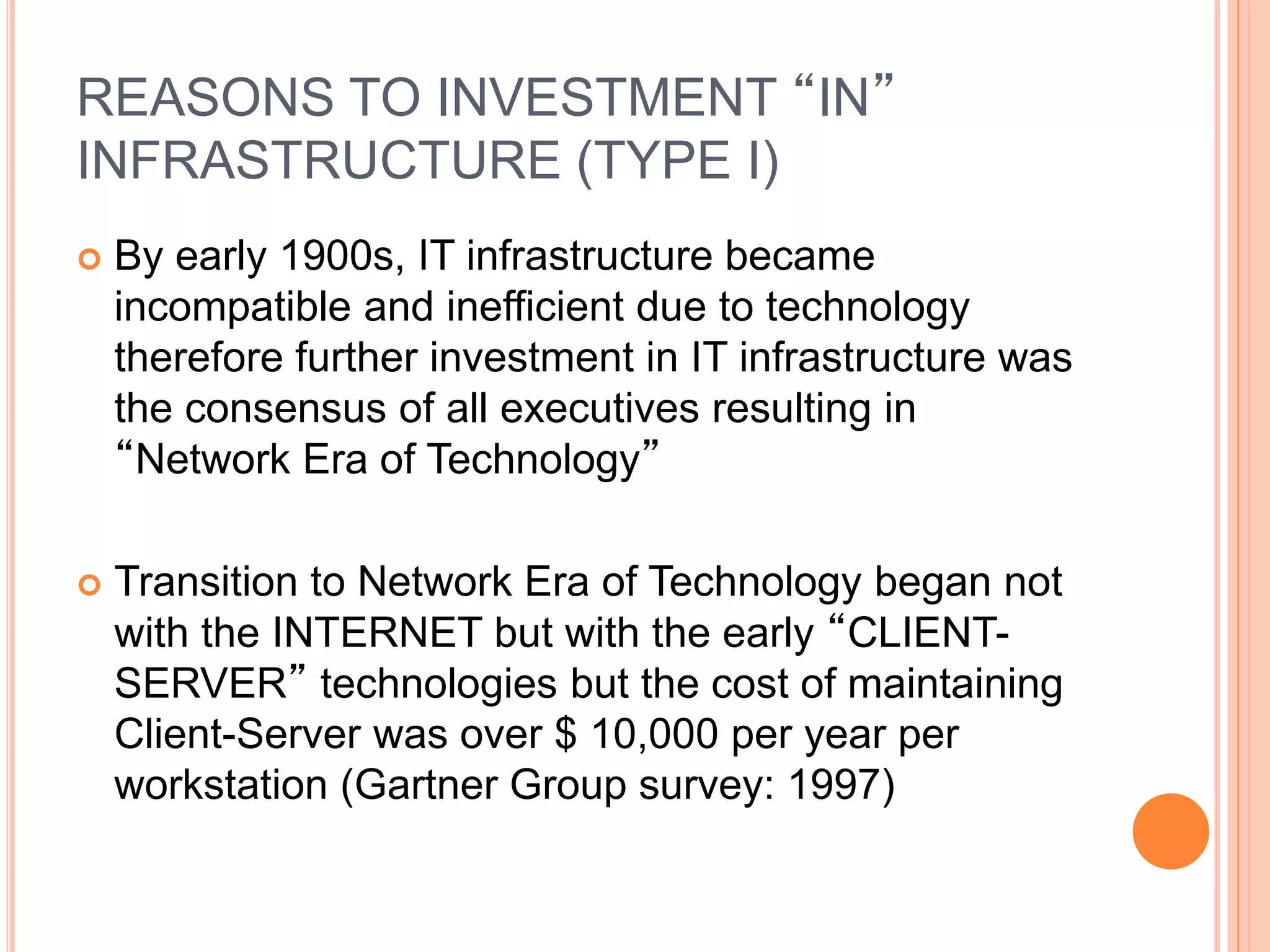
REASONS TO INVESTMENT “IN”
INFRASTRUCTURE (TYPE I)
 By early 1900s, IT infrastructure became
incompatible and inefficient due to technology
therefore further investment in IT infrastructure was
the consensus of all executives resulting in
“Network Era of Technology”
 Transition to Network Era of Technology began not
with the INTERNET but with the early “CLIENT-
SERVER” technologies but the cost of maintaining
Client-Server was over $ 10,000 per year per
workstation (Gartner Group survey: 1997)
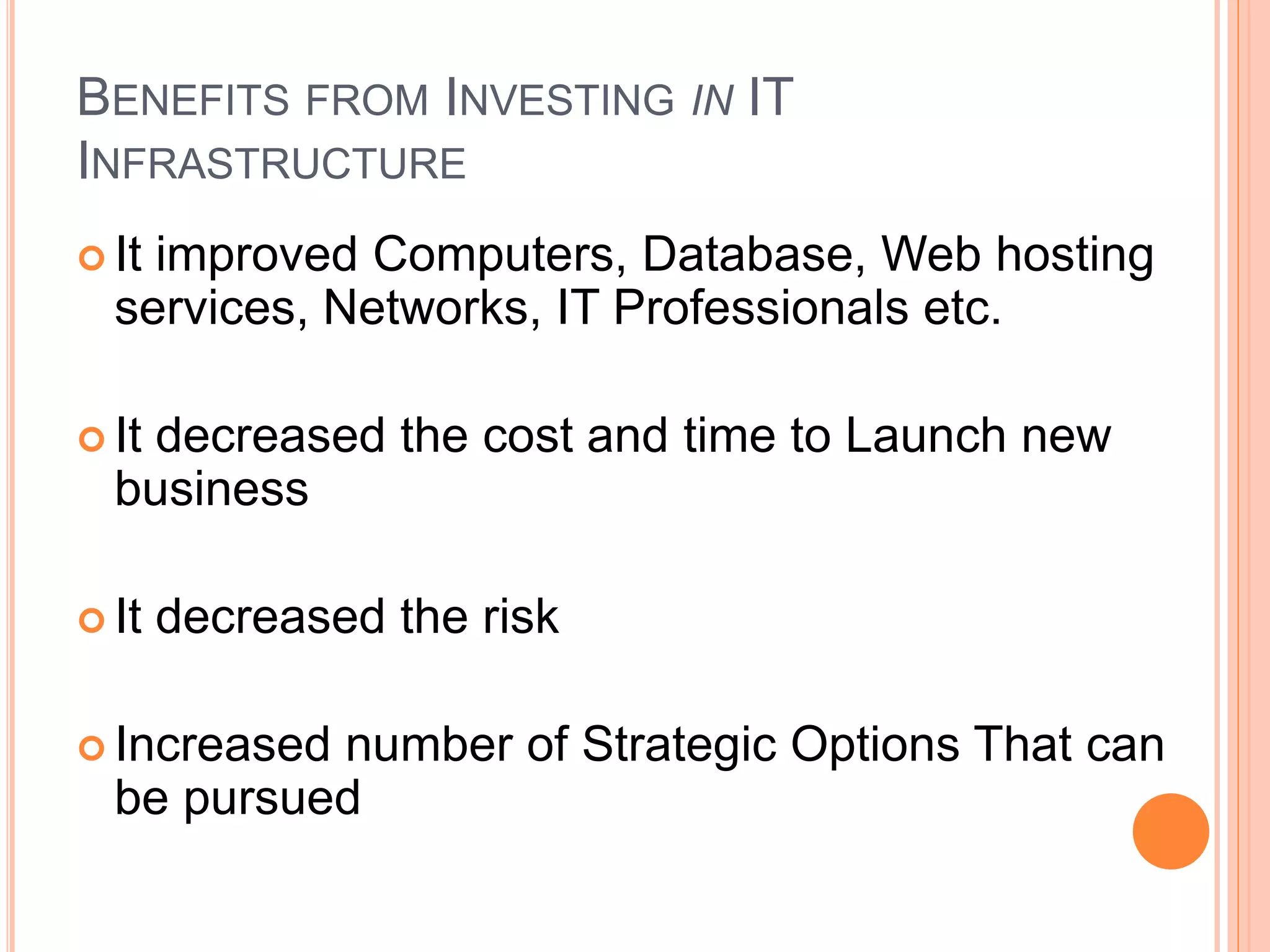
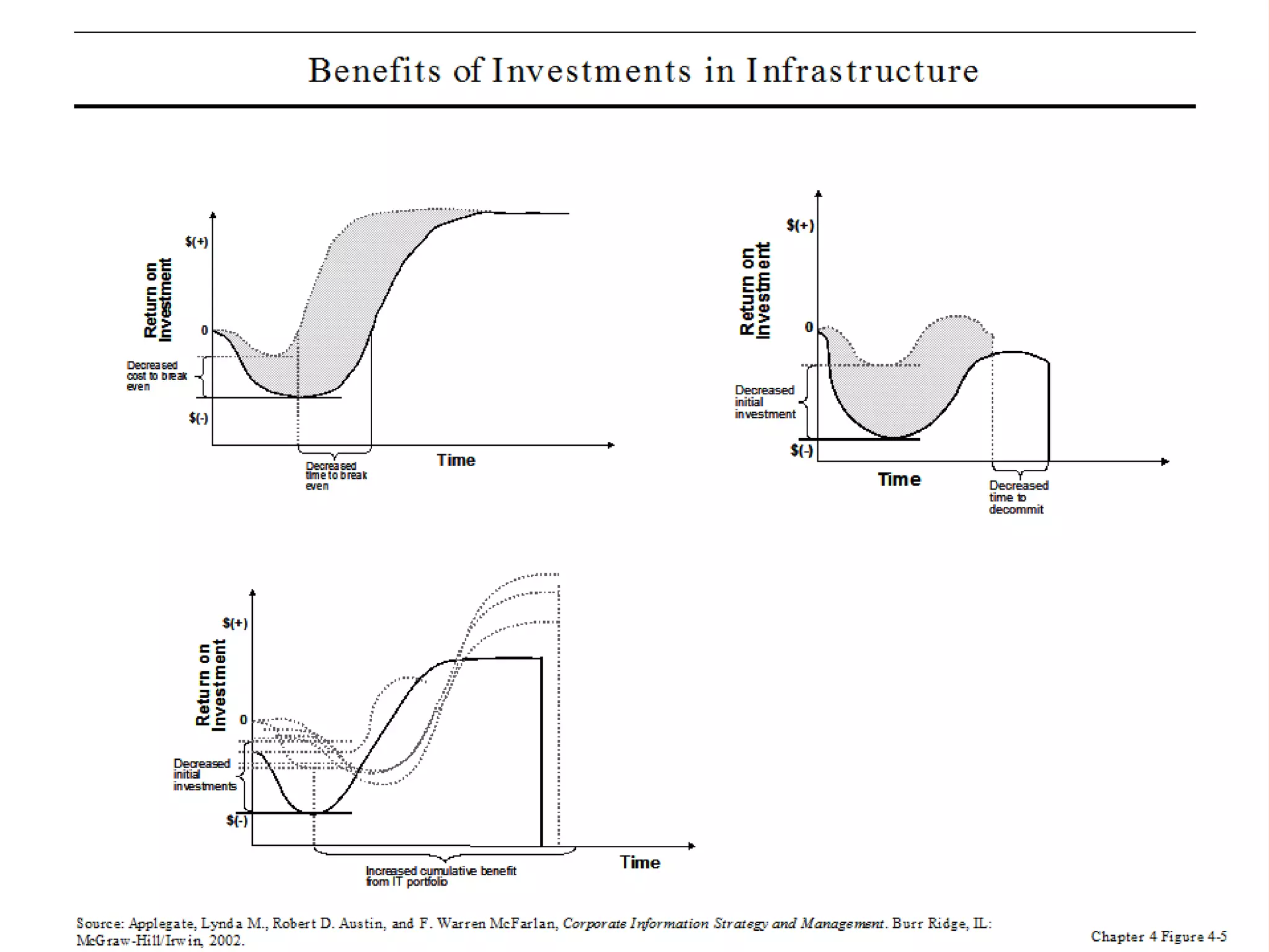
BENEFITS FROM INVESTING IN IT
INFRASTRUCTURE
 It improved Computers, Database, Web hosting
services, Networks, IT Professionals etc.
 It decreased the cost and time to Launch new
business
 It decreased the risk
 Increased number of Strategic Options That can
be pursued
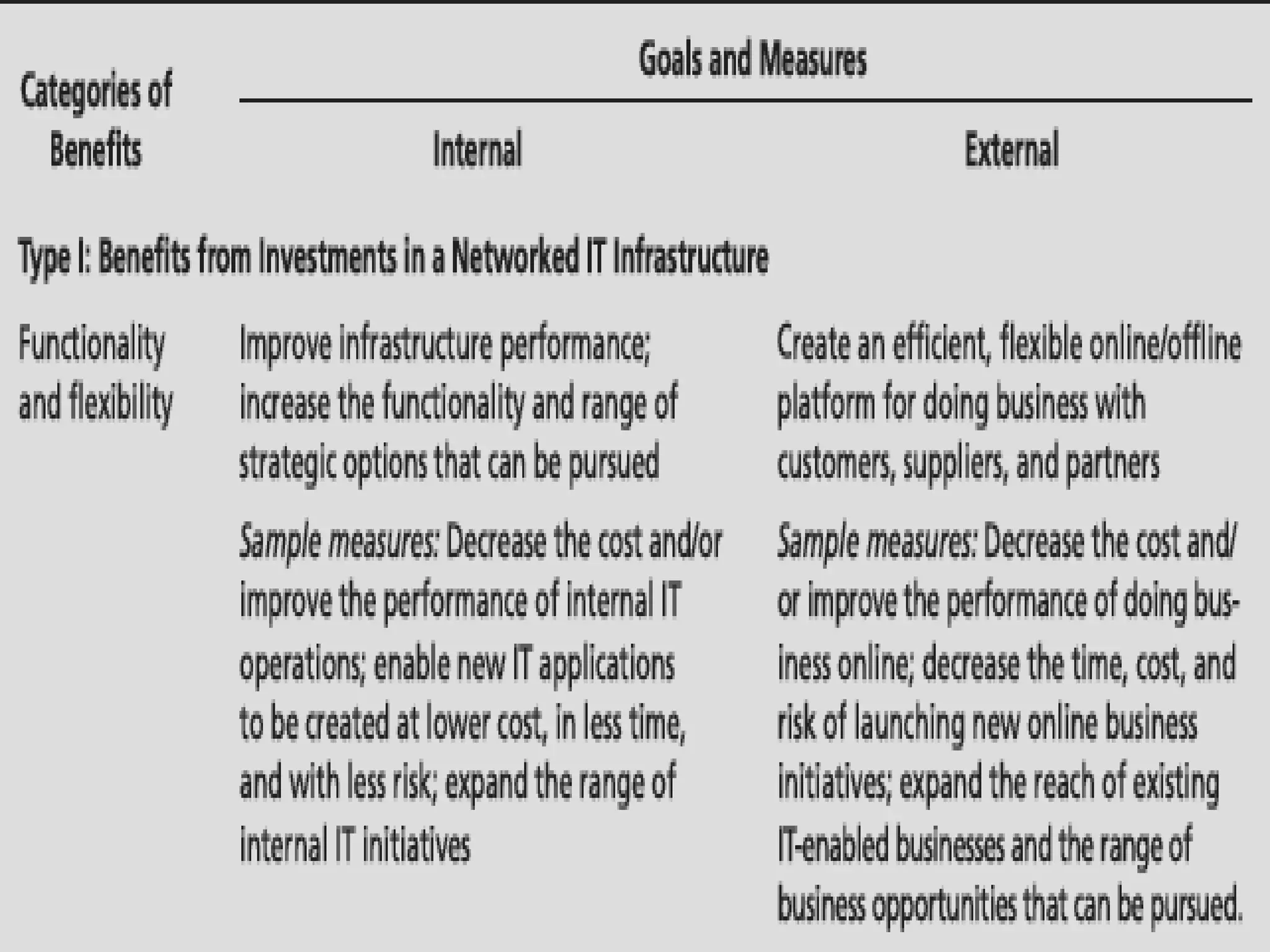
IT BUSINESS VALUE SCORECARD
 For Type I benefits: Benefits from Investment in IT
Infrastructure
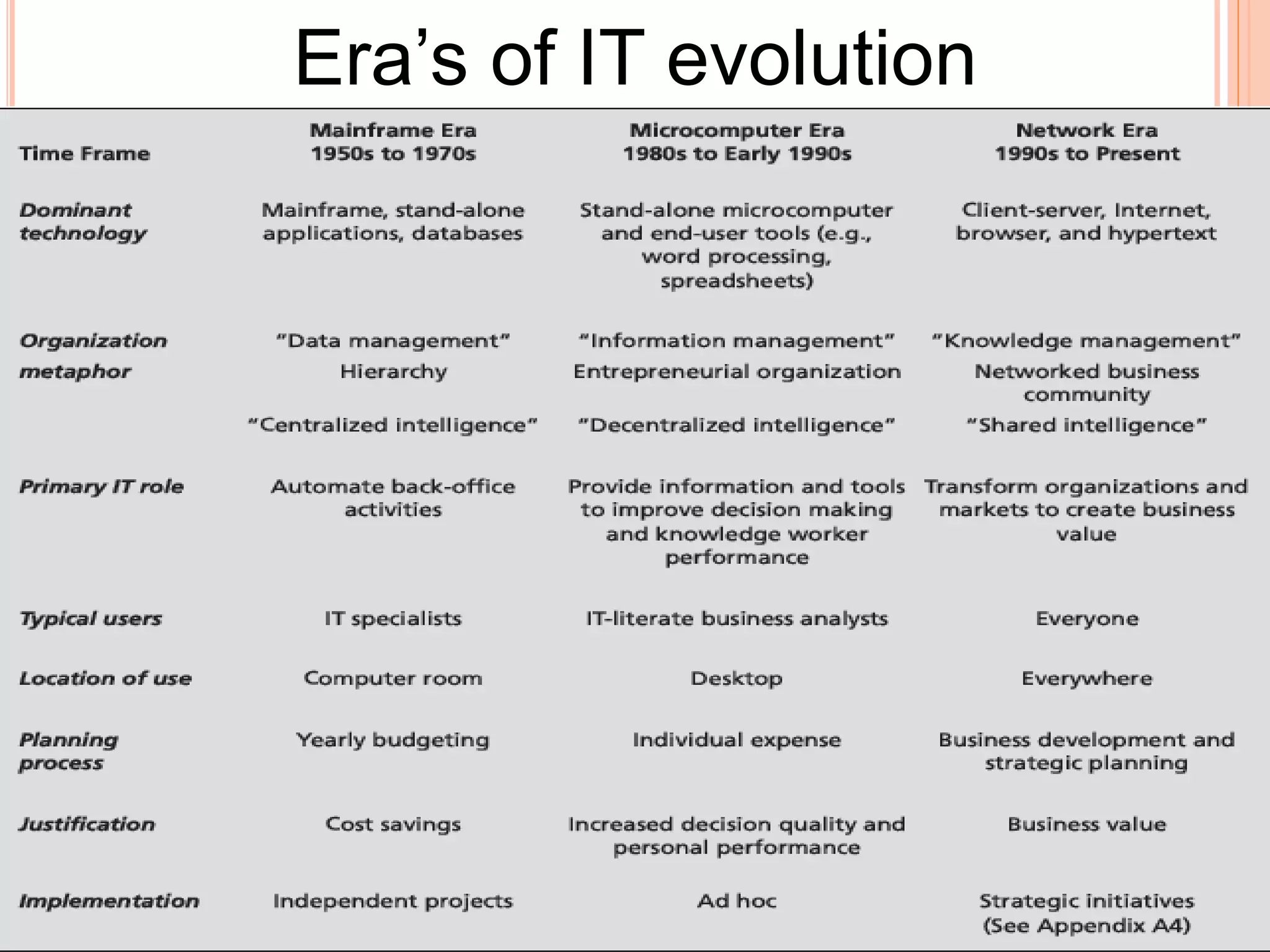
Era’s of IT evolution
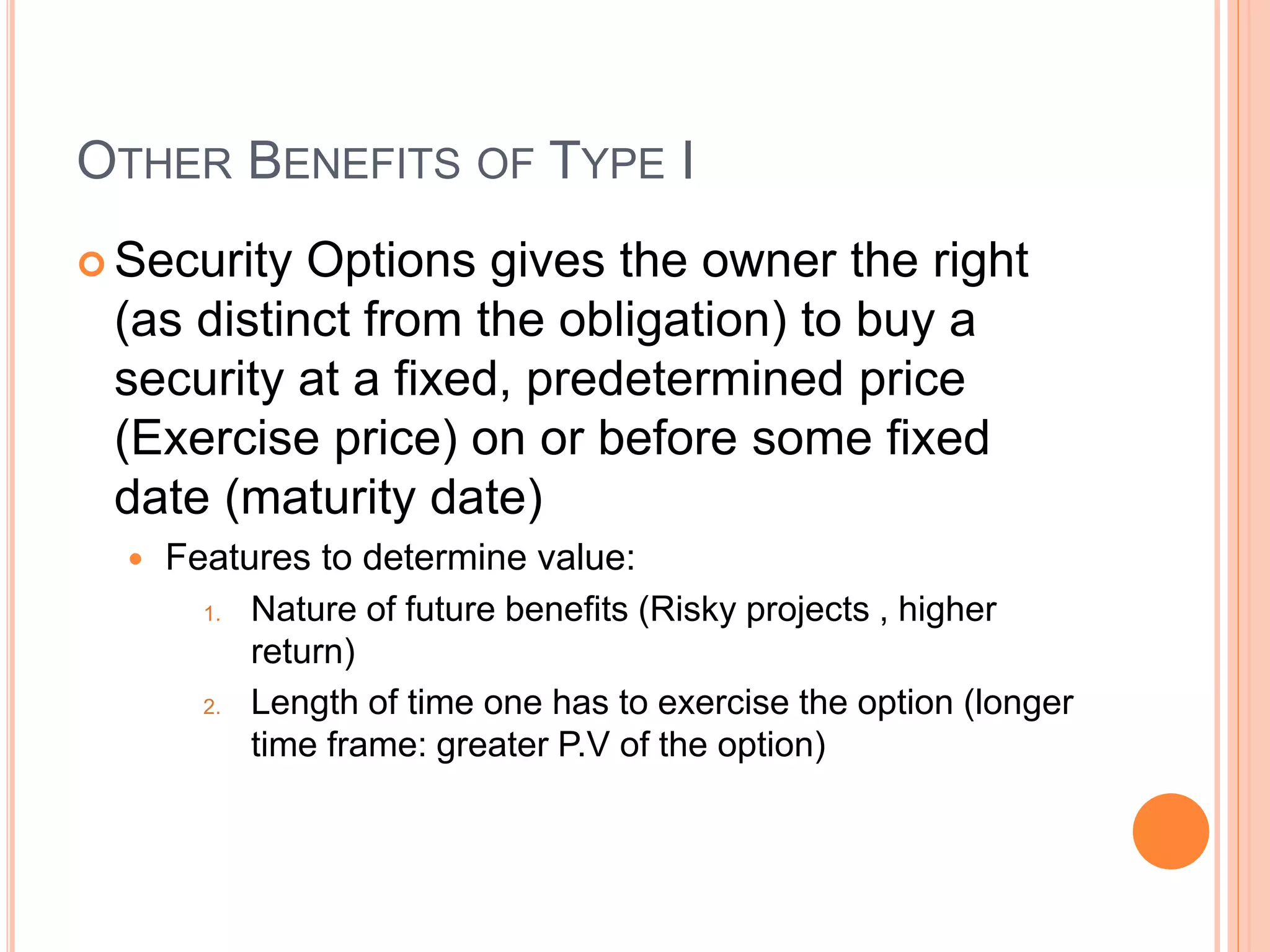
OTHER BENEFITS OF TYPE I
 Security Options gives the owner the right
(as distinct from the obligation) to buy a
security at a fixed, predetermined price
(Exercise price) on or before some fixed
date (maturity date)
 Features to determine value:
1. Nature of future benefits (Risky projects , higher
return)
2. Length of time one has to exercise the option (longer
time frame: greater P.V of the option)
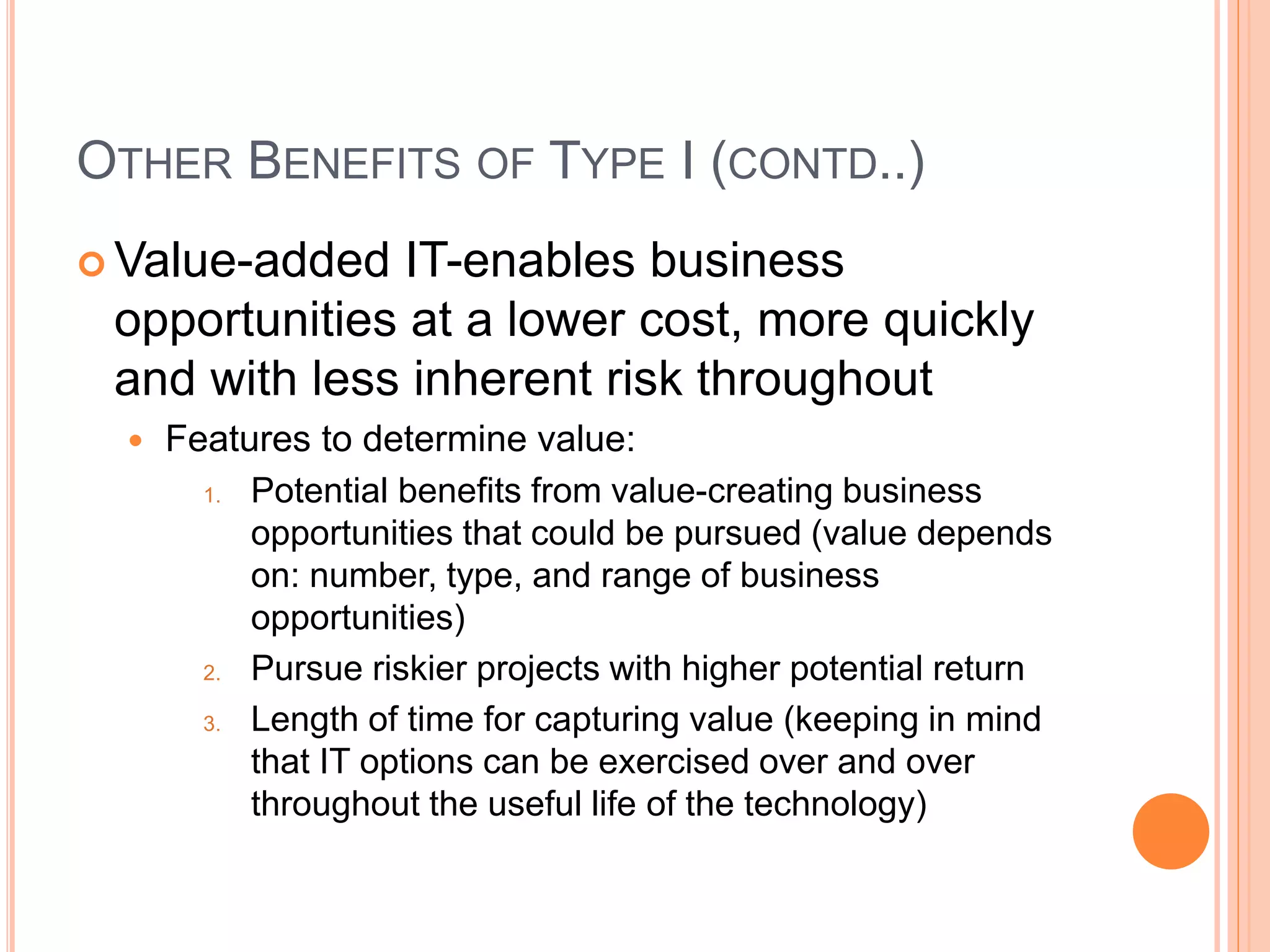
OTHER BENEFITS OF TYPE I (CONTD..)
 Value-added IT-enables business
opportunities at a lower cost, more quickly
and with less inherent risk throughout
 Features to determine value:
1. Potential benefits from value-creating business
opportunities that could be pursued (value depends
on: number, type, and range of business
opportunities)
2. Pursue riskier projects with higher potential return
3. Length of time for capturing value (keeping in mind
that IT options can be exercised over and over
throughout the useful life of the technology)
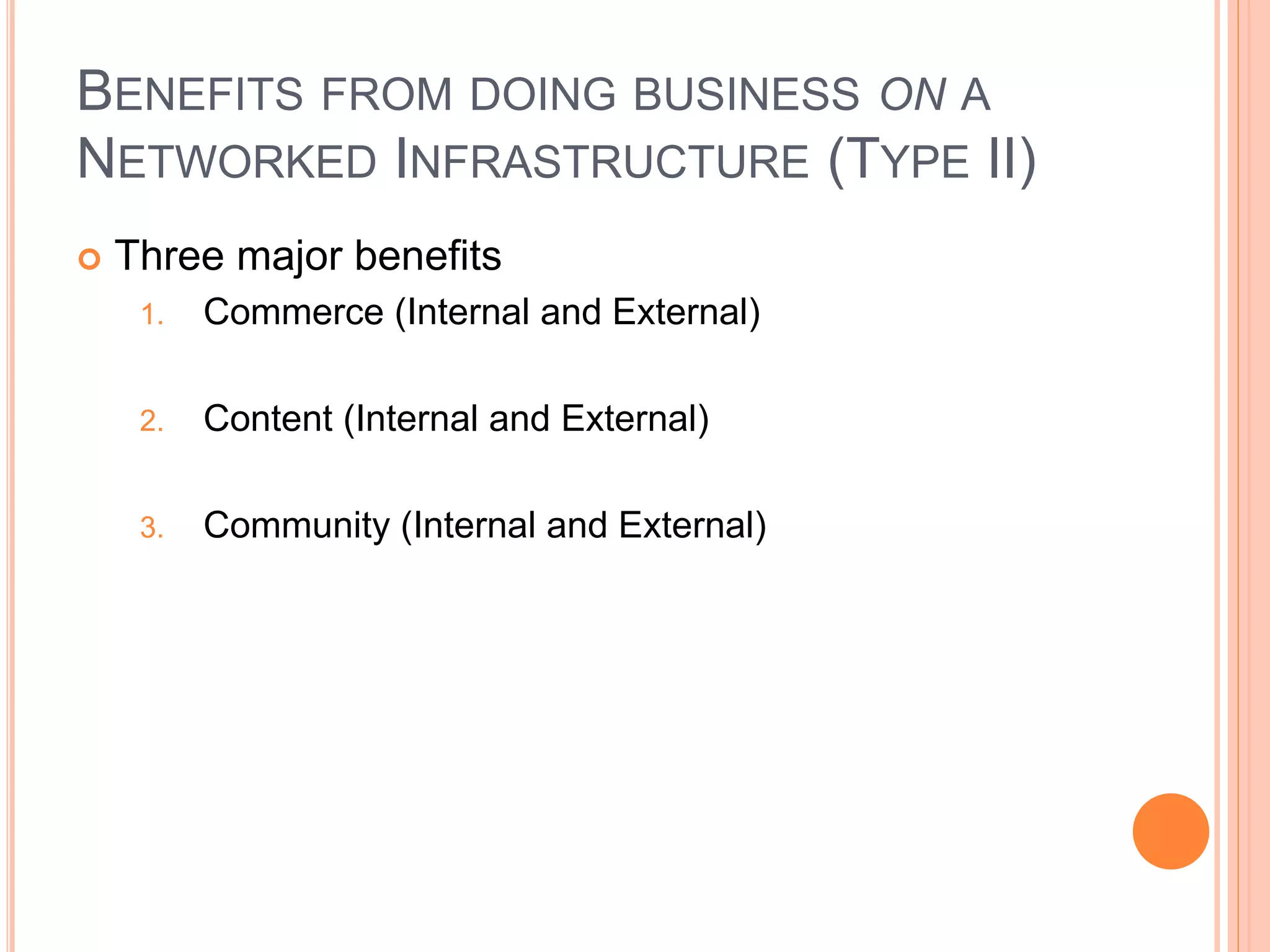
BENEFITS FROM DOING BUSINESS ON A
NETWORKED INFRASTRUCTURE (TYPE II)
 Three major benefits
1. Commerce (Internal and External)
2. Content (Internal and External)
3. Community (Internal and External)
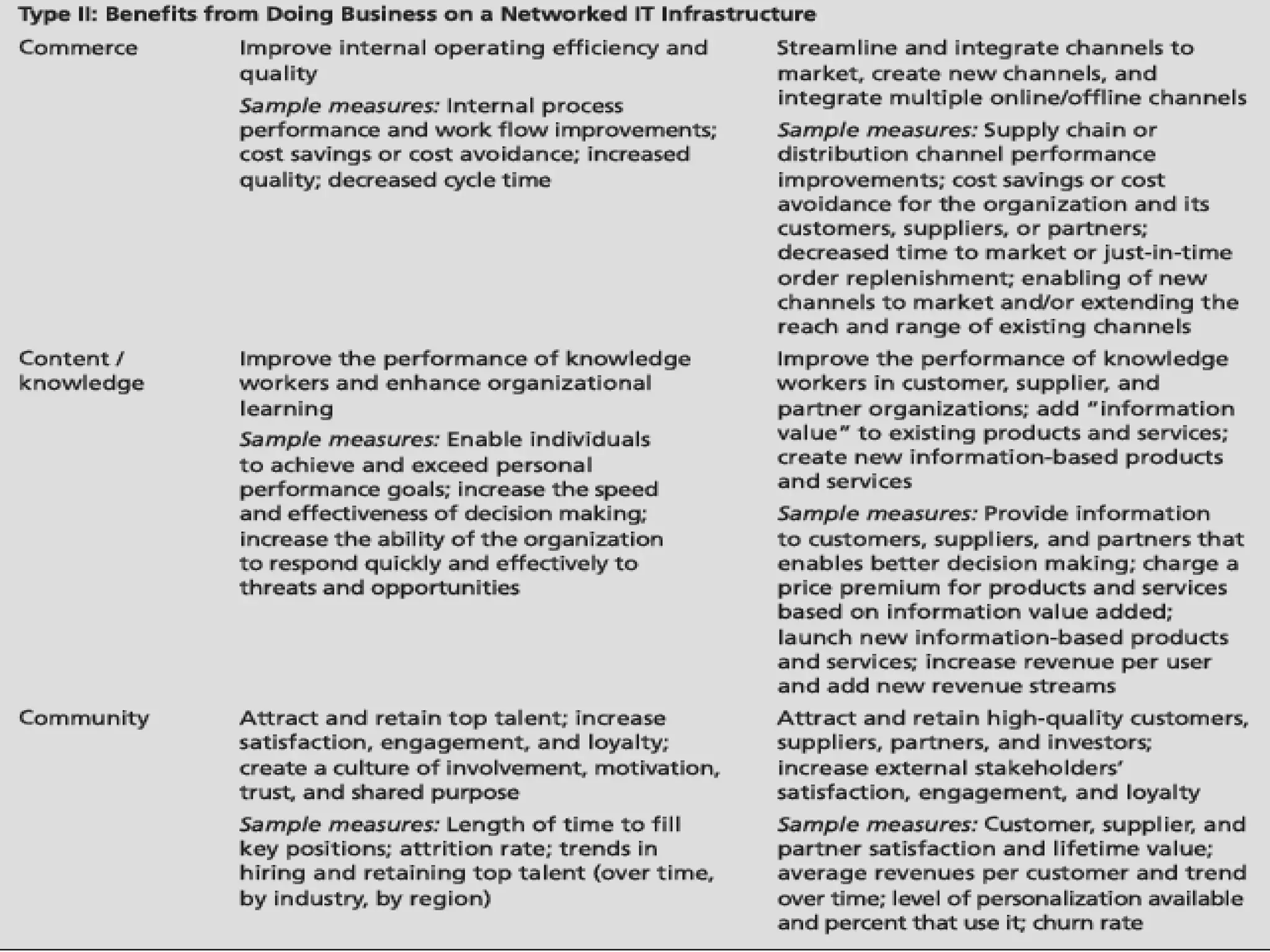
IT BUSINESS VALUE SCORECARD
 For Type II benefits: Benefits from Investment on IT
Infrastructure
Thank you..

Ch 4 Presentation Final Iis2

  • 1.
    CHAPTER# 04 CORPORATE INFORMATION STRUCTUREAND COMPETITIVE STRATEGY Making the Case for Networked Business Presenters Kamran Iqbal Siddiqui Syed Hamid Jamal Yahya Vana (Out of town)
  • 2.
    Major Topics ofthe Chapter  Changing Economies  Linking strategies to Execution to Results  Developing the Business case for IT
  • 3.
    Presented by: KamranIqbal  Changing Economics  Linking Strategy to Execution and Results Presented by: Hamid Jamal  Developing the Business Case for IT
  • 4.
    CHANGING ECONOMICS  ComparingIndustrial and Networked Economies  The Successful Organizations of the past century differentiated themselves from others by creating economies of scale and scope  Economies of Scale  The ability to produce better, faster and cheaper by building specialized plants, creating specialized jobs.  Economies of Scope  The ability to leverage an existing infrastructure to produce and distribute new products
  • 5.
  • 6.
  • 7.
    CHANGING ECONOMICS  TheNext Evolution – Network Economies of Scale and Network Economies of Scope  Network Economies of Scale  Community of firms use a common infrastructure to better produce and distribute products and services  Network Economies of Scope  Community of firms use a common infrastructure to launch new products and services
  • 8.
    CHANGING ECONOMICS  ExampleCovisint  In 2002, Covisint united its eight equity partners (Ford, Daimler – Chrysler, GM, Nissan etc) and 19 Tier 1 suppliers (Delphi, Siemens, Arvin Meritor etc) and thousands of smaller Tier 2 and 3 suppliers.  Thus creating a network of networks and community members could routinely develop and execute proprietary strategies and capabilities.
  • 9.
  • 10.
    CHANGING ECONOMICS  DavePerry and Ventro  B2B e-commerce is all about getting in between the existing buyers and sellers and creating an internet solution which helps them in doing business more effectively.  You need to have a critical mass of both buyers and sellers.
  • 11.
    DAVE PERRY’S VIEWON CREATING VALUE
  • 12.
    LINKING STRATEGY TORESULTS  Analyzing Performance Drivers  Analysis of Business Concept, business capabilities and value created.  These three categories links directly to revenues costs and assets which in turn drive your market valuation.
  • 13.
    LINKING STRATEGY TORESULTS  Business Concept  Opportunities a firm will pursue and its strategy to achieve a dominant position  The business concept is used to frame the assumptions used to forecast revenues.
  • 14.
    LINKING STRATEGY TORESULTS  Capabilities  Once the business concept is defined then capabilities must be built to execute this strategy  Analysis of an organizations capabilities frames the assumptions used to forecast costs.  Operating and Innovating Capabilities  Managing and Learning Capabilities  Leading and Engaging Capabilities
  • 15.
    LINKING STRATEGY TORESULTS  Value  Value analysis begins with assessment of benefits delivered to customers, suppliers, partners and employees.  These benefits together with organization’s concept and capabilities create the assets that drive the financial and market performance.
  • 16.
  • 17.
    DEVELOPING THE BUSINESSCASE FOR IT We can use the framework (linking strategy to execution to results) to analyze and priorities IT investments. Type 1 benefits arise from improvements in IT infrastructure. An organization is poised to pursue the Type 2 benefits that accrue when an organization exploits new IT-enabled business opportunities that take advantage of the infrastructure i.e. “Benefits from doing business on a Networked Infrastructure”
  • 18.
    REASONS TO INVESTMENT“IN” INFRASTRUCTURE (TYPE I)  By early 1900s, IT infrastructure became incompatible and inefficient due to technology therefore further investment in IT infrastructure was the consensus of all executives resulting in “Network Era of Technology”  Transition to Network Era of Technology began not with the INTERNET but with the early “CLIENT- SERVER” technologies but the cost of maintaining Client-Server was over $ 10,000 per year per workstation (Gartner Group survey: 1997)
  • 19.
    BENEFITS FROM INVESTINGIN IT INFRASTRUCTURE  It improved Computers, Database, Web hosting services, Networks, IT Professionals etc.  It decreased the cost and time to Launch new business  It decreased the risk  Increased number of Strategic Options That can be pursued
  • 20.
    IT BUSINESS VALUESCORECARD  For Type I benefits: Benefits from Investment in IT Infrastructure
  • 22.
    Era’s of ITevolution
  • 24.
    OTHER BENEFITS OFTYPE I  Security Options gives the owner the right (as distinct from the obligation) to buy a security at a fixed, predetermined price (Exercise price) on or before some fixed date (maturity date)  Features to determine value: 1. Nature of future benefits (Risky projects , higher return) 2. Length of time one has to exercise the option (longer time frame: greater P.V of the option)
  • 25.
    OTHER BENEFITS OFTYPE I (CONTD..)  Value-added IT-enables business opportunities at a lower cost, more quickly and with less inherent risk throughout  Features to determine value: 1. Potential benefits from value-creating business opportunities that could be pursued (value depends on: number, type, and range of business opportunities) 2. Pursue riskier projects with higher potential return 3. Length of time for capturing value (keeping in mind that IT options can be exercised over and over throughout the useful life of the technology)
  • 26.
    BENEFITS FROM DOINGBUSINESS ON A NETWORKED INFRASTRUCTURE (TYPE II)  Three major benefits 1. Commerce (Internal and External) 2. Content (Internal and External) 3. Community (Internal and External)
  • 27.
    IT BUSINESS VALUESCORECARD  For Type II benefits: Benefits from Investment on IT Infrastructure
  • 29.