Presents
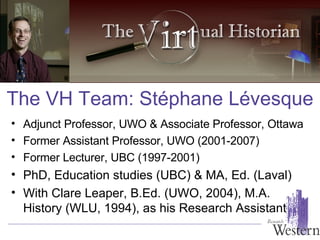
The VH Team: St é phane L é vesque Adjunct Professor, UWO & Associate Professor, Ottawa Former Assistant Professor, UWO (2001-2007) Former Lecturer, UBC (1997-2001) PhD, Education studies (UBC) & MA, Ed. (Laval) With Clare Leaper, B.Ed. (UWO, 2004), M.A. History (WLU, 1994), as his Research Assistant
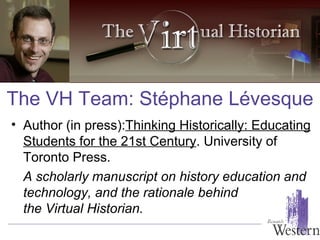
Author (in press): Thinking Historically: Educating Students for the 21st Century . University of Toronto Press.  A scholarly manuscript on history education and technology, and the rationale behind  the Virtual Historian. The VH Team: St é phane L é vesque
The VH Team: Western e-Learning Most experienced providers of virtual Continuing Teacher Education in Canada, online since 1998 Continuing Teacher Education’s integrated team of Web Designers, Faculty, Administrators and Staff ensures technological planning and development follow pedagogical priorities
Digital history has the enormous potential of promoting and enhancing the  active   learning  and  doing  of history (puts students in charge of their own work in meaningful tasks) Why Digital History?
“Playing” History “ In the history courses I took in school in the 1960s, we read about history, talked about history and wrote about history; we never actually did history… –  Canadian historian Chad Gaffield (2001)
“Playing” History … If I had learned basketball in this way, I would have spent years reading the interpretations and viewpoints of great players, watching them play games, and analysing the results of various techniques and strategies…  –  Canadian historian Chad Gaffield (2001)
“Playing” History … Instead, though, I was soon dribbling a basketball and trying to shoot it into the hoop after just a few instructions.  In my history courses, by contrast, … I began in earnest to play the sport only at the doctoral thesis level.”  –  Canadian historian Chad Gaffield (2001)
Twenty-first century students were born into a world of laptop computers, cell phones, video games, and the Internet. Their entire lives have been shaped by the digital age and they logically expect schooling to be as engaging and connected as their virtual conversations and games. Situation: The Digital Age
Virtual-ready teachers are professional educators who know best how to use computational and  digital  technologies to make all their students learn and achieve well in their own respective subject and discipline.   Response: The v-ready teacher
Virtual-ready teachers  have a constructivist vision of education .  They have a student-centred approach to curriculum and view learning as an active process of knowledge construction as opposed to a passive acquisition of facts. Response: The v-ready teacher
Virtual-ready teachers  view themselves as facilitators of knowledge construction . They are not “content providers” but rather “coaches” who guide and assist students in their practice of the discipline. Response: The v-ready teacher
Virtual-ready teachers f ocus on inquiry-based learning strategies . They provide students with multiple, meaningful opportunities to move beyond memorization so as to critically investigate essential problems at the heart of their subject Response: The v-ready teacher
Virtual-ready teachers  empower students to learn.  They assist, guide and provide students with the necessary disciplinary tools to construct their own knowledge . Response: The v-ready teacher
Virtual-ready teachers  accommodate the needs and aspirations of all students  through multiple activities and assessment tools which reflect their own learning experience. Response: The v-ready teacher
Virtual-ready teachers  draw on pertinent technological tools and resources to engage their students in active learning . They have an appropriate level of technological skill and adequate access to computer facilities and digital resources.   Response: The v-ready teacher
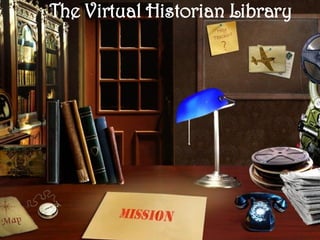
The Virtual Historian Library
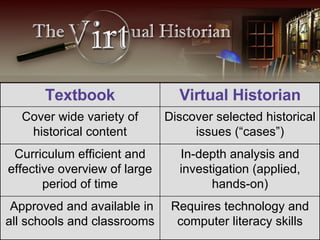
Requires technology and computer literacy skills Approved and available in all schools and classrooms In-depth analysis and investigation (applied, hands-on) Curriculum efficient and effective overview of large period of time Discover selected historical issues (“cases”) Cover wide variety of historical content Virtual Historian Textbook
The Virtual Historian Library Content is organized and packaged in ways that promote “unpacking” and “discovery”  “ Cases” are prearranged and ready-made for teachers and students in applied and academic levels – in both French/English  Presents a key issue at the heart of Canadian history (significant theme, event, or figure from curriculum)
The Virtual Historian Library Ultimate goal is  not  to provide an exciting experience in virtual reality ( although  this can be one of the objectives) but rather to enhance students’ historical understanding and practice Provides an “essential question” framed in thought-provoking and engaging way leading to inquiry, along with a “mission” (task) to be accomplished
The Virtual Historian Library Engages students in web-based investigation and sourcing (consider the problem/issue, how to answer, analyze multiple-perspectives sources) Provides ready-made scaffolds (templates, questions, and clues) Offers students and teachers evaluation rubrics to guide their work and performance assessment
Social Science Humanities Research Council:  International study on history learning using the Virtual Historian Canadian   Council on Learning : Canadian study on historical literacy and web-based learning using the Virtual Historian VH Research Funding
Key Questions: Does students’ experience of the Virtual Historian facilitate their understanding of a key event in Canadian history? Does students’ historical learning with the Virtual Historian improve their knowledge of the discipline ? An exploratory study: G10 TVDSB
Methodology: Historical inquiry:  The October Crisis 1970  (a curriculum unit on French-English relations, the Quiet Revolution)  Subjects: two grade 10 Canadian history classes (one experimental n=22, one control n=22) from southwestern Ontario An exploratory study: G10 TVDSB
Methodology: Experimental group: three classes using exclusively the Virtual Historian Control group: three classes from teacher’s lectures (powerpoint, textbooks, secondary sources) and .5 class time in library/internet An exploratory study: G10 TVDSB
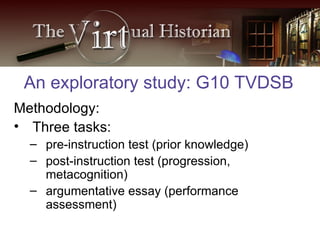
Methodology: Three tasks:  pre-instruction test (prior knowledge)  post-instruction test (progression, metacognition) argumentative essay (performance assessment) An exploratory study: G10 TVDSB
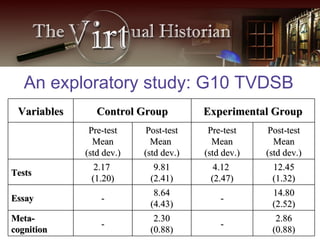
An exploratory study: G10 TVDSB 2.86 (0.88) - 2.30 (0.88) - Meta-cognition 14.80 (2.52) - 8.64 (4.43) - Essay 12.45 (1.32) 4.12  (2.47) 9.81 (2.41) 2.17  (1.20) Tests Post-test Mean (std dev.) Pre-test Mean (std dev.) Post-test Mean  (std dev.) Pre-test Mean (std dev.) Experimental Group Control Group Variables
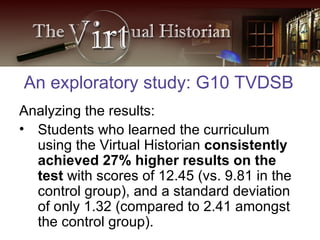
Analyzing the results: Students who learned the curriculum using the Virtual Historian  consistently achieved 27% higher results on the test  with scores of 12.45 (vs. 9.81 in the control group), and a standard deviation of only 1.32 (compared to 2.41 amongst the control group).  An exploratory study: G10 TVDSB
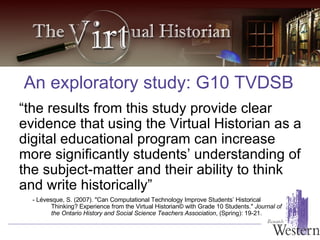
“ the results from this study provide clear evidence that using the Virtual Historian as a digital educational program can increase more significantly students’ understanding of the subject-matter and their ability to think and write historically” An exploratory study: G10 TVDSB -  Lévesque, S. (2007). "Can Computational Technology Improve Students’ Historical Thinking? Experience from the Virtual Historian© with Grade 10 Students."  Journal of the Ontario History and Social Science Teachers Association , (Spring): 19-21.
“ It’s way better than reading from a textbook  or other websites you can’t be sure of .”   -  Student E002 (2007) An exploratory study: G10 TVDSB
Overall, the kids love it. They love the interactive nature of it and think the original films and archival material are "cool".  It took us 115 minutes to do the Dieppe Raid.  You've done some fantastic work. Thank you!  - Sigrid Hynscht, French immersion, Thames Valley District School Board
As historians we are always looking for new ways to develop in our students the appreciation for history and for the lives and event of the past… This new and innovative technological tool has brought together many types of media presentation from archival film footage, never before used historical documents, audio and sound clips, and primary documents our students otherwise would never have access to. The integration of this technology into research and essay writing process will reap great rewards in the learning process for all students. In particular, student with learning disabilities and or difficulties have the opportunities to network with other students on a level never before enjoyed.  - Bruce Clarke, Thames Valley District School Board
The website program that you've created to teach Canadian history looks great. It uses models of 'best practices' in terms of students investigating and exploring.  - Dr. Adam M. Friedman, Professor of Instructional Systems Technology, The University of North Carolina at Charlotte
Last year, I informed you that students in my Grade 10 Academic class used the October Crisis Comprehensive Case documents as a major online resource for researching an argumentative essay on the use of the War Measures Act in 1970.  Students found the site to be very useful as a resource of primary source material.   Students provided feedback on the program after completing the research essay writing process… Many students noted the benefits of having a centralized access to documents focusing on the October Crisis.  The timeline also assisted them in understanding the chronology of events. Overall, the finished essays reflected a smoother, knowledgeable integration of primary source information than in past semesters. - Patricia McGoldrick Goldberg, History Teacher, St. Mary's High  School, Kitchener ON
Educators have often bemoaned the fact that history should be about more than memorizing dates and names, but teachers have been given few tools to assess learning in other ways. Teachers have also had difficulty finding primary sources that younger students could use, since these sources are written in archaic and inaccessible language. The Virtual Historian solves both problems by selecting age appropriate, manageable sources and by creating fun activities that require students to employ judgment, reflection, and understanding.  - Stanley Hallman-Chong, Toronto District School Board
Students do not just learn about what historians have discovered, but do the discovering themselves. By learning about how to deal with evidence, they learn how knowledge is created. This gives them the skills needed to be critical citizens. My students have felt liberated and engaged as a result of allowing them to be the creators of historical knowledge. - Stanley Hallman-Chong, Toronto District School Board
The Virtual Historian is a look forward into the future methodology of teaching and presenting the concepts of history inquiry to students. The level of research and ease of students use allow a depth of understanding that would take weeks in an ordinary class room setting. The Virtual Historian opens up the avenues of technological use for students and teachers alike.   - Bruce Clarke, Thames Valley District School Board
We had an opportunity to get into the program today.  It was a very interesting experience for both me and my grade 10 students.  The research question was simply framed, so the basic focus was clear to the students.  We walked through the mission and the basic format of Virtual Historian and the tools and resources available.  At the end of class we had a preliminary discussion, starting with the focusing question.  Amazingly kids had started to construct answers to the research question and they had pulled out various pieces of evidence to support their ideas-- a lively debate ensued .  In the end most students acknowledged that this was the most successful they had been at constructing an interpretation of history based on evidence (my words not theirs) and that our discussion had been quite good--everyone had sufficient evidence to support a position.    - Craig Winegarder, Ottawa-Carleton District School Board
To Experience VH… Visit:  www.virtualhistorian.ca Or  www.historienvirtuel.ca Email:   [email_address]   for free trial access

ATA Workshop Oct 2007

  • 1.
  • 2.
    The VH Team:St é phane L é vesque Adjunct Professor, UWO & Associate Professor, Ottawa Former Assistant Professor, UWO (2001-2007) Former Lecturer, UBC (1997-2001) PhD, Education studies (UBC) & MA, Ed. (Laval) With Clare Leaper, B.Ed. (UWO, 2004), M.A. History (WLU, 1994), as his Research Assistant
  • 3.
    Author (in press):Thinking Historically: Educating Students for the 21st Century . University of Toronto Press. A scholarly manuscript on history education and technology, and the rationale behind the Virtual Historian. The VH Team: St é phane L é vesque
  • 4.
    The VH Team:Western e-Learning Most experienced providers of virtual Continuing Teacher Education in Canada, online since 1998 Continuing Teacher Education’s integrated team of Web Designers, Faculty, Administrators and Staff ensures technological planning and development follow pedagogical priorities
  • 5.
    Digital history hasthe enormous potential of promoting and enhancing the active learning and doing of history (puts students in charge of their own work in meaningful tasks) Why Digital History?
  • 6.
    “Playing” History “In the history courses I took in school in the 1960s, we read about history, talked about history and wrote about history; we never actually did history… – Canadian historian Chad Gaffield (2001)
  • 7.
    “Playing” History …If I had learned basketball in this way, I would have spent years reading the interpretations and viewpoints of great players, watching them play games, and analysing the results of various techniques and strategies… – Canadian historian Chad Gaffield (2001)
  • 8.
    “Playing” History …Instead, though, I was soon dribbling a basketball and trying to shoot it into the hoop after just a few instructions. In my history courses, by contrast, … I began in earnest to play the sport only at the doctoral thesis level.” – Canadian historian Chad Gaffield (2001)
  • 9.
    Twenty-first century studentswere born into a world of laptop computers, cell phones, video games, and the Internet. Their entire lives have been shaped by the digital age and they logically expect schooling to be as engaging and connected as their virtual conversations and games. Situation: The Digital Age
  • 10.
    Virtual-ready teachers areprofessional educators who know best how to use computational and digital technologies to make all their students learn and achieve well in their own respective subject and discipline. Response: The v-ready teacher
  • 11.
    Virtual-ready teachers have a constructivist vision of education . They have a student-centred approach to curriculum and view learning as an active process of knowledge construction as opposed to a passive acquisition of facts. Response: The v-ready teacher
  • 12.
    Virtual-ready teachers view themselves as facilitators of knowledge construction . They are not “content providers” but rather “coaches” who guide and assist students in their practice of the discipline. Response: The v-ready teacher
  • 13.
    Virtual-ready teachers focus on inquiry-based learning strategies . They provide students with multiple, meaningful opportunities to move beyond memorization so as to critically investigate essential problems at the heart of their subject Response: The v-ready teacher
  • 14.
    Virtual-ready teachers empower students to learn. They assist, guide and provide students with the necessary disciplinary tools to construct their own knowledge . Response: The v-ready teacher
  • 15.
    Virtual-ready teachers accommodate the needs and aspirations of all students through multiple activities and assessment tools which reflect their own learning experience. Response: The v-ready teacher
  • 16.
    Virtual-ready teachers draw on pertinent technological tools and resources to engage their students in active learning . They have an appropriate level of technological skill and adequate access to computer facilities and digital resources. Response: The v-ready teacher
  • 17.
  • 18.
    Requires technology andcomputer literacy skills Approved and available in all schools and classrooms In-depth analysis and investigation (applied, hands-on) Curriculum efficient and effective overview of large period of time Discover selected historical issues (“cases”) Cover wide variety of historical content Virtual Historian Textbook
  • 19.
    The Virtual HistorianLibrary Content is organized and packaged in ways that promote “unpacking” and “discovery” “ Cases” are prearranged and ready-made for teachers and students in applied and academic levels – in both French/English Presents a key issue at the heart of Canadian history (significant theme, event, or figure from curriculum)
  • 20.
    The Virtual HistorianLibrary Ultimate goal is not to provide an exciting experience in virtual reality ( although this can be one of the objectives) but rather to enhance students’ historical understanding and practice Provides an “essential question” framed in thought-provoking and engaging way leading to inquiry, along with a “mission” (task) to be accomplished
  • 21.
    The Virtual HistorianLibrary Engages students in web-based investigation and sourcing (consider the problem/issue, how to answer, analyze multiple-perspectives sources) Provides ready-made scaffolds (templates, questions, and clues) Offers students and teachers evaluation rubrics to guide their work and performance assessment
  • 22.
    Social Science HumanitiesResearch Council: International study on history learning using the Virtual Historian Canadian Council on Learning : Canadian study on historical literacy and web-based learning using the Virtual Historian VH Research Funding
  • 23.
    Key Questions: Doesstudents’ experience of the Virtual Historian facilitate their understanding of a key event in Canadian history? Does students’ historical learning with the Virtual Historian improve their knowledge of the discipline ? An exploratory study: G10 TVDSB
  • 24.
    Methodology: Historical inquiry: The October Crisis 1970 (a curriculum unit on French-English relations, the Quiet Revolution) Subjects: two grade 10 Canadian history classes (one experimental n=22, one control n=22) from southwestern Ontario An exploratory study: G10 TVDSB
  • 25.
    Methodology: Experimental group:three classes using exclusively the Virtual Historian Control group: three classes from teacher’s lectures (powerpoint, textbooks, secondary sources) and .5 class time in library/internet An exploratory study: G10 TVDSB
  • 26.
    Methodology: Three tasks: pre-instruction test (prior knowledge) post-instruction test (progression, metacognition) argumentative essay (performance assessment) An exploratory study: G10 TVDSB
  • 27.
    An exploratory study:G10 TVDSB 2.86 (0.88) - 2.30 (0.88) - Meta-cognition 14.80 (2.52) - 8.64 (4.43) - Essay 12.45 (1.32) 4.12 (2.47) 9.81 (2.41) 2.17 (1.20) Tests Post-test Mean (std dev.) Pre-test Mean (std dev.) Post-test Mean (std dev.) Pre-test Mean (std dev.) Experimental Group Control Group Variables
  • 28.
    Analyzing the results:Students who learned the curriculum using the Virtual Historian consistently achieved 27% higher results on the test with scores of 12.45 (vs. 9.81 in the control group), and a standard deviation of only 1.32 (compared to 2.41 amongst the control group). An exploratory study: G10 TVDSB
  • 29.
    “ the resultsfrom this study provide clear evidence that using the Virtual Historian as a digital educational program can increase more significantly students’ understanding of the subject-matter and their ability to think and write historically” An exploratory study: G10 TVDSB - Lévesque, S. (2007). "Can Computational Technology Improve Students’ Historical Thinking? Experience from the Virtual Historian© with Grade 10 Students." Journal of the Ontario History and Social Science Teachers Association , (Spring): 19-21.
  • 30.
    “ It’s waybetter than reading from a textbook or other websites you can’t be sure of .” - Student E002 (2007) An exploratory study: G10 TVDSB
  • 31.
    Overall, the kidslove it. They love the interactive nature of it and think the original films and archival material are "cool".  It took us 115 minutes to do the Dieppe Raid. You've done some fantastic work. Thank you! - Sigrid Hynscht, French immersion, Thames Valley District School Board
  • 32.
    As historians weare always looking for new ways to develop in our students the appreciation for history and for the lives and event of the past… This new and innovative technological tool has brought together many types of media presentation from archival film footage, never before used historical documents, audio and sound clips, and primary documents our students otherwise would never have access to. The integration of this technology into research and essay writing process will reap great rewards in the learning process for all students. In particular, student with learning disabilities and or difficulties have the opportunities to network with other students on a level never before enjoyed. - Bruce Clarke, Thames Valley District School Board
  • 33.
    The website programthat you've created to teach Canadian history looks great. It uses models of 'best practices' in terms of students investigating and exploring. - Dr. Adam M. Friedman, Professor of Instructional Systems Technology, The University of North Carolina at Charlotte
  • 34.
    Last year, Iinformed you that students in my Grade 10 Academic class used the October Crisis Comprehensive Case documents as a major online resource for researching an argumentative essay on the use of the War Measures Act in 1970.  Students found the site to be very useful as a resource of primary source material.  Students provided feedback on the program after completing the research essay writing process… Many students noted the benefits of having a centralized access to documents focusing on the October Crisis.  The timeline also assisted them in understanding the chronology of events. Overall, the finished essays reflected a smoother, knowledgeable integration of primary source information than in past semesters. - Patricia McGoldrick Goldberg, History Teacher, St. Mary's High School, Kitchener ON
  • 35.
    Educators have oftenbemoaned the fact that history should be about more than memorizing dates and names, but teachers have been given few tools to assess learning in other ways. Teachers have also had difficulty finding primary sources that younger students could use, since these sources are written in archaic and inaccessible language. The Virtual Historian solves both problems by selecting age appropriate, manageable sources and by creating fun activities that require students to employ judgment, reflection, and understanding. - Stanley Hallman-Chong, Toronto District School Board
  • 36.
    Students do notjust learn about what historians have discovered, but do the discovering themselves. By learning about how to deal with evidence, they learn how knowledge is created. This gives them the skills needed to be critical citizens. My students have felt liberated and engaged as a result of allowing them to be the creators of historical knowledge. - Stanley Hallman-Chong, Toronto District School Board
  • 37.
    The Virtual Historianis a look forward into the future methodology of teaching and presenting the concepts of history inquiry to students. The level of research and ease of students use allow a depth of understanding that would take weeks in an ordinary class room setting. The Virtual Historian opens up the avenues of technological use for students and teachers alike. - Bruce Clarke, Thames Valley District School Board
  • 38.
    We had anopportunity to get into the program today.  It was a very interesting experience for both me and my grade 10 students.  The research question was simply framed, so the basic focus was clear to the students.  We walked through the mission and the basic format of Virtual Historian and the tools and resources available. At the end of class we had a preliminary discussion, starting with the focusing question.  Amazingly kids had started to construct answers to the research question and they had pulled out various pieces of evidence to support their ideas-- a lively debate ensued .  In the end most students acknowledged that this was the most successful they had been at constructing an interpretation of history based on evidence (my words not theirs) and that our discussion had been quite good--everyone had sufficient evidence to support a position.   - Craig Winegarder, Ottawa-Carleton District School Board
  • 39.
    To Experience VH…Visit: www.virtualhistorian.ca Or www.historienvirtuel.ca Email: [email_address] for free trial access