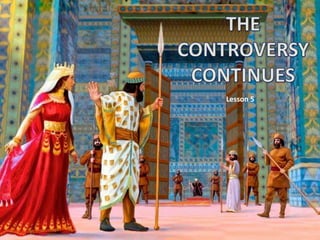
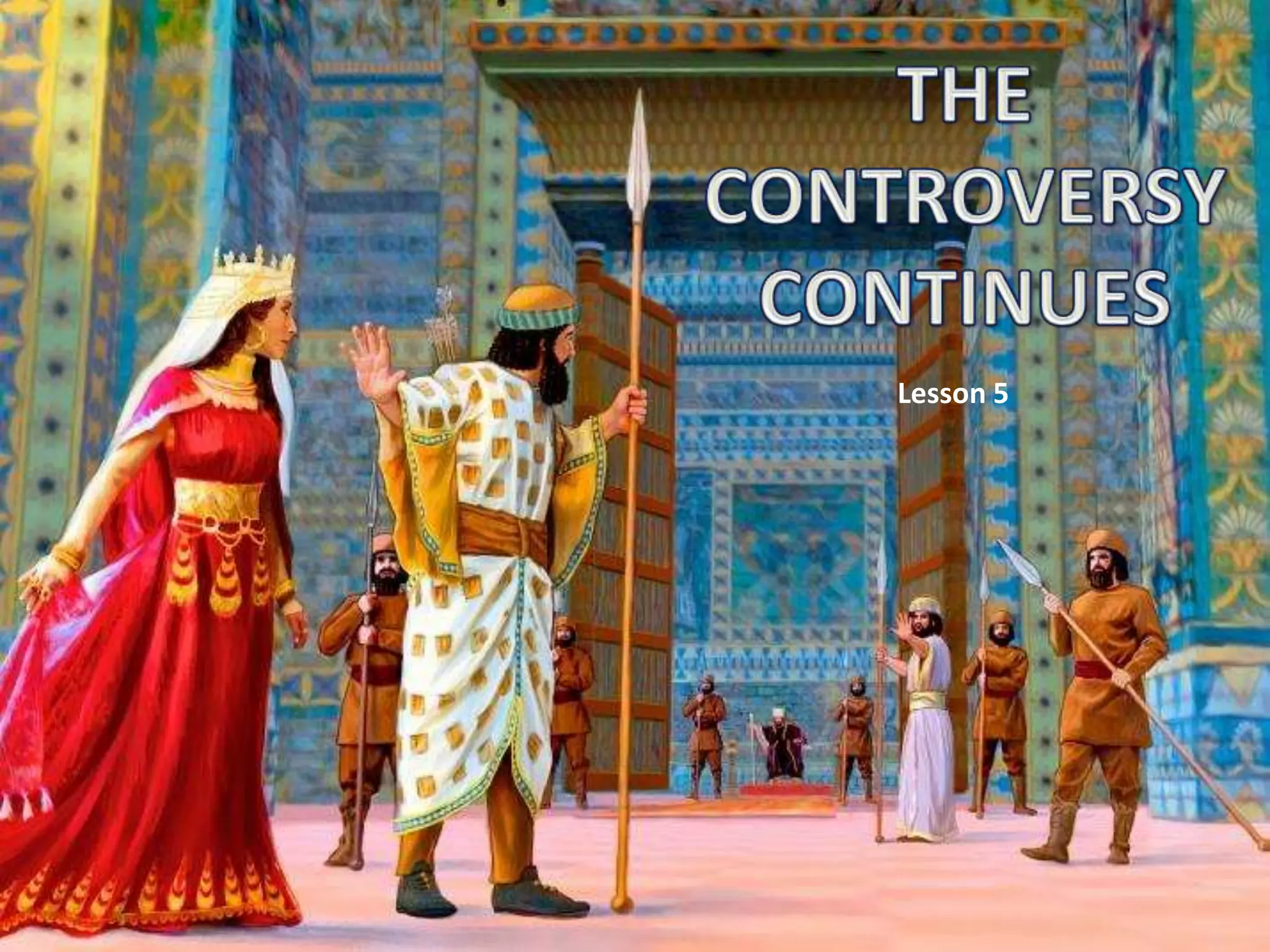
Lesson 5
Key Text:
“And I told them of the
hand of my God which
had been good upon me,
and also of the king’s
words that he had
spoken to me.
So they said, ‘Let us rise
up and build.’
Then they set their hands
to this good work”
(Nehemiah 2:18, NKJV.
When we compare the lives of David, Elijah,
Hezekiah, Esther, and Nehemiah, similar themes
surface: God is able to use "insignificant" people
to turn back the tide of evil. Through some of
these accounts we can see that, despite
tremendous obstacles, we don't need to buckle
under overwhelming evil.
Instead, we can stand
firm, but only in the
power of God, who is
faithful to His covenant
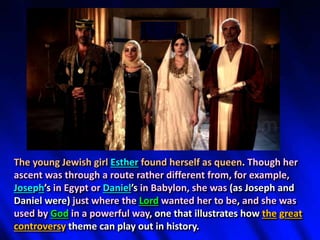
promises, promises
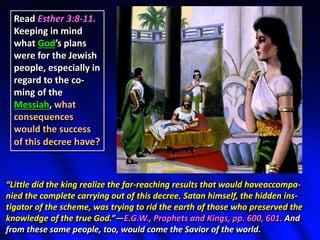
fulfilled for us in Jesus.
The focus, and the
challenge, is for us to
rejoice in His deliverance.
This does not always
make sense in the con-
text of the overwhel-
ming challenges that
we sometimes find our-
selves in, challenges
that are so much bigger than ourselves. Rejoicing in God’s deliveran-
ce before deliverance comes is an act of faith and worship, rather
than the logical consequence of what is happening around us. On
the other hand, because of what Christ has done for us, trusting in
God’s faithfulness is, really, the only logical thing we can do.
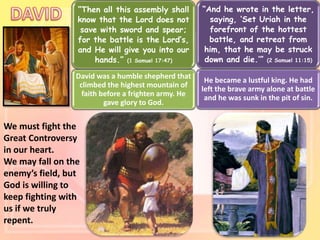
We must fight the
Great Controversy
in our heart.
We may fall on the
enemy’s field, but
God is willing to
keep fighting with
us if we truly
repent.
“Then all this assembly shall
know that the Lord does not
save with sword and spear;
for the battle is the Lord’s,
and He will give you into our
hands.” (1 Samuel 17:47)
David was a humble shepherd that
climbed the highest mountain of
faith before a frighten army. He
gave glory to God.
“And he wrote in the letter,
saying, ‘Set Uriah in the
forefront of the hottest
battle, and retreat from
him, that he may be struck
down and die.’” (2 Samuel 11:15)
He became a lustful king. He had
left the brave army alone at battle
and he was sunk in the pit of sin.
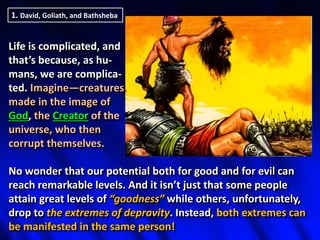
1. David, Goliath, and Bathsheba
Life is complicated, and
that’s because, as hu-
mans, we are complica-
ted. Imagine—creatures
made in the image of
God, the Creator of the
universe, who then
corrupt themselves.
No wonder that our potential both for good and for evil can
reach remarkable levels. And it isn’t just that some people
attain great levels of “goodness” while others, unfortunately,
drop to the extremes of depravity. Instead, both extremes can
be manifested in the same person!
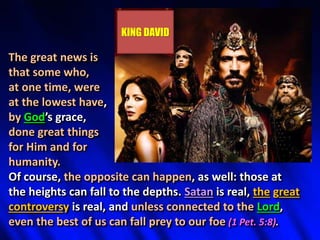
The great news is
that some who,
at one time, were
at the lowest have,
by God’s grace,
done great things
for Him and for
humanity.
Of course, the opposite can happen, as well: those at
the heights can fall to the depths. Satan is real, the great
controversy is real, and unless connected to the Lord,
even the best of us can fall prey to our foe (1 Pet. 5:8).
KING DAVID
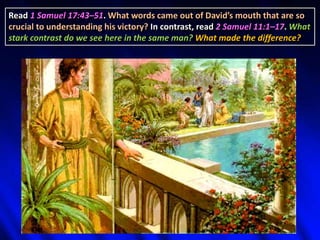
Read 1 Samuel 17:43–51. What words came out of David’s mouth that are so
crucial to understanding his victory? In contrast, read 2 Samuel 11:1–17. What
stark contrast do we see here in the same man? What made the difference?
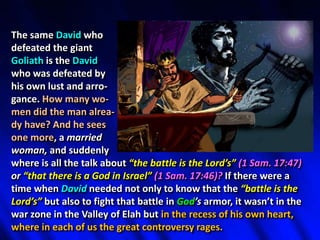
The same David who
defeated the giant
Goliath is the David
who was defeated by
his own lust and arro-
gance. How many wo-
men did the man alrea-
dy have? And he sees
one more, a married
woman, and suddenly
where is all the talk about “the battle is the Lord’s” (1 Sam. 17:47)
or “that there is a God in Israel” (1 Sam. 17:46)? If there were a
time when David needed not only to know that the “battle is the
Lord’s” but also to fight that battle in God’s armor, it wasn’t in the
war zone in the Valley of Elah but in the recess of his own heart,
where in each of us the great controversy rages.
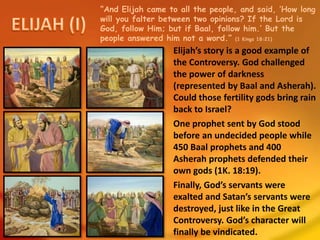
“And Elijah came to all the people, and said, ‘How long
will you falter between two opinions? If the Lord is
God, follow Him; but if Baal, follow him.’ But the
people answered him not a word.” (1 Kings 18:21)
Elijah’s story is a good example of
the Controversy. God challenged
the power of darkness
(represented by Baal and Asherah).
Could those fertility gods bring rain
back to Israel?
One prophet sent by God stood
before an undecided people while
450 Baal prophets and 400
Asherah prophets defended their
own gods (1K. 18:19).
Finally, God’s servants were
exalted and Satan’s servants were
destroyed, just like in the Great
Controversy. God’s character will
finally be vindicated.
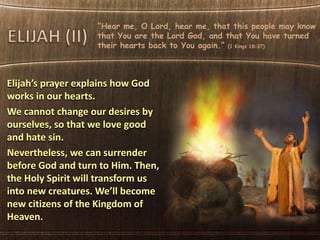
“Hear me, O Lord, hear me, that this people may know
that You are the Lord God, and that You have turned
their hearts back to You again.” (1 Kings 18:37)
Elijah’s prayer explains how God
works in our hearts.
We cannot change our desires by
ourselves, so that we love good
and hate sin.
Nevertheless, we can surrender
before God and turn to Him. Then,
the Holy Spirit will transform us
into new creatures. We’ll become
new citizens of the Kingdom of
Heaven.
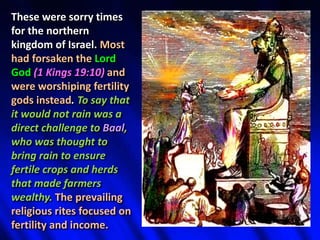
These were sorry times
for the northern
kingdom of Israel. Most
had forsaken the Lord
God (1 Kings 19:10) and
were worshiping fertility
gods instead. To say that
it would not rain was a
direct challenge to Baal,
who was thought to
bring rain to ensure
fertile crops and herds
that made farmers
wealthy. The prevailing
religious rites focused on
fertility and income.
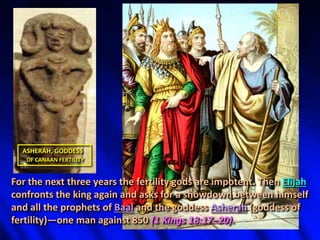
ASHERAH, GODDESS
OF CANAAN FERTILITY
For the next three years the fertility gods are impotent. Then Elijah
confronts the king again and asks for a showdown between himself
and all the prophets of Baal and the goddess Asherah (goddess of
fertility)—one man against 850 (1 Kings 18:17–20).
When the day arrives and the crowds gather at the top of Mount Carmel,
Elijah addresses the people: “How long will you falter [limp] between two
opinions?” (1 Kings 18:21, NKJV). Bulls are chosen and prepared for sacri-
fice, and the people wait to see which god is powerful enough to answer
by fire from heaven. The bull was the most powerful object of the ancient
fertility religions. Surely the gods of fertility would show their strength.
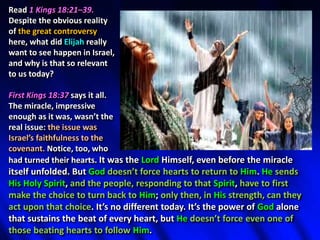
Read 1 Kings 18:21–39.
Despite the obvious reality
of the great controversy
here, what did Elijah really
want to see happen in Israel,
and why is that so relevant
to us today?
First Kings 18:37 says it all.
The miracle, impressive
enough as it was, wasn’t the
real issue: the issue was
Israel’s faithfulness to the
covenant. Notice, too, who
had turned their hearts. It was the Lord Himself, even before the miracle
itself unfolded. But God doesn’t force hearts to return to Him. He sends
His Holy Spirit, and the people, responding to that Spirit, have to first
make the choice to turn back to Him; only then, in His strength, can they
act upon that choice. It’s no different today. It’s the power of God alone
that sustains the beat of every heart, but He doesn’t force even one of
those beating hearts to follow Him.
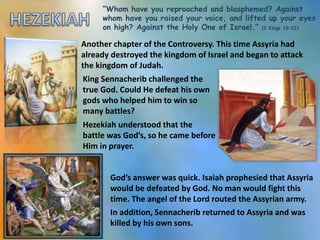
“Whom have you reproached and blasphemed? Against
whom have you raised your voice, and lifted up your eyes
on high? Against the Holy One of Israel.” (2 Kings 19:22)
Another chapter of the Controversy. This time Assyria had
already destroyed the kingdom of Israel and began to attack
the kingdom of Judah.
Hezekiah understood that the
battle was God’s, so he came before
Him in prayer.
God’s answer was quick. Isaiah prophesied that Assyria
would be defeated by God. No man would fight this
time. The angel of the Lord routed the Assyrian army.
In addition, Sennacherib returned to Assyria and was
killed by his own sons.
King Sennacherib challenged the
true God. Could He defeat his own
gods who helped him to win so
many battles?
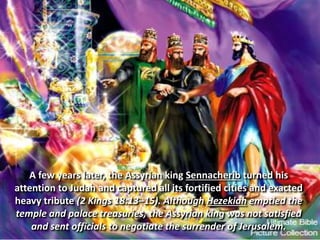
A few years later, the Assyrian king Sennacherib turned his
attention to Judah and captured all its fortified cities and exacted
heavy tribute (2 Kings 18:13–15). Although Hezekiah emptied the
temple and palace treasuries, the Assyrian king was not satisfied
and sent officials to negotiate the surrender of Jerusalem.
The Assyrians then taunted the people, warning that since the gods of
the nations around them didn’t save them from Assyria, what made
the Jews think that their God would do any better? (See 2 Kings 18:28–
30, 33–35.) Hezekiah then did the only thing possible for him—he
prayed (2 Kings 19:15–19). God had already used Isaiah to encourage
Hezekiah (2 Kings 19:6), and now God sends the prophet to him again.
Hezekiah prayed
God acted
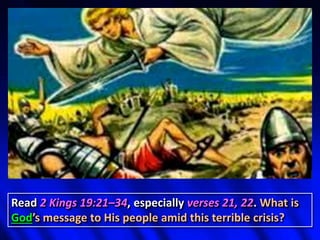
Read 2 Kings 19:21–34, especially verses 21, 22. What is
God’s message to His people amid this terrible crisis?
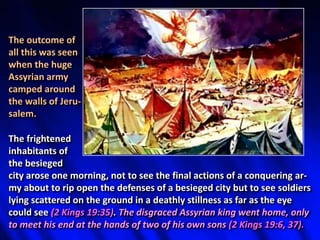
The outcome of
all this was seen
when the huge
Assyrian army
camped around
the walls of Jeru-
salem.
The frightened
inhabitants of
the besieged
city arose one morning, not to see the final actions of a conquering ar-
my about to rip open the defenses of a besieged city but to see soldiers
lying scattered on the ground in a deathly stillness as far as the eye
could see (2 Kings 19:35). The disgraced Assyrian king went home, only
to meet his end at the hands of two of his own sons (2 Kings 19:6, 37).
“Not in freedom from trial, but in the midst of
it, is Christian character developed. Exposure
to rebuffs and opposition leads the follower of
Christ to greater watchfulness and more
earnest prayer to the mighty Helper. Severe
trial endured by the grace of God develops
patience, vigilance, fortitude, and a deep and
abiding trust in God. It is the triumph of the
Christian faith that it enables its followers to
suffer and be strong; to submit, and thus to
conquer; to be killed all the day long, and yet
to live; to bear the cross, and thus to win the
crown of glory.”
E.G.W. (The Acts of the Apostles, cp. 44, pg. 467)
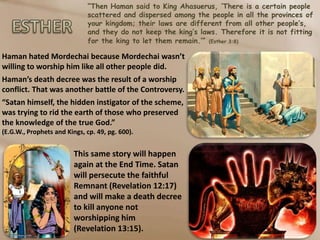
“Then Haman said to King Ahasuerus, ‘There is a certain people
scattered and dispersed among the people in all the provinces of
your kingdom; their laws are different from all other people’s,
and they do not keep the king’s laws. Therefore it is not fitting
for the king to let them remain.’” (Esther 3:8)
Haman hated Mordechai because Mordechai wasn’t
willing to worship him like all other people did.
Haman’s death decree was the result of a worship
conflict. That was another battle of the Controversy.
“Satan himself, the hidden instigator of the scheme,
was trying to rid the earth of those who preserved
the knowledge of the true God.”
(E.G.W., Prophets and Kings, cp. 49, pg. 600).
This same story will happen
again at the End Time. Satan
will persecute the faithful
Remnant (Revelation 12:17)
and will make a death decree
to kill anyone not
worshipping him
(Revelation 13:15).
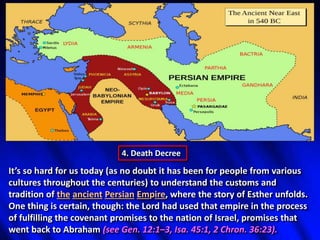
It’s so hard for us today (as no doubt it has been for people from various
cultures throughout the centuries) to understand the customs and
tradition of the ancient Persian Empire, where the story of Esther unfolds.
One thing is certain, though: the Lord had used that empire in the process
of fulfilling the covenant promises to the nation of Israel, promises that
went back to Abraham (see Gen. 12:1–3, Isa. 45:1, 2 Chron. 36:23).
4. Death Decree
The young Jewish girl Esther found herself as queen. Though her
ascent was through a route rather different from, for example,
Joseph’s in Egypt or Daniel’s in Babylon, she was (as Joseph and
Daniel were) just where the Lord wanted her to be, and she was
used by God in a powerful way, one that illustrates how the great
controversy theme can play out in history.
Read Esther 3:8-11.
Keeping in mind
what God’s plans
were for the Jewish
people, especially in
regard to the co-
ming of the
Messiah, what
consequences
would the success
of this decree have?
“Little did the king realize the far-reaching results that would haveaccompa-
nied the complete carrying out of this decree. Satan himself, the hidden ins-
tigator of the scheme, was trying to rid the earth of those who preserved the
knowledge of the true God.”—E.G.W., Prophets and Kings, pp. 600, 601. And
from these same people, too, would come the Savior of the world.
How fascinating it is that
the issue started over
worship (see Esther 3:5,
8) and the refusal of a
distinct group of people
to follow the laws and
customs of the ones in
power.
Though, of course, the
context will be different
at the end of time, the
reality behind it— the
great controversy between Christ and Satan—is still the same, and those
who seek to be faithful to God will face something as the Jews here did.
We have been warned that, in the closing scenes of earth’s history, the
decree will go out, declaring that “as many as [will] not worship the image
of the beast [are to] be killed” (Rev. 13:15). The one thing we learn from
history is that we don’t learn from history.
“please let Your ear be attentive and Your eyes
open, that You may hear the prayer of Your
servant which I pray before You now, day and
night, for the children of Israel Your servants,
and confess the sins of the children of Israel
which we have sinned against You. Both my
father’s house and I have sinned.” (Nehemiah 1:6)
What can we learn from the prayers in
Daniel 9:4-19 and Nehemiah 1:5-11 about
the Controversy?
Confessing our sins, an attitude of
repentance, asking for help when conflicts
arise (both at personal and church level).
First, prayer; then, action.
Nehemiah found grace before the king and was
appointed governor of Judea. He encouraged the
people to rebuild the city and they began working
right away.
Taunts, threads and lies didn’t matter. The work of
God was first. It must also be first today.
“When perplexities arise, as they are sure to do,
draw near to God, and He will draw near to you.
And then, when the enemy comes in like a flood,
the Spirit of the Lord will lift up a standard for
you. Decide that there is a great work to be done,
and that no man’s influence or opposition shall
divert you from the plain path of duty. Then you
can say with Nehemiah, ‘The hand of my God is
good upon me’ (see Nehemiah 2:18).”
E.G.W. (This Day with God, October 2)
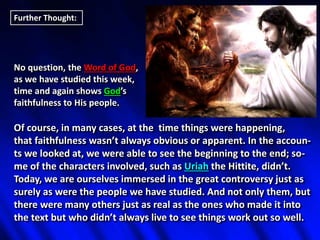
Further Thought:
No question, the Word of God,
as we have studied this week,
time and again shows God’s
faithfulness to His people.
Of course, in many cases, at the time things were happening,
that faithfulness wasn’t always obvious or apparent. In the accoun-
ts we looked at, we were able to see the beginning to the end; so-
me of the characters involved, such as Uriah the Hittite, didn’t.
Today, we are ourselves immersed in the great controversy just as
surely as were the people we have studied. And not only them, but
there were many others just as real as the ones who made it into
the text but who didn’t always live to see things work out so well.
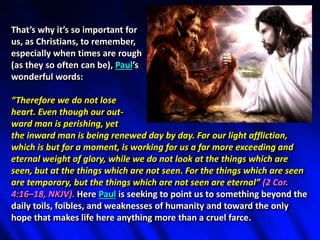
That’s why it’s so important for
us, as Christians, to remember,
especially when times are rough
(as they so often can be), Paul’s
wonderful words:
“Therefore we do not lose
heart. Even though our out-
ward man is perishing, yet
the inward man is being renewed day by day. For our light affliction,
which is but for a moment, is working for us a far more exceeding and
eternal weight of glory, while we do not look at the things which are
seen, but at the things which are not seen. For the things which are seen
are temporary, but the things which are not seen are eternal” (2 Cor.
4:16–18, NKJV). Here Paul is seeking to point us to something beyond the
daily toils, foibles, and weaknesses of humanity and toward the only
hope that makes life here anything more than a cruel farce.
Slideshare.net/chucho1943
We invite you to download and study each one of the 13 lessons
about this serie
THIS SERVICE IS
FREE AND YOU
CAN USE IT
 Rebellion Redemption

05 the controversy continues

  • 1.
  • 2.
    Key Text: “And Itold them of the hand of my God which had been good upon me, and also of the king’s words that he had spoken to me. So they said, ‘Let us rise up and build.’ Then they set their hands to this good work” (Nehemiah 2:18, NKJV.
  • 3.
    When we comparethe lives of David, Elijah, Hezekiah, Esther, and Nehemiah, similar themes surface: God is able to use "insignificant" people to turn back the tide of evil. Through some of these accounts we can see that, despite tremendous obstacles, we don't need to buckle under overwhelming evil. Instead, we can stand firm, but only in the power of God, who is faithful to His covenant promises, promises fulfilled for us in Jesus.
  • 4.
    The focus, andthe challenge, is for us to rejoice in His deliverance. This does not always make sense in the con- text of the overwhel- ming challenges that we sometimes find our- selves in, challenges that are so much bigger than ourselves. Rejoicing in God’s deliveran- ce before deliverance comes is an act of faith and worship, rather than the logical consequence of what is happening around us. On the other hand, because of what Christ has done for us, trusting in God’s faithfulness is, really, the only logical thing we can do.
  • 5.
    We must fightthe Great Controversy in our heart. We may fall on the enemy’s field, but God is willing to keep fighting with us if we truly repent. “Then all this assembly shall know that the Lord does not save with sword and spear; for the battle is the Lord’s, and He will give you into our hands.” (1 Samuel 17:47) David was a humble shepherd that climbed the highest mountain of faith before a frighten army. He gave glory to God. “And he wrote in the letter, saying, ‘Set Uriah in the forefront of the hottest battle, and retreat from him, that he may be struck down and die.’” (2 Samuel 11:15) He became a lustful king. He had left the brave army alone at battle and he was sunk in the pit of sin.
  • 6.
    1. David, Goliath,and Bathsheba Life is complicated, and that’s because, as hu- mans, we are complica- ted. Imagine—creatures made in the image of God, the Creator of the universe, who then corrupt themselves. No wonder that our potential both for good and for evil can reach remarkable levels. And it isn’t just that some people attain great levels of “goodness” while others, unfortunately, drop to the extremes of depravity. Instead, both extremes can be manifested in the same person!
  • 7.
    The great newsis that some who, at one time, were at the lowest have, by God’s grace, done great things for Him and for humanity. Of course, the opposite can happen, as well: those at the heights can fall to the depths. Satan is real, the great controversy is real, and unless connected to the Lord, even the best of us can fall prey to our foe (1 Pet. 5:8). KING DAVID
  • 8.
    Read 1 Samuel17:43–51. What words came out of David’s mouth that are so crucial to understanding his victory? In contrast, read 2 Samuel 11:1–17. What stark contrast do we see here in the same man? What made the difference?
  • 9.
    The same Davidwho defeated the giant Goliath is the David who was defeated by his own lust and arro- gance. How many wo- men did the man alrea- dy have? And he sees one more, a married woman, and suddenly where is all the talk about “the battle is the Lord’s” (1 Sam. 17:47) or “that there is a God in Israel” (1 Sam. 17:46)? If there were a time when David needed not only to know that the “battle is the Lord’s” but also to fight that battle in God’s armor, it wasn’t in the war zone in the Valley of Elah but in the recess of his own heart, where in each of us the great controversy rages.
  • 10.
    “And Elijah cameto all the people, and said, ‘How long will you falter between two opinions? If the Lord is God, follow Him; but if Baal, follow him.’ But the people answered him not a word.” (1 Kings 18:21) Elijah’s story is a good example of the Controversy. God challenged the power of darkness (represented by Baal and Asherah). Could those fertility gods bring rain back to Israel? One prophet sent by God stood before an undecided people while 450 Baal prophets and 400 Asherah prophets defended their own gods (1K. 18:19). Finally, God’s servants were exalted and Satan’s servants were destroyed, just like in the Great Controversy. God’s character will finally be vindicated.
  • 11.
    “Hear me, OLord, hear me, that this people may know that You are the Lord God, and that You have turned their hearts back to You again.” (1 Kings 18:37) Elijah’s prayer explains how God works in our hearts. We cannot change our desires by ourselves, so that we love good and hate sin. Nevertheless, we can surrender before God and turn to Him. Then, the Holy Spirit will transform us into new creatures. We’ll become new citizens of the Kingdom of Heaven.
  • 12.
    These were sorrytimes for the northern kingdom of Israel. Most had forsaken the Lord God (1 Kings 19:10) and were worshiping fertility gods instead. To say that it would not rain was a direct challenge to Baal, who was thought to bring rain to ensure fertile crops and herds that made farmers wealthy. The prevailing religious rites focused on fertility and income.
  • 13.
    ASHERAH, GODDESS OF CANAANFERTILITY For the next three years the fertility gods are impotent. Then Elijah confronts the king again and asks for a showdown between himself and all the prophets of Baal and the goddess Asherah (goddess of fertility)—one man against 850 (1 Kings 18:17–20).
  • 14.
    When the dayarrives and the crowds gather at the top of Mount Carmel, Elijah addresses the people: “How long will you falter [limp] between two opinions?” (1 Kings 18:21, NKJV). Bulls are chosen and prepared for sacri- fice, and the people wait to see which god is powerful enough to answer by fire from heaven. The bull was the most powerful object of the ancient fertility religions. Surely the gods of fertility would show their strength.
  • 15.
    Read 1 Kings18:21–39. Despite the obvious reality of the great controversy here, what did Elijah really want to see happen in Israel, and why is that so relevant to us today? First Kings 18:37 says it all. The miracle, impressive enough as it was, wasn’t the real issue: the issue was Israel’s faithfulness to the covenant. Notice, too, who had turned their hearts. It was the Lord Himself, even before the miracle itself unfolded. But God doesn’t force hearts to return to Him. He sends His Holy Spirit, and the people, responding to that Spirit, have to first make the choice to turn back to Him; only then, in His strength, can they act upon that choice. It’s no different today. It’s the power of God alone that sustains the beat of every heart, but He doesn’t force even one of those beating hearts to follow Him.
  • 16.
    “Whom have youreproached and blasphemed? Against whom have you raised your voice, and lifted up your eyes on high? Against the Holy One of Israel.” (2 Kings 19:22) Another chapter of the Controversy. This time Assyria had already destroyed the kingdom of Israel and began to attack the kingdom of Judah. Hezekiah understood that the battle was God’s, so he came before Him in prayer. God’s answer was quick. Isaiah prophesied that Assyria would be defeated by God. No man would fight this time. The angel of the Lord routed the Assyrian army. In addition, Sennacherib returned to Assyria and was killed by his own sons. King Sennacherib challenged the true God. Could He defeat his own gods who helped him to win so many battles?
  • 17.
    A few yearslater, the Assyrian king Sennacherib turned his attention to Judah and captured all its fortified cities and exacted heavy tribute (2 Kings 18:13–15). Although Hezekiah emptied the temple and palace treasuries, the Assyrian king was not satisfied and sent officials to negotiate the surrender of Jerusalem.
  • 18.
    The Assyrians thentaunted the people, warning that since the gods of the nations around them didn’t save them from Assyria, what made the Jews think that their God would do any better? (See 2 Kings 18:28– 30, 33–35.) Hezekiah then did the only thing possible for him—he prayed (2 Kings 19:15–19). God had already used Isaiah to encourage Hezekiah (2 Kings 19:6), and now God sends the prophet to him again. Hezekiah prayed God acted
  • 19.
    Read 2 Kings19:21–34, especially verses 21, 22. What is God’s message to His people amid this terrible crisis?
  • 20.
    The outcome of allthis was seen when the huge Assyrian army camped around the walls of Jeru- salem. The frightened inhabitants of the besieged city arose one morning, not to see the final actions of a conquering ar- my about to rip open the defenses of a besieged city but to see soldiers lying scattered on the ground in a deathly stillness as far as the eye could see (2 Kings 19:35). The disgraced Assyrian king went home, only to meet his end at the hands of two of his own sons (2 Kings 19:6, 37).
  • 21.
    “Not in freedomfrom trial, but in the midst of it, is Christian character developed. Exposure to rebuffs and opposition leads the follower of Christ to greater watchfulness and more earnest prayer to the mighty Helper. Severe trial endured by the grace of God develops patience, vigilance, fortitude, and a deep and abiding trust in God. It is the triumph of the Christian faith that it enables its followers to suffer and be strong; to submit, and thus to conquer; to be killed all the day long, and yet to live; to bear the cross, and thus to win the crown of glory.” E.G.W. (The Acts of the Apostles, cp. 44, pg. 467)
  • 22.
    “Then Haman saidto King Ahasuerus, ‘There is a certain people scattered and dispersed among the people in all the provinces of your kingdom; their laws are different from all other people’s, and they do not keep the king’s laws. Therefore it is not fitting for the king to let them remain.’” (Esther 3:8) Haman hated Mordechai because Mordechai wasn’t willing to worship him like all other people did. Haman’s death decree was the result of a worship conflict. That was another battle of the Controversy. “Satan himself, the hidden instigator of the scheme, was trying to rid the earth of those who preserved the knowledge of the true God.” (E.G.W., Prophets and Kings, cp. 49, pg. 600). This same story will happen again at the End Time. Satan will persecute the faithful Remnant (Revelation 12:17) and will make a death decree to kill anyone not worshipping him (Revelation 13:15).
  • 23.
    It’s so hardfor us today (as no doubt it has been for people from various cultures throughout the centuries) to understand the customs and tradition of the ancient Persian Empire, where the story of Esther unfolds. One thing is certain, though: the Lord had used that empire in the process of fulfilling the covenant promises to the nation of Israel, promises that went back to Abraham (see Gen. 12:1–3, Isa. 45:1, 2 Chron. 36:23). 4. Death Decree
  • 24.
    The young Jewishgirl Esther found herself as queen. Though her ascent was through a route rather different from, for example, Joseph’s in Egypt or Daniel’s in Babylon, she was (as Joseph and Daniel were) just where the Lord wanted her to be, and she was used by God in a powerful way, one that illustrates how the great controversy theme can play out in history.
  • 25.
    Read Esther 3:8-11. Keepingin mind what God’s plans were for the Jewish people, especially in regard to the co- ming of the Messiah, what consequences would the success of this decree have? “Little did the king realize the far-reaching results that would haveaccompa- nied the complete carrying out of this decree. Satan himself, the hidden ins- tigator of the scheme, was trying to rid the earth of those who preserved the knowledge of the true God.”—E.G.W., Prophets and Kings, pp. 600, 601. And from these same people, too, would come the Savior of the world.
  • 26.
    How fascinating itis that the issue started over worship (see Esther 3:5, 8) and the refusal of a distinct group of people to follow the laws and customs of the ones in power. Though, of course, the context will be different at the end of time, the reality behind it— the great controversy between Christ and Satan—is still the same, and those who seek to be faithful to God will face something as the Jews here did. We have been warned that, in the closing scenes of earth’s history, the decree will go out, declaring that “as many as [will] not worship the image of the beast [are to] be killed” (Rev. 13:15). The one thing we learn from history is that we don’t learn from history.
  • 27.
    “please let Yourear be attentive and Your eyes open, that You may hear the prayer of Your servant which I pray before You now, day and night, for the children of Israel Your servants, and confess the sins of the children of Israel which we have sinned against You. Both my father’s house and I have sinned.” (Nehemiah 1:6) What can we learn from the prayers in Daniel 9:4-19 and Nehemiah 1:5-11 about the Controversy? Confessing our sins, an attitude of repentance, asking for help when conflicts arise (both at personal and church level). First, prayer; then, action. Nehemiah found grace before the king and was appointed governor of Judea. He encouraged the people to rebuild the city and they began working right away. Taunts, threads and lies didn’t matter. The work of God was first. It must also be first today.
  • 28.
    “When perplexities arise,as they are sure to do, draw near to God, and He will draw near to you. And then, when the enemy comes in like a flood, the Spirit of the Lord will lift up a standard for you. Decide that there is a great work to be done, and that no man’s influence or opposition shall divert you from the plain path of duty. Then you can say with Nehemiah, ‘The hand of my God is good upon me’ (see Nehemiah 2:18).” E.G.W. (This Day with God, October 2)
  • 29.
    Further Thought: No question,the Word of God, as we have studied this week, time and again shows God’s faithfulness to His people. Of course, in many cases, at the time things were happening, that faithfulness wasn’t always obvious or apparent. In the accoun- ts we looked at, we were able to see the beginning to the end; so- me of the characters involved, such as Uriah the Hittite, didn’t. Today, we are ourselves immersed in the great controversy just as surely as were the people we have studied. And not only them, but there were many others just as real as the ones who made it into the text but who didn’t always live to see things work out so well.
  • 30.
    That’s why it’sso important for us, as Christians, to remember, especially when times are rough (as they so often can be), Paul’s wonderful words: “Therefore we do not lose heart. Even though our out- ward man is perishing, yet the inward man is being renewed day by day. For our light affliction, which is but for a moment, is working for us a far more exceeding and eternal weight of glory, while we do not look at the things which are seen, but at the things which are not seen. For the things which are seen are temporary, but the things which are not seen are eternal” (2 Cor. 4:16–18, NKJV). Here Paul is seeking to point us to something beyond the daily toils, foibles, and weaknesses of humanity and toward the only hope that makes life here anything more than a cruel farce.
  • 31.
    Slideshare.net/chucho1943 We invite youto download and study each one of the 13 lessons about this serie THIS SERVICE IS FREE AND YOU CAN USE IT  Rebellion Redemption