Service Operation
IT Infrastructure Library Versi 3
• Sumber:
“An Introductory Overview of ITIL v3” version
1.0, UK Chapter of itSMF
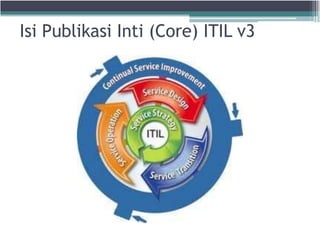
Isi Publikasi Inti (Core) ITIL v3
Fungsi “Service Operation”
• The purpose of Service Operation is to deliver
agreed levels of service to users and customers,
and to manage the applications, technology and
infrastructure that support delivery of the
services.
• It is only during this stage of the lifecycle that
services actually deliver value to the business,
and it is the responsibility of Service Operation
staff to ensure that this value is delivered.
Keseimbangan Yg Harus Dijaga
• internal IT view versus external business view
• stability versus responsiveness
• quality of service versus cost of service
• reactive versus proactive activities
Tanda-tanda “Sehat”
• Many organizations find it helpful to consider
the “operational health” of services.
• This identifies “vital signs” that are critical for
execution of Vital Business Functions.
• If these are within normal ranges, the system or
service is healthy.
• This leads to a reduction in the cost of
monitoring, and enables staff to focus on areas
that will lead to service success
Event Management Process
• An event is a change of state that has
significance for the management of a
configuration item or IT service
• Merupakan indikasi:
▫ something is not functioning correctly, leading to
an incident being logged.
▫ normal activity, or a need for routine intervention
such as changing a tape
Event vs Monitoring
• Event management depends on monitoring, but
it is different.
▫ Event management generates and detects
notifications,
▫ monitoring checks the status of components even
when no events are occurring.
Penanganan Pasca “Event”
• After an event has been detected it may lead to
an Incident, Problem or Change, or it may
simply be logged in case the information is
needed.
• Response to an event may be automated or may
require manual intervention. If
• actions are needed then a trigger, such as an
SMS message or an incident being
• automatically logged, can alert support staff.
Incident Management Process
• “unplanned interruption to an IT service, or a
reduction in the quality of an IT service.”
• Failure of a configuration item that has not yet
impacted service is also an incident.
• Fungsi Incident Management:
▫ restore normal service as quickly as possible, and
▫ to minimize the adverse impact on business operations
• Incidents are often detected by event management,
or by users contacting the service desk.
• Incidents are categorized to identify who should
work on them and for trend analysis, and they are
prioritized according to urgency and business
impact.
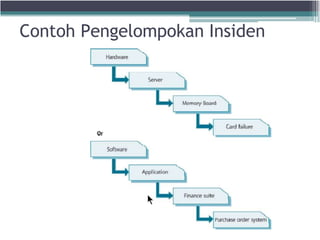
Contoh Pengelompokan Insiden
Eskalasi Insiden
• If an incident cannot be resolved quickly, it may
be escalated.
• Functional escalation passes the incident to a
technical support team with appropriate skills;
hierarchical escalation engages appropriate
levels of management.
• After the incident has been investigated and
diagnosed, and the resolution has been tested,
the Service Desk should ensure that the user is
satisfied before the incident is closed.
Pengguna
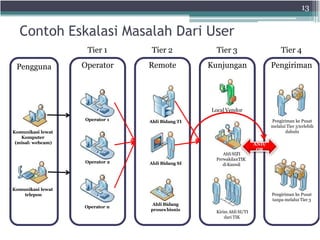
Contoh Eskalasi Masalah Dari User
1
3
Komunikasi lewat
Komputer
(misal: webcam)
Komunikasi lewat
telepon
Tier 1
Operator
Tier 2
Remote
Tier 3
Kunjungan
Local Vendor
Tier 4
Pengiriman
Operator 1
Operator 2
Operator n
Ahli Bidang TI
Ahli Bidang SI
Ahli Bidang
proses bisnis
AhliSI/
Perwakilan
diKanw
TI
TIK
il
Kirim Ahli SI/TI
dari TIK
AND/
OR
Pengiriman ke Pusat
melalui Tier 3 terlebih
dahulu
Pengiriman ke Pusat
tanpa melalui Tier 3
Request Fulfillment Process
• a request from a user for:
▫ information or
▫ advice, or
▫ a standard change, or
▫ access to an IT service
• Kegunaan “Request Fulfillment Process”:
▫ enable users to request and receive standard services;
▫ to source and deliver these services;
▫ to provide information to users and customers about
services and procedures for obtaining the services;
▫ And to assist with general information, complaints and
comments.
• All requests should be logged and tracked.
• The process should include appropriate approval before
fulfilling the request
Access Management Process
• The purpose of the Access Management process is to
provide the rights for users to be able to access a
service or group of services, while preventing access
to non-authorized users
• Access Management is concerned with identity
(unique information that distinguishes an
individual) and rights (settings that provide access
to data and services).
• The process includes:
▫ verifying identity and entitlement,
▫ granting access to services,
▫ logging and tracking access, and
▫ removing or modifying rights when status or roles
change.
Problem Management Process
• A problem is a cause of one or more incidents.
• The cause is not usually known at the time a
problem record is created, and the problem
management process is responsible for further
investigation.
• The key objectives:
▫ to prevent problems and resulting incidents from
happening,
▫ to eliminate recurring incidents and
▫ To minimize the impact of incidents that cannot be
prevented.
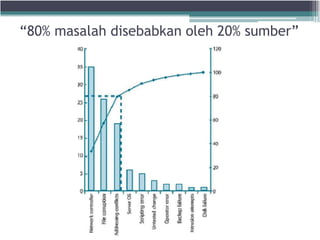
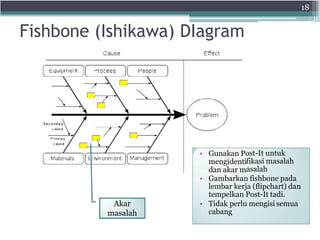
• Bisa menggunakan teori manajemen mutu, seperti
Pareto analysis dan Ishikawa diagram!
“80% masalah disebabkan oleh 20% sumber”
Fishbone (Ishikawa) DIagram
1
8
• Gunakan P
mengidenti
dan akar m
ost-It untuk
fikasi masalah
asalah
• Gambarkan fishbone pada
lembar kerja (flipchart) dan
tempelkan Post-It tadi.
• Tidak perlu mengisi semua
cabang
Akar
masalah
Cakupan Problem Management
• diagnosing causes of incidents,
• Determining the resolution, and
• ensuring that the resolution is implemented
• maintains information about problems
• Records appropriate workarounds and
resolutions.
Workarounds are documented in a Known Error
Database, which improves the efficiency and
effectiveness of Incident Management.
Common Service Operation Activities
• monitoring and control: to detect the status
of services and CIs and takeappropriate
corrective action
• console management/operations bridge: a
central coordination point for monitoring and
managing services
• management of the infrastructure: storage,
databases, middleware, directory services,
facilities/data centre etc.
Service Desk Function
• The Service Desk provides a single central point
of contact for all users of IT.
• The Service Desk usually logs and manages all
incidents, service requests and access requests
and provides an interface for all other Service
Operation processes and activities.
Tanggung jawab Service Desk
• logging all incidents and requests, categorizing
and prioritizing them
• first-line investigation and diagnosis
• managing the lifecycle of incidents and requests,
escalating as appropriate and closing them when
the user is satisfied
• keeping users informed of the status of services,
incidents and requests.
Service desk tidak harus berarti IT help desk! Di beberapa
tempat, service desk bahkan merupana sistem pelayanan
publik dari sebuah kementrian yang berbasis TI.
Penempatan struktur “Service Desk”
• local service desk: physically close to the users
• centralized service desk: allows fewer staff to
deal with a higher volume of calls
• virtual service desk: staff are in many locations
but appear to the users to be a single team
• follow the sun: Service Desks in different time
zones give 24-hour coverage by passing calls to a
location where staff are working.
IT Operations Management Function
• IT Operations Management is responsible for the
management and maintenance of the IT
infrastructure required to deliver the agreed level of
IT services to the business.
• Ada 2 jabatan penting di fungsi ini:
▫ IT Operations Control is usually staffed by shifts of
operators who carry out routine operational tasks.
They provide centralized monitoring and control,
usually from an operations bridge or network
operations centre.
▫ Facilities Management is responsible for management
of data centres, computer rooms and recovery sites.
Facilities Management also coordinates large-scale
projects, such as data centre consolidation or server
▫ consolidation.

05. itil v3 service operation 2020.pptx

  • 1.
  • 2.
    • Sumber: “An IntroductoryOverview of ITIL v3” version 1.0, UK Chapter of itSMF
  • 3.
    Isi Publikasi Inti(Core) ITIL v3
  • 4.
    Fungsi “Service Operation” •The purpose of Service Operation is to deliver agreed levels of service to users and customers, and to manage the applications, technology and infrastructure that support delivery of the services. • It is only during this stage of the lifecycle that services actually deliver value to the business, and it is the responsibility of Service Operation staff to ensure that this value is delivered.
  • 5.
    Keseimbangan Yg HarusDijaga • internal IT view versus external business view • stability versus responsiveness • quality of service versus cost of service • reactive versus proactive activities
  • 6.
    Tanda-tanda “Sehat” • Manyorganizations find it helpful to consider the “operational health” of services. • This identifies “vital signs” that are critical for execution of Vital Business Functions. • If these are within normal ranges, the system or service is healthy. • This leads to a reduction in the cost of monitoring, and enables staff to focus on areas that will lead to service success
  • 7.
    Event Management Process •An event is a change of state that has significance for the management of a configuration item or IT service • Merupakan indikasi: ▫ something is not functioning correctly, leading to an incident being logged. ▫ normal activity, or a need for routine intervention such as changing a tape
  • 8.
    Event vs Monitoring •Event management depends on monitoring, but it is different. ▫ Event management generates and detects notifications, ▫ monitoring checks the status of components even when no events are occurring.
  • 9.
    Penanganan Pasca “Event” •After an event has been detected it may lead to an Incident, Problem or Change, or it may simply be logged in case the information is needed. • Response to an event may be automated or may require manual intervention. If • actions are needed then a trigger, such as an SMS message or an incident being • automatically logged, can alert support staff.
  • 10.
    Incident Management Process •“unplanned interruption to an IT service, or a reduction in the quality of an IT service.” • Failure of a configuration item that has not yet impacted service is also an incident. • Fungsi Incident Management: ▫ restore normal service as quickly as possible, and ▫ to minimize the adverse impact on business operations • Incidents are often detected by event management, or by users contacting the service desk. • Incidents are categorized to identify who should work on them and for trend analysis, and they are prioritized according to urgency and business impact.
  • 11.
  • 12.
    Eskalasi Insiden • Ifan incident cannot be resolved quickly, it may be escalated. • Functional escalation passes the incident to a technical support team with appropriate skills; hierarchical escalation engages appropriate levels of management. • After the incident has been investigated and diagnosed, and the resolution has been tested, the Service Desk should ensure that the user is satisfied before the incident is closed.
  • 13.
    Pengguna Contoh Eskalasi MasalahDari User 1 3 Komunikasi lewat Komputer (misal: webcam) Komunikasi lewat telepon Tier 1 Operator Tier 2 Remote Tier 3 Kunjungan Local Vendor Tier 4 Pengiriman Operator 1 Operator 2 Operator n Ahli Bidang TI Ahli Bidang SI Ahli Bidang proses bisnis AhliSI/ Perwakilan diKanw TI TIK il Kirim Ahli SI/TI dari TIK AND/ OR Pengiriman ke Pusat melalui Tier 3 terlebih dahulu Pengiriman ke Pusat tanpa melalui Tier 3
  • 14.
    Request Fulfillment Process •a request from a user for: ▫ information or ▫ advice, or ▫ a standard change, or ▫ access to an IT service • Kegunaan “Request Fulfillment Process”: ▫ enable users to request and receive standard services; ▫ to source and deliver these services; ▫ to provide information to users and customers about services and procedures for obtaining the services; ▫ And to assist with general information, complaints and comments. • All requests should be logged and tracked. • The process should include appropriate approval before fulfilling the request
  • 15.
    Access Management Process •The purpose of the Access Management process is to provide the rights for users to be able to access a service or group of services, while preventing access to non-authorized users • Access Management is concerned with identity (unique information that distinguishes an individual) and rights (settings that provide access to data and services). • The process includes: ▫ verifying identity and entitlement, ▫ granting access to services, ▫ logging and tracking access, and ▫ removing or modifying rights when status or roles change.
  • 16.
    Problem Management Process •A problem is a cause of one or more incidents. • The cause is not usually known at the time a problem record is created, and the problem management process is responsible for further investigation. • The key objectives: ▫ to prevent problems and resulting incidents from happening, ▫ to eliminate recurring incidents and ▫ To minimize the impact of incidents that cannot be prevented. • Bisa menggunakan teori manajemen mutu, seperti Pareto analysis dan Ishikawa diagram!
  • 17.
    “80% masalah disebabkanoleh 20% sumber”
  • 18.
    Fishbone (Ishikawa) DIagram 1 8 •Gunakan P mengidenti dan akar m ost-It untuk fikasi masalah asalah • Gambarkan fishbone pada lembar kerja (flipchart) dan tempelkan Post-It tadi. • Tidak perlu mengisi semua cabang Akar masalah
  • 19.
    Cakupan Problem Management •diagnosing causes of incidents, • Determining the resolution, and • ensuring that the resolution is implemented • maintains information about problems • Records appropriate workarounds and resolutions. Workarounds are documented in a Known Error Database, which improves the efficiency and effectiveness of Incident Management.
  • 20.
    Common Service OperationActivities • monitoring and control: to detect the status of services and CIs and takeappropriate corrective action • console management/operations bridge: a central coordination point for monitoring and managing services • management of the infrastructure: storage, databases, middleware, directory services, facilities/data centre etc.
  • 21.
    Service Desk Function •The Service Desk provides a single central point of contact for all users of IT. • The Service Desk usually logs and manages all incidents, service requests and access requests and provides an interface for all other Service Operation processes and activities.
  • 22.
    Tanggung jawab ServiceDesk • logging all incidents and requests, categorizing and prioritizing them • first-line investigation and diagnosis • managing the lifecycle of incidents and requests, escalating as appropriate and closing them when the user is satisfied • keeping users informed of the status of services, incidents and requests. Service desk tidak harus berarti IT help desk! Di beberapa tempat, service desk bahkan merupana sistem pelayanan publik dari sebuah kementrian yang berbasis TI.
  • 23.
    Penempatan struktur “ServiceDesk” • local service desk: physically close to the users • centralized service desk: allows fewer staff to deal with a higher volume of calls • virtual service desk: staff are in many locations but appear to the users to be a single team • follow the sun: Service Desks in different time zones give 24-hour coverage by passing calls to a location where staff are working.
  • 24.
    IT Operations ManagementFunction • IT Operations Management is responsible for the management and maintenance of the IT infrastructure required to deliver the agreed level of IT services to the business. • Ada 2 jabatan penting di fungsi ini: ▫ IT Operations Control is usually staffed by shifts of operators who carry out routine operational tasks. They provide centralized monitoring and control, usually from an operations bridge or network operations centre. ▫ Facilities Management is responsible for management of data centres, computer rooms and recovery sites. Facilities Management also coordinates large-scale projects, such as data centre consolidation or server ▫ consolidation.