Dogmatism, Skepticism,
Cynicism, and Nihilism
The Complete Idiot’s Guide to Understanding Ethics, CHAPTERS 3 & 8
1
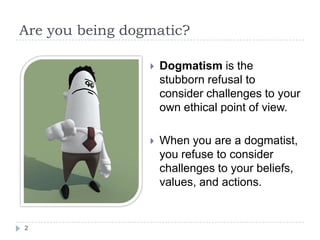
 Dogmatism is the
stubborn refusal to
consider challenges to your
own ethical point of view.
 When you are a dogmatist,
you refuse to consider
challenges to your beliefs,
values, and actions.
Are you being dogmatic?
2
There’s a difference between
being convinced of
someone’s reasons through
a sound argument and
being manipulated into
accepting their reasons.
3
Know the why for your what!
Prove it!
 Skepticism:
 A philosophical stance
 An everyday attitude of
doubting the truth of
commonly held beliefs
4
Skepticism…
 A skeptical attitude toward ethical claims would
require the “prove it” mentality…
 It will help you in the three following ways:
1. You will demand a reasoned account of others’ ethical
claims
2. You will consider all points of view
3. You will not be swayed by partial considerations
5
Religion and Science, Dogmatists and Skeptics
6
…in VIDEO GAMES!
Cynicism (a Greek perspective)
 Historically, Cynicism started as
a philosophical movement in the
4th Century B.C. that lasted until
the Fall of Rome.
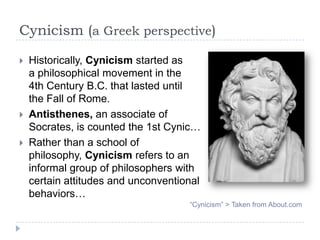
 Antisthenes, an associate of
Socrates, is counted the 1st Cynic…
 Rather than a school of
philosophy, Cynicism refers to an
informal group of philosophers with
certain attitudes and unconventional
behaviors…
“Cynicism” > Taken from About.com
Cynicism…
 “…the highest good of a human life was to fulfill basic,
natural needs. As such, Cynics rejected the argument
that humans needed to be concerned with social
conventions and conformity.”
 “…the Cynics …questioned everything, whether that
be rules, laws, sciences, "gods", or social norms.”
Cynicism…
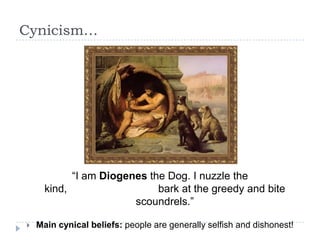
“I am Diogenes the Dog. I nuzzle the
kind, bark at the greedy and bite
scoundrels.”
 Main cynical beliefs: people are generally selfish and dishonest!
Cynicism today
 Cynicism: an attitude of doubt directed
against moral beliefs, practices, and
institutions.
 Cynic: a person who believes that
people are motivated purely by self-
interest rather than acting for
honorable or unselfish reasons.
Nihilism
 From the Latin root nihil, “nothing”,
“that which does not exist.”
 This same root is found in the verb
“annihilate”: to bring to nothing, to destroy
completely.
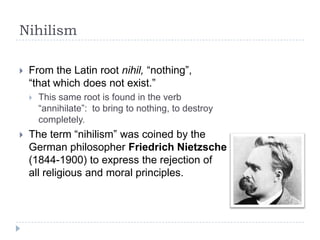
 The term “nihilism” was coined by the
German philosopher Friedrich Nietzsche
(1844-1900) to express the rejection of
all religious and moral principles.
Nietzsche and Nihilism…
 In Will to Power [notes 1883-1888], Nietzsche
writes,
“Every belief, every considering
something true, is necessarily
false because there is simply
no true world.”
 For Nietzsche, there is no objective order or
structure in the world except what we give it.
So…
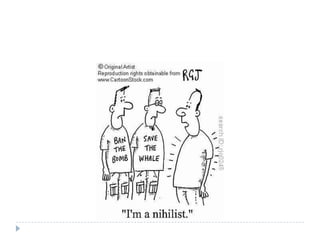
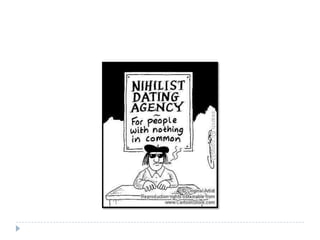
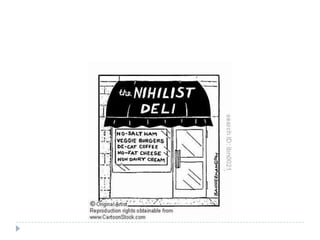
 Nihilism is the belief which:
 labels all values as worthless
 associates itself with extreme pessimism
and a radical skepticism
 It is often seen as the belief that
life is meaningless.
Nihilism…
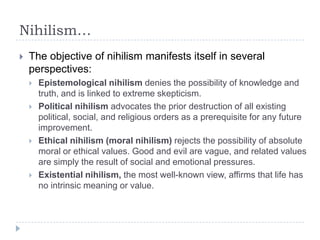
 The objective of nihilism manifests itself in several
perspectives:
 Epistemological nihilism denies the possibility of knowledge and
truth, and is linked to extreme skepticism.
 Political nihilism advocates the prior destruction of all existing
political, social, and religious orders as a prerequisite for any future
improvement.
 Ethical nihilism (moral nihilism) rejects the possibility of absolute
moral or ethical values. Good and evil are vague, and related values
are simply the result of social and emotional pressures.
 Existential nihilism, the most well-known view, affirms that life has
no intrinsic meaning or value.
ADDITIONAL SOURCES:
Apple Dictionary
http://atheism.about.com/library/glossary/general/bldef_cynicis
m.htm
http://atheism.about.com/u/ua/atheismhistory/Favorite-Ancient-
Greek-Philosopher.htm
http://www.learnersdictionary.com/search/cynicism
http://www.allaboutphilosophy.org/nihilism.htm
http://www.cartoonstock.com/

05 dogmatism skepticism n more(3)

  • 1.
    Dogmatism, Skepticism, Cynicism, andNihilism The Complete Idiot’s Guide to Understanding Ethics, CHAPTERS 3 & 8 1
  • 2.
     Dogmatism isthe stubborn refusal to consider challenges to your own ethical point of view.  When you are a dogmatist, you refuse to consider challenges to your beliefs, values, and actions. Are you being dogmatic? 2
  • 3.
    There’s a differencebetween being convinced of someone’s reasons through a sound argument and being manipulated into accepting their reasons. 3 Know the why for your what!
  • 4.
    Prove it!  Skepticism: A philosophical stance  An everyday attitude of doubting the truth of commonly held beliefs 4
  • 5.
    Skepticism…  A skepticalattitude toward ethical claims would require the “prove it” mentality…  It will help you in the three following ways: 1. You will demand a reasoned account of others’ ethical claims 2. You will consider all points of view 3. You will not be swayed by partial considerations 5
  • 6.
    Religion and Science,Dogmatists and Skeptics 6 …in VIDEO GAMES!
  • 7.
    Cynicism (a Greekperspective)  Historically, Cynicism started as a philosophical movement in the 4th Century B.C. that lasted until the Fall of Rome.  Antisthenes, an associate of Socrates, is counted the 1st Cynic…  Rather than a school of philosophy, Cynicism refers to an informal group of philosophers with certain attitudes and unconventional behaviors… “Cynicism” > Taken from About.com
  • 8.
    Cynicism…  “…the highestgood of a human life was to fulfill basic, natural needs. As such, Cynics rejected the argument that humans needed to be concerned with social conventions and conformity.”  “…the Cynics …questioned everything, whether that be rules, laws, sciences, "gods", or social norms.”
  • 9.
    Cynicism… “I am Diogenesthe Dog. I nuzzle the kind, bark at the greedy and bite scoundrels.”  Main cynical beliefs: people are generally selfish and dishonest!
  • 10.
    Cynicism today  Cynicism:an attitude of doubt directed against moral beliefs, practices, and institutions.  Cynic: a person who believes that people are motivated purely by self- interest rather than acting for honorable or unselfish reasons.
  • 11.
    Nihilism  From theLatin root nihil, “nothing”, “that which does not exist.”  This same root is found in the verb “annihilate”: to bring to nothing, to destroy completely.  The term “nihilism” was coined by the German philosopher Friedrich Nietzsche (1844-1900) to express the rejection of all religious and moral principles.
  • 12.
    Nietzsche and Nihilism… In Will to Power [notes 1883-1888], Nietzsche writes, “Every belief, every considering something true, is necessarily false because there is simply no true world.”  For Nietzsche, there is no objective order or structure in the world except what we give it.
  • 13.
    So…  Nihilism isthe belief which:  labels all values as worthless  associates itself with extreme pessimism and a radical skepticism  It is often seen as the belief that life is meaningless.
  • 14.
    Nihilism…  The objectiveof nihilism manifests itself in several perspectives:  Epistemological nihilism denies the possibility of knowledge and truth, and is linked to extreme skepticism.  Political nihilism advocates the prior destruction of all existing political, social, and religious orders as a prerequisite for any future improvement.  Ethical nihilism (moral nihilism) rejects the possibility of absolute moral or ethical values. Good and evil are vague, and related values are simply the result of social and emotional pressures.  Existential nihilism, the most well-known view, affirms that life has no intrinsic meaning or value.
  • 18.