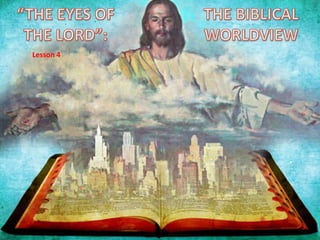
Lesson 4
God’s existence
Creation
The biblical doctrine
The Plan of Redemption
The Law of God
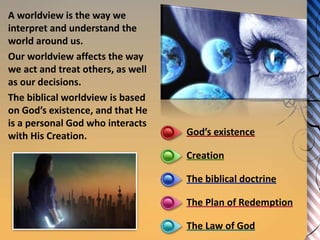
A worldview is the way we
interpret and understand the
world around us.
Our worldview affects the way
we act and treat others, as well
as our decisions.
The biblical worldview is based
on God’s existence, and that He
is a personal God who interacts
with His Creation.
ATHEISTIC WORLDVIEW
• The Universe and everything in it
just exists
• There are no gods or other
supernatural entities
• Life has no purpose or meaning, it’s
only subsistence
THEISTIC WORLDVIEW
• The Universe and everything in it
were created by God
• God exists and cares for His
Creation
• We were created with a purpose:
to live with our God forever
“The fool has said in his heart, ‘There is no God.’” (Psalm 53:1)
There are two main types
of worldviews:
The Bible explains that God is a personal God who
loves us and interacts with His Creation.
He is omnipotent, omniscient, and omnipresent.
But He also cares for each one of us and longs for
our company.
The Bible considers two facts settled since its very
first verse: God exists, and He created the Universe
(Genesis 1:1).
The rest of the biblical truths are based on those
two principles: The Law, redemption, the
resurrection…
The biblical doctrines make no sense
if we deny that God created the
world in six days. The Bible cannot
be true only in some of its sections.
In fact, Creation is one of the most repeated themes in
the Bible (Gn. 14:9; Ex. 20:8-11; Eccl. 12:1; Mal. 2:10; Jn.
1:1-4; Ro. 1:25; Col. 1:6; 1P. 4:19; Rev. 5:13; 14:6-7…).
If we accept the concept of an evolution that took place
during millions of years–either conducted by God or not–,
we are denying that God inspired the Bible.
“that we should no longer be
children, tossed to and for and
carried about with every wind of
doctrine, by the trickery of men,
in the cunning craftiness of
deceitful plotting.” (Ephesians 4:14)
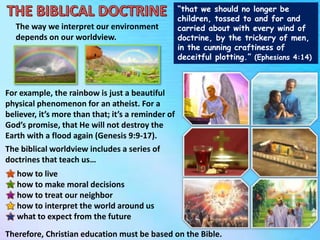
For example, the rainbow is just a beautiful
physical phenomenon for an atheist. For a
believer, it’s more than that; it’s a reminder of
God’s promise, that He will not destroy the
Earth with a flood again (Genesis 9:9-17).
The biblical worldview includes a series of
doctrines that teach us…
Therefore, Christian education must be based on the Bible.
how to live
how to make moral decisions
how to treat our neighbor
how to interpret the world around us
what to expect from the future
The way we interpret our environment
depends on our worldview.
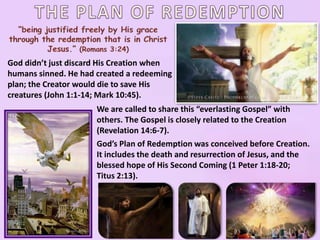
God didn’t just discard His Creation when
humans sinned. He had created a redeeming
plan; the Creator would die to save His
creatures (John 1:1-14; Mark 10:45).
We are called to share this “everlasting Gospel” with
others. The Gospel is closely related to the Creation
(Revelation 14:6-7).
God’s Plan of Redemption was conceived before Creation.
It includes the death and resurrection of Jesus, and the
blessed hope of His Second Coming (1 Peter 1:18-20;
Titus 2:13).
There is no absolute morality for the atheistic worldview.
Therefore, moral decisions are relative. So it makes sense for
different countries to have different laws about the moral
behavior of their citizens.
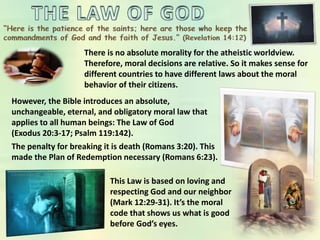
However, the Bible introduces an absolute,
unchangeable, eternal, and obligatory moral law that
applies to all human beings: The Law of God
(Exodus 20:3-17; Psalm 119:142).
The penalty for breaking it is death (Romans 3:20). This
made the Plan of Redemption necessary (Romans 6:23).
This Law is based on loving and
respecting God and our neighbor
(Mark 12:29-31). It’s the moral
code that shows us what is good
before God’s eyes.
“In God’s word alone we find an authentic
account of creation […]
In the word of God the mind finds subject for
the deepest thought, the loftiest aspiration
[…] Here we behold the Majesty of heaven as
He humbled Himself to become our substitute
and surety to cope singlehanded with the
powers of darkness and to gain the victory in
our behalf. A reverent contemplation of such
themes as these cannot fail to soften, purify,
and ennoble the heart, and, at the same time,
to inspire the mind with new strength and
vigor.”
E.G.W. (Testimonies for the Church, vol. 5, cp. 2, p. 25)
Slideshare.net/chucho1943
The education
We invite you to download
and study each one of the 13
lessons about this serie:
THIS SERVICE IS
FREE AND YOU
CAN USE IT

04 the biblical worldview

  • 1.
  • 3.
    God’s existence Creation The biblicaldoctrine The Plan of Redemption The Law of God A worldview is the way we interpret and understand the world around us. Our worldview affects the way we act and treat others, as well as our decisions. The biblical worldview is based on God’s existence, and that He is a personal God who interacts with His Creation.
  • 4.
    ATHEISTIC WORLDVIEW • TheUniverse and everything in it just exists • There are no gods or other supernatural entities • Life has no purpose or meaning, it’s only subsistence THEISTIC WORLDVIEW • The Universe and everything in it were created by God • God exists and cares for His Creation • We were created with a purpose: to live with our God forever “The fool has said in his heart, ‘There is no God.’” (Psalm 53:1) There are two main types of worldviews: The Bible explains that God is a personal God who loves us and interacts with His Creation. He is omnipotent, omniscient, and omnipresent. But He also cares for each one of us and longs for our company.
  • 5.
    The Bible considerstwo facts settled since its very first verse: God exists, and He created the Universe (Genesis 1:1). The rest of the biblical truths are based on those two principles: The Law, redemption, the resurrection… The biblical doctrines make no sense if we deny that God created the world in six days. The Bible cannot be true only in some of its sections. In fact, Creation is one of the most repeated themes in the Bible (Gn. 14:9; Ex. 20:8-11; Eccl. 12:1; Mal. 2:10; Jn. 1:1-4; Ro. 1:25; Col. 1:6; 1P. 4:19; Rev. 5:13; 14:6-7…). If we accept the concept of an evolution that took place during millions of years–either conducted by God or not–, we are denying that God inspired the Bible.
  • 6.
    “that we shouldno longer be children, tossed to and for and carried about with every wind of doctrine, by the trickery of men, in the cunning craftiness of deceitful plotting.” (Ephesians 4:14) For example, the rainbow is just a beautiful physical phenomenon for an atheist. For a believer, it’s more than that; it’s a reminder of God’s promise, that He will not destroy the Earth with a flood again (Genesis 9:9-17). The biblical worldview includes a series of doctrines that teach us… Therefore, Christian education must be based on the Bible. how to live how to make moral decisions how to treat our neighbor how to interpret the world around us what to expect from the future The way we interpret our environment depends on our worldview.
  • 7.
    God didn’t justdiscard His Creation when humans sinned. He had created a redeeming plan; the Creator would die to save His creatures (John 1:1-14; Mark 10:45). We are called to share this “everlasting Gospel” with others. The Gospel is closely related to the Creation (Revelation 14:6-7). God’s Plan of Redemption was conceived before Creation. It includes the death and resurrection of Jesus, and the blessed hope of His Second Coming (1 Peter 1:18-20; Titus 2:13).
  • 8.
    There is noabsolute morality for the atheistic worldview. Therefore, moral decisions are relative. So it makes sense for different countries to have different laws about the moral behavior of their citizens. However, the Bible introduces an absolute, unchangeable, eternal, and obligatory moral law that applies to all human beings: The Law of God (Exodus 20:3-17; Psalm 119:142). The penalty for breaking it is death (Romans 3:20). This made the Plan of Redemption necessary (Romans 6:23). This Law is based on loving and respecting God and our neighbor (Mark 12:29-31). It’s the moral code that shows us what is good before God’s eyes.
  • 9.
    “In God’s wordalone we find an authentic account of creation […] In the word of God the mind finds subject for the deepest thought, the loftiest aspiration […] Here we behold the Majesty of heaven as He humbled Himself to become our substitute and surety to cope singlehanded with the powers of darkness and to gain the victory in our behalf. A reverent contemplation of such themes as these cannot fail to soften, purify, and ennoble the heart, and, at the same time, to inspire the mind with new strength and vigor.” E.G.W. (Testimonies for the Church, vol. 5, cp. 2, p. 25)
  • 10.
    Slideshare.net/chucho1943 The education We inviteyou to download and study each one of the 13 lessons about this serie: THIS SERVICE IS FREE AND YOU CAN USE IT