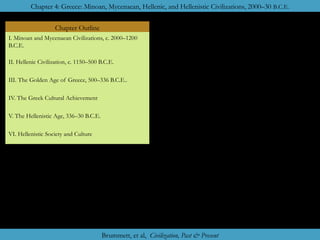
Chapter 4: Greece: Minoan, Mycenaean, Hellenic, and Hellenistic Civilizations, 2000–30 B.C.E.


                   Chapter Outline
I. Minoan and Mycenaean Civilizations, c. 2000–1200
B.C.E.

II. Hellenic Civilization, c. 1150–500 B.C.E.

III. The Golden Age of Greece, 500–336 B.C.E..

IV. The Greek Cultural Achievement

V. The Hellenistic Age, 336–30 B.C.E.

VI. Hellenistic Society and Culture


                                                                                                         ©2006, Pearson Education, Inc.
                                        Brummett, et al, Civilization, Past & Present
Chapter 4: Greece: Minoan, Mycenaean, Hellenic, and Hellenistic Civilizations, 2000–30 B.C.E.

I. Minoan and Mycenaean Civilizations,
    c. 2000–1200 B.C.E.

   A. The Minoans
      King Minos — legendary
      Language — undeciphered
          hieroglyphics
          Linear A — syllabic
      Sir Arthur Evans
          archaeologist
      Knossos
          “Palace of Minos”
      Art
          murals
          realistic, everyday scenes


                                                                                                        ©2006, Pearson Education, Inc.
                      Brummett, et al, Civilization, Past & Present, Part One; Classical Origins
Chapter 4: Greece: Minoan, Mycenaean, Hellenic, and Hellenistic Civilizations, 2000–30 B.C.E.

I. Minoan and Minoan and Mycenaean Civilizations

B. The Myceneans
   Achaeans — Indo-Europeans
      from north, c. 2000
   Mycenae
      Heinrich Schliemann (1822–1890)
      acropolis — massive palace

      royal tombs, after 1500
      expansion
         Knossos, c. 1450
   Linear B
      deciphered by Michael Ventris

C. Troy
   Heinrich Schliemann
      Iliad
      1870 — excavation begins
      Troy VI or VII (1200–1125 B.C.E.)


                                                                                                         ©2006, Pearson Education, Inc.
D. Fall of Mycenaean Civilization


                      Brummett, et al, Civilization, Past & Present, Part One; Classical Origins
Chapter 4: Greece: Minoan, Mycenaean, Hellenic, and Hellenistic Civilizations, 2000–30 B.C.E.

II. Hellenic Civilization, c. 1150–500 B.C.E.

   Dark Ages (1150–750 B.C.E)
   Geography

   A. Homeric Age
      information scarce
         Iliad, Odyssey

      arête
          excellence, virtue
      aristoi = the best
          aristocracy


                                                                                                         ©2006, Pearson Education, Inc.
                       Brummett, et al, Civilization, Past & Present, Part One; Classical Origins
Chapter 4: Greece: Minoan, Mycenaean, Hellenic, and Hellenistic Civilizations, 2000–30 B.C.E.

II. Hellenic Civilization, c. 1150–500 B.C.E

B. From Oligarchy to Tyranny
   polis (plural poleis) = city-state
   acropolis = high city
   agora = marketplace
   Oligarchy = government of the few
       c. 750 — nobles in control
   Colonization (750–550 B.C.E.)
       Magna Graecia = Great Greece
           Southern Italy

   Economic transformation
      production for trade
      land hunger
   > Tyrants, c. 650 B.C.E.
      hoplite phalanx
      tyrannus = absolute ruler


                                                                                                    ©2006, Pearson Education, Inc.
                  Brummett, et al, Civilization, Past & Present, Part One; Classical Origins
Chapter 4: Greece: Minoan, Mycenaean, Hellenic, and Hellenistic Civilizations, 2000–30 B.C.E.
II. Hellenic Civilization, c. 1150–500 B.C.E.

C. Athens to 500 B.C.E.
   7th Century — oligarchy
      council of nobles dominant
      9 archons = rulers
   Solon — 594 B.C.E.
      economic and social reform:
      Council of Four Hundred
      Popular Assembly

   Pisistratus — 560 B.C.E.
       tyrant
       public works
       weakening of nobles
   Cleisthenes
       508–502 B.C.E. — reforms
           further weakened nobility
       ostracism

D. Sparta to 500 B.C.E.
      monarchy > oligarchy
      ephors = overseers
      Messenians — neighbors


                                                                                                         ©2006, Pearson Education, Inc.
          conquest > helots
      Lycurgus
          legendary?


                       Brummett, et al, Civilization, Past & Present, Part One; Classical Origins
Chapter 4: Greece: Minoan, Mycenaean, Hellenic, and Hellenistic Civilizations, 2000–30 B.C.E.

III. The Golden Age of Greece, 500–336
     B.C.E.

   A. Persian Wars
      King Cyrus
         conquest of Lydia, 547 B.C.E.
         > revolt of Ionian poleis
             crushed by Darius I

         490 B.C.E. — to Greece
            Marathon — Greek victory

        480 B.C.E. — Xerxes
           Thermopylae
           Themistocles
               Salamis Bay
        479 B.C.E. — Plataea
      Impact
        Athenian confidence
        Pericles (461–429 B.C.E.)


                                                                                                      ©2006, Pearson Education, Inc.
                   Brummett, et al, Civilization, Past & Present, Part One; Classical Origins
Chapter 4: Greece: Minoan, Mycenaean, Hellenic, and Hellenistic Civilizations, 2000–30 B.C.E.

III. The Golden Age of Greece, 500–336 B.C.E.

B. Athenian Society
   Women
   Slavery

C. Athenian Imperialism
   Sparta isolationist
   Delian League — 478 B.C.E.
      navy of 200 ships
      468 B.C.E. — Goal achieved

D. Peloponnesian War (431–404 B.C.E.)
   Spartan League v. Athenian Empire
   416 B.C.E. — Melians enslaved
   415 B.C.E. — expedition to Syracuse

E. Macedonia
   King Philip II (359–336 B.C.E.)
   Demosthenes
      speaks against Philip
   Chaeronea — 338 B.C.E.
      Macedonian victory


                                                                                                        ©2006, Pearson Education, Inc.
                      Brummett, et al, Civilization, Past & Present, Part One; Classical Origins
Chapter 4: Greece: Minoan, Mycenaean, Hellenic, and Hellenistic Civilizations, 2000–30 B.C.E.

IV. The Greek Cultural Achievement           IV. The Greek Cultural Achievement

   A. Values
      sophrosyne                             D. The Great Philosophers
      hubris                                    Socrates (470–399 B.C.E.)
      nemesis                                      399 — condemned
                                                Plato (427–347 B.C.E.)
   B. Greek Religion                               Republic
      Zeus                                         The Academy (388 B.C.E. 529 C.E.)
      Hesiod (c. 700 B.C.E.)                    Aristotle (384–322 B.C.E.)
      Mysteries —Orphic, Eleusinian                Lyceum
         mystae = initiates
         afterlife — Elysium

   C. Early Greek Philosophy
   Physikoi — physical world
      Thales of Miletus c. 600 B.C.E.
      natural causes
      human reason
   Search for first principle
   Pythagoras of Samos (c. 582–500 B.C.E.)
   Anaximander


                                                                                                    ©2006, Pearson Education, Inc.
   Xenophanes
   Sophists — late 5th B.C.E.


                   Brummett, et al, Civilization, Past & Present, Part One; Classical Origins
Chapter 4: Greece: Minoan, Mycenaean, Hellenic, and Hellenistic Civilizations, 2000–30 B.C.E.

IV. The Greek Cultural
Achievement

E. Fields of Inquiry

   Medicine
       Hippocrates
          420 B.C.E. — founds
school
   History
       Herodotos of Halicarnassus
          (c. 484–c. 425 B.C.E.)
       Thucydides (460–400 B.C.E.)
          History of Peloponnesian War


                                                                                                         ©2006, Pearson Education, Inc.
                       Brummett, et al, Civilization, Past & Present, Part One; Classical Origins
Chapter 4: Greece: Minoan, Mycenaean, Hellenic, and Hellenistic Civilizations, 2000–30 B.C.E.


                                                                                                ©2006, Pearson Education, Inc.
           Brummett, et al, Civilization, Past & Present, Part One; Classical Origins
Chapter 4: Greece: Minoan, Mycenaean, Hellenic, and Hellenistic Civilizations, 2000–30 B.C.E.


                                                                                                ©2006, Pearson Education, Inc.
           Brummett, et al, Civilization, Past & Present, Part One; Classical Origins
Chapter 4: Greece: Minoan, Mycenaean, Hellenic, and Hellenistic Civilizations, 2000–30 B.C.E.


                                                                                                ©2006, Pearson Education, Inc.
           Brummett, et al, Civilization, Past & Present, Part One; Classical Origins

0321333209 04

  • 1.
    Chapter 4: Greece:Minoan, Mycenaean, Hellenic, and Hellenistic Civilizations, 2000–30 B.C.E. Chapter Outline I. Minoan and Mycenaean Civilizations, c. 2000–1200 B.C.E. II. Hellenic Civilization, c. 1150–500 B.C.E. III. The Golden Age of Greece, 500–336 B.C.E.. IV. The Greek Cultural Achievement V. The Hellenistic Age, 336–30 B.C.E. VI. Hellenistic Society and Culture ©2006, Pearson Education, Inc. Brummett, et al, Civilization, Past & Present
  • 2.
    Chapter 4: Greece:Minoan, Mycenaean, Hellenic, and Hellenistic Civilizations, 2000–30 B.C.E. I. Minoan and Mycenaean Civilizations, c. 2000–1200 B.C.E. A. The Minoans King Minos — legendary Language — undeciphered hieroglyphics Linear A — syllabic Sir Arthur Evans archaeologist Knossos “Palace of Minos” Art murals realistic, everyday scenes ©2006, Pearson Education, Inc. Brummett, et al, Civilization, Past & Present, Part One; Classical Origins
  • 3.
    Chapter 4: Greece:Minoan, Mycenaean, Hellenic, and Hellenistic Civilizations, 2000–30 B.C.E. I. Minoan and Minoan and Mycenaean Civilizations B. The Myceneans Achaeans — Indo-Europeans from north, c. 2000 Mycenae Heinrich Schliemann (1822–1890) acropolis — massive palace royal tombs, after 1500 expansion Knossos, c. 1450 Linear B deciphered by Michael Ventris C. Troy Heinrich Schliemann Iliad 1870 — excavation begins Troy VI or VII (1200–1125 B.C.E.) ©2006, Pearson Education, Inc. D. Fall of Mycenaean Civilization Brummett, et al, Civilization, Past & Present, Part One; Classical Origins
  • 4.
    Chapter 4: Greece:Minoan, Mycenaean, Hellenic, and Hellenistic Civilizations, 2000–30 B.C.E. II. Hellenic Civilization, c. 1150–500 B.C.E. Dark Ages (1150–750 B.C.E) Geography A. Homeric Age information scarce Iliad, Odyssey arête excellence, virtue aristoi = the best aristocracy ©2006, Pearson Education, Inc. Brummett, et al, Civilization, Past & Present, Part One; Classical Origins
  • 5.
    Chapter 4: Greece:Minoan, Mycenaean, Hellenic, and Hellenistic Civilizations, 2000–30 B.C.E. II. Hellenic Civilization, c. 1150–500 B.C.E B. From Oligarchy to Tyranny polis (plural poleis) = city-state acropolis = high city agora = marketplace Oligarchy = government of the few c. 750 — nobles in control Colonization (750–550 B.C.E.) Magna Graecia = Great Greece Southern Italy Economic transformation production for trade land hunger > Tyrants, c. 650 B.C.E. hoplite phalanx tyrannus = absolute ruler ©2006, Pearson Education, Inc. Brummett, et al, Civilization, Past & Present, Part One; Classical Origins
  • 6.
    Chapter 4: Greece:Minoan, Mycenaean, Hellenic, and Hellenistic Civilizations, 2000–30 B.C.E. II. Hellenic Civilization, c. 1150–500 B.C.E. C. Athens to 500 B.C.E. 7th Century — oligarchy council of nobles dominant 9 archons = rulers Solon — 594 B.C.E. economic and social reform: Council of Four Hundred Popular Assembly Pisistratus — 560 B.C.E. tyrant public works weakening of nobles Cleisthenes 508–502 B.C.E. — reforms further weakened nobility ostracism D. Sparta to 500 B.C.E. monarchy > oligarchy ephors = overseers Messenians — neighbors ©2006, Pearson Education, Inc. conquest > helots Lycurgus legendary? Brummett, et al, Civilization, Past & Present, Part One; Classical Origins
  • 7.
    Chapter 4: Greece:Minoan, Mycenaean, Hellenic, and Hellenistic Civilizations, 2000–30 B.C.E. III. The Golden Age of Greece, 500–336 B.C.E. A. Persian Wars King Cyrus conquest of Lydia, 547 B.C.E. > revolt of Ionian poleis crushed by Darius I 490 B.C.E. — to Greece Marathon — Greek victory 480 B.C.E. — Xerxes Thermopylae Themistocles Salamis Bay 479 B.C.E. — Plataea Impact Athenian confidence Pericles (461–429 B.C.E.) ©2006, Pearson Education, Inc. Brummett, et al, Civilization, Past & Present, Part One; Classical Origins
  • 8.
    Chapter 4: Greece:Minoan, Mycenaean, Hellenic, and Hellenistic Civilizations, 2000–30 B.C.E. III. The Golden Age of Greece, 500–336 B.C.E. B. Athenian Society Women Slavery C. Athenian Imperialism Sparta isolationist Delian League — 478 B.C.E. navy of 200 ships 468 B.C.E. — Goal achieved D. Peloponnesian War (431–404 B.C.E.) Spartan League v. Athenian Empire 416 B.C.E. — Melians enslaved 415 B.C.E. — expedition to Syracuse E. Macedonia King Philip II (359–336 B.C.E.) Demosthenes speaks against Philip Chaeronea — 338 B.C.E. Macedonian victory ©2006, Pearson Education, Inc. Brummett, et al, Civilization, Past & Present, Part One; Classical Origins
  • 9.
    Chapter 4: Greece:Minoan, Mycenaean, Hellenic, and Hellenistic Civilizations, 2000–30 B.C.E. IV. The Greek Cultural Achievement IV. The Greek Cultural Achievement A. Values sophrosyne D. The Great Philosophers hubris Socrates (470–399 B.C.E.) nemesis 399 — condemned Plato (427–347 B.C.E.) B. Greek Religion Republic Zeus The Academy (388 B.C.E. 529 C.E.) Hesiod (c. 700 B.C.E.) Aristotle (384–322 B.C.E.) Mysteries —Orphic, Eleusinian Lyceum mystae = initiates afterlife — Elysium C. Early Greek Philosophy Physikoi — physical world Thales of Miletus c. 600 B.C.E. natural causes human reason Search for first principle Pythagoras of Samos (c. 582–500 B.C.E.) Anaximander ©2006, Pearson Education, Inc. Xenophanes Sophists — late 5th B.C.E. Brummett, et al, Civilization, Past & Present, Part One; Classical Origins
  • 10.
    Chapter 4: Greece:Minoan, Mycenaean, Hellenic, and Hellenistic Civilizations, 2000–30 B.C.E. IV. The Greek Cultural Achievement E. Fields of Inquiry Medicine Hippocrates 420 B.C.E. — founds school History Herodotos of Halicarnassus (c. 484–c. 425 B.C.E.) Thucydides (460–400 B.C.E.) History of Peloponnesian War ©2006, Pearson Education, Inc. Brummett, et al, Civilization, Past & Present, Part One; Classical Origins
  • 11.
    Chapter 4: Greece:Minoan, Mycenaean, Hellenic, and Hellenistic Civilizations, 2000–30 B.C.E. ©2006, Pearson Education, Inc. Brummett, et al, Civilization, Past & Present, Part One; Classical Origins
  • 12.
    Chapter 4: Greece:Minoan, Mycenaean, Hellenic, and Hellenistic Civilizations, 2000–30 B.C.E. ©2006, Pearson Education, Inc. Brummett, et al, Civilization, Past & Present, Part One; Classical Origins
  • 13.
    Chapter 4: Greece:Minoan, Mycenaean, Hellenic, and Hellenistic Civilizations, 2000–30 B.C.E. ©2006, Pearson Education, Inc. Brummett, et al, Civilization, Past & Present, Part One; Classical Origins