Background: Online Learning


  Dr. Rob Darrow / Dr. Kelly Schwirzke
               #Iste12
              June 2012

  http://iste12.wikispaces.com
Big Question:
   What do you have to do to
    create an effective and
  sustainable online or blended
 learning program? (Demystify
the myths, know the landscape,
         create a plan)
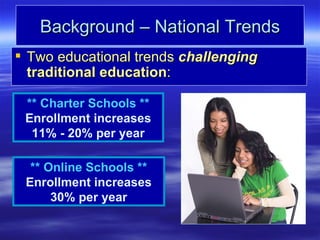
Background – National Trends
 Two educational trends challenging
  traditional education:

 ** Charter Schools **
 Enrollment increases
  11% - 20% per year

  ** Online Schools **
 Enrollment increases
      30% per year
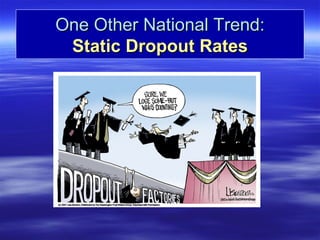
One Other National Trend:
 Static Dropout Rates
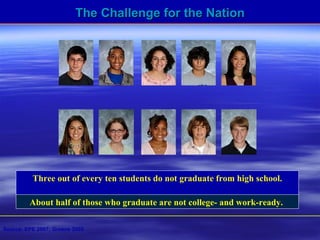
The Challenge for the Nation


          Three out of every ten students do not graduate from high school.

         About half of those who graduate are not college- and work-ready.

Source: EPE 2007; Greene 2002
Research and Dropouts

 “Lack of school success is
 probably the greatest single
 cause which impels pupils to
     drop out of school.”
– Ayres (1909). Laggards in our schools.
Online School History and Policy

 1994 – 1997 - First K-12 online schools:
   –   Utah Electronic School
   –   Virtual High School – Massachusetts
   –   Florida Virtual School
 2007 – Number of states with online programs / online
  legislation: 42
 2007 – Number of online charter schools:
   – 173 in 18 states
   – 92,235 students (Center for Ed Reform, 2008)
 2008 – Online course enrollments grew by 65% from
         2002-03 to 2004-05 (Means, 2009)
 2009 – More than a million K-12 online school students
  (Picciano and Seaman, 2009)
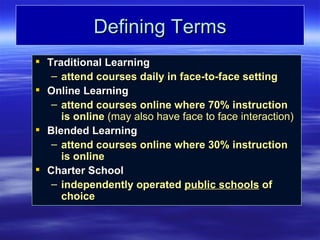
Defining Terms
 Traditional Learning
   – attend courses daily in face-to-face setting
 Online Learning
   – attend courses online where 70% instruction
     is online (may also have face to face interaction)
 Blended Learning
   – attend courses online where 30% instruction
     is online
 Charter School
   – independently operated public schools of
     choice
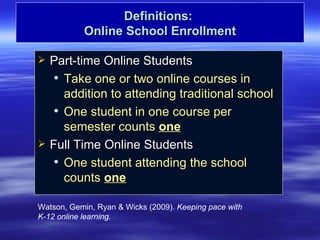
Definitions:
           Online School Enrollment

   Part-time Online Students
      Take one or two online courses in

       addition to attending traditional school
      One student in one course per

       semester counts one
   Full Time Online Students
      One student attending the school

       counts one

Watson, Gemin, Ryan & Wicks (2009). Keeping pace with
K-12 online learning.
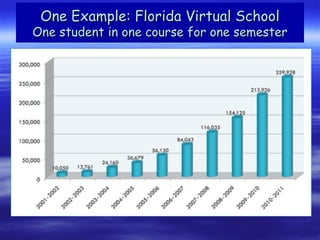
One Example: Florida Virtual School
One student in one course for one semester
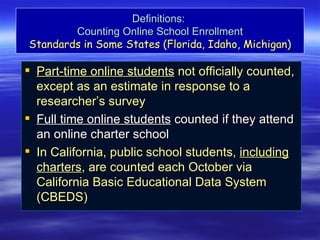
Definitions:
        Counting Online School Enrollment
Standards in Some States (Florida, Idaho, Michigan)

 Part-time online students not officially counted,
  except as an estimate in response to a
  researcher’s survey
 Full time online students counted if they attend
  an online charter school
 In California, public school students, including
  charters, are counted each October via
  California Basic Educational Data System
  (CBEDS)
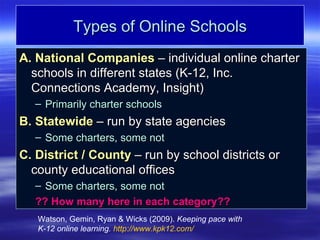
Types of Online Schools
A. National Companies – individual online charter
  schools in different states (K-12, Inc.
  Connections Academy, Insight)
   – Primarily charter schools
B. Statewide – run by state agencies
   – Some charters, some not
C. District / County – run by school districts or
  county educational offices
   – Some charters, some not
   ?? How many here in each category??
   Watson, Gemin, Ryan & Wicks (2009). Keeping pace with
   K-12 online learning. http://www.kpk12.com/
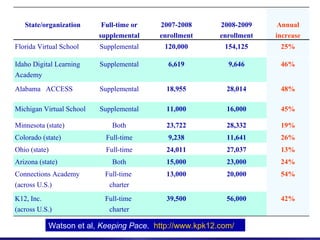
State/organization      Full-time or   2007-2008     2008-2009     Annual
                          supplemental    enrollment    enrollment   increase
Florida Virtual School    Supplemental     120,000       154,125      25%

Idaho Digital Learning    Supplemental      6,619         9,646       46%
Academy
Alabama ACCESS            Supplemental      18,955        28,014      48%

Michigan Virtual School   Supplemental      11,000        16,000      45%

Minnesota (state)             Both          23,722        28,332      19%
Colorado (state)            Full-time       9,238         11,641      26%
Ohio (state)                Full-time       24,011        27,037      13%
Arizona (state)               Both          15,000        23,000      24%
Connections Academy         Full-time       13,000        20,000      54%
(across U.S.)                charter
K12, Inc.                   Full-time       39,500        56,000      42%
(across U.S.)                charter

           Watson et al, Keeping Pace. http://www.kpk12.com/
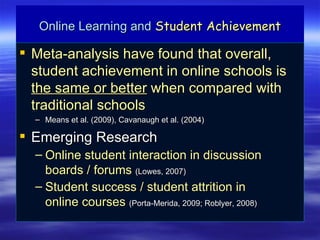
Online Learning and Student Achievement

 Meta-analysis have found that overall,
  student achievement in online schools is
  the same or better when compared with
  traditional schools
  – Means et al. (2009), Cavanaugh et al. (2004)

 Emerging Research
  – Online student interaction in discussion
    boards / forums (Lowes, 2007)
  – Student success / student attrition in
    online courses (Porta-Merida, 2009; Roblyer, 2008)
Contact Information
        Rob Darrow, Ed.D.                Kelly Schwirzke, Ed.D.
Director of Member Services       Instructor, Oasis Independent Study /
                                   Coordinator of Online Learning
iNacol
                                   Alternative Education Programs
559-838-6151
                                   Santa Cruz County Office of
rdarrow@inacol.org
                                   Education
www.inacol.org
                                   P 831-466-5655
Rob’s Wiki:
                                   C 831-359-1778
http://robdarrow.wikispaces.com
                                   kschwirzke@santacruz.k12.ca.us


     http://iste12.wikispaces.com

02.ol background.darrow schwirzke

  • 1.
    Background: Online Learning Dr. Rob Darrow / Dr. Kelly Schwirzke #Iste12 June 2012 http://iste12.wikispaces.com
  • 2.
    Big Question: What do you have to do to create an effective and sustainable online or blended learning program? (Demystify the myths, know the landscape, create a plan)
  • 3.
    Background – NationalTrends  Two educational trends challenging traditional education: ** Charter Schools ** Enrollment increases 11% - 20% per year ** Online Schools ** Enrollment increases 30% per year
  • 4.
    One Other NationalTrend: Static Dropout Rates
  • 5.
    The Challenge forthe Nation Three out of every ten students do not graduate from high school. About half of those who graduate are not college- and work-ready. Source: EPE 2007; Greene 2002
  • 6.
    Research and Dropouts “Lack of school success is probably the greatest single cause which impels pupils to drop out of school.” – Ayres (1909). Laggards in our schools.
  • 7.
    Online School Historyand Policy  1994 – 1997 - First K-12 online schools: – Utah Electronic School – Virtual High School – Massachusetts – Florida Virtual School  2007 – Number of states with online programs / online legislation: 42  2007 – Number of online charter schools: – 173 in 18 states – 92,235 students (Center for Ed Reform, 2008)  2008 – Online course enrollments grew by 65% from 2002-03 to 2004-05 (Means, 2009)  2009 – More than a million K-12 online school students (Picciano and Seaman, 2009)
  • 8.
    Defining Terms  TraditionalLearning – attend courses daily in face-to-face setting  Online Learning – attend courses online where 70% instruction is online (may also have face to face interaction)  Blended Learning – attend courses online where 30% instruction is online  Charter School – independently operated public schools of choice
  • 9.
    Definitions: Online School Enrollment  Part-time Online Students  Take one or two online courses in addition to attending traditional school  One student in one course per semester counts one  Full Time Online Students  One student attending the school counts one Watson, Gemin, Ryan & Wicks (2009). Keeping pace with K-12 online learning.
  • 10.
    One Example: FloridaVirtual School One student in one course for one semester
  • 11.
    Definitions: Counting Online School Enrollment Standards in Some States (Florida, Idaho, Michigan)  Part-time online students not officially counted, except as an estimate in response to a researcher’s survey  Full time online students counted if they attend an online charter school  In California, public school students, including charters, are counted each October via California Basic Educational Data System (CBEDS)
  • 12.
    Types of OnlineSchools A. National Companies – individual online charter schools in different states (K-12, Inc. Connections Academy, Insight) – Primarily charter schools B. Statewide – run by state agencies – Some charters, some not C. District / County – run by school districts or county educational offices – Some charters, some not ?? How many here in each category?? Watson, Gemin, Ryan & Wicks (2009). Keeping pace with K-12 online learning. http://www.kpk12.com/
  • 13.
    State/organization Full-time or 2007-2008 2008-2009 Annual supplemental enrollment enrollment increase Florida Virtual School Supplemental 120,000 154,125 25% Idaho Digital Learning Supplemental 6,619 9,646 46% Academy Alabama ACCESS Supplemental 18,955 28,014 48% Michigan Virtual School Supplemental 11,000 16,000 45% Minnesota (state) Both 23,722 28,332 19% Colorado (state) Full-time 9,238 11,641 26% Ohio (state) Full-time 24,011 27,037 13% Arizona (state) Both 15,000 23,000 24% Connections Academy Full-time 13,000 20,000 54% (across U.S.) charter K12, Inc. Full-time 39,500 56,000 42% (across U.S.) charter Watson et al, Keeping Pace. http://www.kpk12.com/
  • 14.
    Online Learning andStudent Achievement  Meta-analysis have found that overall, student achievement in online schools is the same or better when compared with traditional schools – Means et al. (2009), Cavanaugh et al. (2004)  Emerging Research – Online student interaction in discussion boards / forums (Lowes, 2007) – Student success / student attrition in online courses (Porta-Merida, 2009; Roblyer, 2008)
  • 15.
    Contact Information Rob Darrow, Ed.D. Kelly Schwirzke, Ed.D. Director of Member Services Instructor, Oasis Independent Study / Coordinator of Online Learning iNacol Alternative Education Programs 559-838-6151 Santa Cruz County Office of rdarrow@inacol.org Education www.inacol.org P 831-466-5655 Rob’s Wiki: C 831-359-1778 http://robdarrow.wikispaces.com kschwirzke@santacruz.k12.ca.us http://iste12.wikispaces.com

Editor's Notes

  • #6 STAFF NOTE If state or local presentation, can add “The Challenge for X State & the Nation” There are multiple options, pending the audience 1. Start with 10 2. Lose 3 – don ’t graduate from high school on time with regular diploma 3A. Lose 2 more – 50% of minorities or urban students don ’t graduate from high school on time with regular diploma OR 3B. Lose 3 more - Of the students that do graduate, three are not work and college ready.