Preparation for
Construction
Staking-Out the Building
Laying the Batterboards
Formwork & Shoring
Construction Tools &
Equipment
Major Parts of a Building
Foundation Bed
Site Investigation
Soil mechanics
Excavation & Earthworking
Site Drainage
Slope Protection and
Retaining Structures
Pavements PREPARATION FOR
CONSTRUCTION
02
This teaching material is a compilation of information from journals, books,
magazines, internet, several review centers and other sources of publication for
the purpose of further studying architecture. ArcStudio, its offices, members
and lecturers assumes no liability whatsoever and do not claim any express or
implied authorship, patents relating to all contents found herein. Some content
herein maybe claim by the rightful owners.
Preparation for
Construction
Staking-Out the Building
Laying the Batterboards
Formwork & Shoring
Construction Tools &
Equipment
Major Parts of a Building
Foundation Bed
Site Investigation
Soil mechanics
Excavation & Earthworking
Site Drainage
Slope Protection and
Retaining Structures
Pavements
PREPARATION FOR CONSTRUCTION
STAKING-OUT THE BUILDING
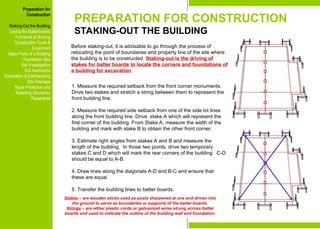
1. Measure the required setback from the front corner monuments.
Drive two stakes and stretch a string between them to represent the
front building line.
2. Measure the required side setback from one of the side lot lines
along the front building line. Drive stake A which will represent the
first corner of the building. From Stake A, measure the width of the
building and mark with stake B to obtain the other front corner.
3. Estimate right angles from stakes A and B and measure the
length of the building. In those two points, drive two temporary
stakes C and D which will mark the rear corners of the building. C-D
should be equal to A-B.
4. Draw lines along the diagonals A-D and B-C and ensure that
these are equal.
5. Transfer the building lines to batter boards.
Before staking-out, it is advisable to go through the process of
relocating the point of boundaries and property line of the site where
the building is to be constructed. Staking-out is the driving of
stakes for batter boards to locate the corners and foundations of
a building for excavation.
Preparation for
Construction
Staking-Out the Building
Laying the Batterboards
Formwork & Shoring
Construction Tools &
Equipment
Major Parts of a Building
Foundation Bed
Site Investigation
Soil mechanics
Excavation & Earthworking
Site Drainage
Slope Protection and
Retaining Structures
Pavements
Stakes – are wooden sticks used as posts sharpened at one end driven into
the ground to serve as boundaries or supports of the batter boards.
Strings – are either plastic cords or galvanized wires strung across batter
boards and used to indicate the outline of the building wall and foundation.
Preparation for
Construction
Staking-Out the Building
Laying the Batterboards
Formwork & Shoring
Construction Tools &
Equipment
Major Parts of a Building
Foundation Bed
Site Investigation
Soil mechanics
Excavation & Earthworking
Site Drainage
Slope Protection and
Retaining Structures
Pavements
LAYING THE BATTERBOARDS
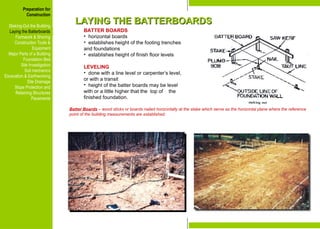
Batter Boards – wood sticks or boards nailed horizontally at the stake which serve as the horizontal plane where the reference
point of the building measurements are established.
BATTER BOARDS
• horizontal boards
• establishes height of the footing trenches
and foundations
• establishes height of finish floor levels
LEVELING
• done with a line level or carpenter’s level,
or with a transit
• height of the batter boards may be level
with or a little higher that the top of the
finished foundation.
Preparation for
Construction
Staking-Out the Building
Laying the Batterboards
Formwork & Shoring
Construction Tools &
Equipment
Major Parts of a Building
Foundation Bed
Site Investigation
Soil mechanics
Excavation & Earthworking
Site Drainage
Slope Protection and
Retaining Structures
Pavements
Preparation for
Construction
Staking-Out the Building
Laying the Batterboards
Formwork & Shoring
Construction Tools &
Equipment
Major Parts of a Building
Foundation Bed
Site Investigation
Soil mechanics
Excavation & Earthworking
Site Drainage
Slope Protection and
Retaining Structures
Pavements
Notes:
Spirit Level – an instrument or tool capable
of vertical and horizontal line
check.
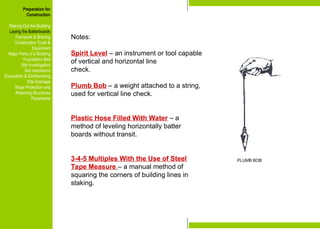
Plumb Bob – a weight attached to a string,
used for vertical line check.
Plastic Hose Filled With Water – a
method of leveling horizontally batter
boards without transit.
3-4-5 Multiples With the Use of Steel
Tape Measure – a manual method of
squaring the corners of building lines in
staking.
Preparation for
Construction
Staking-Out the Building
Laying the Batterboards
Formwork & Shoring
Construction Tools &
Equipment
Major Parts of a Building
Foundation Bed
Site Investigation
Soil mechanics
Excavation & Earthworking
Site Drainage
Slope Protection and
Retaining Structures
Pavements
PLUMB BOB
Preparation for
Construction
Staking-Out the Building
Laying the Batterboards
Formwork & Shoring
Construction Tools &
Equipment
Major Parts of a Building
Foundation Bed
Site Investigation
Soil mechanics
Excavation & Earthworking
Site Drainage
Slope Protection and
Retaining Structures
Pavements
FORMWORK AND SHORING
Formwork - used to shape and support fresh concrete until cured and
able to support itself.
Shoring - temporary supports designed to carry forms for beams and slabs.
Phenolic resin or phenol-formaldehyde resin –
is a thermosetting, waterproof, low-cost, mold-resistant, high
strength synthetic resin made from phenol and formaldehyde;
has good resistance to aging; used extensively in the
manufacture of adhesives, exterior and marine plywood,
laminated products, and molded articles.
Preparation for
Construction
Staking-Out the Building
Laying the Batterboards
Formwork & Shoring
Construction Tools &
Equipment
Major Parts of a Building
Foundation Bed
Site Investigation
Soil mechanics
Excavation & Earthworking
Site Drainage
Slope Protection and
Retaining Structures
Pavements
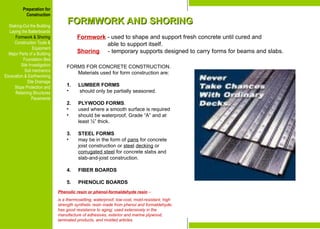
FORMS FOR CONCRETE CONSTRUCTION.
Materials used for form construction are:
1. LUMBER FORMS
• should only be partially seasoned.
2. PLYWOOD FORMS.
• used where a smooth surface is required
• should be waterproof, Grade “A” and at
least ½” thick.
3. STEEL FORMS
• may be in the form of pans for concrete
joist construction or steel decking or
corrugated steel for concrete slabs and
slab-and-joist construction.
4. FIBER BOARDS
5. PHENOLIC BOARDS
Preparation for
Construction
Staking-Out the Building
Laying the Batterboards
Formwork & Shoring
Construction Tools &
Equipment
Major Parts of a Building
Foundation Bed
Site Investigation
Soil mechanics
Excavation & Earthworking
Site Drainage
Slope Protection and
Retaining Structures
Pavements
TWO MAJOR MATERIALS USED FOR FORMS AND
SHORING CONSTRUCTION ARE:
(1) LUMBER
(2) STEEL.
1.3.1 Lumber Forms and Shoring
• partially seasoned and to some extent
slightly wet in order to prevent swelling
and distortion of the forms;
• dressed at least one side and both
edges even for non-exposed surfaces;
• joints in forms for columns, beams, and
girders made tight by dressing the lumber
true to edge, forming square or butt joints;
tight joints in floor and wall panels obtained
by using tongue-and grooved stock;
• sizes of lumber used are: 2-in.stock for
columns, beams and girder bottoms; 1-in.
stock for floor panels and beam and girder
sides; 2x4s for struts, posts, shores, and
uprights; 1 or 2-inch stock for cleats;
• crude oil and petroline are used to
prevent concrete from adhering to the
wood and preserve the forms against
damage by alternate wetting and drying; on
forms against surfaces which are to be
plastered, wetting with water will be
sufficient since oiling prevents adhesion of
the plaster;
• wire ties or bolts and rods are used to
hold wall forms together; rods are preferred
and should be arranged that upon removal
of the forms, no metal shall be within one
inch of any surface; wire ties should be
used only on light and unimportant work
where discoloring will not be
objectionable;
• plywood forms used where a smooth
surface is required; should be waterproof,
Grade “A” and at least ½” thick.
Preparation for
Construction
Staking-Out the Building
Laying the Batterboards
Formwork & Shoring
Construction Tools &
Equipment
Major Parts of a Building
Foundation Bed
Site Investigation
Soil mechanics
Excavation & Earthworking
Site Drainage
Slope Protection and
Retaining Structures
Pavements
Preparation for
Construction
Staking-Out the Building
Laying the Batterboards
Formwork & Shoring
Construction Tools &
Equipment
Major Parts of a Building
Foundation Bed
Site Investigation
Soil mechanics
Excavation & Earthworking
Site Drainage
Slope Protection and
Retaining Structures
Pavements
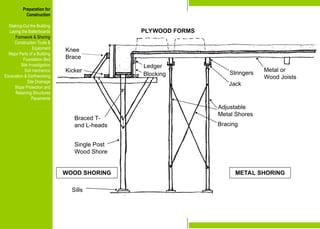
Knee
Brace
Ledger
Blocking
Kicker
Sills
PLYWOOD FORMS
WOOD SHORING METAL SHORING
Braced T-
and L-heads
Single Post
Wood Shore
Metal or
Wood Joists
Stringers
Jack
Adjustable
Metal Shores
Bracing
Preparation for
Construction
Staking-Out the Building
Laying the Batterboards
Formwork & Shoring
Construction Tools &
Equipment
Major Parts of a Building
Foundation Bed
Site Investigation
Soil mechanics
Excavation & Earthworking
Site Drainage
Slope Protection and
Retaining Structures
Pavements
Preparation for
Construction
Staking-Out the Building
Laying the Batterboards
Formwork & Shoring
Construction Tools &
Equipment
Major Parts of a Building
Foundation Bed
Site Investigation
Soil mechanics
Excavation & Earthworking
Site Drainage
Slope Protection and
Retaining Structures
Pavements
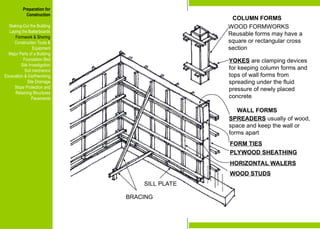
COLUMN FORMS
WALL FORMS
WOOD FORMWORKS
Reusable forms may have a
square or rectangular cross
section
YOKES are clamping devices
for keeping column forms and
tops of wall forms from
spreading under the fluid
pressure of newly placed
concrete
SPREADERS usually of wood,
space and keep the wall or
forms apart
FORM TIES
PLYWOOD SHEATHING
WOOD STUDS
HORIZONTAL WALERS
SILL PLATE
BRACING
Preparation for
Construction
Staking-Out the Building
Laying the Batterboards
Formwork & Shoring
Construction Tools &
Equipment
Major Parts of a Building
Foundation Bed
Site Investigation
Soil mechanics
Excavation & Earthworking
Site Drainage
Slope Protection and
Retaining Structures
Pavements
Preparation for
Construction
Staking-Out the Building
Laying the Batterboards
Formwork & Shoring
Construction Tools &
Equipment
Major Parts of a Building
Foundation Bed
Site Investigation
Soil mechanics
Excavation & Earthworking
Site Drainage
Slope Protection and
Retaining Structures
Pavements
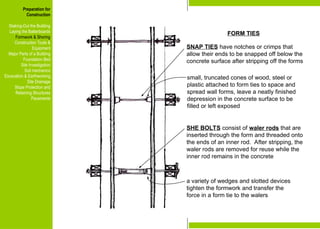
FORM TIES
SNAP TIES have notches or crimps that
allow their ends to be snapped off below the
concrete surface after stripping off the forms
small, truncated cones of wood, steel or
plastic attached to form ties to space and
spread wall forms, leave a neatly finished
depression in the concrete surface to be
filled or left exposed
SHE BOLTS consist of waler rods that are
inserted through the form and threaded onto
the ends of an inner rod. After stripping, the
waler rods are removed for reuse while the
inner rod remains in the concrete
a variety of wedges and slotted devices
tighten the formwork and transfer the
force in a form tie to the walers
Preparation for
Construction
Staking-Out the Building
Laying the Batterboards
Formwork & Shoring
Construction Tools &
Equipment
Major Parts of a Building
Foundation Bed
Site Investigation
Soil mechanics
Excavation & Earthworking
Site Drainage
Slope Protection and
Retaining Structures
Pavements
Preparation for
Construction
Staking-Out the Building
Laying the Batterboards
Formwork & Shoring
Construction Tools &
Equipment
Major Parts of a Building
Foundation Bed
Site Investigation
Soil mechanics
Excavation & Earthworking
Site Drainage
Slope Protection and
Retaining Structures
Pavements
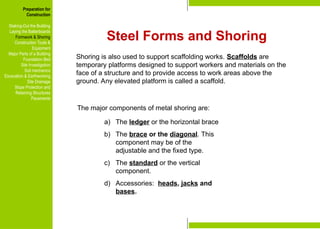
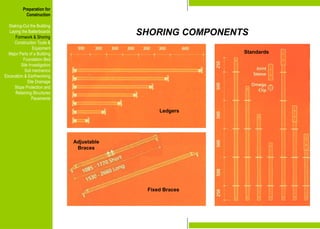
The major components of metal shoring are:
a) The ledger or the horizontal brace
b) The brace or the diagonal. This
component may be of the
adjustable and the fixed type.
c) The standard or the vertical
component.
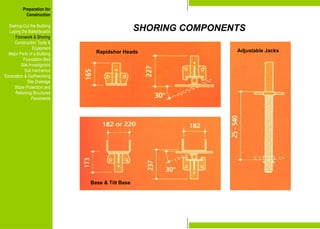
d) Accessories: heads, jacks and
bases.
Preparation for
Construction
Staking-Out the Building
Laying the Batterboards
Formwork & Shoring
Construction Tools &
Equipment
Major Parts of a Building
Foundation Bed
Site Investigation
Soil mechanics
Excavation & Earthworking
Site Drainage
Slope Protection and
Retaining Structures
Pavements
Steel Forms and Shoring
Shoring is also used to support scaffolding works. Scaffolds are
temporary platforms designed to support workers and materials on the
face of a structure and to provide access to work areas above the
ground. Any elevated platform is called a scaffold.
Preparation for
Construction
Staking-Out the Building
Laying the Batterboards
Formwork & Shoring
Construction Tools &
Equipment
Major Parts of a Building
Foundation Bed
Site Investigation
Soil mechanics
Excavation & Earthworking
Site Drainage
Slope Protection and
Retaining Structures
Pavements
SHORING COMPONENTS
Ledgers
Standards
Fixed Braces
Adjustable
Braces
Preparation for
Construction
Staking-Out the Building
Laying the Batterboards
Formwork & Shoring
Construction Tools &
Equipment
Major Parts of a Building
Foundation Bed
Site Investigation
Soil mechanics
Excavation & Earthworking
Site Drainage
Slope Protection and
Retaining Structures
Pavements
Preparation for
Construction
Staking-Out the Building
Laying the Batterboards
Formwork & Shoring
Construction Tools &
Equipment
Major Parts of a Building
Foundation Bed
Site Investigation
Soil mechanics
Excavation & Earthworking
Site Drainage
Slope Protection and
Retaining Structures
Pavements
Rapidshor Heads
Base & Tilt Base
Adjustable Jacks
SHORING COMPONENTS
Preparation for
Construction
Staking-Out the Building
Laying the Batterboards
Formwork & Shoring
Construction Tools &
Equipment
Major Parts of a Building
Foundation Bed
Site Investigation
Soil mechanics
Excavation & Earthworking
Site Drainage
Slope Protection and
Retaining Structures
Pavements
Preparation for
Construction
Staking-Out the Building
Laying the Batterboards
Formwork & Shoring
Construction Tools &
Equipment
Major Parts of a Building
Foundation Bed
Site Investigation
Soil mechanics
Excavation & Earthworking
Site Drainage
Slope Protection and
Retaining Structures
Pavements
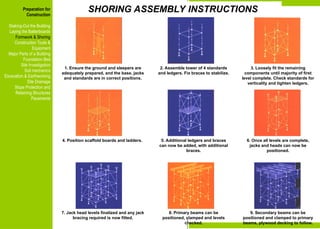
1. Ensure the ground and sleepers are
adequately prepared, and the base, jacks
and standards are in correct positions.
2. Assemble tower of 4 standards
and ledgers. Fix braces to stabilize.
3. Loosely fit the remaining
components until majority of first
level complete. Check standards for
verticality and tighten ledgers.
4. Position scaffold boards and ladders. 5. Additional ledgers and braces
can now be added, with additional
braces.
6. Once all levels are complete,
jacks and heads can now be
positioned.
7. Jack head levels finalized and any jack
bracing required is now fitted.
8. Primary beams can be
positioned, clamped and levels
checked.
9. Secondary beams can be
positioned and clamped to primary
beams, plywood decking to follow.
SHORING ASSEMBLY INSTRUCTIONS
Preparation for
Construction
Staking-Out the Building
Laying the Batterboards
Formwork & Shoring
Construction Tools &
Equipment
Major Parts of a Building
Foundation Bed
Site Investigation
Soil mechanics
Excavation & Earthworking
Site Drainage
Slope Protection and
Retaining Structures
Pavements
Preparation for
Construction
Staking-Out the Building
Laying the Batterboards
Formwork & Shoring
Construction Tools &
Equipment
Major Parts of a Building
Foundation Bed
Site Investigation
Soil mechanics
Excavation & Earthworking
Site Drainage
Slope Protection and
Retaining Structures
Pavements
CONSTRUCTION TOOLS & EQUIPMENT
Tools and equipment employed in construction are grouped into four:
1. Hand Tools are the tools that use power
delivered by man only.
2. Power Tools are those that employ power
supplied by forces other than that coming from
humans.
3. Equipment is a term that refers to large,
complex tools and machines that is designed to
do a particular job.
4. Heavy Equipment is equipment which is very
large and very powerful.
Preparation for
Construction
Staking-Out the Building
Laying the Batterboards
Formwork & Shoring
Construction Tools &
Equipment
Major Parts of a Building
Foundation Bed
Site Investigation
Soil mechanics
Excavation & Earthworking
Site Drainage
Slope Protection and
Retaining Structures
Pavements
Preparation for
Construction
Staking-Out the Building
Laying the Batterboards
Formwork & Shoring
Construction Tools &
Equipment
Major Parts of a Building
Foundation Bed
Site Investigation
Soil mechanics
Excavation & Earthworking
Site Drainage
Slope Protection and
Retaining Structures
Pavements
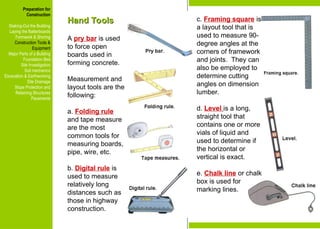
Hand Tools
Hand Tools
A pry bar is used
to force open
boards used in
forming concrete.
Measurement and
layout tools are the
following:
a. Folding rule
and tape measure
are the most
common tools for
measuring boards,
pipe, wire, etc.
b. Digital rule is
used to measure
relatively long
distances such as
those in highway
construction.
c. Framing square is
a layout tool that is
used to measure 90-
degree angles at the
corners of framework
and joints. They can
also be employed to
determine cutting
angles on dimension
lumber.
d. Level is a long,
straight tool that
contains one or more
vials of liquid and
used to determine if
the horizontal or
vertical is exact.
e. Chalk line or chalk
box is used for
marking lines.
Preparation for
Construction
Staking-Out the Building
Laying the Batterboards
Formwork & Shoring
Construction Tools &
Equipment
Major Parts of a Building
Foundation Bed
Site Investigation
Soil mechanics
Excavation & Earthworking
Site Drainage
Slope Protection and
Retaining Structures
Pavements
Preparation for
Construction
Staking-Out the Building
Laying the Batterboards
Formwork & Shoring
Construction Tools &
Equipment
Major Parts of a Building
Foundation Bed
Site Investigation
Soil mechanics
Excavation & Earthworking
Site Drainage
Slope Protection and
Retaining Structures
Pavements
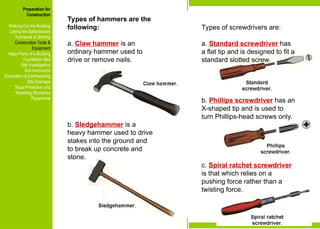
Types of hammers are the
following:
a. Claw hammer is an
ordinary hammer used to
drive or remove nails.
b. Sledgehammer is a
heavy hammer used to drive
stakes into the ground and
to break up concrete and
stone.
Types of screwdrivers are:
a. Standard screwdriver has
a flat tip and is designed to fit a
standard slotted screw.
b. Phillips screwdriver has an
X-shaped tip and is used to
turn Phillips-head screws only.
c. Spiral ratchet screwdriver
is that which relies on a
pushing force rather than a
twisting force.
Preparation for
Construction
Staking-Out the Building
Laying the Batterboards
Formwork & Shoring
Construction Tools &
Equipment
Major Parts of a Building
Foundation Bed
Site Investigation
Soil mechanics
Excavation & Earthworking
Site Drainage
Slope Protection and
Retaining Structures
Pavements
Preparation for
Construction
Staking-Out the Building
Laying the Batterboards
Formwork & Shoring
Construction Tools &
Equipment
Major Parts of a Building
Foundation Bed
Site Investigation
Soil mechanics
Excavation & Earthworking
Site Drainage
Slope Protection and
Retaining Structures
Pavements
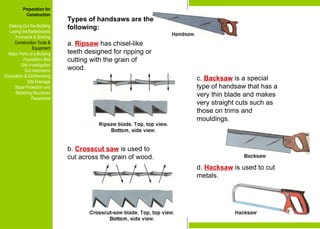
Types of handsaws are the
following:
a. Ripsaw has chisel-like
teeth designed for ripping or
cutting with the grain of
wood.
b. Crosscut saw is used to
cut across the grain of wood.
c. Backsaw is a special
type of handsaw that has a
very thin blade and makes
very straight cuts such as
those on trims and
mouldings.
d. Hacksaw is used to cut
metals.
Preparation for
Construction
Staking-Out the Building
Laying the Batterboards
Formwork & Shoring
Construction Tools &
Equipment
Major Parts of a Building
Foundation Bed
Site Investigation
Soil mechanics
Excavation & Earthworking
Site Drainage
Slope Protection and
Retaining Structures
Pavements
Preparation for
Construction
Staking-Out the Building
Laying the Batterboards
Formwork & Shoring
Construction Tools &
Equipment
Major Parts of a Building
Foundation Bed
Site Investigation
Soil mechanics
Excavation & Earthworking
Site Drainage
Slope Protection and
Retaining Structures
Pavements
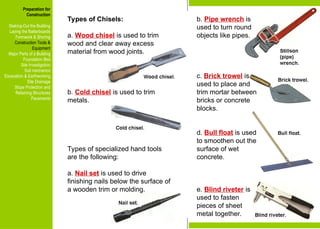
Types of Chisels:
a. Wood chisel is used to trim
wood and clear away excess
material from wood joints.
b. Cold chisel is used to trim
metals.
Types of specialized hand tools
are the following:
a. Nail set is used to drive
finishing nails below the surface of
a wooden trim or molding.
b. Pipe wrench is
used to turn round
objects like pipes.
c. Brick trowel is
used to place and
trim mortar between
bricks or concrete
blocks.
d. Bull float is used
to smoothen out the
surface of wet
concrete.
e. Blind riveter is
used to fasten
pieces of sheet
metal together.
Preparation for
Construction
Staking-Out the Building
Laying the Batterboards
Formwork & Shoring
Construction Tools &
Equipment
Major Parts of a Building
Foundation Bed
Site Investigation
Soil mechanics
Excavation & Earthworking
Site Drainage
Slope Protection and
Retaining Structures
Pavements
Preparation for
Construction
Staking-Out the Building
Laying the Batterboards
Formwork & Shoring
Construction Tools &
Equipment
Major Parts of a Building
Foundation Bed
Site Investigation
Soil mechanics
Excavation & Earthworking
Site Drainage
Slope Protection and
Retaining Structures
Pavements
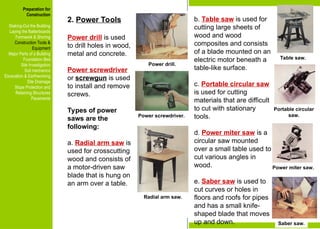
Power drill.
Power screwdriver.
Radial arm saw.
Table saw.
Portable circular
saw.
Power miter saw.
Saber saw.
2. Power Tools
Power drill is used
to drill holes in wood,
metal and concrete.
Power screwdriver
or screwgun is used
to install and remove
screws.
Types of power
saws are the
following:
a. Radial arm saw is
used for crosscutting
wood and consists of
a motor-driven saw
blade that is hung on
an arm over a table.
b. Table saw is used for
cutting large sheets of
wood and wood
composites and consists
of a blade mounted on an
electric motor beneath a
table-like surface.
c. Portable circular saw
is used for cutting
materials that are difficult
to cut with stationary
tools.
d. Power miter saw is a
circular saw mounted
over a small table used to
cut various angles in
wood.
e. Saber saw is used to
cut curves or holes in
floors and roofs for pipes
and has a small knife-
shaped blade that moves
up and down.
Preparation for
Construction
Staking-Out the Building
Laying the Batterboards
Formwork & Shoring
Construction Tools &
Equipment
Major Parts of a Building
Foundation Bed
Site Investigation
Soil mechanics
Excavation & Earthworking
Site Drainage
Slope Protection and
Retaining Structures
Pavements
Preparation for
Construction
Staking-Out the Building
Laying the Batterboards
Formwork & Shoring
Construction Tools &
Equipment
Major Parts of a Building
Foundation Bed
Site Investigation
Soil mechanics
Excavation & Earthworking
Site Drainage
Slope Protection and
Retaining Structures
Pavements
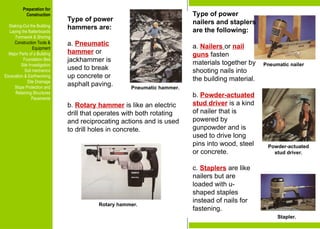
Pneumatic hammer.
Rotary hammer.
Pneumatic nailer
Powder-actuated
stud driver.
Stapler.
Type of power
hammers are:
a. Pneumatic
hammer or
jackhammer is
used to break
up concrete or
asphalt paving.
Type of power
nailers and staplers
are the following:
a. Nailers or nail
guns fasten
materials together by
shooting nails into
the building material.
b. Powder-actuated
stud driver is a kind
of nailer that is
powered by
gunpowder and is
used to drive long
pins into wood, steel
or concrete.
c. Staplers are like
nailers but are
loaded with u-
shaped staples
instead of nails for
fastening.
b. Rotary hammer is like an electric
drill that operates with both rotating
and reciprocating actions and is used
to drill holes in concrete.
Preparation for
Construction
Staking-Out the Building
Laying the Batterboards
Formwork & Shoring
Construction Tools &
Equipment
Major Parts of a Building
Foundation Bed
Site Investigation
Soil mechanics
Excavation & Earthworking
Site Drainage
Slope Protection and
Retaining Structures
Pavements
Preparation for
Construction
Staking-Out the Building
Laying the Batterboards
Formwork & Shoring
Construction Tools &
Equipment
Major Parts of a Building
Foundation Bed
Site Investigation
Soil mechanics
Excavation & Earthworking
Site Drainage
Slope Protection and
Retaining Structures
Pavements
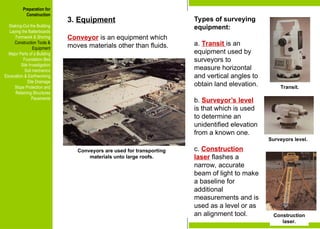
Conveyors are used for transporting
materials unto large roofs.
Construction
laser.
Transit.
Surveyors level.
3. Equipment
Conveyor is an equipment which
moves materials other than fluids.
Types of surveying
equipment:
a. Transit is an
equipment used by
surveyors to
measure horizontal
and vertical angles to
obtain land elevation.
b. Surveyor’s level
is that which is used
to determine an
unidentified elevation
from a known one.
c. Construction
laser flashes a
narrow, accurate
beam of light to make
a baseline for
additional
measurements and is
used as a level or as
an alignment tool.
Preparation for
Construction
Staking-Out the Building
Laying the Batterboards
Formwork & Shoring
Construction Tools &
Equipment
Major Parts of a Building
Foundation Bed
Site Investigation
Soil mechanics
Excavation & Earthworking
Site Drainage
Slope Protection and
Retaining Structures
Pavements
Preparation for
Construction
Staking-Out the Building
Laying the Batterboards
Formwork & Shoring
Construction Tools &
Equipment
Major Parts of a Building
Foundation Bed
Site Investigation
Soil mechanics
Excavation & Earthworking
Site Drainage
Slope Protection and
Retaining Structures
Pavements
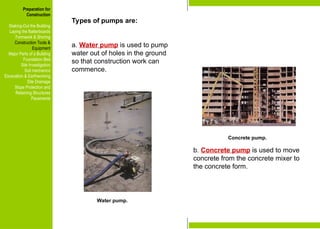
Concrete pump.
Water pump.
Types of pumps are:
a. Water pump is used to pump
water out of holes in the ground
so that construction work can
commence.
b. Concrete pump is used to move
concrete from the concrete mixer to
the concrete form.
Preparation for
Construction
Staking-Out the Building
Laying the Batterboards
Formwork & Shoring
Construction Tools &
Equipment
Major Parts of a Building
Foundation Bed
Site Investigation
Soil mechanics
Excavation & Earthworking
Site Drainage
Slope Protection and
Retaining Structures
Pavements
Preparation for
Construction
Staking-Out the Building
Laying the Batterboards
Formwork & Shoring
Construction Tools &
Equipment
Major Parts of a Building
Foundation Bed
Site Investigation
Soil mechanics
Excavation & Earthworking
Site Drainage
Slope Protection and
Retaining Structures
Pavements
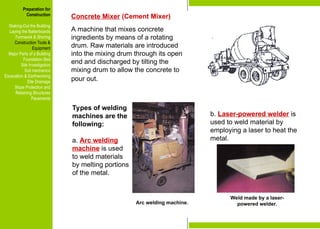
Concrete Mixer (Cement Mixer)
A machine that mixes concrete
ingredients by means of a rotating
drum. Raw materials are introduced
into the mixing drum through its open
end and discharged by tilting the
mixing drum to allow the concrete to
pour out.
Types of welding
machines are the
following:
a. Arc welding
machine is used
to weld materials
by melting portions
of the metal.
Arc welding machine.
Weld made by a laser-
powered welder.
b. Laser-powered welder is
used to weld material by
employing a laser to heat the
metal.
Preparation for
Construction
Staking-Out the Building
Laying the Batterboards
Formwork & Shoring
Construction Tools &
Equipment
Major Parts of a Building
Foundation Bed
Site Investigation
Soil mechanics
Excavation & Earthworking
Site Drainage
Slope Protection and
Retaining Structures
Pavements
Preparation for
Construction
Staking-Out the Building
Laying the Batterboards
Formwork & Shoring
Construction Tools &
Equipment
Major Parts of a Building
Foundation Bed
Site Investigation
Soil mechanics
Excavation & Earthworking
Site Drainage
Slope Protection and
Retaining Structures
Pavements
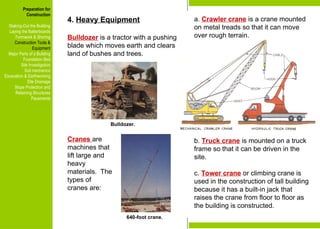
Bulldozer.
640-foot crane.
4. Heavy Equipment
Bulldozer is a tractor with a pushing
blade which moves earth and clears
land of bushes and trees.
a. Crawler crane is a crane mounted
on metal treads so that it can move
over rough terrain.
b. Truck crane is mounted on a truck
frame so that it can be driven in the
site.
c. Tower crane or climbing crane is
used in the construction of tall building
because it has a built-in jack that
raises the crane from floor to floor as
the building is constructed.
Cranes are
machines that
lift large and
heavy
materials. The
types of
cranes are:
Preparation for
Construction
Staking-Out the Building
Laying the Batterboards
Formwork & Shoring
Construction Tools &
Equipment
Major Parts of a Building
Foundation Bed
Site Investigation
Soil mechanics
Excavation & Earthworking
Site Drainage
Slope Protection and
Retaining Structures
Pavements
Preparation for
Construction
Staking-Out the Building
Laying the Batterboards
Formwork & Shoring
Construction Tools &
Equipment
Major Parts of a Building
Foundation Bed
Site Investigation
Soil mechanics
Excavation & Earthworking
Site Drainage
Slope Protection and
Retaining Structures
Pavements
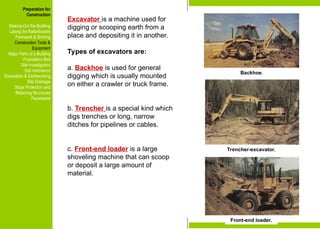
Excavator is a machine used for
digging or scooping earth from a
place and depositing it in another.
Types of excavators are:
a. Backhoe is used for general
digging which is usually mounted
on either a crawler or truck frame.
b. Trencher is a special kind which
digs trenches or long, narrow
ditches for pipelines or cables.
c. Front-end loader is a large
shoveling machine that can scoop
or deposit a large amount of
material.
Trencher-excavator.
Backhoe.
Front-end loader.
Preparation for
Construction
Staking-Out the Building
Laying the Batterboards
Formwork & Shoring
Construction Tools &
Equipment
Major Parts of a Building
Foundation Bed
Site Investigation
Soil mechanics
Excavation & Earthworking
Site Drainage
Slope Protection and
Retaining Structures
Pavements
Preparation for
Construction
Staking-Out the Building
Laying the Batterboards
Formwork & Shoring
Construction Tools &
Equipment
Major Parts of a Building
Foundation Bed
Site Investigation
Soil mechanics
Excavation & Earthworking
Site Drainage
Slope Protection and
Retaining Structures
Pavements
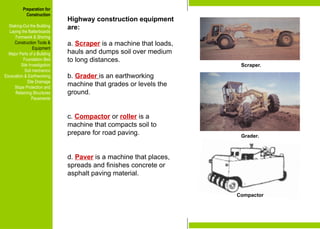
Highway construction equipment
are:
a. Scraper is a machine that loads,
hauls and dumps soil over medium
to long distances.
b. Grader is an earthworking
machine that grades or levels the
ground.
c. Compactor or roller is a
machine that compacts soil to
prepare for road paving.
d. Paver is a machine that places,
spreads and finishes concrete or
asphalt paving material.
Scraper.
Grader.
Preparation for
Construction
Staking-Out the Building
Laying the Batterboards
Formwork & Shoring
Construction Tools &
Equipment
Major Parts of a Building
Foundation Bed
Site Investigation
Soil mechanics
Excavation & Earthworking
Site Drainage
Slope Protection and
Retaining Structures
Pavements
Compactor
Preparation for
Construction
Staking-Out the Building
Laying the Batterboards
Formwork & Shoring
Construction Tools &
Equipment
Major Parts of a Building
Foundation Bed
Site Investigation
Soil mechanics
Excavation & Earthworking
Site Drainage
Slope Protection and
Retaining Structures
Pavements
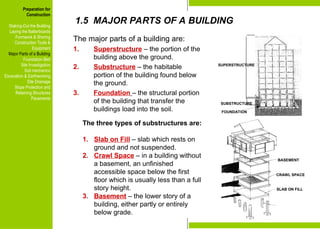
1.5 MAJOR PARTS OF A BUILDING
The major parts of a building are:
1. Superstructure – the portion of the
building above the ground.
2. Substructure – the habitable
portion of the building found below
the ground.
3. Foundation – the structural portion
of the building that transfer the
buildings load into the soil.
The three types of substructures are:
1. Slab on Fill – slab which rests on
ground and not suspended.
2. Crawl Space – in a building without
a basement, an unfinished
accessible space below the first
floor which is usually less than a full
story height.
3. Basement – the lower story of a
building, either partly or entirely
below grade.
SUPERSTRUCTURE
SUBSTRUCTURE
FOUNDATION
Preparation for
Construction
Staking-Out the Building
Laying the Batterboards
Formwork & Shoring
Construction Tools &
Equipment
Major Parts of a Building
Foundation Bed
Site Investigation
Soil mechanics
Excavation & Earthworking
Site Drainage
Slope Protection and
Retaining Structures
Pavements
SLAB ON FILL
BASEMENT
CRAWL SPACE
Preparation for
Construction
Staking-Out the Building
Laying the Batterboards
Formwork & Shoring
Construction Tools &
Equipment
Major Parts of a Building
Foundation Bed
Site Investigation
Soil mechanics
Excavation & Earthworking
Site Drainage
Slope Protection and
Retaining Structures
Pavements
1.6 FOUNDATION BED
The word “foundation” is applied to:
Preparation for
Construction
Staking-Out the Building
Laying the Batterboards
Formwork & Shoring
Construction Tools &
Equipment
Major Parts of a Building
Foundation Bed
Site Investigation
Soil mechanics
Excavation & Earthworking
Site Drainage
Slope Protection and
Retaining Structures
Pavements
1. Construction below grade, such as footing
courses, basement walls, etc., forming the
lower section of a structure;
2. The natural material, the particular part of the
earth’s surface on which the construction rests;
3. Special construction such as piling or piers
used to transmit the loads of the building to firm
substrata.
Preparation for
Construction
Staking-Out the Building
Laying the Batterboards
Formwork & Shoring
Construction Tools &
Equipment
Major Parts of a Building
Foundation Bed
Site Investigation
Soil mechanics
Excavation & Earthworking
Site Drainage
Slope Protection and
Retaining Structures
Pavements
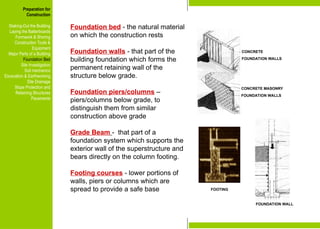
Foundation bed - the natural material
on which the construction rests
Foundation walls - that part of the
building foundation which forms the
permanent retaining wall of the
structure below grade.
Foundation piers/columns –
piers/columns below grade, to
distinguish them from similar
construction above grade
Grade Beam - that part of a
foundation system which supports the
exterior wall of the superstructure and
bears directly on the column footing.
Footing courses - lower portions of
walls, piers or columns which are
spread to provide a safe base
Preparation for
Construction
Staking-Out the Building
Laying the Batterboards
Formwork & Shoring
Construction Tools &
Equipment
Major Parts of a Building
Foundation Bed
Site Investigation
Soil mechanics
Excavation & Earthworking
Site Drainage
Slope Protection and
Retaining Structures
Pavements
CONCRETE
FOUNDATION WALLS
CONCRETE MASONRY
FOUNDATION WALLS
FOUNDATION WALL
FOOTING
Preparation for
Construction
Staking-Out the Building
Laying the Batterboards
Formwork & Shoring
Construction Tools &
Equipment
Major Parts of a Building
Foundation Bed
Site Investigation
Soil mechanics
Excavation & Earthworking
Site Drainage
Slope Protection and
Retaining Structures
Pavements
TYPES OF FOUNDATION BEDS
Foundation beds may be classified as follows:
Preparation for
Construction
Staking-Out the Building
Laying the Batterboards
Formwork & Shoring
Construction Tools &
Equipment
Major Parts of a Building
Foundation Bed
Site Investigation
Soil mechanics
Excavation & Earthworking
Site Drainage
Slope Protection and
Retaining Structures
Pavements
1. Rock (solid rock, bedrock or ledge). Undisturbed rock masses forming an
undisturbed part of the original rock-formation. Some examples of harder rocks
are granite, slate, sandstone, and limestone which are all capable of carrying
the load of any ordinary structure. Examples of softer rocks are shale, shaley
slates and certain marley limestone and clay stones.
2. Decayed rock (rotten rock). Sand, clays and other materials resulting from
the disintegration of rock masses, lacking the coherent qualities but occupying
the space formerly occupied by the original rock.
3. Loose rock. Rock masses detached from the ledge of which they originally
formed a part.
4. Gravel. Detached rock particles, generally water-worn, rounded and
intermediate in size between sand particles and boulders.
5. Boulders. Detached rock masses larger than gravel, generally rounded and
worn as a result of having been transported by water a considerable distance
from the ledges of which they originally formed a part.
Preparation for
Construction
Staking-Out the Building
Laying the Batterboards
Formwork & Shoring
Construction Tools &
Equipment
Major Parts of a Building
Foundation Bed
Site Investigation
Soil mechanics
Excavation & Earthworking
Site Drainage
Slope Protection and
Retaining Structures
Pavements
6. Sand. Non-coherent rock particles smaller than ¼” in maximum dimension.
7. Clay. A plastic material resulting from the decomposition and hydration of feldspathic
rocks, being hydrated silicate of alumina, generally mixed with powdered feldspar, quartz
and other materials.
8. Hard-pan. Any strong coherent mixture of clay or other cementing material with sand,
gravel and boulders.
9. Silt. A finely divided earthy material deposited from running water.
10. Mud. Finely divided earthy material generally containing vegetable matter and
deposited from still or slowly moving water.
11. Mould. Earthy material containing a large proportion of humus or vegetable matter.
12. Loam. Earthy material containing a proportion of vegetable matter.
13. Peat. Compressed and partially carbonized vegetable matter.
14. Filled Ground. All artificial fills and some natural fills are liable to a more or less
uniform but continuous settlement or shrinkage due to the gradual consolidation of the
material of which the fill is composed
Preparation for
Construction
Staking-Out the Building
Laying the Batterboards
Formwork & Shoring
Construction Tools &
Equipment
Major Parts of a Building
Foundation Bed
Site Investigation
Soil mechanics
Excavation & Earthworking
Site Drainage
Slope Protection and
Retaining Structures
Pavements
Preparation for
Construction
Staking-Out the Building
Laying the Batterboards
Formwork & Shoring
Construction Tools &
Equipment
Major Parts of a Building
Foundation Bed
Site Investigation
Soil mechanics
Excavation & Earthworking
Site Drainage
Slope Protection and
Retaining Structures
Pavements
ALLOWABLE LOADS ON FOUNDATION
BEDS
Preparation for
Construction
Staking-Out the Building
Laying the Batterboards
Formwork & Shoring
Construction Tools &
Equipment
Major Parts of a Building
Foundation Bed
Site Investigation
Soil mechanics
Excavation & Earthworking
Site Drainage
Slope Protection and
Retaining Structures
Pavements
Thorough investigation is required before
one can determine the allowable unit load on the
foundation bed. When material and conditions are
uniform over the entire site of the building, a uniform
unit load may be used. In cases when entirely different
conditions exist under different portions of the same
building, the unit load on the foundation bed must be
reduced as much as possible so as to reduce the
differences in settlements between the two sections of
the building to a minimum.
Preparation for
Construction
Staking-Out the Building
Laying the Batterboards
Formwork & Shoring
Construction Tools &
Equipment
Major Parts of a Building
Foundation Bed
Site Investigation
Soil mechanics
Excavation & Earthworking
Site Drainage
Slope Protection and
Retaining Structures
Pavements
SITE INVESTIGATION
SITE INVESTIGATION
Before any design is made, the architect is required to get as much
valuable data about site excavation and building erection at the project
site in order to determine the character of the materials which will be
encountered at the level of a foundation bed.
METHODS OF
EXPLORATION
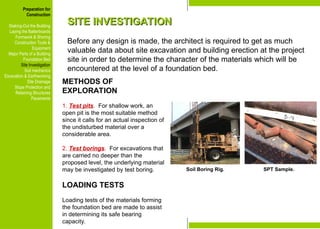
1. Test pits. For shallow work, an
open pit is the most suitable method
since it calls for an actual inspection of
the undisturbed material over a
considerable area.
2. Test borings. For excavations that
are carried no deeper than the
proposed level, the underlying material
may be investigated by test boring.
LOADING TESTS
Loading tests of the materials forming
the foundation bed are made to assist
in determining its safe bearing
capacity.
Soil Boring Rig. SPT Sample.
Preparation for
Construction
Staking-Out the Building
Laying the Batterboards
Formwork & Shoring
Construction Tools &
Equipment
Major Parts of a Building
Foundation Bed
Site Investigation
Soil mechanics
Excavation & Earthworking
Site Drainage
Slope Protection and
Retaining Structures
Pavements
Preparation for
Construction
Staking-Out the Building
Laying the Batterboards
Formwork & Shoring
Construction Tools &
Equipment
Major Parts of a Building
Foundation Bed
Site Investigation
Soil mechanics
Excavation & Earthworking
Site Drainage
Slope Protection and
Retaining Structures
Pavements
SOIL MECHANICS
SOIL MECHANICS
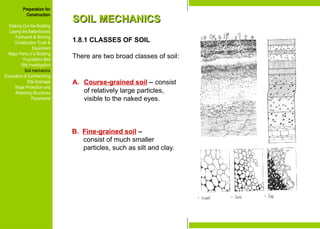
1.8.1 CLASSES OF SOIL
There are two broad classes of soil:
A. Course-grained soil – consist
of relatively large particles,
visible to the naked eyes.
B. Fine-grained soil –
consist of much smaller
particles, such as silt and clay.
Preparation for
Construction
Staking-Out the Building
Laying the Batterboards
Formwork & Shoring
Construction Tools &
Equipment
Major Parts of a Building
Foundation Bed
Site Investigation
Soil mechanics
Excavation & Earthworking
Site Drainage
Slope Protection and
Retaining Structures
Pavements
Preparation for
Construction
Staking-Out the Building
Laying the Batterboards
Formwork & Shoring
Construction Tools &
Equipment
Major Parts of a Building
Foundation Bed
Site Investigation
Soil mechanics
Excavation & Earthworking
Site Drainage
Slope Protection and
Retaining Structures
Pavements
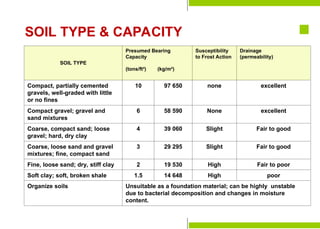
SOIL TYPE
Presumed Bearing
Capacity
(tons/ft²) (kg/m²)
Susceptibility
to Frost Action
Drainage
(permeability)
Compact, partially cemented
gravels, well-graded with little
or no fines
10 97 650 none excellent
Compact gravel; gravel and
sand mixtures
6 58 590 None excellent
Coarse, compact sand; loose
gravel; hard, dry clay
4 39 060 Slight Fair to good
Coarse, loose sand and gravel
mixtures; fine, compact sand
3 29 295 Slight Fair to good
Fine, loose sand; dry, stiff clay 2 19 530 High Fair to poor
Soft clay; soft, broken shale 1.5 14 648 High poor
Organize soils Unsuitable as a foundation material; can be highly unstable
due to bacterial decomposition and changes in moisture
content.
SOIL TYPE & CAPACITY
Preparation for
Construction
Staking-Out the Building
Laying the Batterboards
Formwork & Shoring
Construction Tools &
Equipment
Major Parts of a Building
Foundation Bed
Site Investigation
Soil mechanics
Excavation & Earthworking
Site Drainage
Slope Protection and
Retaining Structures
Pavements
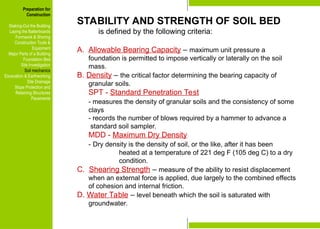
STABILITY AND STRENGTH OF SOIL BED
is defined by the following criteria:
A. Allowable Bearing Capacity – maximum unit pressure a
foundation is permitted to impose vertically or laterally on the soil
mass.
B. Density – the critical factor determining the bearing capacity of
granular soils.
SPT - Standard Penetration Test
- measures the density of granular soils and the consistency of some
clays
- records the number of blows required by a hammer to advance a
standard soil sampler.
MDD - Maximum Dry Density
- Dry density is the density of soil, or the like, after it has been
heated at a temperature of 221 deg F (105 deg C) to a dry
condition.
C. Shearing Strength – measure of the ability to resist displacement
when an external force is applied, due largely to the combined effects
of cohesion and internal friction.
D. Water Table – level beneath which the soil is saturated with
groundwater.
Preparation for
Construction
Staking-Out the Building
Laying the Batterboards
Formwork & Shoring
Construction Tools &
Equipment
Major Parts of a Building
Foundation Bed
Site Investigation
Soil mechanics
Excavation & Earthworking
Site Drainage
Slope Protection and
Retaining Structures
Pavements
Preparation for
Construction
Staking-Out the Building
Laying the Batterboards
Formwork & Shoring
Construction Tools &
Equipment
Major Parts of a Building
Foundation Bed
Site Investigation
Soil mechanics
Excavation & Earthworking
Site Drainage
Slope Protection and
Retaining Structures
Pavements
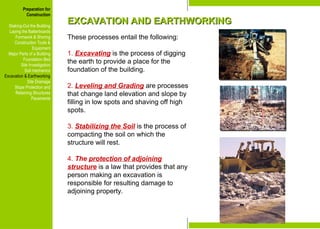
EXCAVATION AND EARTHWORKING
These processes entail the following:
1. Excavating is the process of digging
the earth to provide a place for the
foundation of the building.
2. Leveling and Grading are processes
that change land elevation and slope by
filling in low spots and shaving off high
spots.
3. Stabilizing the Soil is the process of
compacting the soil on which the
structure will rest.
4. The protection of adjoining
structure is a law that provides that any
person making an excavation is
responsible for resulting damage to
adjoining property.
Preparation for
Construction
Staking-Out the Building
Laying the Batterboards
Formwork & Shoring
Construction Tools &
Equipment
Major Parts of a Building
Foundation Bed
Site Investigation
Soil mechanics
Excavation & Earthworking
Site Drainage
Slope Protection and
Retaining Structures
Pavements
Preparation for
Construction
Staking-Out the Building
Laying the Batterboards
Formwork & Shoring
Construction Tools &
Equipment
Major Parts of a Building
Foundation Bed
Site Investigation
Soil mechanics
Excavation & Earthworking
Site Drainage
Slope Protection and
Retaining Structures
Pavements
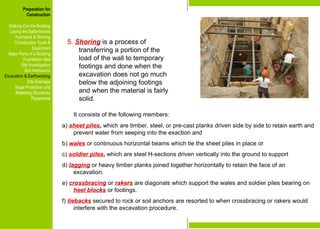
5. Shoring is a process of
transferring a portion of the
load of the wall to temporary
footings and done when the
excavation does not go much
below the adjoining footings
and when the material is fairly
solid.
It consists of the following members:
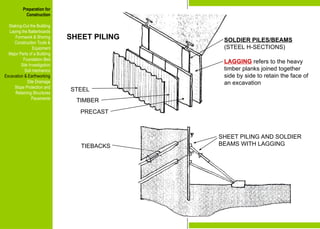
a) sheet piles, which are timber, steel, or pre-cast planks driven side by side to retain earth and
prevent water from seeping into the exaction and
b) wales or continuous horizontal beams which tie the sheet piles in place or
c) soldier piles, which are steel H-sections driven vertically into the ground to support
d) lagging or heavy timber planks joined together horizontally to retain the face of an
excavation.
e) crossbracing or rakers are diagonals which support the wales and soldier piles bearing on
heel blocks or footings.
f) tiebacks secured to rock or soil anchors are resorted to when crossbracing or rakers would
interfere with the excavation procedure.
Preparation for
Construction
Staking-Out the Building
Laying the Batterboards
Formwork & Shoring
Construction Tools &
Equipment
Major Parts of a Building
Foundation Bed
Site Investigation
Soil mechanics
Excavation & Earthworking
Site Drainage
Slope Protection and
Retaining Structures
Pavements
Preparation for
Construction
Staking-Out the Building
Laying the Batterboards
Formwork & Shoring
Construction Tools &
Equipment
Major Parts of a Building
Foundation Bed
Site Investigation
Soil mechanics
Excavation & Earthworking
Site Drainage
Slope Protection and
Retaining Structures
Pavements
STEEL
TIMBER
PRECAST
SOLDIER PILES/BEAMS
(STEEL H-SECTIONS)
LAGGING refers to the heavy
timber planks joined together
side by side to retain the face of
an excavation
TIEBACKS
SHEET PILING AND SOLDIER
BEAMS WITH LAGGING
SHEET PILING
Preparation for
Construction
Staking-Out the Building
Laying the Batterboards
Formwork & Shoring
Construction Tools &
Equipment
Major Parts of a Building
Foundation Bed
Site Investigation
Soil mechanics
Excavation & Earthworking
Site Drainage
Slope Protection and
Retaining Structures
Pavements
Preparation for
Construction
Staking-Out the Building
Laying the Batterboards
Formwork & Shoring
Construction Tools &
Equipment
Major Parts of a Building
Foundation Bed
Site Investigation
Soil mechanics
Excavation & Earthworking
Site Drainage
Slope Protection and
Retaining Structures
Pavements
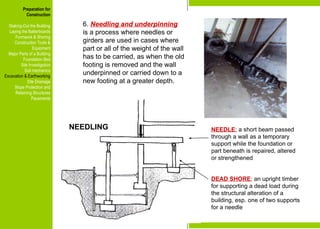
6. Needling and underpinning
is a process where needles or
girders are used in cases where
part or all of the weight of the wall
has to be carried, as when the old
footing is removed and the wall
underpinned or carried down to a
new footing at a greater depth.
NEEDLE; a short beam passed
through a wall as a temporary
support while the foundation or
part beneath is repaired, altered
or strengthened
DEAD SHORE; an upright timber
for supporting a dead load during
the structural alteration of a
building, esp. one of two supports
for a needle
NEEDLING
Preparation for
Construction
Staking-Out the Building
Laying the Batterboards
Formwork & Shoring
Construction Tools &
Equipment
Major Parts of a Building
Foundation Bed
Site Investigation
Soil mechanics
Excavation & Earthworking
Site Drainage
Slope Protection and
Retaining Structures
Pavements
Preparation for
Construction
Staking-Out the Building
Laying the Batterboards
Formwork & Shoring
Construction Tools &
Equipment
Major Parts of a Building
Foundation Bed
Site Investigation
Soil mechanics
Excavation & Earthworking
Site Drainage
Slope Protection and
Retaining Structures
Pavements
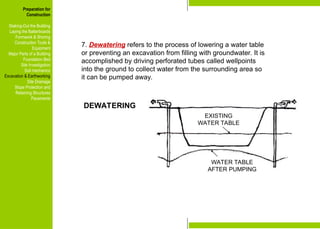
EXISTING
WATER TABLE
WATER TABLE
AFTER PUMPING
DEWATERING
7. Dewatering refers to the process of lowering a water table
or preventing an excavation from filling with groundwater. It is
accomplished by driving perforated tubes called wellpoints
into the ground to collect water from the surrounding area so
it can be pumped away.
Preparation for
Construction
Staking-Out the Building
Laying the Batterboards
Formwork & Shoring
Construction Tools &
Equipment
Major Parts of a Building
Foundation Bed
Site Investigation
Soil mechanics
Excavation & Earthworking
Site Drainage
Slope Protection and
Retaining Structures
Pavements
Preparation for
Construction
Staking-Out the Building
Laying the Batterboards
Formwork & Shoring
Construction Tools &
Equipment
Major Parts of a Building
Foundation Bed
Site Investigation
Soil mechanics
Excavation & Earthworking
Site Drainage
Slope Protection and
Retaining Structures
Pavements
SITE DRAINAGE
SITE DRAINAGE
- necessary to prevent erosion and collection of excess surface
water or groundwater resulting from new construction.
Surface Water –
1. Rainfall which runs over the surface of the
ground.
2. Water carried by an aggregate except that held
by absorption within the aggregate particles
themselves.
Preparation for
Construction
Staking-Out the Building
Laying the Batterboards
Formwork & Shoring
Construction Tools &
Equipment
Major Parts of a Building
Foundation Bed
Site Investigation
Soil mechanics
Excavation & Earthworking
Site Drainage
Slope Protection and
Retaining Structures
Pavements
Groundwater –
Water, near the surface of the
ground , which passes through the
subsoil.
BASIC TYPES OF SITE DRAINAGE
A. SUB-SURFACE DRAINAGE –
consists of an underground network of piping for conveying groundwater
to a point of disposal, as a storm sewer system or a natural outfall at a
lower elevation on the site. Excess groundwater can reduce the load-
carrying capacity of a foundation soil and increase the hydrostatic
pressure on a building foundation. Waterproofing is required for basement
structures situated close to or below the water table of a site.
Preparation for
Construction
Staking-Out the Building
Laying the Batterboards
Formwork & Shoring
Construction Tools &
Equipment
Major Parts of a Building
Foundation Bed
Site Investigation
Soil mechanics
Excavation & Earthworking
Site Drainage
Slope Protection and
Retaining Structures
Pavements
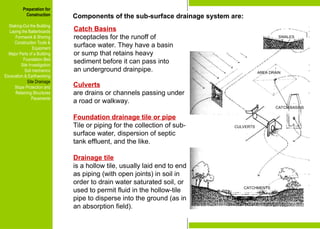
Culverts
are drains or channels passing under
a road or walkway.
Foundation drainage tile or pipe
Tile or piping for the collection of sub-
surface water, dispersion of septic
tank effluent, and the like.
Drainage tile
is a hollow tile, usually laid end to end
as piping (with open joints) in soil in
order to drain water saturated soil, or
used to permit fluid in the hollow-tile
pipe to disperse into the ground (as in
an absorption field).
Preparation for
Construction
Staking-Out the Building
Laying the Batterboards
Formwork & Shoring
Construction Tools &
Equipment
Major Parts of a Building
Foundation Bed
Site Investigation
Soil mechanics
Excavation & Earthworking
Site Drainage
Slope Protection and
Retaining Structures
Pavements
AREA DRAIN
CATCH BASINS
CULVERTS
CATCHMENTS
SWALES
Catch Basins
receptacles for the runoff of
surface water. They have a basin
or sump that retains heavy
sediment before it can pass into
an underground drainpipe.
Components of the sub-surface drainage system are:
Preparation for
Construction
Staking-Out the Building
Laying the Batterboards
Formwork & Shoring
Construction Tools &
Equipment
Major Parts of a Building
Foundation Bed
Site Investigation
Soil mechanics
Excavation & Earthworking
Site Drainage
Slope Protection and
Retaining Structures
Pavements
B.SURFACE DRAINAGE
refers to the grading and surfacing of a site in order to divert rain and
other surface water into natural drainage patterns or a municipal
storm sewer system. Grass and lawn areas are sloped 1.5% to
10%; while paved parking areas, 2% to 3%. A holding pond may
be necessary when the amount of surface runoff exceeds the
capacity of the storm sewer system.
Components of the surface drainage system are:
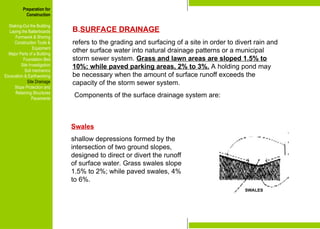
Swales
shallow depressions formed by the
intersection of two ground slopes,
designed to direct or divert the runoff
of surface water. Grass swales slope
1.5% to 2%; while paved swales, 4%
to 6%.
Preparation for
Construction
Staking-Out the Building
Laying the Batterboards
Formwork & Shoring
Construction Tools &
Equipment
Major Parts of a Building
Foundation Bed
Site Investigation
Soil mechanics
Excavation & Earthworking
Site Drainage
Slope Protection and
Retaining Structures
Pavements
SWALES
Preparation for
Construction
Staking-Out the Building
Laying the Batterboards
Formwork & Shoring
Construction Tools &
Equipment
Major Parts of a Building
Foundation Bed
Site Investigation
Soil mechanics
Excavation & Earthworking
Site Drainage
Slope Protection and
Retaining Structures
Pavements
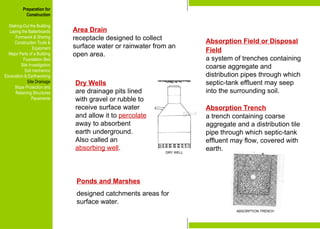
Area Drain
receptacle designed to collect
surface water or rainwater from an
open area.
Ponds and Marshes
designed catchments areas for
surface water.
Preparation for
Construction
Staking-Out the Building
Laying the Batterboards
Formwork & Shoring
Construction Tools &
Equipment
Major Parts of a Building
Foundation Bed
Site Investigation
Soil mechanics
Excavation & Earthworking
Site Drainage
Slope Protection and
Retaining Structures
Pavements
Absorption Field or Disposal
Field
a system of trenches containing
coarse aggregate and
distribution pipes through which
septic-tank effluent may seep
into the surrounding soil.
Absorption Trench
a trench containing coarse
aggregate and a distribution tile
pipe through which septic-tank
effluent may flow, covered with
earth.
DRY WELL
Dry Wells
are drainage pits lined
with gravel or rubble to
receive surface water
and allow it to percolate
away to absorbent
earth underground.
Also called an
absorbing well.
ABSORPTION TRENCH
Preparation for
Construction
Staking-Out the Building
Laying the Batterboards
Formwork & Shoring
Construction Tools &
Equipment
Major Parts of a Building
Foundation Bed
Site Investigation
Soil mechanics
Excavation & Earthworking
Site Drainage
Slope Protection and
Retaining Structures
Pavements
TOPOGRAPHY AND BUILDING FORM
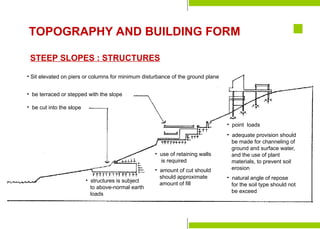
STEEP SLOPES : STRUCTURES
• Sit elevated on piers or columns for minimum disturbance of the ground plane
• be terraced or stepped with the slope
• be cut into the slope
• structures is subject
to above-normal earth
loads
• use of retaining walls
is required
• amount of cut should
should approximate
amount of fill
• point loads
• adequate provision should
be made for channeling of
ground and surface water,
and the use of plant
materials, to prevent soil
erosion
• natural angle of repose
for the soil type should not
be exceed
Preparation for
Construction
Staking-Out the Building
Laying the Batterboards
Formwork & Shoring
Construction Tools &
Equipment
Major Parts of a Building
Foundation Bed
Site Investigation
Soil mechanics
Excavation & Earthworking
Site Drainage
Slope Protection and
Retaining Structures
Pavements
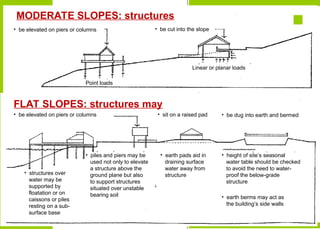
• be elevated on piers or columns • be cut into the slope
Linear or planar loads
Point loads
FLAT SLOPES: structures may
• be elevated on piers or columns • sit on a raised pad • be dug into earth and bermed
• structures over
water may be
supported by
floatation or on
caissons or piles
resting on a sub-
surface base
• piles and piers may be
used not only to elevate
a structure above the
ground plane but also
to support structures
situated over unstable
bearing soil
• earth pads aid in
draining surface
water away from
structure
0
• height of site’s seasonal
water table should be checked
to avoid the need to water-
proof the below-grade
structure
• earth berms may act as
the building’s side walls
MODERATE SLOPES: structures
Preparation for
Construction
Staking-Out the Building
Laying the Batterboards
Formwork & Shoring
Construction Tools &
Equipment
Major Parts of a Building
Foundation Bed
Site Investigation
Soil mechanics
Excavation & Earthworking
Site Drainage
Slope Protection and
Retaining Structures
Pavements
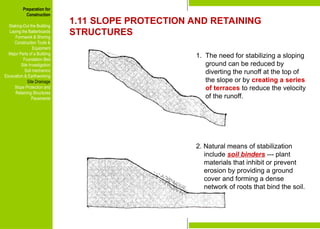
1.11 SLOPE PROTECTION AND RETAINING
STRUCTURES
1. The need for stabilizing a sloping
ground can be reduced by
diverting the runoff at the top of
the slope or by creating a series
of terraces to reduce the velocity
of the runoff.
2. Natural means of stabilization
include soil binders --- plant
materials that inhibit or prevent
erosion by providing a ground
cover and forming a dense
network of roots that bind the soil.
Preparation for
Construction
Staking-Out the Building
Laying the Batterboards
Formwork & Shoring
Construction Tools &
Equipment
Major Parts of a Building
Foundation Bed
Site Investigation
Soil mechanics
Excavation & Earthworking
Site Drainage
Slope Protection and
Retaining Structures
Pavements
Preparation for
Construction
Staking-Out the Building
Laying the Batterboards
Formwork & Shoring
Construction Tools &
Equipment
Major Parts of a Building
Foundation Bed
Site Investigation
Soil mechanics
Excavation & Earthworking
Site Drainage
Slope Protection and
Retaining Structures
Pavements
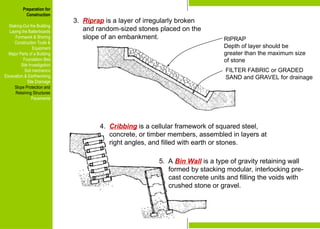
RIPRAP
Depth of layer should be
greater than the maximum size
of stone
FILTER FABRIC or GRADED
SAND and GRAVEL for drainage
3. Riprap is a layer of irregularly broken
and random-sized stones placed on the
slope of an embankment.
4. Cribbing is a cellular framework of squared steel,
concrete, or timber members, assembled in layers at
right angles, and filled with earth or stones.
5. A Bin Wall is a type of gravity retaining wall
formed by stacking modular, interlocking pre-
cast concrete units and filling the voids with
crushed stone or gravel.
Preparation for
Construction
Staking-Out the Building
Laying the Batterboards
Formwork & Shoring
Construction Tools &
Equipment
Major Parts of a Building
Foundation Bed
Site Investigation
Soil mechanics
Excavation & Earthworking
Site Drainage
Slope Protection and
Retaining Structures
Pavements
Preparation for
Construction
Staking-Out the Building
Laying the Batterboards
Formwork & Shoring
Construction Tools &
Equipment
Major Parts of a Building
Foundation Bed
Site Investigation
Soil mechanics
Excavation & Earthworking
Site Drainage
Slope Protection and
Retaining Structures
Pavements
GABIONS
Filter fabric or graded
sand and gravel for
drainage
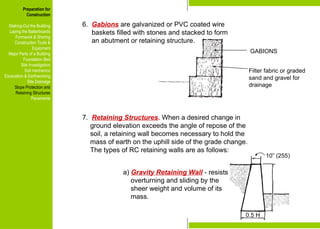
6. Gabions are galvanized or PVC coated wire
baskets filled with stones and stacked to form
an abutment or retaining structure.
7. Retaining Structures. When a desired change in
ground elevation exceeds the angle of repose of the
soil, a retaining wall becomes necessary to hold the
mass of earth on the uphill side of the grade change.
The types of RC retaining walls are as follows:
10” (255)
0.5 H
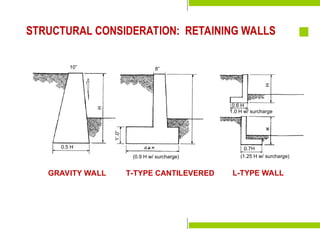
a) Gravity Retaining Wall - resists
overturning and sliding by the
sheer weight and volume of its
mass.
Preparation for
Construction
Staking-Out the Building
Laying the Batterboards
Formwork & Shoring
Construction Tools &
Equipment
Major Parts of a Building
Foundation Bed
Site Investigation
Soil mechanics
Excavation & Earthworking
Site Drainage
Slope Protection and
Retaining Structures
Pavements
Preparation for
Construction
Staking-Out the Building
Laying the Batterboards
Formwork & Shoring
Construction Tools &
Equipment
Major Parts of a Building
Foundation Bed
Site Investigation
Soil mechanics
Excavation & Earthworking
Site Drainage
Slope Protection and
Retaining Structures
Pavements
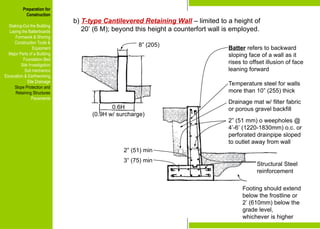
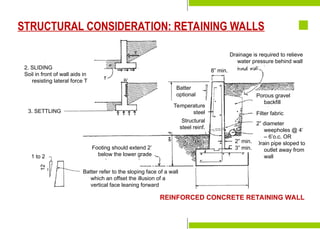
8” (205)
0.6H
(0.9H w/ surcharge)
Batter refers to backward
sloping face of a wall as it
rises to offset illusion of face
leaning forward
Temperature steel for walls
more than 10” (255) thick
Structural Steel
reinforcement
Drainage mat w/ filter fabric
or porous gravel backfill
2” (51 mm) o weepholes @
4’-6’ (1220-1830mm) o.c. or
perforated drainpipe sloped
to outlet away from wall
Footing should extend
below the frostline or
2’ (610mm) below the
grade level,
whichever is higher
2” (51) min
3” (75) min
b) T-type Cantilevered Retaining Wall – limited to a height of
20’ (6 M); beyond this height a counterfort wall is employed.
Preparation for
Construction
Staking-Out the Building
Laying the Batterboards
Formwork & Shoring
Construction Tools &
Equipment
Major Parts of a Building
Foundation Bed
Site Investigation
Soil mechanics
Excavation & Earthworking
Site Drainage
Slope Protection and
Retaining Structures
Pavements
Preparation for
Construction
Staking-Out the Building
Laying the Batterboards
Formwork & Shoring
Construction Tools &
Equipment
Major Parts of a Building
Foundation Bed
Site Investigation
Soil mechanics
Excavation & Earthworking
Site Drainage
Slope Protection and
Retaining Structures
Pavements
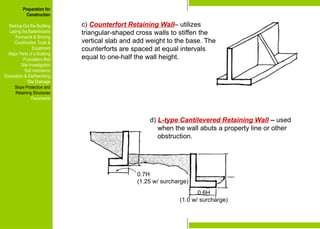
c) Counterfort Retaining Wall– utilizes
triangular-shaped cross walls to stiffen the
vertical slab and add weight to the base. The
counterforts are spaced at equal intervals
equal to one-half the wall height.
0.7H
(1.25 w/ surcharge)
0.6H
(1.0 w/ surcharge)
d) L-type Cantilevered Retaining Wall – used
when the wall abuts a property line or other
obstruction.
Preparation for
Construction
Staking-Out the Building
Laying the Batterboards
Formwork & Shoring
Construction Tools &
Equipment
Major Parts of a Building
Foundation Bed
Site Investigation
Soil mechanics
Excavation & Earthworking
Site Drainage
Slope Protection and
Retaining Structures
Pavements
Preparation for
Construction
Staking-Out the Building
Laying the Batterboards
Formwork & Shoring
Construction Tools &
Equipment
Major Parts of a Building
Foundation Bed
Site Investigation
Soil mechanics
Excavation & Earthworking
Site Drainage
Slope Protection and
Retaining Structures
Pavements
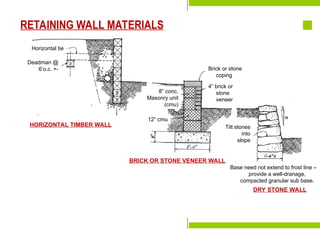
Horizontal tie
Deadman @
6’o.c. +- Brick or stone
coping
Tilt stones
into
slope
4” brick or
stone
veneer
8” conc.
Masonry unit
(cmu)
12” cmu
HORIZONTAL TIMBER WALL
BRICK OR STONE VENEER WALL
DRY STONE WALL
Base need not extend to frost line –
provide a well-dranage,
compacted granular sub base.
RETAINING WALL MATERIALS
Preparation for
Construction
Staking-Out the Building
Laying the Batterboards
Formwork & Shoring
Construction Tools &
Equipment
Major Parts of a Building
Foundation Bed
Site Investigation
Soil mechanics
Excavation & Earthworking
Site Drainage
Slope Protection and
Retaining Structures
Pavements
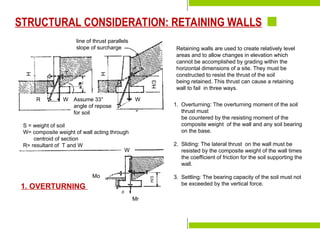
STRUCTURAL CONSIDERATION: RETAINING WALLS
Retaining walls are used to create relatively level
areas and to allow changes in elevation which
cannot be accomplished by grading within the
horizontal dimensions of a site. They must be
constructed to resist the thrust of the soil
being retained. This thrust can cause a retaining
wall to fail in three ways.
1. Overturning: The overturning moment of the soil
thrust must
be countered by the resisting moment of the
composite weight of the wall and any soil bearing
on the base.
2. Sliding: The lateral thrust on the wall must be
resisted by the composite weight of the wall times
the coefficient of friction for the soil supporting the
wall.
3. Settling: The bearing capacity of the soil must not
be exceeded by the vertical force.
line of thrust parallels
slope of surcharge
S = weight of soil
W= composite weight of wall acting through
centroid of section
R= resultant of T and W
R Assume 33°
angle of repose
for soil
W W
H
H
H/3
W
Mr
H/3
Mo
d
1. OVERTURNING
Preparation for
Construction
Staking-Out the Building
Laying the Batterboards
Formwork & Shoring
Construction Tools &
Equipment
Major Parts of a Building
Foundation Bed
Site Investigation
Soil mechanics
Excavation & Earthworking
Site Drainage
Slope Protection and
Retaining Structures
Pavements
2. SLIDING
Soil in front of wall aids in
resisting lateral force T
Drainage is required to relieve
water pressure behind wall
8” min.
Batter
optional
Temperature
steel
Structural
steel reinf.
Porous gravel
backfill
Filter fabric
2” diameter
weepholes @ 4’
– 6’o.c. OR
Drain pipe sloped to
outlet away from
wall
Footing should extend 2’
below the lower grade
Batter refer to the sloping face of a wall
which an offset the illusion of a
vertical face leaning forward
1 to 2
12
2” min.
3” min.
REINFORCED CONCRETE RETAINING WALL
3. SETTLING
STRUCTURAL CONSIDERATION: RETAINING WALLS
Preparation for
Construction
Staking-Out the Building
Laying the Batterboards
Formwork & Shoring
Construction Tools &
Equipment
Major Parts of a Building
Foundation Bed
Site Investigation
Soil mechanics
Excavation & Earthworking
Site Drainage
Slope Protection and
Retaining Structures
Pavements
10” 8”
0.5 H
GRAVITY WALL L-TYPE WALL
0.7H
1.0 H w/ surcharge
H
0.6 H
(0.9 H w/ surcharge)
1’.0”
(1.25 H w/ surcharge)
STRUCTURAL CONSIDERATION: RETAINING WALLS
T-TYPE CANTILEVERED
Preparation for
Construction
Staking-Out the Building
Laying the Batterboards
Formwork & Shoring
Construction Tools &
Equipment
Major Parts of a Building
Foundation Bed
Site Investigation
Soil mechanics
Excavation & Earthworking
Site Drainage
Slope Protection and
Retaining Structures
Pavements
PAVEMENTS
Paving provides a wearing surface for pedestrian
or vehicular traffic on a site.
1. The Subgrade – which must ultimately carry the
pavement load, should be undisturbed soil or
compacted fil.
2. The base – is a foundation of well-graded aggre-
gate that transfers the pavement load to the
subgrade. It also prevents the upward migration
of capillarry water.
3. The pavement– receives the traffic wear, protects
the base, and transfers its load to the base structure.
There are two types of pavement: flexible and rigid.
Flexible pavements, such as bituminous concrete or
unit pavers on a sand setting bed. Rigid pavements,
such as reinforced concrete slabs or paving units
mortared over a broad area.
Preparation for
Construction
Staking-Out the Building
Laying the Batterboards
Formwork & Shoring
Construction Tools &
Equipment
Major Parts of a Building
Foundation Bed
Site Investigation
Soil mechanics
Excavation & Earthworking
Site Drainage
Slope Protection and
Retaining Structures
Pavements
raised curb
flush divider raised pavement
EDGE CONDITIONS
Slope for drainage
0.3% min.; 1% preferred;
highly textured pavements may require a
steeper ( 2%) slope for drainage.
Slopes: 0% - 3% preferred; 5% maximum
Ramps: 5% - 8% ; use only where climatic
conditions permit
3%
33
5%
20
8%
12.5
Flexible pavements require wood, steel,
stone, masonry, or concrete edging to
restrain the horizontal movement of the
paving material.
Rigid pavements require reinforcement and
an extension of the base material along
their edges.
Additional notes:
• Pavement color and texture are important aesthetic
considerations which also affect the pavement’s
absorption or reflection of heat and light.
• Avoid surface irregularities for wheelchair traffic.
• Provide tactile warning strips for the visually impaired at
grade changes and hazardous vehicular area.
PAVEMENTS
Preparation for
Construction
Staking-Out the Building
Laying the Batterboards
Formwork & Shoring
Construction Tools &
Equipment
Major Parts of a Building
Foundation Bed
Site Investigation
Soil mechanics
Excavation & Earthworking
Site Drainage
Slope Protection and
Retaining Structures
Pavements
Brick Paver Concrete Unit Paver
Interlocking Paver Granite Cobble
UNIT PAVING DETAILS
Grid or Turf Block Cut Stone
PAVING MATERIALS: Consult local supplier for availability of shapes, sizes, colors, textures, absoption properties,
compressive strength, and installation recommendations.
running bond herringbone basketweave herringbone 1000
random
basketweave stack bond basketweave diagonal square 1000
running bond
Unit Pavers
PAVING PATTERNS
Interlocking Pavers Cut Stone
Preparation for
Construction
Staking-Out the Building
Laying the Batterboards
Formwork & Shoring
Construction Tools &
Equipment
Major Parts of a Building
Foundation Bed
Site Investigation
Soil mechanics
Excavation & Earthworking
Site Drainage
Slope Protection and
Retaining Structures
Pavements
brick or conc. Pavers w/ handtight
Or 1/8”-1/4” sand swept joints
1”-2” sand setting bed
2”-6” compacted aggregate
where required in high traffic
wreas or over expansive soil
unit pavers as above
compacted subgrade or
undisturbed soil
¾” bituminous setting bed
4”-6” conc. slab
compacted aggregate, if req’d.
turf block
topsoil mix for grass or ground cover
2” sand setting bed
2”-6” compacted aggregate
PAVING DETAILS
paving unit on mortar
bed, set on edge or
laid flat
conc. Grade beam
w/ exp. jts.
paving unit set
vertically on mortar
bed – may extend up
to ½ of paver ht. to
form curb
conc. or mortar ft’g.
(provide gravel under
footing if frost depth
is deeper than footing)
2x,4x, or 6x pressure
treated wood edge
depth varies w/
paving material
2x2 or 2x4 p.t.
wood stakes, 24” long,
@ 3’-4’ o.c.
EDGE CONDITIONS
FLEXIBLE BASE
RIGID BASE
TURP BASE
Preparation for
Construction
Staking-Out the Building
Laying the Batterboards
Formwork & Shoring
Construction Tools &
Equipment
Major Parts of a Building
Foundation Bed
Site Investigation
Soil mechanics
Excavation & Earthworking
Site Drainage
Slope Protection and
Retaining Structures
Pavements
END
THANK YOU

02-review on PREPARATION-FOR-CONSTRUCTION.ppt

  • 1.
    Preparation for Construction Staking-Out theBuilding Laying the Batterboards Formwork & Shoring Construction Tools & Equipment Major Parts of a Building Foundation Bed Site Investigation Soil mechanics Excavation & Earthworking Site Drainage Slope Protection and Retaining Structures Pavements PREPARATION FOR CONSTRUCTION 02 This teaching material is a compilation of information from journals, books, magazines, internet, several review centers and other sources of publication for the purpose of further studying architecture. ArcStudio, its offices, members and lecturers assumes no liability whatsoever and do not claim any express or implied authorship, patents relating to all contents found herein. Some content herein maybe claim by the rightful owners.
  • 2.
    Preparation for Construction Staking-Out theBuilding Laying the Batterboards Formwork & Shoring Construction Tools & Equipment Major Parts of a Building Foundation Bed Site Investigation Soil mechanics Excavation & Earthworking Site Drainage Slope Protection and Retaining Structures Pavements PREPARATION FOR CONSTRUCTION STAKING-OUT THE BUILDING 1. Measure the required setback from the front corner monuments. Drive two stakes and stretch a string between them to represent the front building line. 2. Measure the required side setback from one of the side lot lines along the front building line. Drive stake A which will represent the first corner of the building. From Stake A, measure the width of the building and mark with stake B to obtain the other front corner. 3. Estimate right angles from stakes A and B and measure the length of the building. In those two points, drive two temporary stakes C and D which will mark the rear corners of the building. C-D should be equal to A-B. 4. Draw lines along the diagonals A-D and B-C and ensure that these are equal. 5. Transfer the building lines to batter boards. Before staking-out, it is advisable to go through the process of relocating the point of boundaries and property line of the site where the building is to be constructed. Staking-out is the driving of stakes for batter boards to locate the corners and foundations of a building for excavation. Preparation for Construction Staking-Out the Building Laying the Batterboards Formwork & Shoring Construction Tools & Equipment Major Parts of a Building Foundation Bed Site Investigation Soil mechanics Excavation & Earthworking Site Drainage Slope Protection and Retaining Structures Pavements Stakes – are wooden sticks used as posts sharpened at one end driven into the ground to serve as boundaries or supports of the batter boards. Strings – are either plastic cords or galvanized wires strung across batter boards and used to indicate the outline of the building wall and foundation.
  • 3.
    Preparation for Construction Staking-Out theBuilding Laying the Batterboards Formwork & Shoring Construction Tools & Equipment Major Parts of a Building Foundation Bed Site Investigation Soil mechanics Excavation & Earthworking Site Drainage Slope Protection and Retaining Structures Pavements LAYING THE BATTERBOARDS LAYING THE BATTERBOARDS Batter Boards – wood sticks or boards nailed horizontally at the stake which serve as the horizontal plane where the reference point of the building measurements are established. BATTER BOARDS • horizontal boards • establishes height of the footing trenches and foundations • establishes height of finish floor levels LEVELING • done with a line level or carpenter’s level, or with a transit • height of the batter boards may be level with or a little higher that the top of the finished foundation. Preparation for Construction Staking-Out the Building Laying the Batterboards Formwork & Shoring Construction Tools & Equipment Major Parts of a Building Foundation Bed Site Investigation Soil mechanics Excavation & Earthworking Site Drainage Slope Protection and Retaining Structures Pavements
  • 4.
    Preparation for Construction Staking-Out theBuilding Laying the Batterboards Formwork & Shoring Construction Tools & Equipment Major Parts of a Building Foundation Bed Site Investigation Soil mechanics Excavation & Earthworking Site Drainage Slope Protection and Retaining Structures Pavements Notes: Spirit Level – an instrument or tool capable of vertical and horizontal line check. Plumb Bob – a weight attached to a string, used for vertical line check. Plastic Hose Filled With Water – a method of leveling horizontally batter boards without transit. 3-4-5 Multiples With the Use of Steel Tape Measure – a manual method of squaring the corners of building lines in staking. Preparation for Construction Staking-Out the Building Laying the Batterboards Formwork & Shoring Construction Tools & Equipment Major Parts of a Building Foundation Bed Site Investigation Soil mechanics Excavation & Earthworking Site Drainage Slope Protection and Retaining Structures Pavements PLUMB BOB
  • 5.
    Preparation for Construction Staking-Out theBuilding Laying the Batterboards Formwork & Shoring Construction Tools & Equipment Major Parts of a Building Foundation Bed Site Investigation Soil mechanics Excavation & Earthworking Site Drainage Slope Protection and Retaining Structures Pavements FORMWORK AND SHORING FORMWORK AND SHORING Formwork - used to shape and support fresh concrete until cured and able to support itself. Shoring - temporary supports designed to carry forms for beams and slabs. Phenolic resin or phenol-formaldehyde resin – is a thermosetting, waterproof, low-cost, mold-resistant, high strength synthetic resin made from phenol and formaldehyde; has good resistance to aging; used extensively in the manufacture of adhesives, exterior and marine plywood, laminated products, and molded articles. Preparation for Construction Staking-Out the Building Laying the Batterboards Formwork & Shoring Construction Tools & Equipment Major Parts of a Building Foundation Bed Site Investigation Soil mechanics Excavation & Earthworking Site Drainage Slope Protection and Retaining Structures Pavements FORMS FOR CONCRETE CONSTRUCTION. Materials used for form construction are: 1. LUMBER FORMS • should only be partially seasoned. 2. PLYWOOD FORMS. • used where a smooth surface is required • should be waterproof, Grade “A” and at least ½” thick. 3. STEEL FORMS • may be in the form of pans for concrete joist construction or steel decking or corrugated steel for concrete slabs and slab-and-joist construction. 4. FIBER BOARDS 5. PHENOLIC BOARDS
  • 6.
    Preparation for Construction Staking-Out theBuilding Laying the Batterboards Formwork & Shoring Construction Tools & Equipment Major Parts of a Building Foundation Bed Site Investigation Soil mechanics Excavation & Earthworking Site Drainage Slope Protection and Retaining Structures Pavements TWO MAJOR MATERIALS USED FOR FORMS AND TWO MAJOR MATERIALS USED FOR FORMS AND SHORING CONSTRUCTION ARE: SHORING CONSTRUCTION ARE: (1) LUMBER (2) STEEL. 1.3.1 Lumber Forms and Shoring • partially seasoned and to some extent slightly wet in order to prevent swelling and distortion of the forms; • dressed at least one side and both edges even for non-exposed surfaces; • joints in forms for columns, beams, and girders made tight by dressing the lumber true to edge, forming square or butt joints; tight joints in floor and wall panels obtained by using tongue-and grooved stock; • sizes of lumber used are: 2-in.stock for columns, beams and girder bottoms; 1-in. stock for floor panels and beam and girder sides; 2x4s for struts, posts, shores, and uprights; 1 or 2-inch stock for cleats; • crude oil and petroline are used to prevent concrete from adhering to the wood and preserve the forms against damage by alternate wetting and drying; on forms against surfaces which are to be plastered, wetting with water will be sufficient since oiling prevents adhesion of the plaster; • wire ties or bolts and rods are used to hold wall forms together; rods are preferred and should be arranged that upon removal of the forms, no metal shall be within one inch of any surface; wire ties should be used only on light and unimportant work where discoloring will not be objectionable; • plywood forms used where a smooth surface is required; should be waterproof, Grade “A” and at least ½” thick. Preparation for Construction Staking-Out the Building Laying the Batterboards Formwork & Shoring Construction Tools & Equipment Major Parts of a Building Foundation Bed Site Investigation Soil mechanics Excavation & Earthworking Site Drainage Slope Protection and Retaining Structures Pavements
  • 7.
    Preparation for Construction Staking-Out theBuilding Laying the Batterboards Formwork & Shoring Construction Tools & Equipment Major Parts of a Building Foundation Bed Site Investigation Soil mechanics Excavation & Earthworking Site Drainage Slope Protection and Retaining Structures Pavements Knee Brace Ledger Blocking Kicker Sills PLYWOOD FORMS WOOD SHORING METAL SHORING Braced T- and L-heads Single Post Wood Shore Metal or Wood Joists Stringers Jack Adjustable Metal Shores Bracing Preparation for Construction Staking-Out the Building Laying the Batterboards Formwork & Shoring Construction Tools & Equipment Major Parts of a Building Foundation Bed Site Investigation Soil mechanics Excavation & Earthworking Site Drainage Slope Protection and Retaining Structures Pavements
  • 8.
    Preparation for Construction Staking-Out theBuilding Laying the Batterboards Formwork & Shoring Construction Tools & Equipment Major Parts of a Building Foundation Bed Site Investigation Soil mechanics Excavation & Earthworking Site Drainage Slope Protection and Retaining Structures Pavements COLUMN FORMS WALL FORMS WOOD FORMWORKS Reusable forms may have a square or rectangular cross section YOKES are clamping devices for keeping column forms and tops of wall forms from spreading under the fluid pressure of newly placed concrete SPREADERS usually of wood, space and keep the wall or forms apart FORM TIES PLYWOOD SHEATHING WOOD STUDS HORIZONTAL WALERS SILL PLATE BRACING Preparation for Construction Staking-Out the Building Laying the Batterboards Formwork & Shoring Construction Tools & Equipment Major Parts of a Building Foundation Bed Site Investigation Soil mechanics Excavation & Earthworking Site Drainage Slope Protection and Retaining Structures Pavements
  • 9.
    Preparation for Construction Staking-Out theBuilding Laying the Batterboards Formwork & Shoring Construction Tools & Equipment Major Parts of a Building Foundation Bed Site Investigation Soil mechanics Excavation & Earthworking Site Drainage Slope Protection and Retaining Structures Pavements FORM TIES SNAP TIES have notches or crimps that allow their ends to be snapped off below the concrete surface after stripping off the forms small, truncated cones of wood, steel or plastic attached to form ties to space and spread wall forms, leave a neatly finished depression in the concrete surface to be filled or left exposed SHE BOLTS consist of waler rods that are inserted through the form and threaded onto the ends of an inner rod. After stripping, the waler rods are removed for reuse while the inner rod remains in the concrete a variety of wedges and slotted devices tighten the formwork and transfer the force in a form tie to the walers Preparation for Construction Staking-Out the Building Laying the Batterboards Formwork & Shoring Construction Tools & Equipment Major Parts of a Building Foundation Bed Site Investigation Soil mechanics Excavation & Earthworking Site Drainage Slope Protection and Retaining Structures Pavements
  • 10.
    Preparation for Construction Staking-Out theBuilding Laying the Batterboards Formwork & Shoring Construction Tools & Equipment Major Parts of a Building Foundation Bed Site Investigation Soil mechanics Excavation & Earthworking Site Drainage Slope Protection and Retaining Structures Pavements The major components of metal shoring are: a) The ledger or the horizontal brace b) The brace or the diagonal. This component may be of the adjustable and the fixed type. c) The standard or the vertical component. d) Accessories: heads, jacks and bases. Preparation for Construction Staking-Out the Building Laying the Batterboards Formwork & Shoring Construction Tools & Equipment Major Parts of a Building Foundation Bed Site Investigation Soil mechanics Excavation & Earthworking Site Drainage Slope Protection and Retaining Structures Pavements Steel Forms and Shoring Shoring is also used to support scaffolding works. Scaffolds are temporary platforms designed to support workers and materials on the face of a structure and to provide access to work areas above the ground. Any elevated platform is called a scaffold.
  • 11.
    Preparation for Construction Staking-Out theBuilding Laying the Batterboards Formwork & Shoring Construction Tools & Equipment Major Parts of a Building Foundation Bed Site Investigation Soil mechanics Excavation & Earthworking Site Drainage Slope Protection and Retaining Structures Pavements SHORING COMPONENTS Ledgers Standards Fixed Braces Adjustable Braces Preparation for Construction Staking-Out the Building Laying the Batterboards Formwork & Shoring Construction Tools & Equipment Major Parts of a Building Foundation Bed Site Investigation Soil mechanics Excavation & Earthworking Site Drainage Slope Protection and Retaining Structures Pavements
  • 12.
    Preparation for Construction Staking-Out theBuilding Laying the Batterboards Formwork & Shoring Construction Tools & Equipment Major Parts of a Building Foundation Bed Site Investigation Soil mechanics Excavation & Earthworking Site Drainage Slope Protection and Retaining Structures Pavements Rapidshor Heads Base & Tilt Base Adjustable Jacks SHORING COMPONENTS Preparation for Construction Staking-Out the Building Laying the Batterboards Formwork & Shoring Construction Tools & Equipment Major Parts of a Building Foundation Bed Site Investigation Soil mechanics Excavation & Earthworking Site Drainage Slope Protection and Retaining Structures Pavements
  • 13.
    Preparation for Construction Staking-Out theBuilding Laying the Batterboards Formwork & Shoring Construction Tools & Equipment Major Parts of a Building Foundation Bed Site Investigation Soil mechanics Excavation & Earthworking Site Drainage Slope Protection and Retaining Structures Pavements 1. Ensure the ground and sleepers are adequately prepared, and the base, jacks and standards are in correct positions. 2. Assemble tower of 4 standards and ledgers. Fix braces to stabilize. 3. Loosely fit the remaining components until majority of first level complete. Check standards for verticality and tighten ledgers. 4. Position scaffold boards and ladders. 5. Additional ledgers and braces can now be added, with additional braces. 6. Once all levels are complete, jacks and heads can now be positioned. 7. Jack head levels finalized and any jack bracing required is now fitted. 8. Primary beams can be positioned, clamped and levels checked. 9. Secondary beams can be positioned and clamped to primary beams, plywood decking to follow. SHORING ASSEMBLY INSTRUCTIONS Preparation for Construction Staking-Out the Building Laying the Batterboards Formwork & Shoring Construction Tools & Equipment Major Parts of a Building Foundation Bed Site Investigation Soil mechanics Excavation & Earthworking Site Drainage Slope Protection and Retaining Structures Pavements
  • 14.
    Preparation for Construction Staking-Out theBuilding Laying the Batterboards Formwork & Shoring Construction Tools & Equipment Major Parts of a Building Foundation Bed Site Investigation Soil mechanics Excavation & Earthworking Site Drainage Slope Protection and Retaining Structures Pavements CONSTRUCTION TOOLS & EQUIPMENT CONSTRUCTION TOOLS & EQUIPMENT Tools and equipment employed in construction are grouped into four: 1. Hand Tools are the tools that use power delivered by man only. 2. Power Tools are those that employ power supplied by forces other than that coming from humans. 3. Equipment is a term that refers to large, complex tools and machines that is designed to do a particular job. 4. Heavy Equipment is equipment which is very large and very powerful. Preparation for Construction Staking-Out the Building Laying the Batterboards Formwork & Shoring Construction Tools & Equipment Major Parts of a Building Foundation Bed Site Investigation Soil mechanics Excavation & Earthworking Site Drainage Slope Protection and Retaining Structures Pavements
  • 15.
    Preparation for Construction Staking-Out theBuilding Laying the Batterboards Formwork & Shoring Construction Tools & Equipment Major Parts of a Building Foundation Bed Site Investigation Soil mechanics Excavation & Earthworking Site Drainage Slope Protection and Retaining Structures Pavements Hand Tools Hand Tools A pry bar is used to force open boards used in forming concrete. Measurement and layout tools are the following: a. Folding rule and tape measure are the most common tools for measuring boards, pipe, wire, etc. b. Digital rule is used to measure relatively long distances such as those in highway construction. c. Framing square is a layout tool that is used to measure 90- degree angles at the corners of framework and joints. They can also be employed to determine cutting angles on dimension lumber. d. Level is a long, straight tool that contains one or more vials of liquid and used to determine if the horizontal or vertical is exact. e. Chalk line or chalk box is used for marking lines. Preparation for Construction Staking-Out the Building Laying the Batterboards Formwork & Shoring Construction Tools & Equipment Major Parts of a Building Foundation Bed Site Investigation Soil mechanics Excavation & Earthworking Site Drainage Slope Protection and Retaining Structures Pavements
  • 16.
    Preparation for Construction Staking-Out theBuilding Laying the Batterboards Formwork & Shoring Construction Tools & Equipment Major Parts of a Building Foundation Bed Site Investigation Soil mechanics Excavation & Earthworking Site Drainage Slope Protection and Retaining Structures Pavements Types of hammers are the following: a. Claw hammer is an ordinary hammer used to drive or remove nails. b. Sledgehammer is a heavy hammer used to drive stakes into the ground and to break up concrete and stone. Types of screwdrivers are: a. Standard screwdriver has a flat tip and is designed to fit a standard slotted screw. b. Phillips screwdriver has an X-shaped tip and is used to turn Phillips-head screws only. c. Spiral ratchet screwdriver is that which relies on a pushing force rather than a twisting force. Preparation for Construction Staking-Out the Building Laying the Batterboards Formwork & Shoring Construction Tools & Equipment Major Parts of a Building Foundation Bed Site Investigation Soil mechanics Excavation & Earthworking Site Drainage Slope Protection and Retaining Structures Pavements
  • 17.
    Preparation for Construction Staking-Out theBuilding Laying the Batterboards Formwork & Shoring Construction Tools & Equipment Major Parts of a Building Foundation Bed Site Investigation Soil mechanics Excavation & Earthworking Site Drainage Slope Protection and Retaining Structures Pavements Types of handsaws are the following: a. Ripsaw has chisel-like teeth designed for ripping or cutting with the grain of wood. b. Crosscut saw is used to cut across the grain of wood. c. Backsaw is a special type of handsaw that has a very thin blade and makes very straight cuts such as those on trims and mouldings. d. Hacksaw is used to cut metals. Preparation for Construction Staking-Out the Building Laying the Batterboards Formwork & Shoring Construction Tools & Equipment Major Parts of a Building Foundation Bed Site Investigation Soil mechanics Excavation & Earthworking Site Drainage Slope Protection and Retaining Structures Pavements
  • 18.
    Preparation for Construction Staking-Out theBuilding Laying the Batterboards Formwork & Shoring Construction Tools & Equipment Major Parts of a Building Foundation Bed Site Investigation Soil mechanics Excavation & Earthworking Site Drainage Slope Protection and Retaining Structures Pavements Types of Chisels: a. Wood chisel is used to trim wood and clear away excess material from wood joints. b. Cold chisel is used to trim metals. Types of specialized hand tools are the following: a. Nail set is used to drive finishing nails below the surface of a wooden trim or molding. b. Pipe wrench is used to turn round objects like pipes. c. Brick trowel is used to place and trim mortar between bricks or concrete blocks. d. Bull float is used to smoothen out the surface of wet concrete. e. Blind riveter is used to fasten pieces of sheet metal together. Preparation for Construction Staking-Out the Building Laying the Batterboards Formwork & Shoring Construction Tools & Equipment Major Parts of a Building Foundation Bed Site Investigation Soil mechanics Excavation & Earthworking Site Drainage Slope Protection and Retaining Structures Pavements
  • 19.
    Preparation for Construction Staking-Out theBuilding Laying the Batterboards Formwork & Shoring Construction Tools & Equipment Major Parts of a Building Foundation Bed Site Investigation Soil mechanics Excavation & Earthworking Site Drainage Slope Protection and Retaining Structures Pavements Power drill. Power screwdriver. Radial arm saw. Table saw. Portable circular saw. Power miter saw. Saber saw. 2. Power Tools Power drill is used to drill holes in wood, metal and concrete. Power screwdriver or screwgun is used to install and remove screws. Types of power saws are the following: a. Radial arm saw is used for crosscutting wood and consists of a motor-driven saw blade that is hung on an arm over a table. b. Table saw is used for cutting large sheets of wood and wood composites and consists of a blade mounted on an electric motor beneath a table-like surface. c. Portable circular saw is used for cutting materials that are difficult to cut with stationary tools. d. Power miter saw is a circular saw mounted over a small table used to cut various angles in wood. e. Saber saw is used to cut curves or holes in floors and roofs for pipes and has a small knife- shaped blade that moves up and down. Preparation for Construction Staking-Out the Building Laying the Batterboards Formwork & Shoring Construction Tools & Equipment Major Parts of a Building Foundation Bed Site Investigation Soil mechanics Excavation & Earthworking Site Drainage Slope Protection and Retaining Structures Pavements
  • 20.
    Preparation for Construction Staking-Out theBuilding Laying the Batterboards Formwork & Shoring Construction Tools & Equipment Major Parts of a Building Foundation Bed Site Investigation Soil mechanics Excavation & Earthworking Site Drainage Slope Protection and Retaining Structures Pavements Pneumatic hammer. Rotary hammer. Pneumatic nailer Powder-actuated stud driver. Stapler. Type of power hammers are: a. Pneumatic hammer or jackhammer is used to break up concrete or asphalt paving. Type of power nailers and staplers are the following: a. Nailers or nail guns fasten materials together by shooting nails into the building material. b. Powder-actuated stud driver is a kind of nailer that is powered by gunpowder and is used to drive long pins into wood, steel or concrete. c. Staplers are like nailers but are loaded with u- shaped staples instead of nails for fastening. b. Rotary hammer is like an electric drill that operates with both rotating and reciprocating actions and is used to drill holes in concrete. Preparation for Construction Staking-Out the Building Laying the Batterboards Formwork & Shoring Construction Tools & Equipment Major Parts of a Building Foundation Bed Site Investigation Soil mechanics Excavation & Earthworking Site Drainage Slope Protection and Retaining Structures Pavements
  • 21.
    Preparation for Construction Staking-Out theBuilding Laying the Batterboards Formwork & Shoring Construction Tools & Equipment Major Parts of a Building Foundation Bed Site Investigation Soil mechanics Excavation & Earthworking Site Drainage Slope Protection and Retaining Structures Pavements Conveyors are used for transporting materials unto large roofs. Construction laser. Transit. Surveyors level. 3. Equipment Conveyor is an equipment which moves materials other than fluids. Types of surveying equipment: a. Transit is an equipment used by surveyors to measure horizontal and vertical angles to obtain land elevation. b. Surveyor’s level is that which is used to determine an unidentified elevation from a known one. c. Construction laser flashes a narrow, accurate beam of light to make a baseline for additional measurements and is used as a level or as an alignment tool. Preparation for Construction Staking-Out the Building Laying the Batterboards Formwork & Shoring Construction Tools & Equipment Major Parts of a Building Foundation Bed Site Investigation Soil mechanics Excavation & Earthworking Site Drainage Slope Protection and Retaining Structures Pavements
  • 22.
    Preparation for Construction Staking-Out theBuilding Laying the Batterboards Formwork & Shoring Construction Tools & Equipment Major Parts of a Building Foundation Bed Site Investigation Soil mechanics Excavation & Earthworking Site Drainage Slope Protection and Retaining Structures Pavements Concrete pump. Water pump. Types of pumps are: a. Water pump is used to pump water out of holes in the ground so that construction work can commence. b. Concrete pump is used to move concrete from the concrete mixer to the concrete form. Preparation for Construction Staking-Out the Building Laying the Batterboards Formwork & Shoring Construction Tools & Equipment Major Parts of a Building Foundation Bed Site Investigation Soil mechanics Excavation & Earthworking Site Drainage Slope Protection and Retaining Structures Pavements
  • 23.
    Preparation for Construction Staking-Out theBuilding Laying the Batterboards Formwork & Shoring Construction Tools & Equipment Major Parts of a Building Foundation Bed Site Investigation Soil mechanics Excavation & Earthworking Site Drainage Slope Protection and Retaining Structures Pavements Concrete Mixer (Cement Mixer) A machine that mixes concrete ingredients by means of a rotating drum. Raw materials are introduced into the mixing drum through its open end and discharged by tilting the mixing drum to allow the concrete to pour out. Types of welding machines are the following: a. Arc welding machine is used to weld materials by melting portions of the metal. Arc welding machine. Weld made by a laser- powered welder. b. Laser-powered welder is used to weld material by employing a laser to heat the metal. Preparation for Construction Staking-Out the Building Laying the Batterboards Formwork & Shoring Construction Tools & Equipment Major Parts of a Building Foundation Bed Site Investigation Soil mechanics Excavation & Earthworking Site Drainage Slope Protection and Retaining Structures Pavements
  • 24.
    Preparation for Construction Staking-Out theBuilding Laying the Batterboards Formwork & Shoring Construction Tools & Equipment Major Parts of a Building Foundation Bed Site Investigation Soil mechanics Excavation & Earthworking Site Drainage Slope Protection and Retaining Structures Pavements Bulldozer. 640-foot crane. 4. Heavy Equipment Bulldozer is a tractor with a pushing blade which moves earth and clears land of bushes and trees. a. Crawler crane is a crane mounted on metal treads so that it can move over rough terrain. b. Truck crane is mounted on a truck frame so that it can be driven in the site. c. Tower crane or climbing crane is used in the construction of tall building because it has a built-in jack that raises the crane from floor to floor as the building is constructed. Cranes are machines that lift large and heavy materials. The types of cranes are: Preparation for Construction Staking-Out the Building Laying the Batterboards Formwork & Shoring Construction Tools & Equipment Major Parts of a Building Foundation Bed Site Investigation Soil mechanics Excavation & Earthworking Site Drainage Slope Protection and Retaining Structures Pavements
  • 25.
    Preparation for Construction Staking-Out theBuilding Laying the Batterboards Formwork & Shoring Construction Tools & Equipment Major Parts of a Building Foundation Bed Site Investigation Soil mechanics Excavation & Earthworking Site Drainage Slope Protection and Retaining Structures Pavements Excavator is a machine used for digging or scooping earth from a place and depositing it in another. Types of excavators are: a. Backhoe is used for general digging which is usually mounted on either a crawler or truck frame. b. Trencher is a special kind which digs trenches or long, narrow ditches for pipelines or cables. c. Front-end loader is a large shoveling machine that can scoop or deposit a large amount of material. Trencher-excavator. Backhoe. Front-end loader. Preparation for Construction Staking-Out the Building Laying the Batterboards Formwork & Shoring Construction Tools & Equipment Major Parts of a Building Foundation Bed Site Investigation Soil mechanics Excavation & Earthworking Site Drainage Slope Protection and Retaining Structures Pavements
  • 26.
    Preparation for Construction Staking-Out theBuilding Laying the Batterboards Formwork & Shoring Construction Tools & Equipment Major Parts of a Building Foundation Bed Site Investigation Soil mechanics Excavation & Earthworking Site Drainage Slope Protection and Retaining Structures Pavements Highway construction equipment are: a. Scraper is a machine that loads, hauls and dumps soil over medium to long distances. b. Grader is an earthworking machine that grades or levels the ground. c. Compactor or roller is a machine that compacts soil to prepare for road paving. d. Paver is a machine that places, spreads and finishes concrete or asphalt paving material. Scraper. Grader. Preparation for Construction Staking-Out the Building Laying the Batterboards Formwork & Shoring Construction Tools & Equipment Major Parts of a Building Foundation Bed Site Investigation Soil mechanics Excavation & Earthworking Site Drainage Slope Protection and Retaining Structures Pavements Compactor
  • 27.
    Preparation for Construction Staking-Out theBuilding Laying the Batterboards Formwork & Shoring Construction Tools & Equipment Major Parts of a Building Foundation Bed Site Investigation Soil mechanics Excavation & Earthworking Site Drainage Slope Protection and Retaining Structures Pavements 1.5 MAJOR PARTS OF A BUILDING The major parts of a building are: 1. Superstructure – the portion of the building above the ground. 2. Substructure – the habitable portion of the building found below the ground. 3. Foundation – the structural portion of the building that transfer the buildings load into the soil. The three types of substructures are: 1. Slab on Fill – slab which rests on ground and not suspended. 2. Crawl Space – in a building without a basement, an unfinished accessible space below the first floor which is usually less than a full story height. 3. Basement – the lower story of a building, either partly or entirely below grade. SUPERSTRUCTURE SUBSTRUCTURE FOUNDATION Preparation for Construction Staking-Out the Building Laying the Batterboards Formwork & Shoring Construction Tools & Equipment Major Parts of a Building Foundation Bed Site Investigation Soil mechanics Excavation & Earthworking Site Drainage Slope Protection and Retaining Structures Pavements SLAB ON FILL BASEMENT CRAWL SPACE
  • 28.
    Preparation for Construction Staking-Out theBuilding Laying the Batterboards Formwork & Shoring Construction Tools & Equipment Major Parts of a Building Foundation Bed Site Investigation Soil mechanics Excavation & Earthworking Site Drainage Slope Protection and Retaining Structures Pavements 1.6 FOUNDATION BED The word “foundation” is applied to: Preparation for Construction Staking-Out the Building Laying the Batterboards Formwork & Shoring Construction Tools & Equipment Major Parts of a Building Foundation Bed Site Investigation Soil mechanics Excavation & Earthworking Site Drainage Slope Protection and Retaining Structures Pavements 1. Construction below grade, such as footing courses, basement walls, etc., forming the lower section of a structure; 2. The natural material, the particular part of the earth’s surface on which the construction rests; 3. Special construction such as piling or piers used to transmit the loads of the building to firm substrata.
  • 29.
    Preparation for Construction Staking-Out theBuilding Laying the Batterboards Formwork & Shoring Construction Tools & Equipment Major Parts of a Building Foundation Bed Site Investigation Soil mechanics Excavation & Earthworking Site Drainage Slope Protection and Retaining Structures Pavements Foundation bed - the natural material on which the construction rests Foundation walls - that part of the building foundation which forms the permanent retaining wall of the structure below grade. Foundation piers/columns – piers/columns below grade, to distinguish them from similar construction above grade Grade Beam - that part of a foundation system which supports the exterior wall of the superstructure and bears directly on the column footing. Footing courses - lower portions of walls, piers or columns which are spread to provide a safe base Preparation for Construction Staking-Out the Building Laying the Batterboards Formwork & Shoring Construction Tools & Equipment Major Parts of a Building Foundation Bed Site Investigation Soil mechanics Excavation & Earthworking Site Drainage Slope Protection and Retaining Structures Pavements CONCRETE FOUNDATION WALLS CONCRETE MASONRY FOUNDATION WALLS FOUNDATION WALL FOOTING
  • 30.
    Preparation for Construction Staking-Out theBuilding Laying the Batterboards Formwork & Shoring Construction Tools & Equipment Major Parts of a Building Foundation Bed Site Investigation Soil mechanics Excavation & Earthworking Site Drainage Slope Protection and Retaining Structures Pavements TYPES OF FOUNDATION BEDS Foundation beds may be classified as follows: Preparation for Construction Staking-Out the Building Laying the Batterboards Formwork & Shoring Construction Tools & Equipment Major Parts of a Building Foundation Bed Site Investigation Soil mechanics Excavation & Earthworking Site Drainage Slope Protection and Retaining Structures Pavements 1. Rock (solid rock, bedrock or ledge). Undisturbed rock masses forming an undisturbed part of the original rock-formation. Some examples of harder rocks are granite, slate, sandstone, and limestone which are all capable of carrying the load of any ordinary structure. Examples of softer rocks are shale, shaley slates and certain marley limestone and clay stones. 2. Decayed rock (rotten rock). Sand, clays and other materials resulting from the disintegration of rock masses, lacking the coherent qualities but occupying the space formerly occupied by the original rock. 3. Loose rock. Rock masses detached from the ledge of which they originally formed a part. 4. Gravel. Detached rock particles, generally water-worn, rounded and intermediate in size between sand particles and boulders. 5. Boulders. Detached rock masses larger than gravel, generally rounded and worn as a result of having been transported by water a considerable distance from the ledges of which they originally formed a part.
  • 31.
    Preparation for Construction Staking-Out theBuilding Laying the Batterboards Formwork & Shoring Construction Tools & Equipment Major Parts of a Building Foundation Bed Site Investigation Soil mechanics Excavation & Earthworking Site Drainage Slope Protection and Retaining Structures Pavements 6. Sand. Non-coherent rock particles smaller than ¼” in maximum dimension. 7. Clay. A plastic material resulting from the decomposition and hydration of feldspathic rocks, being hydrated silicate of alumina, generally mixed with powdered feldspar, quartz and other materials. 8. Hard-pan. Any strong coherent mixture of clay or other cementing material with sand, gravel and boulders. 9. Silt. A finely divided earthy material deposited from running water. 10. Mud. Finely divided earthy material generally containing vegetable matter and deposited from still or slowly moving water. 11. Mould. Earthy material containing a large proportion of humus or vegetable matter. 12. Loam. Earthy material containing a proportion of vegetable matter. 13. Peat. Compressed and partially carbonized vegetable matter. 14. Filled Ground. All artificial fills and some natural fills are liable to a more or less uniform but continuous settlement or shrinkage due to the gradual consolidation of the material of which the fill is composed Preparation for Construction Staking-Out the Building Laying the Batterboards Formwork & Shoring Construction Tools & Equipment Major Parts of a Building Foundation Bed Site Investigation Soil mechanics Excavation & Earthworking Site Drainage Slope Protection and Retaining Structures Pavements
  • 32.
    Preparation for Construction Staking-Out theBuilding Laying the Batterboards Formwork & Shoring Construction Tools & Equipment Major Parts of a Building Foundation Bed Site Investigation Soil mechanics Excavation & Earthworking Site Drainage Slope Protection and Retaining Structures Pavements ALLOWABLE LOADS ON FOUNDATION BEDS Preparation for Construction Staking-Out the Building Laying the Batterboards Formwork & Shoring Construction Tools & Equipment Major Parts of a Building Foundation Bed Site Investigation Soil mechanics Excavation & Earthworking Site Drainage Slope Protection and Retaining Structures Pavements Thorough investigation is required before one can determine the allowable unit load on the foundation bed. When material and conditions are uniform over the entire site of the building, a uniform unit load may be used. In cases when entirely different conditions exist under different portions of the same building, the unit load on the foundation bed must be reduced as much as possible so as to reduce the differences in settlements between the two sections of the building to a minimum.
  • 33.
    Preparation for Construction Staking-Out theBuilding Laying the Batterboards Formwork & Shoring Construction Tools & Equipment Major Parts of a Building Foundation Bed Site Investigation Soil mechanics Excavation & Earthworking Site Drainage Slope Protection and Retaining Structures Pavements SITE INVESTIGATION SITE INVESTIGATION Before any design is made, the architect is required to get as much valuable data about site excavation and building erection at the project site in order to determine the character of the materials which will be encountered at the level of a foundation bed. METHODS OF EXPLORATION 1. Test pits. For shallow work, an open pit is the most suitable method since it calls for an actual inspection of the undisturbed material over a considerable area. 2. Test borings. For excavations that are carried no deeper than the proposed level, the underlying material may be investigated by test boring. LOADING TESTS Loading tests of the materials forming the foundation bed are made to assist in determining its safe bearing capacity. Soil Boring Rig. SPT Sample. Preparation for Construction Staking-Out the Building Laying the Batterboards Formwork & Shoring Construction Tools & Equipment Major Parts of a Building Foundation Bed Site Investigation Soil mechanics Excavation & Earthworking Site Drainage Slope Protection and Retaining Structures Pavements
  • 34.
    Preparation for Construction Staking-Out theBuilding Laying the Batterboards Formwork & Shoring Construction Tools & Equipment Major Parts of a Building Foundation Bed Site Investigation Soil mechanics Excavation & Earthworking Site Drainage Slope Protection and Retaining Structures Pavements SOIL MECHANICS SOIL MECHANICS 1.8.1 CLASSES OF SOIL There are two broad classes of soil: A. Course-grained soil – consist of relatively large particles, visible to the naked eyes. B. Fine-grained soil – consist of much smaller particles, such as silt and clay. Preparation for Construction Staking-Out the Building Laying the Batterboards Formwork & Shoring Construction Tools & Equipment Major Parts of a Building Foundation Bed Site Investigation Soil mechanics Excavation & Earthworking Site Drainage Slope Protection and Retaining Structures Pavements
  • 35.
    Preparation for Construction Staking-Out theBuilding Laying the Batterboards Formwork & Shoring Construction Tools & Equipment Major Parts of a Building Foundation Bed Site Investigation Soil mechanics Excavation & Earthworking Site Drainage Slope Protection and Retaining Structures Pavements SOIL TYPE Presumed Bearing Capacity (tons/ft²) (kg/m²) Susceptibility to Frost Action Drainage (permeability) Compact, partially cemented gravels, well-graded with little or no fines 10 97 650 none excellent Compact gravel; gravel and sand mixtures 6 58 590 None excellent Coarse, compact sand; loose gravel; hard, dry clay 4 39 060 Slight Fair to good Coarse, loose sand and gravel mixtures; fine, compact sand 3 29 295 Slight Fair to good Fine, loose sand; dry, stiff clay 2 19 530 High Fair to poor Soft clay; soft, broken shale 1.5 14 648 High poor Organize soils Unsuitable as a foundation material; can be highly unstable due to bacterial decomposition and changes in moisture content. SOIL TYPE & CAPACITY
  • 36.
    Preparation for Construction Staking-Out theBuilding Laying the Batterboards Formwork & Shoring Construction Tools & Equipment Major Parts of a Building Foundation Bed Site Investigation Soil mechanics Excavation & Earthworking Site Drainage Slope Protection and Retaining Structures Pavements STABILITY AND STRENGTH OF SOIL BED is defined by the following criteria: A. Allowable Bearing Capacity – maximum unit pressure a foundation is permitted to impose vertically or laterally on the soil mass. B. Density – the critical factor determining the bearing capacity of granular soils. SPT - Standard Penetration Test - measures the density of granular soils and the consistency of some clays - records the number of blows required by a hammer to advance a standard soil sampler. MDD - Maximum Dry Density - Dry density is the density of soil, or the like, after it has been heated at a temperature of 221 deg F (105 deg C) to a dry condition. C. Shearing Strength – measure of the ability to resist displacement when an external force is applied, due largely to the combined effects of cohesion and internal friction. D. Water Table – level beneath which the soil is saturated with groundwater. Preparation for Construction Staking-Out the Building Laying the Batterboards Formwork & Shoring Construction Tools & Equipment Major Parts of a Building Foundation Bed Site Investigation Soil mechanics Excavation & Earthworking Site Drainage Slope Protection and Retaining Structures Pavements
  • 37.
    Preparation for Construction Staking-Out theBuilding Laying the Batterboards Formwork & Shoring Construction Tools & Equipment Major Parts of a Building Foundation Bed Site Investigation Soil mechanics Excavation & Earthworking Site Drainage Slope Protection and Retaining Structures Pavements EXCAVATION AND EARTHWORKING EXCAVATION AND EARTHWORKING These processes entail the following: 1. Excavating is the process of digging the earth to provide a place for the foundation of the building. 2. Leveling and Grading are processes that change land elevation and slope by filling in low spots and shaving off high spots. 3. Stabilizing the Soil is the process of compacting the soil on which the structure will rest. 4. The protection of adjoining structure is a law that provides that any person making an excavation is responsible for resulting damage to adjoining property. Preparation for Construction Staking-Out the Building Laying the Batterboards Formwork & Shoring Construction Tools & Equipment Major Parts of a Building Foundation Bed Site Investigation Soil mechanics Excavation & Earthworking Site Drainage Slope Protection and Retaining Structures Pavements
  • 38.
    Preparation for Construction Staking-Out theBuilding Laying the Batterboards Formwork & Shoring Construction Tools & Equipment Major Parts of a Building Foundation Bed Site Investigation Soil mechanics Excavation & Earthworking Site Drainage Slope Protection and Retaining Structures Pavements 5. Shoring is a process of transferring a portion of the load of the wall to temporary footings and done when the excavation does not go much below the adjoining footings and when the material is fairly solid. It consists of the following members: a) sheet piles, which are timber, steel, or pre-cast planks driven side by side to retain earth and prevent water from seeping into the exaction and b) wales or continuous horizontal beams which tie the sheet piles in place or c) soldier piles, which are steel H-sections driven vertically into the ground to support d) lagging or heavy timber planks joined together horizontally to retain the face of an excavation. e) crossbracing or rakers are diagonals which support the wales and soldier piles bearing on heel blocks or footings. f) tiebacks secured to rock or soil anchors are resorted to when crossbracing or rakers would interfere with the excavation procedure. Preparation for Construction Staking-Out the Building Laying the Batterboards Formwork & Shoring Construction Tools & Equipment Major Parts of a Building Foundation Bed Site Investigation Soil mechanics Excavation & Earthworking Site Drainage Slope Protection and Retaining Structures Pavements
  • 39.
    Preparation for Construction Staking-Out theBuilding Laying the Batterboards Formwork & Shoring Construction Tools & Equipment Major Parts of a Building Foundation Bed Site Investigation Soil mechanics Excavation & Earthworking Site Drainage Slope Protection and Retaining Structures Pavements STEEL TIMBER PRECAST SOLDIER PILES/BEAMS (STEEL H-SECTIONS) LAGGING refers to the heavy timber planks joined together side by side to retain the face of an excavation TIEBACKS SHEET PILING AND SOLDIER BEAMS WITH LAGGING SHEET PILING Preparation for Construction Staking-Out the Building Laying the Batterboards Formwork & Shoring Construction Tools & Equipment Major Parts of a Building Foundation Bed Site Investigation Soil mechanics Excavation & Earthworking Site Drainage Slope Protection and Retaining Structures Pavements
  • 40.
    Preparation for Construction Staking-Out theBuilding Laying the Batterboards Formwork & Shoring Construction Tools & Equipment Major Parts of a Building Foundation Bed Site Investigation Soil mechanics Excavation & Earthworking Site Drainage Slope Protection and Retaining Structures Pavements 6. Needling and underpinning is a process where needles or girders are used in cases where part or all of the weight of the wall has to be carried, as when the old footing is removed and the wall underpinned or carried down to a new footing at a greater depth. NEEDLE; a short beam passed through a wall as a temporary support while the foundation or part beneath is repaired, altered or strengthened DEAD SHORE; an upright timber for supporting a dead load during the structural alteration of a building, esp. one of two supports for a needle NEEDLING Preparation for Construction Staking-Out the Building Laying the Batterboards Formwork & Shoring Construction Tools & Equipment Major Parts of a Building Foundation Bed Site Investigation Soil mechanics Excavation & Earthworking Site Drainage Slope Protection and Retaining Structures Pavements
  • 41.
    Preparation for Construction Staking-Out theBuilding Laying the Batterboards Formwork & Shoring Construction Tools & Equipment Major Parts of a Building Foundation Bed Site Investigation Soil mechanics Excavation & Earthworking Site Drainage Slope Protection and Retaining Structures Pavements EXISTING WATER TABLE WATER TABLE AFTER PUMPING DEWATERING 7. Dewatering refers to the process of lowering a water table or preventing an excavation from filling with groundwater. It is accomplished by driving perforated tubes called wellpoints into the ground to collect water from the surrounding area so it can be pumped away. Preparation for Construction Staking-Out the Building Laying the Batterboards Formwork & Shoring Construction Tools & Equipment Major Parts of a Building Foundation Bed Site Investigation Soil mechanics Excavation & Earthworking Site Drainage Slope Protection and Retaining Structures Pavements
  • 42.
    Preparation for Construction Staking-Out theBuilding Laying the Batterboards Formwork & Shoring Construction Tools & Equipment Major Parts of a Building Foundation Bed Site Investigation Soil mechanics Excavation & Earthworking Site Drainage Slope Protection and Retaining Structures Pavements SITE DRAINAGE SITE DRAINAGE - necessary to prevent erosion and collection of excess surface water or groundwater resulting from new construction. Surface Water – 1. Rainfall which runs over the surface of the ground. 2. Water carried by an aggregate except that held by absorption within the aggregate particles themselves. Preparation for Construction Staking-Out the Building Laying the Batterboards Formwork & Shoring Construction Tools & Equipment Major Parts of a Building Foundation Bed Site Investigation Soil mechanics Excavation & Earthworking Site Drainage Slope Protection and Retaining Structures Pavements Groundwater – Water, near the surface of the ground , which passes through the subsoil. BASIC TYPES OF SITE DRAINAGE A. SUB-SURFACE DRAINAGE – consists of an underground network of piping for conveying groundwater to a point of disposal, as a storm sewer system or a natural outfall at a lower elevation on the site. Excess groundwater can reduce the load- carrying capacity of a foundation soil and increase the hydrostatic pressure on a building foundation. Waterproofing is required for basement structures situated close to or below the water table of a site.
  • 43.
    Preparation for Construction Staking-Out theBuilding Laying the Batterboards Formwork & Shoring Construction Tools & Equipment Major Parts of a Building Foundation Bed Site Investigation Soil mechanics Excavation & Earthworking Site Drainage Slope Protection and Retaining Structures Pavements Culverts are drains or channels passing under a road or walkway. Foundation drainage tile or pipe Tile or piping for the collection of sub- surface water, dispersion of septic tank effluent, and the like. Drainage tile is a hollow tile, usually laid end to end as piping (with open joints) in soil in order to drain water saturated soil, or used to permit fluid in the hollow-tile pipe to disperse into the ground (as in an absorption field). Preparation for Construction Staking-Out the Building Laying the Batterboards Formwork & Shoring Construction Tools & Equipment Major Parts of a Building Foundation Bed Site Investigation Soil mechanics Excavation & Earthworking Site Drainage Slope Protection and Retaining Structures Pavements AREA DRAIN CATCH BASINS CULVERTS CATCHMENTS SWALES Catch Basins receptacles for the runoff of surface water. They have a basin or sump that retains heavy sediment before it can pass into an underground drainpipe. Components of the sub-surface drainage system are:
  • 44.
    Preparation for Construction Staking-Out theBuilding Laying the Batterboards Formwork & Shoring Construction Tools & Equipment Major Parts of a Building Foundation Bed Site Investigation Soil mechanics Excavation & Earthworking Site Drainage Slope Protection and Retaining Structures Pavements B.SURFACE DRAINAGE refers to the grading and surfacing of a site in order to divert rain and other surface water into natural drainage patterns or a municipal storm sewer system. Grass and lawn areas are sloped 1.5% to 10%; while paved parking areas, 2% to 3%. A holding pond may be necessary when the amount of surface runoff exceeds the capacity of the storm sewer system. Components of the surface drainage system are: Swales shallow depressions formed by the intersection of two ground slopes, designed to direct or divert the runoff of surface water. Grass swales slope 1.5% to 2%; while paved swales, 4% to 6%. Preparation for Construction Staking-Out the Building Laying the Batterboards Formwork & Shoring Construction Tools & Equipment Major Parts of a Building Foundation Bed Site Investigation Soil mechanics Excavation & Earthworking Site Drainage Slope Protection and Retaining Structures Pavements SWALES
  • 45.
    Preparation for Construction Staking-Out theBuilding Laying the Batterboards Formwork & Shoring Construction Tools & Equipment Major Parts of a Building Foundation Bed Site Investigation Soil mechanics Excavation & Earthworking Site Drainage Slope Protection and Retaining Structures Pavements Area Drain receptacle designed to collect surface water or rainwater from an open area. Ponds and Marshes designed catchments areas for surface water. Preparation for Construction Staking-Out the Building Laying the Batterboards Formwork & Shoring Construction Tools & Equipment Major Parts of a Building Foundation Bed Site Investigation Soil mechanics Excavation & Earthworking Site Drainage Slope Protection and Retaining Structures Pavements Absorption Field or Disposal Field a system of trenches containing coarse aggregate and distribution pipes through which septic-tank effluent may seep into the surrounding soil. Absorption Trench a trench containing coarse aggregate and a distribution tile pipe through which septic-tank effluent may flow, covered with earth. DRY WELL Dry Wells are drainage pits lined with gravel or rubble to receive surface water and allow it to percolate away to absorbent earth underground. Also called an absorbing well. ABSORPTION TRENCH
  • 46.
    Preparation for Construction Staking-Out theBuilding Laying the Batterboards Formwork & Shoring Construction Tools & Equipment Major Parts of a Building Foundation Bed Site Investigation Soil mechanics Excavation & Earthworking Site Drainage Slope Protection and Retaining Structures Pavements TOPOGRAPHY AND BUILDING FORM STEEP SLOPES : STRUCTURES • Sit elevated on piers or columns for minimum disturbance of the ground plane • be terraced or stepped with the slope • be cut into the slope • structures is subject to above-normal earth loads • use of retaining walls is required • amount of cut should should approximate amount of fill • point loads • adequate provision should be made for channeling of ground and surface water, and the use of plant materials, to prevent soil erosion • natural angle of repose for the soil type should not be exceed
  • 47.
    Preparation for Construction Staking-Out theBuilding Laying the Batterboards Formwork & Shoring Construction Tools & Equipment Major Parts of a Building Foundation Bed Site Investigation Soil mechanics Excavation & Earthworking Site Drainage Slope Protection and Retaining Structures Pavements • be elevated on piers or columns • be cut into the slope Linear or planar loads Point loads FLAT SLOPES: structures may • be elevated on piers or columns • sit on a raised pad • be dug into earth and bermed • structures over water may be supported by floatation or on caissons or piles resting on a sub- surface base • piles and piers may be used not only to elevate a structure above the ground plane but also to support structures situated over unstable bearing soil • earth pads aid in draining surface water away from structure 0 • height of site’s seasonal water table should be checked to avoid the need to water- proof the below-grade structure • earth berms may act as the building’s side walls MODERATE SLOPES: structures
  • 48.
    Preparation for Construction Staking-Out theBuilding Laying the Batterboards Formwork & Shoring Construction Tools & Equipment Major Parts of a Building Foundation Bed Site Investigation Soil mechanics Excavation & Earthworking Site Drainage Slope Protection and Retaining Structures Pavements 1.11 SLOPE PROTECTION AND RETAINING STRUCTURES 1. The need for stabilizing a sloping ground can be reduced by diverting the runoff at the top of the slope or by creating a series of terraces to reduce the velocity of the runoff. 2. Natural means of stabilization include soil binders --- plant materials that inhibit or prevent erosion by providing a ground cover and forming a dense network of roots that bind the soil. Preparation for Construction Staking-Out the Building Laying the Batterboards Formwork & Shoring Construction Tools & Equipment Major Parts of a Building Foundation Bed Site Investigation Soil mechanics Excavation & Earthworking Site Drainage Slope Protection and Retaining Structures Pavements
  • 49.
    Preparation for Construction Staking-Out theBuilding Laying the Batterboards Formwork & Shoring Construction Tools & Equipment Major Parts of a Building Foundation Bed Site Investigation Soil mechanics Excavation & Earthworking Site Drainage Slope Protection and Retaining Structures Pavements RIPRAP Depth of layer should be greater than the maximum size of stone FILTER FABRIC or GRADED SAND and GRAVEL for drainage 3. Riprap is a layer of irregularly broken and random-sized stones placed on the slope of an embankment. 4. Cribbing is a cellular framework of squared steel, concrete, or timber members, assembled in layers at right angles, and filled with earth or stones. 5. A Bin Wall is a type of gravity retaining wall formed by stacking modular, interlocking pre- cast concrete units and filling the voids with crushed stone or gravel. Preparation for Construction Staking-Out the Building Laying the Batterboards Formwork & Shoring Construction Tools & Equipment Major Parts of a Building Foundation Bed Site Investigation Soil mechanics Excavation & Earthworking Site Drainage Slope Protection and Retaining Structures Pavements
  • 50.
    Preparation for Construction Staking-Out theBuilding Laying the Batterboards Formwork & Shoring Construction Tools & Equipment Major Parts of a Building Foundation Bed Site Investigation Soil mechanics Excavation & Earthworking Site Drainage Slope Protection and Retaining Structures Pavements GABIONS Filter fabric or graded sand and gravel for drainage 6. Gabions are galvanized or PVC coated wire baskets filled with stones and stacked to form an abutment or retaining structure. 7. Retaining Structures. When a desired change in ground elevation exceeds the angle of repose of the soil, a retaining wall becomes necessary to hold the mass of earth on the uphill side of the grade change. The types of RC retaining walls are as follows: 10” (255) 0.5 H a) Gravity Retaining Wall - resists overturning and sliding by the sheer weight and volume of its mass. Preparation for Construction Staking-Out the Building Laying the Batterboards Formwork & Shoring Construction Tools & Equipment Major Parts of a Building Foundation Bed Site Investigation Soil mechanics Excavation & Earthworking Site Drainage Slope Protection and Retaining Structures Pavements
  • 51.
    Preparation for Construction Staking-Out theBuilding Laying the Batterboards Formwork & Shoring Construction Tools & Equipment Major Parts of a Building Foundation Bed Site Investigation Soil mechanics Excavation & Earthworking Site Drainage Slope Protection and Retaining Structures Pavements 8” (205) 0.6H (0.9H w/ surcharge) Batter refers to backward sloping face of a wall as it rises to offset illusion of face leaning forward Temperature steel for walls more than 10” (255) thick Structural Steel reinforcement Drainage mat w/ filter fabric or porous gravel backfill 2” (51 mm) o weepholes @ 4’-6’ (1220-1830mm) o.c. or perforated drainpipe sloped to outlet away from wall Footing should extend below the frostline or 2’ (610mm) below the grade level, whichever is higher 2” (51) min 3” (75) min b) T-type Cantilevered Retaining Wall – limited to a height of 20’ (6 M); beyond this height a counterfort wall is employed. Preparation for Construction Staking-Out the Building Laying the Batterboards Formwork & Shoring Construction Tools & Equipment Major Parts of a Building Foundation Bed Site Investigation Soil mechanics Excavation & Earthworking Site Drainage Slope Protection and Retaining Structures Pavements
  • 52.
    Preparation for Construction Staking-Out theBuilding Laying the Batterboards Formwork & Shoring Construction Tools & Equipment Major Parts of a Building Foundation Bed Site Investigation Soil mechanics Excavation & Earthworking Site Drainage Slope Protection and Retaining Structures Pavements c) Counterfort Retaining Wall– utilizes triangular-shaped cross walls to stiffen the vertical slab and add weight to the base. The counterforts are spaced at equal intervals equal to one-half the wall height. 0.7H (1.25 w/ surcharge) 0.6H (1.0 w/ surcharge) d) L-type Cantilevered Retaining Wall – used when the wall abuts a property line or other obstruction. Preparation for Construction Staking-Out the Building Laying the Batterboards Formwork & Shoring Construction Tools & Equipment Major Parts of a Building Foundation Bed Site Investigation Soil mechanics Excavation & Earthworking Site Drainage Slope Protection and Retaining Structures Pavements
  • 53.
    Preparation for Construction Staking-Out theBuilding Laying the Batterboards Formwork & Shoring Construction Tools & Equipment Major Parts of a Building Foundation Bed Site Investigation Soil mechanics Excavation & Earthworking Site Drainage Slope Protection and Retaining Structures Pavements Horizontal tie Deadman @ 6’o.c. +- Brick or stone coping Tilt stones into slope 4” brick or stone veneer 8” conc. Masonry unit (cmu) 12” cmu HORIZONTAL TIMBER WALL BRICK OR STONE VENEER WALL DRY STONE WALL Base need not extend to frost line – provide a well-dranage, compacted granular sub base. RETAINING WALL MATERIALS
  • 54.
    Preparation for Construction Staking-Out theBuilding Laying the Batterboards Formwork & Shoring Construction Tools & Equipment Major Parts of a Building Foundation Bed Site Investigation Soil mechanics Excavation & Earthworking Site Drainage Slope Protection and Retaining Structures Pavements STRUCTURAL CONSIDERATION: RETAINING WALLS Retaining walls are used to create relatively level areas and to allow changes in elevation which cannot be accomplished by grading within the horizontal dimensions of a site. They must be constructed to resist the thrust of the soil being retained. This thrust can cause a retaining wall to fail in three ways. 1. Overturning: The overturning moment of the soil thrust must be countered by the resisting moment of the composite weight of the wall and any soil bearing on the base. 2. Sliding: The lateral thrust on the wall must be resisted by the composite weight of the wall times the coefficient of friction for the soil supporting the wall. 3. Settling: The bearing capacity of the soil must not be exceeded by the vertical force. line of thrust parallels slope of surcharge S = weight of soil W= composite weight of wall acting through centroid of section R= resultant of T and W R Assume 33° angle of repose for soil W W H H H/3 W Mr H/3 Mo d 1. OVERTURNING
  • 55.
    Preparation for Construction Staking-Out theBuilding Laying the Batterboards Formwork & Shoring Construction Tools & Equipment Major Parts of a Building Foundation Bed Site Investigation Soil mechanics Excavation & Earthworking Site Drainage Slope Protection and Retaining Structures Pavements 2. SLIDING Soil in front of wall aids in resisting lateral force T Drainage is required to relieve water pressure behind wall 8” min. Batter optional Temperature steel Structural steel reinf. Porous gravel backfill Filter fabric 2” diameter weepholes @ 4’ – 6’o.c. OR Drain pipe sloped to outlet away from wall Footing should extend 2’ below the lower grade Batter refer to the sloping face of a wall which an offset the illusion of a vertical face leaning forward 1 to 2 12 2” min. 3” min. REINFORCED CONCRETE RETAINING WALL 3. SETTLING STRUCTURAL CONSIDERATION: RETAINING WALLS
  • 56.
    Preparation for Construction Staking-Out theBuilding Laying the Batterboards Formwork & Shoring Construction Tools & Equipment Major Parts of a Building Foundation Bed Site Investigation Soil mechanics Excavation & Earthworking Site Drainage Slope Protection and Retaining Structures Pavements 10” 8” 0.5 H GRAVITY WALL L-TYPE WALL 0.7H 1.0 H w/ surcharge H 0.6 H (0.9 H w/ surcharge) 1’.0” (1.25 H w/ surcharge) STRUCTURAL CONSIDERATION: RETAINING WALLS T-TYPE CANTILEVERED
  • 57.
    Preparation for Construction Staking-Out theBuilding Laying the Batterboards Formwork & Shoring Construction Tools & Equipment Major Parts of a Building Foundation Bed Site Investigation Soil mechanics Excavation & Earthworking Site Drainage Slope Protection and Retaining Structures Pavements PAVEMENTS Paving provides a wearing surface for pedestrian or vehicular traffic on a site. 1. The Subgrade – which must ultimately carry the pavement load, should be undisturbed soil or compacted fil. 2. The base – is a foundation of well-graded aggre- gate that transfers the pavement load to the subgrade. It also prevents the upward migration of capillarry water. 3. The pavement– receives the traffic wear, protects the base, and transfers its load to the base structure. There are two types of pavement: flexible and rigid. Flexible pavements, such as bituminous concrete or unit pavers on a sand setting bed. Rigid pavements, such as reinforced concrete slabs or paving units mortared over a broad area.
  • 58.
    Preparation for Construction Staking-Out theBuilding Laying the Batterboards Formwork & Shoring Construction Tools & Equipment Major Parts of a Building Foundation Bed Site Investigation Soil mechanics Excavation & Earthworking Site Drainage Slope Protection and Retaining Structures Pavements raised curb flush divider raised pavement EDGE CONDITIONS Slope for drainage 0.3% min.; 1% preferred; highly textured pavements may require a steeper ( 2%) slope for drainage. Slopes: 0% - 3% preferred; 5% maximum Ramps: 5% - 8% ; use only where climatic conditions permit 3% 33 5% 20 8% 12.5 Flexible pavements require wood, steel, stone, masonry, or concrete edging to restrain the horizontal movement of the paving material. Rigid pavements require reinforcement and an extension of the base material along their edges. Additional notes: • Pavement color and texture are important aesthetic considerations which also affect the pavement’s absorption or reflection of heat and light. • Avoid surface irregularities for wheelchair traffic. • Provide tactile warning strips for the visually impaired at grade changes and hazardous vehicular area. PAVEMENTS
  • 59.
    Preparation for Construction Staking-Out theBuilding Laying the Batterboards Formwork & Shoring Construction Tools & Equipment Major Parts of a Building Foundation Bed Site Investigation Soil mechanics Excavation & Earthworking Site Drainage Slope Protection and Retaining Structures Pavements Brick Paver Concrete Unit Paver Interlocking Paver Granite Cobble UNIT PAVING DETAILS Grid or Turf Block Cut Stone PAVING MATERIALS: Consult local supplier for availability of shapes, sizes, colors, textures, absoption properties, compressive strength, and installation recommendations. running bond herringbone basketweave herringbone 1000 random basketweave stack bond basketweave diagonal square 1000 running bond Unit Pavers PAVING PATTERNS Interlocking Pavers Cut Stone
  • 60.
    Preparation for Construction Staking-Out theBuilding Laying the Batterboards Formwork & Shoring Construction Tools & Equipment Major Parts of a Building Foundation Bed Site Investigation Soil mechanics Excavation & Earthworking Site Drainage Slope Protection and Retaining Structures Pavements brick or conc. Pavers w/ handtight Or 1/8”-1/4” sand swept joints 1”-2” sand setting bed 2”-6” compacted aggregate where required in high traffic wreas or over expansive soil unit pavers as above compacted subgrade or undisturbed soil ¾” bituminous setting bed 4”-6” conc. slab compacted aggregate, if req’d. turf block topsoil mix for grass or ground cover 2” sand setting bed 2”-6” compacted aggregate PAVING DETAILS paving unit on mortar bed, set on edge or laid flat conc. Grade beam w/ exp. jts. paving unit set vertically on mortar bed – may extend up to ½ of paver ht. to form curb conc. or mortar ft’g. (provide gravel under footing if frost depth is deeper than footing) 2x,4x, or 6x pressure treated wood edge depth varies w/ paving material 2x2 or 2x4 p.t. wood stakes, 24” long, @ 3’-4’ o.c. EDGE CONDITIONS FLEXIBLE BASE RIGID BASE TURP BASE
  • 61.
    Preparation for Construction Staking-Out theBuilding Laying the Batterboards Formwork & Shoring Construction Tools & Equipment Major Parts of a Building Foundation Bed Site Investigation Soil mechanics Excavation & Earthworking Site Drainage Slope Protection and Retaining Structures Pavements END THANK YOU