Variable
▪ Avariable is a symbol that serves as a placeholder for an unknown member of a
given set of numbers.
Product
▪ When two or more numbers are multiplied together, the answer is called the product.
Factor
▪ Each of the numbers that are being multiplied together is called a factor of product.
Coefficient
▪ If a number and a variable are written next to each other, the number is called
coefficient of the variable.
Like terms
▪ When products such as 3n and 2n different only in their numerical coefficients, they
are called like terms.
▪ Commutative law 交换律
▪ Associative law 结合律
▪ Distributive law 分配律
5.
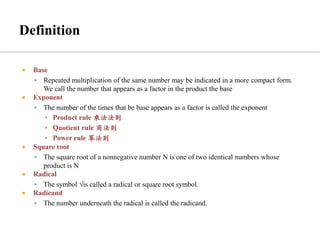
Base
▪ Repeatedmultiplication of the same number may be indicated in a more compact form.
We call the number that appears as a factor in the product the base
Exponent
▪ The number of the times that be base appears as a factor is called the exponent
▪ Product rule 乘法法则
▪ Quotient rule 商法则
▪ Power rule 幂法则
Square root
▪ The square root of a nonnegative number N is one of two identical numbers whose
product is N
Radical
▪ The symbol √is called a radical or square root symbol.
Radicand
▪ The number underneath the radical is called the radicand.
6.
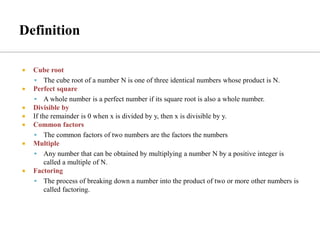
Cube root
▪The cube root of a number N is one of three identical numbers whose product is N.
Perfect square
▪ A whole number is a perfect number if its square root is also a whole number.
Divisible by
If the remainder is 0 when x is divided by y, then x is divisible by y.
Common factors
▪ The common factors of two numbers are the factors the numbers
Multiple
▪ Any number that can be obtained by multiplying a number N by a positive integer is
called a multiple of N.
Factoring
▪ The process of breaking down a number into the product of two or more other numbers is
called factoring.
7.
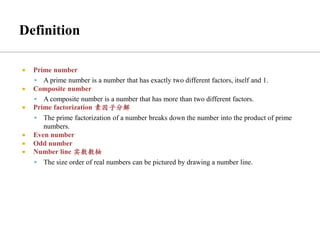
Prime number
▪A prime number is a number that has exactly two different factors, itself and 1.
Composite number
▪ A composite number is a number that has more than two different factors.
Prime factorization 素因子分解
▪ The prime factorization of a number breaks down the number into the product of prime
numbers.
Even number
Odd number
Number line 实数数轴
▪ The size order of real numbers can be pictured by drawing a number line.
8.
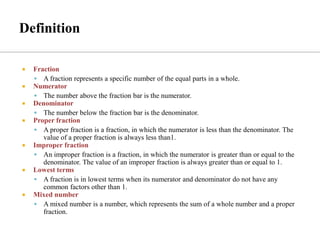
Fraction
▪ Afraction represents a specific number of the equal parts in a whole.
Numerator
▪ The number above the fraction bar is the numerator.
Denominator
▪ The number below the fraction bar is the denominator.
Proper fraction
▪ A proper fraction is a fraction, in which the numerator is less than the denominator. The
value of a proper fraction is always less than1.
Improper fraction
▪ An improper fraction is a fraction, in which the numerator is greater than or equal to the
denominator. The value of an improper fraction is always greater than or equal to 1.
Lowest terms
▪ A fraction is in lowest terms when its numerator and denominator do not have any
common factors other than 1.
Mixed number
▪ A mixed number is a number, which represents the sum of a whole number and a proper
fraction.
9.
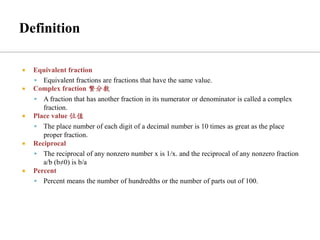
Equivalent fraction
▪Equivalent fractions are fractions that have the same value.
Complex fraction 繁分数
▪ A fraction that has another fraction in its numerator or denominator is called a complex
fraction.
Place value 位值
▪ The place number of each digit of a decimal number is 10 times as great as the place
proper fraction.
Reciprocal
▪ The reciprocal of any nonzero number x is 1/x. and the reciprocal of any nonzero fraction
a/b (b≠0) is b/a
Percent
▪ Percent means the number of hundredths or the number of parts out of 100.
10.
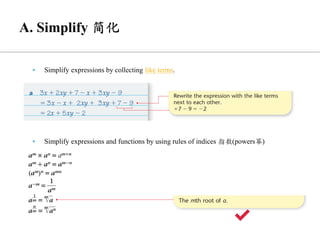
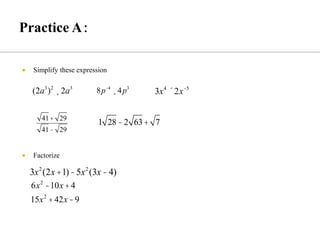
▪ Simplify expressionsby collecting like terms.
▪ Simplify expressions and functions by using rules of indices 指数(powers幂)
✔
11.
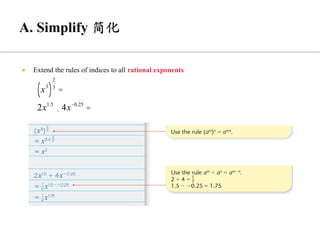
Extend therules of indices to all rational exponents
x3
( )
2
3
=
2x1.5
¸4x-0.25
=
12.
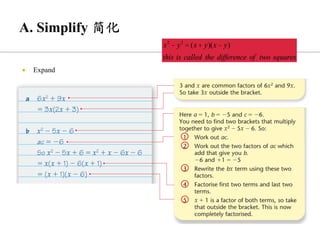
Expand
▪ Expandan expression by multiplying each term inside the bracket by the term outside.
Factorize expressions:
▪ Factorizing is the opposite of expanding expressions
Factorize quadratic expressions
▪ A quadratic expression has the form ,where a, b, c are constant, and a≠0
ax2
+bx+c
x2
- y2
= (x+ y)(x - y)
this is called the difference of two squares
13.
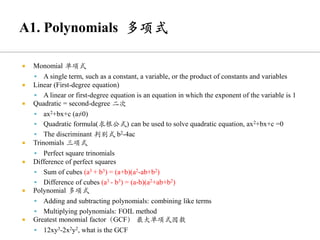
Monomial 单项式
▪A single term, such as a constant, a variable, or the product of constants and variables
Linear (First-degree equation)
▪ A linear or first-degree equation is an equation in which the exponent of the variable is 1
Quadratic = second-degree 二次
▪ ax2+bx+c (a≠0)
▪ Quadratic formula(求根公式) can be used to solve quadratic equation, ax2+bx+c =0
▪ The discriminant 判别式 b2-4ac
Trinomials 三项式
▪ Perfect square trinomials
Difference of perfect squares
▪ Sum of cubes (a3 + b3) = (a+b)(a2-ab+b2)
▪ Difference of cubes (a3 - b3) = (a-b)(a2+ab+b2)
Polynomial 多项式
▪ Adding and subtracting polynomials: combining like terms
▪ Multiplying polynomials: FOIL method
Greatest monomial factor(GCF) 最大单项式因数
▪ 12xy3-2x2y2, what is the GCF
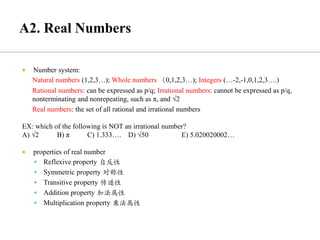
Number system:
Naturalnumbers (1,2,3…); Whole numbers (0,1,2,3…); Integers (…-2,-1,0,1,2,3….)
Rational numbers: can be expressed as p/q; Irrational numbers: cannot be expressed as p/q,
nonterminating and nonrepeating, such as π, and √2
Real numbers: the set of all rational and irrational numbers
EX: which of the following is NOT an irrational number?
A) √2 B) π C) 1.333…. D) √50 E) 5.020020002…
properties of real number
▪ Reflexive property 自反性
▪ Symmetric property 对称性
▪ Transitive property 传递性
▪ Addition property 加法属性
▪ Multiplication property 乘法属性
16.
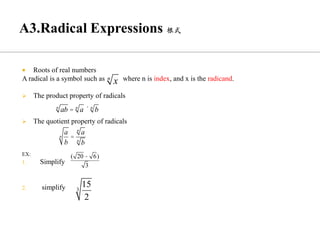
Roots ofreal numbers
A radical is a symbol such as where n is index, and x is the radicand.
➢ The product property of radicals
➢ The quotient property of radicals
EX:
1. Simplify
2. simplify
x
n
ab
n
= a
n
´ b
n
a
b
n =
a
n
b
n
15
2
3
( 20 - 6)
3
17.
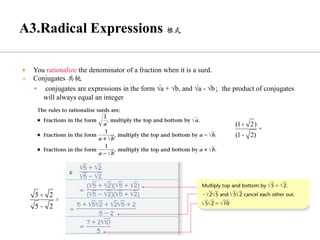
You rationalizethe denominator of a fraction when it is a surd.
➢ Conjugates 共轭
▪ conjugates are expressions in the form √a + √b, and √a - √b;the product of conjugates
will always equal an integer
5 + 2
5 - 2
=
(1+ 2)
(1- 2)
=
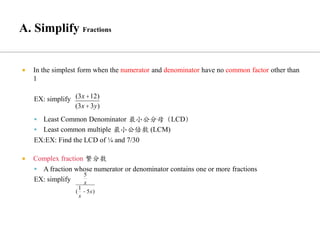
In thesimplest form when the numerator and denominator have no common factor other than
1
EX: simplify
▪ Least Common Denominator 最小公分母(LCD)
▪ Least common multiple 最小公倍数 (LCM)
EX:EX: Find the LCD of ¼ and 7/30
Complex fraction 繁分数
▪ A fraction whose numerator or denominator contains one or more fractions
EX: simplify
(3x +12)
(3x +3y)
5
x
(
1
x
- 5x)
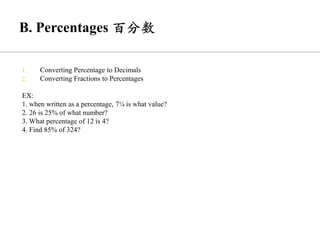
1. Converting Percentageto Decimals
2. Converting Fractions to Percentages
EX:
1. when written as a percentage, 7¼ is what value?
2. 26 is 25% of what number?
3. What percentage of 12 is 4?
4. Find 85% of 324?
22.
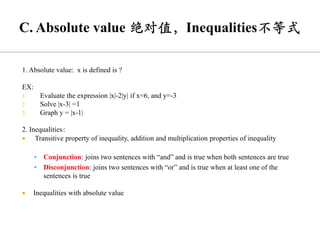
1. Absolute value:x is defined is ?
EX:
1. Evaluate the expression |x|-2|y| if x=6, and y=-3
2. Solve |x-3| =1
3. Graph y = |x-1|
2. Inequalities:
Transitive property of inequality, addition and multiplication properties of inequality
▪ Conjunction: joins two sentences with “and” and is true when both sentences are true
▪ Disconjunction: joins two sentences with “or” and is true when at least one of the
sentences is true
Inequalities with absolute value
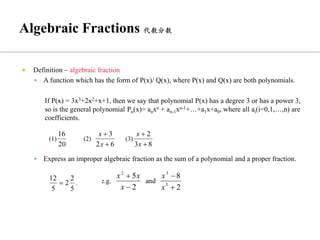
Definition –algebraic fraction
▪ A function which has the form of P(x)/ Q(x), where P(x) and Q(x) are both polynomials.
If P(x) = 3x3+2x2+x+1, then we say that polynomial P(x) has a degree 3 or has a power 3,
so is the general polynomial Pn(x)= anxn + an-1xn-1+…+a1x+a0, where all ai(i=0,1,…,n) are
coefficients.
▪ Express an improper algebraic fraction as the sum of a polynomial and a proper fraction.
25.
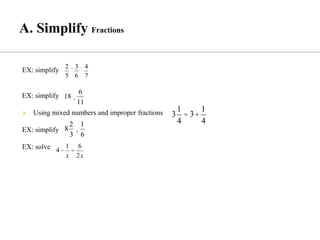
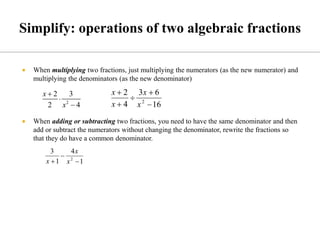
When multiplyingtwo fractions, just multiplying the numerators (as the new numerator) and
multiplying the denominators (as the new denominator)
When adding or subtracting two fractions, you need to have the same denominator and then
add or subtract the numerators without changing the denominator, rewrite the fractions so
that they do have a common denominator.
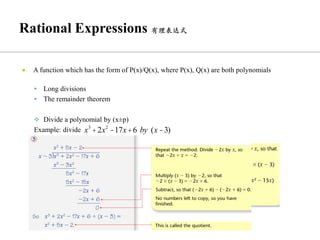
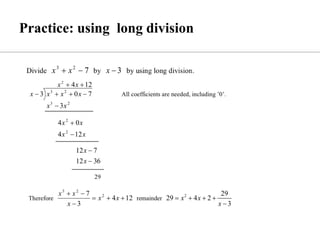
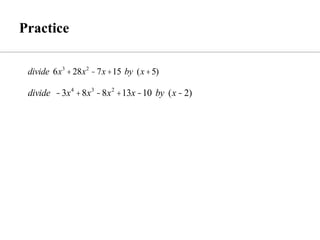
A functionwhich has the form of P(x)/Q(x), where P(x), Q(x) are both polynomials
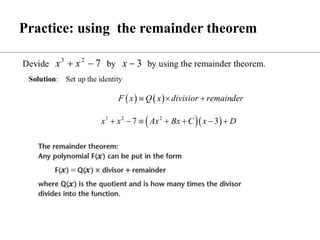
▪ Long divisions
▪ The remainder theorem
❖ Divide a polynomial by (x±
p)
Example: divide x3
+2x2
-17x+6 by (x-3)
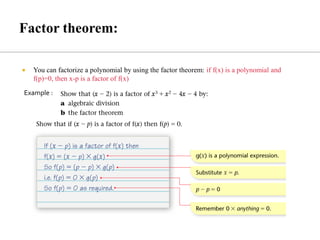
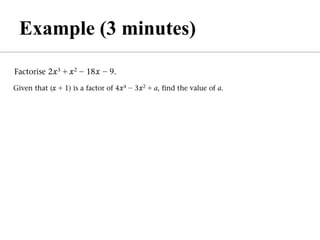
You canfactorize a polynomial by using the factor theorem: if f(x) is a polynomial and
f(p)=0, then x-p is a factor of f(x)
Example :
35.
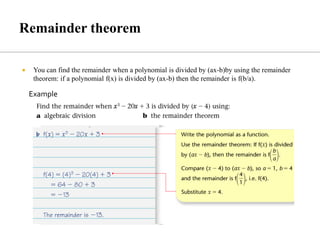
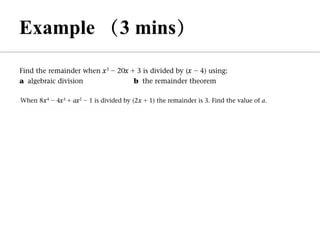
You canfind the remainder when a polynomial is divided by (ax-b)by using the remainder
theorem: if a polynomial f(x) is divided by (ax-b) then the remainder is f(b/a).
Example
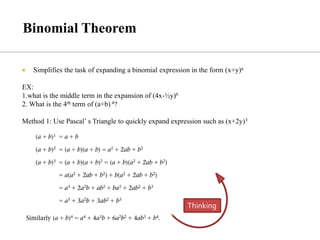
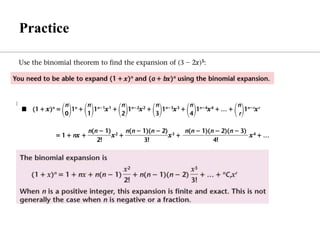
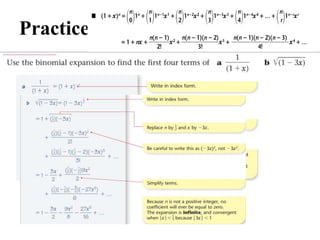
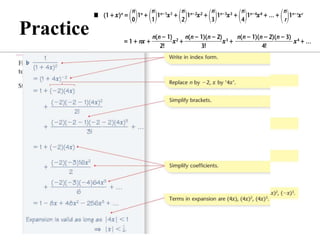
Simplifies thetask of expanding a binomial expression in the form (x+y)n
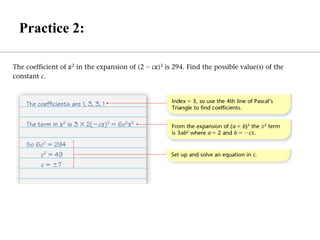
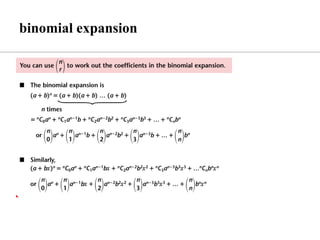
EX:
1.what is the middle term in the expansion of (4x-½y)6
2. What is the 4th term of (a+b) 4?
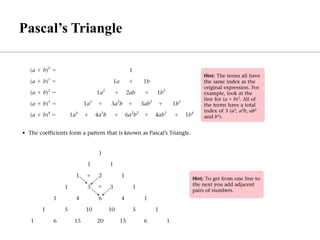
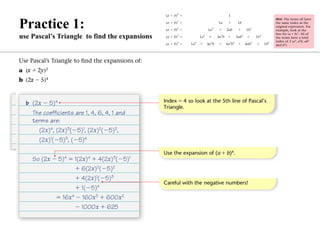
Method 1: Use Pascal’ s Triangle to quickly expand expression such as (x+2y)3
Thinking
42.
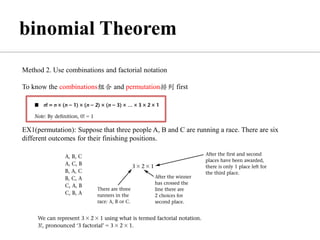
Method 2. Usecombinations and factorial notation
To know the combinations组合 and permutation排列 first
EX1(permutation): Suppose that three people A, B and C are running a race. There are six
different outcomes for their finishing positions.
43.
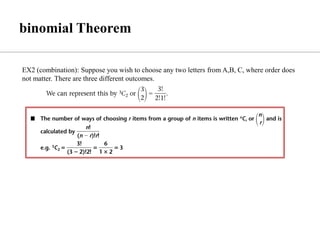
EX2 (combination): Supposeyou wish to choose any two letters from A,B, C, where order does
not matter. There are three different outcomes.


![[DSC Europe 25] Milos Belcevic - Product Professional's Journey to Full-Stack...](https://cdn.slidesharecdn.com/ss_thumbnails/1zovd6fgsycdg4wvgvls-milos-belcevic-product-professionals-journey-to-full-stack-product-developer-260123083019-d993120d-thumbnail.jpg?width=640&height=640&fit=bounds)


