Burger Blogs!
Dylan Li
Jasmine Leong
Restaurants
February 20, 2013
Keywords used: SF food burger blogs
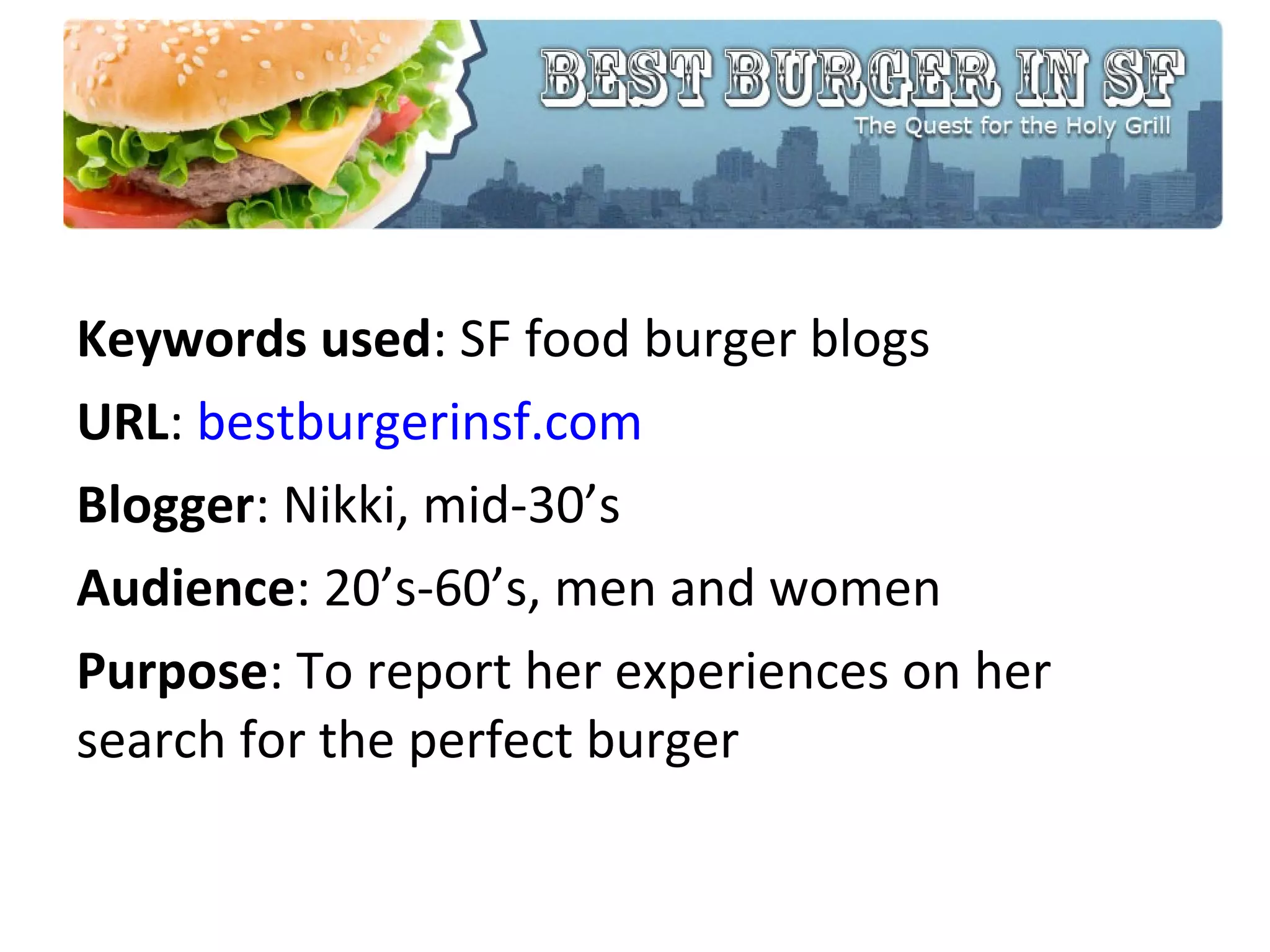
URL: bestburgerinsf.com
Blogger: Nikki, mid-30’s
Audience: 20’s-60’s, men and women
Purpose: To report her experiences on her
search for the perfect burger
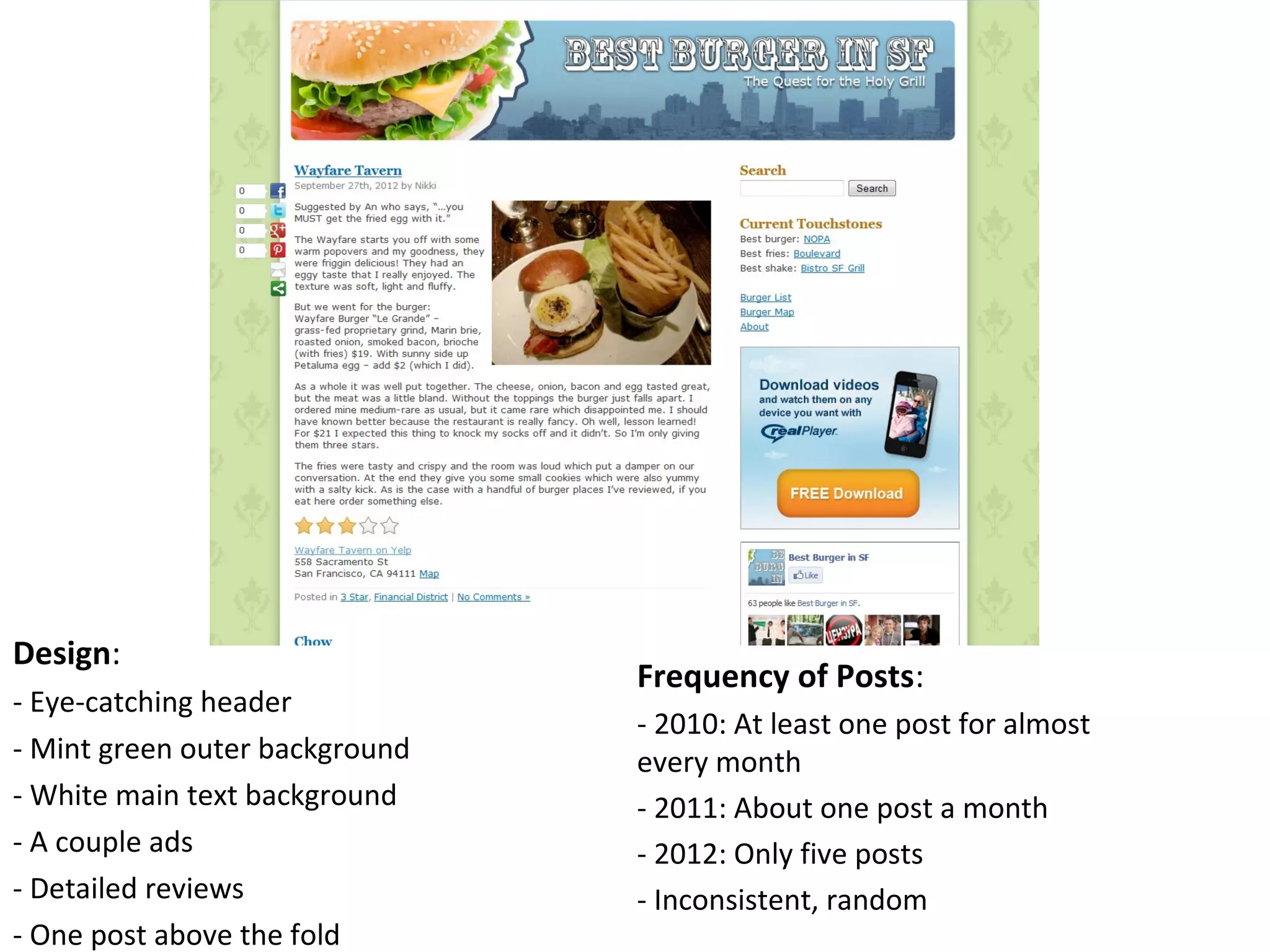
Design:
- Eye-catching header
- Mint green outer background
- White main text background
- A couple ads
- Detailed reviews
- One post above the fold
Frequency of Posts:
- 2010: At least one post for almost
every month
- 2011: About one post a month
- 2012: Only five posts
- Inconsistent, random
Strategies:
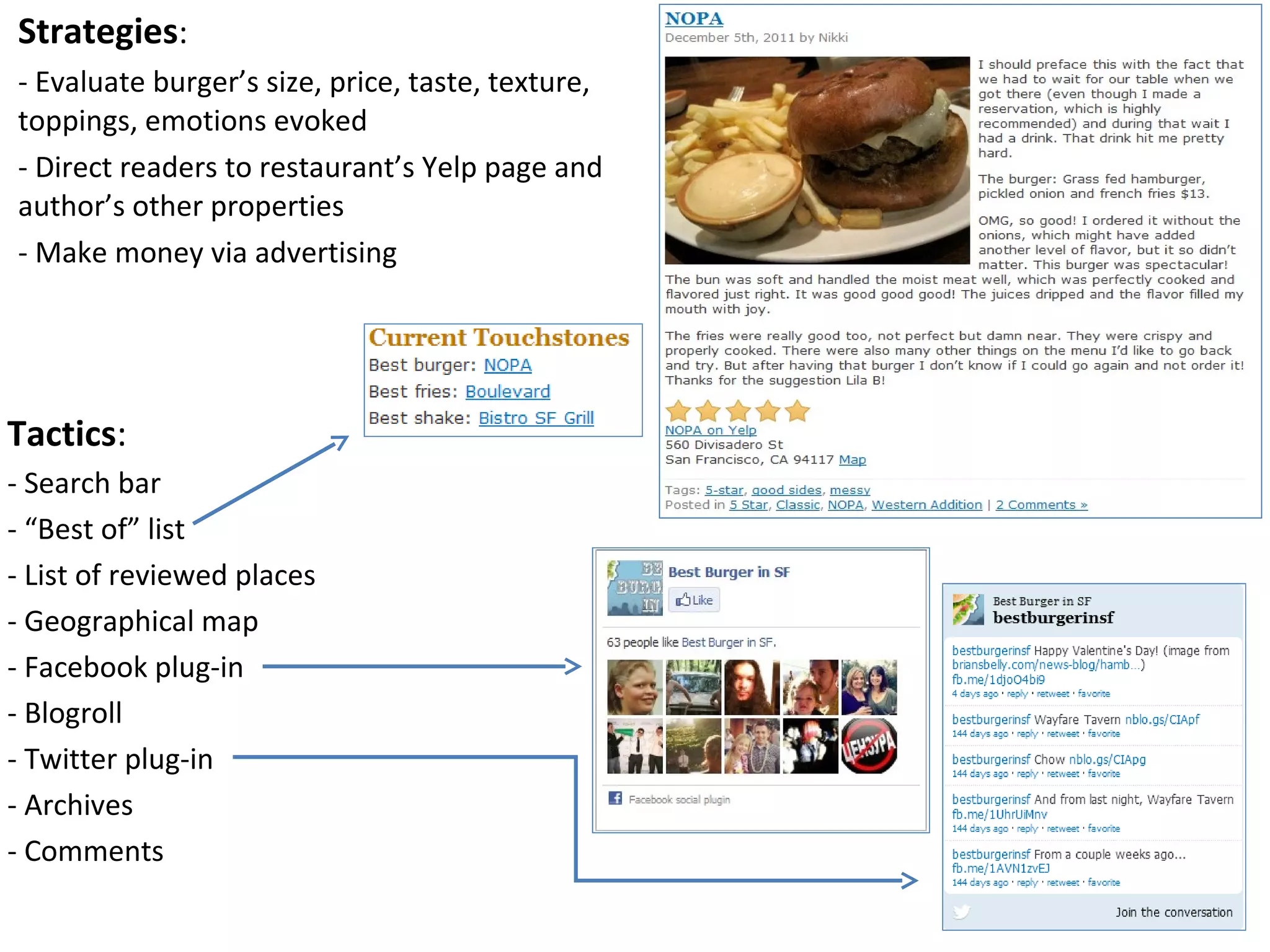
- Evaluate burger’s size, price, taste, texture,
toppings, emotions evoked
- Direct readers to restaurant’s Yelp page and
author’s other properties
- Make money via advertising
Tactics:
- Search bar
- “Best of” list
- List of reviewed places
- Geographical map
- Facebook plug-in
- Blogroll
- Twitter plug-in
- Archives
- Comments
Keyword search: Fat Guy Denny Blogger
URL: http://ohsofat.blogspot.com/
Blogger: Mark Lim, Late 20’s
Audience: Burger Fanatics in the U.S.
Purpose: Expressing himself as a fan and to give
his review.
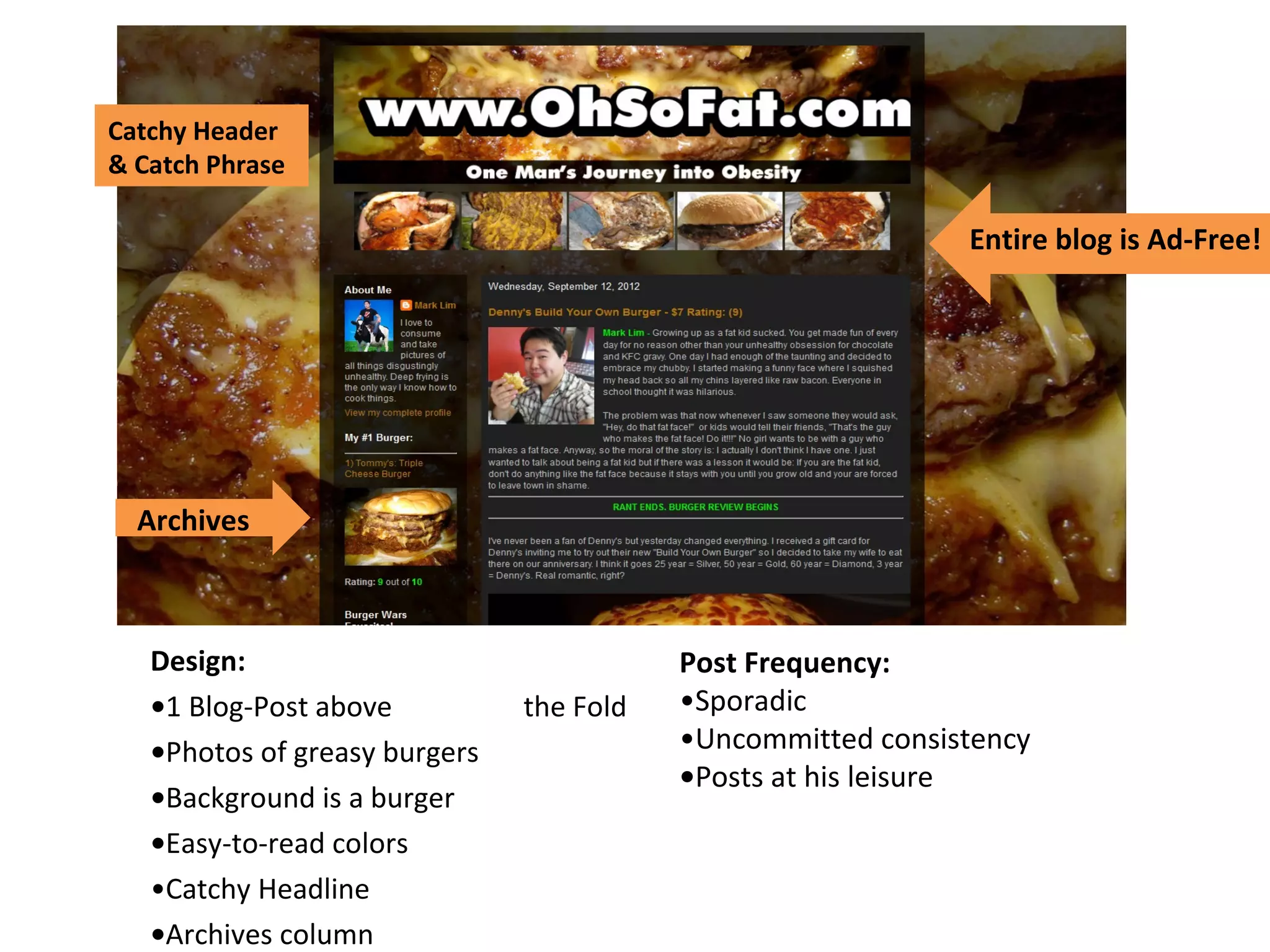
Design:
•1 Blog-Post above the Fold
•Photos of greasy burgers
•Background is a burger
•Easy-to-read colors
•Catchy Headline
•Archives column
Post Frequency:
•Sporadic
•Uncommitted consistency
•Posts at his leisure
Entire blog is Ad-Free!
Archives
Catchy Header
& Catch Phrase
Tactics
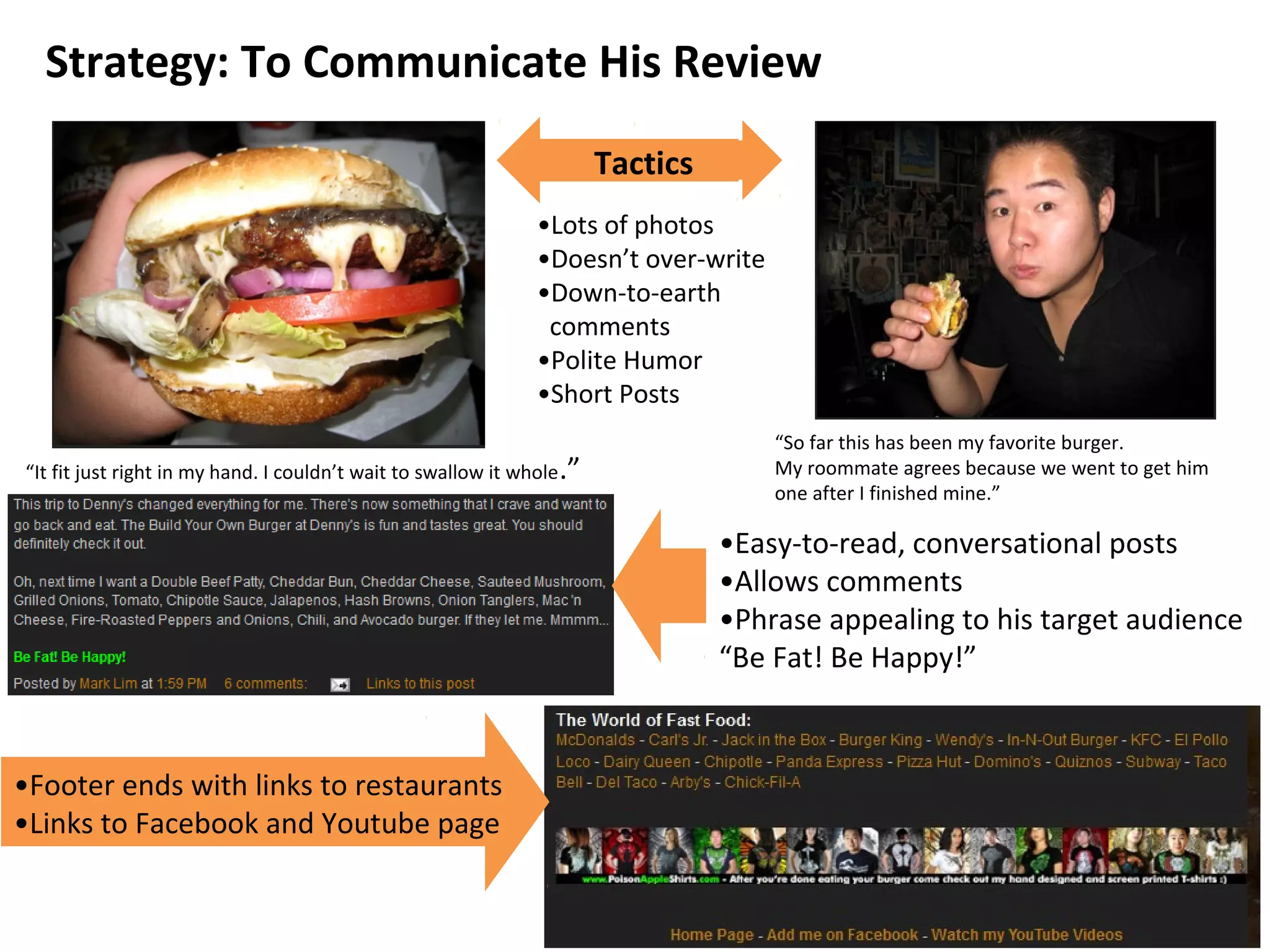
Strategy: To Communicate His Review
•Lots of photos
•Doesn’t over-write
•Down-to-earth
comments
•Polite Humor
•Short Posts
“So far this has been my favorite burger.
My roommate agrees because we went to get him
one after I finished mine.”
“It fit just right in my hand. I couldn’t wait to swallow it whole.”
•Easy-to-read, conversational posts
•Allows comments
•Phrase appealing to his target audience
“Be Fat! Be Happy!”
•Footer ends with links to restaurants
•Links to Facebook and Youtube page
URL: Meatmeburger.blogspot.com
Keywords to search:
•Fat Burger
•Meaty Burger
•Greasy Juicy Burger
•Bay Area burger joint
Purpose:
•To inform readers of our reviewed burger
hotspots
•To potentially make money after gathering
followers
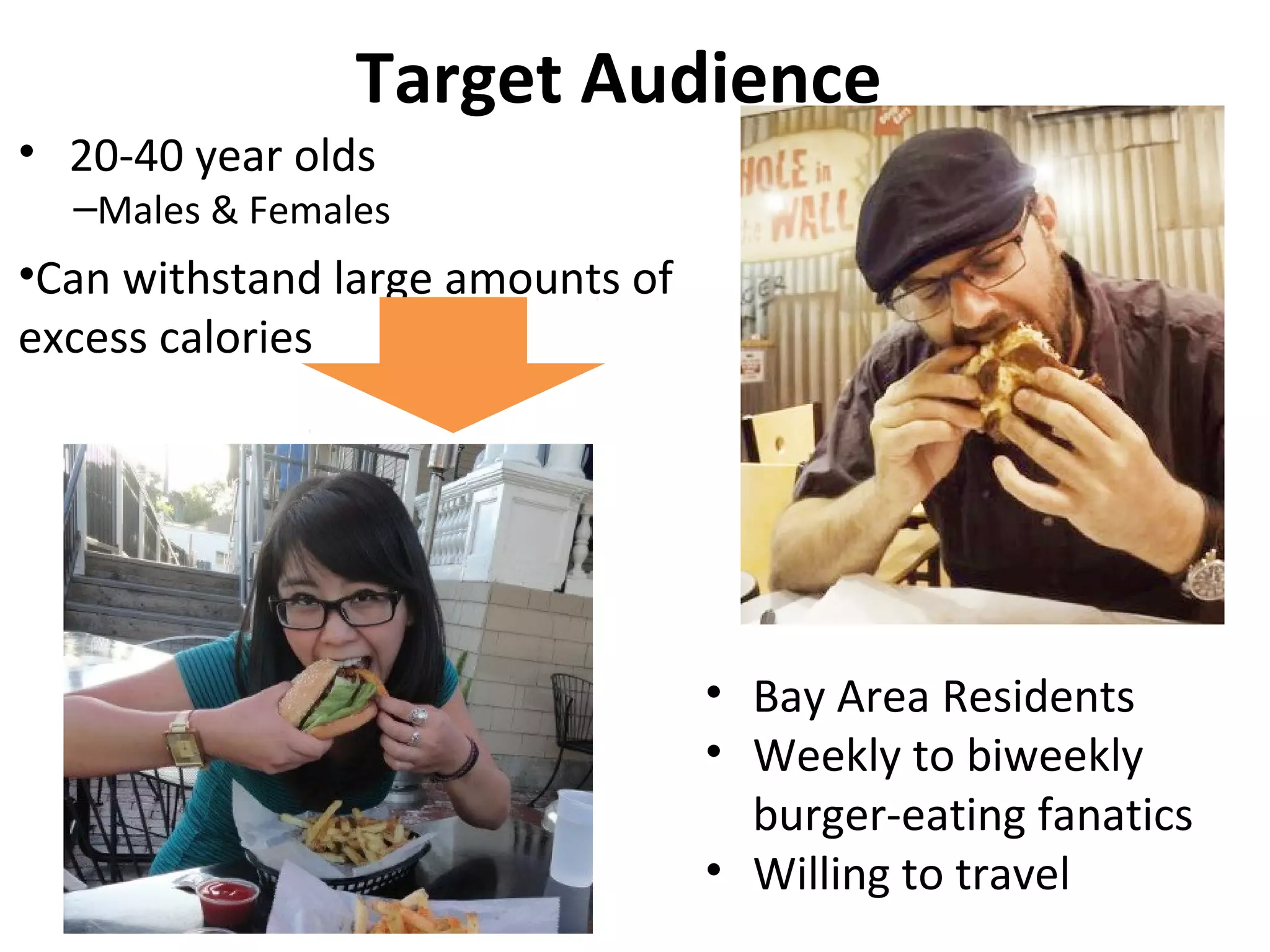
Target Audience
• 20-40 year olds
–Males & Females
•Can withstand large amounts of
excess calories
• Bay Area Residents
• Weekly to biweekly
burger-eating fanatics
• Willing to travel
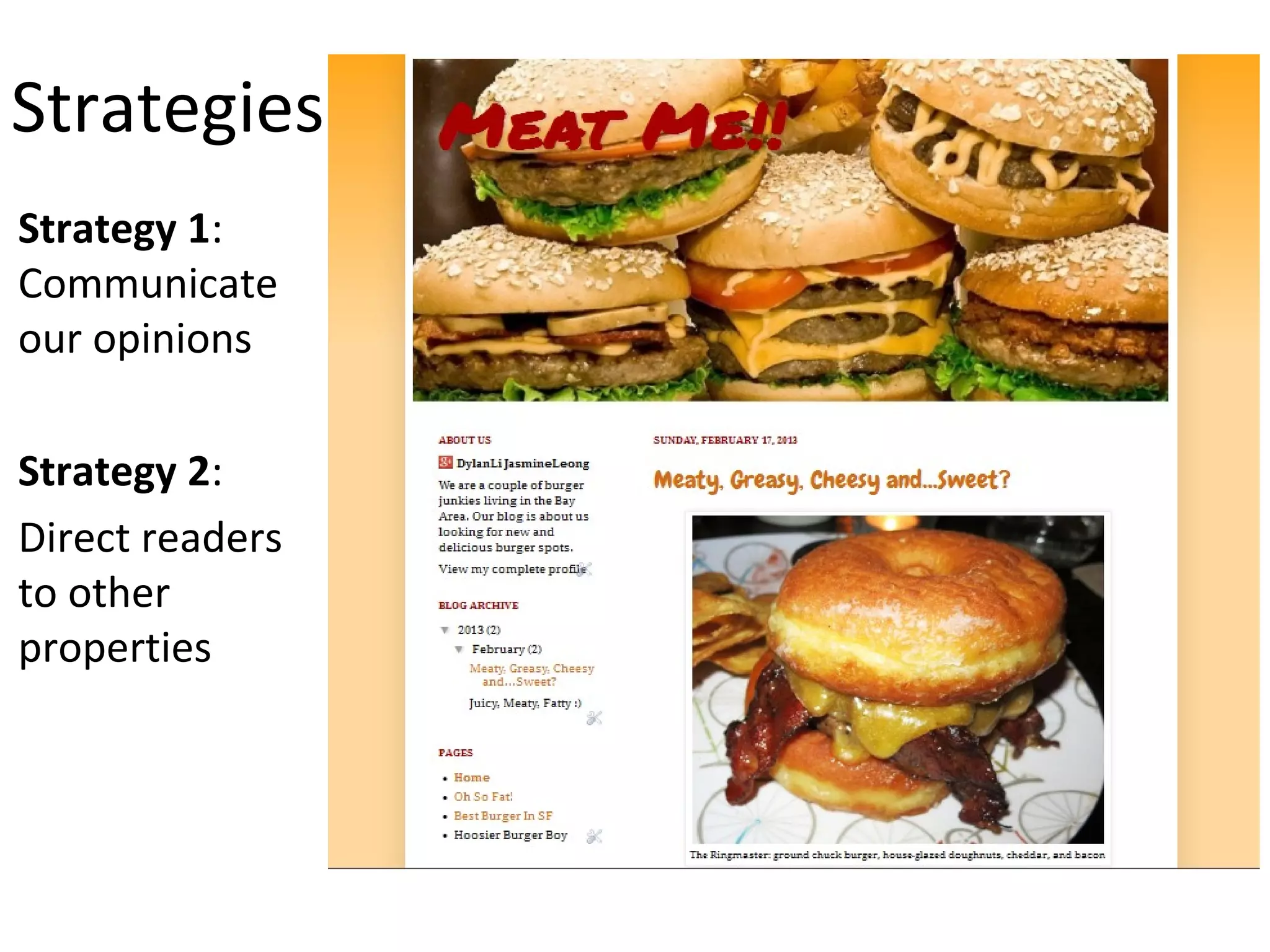
Strategies
Strategy 1:
Communicate
our opinions
Strategy 2:
Direct readers
to other
properties
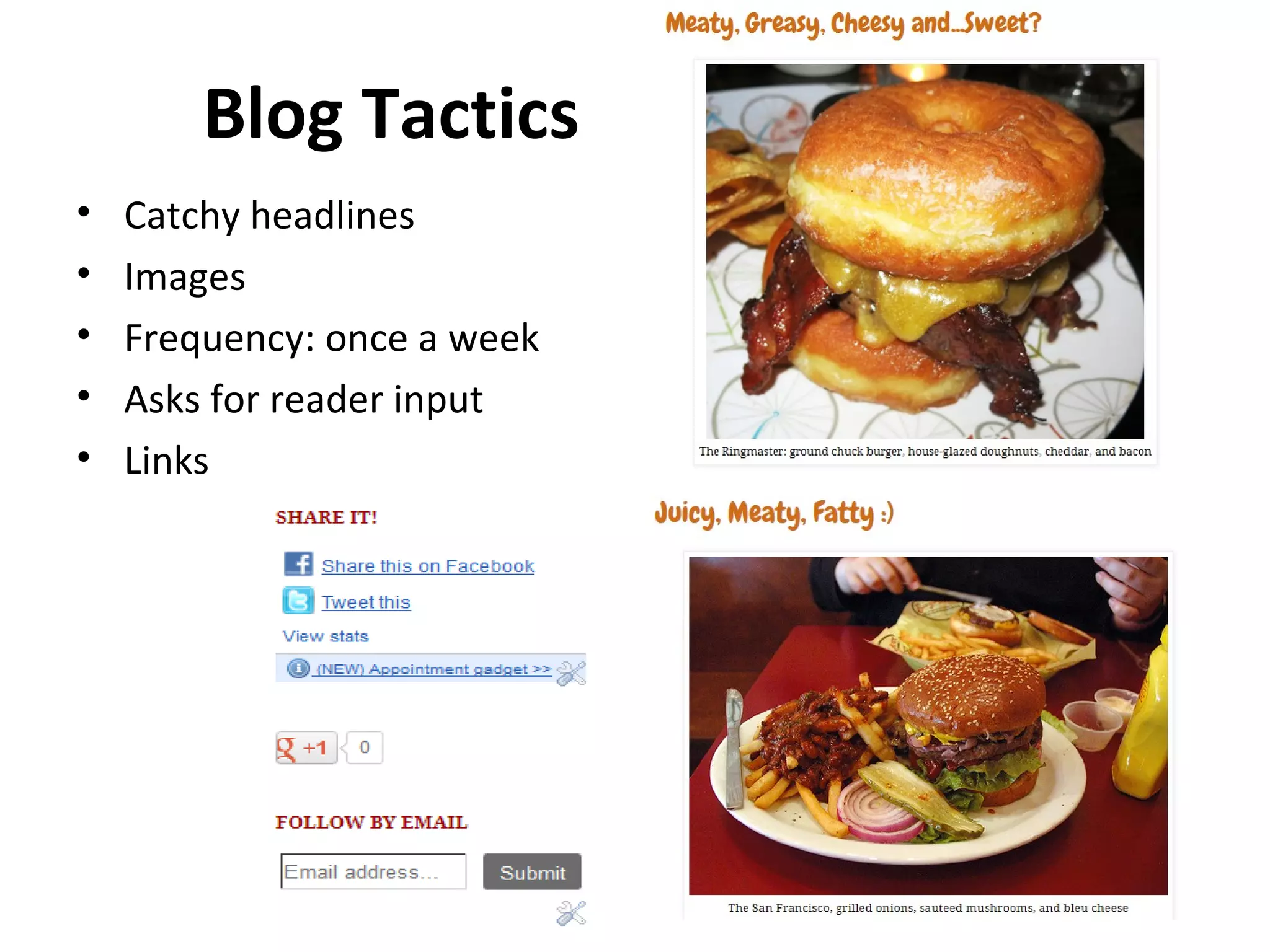
Blog Tactics
• Catchy headlines
• Images
• Frequency: once a week
• Asks for reader input
• Links
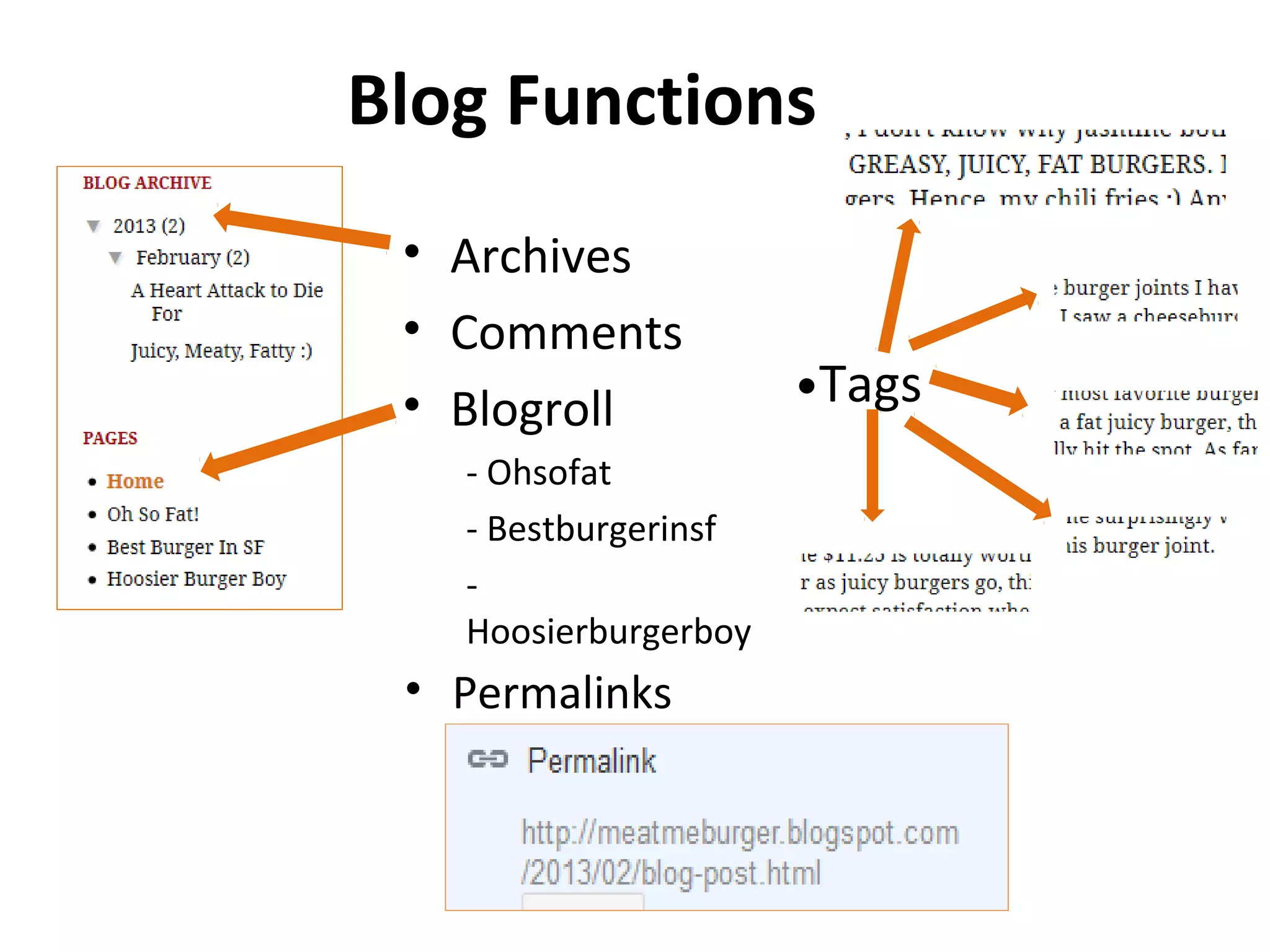
Blog Functions
• Archives
• Comments
• Blogroll
- Ohsofat
- Bestburgerinsf
-
Hoosierburgerboy
•Tags
• Permalinks
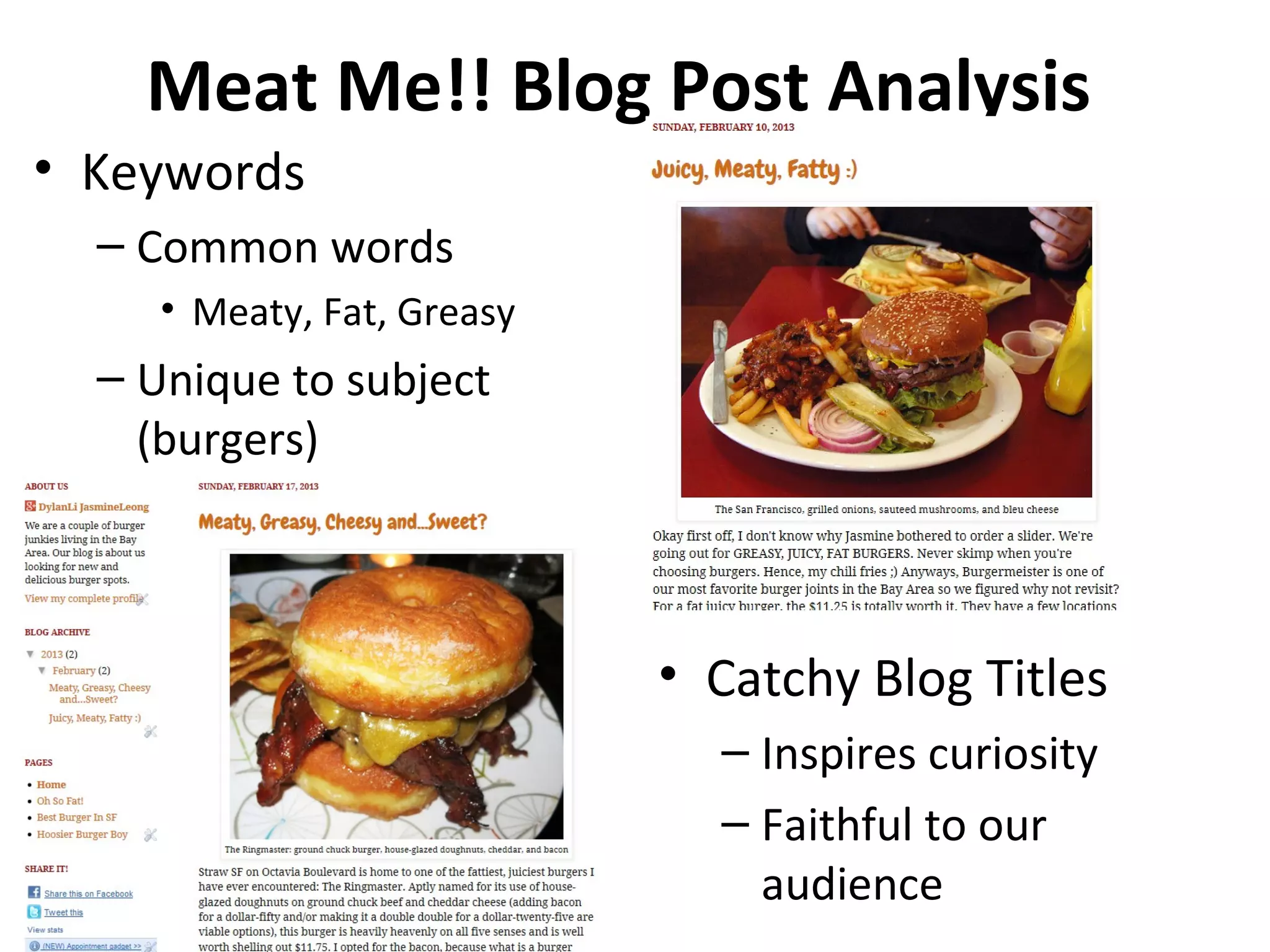
Meat Me!! Blog Post Analysis
• Keywords
– Common words
• Meaty, Fat, Greasy
– Unique to subject
(burgers)
• Catchy Blog Titles
– Inspires curiosity
– Faithful to our
audience

Marketing Via Blogs: Burgers

  • 1.
    Burger Blogs! Dylan Li JasmineLeong Restaurants February 20, 2013
  • 2.
    Keywords used: SFfood burger blogs URL: bestburgerinsf.com Blogger: Nikki, mid-30’s Audience: 20’s-60’s, men and women Purpose: To report her experiences on her search for the perfect burger
  • 3.
    Design: - Eye-catching header -Mint green outer background - White main text background - A couple ads - Detailed reviews - One post above the fold Frequency of Posts: - 2010: At least one post for almost every month - 2011: About one post a month - 2012: Only five posts - Inconsistent, random
  • 4.
    Strategies: - Evaluate burger’ssize, price, taste, texture, toppings, emotions evoked - Direct readers to restaurant’s Yelp page and author’s other properties - Make money via advertising Tactics: - Search bar - “Best of” list - List of reviewed places - Geographical map - Facebook plug-in - Blogroll - Twitter plug-in - Archives - Comments
  • 5.
    Keyword search: FatGuy Denny Blogger URL: http://ohsofat.blogspot.com/ Blogger: Mark Lim, Late 20’s Audience: Burger Fanatics in the U.S. Purpose: Expressing himself as a fan and to give his review.
  • 6.
    Design: •1 Blog-Post abovethe Fold •Photos of greasy burgers •Background is a burger •Easy-to-read colors •Catchy Headline •Archives column Post Frequency: •Sporadic •Uncommitted consistency •Posts at his leisure Entire blog is Ad-Free! Archives Catchy Header & Catch Phrase
  • 7.
    Tactics Strategy: To CommunicateHis Review •Lots of photos •Doesn’t over-write •Down-to-earth comments •Polite Humor •Short Posts “So far this has been my favorite burger. My roommate agrees because we went to get him one after I finished mine.” “It fit just right in my hand. I couldn’t wait to swallow it whole.” •Easy-to-read, conversational posts •Allows comments •Phrase appealing to his target audience “Be Fat! Be Happy!” •Footer ends with links to restaurants •Links to Facebook and Youtube page
  • 8.
    URL: Meatmeburger.blogspot.com Keywords tosearch: •Fat Burger •Meaty Burger •Greasy Juicy Burger •Bay Area burger joint Purpose: •To inform readers of our reviewed burger hotspots •To potentially make money after gathering followers
  • 9.
    Target Audience • 20-40year olds –Males & Females •Can withstand large amounts of excess calories • Bay Area Residents • Weekly to biweekly burger-eating fanatics • Willing to travel
  • 10.
    Strategies Strategy 1: Communicate our opinions Strategy2: Direct readers to other properties
  • 11.
    Blog Tactics • Catchyheadlines • Images • Frequency: once a week • Asks for reader input • Links
  • 12.
    Blog Functions • Archives •Comments • Blogroll - Ohsofat - Bestburgerinsf - Hoosierburgerboy •Tags • Permalinks
  • 13.
    Meat Me!! BlogPost Analysis • Keywords – Common words • Meaty, Fat, Greasy – Unique to subject (burgers) • Catchy Blog Titles – Inspires curiosity – Faithful to our audience

Editor's Notes

  • #3 Q1. Blog Landscape and Analysis Note what keywords you used to search. Originally, we were looking for entire blogs writing about a specific restaurant. After searching for several, we realized how difficult that was because of two problems: one, people like variety and no restaurant has enough items on their menu to keep a blog relevant for more than several months, and two, not too many people would go to the same restaurant over and over just to review their whole menu. After Dylan found his blog, we decided we would broaden the topic and analyze and create blogs about various restaurants’ burgers, based on location and type of burger. Keywords consisted of “SF food burger blogs.” b. Identify the blog site by name and URL. Also show a screenshot on your slides. Make observations about the background image, photo and overall design. This blog’s URL is bestburgerinsf.com, and it is named “Best Burger in SF: The Quest for the Holy Grill.” The mint green wallpaper doesn’t really match the blog itself; rather, it looks like it belongs on an 80’s model home wall. However, it isn’t really a distraction to the overall site’s look because the main background is a clean white with a simple blog-post-on-left, archive/about/pages/etc.-on-right layout. The header is really the most visually exciting part of the site: it’s clean, yet fun and appealing, and it makes sense: it’s a picture of a burger, and to the right, a blue-tinted photo of the city’s skyscrapers. Though this is a personal blog, at the footer, there is a link to and one post fits above the fold, along with tactics such as a search bar, “Current Touchstones” listing best-of’s, links to her burger list, burger map, and about, and the blog’s Facebook Fan Page social plug-in on the right. c. Describe the blogger, audience, and purpose. Though the pronoun “we” is thrown around all throughout the blog, after reading the About page found on the right navigation bar, it becomes obvious that the blog is run solely by Nikki, a burger enthusiast who also Yelps her accounts regularly. Her goal is to find a burger “that has some bite, but remains strong and solid.” She continues to describe her perfect burger in painstaking detail, then explains her method of rating and categorizing burgers. Causally, the purpose of her blog is to detail every burger experience until, and perhaps even after, she finds her perfect burger. Her audience includes 20 to 60 year old males and females living in the San Francisco Bay Area who are either actively or passively on the hunt for new and delicious burgers.
  • #4 d. What strategies and tactics did they use? Effective or not? Describe. Best Burger in SF’s strategies are to evaluate each burger’s quality, size, price, taste, texture, toppings, and emotions evoked by said burger and to either encourage readers to try out the reviewed restaurant or warn them not to. Additionally, the blog directs its readers to its other properties such as its Facebook fan page and Twitter. Lastly, the site makes money by advertising for random companies that contact the writers. The cleanliness and straightforward nature of the blog makes its strategies very effective. This blog utilizes several useful tactics, such as a search bar, a mini “best of” list with links to the corresponding blog posts, a list of the burger hotspots the writers have been to (and where they’d like to go), a map pre-flagged with all the reviewed destinations color coded by quality (1-5 stars) for visiting ease, the restaurant’s Yelp links for a larger variety of opinions, permalinks, a blogroll of other burger blog sites, links to reviews categorized by stars received, archives sorted by topic and by month, comments (and responses), and tags for number of stars received and neighborhood at the end of each review. Nikki gives readers multiple ways to view and choose her reviewed burgers over the span of her site (by stars, burger styles, entire list, by location on map, best of), and provides more publicity to her pages through Yelp links and her blog’s Facebook fan page and Twitter social plug-ins, all very useful methods. e. Note the frequency of the blog posts. Comment and analyze. As Best Burger in SF’s posts come towards the present, its number of blog posts decreases dramatically. Nikki only blogged in the second half of 2012, three times in July and twice in September. However, in 2011, she blogged quite consistently, about one post every month, except for September and June, in which she posted three times. Her postings in 2010 were almost as consistent; there is at least one post for almost every month. Her postings seem almost sporadic, even at the start of her blog. She jumps from posting every two weeks to every month to perhaps “making up” for not having blogged by writing two reviews in one day to back to every two weeks. This is surprising, seeing as on the Advertise page, Nikki states that “As of October, 2011 we get roughly 1,300 unique visitors per month and the number keeps growing (compared to 500 last October).” The lack of recent posts shows that this blog is not on her priority list, nor must it generate enough cash for her to think it is important enough to keep consistent and active.
  • #5 f. Show a post on your slides. Critique the blog posts overall as a follower (e.g. consumer if appropriate) and as a marketer. Use the strategies and tactics reviewed in class to help critique. Though her strategies don’t include selling any products (her own or with an affiliate model) or trying to build a database with an email subscription option, Nikki’s main strategies are to direct her readers to other assets and to communicate messages to her readers, and she does this quite successfully. Additionally, she strives to make a little money through a couple of advertisements on her page. Nikki directs her readers to her other assets through two ways: the Facebook fan page plug-in and the Twitter social plug-in, both found on the right side of her blog. Her second strategy is just as well done, as she details every part of her experience, from sometimes even before arriving to the restaurant, to whether there was a wait, to the quality of her side orders, to whether she would get it again. Her wide array of tactics, including the simple design of the blog, search function, categorized archives, and categorized links functions found all throughout the page, makes her website and its posts extremely accessible and both easy to search for and easy to find. Her writing style is very personable, real and easy to read, and it is easy to see that she is passionate about finding her perfect burger and has enjoyed the vast majority of the ones (and the sides) she has tried. The length of the posts vary depending on the experience, but the majority are in a happy middle of about three to four short paragraphs. When she has comments, she responds quickly and in a friendly manner, like in her NOPA review on December 5th, 2011, where someone recommends a couple places to her, and she replies that she’ll “have to give them a try!” She posts one picture for each of her posts, and the majority of them are appealing and could probably make her viewers hungry enough to venture out to the restaurants she has reviewed.
  • #6 Q1. Blog Landscape and Analysis A) Note what keywords you used to search. I first thought “Restaurant blogs” then realized it’d be fun to find some blogs that flame unhealthy restaurants like Denny’s, Chili’s, and TGI Fridays. So I searched something like “Fat Guy Denny Blogger” Somehow it led me to this guy’s blog of how he rates fast food burgers. B) Identify the two blog sites by name and URL. Also show a screenshot on your slides. Make observations about the background image, photo and overall design. The name is OhSoFat at http://ohsofat.blogspot.com/ The background image is a greasy cheeseburger which is consistent with what the blog is about (greasy, fattening burgers). Mark Lim the author, shows the reader the headline of his first blog-post above the fold, whereas most everything else above the fold are photos of the foods that he’s eaten (He lets the pictures grab the viewer’s attention). He links readers to other blogs and burger restaurants at the footer which is helpful for users to follow up on what Lim has blogged about. C) Describe the blogger, audience, and purpose. The blogger is a young man named Mark Lim. He has a history of being ridiculed for being overweight. His past has conditioned him to be proud of his weight. Through his blog, he communicates to his readers his obsession of gorging down greasy unhealthy foods. “I love to consume and take pictures of all things disgustingly unhealthy.” His purpose is to clue in readers on his experiences eating at different burger spots regardless if it was good or not. Throughout the entire blog he repeatedly chimes phrases such as “Be Fat! Be Happy!” and “Embrace my chubby.” Therefore his targeted audience are burger fanatics living in the United States that love burgers from chain restaurants such as McDonalds, Denny’s, Jack in the Box, and Five Guys. His audience can be male or female and it seems like they would be around 20-40 years old. Their bodies need to be able to withstand the excess calories and high cholesterol of the food that Lim recommends. D) What strategies and tactics did they use? Effective or not? Describe. Lim’s main strategy is to communicate product reviews. He will encourage his audience to share his better experiences by ordering the same burgers from the same restaurant. Lim only reviews burgers from restaurants that his audience can access. For example, there is tons of Wendy’s serving his well-reviewed “Wendy’s Triple Stack.” Lim also directs readers to the restaurants he’s eaten at through hyperlinks at the bottom of his blog. He also tries to make money through a simple affiliate model where he links his viewers to a T-Shirt buying website. However, his blog in general isn’t meant to be a solid source of income for him. Tactics: • Catchy headline labeled “Oh So Fat.” • Constantly uses the same catch phrase after each blog post “Be Fat! Be Happy!” • Lets people comment on his blog posts. • Polite humor. • Designed with a plethora of photos of greasy, unhealthy looking burgers. • Having no advertisements contributes to a more personal, passionate, and conversational blog style
  • #7 E) Frequency of Blog Posts Lim has blogged inconsistently throughout the past 3 years. He created his blog in 2008 but the majority of his posts were in the summer of 2009. Throughout 2010-2012, he will spread 2-3 blog posts throughout the year. His infrequent blogging signifies that his blog is more of a leisure activity for him. There is an average of about 3 comments per blog post even during his most active period of 2009 meaning he feels rewarded regardless if anyone reads it or not. He plays the role of both fan and critic in his blog. F) Critique the blog posts overall as a follower (e.g. consumer if appropriate) and as a marketer. Lim lets his photos talk for him. Every post contains 3-4 photos of only the burger. He gives his input in 1-2 short sentences then moves on to describe his next photograph. After commenting on each of his photos, he writes about 1-2 paragraphs regarding his experience as a whole (price, location, perceived value, satisfaction). His style of blogging is appealing to his readers because he gets right down to the greasy, gritty, fattening goodness of what his blog is about (greasy burgers). Despite the infrequency of his blog posts, his blog-post design remains consistent and creates a down-to-earth, conversational atmosphere with his reader that is attractive to his target audience. His writing is consistently tailored to his target audience (chubby burger fanatics) because most of what he writes describes: • Price – A cheap/expensive burger • Place – It was worth his drive • Promotion/Product – Comparing expectations (from ads/Coupons) to perceived quality (After he’s eaten). It’s obvious that Lim isn’t trying to market the restaurants that he eats at. He is simply a fan who likes to publicize his critiques. Because his personable style of blogging, the few but consistent audience that he has likes him for it.
  • #8 Strategies & Tactics – See Slide 5 notes Q1D and Slide 6.
  • #9 Q2. Create Blog and Post! a. Describe the target audience. Include demographics and psychographics. Give details and be specific. Our target audience members are anywhere between their 20’s and 40’s and are either male or female. Our age range is rather narrow, but that’s because we are focused on fatty, high caloric burgers, and our target audience must be able to withstand excessive calorie intake. We are aiming to target people in the Bay Area, both permanent residents and temporary visitors. Like us, our audience are also burger-eating fanatics and constantly on the search for tasty new burgers and are willing to travel in order to find them. Our audience’s income and education level doesn’t matter, just as long as they can afford the money for a burger every week or so. b. Provide name and URL of your blog on your slide. Describe why you selected the name. Be sure that the professor can access the blog live. Show a screenshot of the blog on the slide. Our blog is called “Meat Me!!” The URL is meatmeburger.blogspot.com. We chose our blog name based on the fact that we like the meatiness and greasiness of burgers. No two burgers are made the same, and not all burgers are made with beef, but most of the time, when people think of burgers, the first thing that comes to mind is the beefy slab of goodness in the middle.
  • #10 Photo courtesy of Brig van Osten’s Tumblr
  • #11 c. Design, Photos, Graphics – Apply a design, photos and graphic images that complement your target industry and blog topics. Describe. Our blog’s design is colorfully bright yet simple. This is to attract our readers but not overwhelm them. Our reviews are very straightforward. We don’t bother to review the restaurant itself, only the tasty, meaty product that they produce. Our target audience is satisfied with our method. We applied a theme of ketchup red, cheddar cheese orange, ground beef brown, and toasty tan bun. We kept a traditional black on white text for easy reading. We use a tasty burger photo and header “Meat Me!!” to catch attention. Additionally, each blog post has an image of the burger we are reviewing. We managed to fit everything above the fold without giving a clustered feel to the blog page. We don’t have any advertisements in order to avoid bombarding the reader. d. Apply 1 blog strategy. Describe it and the rationale of selecting it. Our main strategy is to communicate our satisfaction on the burgers we’ve eaten in an easy to digest way. We chose this based on the nature of our blog: it’s a personal opinion blog about food, which is very subjective to the eater. We are not trying to directly sell anything, nor are we being sponsored to review restaurants’ food. All we are trying to do is share our passion of hunting burger hotspots with others. Therefore, these are our candid and honest thoughts, and we encourage our readers to think for themselves, for they will have their own opinions and may like a burger and/or restaurant we did not and vice versa. In addition, we always link our posts to the restaurant’s websites in order for them to educate themselves further. Our secondary strategy is to gather a following for our blog using Facebook and Twitter. If we get a lot of consistent viewers, we may have the opportunity to make money. We don’t advertise on our blog but if we have a lot of traffic then companies may want to post ads on our website.
  • #12 e. Apply 2 blog tactics. Describe why you chose them. Our headline tactics are to have short phrases to try and catch the reader’s attention while staying within their short attention spans. We let our photos do most of the talking while we elaborate on what our audience can’t see. Less is more and if we have less text our audience should feel like they’re reading a dialogue as opposed to a monologue. This leads into our next tactic in that we ask for the reader’s input. We have restaurant links at the bottom of our blog post just as a simple courtesy for the audience. We have our blog set to list the 5 most recent blog posts (to avoid a massive scrolling bar). We really don’t want to intimidate our readers with a lot of text. We’ve committed to making a weekly blog post to encourage our audience to follow us. This is especially important because we’re a fan-based blog.
  • #13 f. Include 2 blog functions. Describe rationale for those being appropriate for your blog. Our tag function is tailored to our target audience: Burger Fanatics. After writing our blogs, we’ve realized certain phrases that we repeatedly use. These keywords will attract our target audience to us and allow them to find our blog when they use a search engine. Because we’re fans as opposed to critics or marketers, our tags are casual but still unique. We don’t expect people to actually search for a cheeseburger blog (who does that?) so it’s important that our keywords help potential followers stumble across our blog page. If the reader wants to read our older posts, we have an archives available. This is important because we don’t want a tiny scroll bar that shifts the viewer to a completely different screen in the event of a miss click. All of our blog posts will be sorted by the month they were posted and then by their name. If a reader visits our blog, having an archives is something that is expected.
  • #14 g. Make 2 posts to your blog and describe why these posts were most appropriate and effective. Think about the purpose and demonstrate that with the content you post. These should both have excellent high quality content and does not include your “hello world” introductory post unless you add content to it. Describe your blog titles and how they would be “found” in a Google search by new readers and how they would appeal to current readers. Our posts catch the readers’ attention by giving them a taste of the information that follows. After the catchy headline, we immediately throw up photo of what we ate that entices our audience (because they’re interested in burgers). Our content is revolved around capturing the audience with a personal experience. We aim to have dialogue with our audience by converting our experiences into words. We hope the audience can relate to our experiences and in turn feel like we’re talking to them. Our blog is fan-based; we’re fans of burgers. Our target audience is burger fanatics. Our writing should share this common interest. Therefore, we don’t overly emphasize the restaurants themselves or other menu items. Placing emphasis on what we and our audience have in common is most effective. Our blog posts should pop up in a potential new reader’s Google search because of the keywords we use. A burger fanatic that is looking for a new burger spot to try will include burger adjectives for what they’re looking for. Examples of potential keywords are “juicy, meaty and fatty” so we figured it’d be a good idea to make one of our blog titles just that. New readers that aren’t sure what our blog page is about yet should be curious as to what the blog title means. Their thought should be “What is juicy, meaty and fatty? Let me read more.” This strategy is important to keep current readers and potential viewer’s attentions.