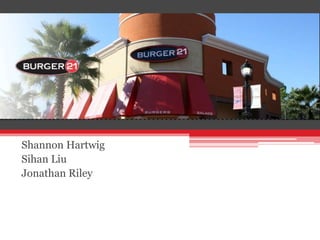
Shannon Hartwig
History
November 2009, the owners of
The Melting Pot Restaurants
had a vision to create a burger
restaurant that offered a
unique variety of high-quality
food.
Opened November 2010 in the
Westchase area of Tampa, Fl.
18 franchises in development
Burger 21 has since opened
locations in Arizona, Georgia,
North Carolina, Virginia, New
Jersey, and New York.
Burger 21 established their“B-isms” –
which range from “B-saucy” and “B-
different” to “B-comfortable” and “B-
involved.”
Growth
New location to open up in Ft.
Lauderdale, Fl.
Resources
Burger 21 is financially backed by The Melting
Pot Restaurants.
The Melting Pot has 170 locations throughout
the United States, Mexico and Canada.
Since The Melting Pot has no experience in
China, they will have to meet the country’s
expectations before entering the international
market with Burger 21.
Current Markets Served
There are many fast-food
burger joints.
Currently rated between 3.5-4
stars on yelp.com
Healthier food options: the
veggie burgers, turkey burgers
and sweet potato fries.
Food allergy accommodations.
Mission and Vision
"To deliver chef-created taste
without the chef price.”
The melting pot wanted to
create a modern fast-casual
burger restaurant, offering
high-quality food in a hip
environment appealing to all
ages.
Goals
Domestic International
Allow for an additional 6
locations within the U.S. by
January 1, 2016
Open a Burger 21 in China by
May 31, 2016
Earn 5% profit within the first
fiscal year of opening
Product and Service Marketing
Excellent quality and a
modern fast- casual dining
experience
We will position Burger 21 in
the high-traffic area of Beijing,
China
Products Include a variety of:
Beef, Chicken, Turkey,
Seafood, Sliders and Veggie
Burgers.
Gourmet Dogs, Chicken
Tenders, Salads,
Shakes/Floats, Sundaes,
Cookies and Fries.
Market Description
Sit-down dining is popular in
major cities.
Not many restaurants sell
burgers in a healthy style.
Population: 1.35 billion
Beijing: 21.15 million
Beijing
Potential Buyers: Families,
Teens, Tourists, Allergy
Consciences
Economy increased by 7.3
percent in the last quarter of
2014
Chinese citizens vary sharply
in their preferences: some
wealthy consumers in China
are still looking for status
labels, while others try not to
display their wealth.
Reasons to eat out include:
being "on to go“, special
occasion or to spend time with
family/friends.
Ages 18-34: 3x a week
Ages 35-54: 1.8x a week
Consumers tend to stay within
10 minutes from their home
Market Trends
The fast casual style of burger
joint dominates the industry
growth.
People are more interested in
a place where you can add
unusual toppings to make
their burger unique unlike
competing fast-food burger
restaurants.
The average check in the U.S.
is $10.69.
Burger Consumption
Communications and Transportation
Unless you speak Chinese (Mandarin), it can be
difficult to do business in many parts of China
without the aid of a translator.
China has transportation systems just like the
U.S.
By placing Burger 21 in a city atmosphere, it will
make the restaurant easily accessed by any
means of transportation.
Competition
Locally Owned Chain Restaurants
Let’s Burger
Hi-Park Bar and Grill
Katchup
People living in the area for a
long time are more likely go to
local restaurants to eat.
Tourist to the area enjoy going to
restaurants where they are
used to the type of food being
served and going to a place
that they can’t go to in their
home country.
FRIDAYS
Great Leap Brewing
Hooter’s
McDonalds
Already established.
Tourist know these common
restaurants.
Tourists may not want to go
there because it is not new to
them.
Market Potential
Burgers have been a favorite
for generations, but customers
want more premium product.
A projected increase in 5.3%
after our first 3 years and 3.4%
by our 5th year.
There are roughly 21.15
million people in our target
market, not taking into
account tourism.
The restaurant industry is
expected to grow by 3.4%.
The fast casual food industry
accounted for $69 billion in
revenue as of 2013.

Burger 21

  • 1.
  • 2.
    History November 2009, theowners of The Melting Pot Restaurants had a vision to create a burger restaurant that offered a unique variety of high-quality food. Opened November 2010 in the Westchase area of Tampa, Fl. 18 franchises in development Burger 21 has since opened locations in Arizona, Georgia, North Carolina, Virginia, New Jersey, and New York. Burger 21 established their“B-isms” – which range from “B-saucy” and “B- different” to “B-comfortable” and “B- involved.”
  • 3.
    Growth New location toopen up in Ft. Lauderdale, Fl.
  • 4.
    Resources Burger 21 isfinancially backed by The Melting Pot Restaurants. The Melting Pot has 170 locations throughout the United States, Mexico and Canada. Since The Melting Pot has no experience in China, they will have to meet the country’s expectations before entering the international market with Burger 21.
  • 5.
    Current Markets Served Thereare many fast-food burger joints. Currently rated between 3.5-4 stars on yelp.com Healthier food options: the veggie burgers, turkey burgers and sweet potato fries. Food allergy accommodations.
  • 6.
    Mission and Vision "Todeliver chef-created taste without the chef price.” The melting pot wanted to create a modern fast-casual burger restaurant, offering high-quality food in a hip environment appealing to all ages.
  • 7.
    Goals Domestic International Allow foran additional 6 locations within the U.S. by January 1, 2016 Open a Burger 21 in China by May 31, 2016 Earn 5% profit within the first fiscal year of opening
  • 8.
    Product and ServiceMarketing Excellent quality and a modern fast- casual dining experience We will position Burger 21 in the high-traffic area of Beijing, China Products Include a variety of: Beef, Chicken, Turkey, Seafood, Sliders and Veggie Burgers. Gourmet Dogs, Chicken Tenders, Salads, Shakes/Floats, Sundaes, Cookies and Fries.
  • 9.
    Market Description Sit-down diningis popular in major cities. Not many restaurants sell burgers in a healthy style. Population: 1.35 billion Beijing: 21.15 million Beijing Potential Buyers: Families, Teens, Tourists, Allergy Consciences Economy increased by 7.3 percent in the last quarter of 2014 Chinese citizens vary sharply in their preferences: some wealthy consumers in China are still looking for status labels, while others try not to display their wealth. Reasons to eat out include: being "on to go“, special occasion or to spend time with family/friends. Ages 18-34: 3x a week Ages 35-54: 1.8x a week Consumers tend to stay within 10 minutes from their home
  • 10.
    Market Trends The fastcasual style of burger joint dominates the industry growth. People are more interested in a place where you can add unusual toppings to make their burger unique unlike competing fast-food burger restaurants. The average check in the U.S. is $10.69. Burger Consumption
  • 11.
    Communications and Transportation Unlessyou speak Chinese (Mandarin), it can be difficult to do business in many parts of China without the aid of a translator. China has transportation systems just like the U.S. By placing Burger 21 in a city atmosphere, it will make the restaurant easily accessed by any means of transportation.
  • 12.
    Competition Locally Owned ChainRestaurants Let’s Burger Hi-Park Bar and Grill Katchup People living in the area for a long time are more likely go to local restaurants to eat. Tourist to the area enjoy going to restaurants where they are used to the type of food being served and going to a place that they can’t go to in their home country. FRIDAYS Great Leap Brewing Hooter’s McDonalds Already established. Tourist know these common restaurants. Tourists may not want to go there because it is not new to them.
  • 13.
    Market Potential Burgers havebeen a favorite for generations, but customers want more premium product. A projected increase in 5.3% after our first 3 years and 3.4% by our 5th year. There are roughly 21.15 million people in our target market, not taking into account tourism. The restaurant industry is expected to grow by 3.4%. The fast casual food industry accounted for $69 billion in revenue as of 2013.