Introduction to ITC
Tools and
preparation of
Market Profiles
Cairo, March
2018
Why to go
global?
• Identify promising markets for
exports
• Identity better import sources
• Access GVC
• Diversify and reduce vulnerability
• …
Reasons to export?
To offset domestic market’s cyclical sales
To achieve additional sales
To extend a product’s life cycle
To respond strategically to foreign competitors
To achieve the success the firm’s management
has seen others achieve
To improve the efficiency of manufacturing
equipment
Reasons not to Export
Two major reasons
Preoccupation with the vast American market
Reluctance to become involved in a new, unknown and
therefore risky operation
Not active in international markets due to
Lack of knowledge
Locating foreign markets
Payment and financing procedures
Export procedures
Show and Sell
Trade events to facilitate international trade
pavilions
Trade missions
Product literature center
Reverse trade missions
Export Marketing Plan
Essentially same as domestic marketing plan
Specific about
Markets to be developed
Marketing strategy for serving them
Tactics to make the strategy operational
Export Marketing Plan
Essentially same as domestic marketing
plan
Specific about
Markets to be developed
Marketing strategy for serving them
Tactics to make the strategy operational
Terms of Sale…
INCOTERMS
Universal trade terminology developed by the
International Chamber of Commerce
Ex-Works
Risk passes at factory door
US equivalent: FOB (free on board)
Terms of Sale
FAS
Free alongside ship, port of call
CIF
Cost, insurance, freight, foreign port
CFR
cost and freight, foreign port
DAF
Delivered at frontier
Importing
Ways to identify import sources
If similar imported products are already in the
market, visit a retailer and examine the product
label
If the product is not being imported, call the
nearest consul or embassy of that country
Use the electronic bulletin boards of the World
Trade Centers
Customhouse Broker
Independent business that handles import
shipments
Acts as agent for importer
Customhouse broker brings goods through customs
May arrange transportation for goods after they
leave customs
Need to know when imports are subject to import
quotas and how much of the quota has been filled
Importing
Bonded warehouse
Area authorized by customs for storage of goods on which payment of
import duties is deferred until goods are removed
Automated Commercial System (ACS)
Used to track, control, and process all commercial goods imported into
U.S.
Import Duties
Importer must know how U.S./Canada calculates import duties
The Harmonized Tariff Schedule of U.S. (HTSUSA)
American version of the Harmonized System used worldwide to classify
imported products
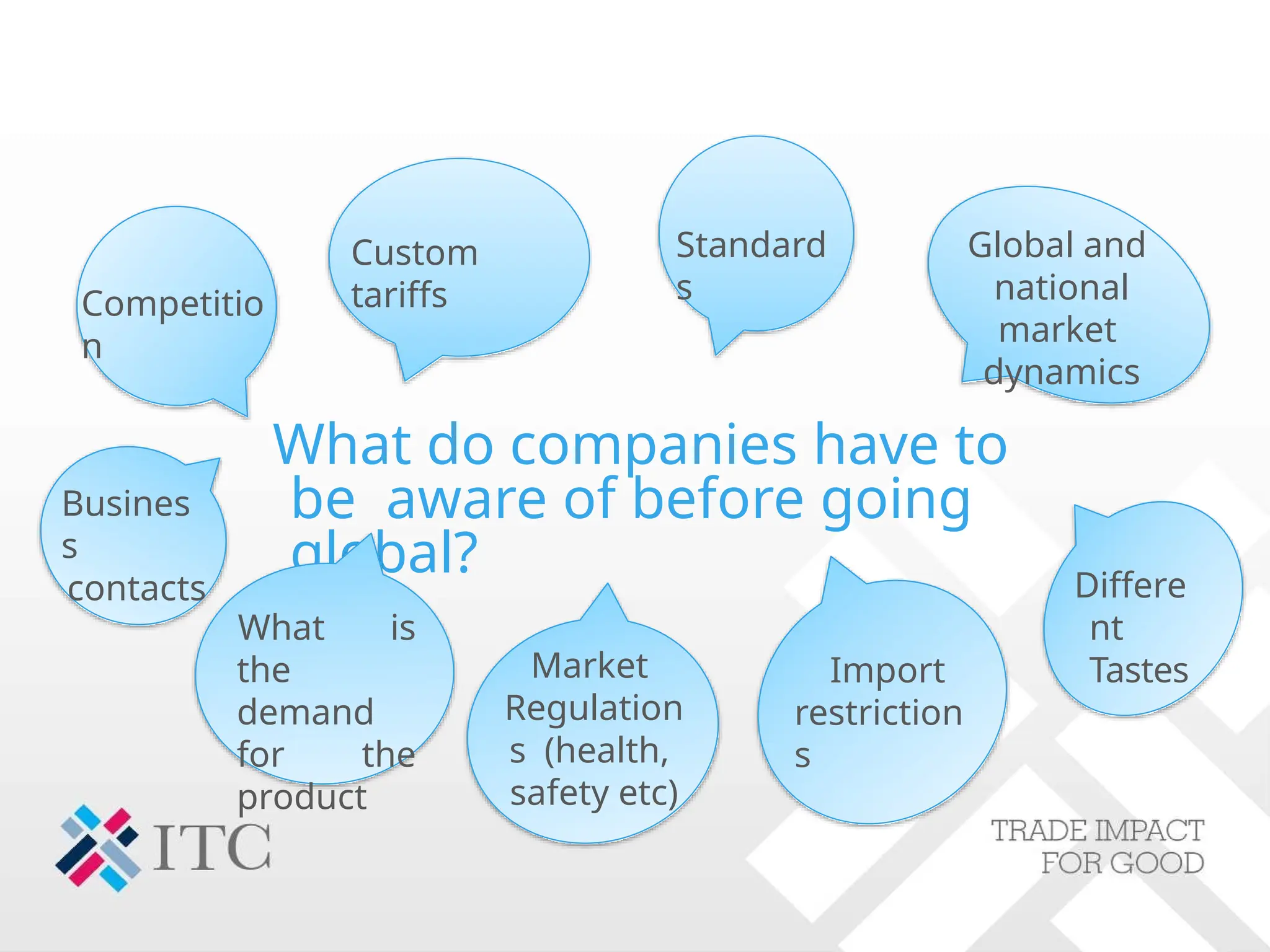
What do companies have to
be aware of before going
global?
Standard
s
Competitio
n
Market
Regulation
s (health,
safety etc)
Differe
nt
Tastes
Busines
s
contacts
Custom
tariffs
Global and
national
market
dynamics
Import
restriction
s
What is
the
demand
for the
product
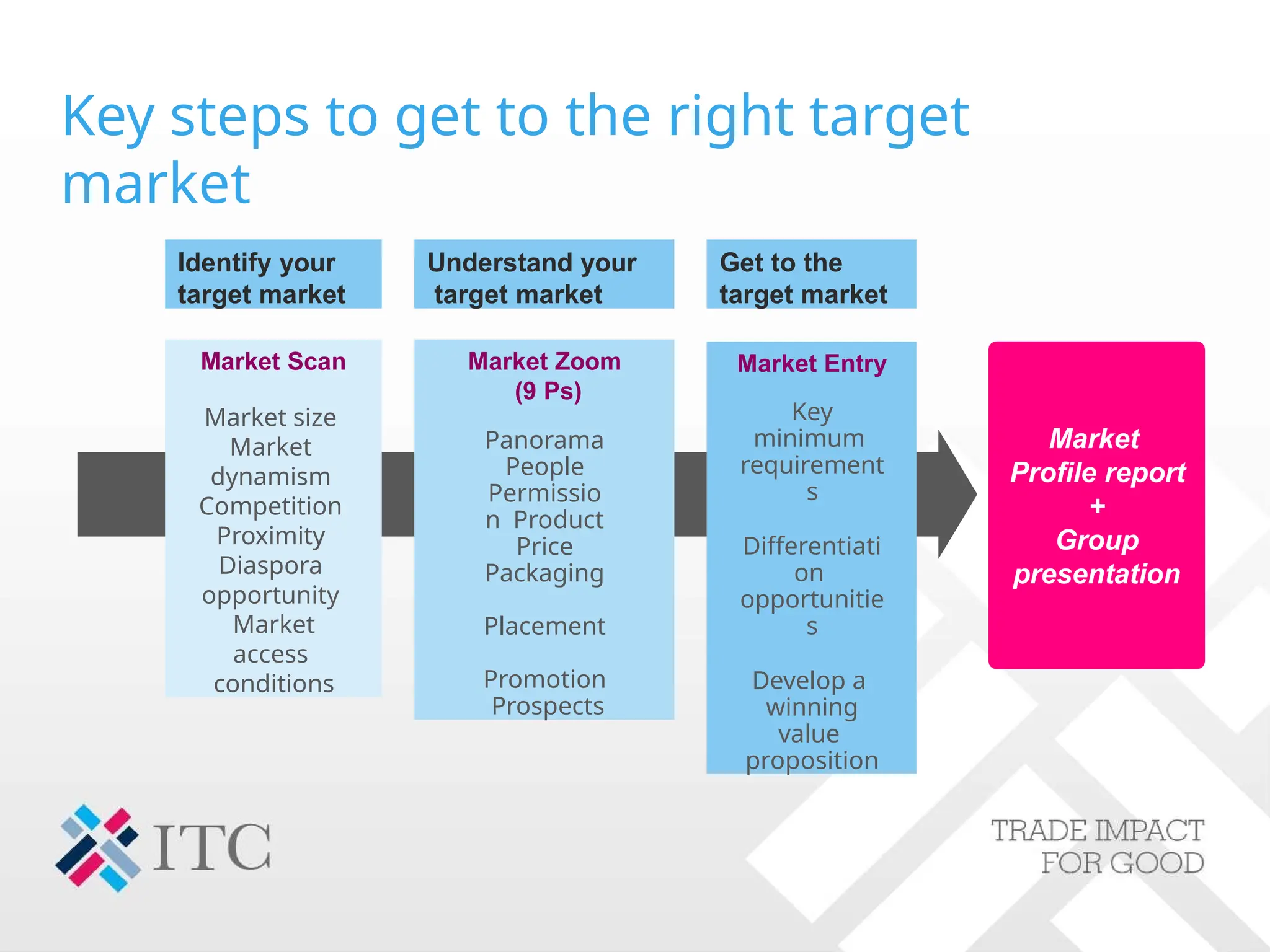
Key steps to get to the right target
market
Market Zoom
(9 Ps)
Panorama
People
Permissio
n Product
Price
Packaging
Placement
Promotion
Prospects
Market Entry
Key
minimum
requirement
s
Differentiati
on
opportunitie
s
Develop a
winning
value
proposition
Identify your
target market
Understand your
target market
Get to the
target market
Market Scan
Market size
Market
dynamism
Competition
Proximity
Diaspora
opportunity
Market
access
conditions
Market
Profile report
+
Group
presentation
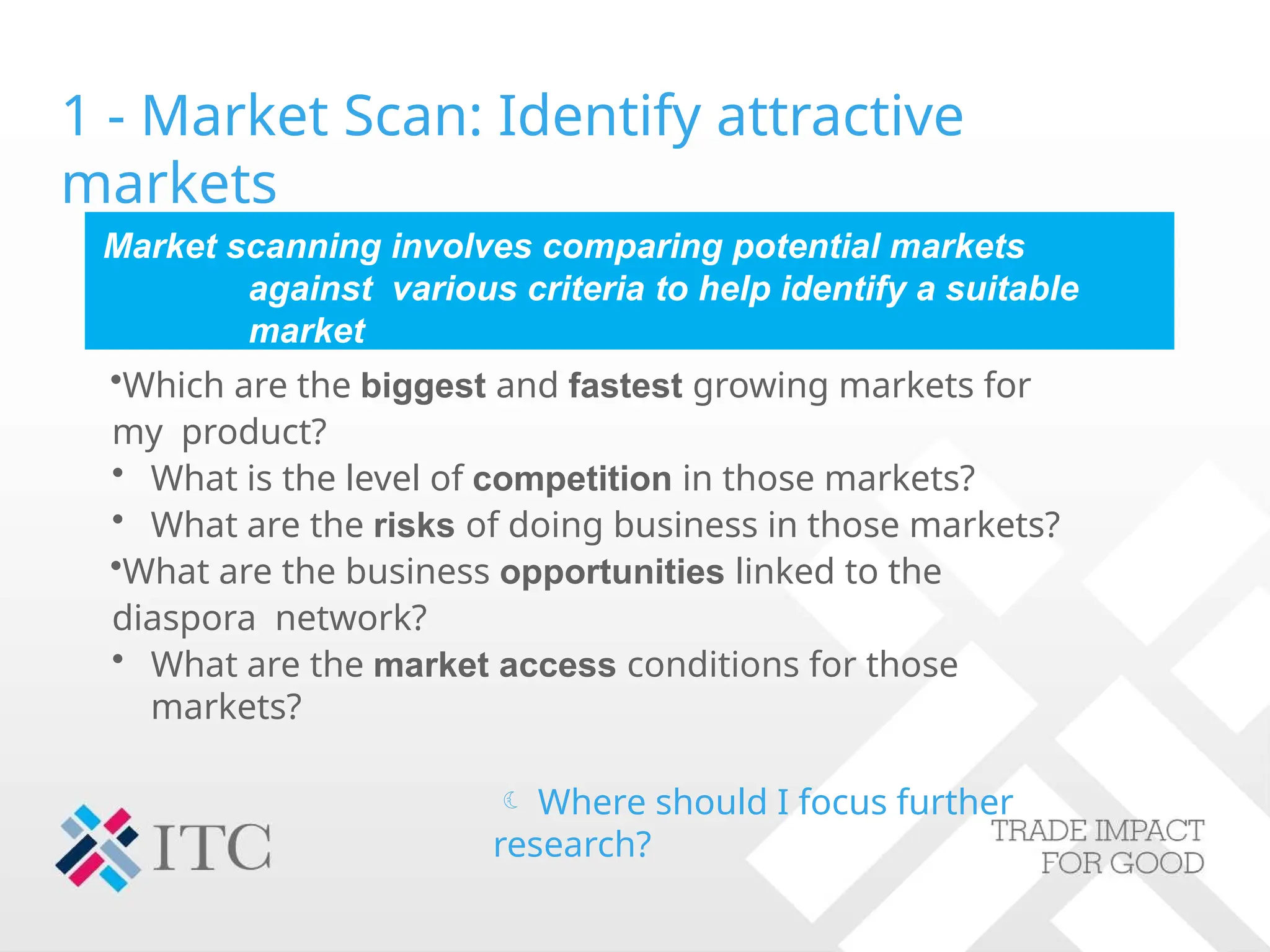
1 - Market Scan: Identify attractive
markets
Market scanning involves comparing potential markets
against various criteria to help identify a suitable
market
•Which are the biggest and fastest growing markets for
my product?
• What is the level of competition in those markets?
• What are the risks of doing business in those markets?
•What are the business opportunities linked to the
diaspora network?
• What are the market access conditions for those
markets?
 Where should I focus further
research?
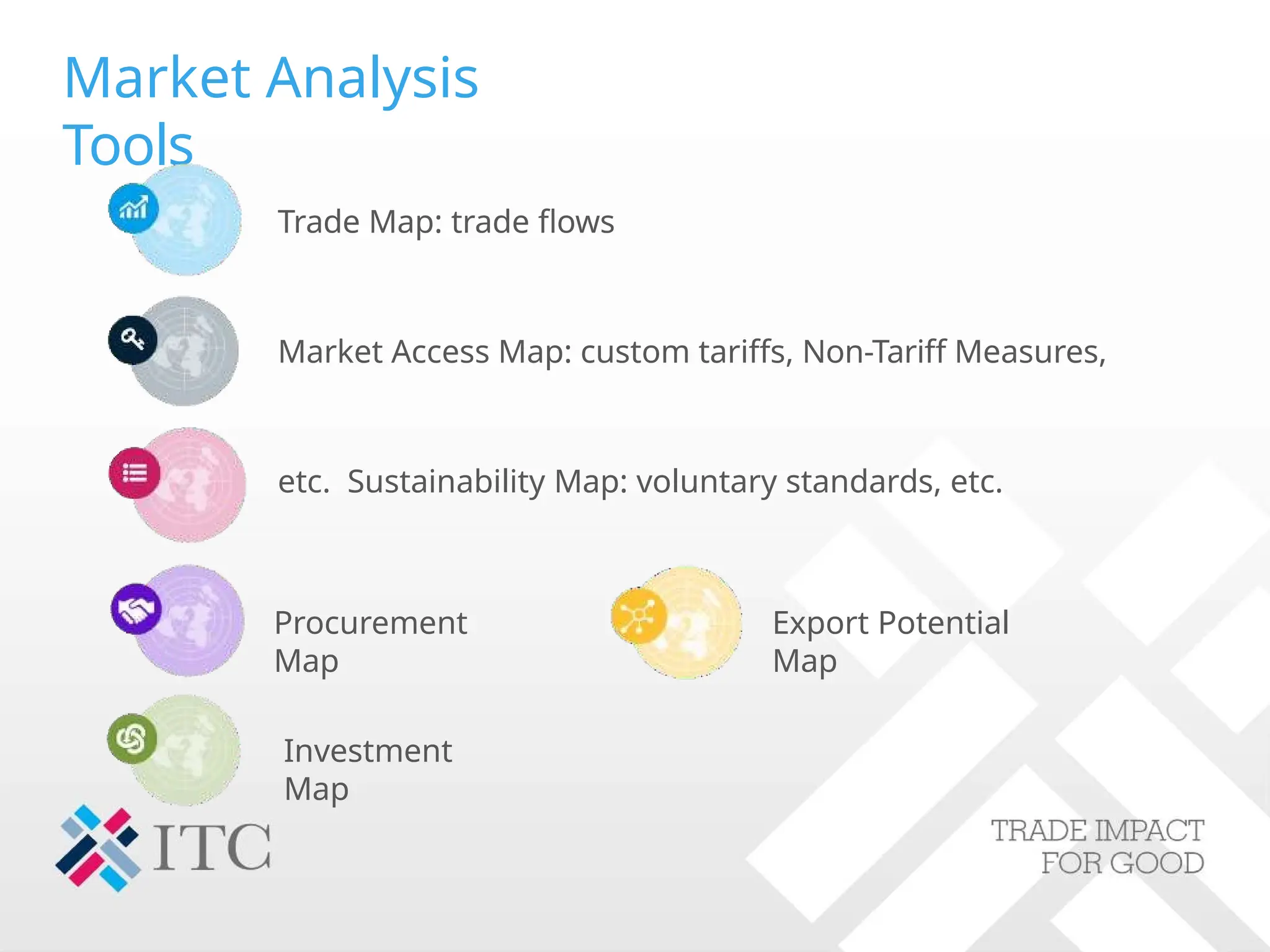
Market Analysis
Tools
Trade Map: trade flows
Market Access Map: custom tariffs, Non-Tariff Measures,
etc. Sustainability Map: voluntary standards, etc.
Procurement
Map
Investment
Map
Export Potential
Map
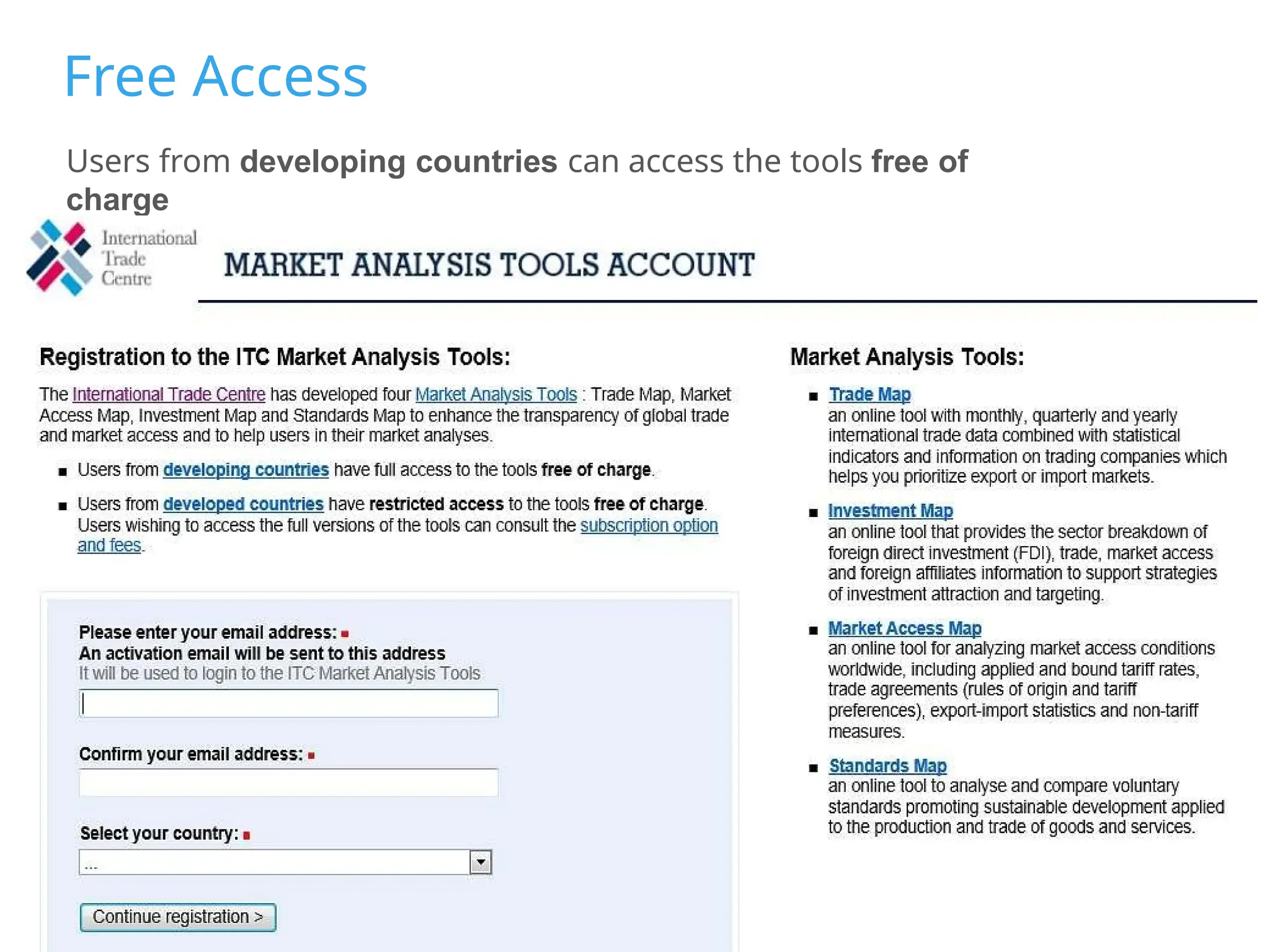
Users from developing countries can access the tools free of
charge
Free Access
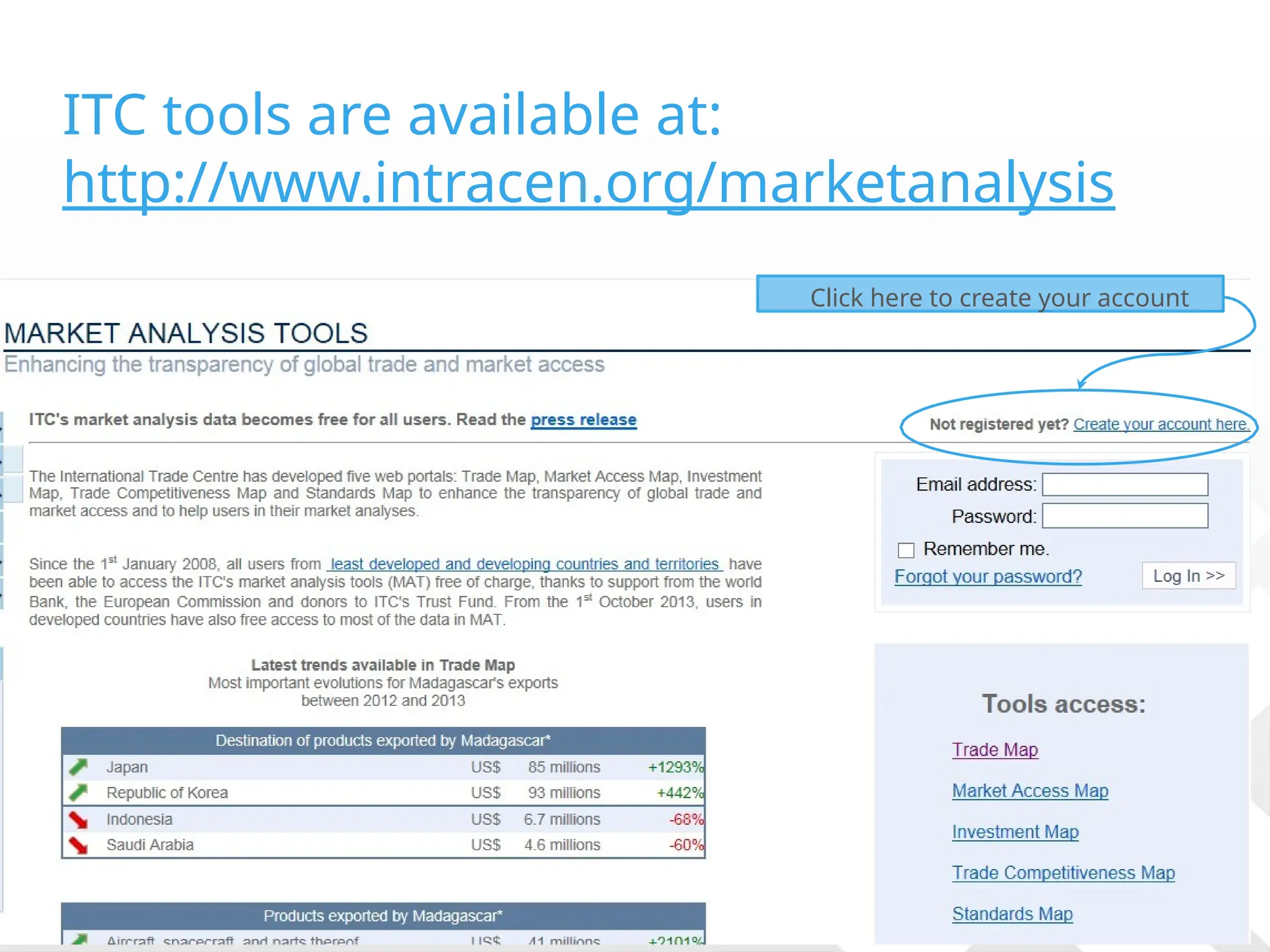
ITC tools are available at:
http://www.intracen.org/marketanalysis
Click here to create your account
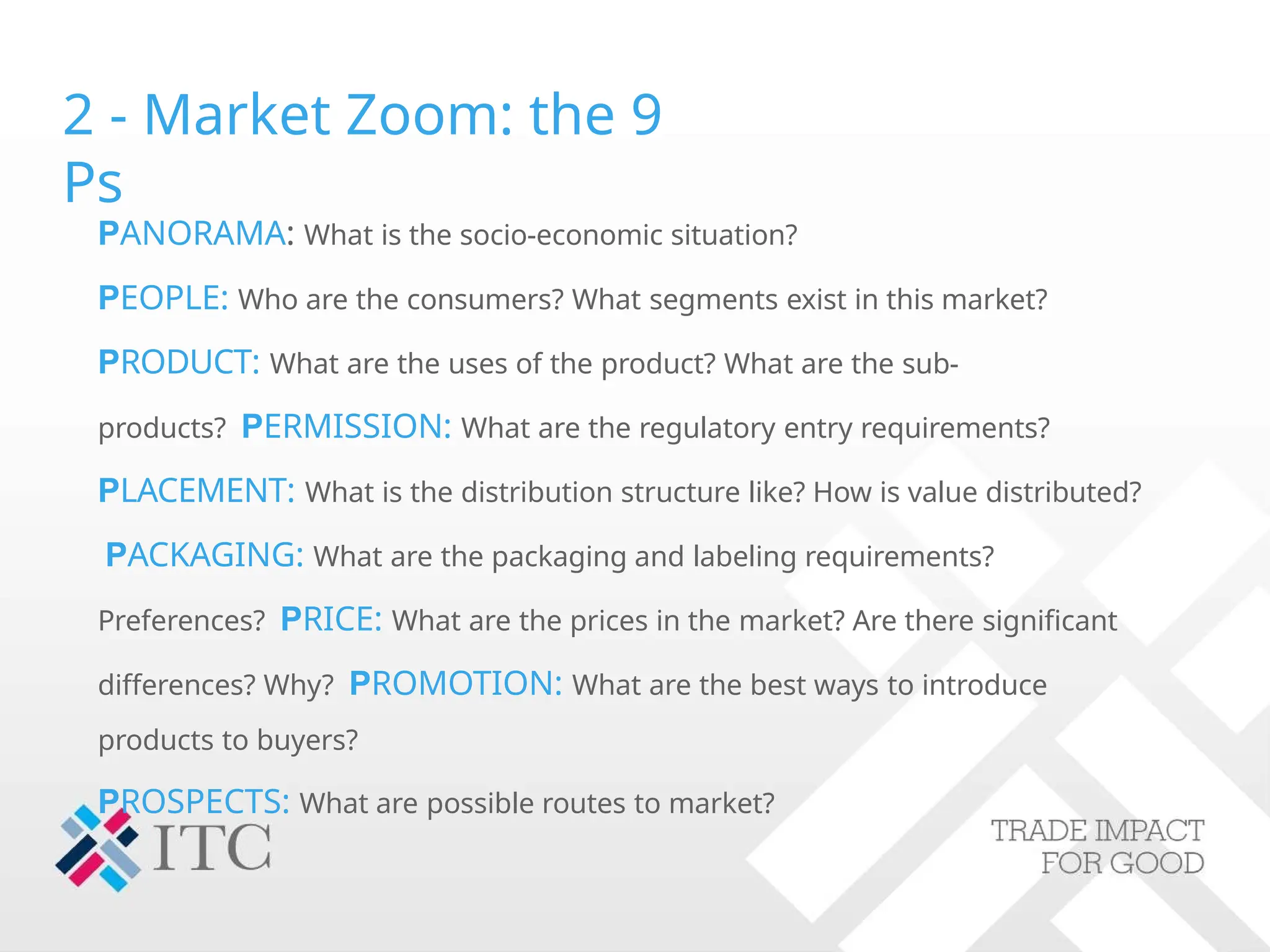
2 - Market Zoom: the 9
Ps
PANORAMA: What is the socio-economic situation?
PEOPLE: Who are the consumers? What segments exist in this market?
PRODUCT: What are the uses of the product? What are the sub-
products? PERMISSION: What are the regulatory entry requirements?
PLACEMENT: What is the distribution structure like? How is value distributed?
PACKAGING: What are the packaging and labeling requirements?
Preferences? PRICE: What are the prices in the market? Are there significant
differences? Why? PROMOTION: What are the best ways to introduce
products to buyers?
PROSPECTS: What are possible routes to market?
3 - Market Entry: Your value
proposition
Minimum requirements
• Example: Phytosanitary requirements
• Product quality standards, on-time delivery, competitive
price
Differentiation
• Example: Differentiate as an “ethnic” gourmet experience
Firm
What do we need to do different at
the firm level?
What is a Market
Profile?
Product focused:
• dealing with a single product or a narrowly defined group of
products
Limited Geographically:
• dealing with one market or markets that share similar features
Concise:
• a good description of the main characteristics of the target market
Practical:
• containing sufficient information to support exporters with the
design of their export strategy
A Market Profile provides an understanding on where
opportunities lie and how to access these
opportunities.
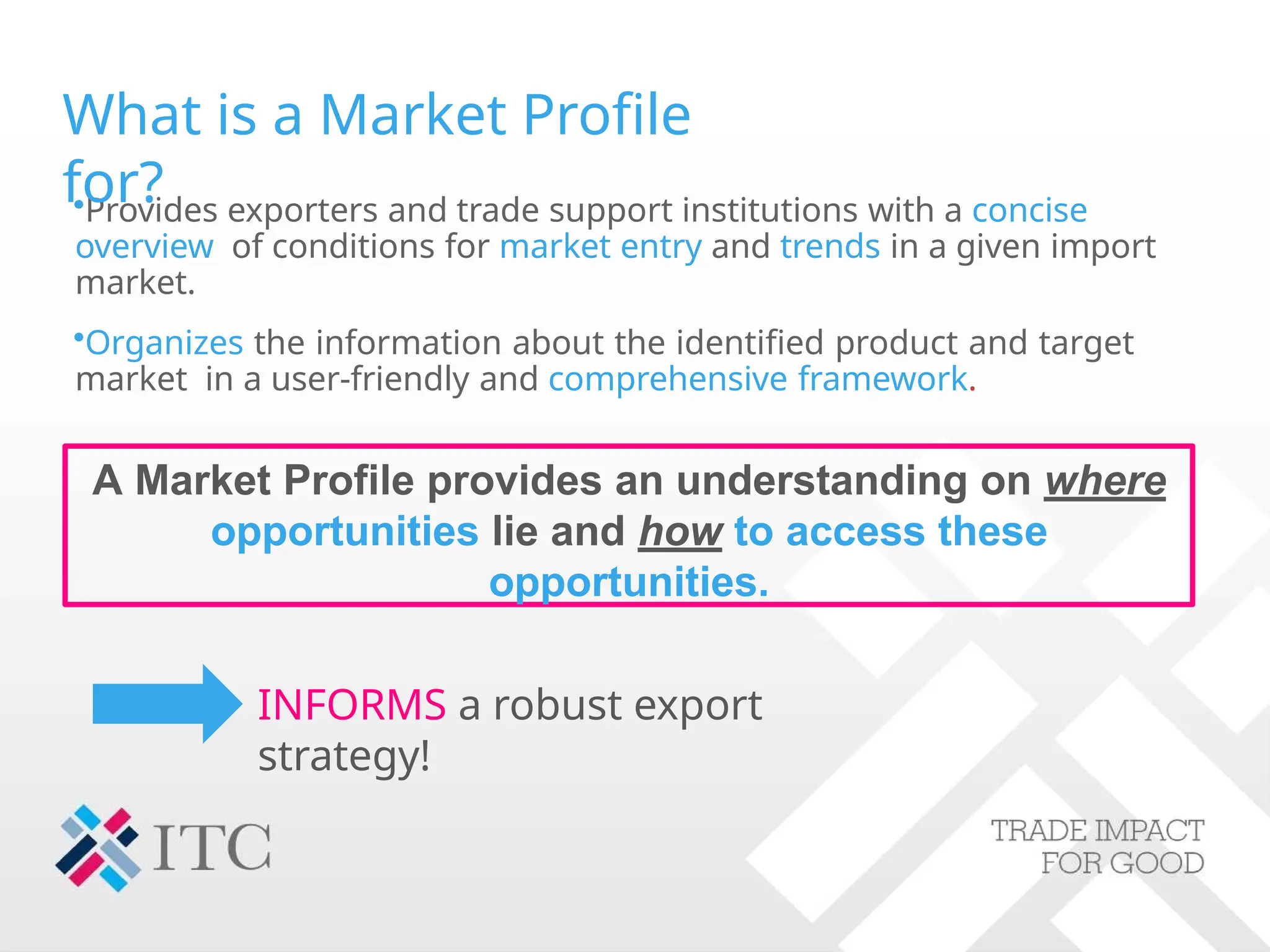
•Provides exporters and trade support institutions with a concise
overview of conditions for market entry and trends in a given import
market.
•Organizes the information about the identified product and target
market in a user-friendly and comprehensive framework.
What is a Market Profile
for?
INFORMS a robust export
strategy!
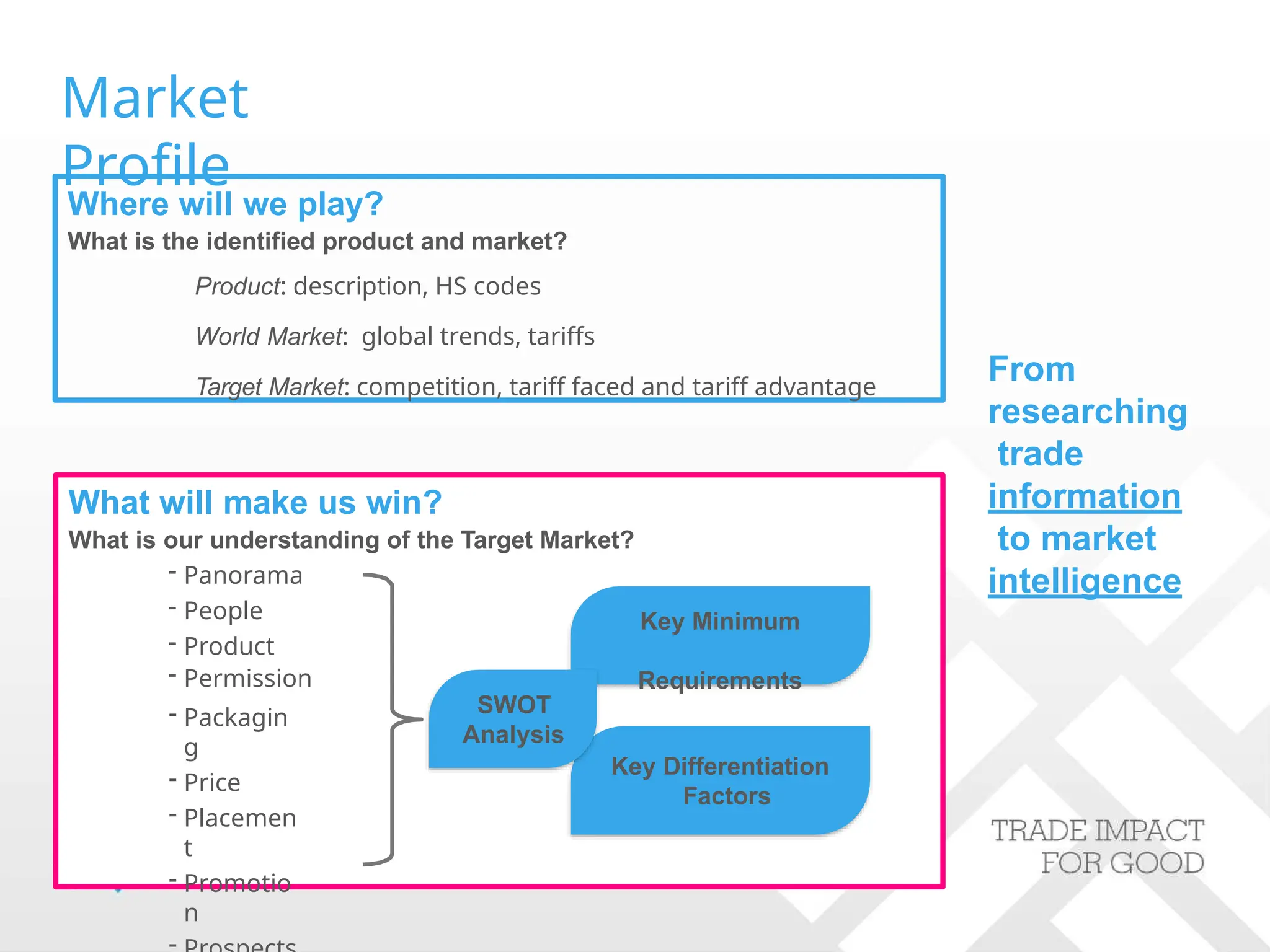
Where will we play?
What is the identified product and market?
Product: description, HS codes
World Market: global trends, tariffs
Target Market: competition, tariff faced and tariff advantage
- Packagin
g
- Price
- Placemen
t
- Promotio
n
Market
Profile
From
researching
trade
information
to market
intelligence
Key Minimum
Requirements
Key Differentiation
Factors
What will make us win?
What is our understanding of the Target Market?
- Panorama
- People
- Product
- Permission
SWOT
Analysis
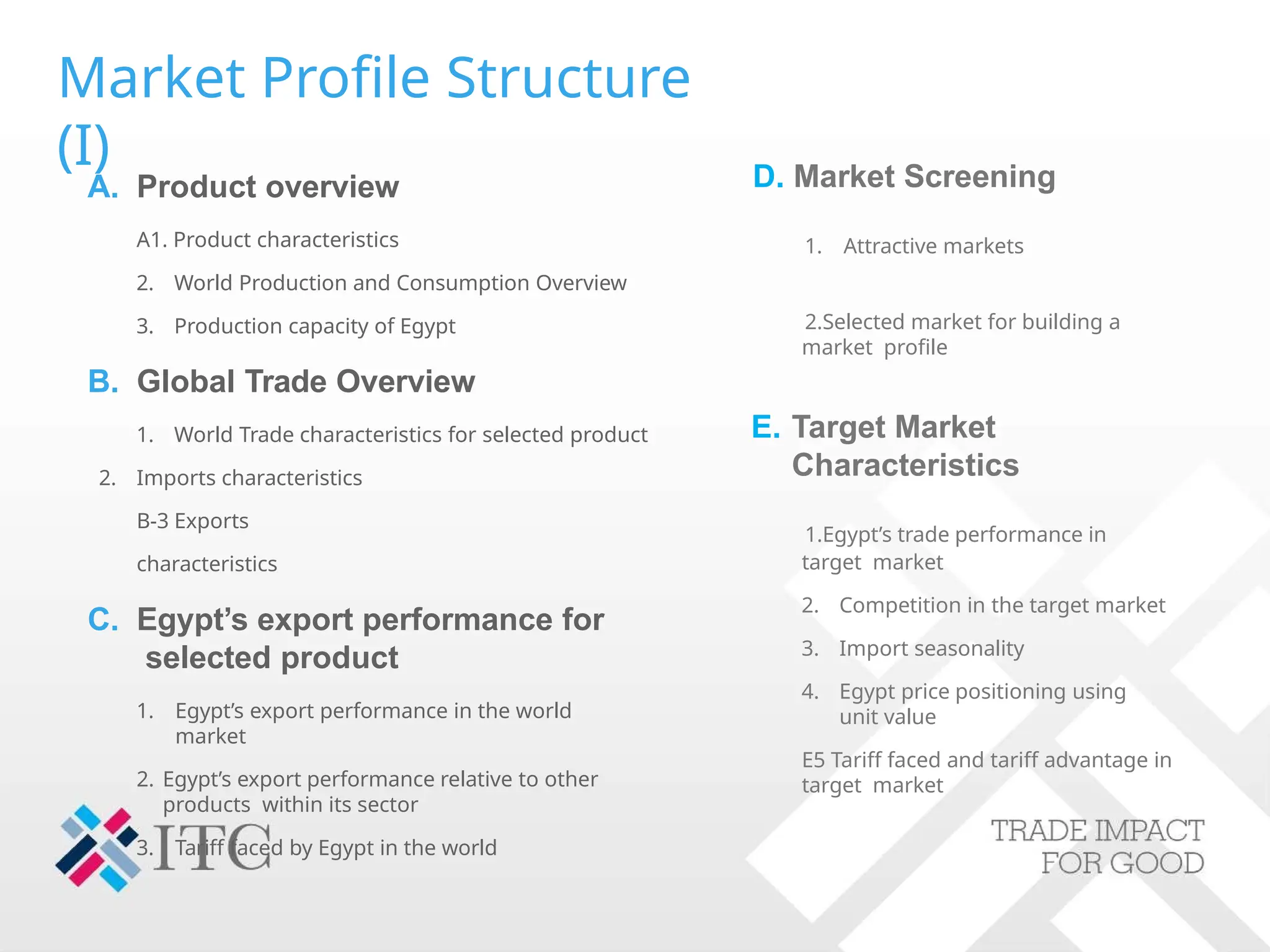
Market Profile Structure
(I) D. Market Screening
1. Attractive markets
2.Selected market for building a
market profile
E. Target Market
Characteristics
1.Egypt’s trade performance in
target market
2. Competition in the target market
3. Import seasonality
4. Egypt price positioning using
unit value
E5 Tariff faced and tariff advantage in
target market
A. Product overview
A1. Product characteristics
2. World Production and Consumption Overview
3. Production capacity of Egypt
B. Global Trade Overview
1. World Trade characteristics for selected product
2. Imports characteristics
B-3 Exports
characteristics
C. Egypt’s export performance for
selected product
1. Egypt’s export performance in the world
market
2. Egypt’s export performance relative to other
products within its sector
3. Tariff faced by Egypt in the world
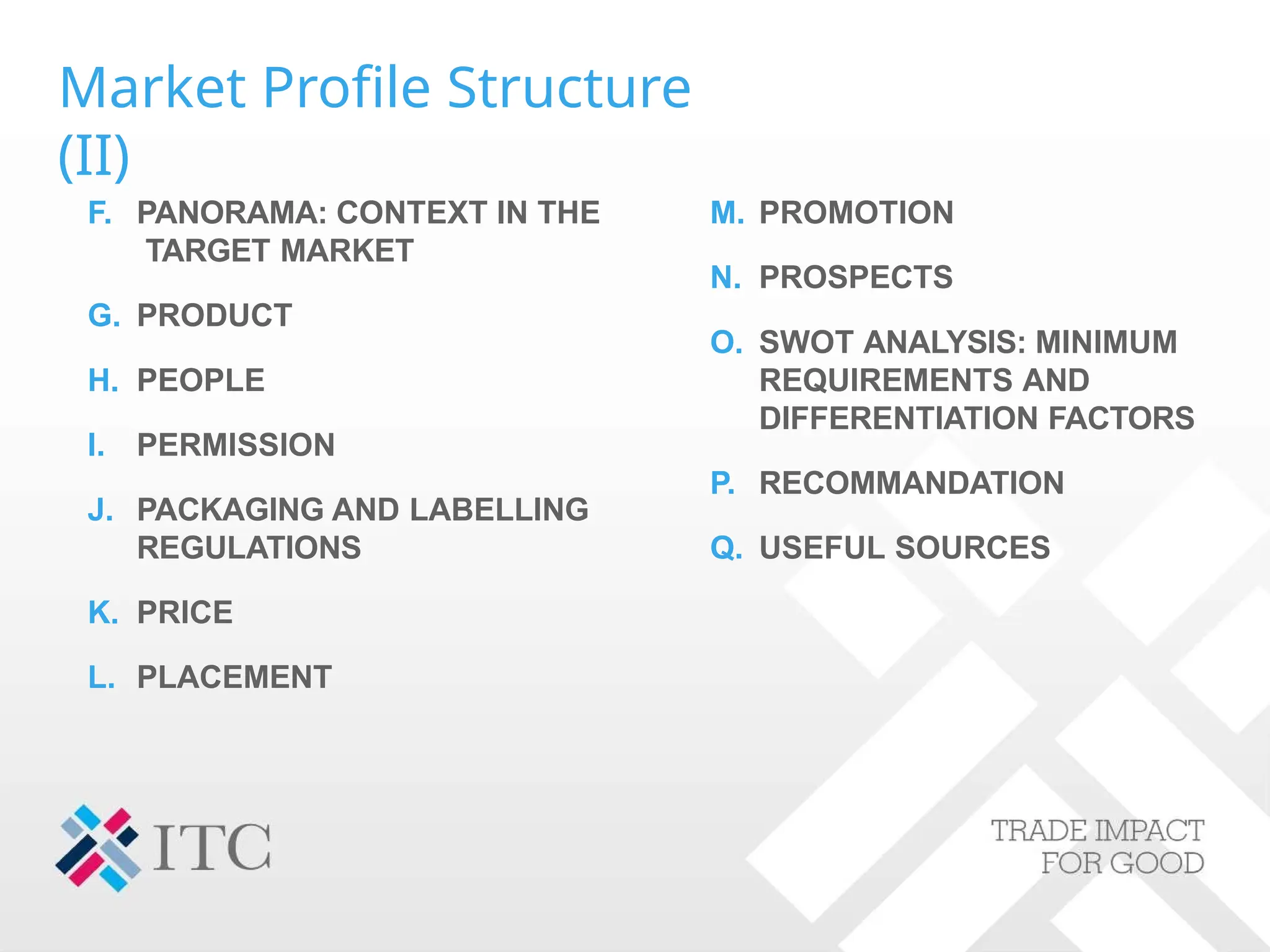
Market Profile Structure
(II)
F. PANORAMA: CONTEXT IN THE
TARGET MARKET
G. PRODUCT
H. PEOPLE
I. PERMISSION
J. PACKAGING AND LABELLING
REGULATIONS
K. PRICE
L. PLACEMENT
M. PROMOTION
N. PROSPECTS
O. SWOT ANALYSIS: MINIMUM
REQUIREMENTS AND
DIFFERENTIATION FACTORS
P. RECOMMANDATION
Q. USEFUL SOURCES
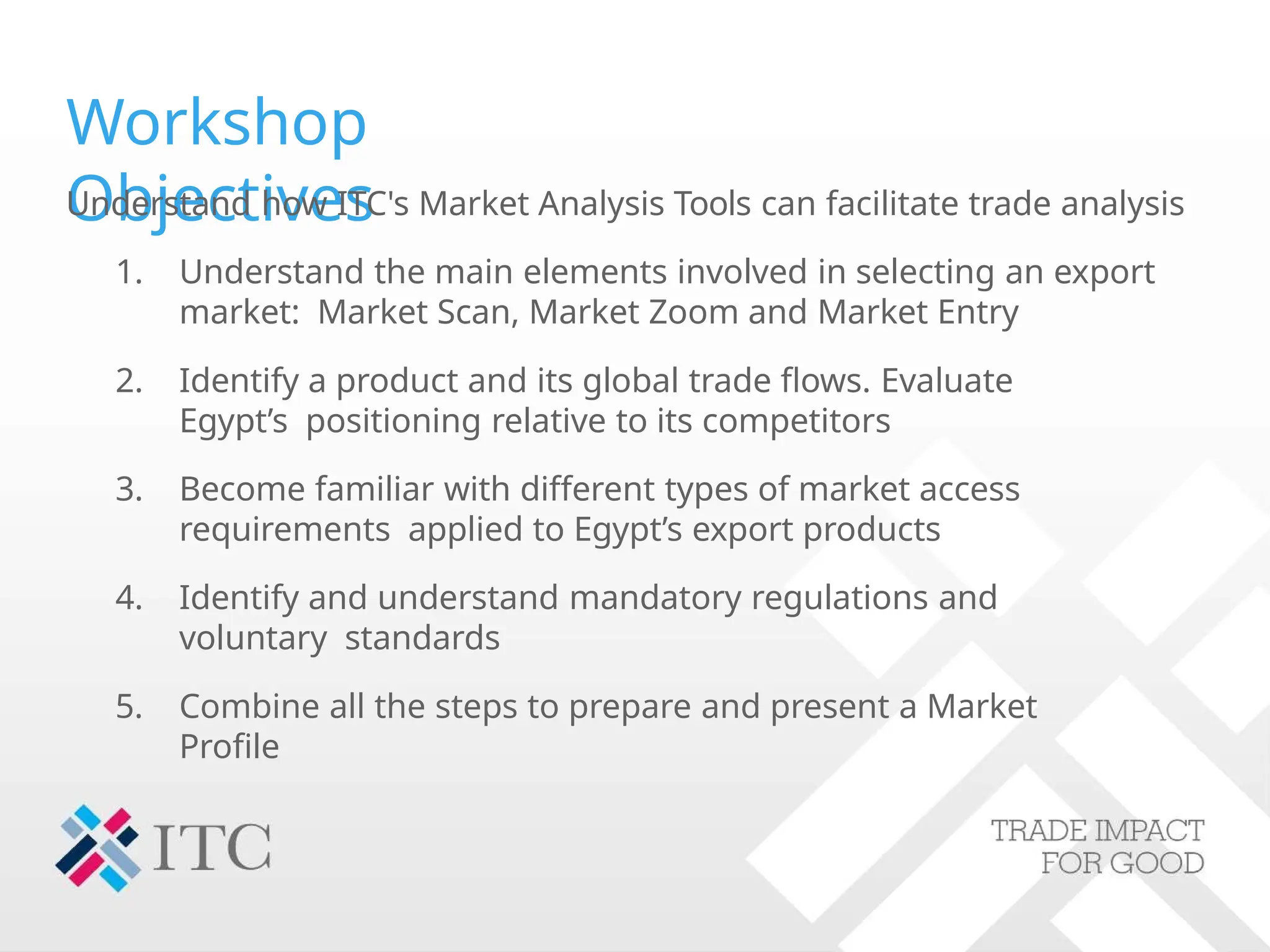
Workshop
Objectives
Understand how ITC's Market Analysis Tools can facilitate trade analysis
1. Understand the main elements involved in selecting an export
market: Market Scan, Market Zoom and Market Entry
2. Identify a product and its global trade flows. Evaluate
Egypt’s positioning relative to its competitors
3. Become familiar with different types of market access
requirements applied to Egypt’s export products
4. Identify and understand mandatory regulations and
voluntary standards
5. Combine all the steps to prepare and present a Market
Profile
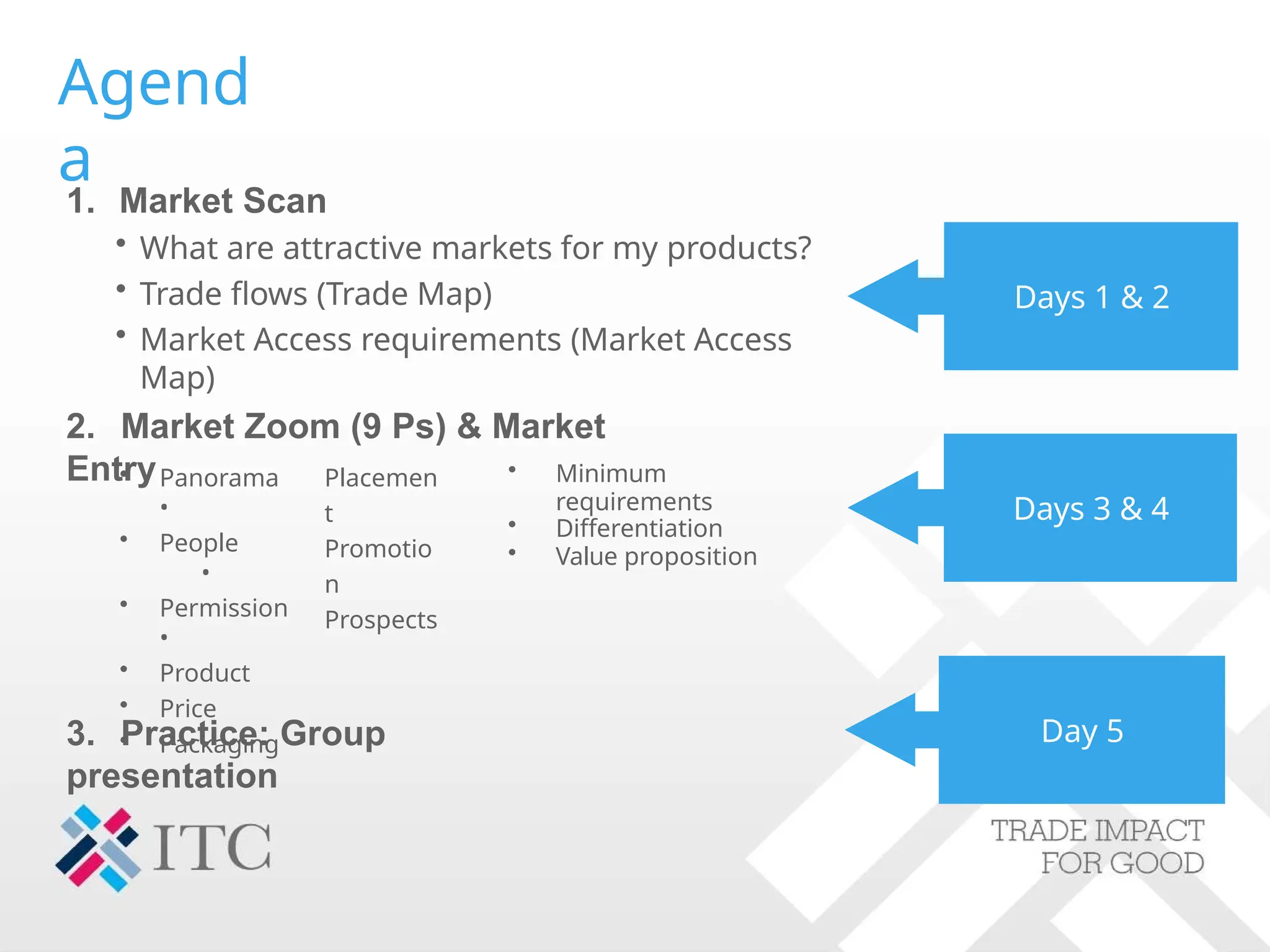
Agend
a
1. Market Scan
• What are attractive markets for my products?
• Trade flows (Trade Map)
• Market Access requirements (Market Access
Map)
2. Market Zoom (9 Ps) & Market
Entry
3. Practice: Group
presentation
Days 3 & 4
Days 1 & 2
Day 5
• Panorama
•
• People
•
• Permission
•
• Product
• Price
• Packaging
Placemen
t
Promotio
n
Prospects
• Minimum
requirements
• Differentiation
• Value proposition
Are you
ready ?

01-Introduction mains toots for trade over the world

  • 1.
    Introduction to ITC Toolsand preparation of Market Profiles Cairo, March 2018
  • 2.
    Why to go global? •Identify promising markets for exports • Identity better import sources • Access GVC • Diversify and reduce vulnerability • …
  • 3.
    Reasons to export? Tooffset domestic market’s cyclical sales To achieve additional sales To extend a product’s life cycle To respond strategically to foreign competitors To achieve the success the firm’s management has seen others achieve To improve the efficiency of manufacturing equipment
  • 4.
    Reasons not toExport Two major reasons Preoccupation with the vast American market Reluctance to become involved in a new, unknown and therefore risky operation Not active in international markets due to Lack of knowledge Locating foreign markets Payment and financing procedures Export procedures
  • 5.
    Show and Sell Tradeevents to facilitate international trade pavilions Trade missions Product literature center Reverse trade missions
  • 6.
    Export Marketing Plan Essentiallysame as domestic marketing plan Specific about Markets to be developed Marketing strategy for serving them Tactics to make the strategy operational
  • 7.
    Export Marketing Plan Essentiallysame as domestic marketing plan Specific about Markets to be developed Marketing strategy for serving them Tactics to make the strategy operational
  • 8.
    Terms of Sale… INCOTERMS Universaltrade terminology developed by the International Chamber of Commerce Ex-Works Risk passes at factory door US equivalent: FOB (free on board)
  • 9.
    Terms of Sale FAS Freealongside ship, port of call CIF Cost, insurance, freight, foreign port CFR cost and freight, foreign port DAF Delivered at frontier
  • 10.
    Importing Ways to identifyimport sources If similar imported products are already in the market, visit a retailer and examine the product label If the product is not being imported, call the nearest consul or embassy of that country Use the electronic bulletin boards of the World Trade Centers
  • 11.
    Customhouse Broker Independent businessthat handles import shipments Acts as agent for importer Customhouse broker brings goods through customs May arrange transportation for goods after they leave customs Need to know when imports are subject to import quotas and how much of the quota has been filled
  • 12.
    Importing Bonded warehouse Area authorizedby customs for storage of goods on which payment of import duties is deferred until goods are removed Automated Commercial System (ACS) Used to track, control, and process all commercial goods imported into U.S. Import Duties Importer must know how U.S./Canada calculates import duties The Harmonized Tariff Schedule of U.S. (HTSUSA) American version of the Harmonized System used worldwide to classify imported products
  • 13.
    What do companieshave to be aware of before going global? Standard s Competitio n Market Regulation s (health, safety etc) Differe nt Tastes Busines s contacts Custom tariffs Global and national market dynamics Import restriction s What is the demand for the product
  • 14.
    Key steps toget to the right target market Market Zoom (9 Ps) Panorama People Permissio n Product Price Packaging Placement Promotion Prospects Market Entry Key minimum requirement s Differentiati on opportunitie s Develop a winning value proposition Identify your target market Understand your target market Get to the target market Market Scan Market size Market dynamism Competition Proximity Diaspora opportunity Market access conditions Market Profile report + Group presentation
  • 15.
    1 - MarketScan: Identify attractive markets Market scanning involves comparing potential markets against various criteria to help identify a suitable market •Which are the biggest and fastest growing markets for my product? • What is the level of competition in those markets? • What are the risks of doing business in those markets? •What are the business opportunities linked to the diaspora network? • What are the market access conditions for those markets?  Where should I focus further research?
  • 16.
    Market Analysis Tools Trade Map:trade flows Market Access Map: custom tariffs, Non-Tariff Measures, etc. Sustainability Map: voluntary standards, etc. Procurement Map Investment Map Export Potential Map
  • 17.
    Users from developingcountries can access the tools free of charge Free Access
  • 18.
    ITC tools areavailable at: http://www.intracen.org/marketanalysis Click here to create your account
  • 19.
    2 - MarketZoom: the 9 Ps PANORAMA: What is the socio-economic situation? PEOPLE: Who are the consumers? What segments exist in this market? PRODUCT: What are the uses of the product? What are the sub- products? PERMISSION: What are the regulatory entry requirements? PLACEMENT: What is the distribution structure like? How is value distributed? PACKAGING: What are the packaging and labeling requirements? Preferences? PRICE: What are the prices in the market? Are there significant differences? Why? PROMOTION: What are the best ways to introduce products to buyers? PROSPECTS: What are possible routes to market?
  • 20.
    3 - MarketEntry: Your value proposition Minimum requirements • Example: Phytosanitary requirements • Product quality standards, on-time delivery, competitive price Differentiation • Example: Differentiate as an “ethnic” gourmet experience Firm What do we need to do different at the firm level?
  • 21.
    What is aMarket Profile? Product focused: • dealing with a single product or a narrowly defined group of products Limited Geographically: • dealing with one market or markets that share similar features Concise: • a good description of the main characteristics of the target market Practical: • containing sufficient information to support exporters with the design of their export strategy
  • 22.
    A Market Profileprovides an understanding on where opportunities lie and how to access these opportunities. •Provides exporters and trade support institutions with a concise overview of conditions for market entry and trends in a given import market. •Organizes the information about the identified product and target market in a user-friendly and comprehensive framework. What is a Market Profile for? INFORMS a robust export strategy!
  • 23.
    Where will weplay? What is the identified product and market? Product: description, HS codes World Market: global trends, tariffs Target Market: competition, tariff faced and tariff advantage - Packagin g - Price - Placemen t - Promotio n Market Profile From researching trade information to market intelligence Key Minimum Requirements Key Differentiation Factors What will make us win? What is our understanding of the Target Market? - Panorama - People - Product - Permission SWOT Analysis
  • 24.
    Market Profile Structure (I)D. Market Screening 1. Attractive markets 2.Selected market for building a market profile E. Target Market Characteristics 1.Egypt’s trade performance in target market 2. Competition in the target market 3. Import seasonality 4. Egypt price positioning using unit value E5 Tariff faced and tariff advantage in target market A. Product overview A1. Product characteristics 2. World Production and Consumption Overview 3. Production capacity of Egypt B. Global Trade Overview 1. World Trade characteristics for selected product 2. Imports characteristics B-3 Exports characteristics C. Egypt’s export performance for selected product 1. Egypt’s export performance in the world market 2. Egypt’s export performance relative to other products within its sector 3. Tariff faced by Egypt in the world
  • 25.
    Market Profile Structure (II) F.PANORAMA: CONTEXT IN THE TARGET MARKET G. PRODUCT H. PEOPLE I. PERMISSION J. PACKAGING AND LABELLING REGULATIONS K. PRICE L. PLACEMENT M. PROMOTION N. PROSPECTS O. SWOT ANALYSIS: MINIMUM REQUIREMENTS AND DIFFERENTIATION FACTORS P. RECOMMANDATION Q. USEFUL SOURCES
  • 26.
    Workshop Objectives Understand how ITC'sMarket Analysis Tools can facilitate trade analysis 1. Understand the main elements involved in selecting an export market: Market Scan, Market Zoom and Market Entry 2. Identify a product and its global trade flows. Evaluate Egypt’s positioning relative to its competitors 3. Become familiar with different types of market access requirements applied to Egypt’s export products 4. Identify and understand mandatory regulations and voluntary standards 5. Combine all the steps to prepare and present a Market Profile
  • 27.
    Agend a 1. Market Scan •What are attractive markets for my products? • Trade flows (Trade Map) • Market Access requirements (Market Access Map) 2. Market Zoom (9 Ps) & Market Entry 3. Practice: Group presentation Days 3 & 4 Days 1 & 2 Day 5 • Panorama • • People • • Permission • • Product • Price • Packaging Placemen t Promotio n Prospects • Minimum requirements • Differentiation • Value proposition
  • 28.