Science-to-Practice Initiative
PROSAD: A Bidding Decision Support System for
PRofit Optimizing Search Engine ADvertising
Bernd Skiera, Nadia Abou Nabout
skiera@wiwi.uni-frankfurt.de
abounabout@wiwi.uni-frankfurt.de
Search Engine Advertising 2
Availability of video presentation and additional
exercises
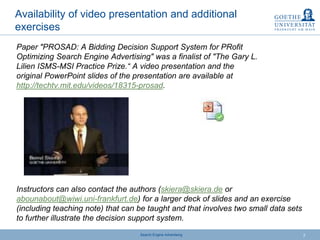
Paper "PROSAD: A Bidding Decision Support System for PRofit
Optimizing Search Engine Advertising" was a finalist of "The Gary L.
Lilien ISMS-MSI Practice Prize.“ A video presentation and the
original PowerPoint slides of the presentation are available at
http://techtv.mit.edu/videos/18315-prosad.
Instructors can also contact the authors (skiera@skiera.de or
abounabout@wiwi.uni-frankfurt.de) for a larger deck of slides and an exercise
(including teaching note) that can be taught and that involves two small data sets
to further illustrate the decision support system.
Search Engine Advertising 3
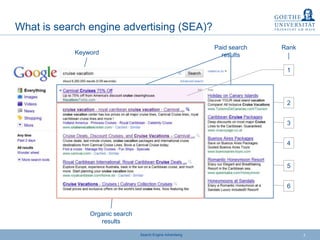
Keyword
Organic search
results
2
3
4
5
6
1
Paid search
results
Rank
What is search engine advertising (SEA)?
Search Engine Advertising 4
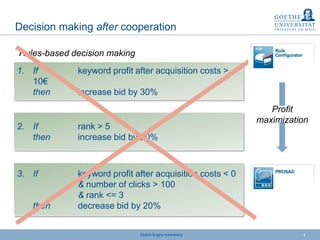
Decision making after cooperation
1. If keyword profit after acquisition costs >
10€
then increase bid by 30%
Rules-based decision making
2. If rank > 5
then increase bid by 20%
3. If keyword profit after acquisition costs < 0
& number of clicks > 100
& rank <= 3
then decrease bid by 20%
Profit
maximization
Search Engine Advertising 5
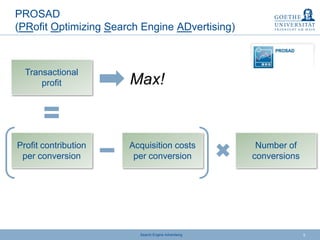
PROSAD
(PRofit Optimizing Search Engine ADvertising)
Transactional
profit
Profit contribution
per conversion
Acquisition costs
per conversion
Number of
conversions
Max!
Search Engine Advertising 6
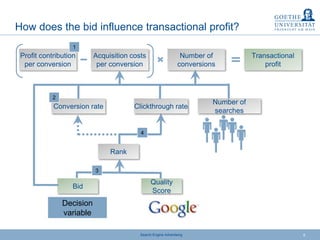
How does the bid influence transactional profit?
Transactional
profit
Profit contribution
per conversion
Acquisition costs
per conversion
Number of
conversions
Bid
Rank
Number of
searches
Quality
Score
Clickthrough rateConversion rate
1
2
3
4
Decision
variable
Search Engine Advertising 7
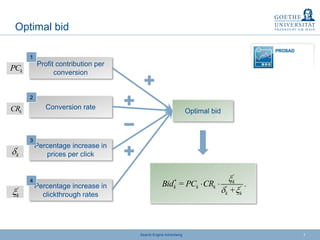
Percentage increase in
clickthrough rates
Percentage increase in
prices per click
Conversion rate
Profit contribution per
conversion
'
' '
* k
k k k
k k
Bid = PC CR .
+

 
 
Optimal bid
Optimal bid
1
2
3
4
kPC
kCR
'
k
'
k
Search Engine Advertising 8
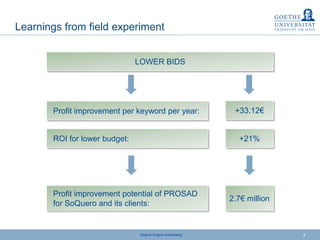
Learnings from field experiment
ROI for lower budget: +21%
Profit improvement per keyword per year: +33.12€
LOWER BIDS
Profit improvement potential of PROSAD
for SoQuero and its clients:
2.7€ million
Search Engine Advertising 9
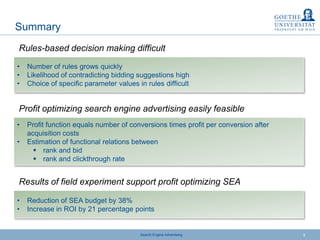
Summary
• Number of rules grows quickly
• Likelihood of contradicting bidding suggestions high
• Choice of specific parameter values in rules difficult
Rules-based decision making difficult
• Profit function equals number of conversions times profit per conversion after
acquisition costs
• Estimation of functional relations between
 rank and bid
 rank and clickthrough rate
Profit optimizing search engine advertising easily feasible
• Reduction of SEA budget by 38%
• Increase in ROI by 21 percentage points
Results of field experiment support profit optimizing SEA

Optimal Search Engine Marketing

  • 1.
    Science-to-Practice Initiative PROSAD: ABidding Decision Support System for PRofit Optimizing Search Engine ADvertising Bernd Skiera, Nadia Abou Nabout skiera@wiwi.uni-frankfurt.de abounabout@wiwi.uni-frankfurt.de
  • 2.
    Search Engine Advertising2 Availability of video presentation and additional exercises Paper "PROSAD: A Bidding Decision Support System for PRofit Optimizing Search Engine Advertising" was a finalist of "The Gary L. Lilien ISMS-MSI Practice Prize.“ A video presentation and the original PowerPoint slides of the presentation are available at http://techtv.mit.edu/videos/18315-prosad. Instructors can also contact the authors (skiera@skiera.de or abounabout@wiwi.uni-frankfurt.de) for a larger deck of slides and an exercise (including teaching note) that can be taught and that involves two small data sets to further illustrate the decision support system.
  • 3.
    Search Engine Advertising3 Keyword Organic search results 2 3 4 5 6 1 Paid search results Rank What is search engine advertising (SEA)?
  • 4.
    Search Engine Advertising4 Decision making after cooperation 1. If keyword profit after acquisition costs > 10€ then increase bid by 30% Rules-based decision making 2. If rank > 5 then increase bid by 20% 3. If keyword profit after acquisition costs < 0 & number of clicks > 100 & rank <= 3 then decrease bid by 20% Profit maximization
  • 5.
    Search Engine Advertising5 PROSAD (PRofit Optimizing Search Engine ADvertising) Transactional profit Profit contribution per conversion Acquisition costs per conversion Number of conversions Max!
  • 6.
    Search Engine Advertising6 How does the bid influence transactional profit? Transactional profit Profit contribution per conversion Acquisition costs per conversion Number of conversions Bid Rank Number of searches Quality Score Clickthrough rateConversion rate 1 2 3 4 Decision variable
  • 7.
    Search Engine Advertising7 Percentage increase in clickthrough rates Percentage increase in prices per click Conversion rate Profit contribution per conversion ' ' ' * k k k k k k Bid = PC CR . +      Optimal bid Optimal bid 1 2 3 4 kPC kCR ' k ' k
  • 8.
    Search Engine Advertising8 Learnings from field experiment ROI for lower budget: +21% Profit improvement per keyword per year: +33.12€ LOWER BIDS Profit improvement potential of PROSAD for SoQuero and its clients: 2.7€ million
  • 9.
    Search Engine Advertising9 Summary • Number of rules grows quickly • Likelihood of contradicting bidding suggestions high • Choice of specific parameter values in rules difficult Rules-based decision making difficult • Profit function equals number of conversions times profit per conversion after acquisition costs • Estimation of functional relations between  rank and bid  rank and clickthrough rate Profit optimizing search engine advertising easily feasible • Reduction of SEA budget by 38% • Increase in ROI by 21 percentage points Results of field experiment support profit optimizing SEA