Influence of the Luminol Chemiluminescence Reaction on the Confirmatory Tests for the Detection & Characterization of Bloodstains in Forensic Analysis  Julio Abreu, William Chauvin, Conor McMenamin,  John Vitale, Andrew Youngstrom BIOL 1115 Dr. Missy McElligot 16 February 2012
Introduction Detection of crime scenes Focus police work Luminol  Detection of invisible blood stains Evaluation of whether or not luminol negatively affects blood and DNA testing  
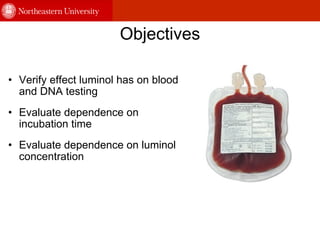
Objectives Verify effect luminol has on blood and DNA testing Evaluate dependence on incubation time Evaluate dependence on luminol concentration                  
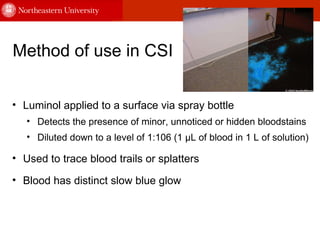
Method of use in CSI Luminol applied to a surface via spray bottle  Detects the presence of minor, unnoticed or hidden bloodstains  Diluted down to a level of 1:106 (1 μL of blood in 1 L of solution) Used to trace blood trails or splatters Blood has distinct slow blue glow
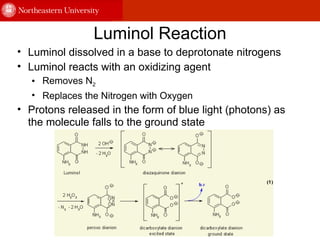
Luminol Reaction Luminol dissolved in a base to deprotonate nitrogens Luminol reacts with an oxidizing agent Removes N 2 Replaces the Nitrogen with Oxygen Protons released in the form of blue light (photons) as the molecule falls to the ground state
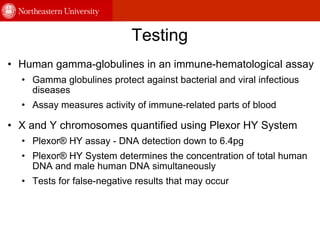
Testing Human gamma-globulines in an immune-hematological assay Gamma globulines protect against bacterial and viral infectious diseases Assay measures activity of immune-related parts of blood X and Y chromosomes quantified using Plexor HY System Plexor® HY assay - DNA detection down to 6.4pg  Plexor® HY System determines the concentration of total human DNA and male human DNA simultaneously Tests for false-negative results that may occur
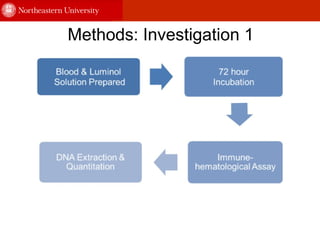
Methods: Investigation 1
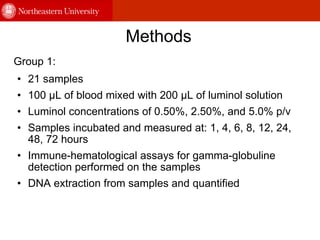
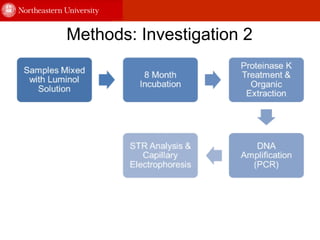
Methods Group 1: 21 samples 100 µL of blood mixed with 200 µL of luminol solution Luminol concentrations of 0.50%, 2.50%, and 5.0% p/v  Samples incubated and measured at: 1, 4, 6, 8, 12, 24,  48, 72 hours Immune-hematological assays for gamma-globuline detection performed on the samples DNA extraction from samples and quantified
Methods: Investigation 2
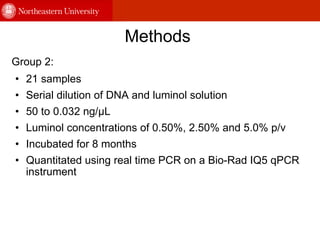
Methods  Group 2: 21 samples Serial dilution of DNA and luminol solution 50 to 0.032 ng/µL  Luminol concentrations of 0.50%, 2.50% and 5.0% p/v  Incubated for 8 months Quantitated using real time PCR on a Bio-Rad IQ5 qPCR instrument
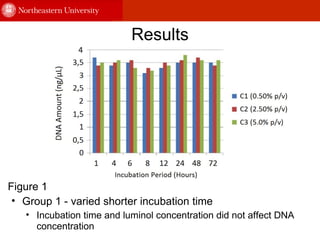
Figure 1.   DNA quantitation of the Group 1 samples with luminol                  solutions at varying concentrations. Figure 1 Group 1 - varied shorter incubation time Incubation time and luminol concentration did not affect DNA concentration  Results
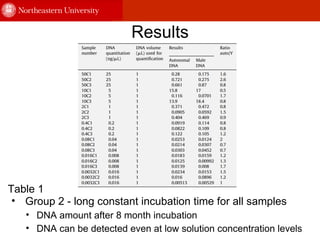
DNA amount after incubation of 4 µL of DNA and 4 µL of  luminol solution at varying concentrations by eight months. Table 1   Group 2 - long constant incubation time for all samples DNA amount after 8 month incubation DNA can be detected even at low solution concentration levels Results
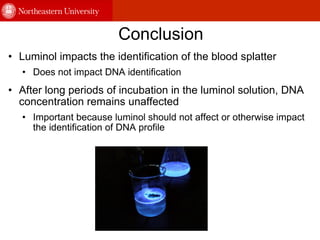
Conclusion Luminol impacts the identification of the blood splatter Does not impact DNA identification After long periods of incubation in the luminol solution, DNA concentration remains unaffected Important because luminol should not affect or otherwise impact the identification of DNA profile
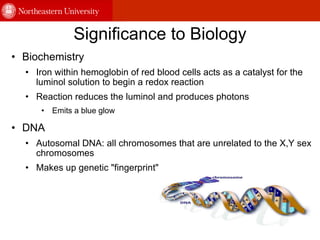
Significance to Biology Biochemistry Iron within hemoglobin of red blood cells acts as a catalyst for the luminol solution to begin a redox reaction Reaction reduces the luminol and produces photons Emits a blue glow DNA Autosomal DNA: all chromosomes that are unrelated to the X,Y sex chromosomes Makes up genetic "fingerprint"
Article Citation Santos, V.R.D., W.X. Paula, and E. Kalapothakis. "Influence of the  Luminol Chemiluminescence Reaction on the Confirmatory Tests for the Detection and Characterization of Bloodstains in Forensic Analysis."  Forensic Science International  (2009): 196-97. Web.
Influence of the Luminol Chemiluminescence Reaction on the Confirmatory Tests for the Detection & Characterization of Bloodstains in Forensic Analysis  Julio Abreu, William Chauvin, Conor McMenamin,  John Vitale, Andrew Youngstrom BIOL 1115 Dr. Missy McElligot 16 February 2012

Group 5 luminol & dna

  • 1.
    Influence of theLuminol Chemiluminescence Reaction on the Confirmatory Tests for the Detection & Characterization of Bloodstains in Forensic Analysis  Julio Abreu, William Chauvin, Conor McMenamin, John Vitale, Andrew Youngstrom BIOL 1115 Dr. Missy McElligot 16 February 2012
  • 2.
    Introduction Detection ofcrime scenes Focus police work Luminol Detection of invisible blood stains Evaluation of whether or not luminol negatively affects blood and DNA testing  
  • 3.
    Objectives Verify effect luminolhas on blood and DNA testing Evaluate dependence on incubation time Evaluate dependence on luminol concentration                  
  • 4.
    Method of usein CSI Luminol applied to a surface via spray bottle Detects the presence of minor, unnoticed or hidden bloodstains Diluted down to a level of 1:106 (1 μL of blood in 1 L of solution) Used to trace blood trails or splatters Blood has distinct slow blue glow
  • 5.
    Luminol Reaction Luminoldissolved in a base to deprotonate nitrogens Luminol reacts with an oxidizing agent Removes N 2 Replaces the Nitrogen with Oxygen Protons released in the form of blue light (photons) as the molecule falls to the ground state
  • 6.
    Testing Human gamma-globulines inan immune-hematological assay Gamma globulines protect against bacterial and viral infectious diseases Assay measures activity of immune-related parts of blood X and Y chromosomes quantified using Plexor HY System Plexor® HY assay - DNA detection down to 6.4pg  Plexor® HY System determines the concentration of total human DNA and male human DNA simultaneously Tests for false-negative results that may occur
  • 7.
  • 8.
    Methods Group 1:21 samples 100 µL of blood mixed with 200 µL of luminol solution Luminol concentrations of 0.50%, 2.50%, and 5.0% p/v  Samples incubated and measured at: 1, 4, 6, 8, 12, 24, 48, 72 hours Immune-hematological assays for gamma-globuline detection performed on the samples DNA extraction from samples and quantified
  • 9.
  • 10.
    Methods  Group 2:21 samples Serial dilution of DNA and luminol solution 50 to 0.032 ng/µL  Luminol concentrations of 0.50%, 2.50% and 5.0% p/v  Incubated for 8 months Quantitated using real time PCR on a Bio-Rad IQ5 qPCR instrument
  • 11.
    Figure 1. DNA quantitation of the Group 1 samples with luminol                  solutions at varying concentrations. Figure 1 Group 1 - varied shorter incubation time Incubation time and luminol concentration did not affect DNA concentration  Results
  • 12.
    DNA amount afterincubation of 4 µL of DNA and 4 µL of  luminol solution at varying concentrations by eight months. Table 1   Group 2 - long constant incubation time for all samples DNA amount after 8 month incubation DNA can be detected even at low solution concentration levels Results
  • 13.
    Conclusion Luminol impactsthe identification of the blood splatter Does not impact DNA identification After long periods of incubation in the luminol solution, DNA concentration remains unaffected Important because luminol should not affect or otherwise impact the identification of DNA profile
  • 14.
    Significance to BiologyBiochemistry Iron within hemoglobin of red blood cells acts as a catalyst for the luminol solution to begin a redox reaction Reaction reduces the luminol and produces photons Emits a blue glow DNA Autosomal DNA: all chromosomes that are unrelated to the X,Y sex chromosomes Makes up genetic "fingerprint"
  • 15.
    Article Citation Santos,V.R.D., W.X. Paula, and E. Kalapothakis. "Influence of the Luminol Chemiluminescence Reaction on the Confirmatory Tests for the Detection and Characterization of Bloodstains in Forensic Analysis." Forensic Science International (2009): 196-97. Web.
  • 16.
    Influence of theLuminol Chemiluminescence Reaction on the Confirmatory Tests for the Detection & Characterization of Bloodstains in Forensic Analysis  Julio Abreu, William Chauvin, Conor McMenamin, John Vitale, Andrew Youngstrom BIOL 1115 Dr. Missy McElligot 16 February 2012

Editor's Notes

  • #4 I think we should keep an objectives slide.  I'll add more to this.
  • #8 1. 2. 3. Immune-hematological assays are used to analyze gamma-globulines.   4.
  • #11 1. Samples prepared and quantitated by Plexor HY System
  • #12 C1, C2, C3 just different luminol concentrationsconcentrations
  • #15 The biological make up of blood is used in a chemical reaction to allow for easier identification