SENSORY IMPAIRMENT
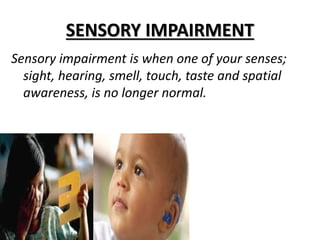
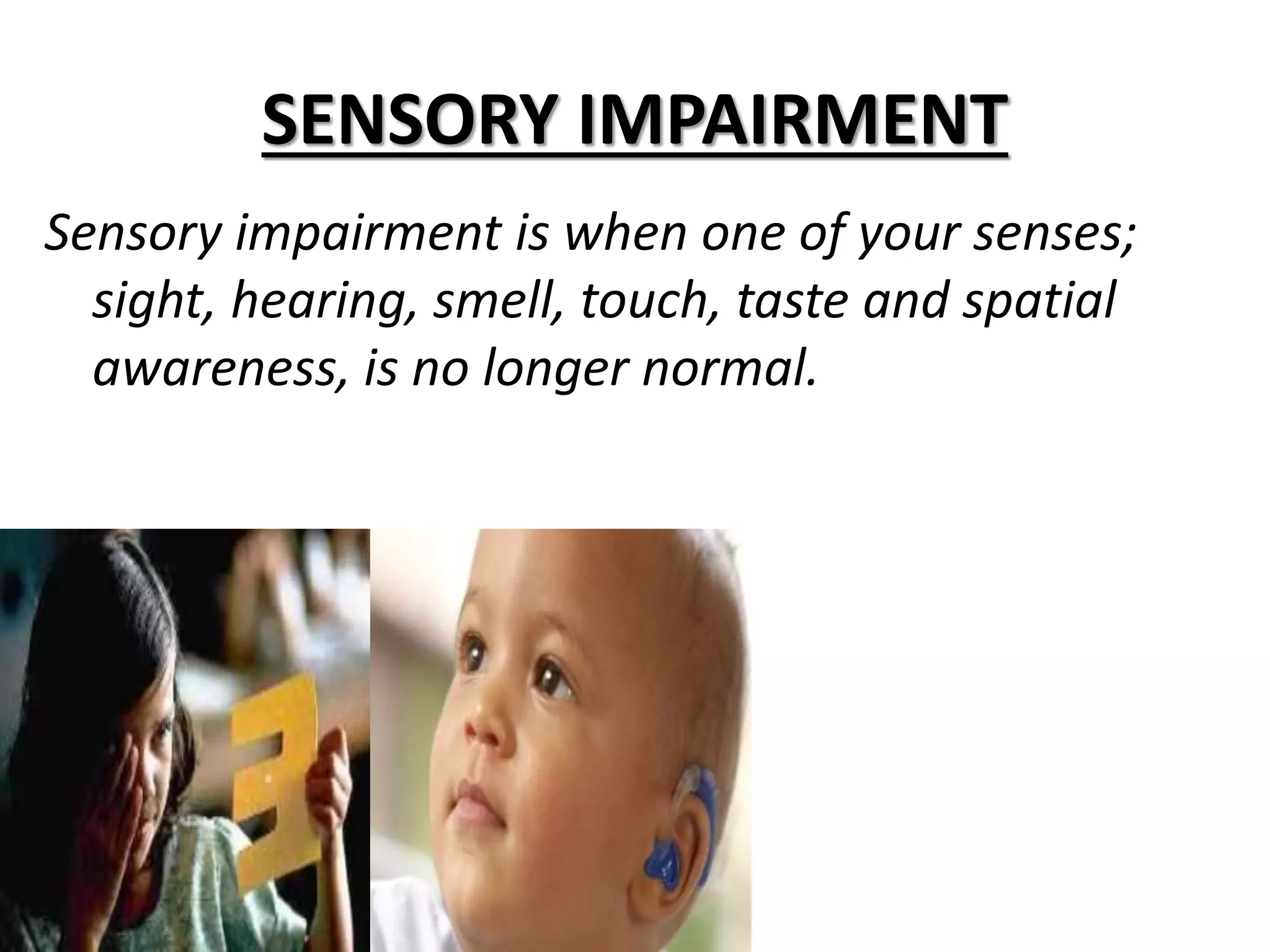
Sensory impairment is when one of your senses;
sight, hearing, smell, touch, taste and spatial
awareness, is no longer normal.
VISUAL IMPAIRMENT
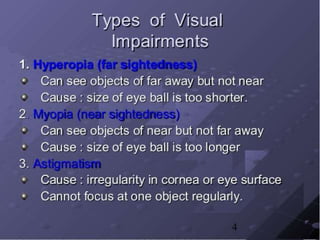
It may be said that visual impairment is the
functional limitation of the eye or eyes or the
vision system.
HEARING IMPAIRMENT
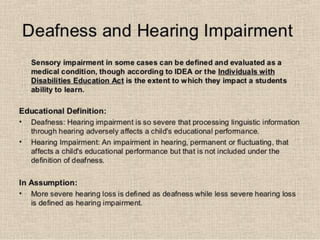
• A hearing impairment is a hearing loss that
prevents a person from totally receiving
sounds through the ear. If the loss is mild, the
person has difficulty hearing faint or distant
speech. A person with this degree of hearing
impairment may use a hearing aid to amplify
sounds. If the hearing loss is severe, the
person may not be able to distinguish any
sounds.
MULTISENSORY IMPAIRMENT (MSI)
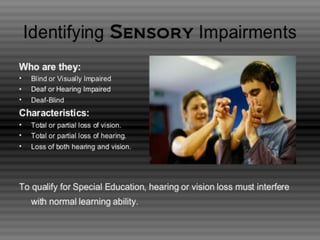
This is a term used to describe students who have a
combination of visual and hearing loss. They are sometimes referred to
as deafblind, although many have some residual sight and/or hearing.
The combination of the two sensory losses intensifies the impact
of each. Students with multisensory impairment have much greater
difficulty in accessing the environment and the curriculum, than those
with a single sensory impairment.
SMELL AND TASTE DISORDERS?
The most common smell and taste disorders are:
Anosmia. Loss of sense of smell
Ageusia. Loss of sense of taste
Hyposmia. Reduced ability to smell
Hypogeusia. Reduced ability to taste sweet, sour, bitter, or
salty things
In other disorders, odors, tastes, or flavors may be misread or
distorted. They may cause you to detect a bad odor or taste
from something that is normally pleasant to taste or smell.
These disorders can affect quality of life.
Sensory impairment
Sensory impairment
Sensory impairment
Sensory impairment
Sensory impairment
Sensory impairment
Sensory impairment
Sensory impairment
Sensory impairment

Sensory impairment

  • 1.
    SENSORY IMPAIRMENT Sensory impairmentis when one of your senses; sight, hearing, smell, touch, taste and spatial awareness, is no longer normal.
  • 4.
    VISUAL IMPAIRMENT It maybe said that visual impairment is the functional limitation of the eye or eyes or the vision system.
  • 5.
    HEARING IMPAIRMENT • Ahearing impairment is a hearing loss that prevents a person from totally receiving sounds through the ear. If the loss is mild, the person has difficulty hearing faint or distant speech. A person with this degree of hearing impairment may use a hearing aid to amplify sounds. If the hearing loss is severe, the person may not be able to distinguish any sounds.
  • 6.
    MULTISENSORY IMPAIRMENT (MSI) Thisis a term used to describe students who have a combination of visual and hearing loss. They are sometimes referred to as deafblind, although many have some residual sight and/or hearing. The combination of the two sensory losses intensifies the impact of each. Students with multisensory impairment have much greater difficulty in accessing the environment and the curriculum, than those with a single sensory impairment.
  • 7.
    SMELL AND TASTEDISORDERS? The most common smell and taste disorders are: Anosmia. Loss of sense of smell Ageusia. Loss of sense of taste Hyposmia. Reduced ability to smell Hypogeusia. Reduced ability to taste sweet, sour, bitter, or salty things In other disorders, odors, tastes, or flavors may be misread or distorted. They may cause you to detect a bad odor or taste from something that is normally pleasant to taste or smell. These disorders can affect quality of life.