Support system and its role in entrepreneurial development in India..
The document discusses the support systems and their critical role in fostering entrepreneurial development in India, emphasizing the importance of small and medium enterprises (SMEs) since the country's liberalization in 1991. It highlights various forms of institutional support, including financial assistance, education, and guidance for entrepreneurs, particularly in backward areas facing infrastructural challenges. A literature review indicates that entrepreneurship has been a significant driver of economic growth and job creation, urging the need for continued support and adaptation of various government and private sector initiatives.
Support system and its role in entrepreneurial development in India..
1.
1
CHAPTER 1
SUPPORT SYSTEMAND ITS ROLE IN ENTREPRENEURIAL
DEVELOPMENT IN INDIA:
Introduction:
India is second among all nations in total entrepreneurship activity as per
the Global Entrepreneurship Monitor Report 2002. The liberalization of the
economy since 1991 has paved the way for a huge number of people to
become entrepreneurs. Developing countries like India are striving to be
outward looking global economies rather than inward looking local
economies. This will be possible only if Small and, Medium scale
Enterprises (SMEs) are encouraged. Entrepreneurship can be cultivated
among the present youth and it can be developed systematically with the
help of support system. The post-globalization era has brought with it a
growing middle class and rising disposable incomes. This presents
tremendous opportunities for developing entrepreneurship. The emerging
entrepreneurs can reap the benefits of these opportunities by catering to
various demands of this segment through their Small Scale Industries.
Small scale industries: An industrial undertaking in which the investment in
fixed assets in plant and machinery whether held on ownership basis or on
hire purchase does not exceed Rs. 5 Crore can be termed as small scale
industrial undertaking. Medium scale undertaking: Units with investment in
plant and machinery in excess of SSI limit and up to Rs. 10 crore may be
treated as Medium scale enterprises. The small scale industries are of two
types, traditional and modern. The traditional small scale industries include
2.
2
khadi and handloom,village industries, handicrafts, sericulture, coir etc.
Modern small industries manufacture a wide variety of goods from simple
items to sophisticated items like television sets, electronic control system,
various engineering products, particularly as ancillaries to large industries.
Since independence, the growth and development of the small scale sector
has been favored by the government of India on the following grounds:
Generation of employment opportunities by SSIs
Mobilization of capital and entrepreneurship skills
Regional dispersal of industries
Equitable distribution of national income
Policies pursued by the government over the years have resulted in the
growth of small scale sector to a considerable extent. To accelerate the
pace of industrialization in the country and also to support economic
development, Government at central as well as at state level has made
good efforts by way of implementing various measures. Government has
set up number of agencies and institutions to assist and support emerging
and established entrepreneurs to set up and develop their business at two
levels- small and medium. Starting a business or an industrial unit requires
various resources and facilities. Finance has been an important resource to
start and run an enterprise because it facilitates the entrepreneur to
procure land, labour, material, machines to run an enterprise. Hence,
finance is the most important requirement of the business. Considering this,
the government has come forward to help small entrepreneurs through the
financial institutions and nationalized banks. But the finance alone is not
3.
3
sufficient to starta business. A minimum level of prior built-up of
infrastructural facilities is also needed. This is one of the reasons for lack of
industrial development in backward areas. Creation of infrastructure
involves huge funds. In view of this various central and state government
institutions have come forward to help small entrepreneurs in this regard by
providing them various kinds of support and facilities. Institutional support
makes the economic environment more conducive for the growth of the
business. These institutions are supporting the entrepreneurs in various
aspects of the business such as education, training, finance, marketing etc.
Support system for the development of entrepreneurship exists in the form
of following institutions.
Educational institutions providing professional and non-professional
or traditional courses
Financing institutions
Promoting institutions
Non-government organizations
Government’s support
Support from family members, relatives and friends
NEED AND IMPORTANCE OF SUPPORT SYSTEM:
Many entrepreneurs and especially those in small-scale sectors have
technology related knowledge to take care of production and quality
aspects. They require lot of guidance and support in the beginning stage
and production stage of the industry in various project and business related
activities. The important areas they need guidance are project report
preparation, location and layout of plant, selection of men and machinery,
4.
4
competition level, variousmarketing aspects, various types of finance
facilities and Government assistance and subsidies. The support functions
will extend necessary guidance and provide inputs and help industries in
moulding during initial stages of an enterprise. Any industry will have
teething problems and uncertain situations in the initial phases of the
organization. With the backing of the support function organization can
decide to get over difficult situations. The most important aspects for a new
businessman are finance and marketing related subjects. An entrepreneur
should be able to consider the advantages of various Government
subsidies and assistance given for backward areas and the disadvantages
of marketing activities and transport cost and problems of raw-materials
and other facilities availability. Many industries started in backward areas
are suffering for various reasons and therefore it is essential to give a
serious thinking about location of an industry. It is always advisable to start
as industry in a location where adequate infrastructure facilities, availability
of raw-material, market and skilled labour are available. In such semi-
developed or developed industrial areas other supports of banks and civic
amenities will be available. In this chapter various organizations which are
started specifically to play a supportive role to small industries are covered
in belief the support function required for small industries is in finance
areas. For this SIDBI which was started mainly for financial assistance to
SSI is very important. Other organizations like SIDO, SSIB, SISI and
SSIDC involve themselves in other types of assistance required for SSI
units. There are specialized institutions like Tool Room Training Centres,
Entrepreneurship Development Centres and Technical Consultancy
Organizations which help SSI in various activities related to their
development Central and State Governments have reviewed the support
5.
5
system to smallenterprises from time to time and provided infrastructure to
this sector. The commercial banks have extended good help in developing
SSI sector in the country. The Banking Commission in its report considered
existences of institutions who offered services like promotion of industrial
and service projects, investment management and financial advisory
services within the country and for exports. The commission pointed out
that there is necessity of institutions that offer services to small
entrepreneurs in project formulation, preparation of project reports, techno-
economic studies and giving advice on technology, management, quality
and finance issues. In last two decades the commercial banks on their own
or with the help of other agencies have taken up the job of advising small,
prospective entrepreneurs about project report preparation, evaluation,
planning and executing of projects. Most of public sector and private sector
banks have opened merchant banking divisions for this purpose. Few of
the banks term the department as entrepreneurial clinic cum guidance
centres. Central and State Government institutions help in development
and initial hand holding functions for the SSI entrepreneurs. Up-gradation
and use of these specialized institutions to changing needs is equally
important.
LITERATURE REVIEW:
Several researchers have studied the Entrepreneurial Development that
has taken place since 2003. Some of these prominent studies were made
by Sindhu S. Narayan and P.S.Geethakutty, (2003), Subrata Dutt, (2004),
Anil K Lai and Ronald W. Clement (2005), Jagannaadha Pawan Tamvada,
6.
6
(2007), Patricia R.Todd and Rajshekhar G. Javalgri, (2007), Patricia R.
Todd and Rajshekhar G Javalgi (2007), K. Lavanya Latha and B.E.V.V.N.
Murthy, (2009), Amit K. Chakrabatty and Krishnamay Gosh (2009),
Madhavi, S.P. (2010). Women entrepreneurship has been recognised as
an essential ingredient of economic development in Kozhikode, Palakkard
and Thissur districts of Kerala. Sindhu and Geethakuuty studied the factors
that contribute to the economic growth in these districts. The researchers
developed the entrepreneurial success index to measure the level of
success in agribusiness by the women entrepreneurs. Result revealed that
majority of women were self-initiated and innovative and these factors
coupled with support from the financial institutions were the factors that led
these women entrepreneurs to be successful. (Sindhu S. Narayan and P.S.
Geethakutty, 2003) the rural industrial entrepreneurship through non-farm
entrepreneurship has contributed to the economic development in Bengal
Region of India. Subrata D. examined the influence of rural industries by
dividing the district into five administrative blocks and collected data from
each block by schedule interviews. Using the Linear Structural Model, the
data was evaluated. The result revealed that the rural industrial
entrepreneurship has strong influence on the rural economic development
(Subrata Dutt, 2004) The market reforms in India have encouraged
individual enterprises to enhance their economic growth. Anil and Ronald
examined the individual enterprises in the government controlled
environment and their response to market based environment. Education in
entrepreneurial skills, financial supports and networking have enabled the
individual enterprise to be successful (Anil K Lai and Ronald W. Clement
2005). Kalyan S and Atish C investigated the marketing strategies of small
scale bakery firms in the city of Kolkata in India; the researchers used the
7.
7
customers’ survey toverify the performance of the small scale bakery
industry in the light of their business strategies. The result divulged that the
small scale bakery firms have aligned their operations with their business
strategy (Kalyan Sengupta and Atish Chattopudhyay, 2006). The skill-
based technology in India has changed the artisans’ routine livelihood and
economic growth. Arindam Banik et al developed a theoretical model based
on conditions of government sponsored poverty reduction programme. The
model was used in cross-examining the situation of the artisan. The result
revealed that changes depended on wages, toolkits and working condition.
(Arindam Banik et al 2007) The determinants of entrepreneurship and role
of the entrepreneurship were little known in less developed countries.
Jagannaadha collected the data through National Sample Survey
Organization of India and analysed it by using Bayesian semi-parametric
methods. The result revealed that the determinants were self-employment,
firm formation and geographical location (Jagannaadha Pawan Tamvada,
2007). Patricia R and Rajshekhar G J assessed the determinants that
influenced the internationalization of small and medium sized enterprises in
India. The importance of developing and promoting small and medium
sized enterprises in India was to position them in the international market
place, which was dependent on the economic situation. The assessment of
economic situation of small medium enterprises revealed that there were
resource gaps. The researchers summarized that utilization of technology
and special infrastructure could enable efficient use of resources and
enhance the entrepreneurial activities among the small medium enterprise
(Patricia R. Todd and Rajshekhar G. Javalgri, 2007). The process of rural
development is dependent on the support received from the members of
rural cooperatives. Substantiating the facts, Amit and Krishnasamy
8.
8
collected the samplefrom 100 members. Data were collected from the
published annual reports of rural co-operatives. Both the data were
analyzed and the result revealed that rural cooperatives have improved the
living standard of rural people and accelerated the process of rural
development of the study area (Amit K. Chakrabatty and Krishnamay Gosh
2009). India has adopted policies that have stimulated consumer demand
and fostered entrepreneurship, whereas China has adopted policies that
have encouraged resource mobilization. Kalyanaram has attempted to
benchmark India’s growth and development against China by comparing
the growth models and market potential. He found that China and India
have adopted two different models of growth and concluded that India’s
model is likely to more sustainable (Kalyanaram G.K., 2009). Small scale
enterprises in Nellore District of Andra Pradesh faced problem in
maintaining their entrepreneurial activities. Lavvanya and Murthy examined
the factors that govern the entrepreneurial activities. They analyzed a
sample size of 553 units in that district by using ANOVA and Z test. The
result revealed that the high price of raw materials, lack of market
mechanism and marketing of products were major problems faced by the
entrepreneurs. (Lavvanya Latha K. and B.E.V.V. N. Murthy, 2009) Madhavi
S P. did a comparative study of rural and urban women entrepreneurs in
Ahmednagar District of Andra Pradesh. Sampling and Garrent’s ranking
technique were used in comparing the rural and urban women
entrepreneurs. The finding disclosed that women from rural area were not
doing well due to lack of financial support and inadequate demand from
customers.
9.
9
SUMMARY:
Literature review hasexposed that the entrepreneurial activities have been
going on since the last several decades. Historical evidences throw light on
the extent of entrepreneurship development which has contributed to the
economic growth of the ancient countries. The introduction of PURA
Scheme was a noble way of inspiring the villagers, who have been cut off
from the urban world. This initiative has indeed prompted many
entrepreneurs to begin with creative and innovative way of doing business.
The literature review has revealed that the entrepreneurship development
has been a source of economic growth, rural development, job opportunity
and business enhancement and provides a source of livelihood for villagers
under poverty line. The researchers of Western and Eastern countries have
illustrated that entrepreneurial activities are a supplement to the progress of
their nations. Likewise, the development of entrepreneurship in India has
also shown uptrend and many researchers have examined the progress of
entrepreneurial growth across the states of India. As for Tamil Nadu, the
entrepreneurship development has been on rise since the introduction of
government policies, which have encouraged many local businesspeople to
venture into business. The literature made available by various researchers
has given the investigator the scope of understanding entrepreneurship
development and its effectiveness. One of the highlights was the training of
entrepreneurs which is an important aspect of fostering entrepreneurs.
Several researchers have concluded that training has built-up the
entrepreneurial culture and also enabled the growth of an individual.
Generally, the under- developed countries have taken up entrepreneurship
10.
10
as a toolto eliminate poverty and to provide poor people a source of
income. Among the Asian countries as per our literature review, China has
been prominently exposing entrepreneurial development. India has also
been promoting entrepreneurship in rural sector to make it on a par with the
urban sector.
RESEARCH GAP:
The review of literature on entrepreneurship development reveals that the
phenomenon of entrepreneurial activities has attracted the interest and
research attention of a broad range of management disciplines.
Entrepreneurship is a relatively new field of research, not more than 20–25
years old. During the last decade it has gained extensive interest beyond
the usual areas of management studies. As in many other fields of
research in social sciences, entrepreneurship research has its roots in the
development of and changes in society. In many countries, especially in
Europe, entrepreneurship became a vehicle to solve regional and national
problems and to stimulate growth. An analysis of research on
entrepreneurship development in India reveals that most of the research
deals with entrepreneurial activities in rural sector and its development as a
tool for solving the problem of poverty. Self-employment, inventor
entrepreneurs, enhancement in livelihood, nuclear economy growth and
industrial revolution has encouraged the rural population to venture into
entrepreneurship. The development of women entrepreneurship has been
covered elaborately in most of the Indian research on entrepreneurial
activities. The literature deals extensively on economic growth through
entrepreneurship and support of government of India. Studies employ
11.
11
sophisticated statistical toolsto identify the motives of entrepreneurship
development, the characteristics of entrepreneurs who have undertaken
entrepreneurial activities and the characteristics of rural sector that become
entrepreneurship hubs. With this milieu, this study is an attempt to study
entrepreneurship development especially in PURA Scheme Villages of
Thanjavur District, Tamil Nadu, and India. The study aims at specifying
determinants of entrepreneurs and role of institutions in supporting the
entrepreneurial development.
Objectives of study:
1. To know the concept and the elements of support system supporting
entrepreneurial development in India during post liberalization period
2. To know the role and importance of support system in entrepreneurial
development in India
3. To introduce the functions and activities of various Central and State
Government agencies supporting entrepreneurial development in
India.
4. To know the support system necessary for entrepreneurship
development provided by the government and private sector in India
since liberalization period
5. To know the different institutions supporting entrepreneurship in India
and also some of the major schemes and programmes launched for
the augmentation of entrepreneurial activity by the government in
India.
12.
12
RESEARCH METHODOLOGY:
The areaof dissertation is support system and its role in entrepreneurial
development in India. The relevant information is gathered about the
support system and how it has augmented entrepreneurship in India after
liberalization period i.e. 1991.
For this study secondary data have been used because of the time
constraints, but relevant and authentic sources have been visited for
gathering the quality data.
13.
13
CHAPTER 2
ENTREPRENEURIAL SUPPORTSYSTEM IN INDIA
Entrepreneurship can be defined by describing what entrepreneurs do.
Entrepreneurs use personal initiative, and engage in calculated risk-taking,
to create new business ventures by raising resources to apply innovative
new ideas that solve problems, meet challenges, or satisfy the needs of a
clearly defined market. Entrepreneurship is not restricted to business and
profit. It involves bringing about change to achieve some benefit. These
benefits may be financial but it also involves the satisfaction of knowing you
have changed something for the better. Entrepreneurship is essentially the
act of creation requiring the ability to recognize an opportunity, shape a
goal, and take advantage of a situation. Entrepreneurs plan, persuade,
raise resources, and give birth to new ventures.
Entrepreneur is another name of Risk Taker. An entrepreneur is an
individual who takes moderate risks and brings innovation. Entrepreneur is
a person who organizes/ manages the risks in his/her enterprise.
“Entrepreneur is an individual who takes risks and starts something new”
Entrepreneur is an Economic agent to unite all the means of production an
entrepreneur is an individual who takes moderate risks and brings
innovation.
An entrepreneur is a person who has possession of a new enterprise,
venture or idea and assumes significant accountability for the inherent risks
and the outcome. An entrepreneur is one who undertakes an enterprise,
14.
14
especially a contractor,acting as intermediately between capital and
labour. Some facts about entrepreneurs and entrepreneurship:
Characteristics of Successful Entrepreneurs:
Entrepreneurs are different from each other, but successful entrepreneurs
tend to share certain characteristics. Not all of them have developed each
of the following to the same degree, but they tend to have developed most
of them to some degree.
Entrepreneurship as a Career:
Positive aspects of entrepreneurship
Being the boss if his own business, he enjoys unlimited powers. He
can do things in his own way and he need not take orders from
someone else. He can make his own decisions and act on them.
There are numerous opportunities for his self- development.
Working on one’s own and thus getting rewards yields immense
satisfaction and pleasure for more than what he can get in a job.
Monetary rewards can be more than commensurate with his capacity
and capabilities.
He can command deference and respect of his immediate family and
friends. It is a kind of intangible reward.
Instead of depending on others, he generates employment for others.
15.
15
He can makesignificant contribution to the development of the
country and be proud of taking part in nation building activities.
He can be a great achiever realizing his goals and proving his
achievements to the world. He can be recognized for his outstanding
efforts.
Seven key Qualities of Entrepreneur:
Being an entrepreneur is about more than just starting a business or two, it
is about having attitude and the drive to succeed in business. All successful
Entrepreneurs have a similar way of thinking and posses several key
personal qualities that make them so successful in business. Successful
entrepreneurs like the ambitious Richard Branson have an inner drive to
succeed and grow their business, rather than having a Harvard Business
degree or technical knowledge in a particular field.
All successful entrepreneurs have the following qualities:
1. Inner Drive to Succeed: Entrepreneurs are driven to succeed and
expand their business. They see the bigger picture and are often very
ambitious. Entrepreneurs set massive goals for themselves and stay
committed to achieving them regardless of the obstacles that get in
the way.
2. Strong Belief in themselves: Successful entrepreneurs have a
healthy opinion of them and often have a strong and assertive
personality. They are focused and determined to achieve their goals
and believe completely in their ability to achieve them. Their self
optimism can often been seen by others as flamboyance or
16.
16
arrogance but entrepreneursare just too focused to spend too much
time thinking about un-constructive criticism.
3. Search for New Ideas and Innovation: All entrepreneurs have a
passionate desire to do things better and to improve their products or
service. They are constantly looking for ways to improve. They're
creative, innovative and resourceful.
4. Openness to Change: If something is not working for them they
simply change. Entrepreneurs know the importance of keeping on top
of their industry and the only way to being number one is to evolve
and change with the times. They're up to date with the latest
technology or service techniques and are always ready to change if
they see a new opportunity arise.
5. Competitive by Nature: Successful entrepreneurs thrive on
competition. The only way to reach their goals and live up to their self
imposed high standards is to compete with other successful
businesses.
6. Highly Motivated and Energetic: Entrepreneurs are always on the
move, full of energy and highly motivated. They are driven to succeed
and have an abundance of self motivation. The high standards and
ambition of many entrepreneurs demand that they have to be
motivated.
7. Accepting of Constructive Criticism and Rejection: Innovative
entrepreneurs are often at the forefront of their industry so they hear
the words "it can't be done" quite a bit. They readjust their path if the
criticism is constructive and useful to their overall plan, otherwise they
will simply disregard the comments as pessimism. Also, the best
17.
17
entrepreneurs know thatrejection and obstacles are a part of any
leading business and they deal with them appropriately.
True entrepreneurs are resourceful, passionate and driven to succeed and
improve. They're pioneers and are comfortable fighting on the frontline the
great ones are ready to be laughed at and criticized in the beginning
because they can see their path ahead and are too busy working towards
their dream.
WOMEN ENTREPRENEURS IN INDIA:
The Indian sociological set up has been traditionally a male dominate done.
Women are considered as weaker sex and always to depend on men folk
in their family and outside, throughout their life. They are left with lesser
commitments and kept as a dormant force for a quite long time. The Indian
culture made them only subordinates and executors of the decisions made
by other male members, in the basic family structure. The traditional set up
is changing in the modern era. The transformation of social fabric of the
Indian society, in terms of increased educational status of women and
varied aspirations for better living, necessitated a change in the life style of
Indian women. Indian families do have the privilege of being envied by the
westerners, since women here are taking more responsibilities in bringing
up children and maintaining a better home with love and affection. At the
family level, the task of coordinating various activities in a much effective
manner, without feeling the pinch of inconveniences, is being carried out by
the women folk. Thus, the Indian women have basic characters in
themselves in the present sociological and cultural setup as follows.
18.
18
Indian women areconsidered as Sakthi, which means source of
power.
Effectively coordinating the available factors and resources.
Efficient execution of decisions imposed on them
Clear vision and ambition on the improvement of family and children.
Patience and bearing the sufferings on behalf of others and
Ability to work physically more at any age.
STATUS OF RURAL WOMEN ENTREPRENEURS IN INDIA:
OPPORTUNITIES AND CHALLENGES
The emergence of rural women entrepreneurs in India depends upon
closely interlinked economic, education, social, cultural, religious,
psychological and institutional variables. These variables ultimately account
for influencing and moulding the attitude of rural women towards business
and industry. With the introduction of innovative methods and scientific
management under the patronage of the state, rural women entrepreneurs
can be expected to be successful in future. The rural women may be
mobilized and may lead to the nation towards the path of progress and
prosperity. Thus, rural women by all means can be very effective agents of
change for better homes, better society and ultimately for robust economy
in the present global scenario.
The entrepreneur stands at the centre of the whole process of economic
development that locates idea and puts them into practice. Thus, an
entrepreneur is an economic leader who possesses the ability to recognize
19.
19
opportunities for thesuccessful introduction of new commodities, new
techniques, and new sources.
Of supply and to assemble the necessary plant and equipment,
management and labour force and reorganize them into a running concern.
The phenomenon of women entrepreneurship is largely confined to
metropolitan cities and big towns in India. Most of the women
entrepreneurs operate small scale units. However, women entrepreneurs
are found in rural areas also. A rural woman entrepreneur is a woman or
group of woman who undertake to organize and run an enterprise in a rural
area. The rural women entrepreneurs may be women who take to
entrepreneurship because of dire economic needs, Women who take to
entrepreneurship because they had the family background tradition in some
skill or trade, hence they would like to have extra money for themselves
and their families, women who take it up because they have certain
personality characteristics such as need for achievement, need for power
and influence and women who take it up as a leisure time activity on official
advice and guidance. There are around seven lakh villages in India and
also that more than 70% of our population live in villages of half are
women. Though rural women represent a sizeable percentage of labour
force in our country yet, they have not been brought under the fold of main
stream of development. The rural women in independent India occupy an
important place and all efforts are being made to establish the significant
role that they can play in their own upliftment and of the society at large.
This enabled them to find ways of supplementing their family income. A
section of rural women have emerged as potential entrepreneurs. This
development is of significant importance in our traditional society. The last
20.
20
decade has witnessedthe emergence of rural women in the small business
and they have achieved remarkable success too. Although, their task has
been full of challenges, but they have overcome the prejudice. Ultimately
they have established themselves as independent entrepreneurs. Realizing
the importance of rural women entrepreneurs, the government and financial
institutions are trying best for their development. Government Initiatives
After the encouraging results of initial efforts made by the pioneering NGO
and entrepreneurs, Government of India of late has realized what rural
women entrepreneurs can offer to the world. It has decided to promote the
rural women entrepreneurship through different agencies like KVIC,
Grameen Bank’s micro-finance through SHGs, NABARD etc. The policy
makers now accept that rural entrepreneurship is a major vehicle for
generating employment and promoting sustainable livelihood. The
Government has started various entrepreneurship programmes under
different schemes like SGSY, SGRY, SJSRY, DWCRA and TRYSEM etc.
Opportunities: In order to assist and develop rural women
entrepreneurship, women at grass root level should be involved through the
women’s organizations. Such organizations can be instrumental in
identifying women for income generating activities. The small industries
service Institute and voluntary organizations should organize special
programmes for prospective women entrepreneurs in villages. Under the
Integrated Rural Development Programme (IRDP), special sub-schemes
can be undertaken for development of women entrepreneurs in rural areas.
Rural women entrepreneurs depend or the environment and the direct
action on the part of government or other agency. Women entrepreneurs in
rural areas can best emerge out of the women folk, with an aptitude for an
experience in entrepreneurship. There is ample evidence to show that the
21.
21
government efforts topromote entrepreneurship either by training or by
granting loans to women without aptitude have failed miserably. While
examining the factors that have been active in moulding entrepreneurship,
it is, therefore, necessary to look into the two aspects of the issue viz,
personal profile of women entrepreneurs and their socio-economic
background, secondly the extent of contact at the higher social and
government levels through her husband and other close relatives, extent of
technical guidance and financial support received from government and
other agencies. Rural women adopt entrepreneurial career due to pull and
push factors. In the former case, they take it as a challenge and an
adventure with an urge to do something new and to take up an
independent occupation. In the latter category, women establish business
enterprises to overcome financial problems of self and family. Challenges
Faced by Rural Women Entrepreneurs. There is a discrimination against
rural women in all walks of life despite the provision of their constitutional
guarantees. The traditional attitude of our society does not encourage
women to utilize their human potentials fully. They are not ranked
according to their capacity to do particular job due to sex, caste and
kinship. The major challenges faced by the rural women entrepreneurs are
Illiteracy, lack of vital information, fear to take risks, lack of experience and
training, feeling of insecurity, rampant corruption, lack of infrastructure lack
of finance etc. In addition, there are structural constrains in the form of
inequality, limited purchasing power, condemnation by local elite, etc. They
have also to face competition from the urban entrepreneurs who make
more attractive and cheaper products due to modern technology and
commercial production.
22.
22
A Case Studyof e-Seva Project:
The need to strengthen businesses owned by women in rural areas and to
facilitate the entry of Small Medium and Micro Enterprises has been
reinforced manifold in the recent years. To encourage the use of
information technology in business, thereby increasing sales and profit; to
help farmers, market women, small/medium scale entrepreneurs and
exporters find buyers for their products in their community and other
countries with our efficient up-to-date internet portal; to help buyers and
importers find sellers of products and guarantees the quality of this product
through our quality control centre. The project e-Seva (e-services) in the
district of West Godavari, in the province of Andhra Pradesh in India, was
initiated as a tool to introduce ICT in the rural areas, especially to women.
Using ICT, the project provides these people with access to various C2C
(citizen-to-citizen) and C2G (Citizen to Governments) services. Web-
enabled rural kiosks termed e-Seva centres have been established at the
mandal (a sub district unit of administration) level A unique feature about
these centres is that they are run and managed by women from self-help
groups, positioning them as information leaders, and helping to bridge the
gender divide. The women’s groups act as change agents while drawing
strength from the project. ICT has played a crucial role in facilitating this
change. Another important aspect of the project is that it replaces the
traditional form of governance and its accompanying deficiencies with a
modern, more open, transparent and responsive service delivery system.
The e-Seva centres run on a district portal that allows access to various
citizen centric services. These services range from the issuance of various
certificates to getting information about programmes and also go to the
extent of allowing citizens to network with each other for mutually beneficial
23.
23
transactions. Citizens canfile grievances at these centres. Every grievance
is acknowledged and transferred online for field action. They can also
publicize their projects and goods through the portal for online auctions.
Even a marriage bureau has been operationalised so that prospective
brides/grooms can place their bio-data online to attract suitable offers, thus
making the search for life partners easier and more cost-effective. Through
the portal, the centers expect to provide a virtual meeting place for the
citizens to discuss issues relating to their districts/villages, their problems
and prospective solutions (http://www.westgodavari.org) the emergence of
rural women entrepreneurs in India depends upon closely interlinked
economic, education, social, cultural, religious, psychological and
institutional variables. These variables ultimately account for influencing
and moulding the attitude of rural women towards business and industry.
With the introduction of innovative methods and scientific management
under the patronage of the state, rural women entrepreneurs can be
expected to be successful in future. The rural women may be mobilized
and may lead to the nation towards the path of progress and prosperity.
Thus, rural women by all means can be very effective agents of change for
better homes, better society and ultimately for robust economy in the
present global scenario.
24.
24
Factors affecting Entrepreneurshipgrowth
Economic factors
Social factors
Cultural factors
Personality factors
Psychological and sociological factors.
Economic Factors:
Lack of adequate basic facilities
Non- availability of capital
Non- availability of raw materials and finished goods.
Greater risk involved in business
Non- availability of skilled labour
Social factors:
Customs and traditions
Rationality of the society
Social system
Social set-up
Personality Factors:
Suspect personality
Emergence of planning
25.
25
CURRENT STATUS OFENTREPRENEURIAL DEVELOPMENT
AND SUPPORT SYSTEM IN INDIA
India started relaxing industrial regulation in the early 1970s. Trade
liberalization began in the late 1970s and the pace of reform picked up
significantly in the mid-1980s. Indian entrepreneurship, however, got a big
boost following the 1991 economic liberalization, which transformed India’s
entrepreneurial landscape. The country has also achieved positive societal
changes.
Entrepreneurship in the Indian IT and off-shoring sector:
India’s entrepreneurial performance is incomplete without a reference to its
off-shoring sector. India has been a global capital of the offshore
information technology (IT) and business process (BP) offshore
outsourcing. India's off shoring industry started from back office works,
which moved to business process and is gradually shifting towards high-
end functions such as Research and Development. Many U.S.-based drug
companies are outsourcing drug development processes to India. One
estimate suggested that developing a drug in India was about US$100
million compared with over US$1 billion in the U.S. Direct employment
created by this industry was estimated at 1.6 million in 2007 and 2.2 million
in 2009. The off shoring industry’s indirect job creation was estimated to be
8 million in 2009. This sector accounted for 1.2% of national GDP in fiscal
year fiscal year 1998, which increased to 5.8% in Fiscal year 2009. India's
business and technology services companies revenues’ increased from
US$4 billion in 1998 to US$ 58 billion in 2008, which further increased to
US$ 60 billion in fiscal year 2009. According to NASSCOM, the export
26.
26
portion of thesector (that is, offshore BP and IT off shoring industry) in FY
2011 grew by 18.7% to reach $59 billion, which was 26% of India's exports
and 11% of services revenue. India’s entrepreneurial IT firms heavily
depend on exports. The industry exports US$3.75 for every dollar earned in
India. For the leading IT company, Infosys, the domestic market accounts
for only 1.2% of revenue. This sector’s contribution to Indian exports
increased from less than 4% in 1998 to about 16% in 2008. In addition to
economic impacts, entrepreneurial activities in the off shoring sector have
brought some positive societal changes. Institutions related to
entrepreneurship are changing. For instance, women have entered into
new status hierarchies. The mixed gender workforce in the off shoring
industry requires working at nights to meet daylight needs of Westerners. In
the off shoring industry, women account for 65% of the workforce and 85%
of them work on night shifts. Call centers are breaking the societal taboos
as men and women work together in nights. In the Rajsthan state, the law
forbidding women to work after sunset was changed at the request of the
outsourcing company, Genpact.
Low overall entrepreneurial performance:
Despite all the hype surrounding entrepreneurship in India’s IT and off
shoring sector, more detailed figures paint a different picture. The country
falls behind many other developing economies on important indicators
related to entrepreneurial activities. For instance, in terms of high-
expectation business launchers per capita, India underperforms Brazil. On
the World Economic Forum’s competitiveness index, India ranked 49th in
2009. The size of the informal economy in India is substantial and
increasing. Size of the informal and shadow economy a proportion of
27.
27
official GDP wasestimated to increase from 18.1% in 1989 to 20.3% in
1994 and 1995 and to 22.8% in 2000-01. Likewise, about 70% of
nonagricultural workforce is informally employed. If agricultural employment
is included, this proportion rises to over 90% Informality thus remains a
pervasive characteristic of the Indian labor markets. Consider another
indicator related impacts of entrepreneurship--poverty reduction. During
2000–2007, 41.6% of the population in the country lived on less than
US$1.25 a day and 75.6% lived on less than US$2 a day. The traditional
sector is economically disadvantaged and there is thus very little progress
in poverty reduction.
Lack of trickledown effect and signs of oligarchic capitalism:
The benefits of economic growth are disproportionately distributed to the
wealthiest and have failed to trickle down to the poor. About 10 families
control more than 80% of the stock in the country’s largest corporations.
According to the ADB, large Indian companies have won most of lucrative
government contracts, hold power over the country's natural resources and
have “privileged access to land”. An indiatimes.com article quoted an
expert on entrepreneurship in India: Entrepreneurship in India was
restricted to the privileged few that were traditionally rich. Entrepreneurship
was only transferred to the second generation [of the same family]. India
obviously has some elements of a market economy and political
democracy. The country, however, lacks a true democratic market system.
A report from the ADB suggested that Indian economy has many
characteristics of oligarchic capitalism and there is a possibility that this
form of capitalism would further consolidate in the country, which can slow
28.
28
long-term development ofthe country. Note that in an oligarchic capitalistic
society, a small group of people maintains a grip over the country's
economy, polity, and society. Research has indicated that the 1991 reforms
have had little or no effect in promoting SMEs. A small number of well-
connected industrialists have dominated the Indian economy and protected
them from outside competition. As it happens in oligarchic capitalism, India
has shown signs of, adverse impact on incentives, required for structural
changes as well as the state’s reduced autonomy. It is noted that most
Indian billionaires built their wealth by “using economic power to secure
neo-liberal policies. While many Indian publicists and economists hail the
"Indian miracle and classify India as an "emerging world power" because of
the high growth rates of the past five years, what really has transpired is
the conversion of India into a billionaire's paradise.
ROLE OF ENTREPRENEURSHIP IN THE ECONOMIC
DEVELOPMENT OF A COUNTRY:
Economic development is the process of change in which the real per
capita income increases over a time period. The role of entrepreneurship in
economic development involves more than increasing the per capita output
and income within an economy but it initiates and constitutes reform in the
structure of business and society. Entrepreneurship has become important
as entrepreneurs use available resources such as land, labour and capital
for the development of new products and services within the economy.
Nevertheless, they may vary from economy to economy because some are
in more favourable conditions than others especially those in developing
countries.
29.
29
ENTREPRENEURSHIP AIDS INTHE DEVELOPMENT PROCESS
OF THE ECONOMIES:
It generates employment especially for the less educated and
graduates. Employment generation for citizens can be direct and
indirect because some are either self-employed or employed by
public or private individuals.
The national income is influenced as the goods and services
manufactured will be domestically consumed and may sometimes 16
meet international requirements, hence being exported. This
influences entrepreneurial activities as it increases the demand for
locally produced goods due to the increase in consumption.
Additionally, the standard of living of people increases because of the
increment in income.
It creates innovation as new ideas are introduced and are combined
with new factors of production in order to generate new products and
services in that economy.
The above points indicate the benefits gained from entrepreneurship within
an economy and are formally recognized by that economy. However, I
disagree with two of the above points that are; it increases national income
and creates innovation. For instance, in Ghana most entrepreneurial
businesses are informal and are small and medium scale enterprises that
are not supported by the government or support systems, thus it does not
influence the economic development and growth of the country as its
activities are not recorded as part of the per capita output and income of
the economy. Though, women benefit from having their own businesses as
their income increase, attain self- satisfaction and fulfilment. India has
30.
30
adopted partial andtotal factor productivity method to sustain business.
Rajesh and Mihir explored on the performance of small manufacturing
enterprises during the pre-reforms (prior to 1991) and post-reforms period
(1991 onwards). The researchers use the data from National Sample
Survey Organization (NSSO), Government of India for analysis. The result
disclosed that there was a decline in growth during the reforms period
compared to the Pre-forms period. The primary factor was fall in
employment and investment. The researchers suggested that the
enhancement of technical efficiency and skills of the labour force would
assist in sustaining the productivity (Rajesh Raj S.N. and Mihir K. M.2009).
Develop new markets:
Under the modern concept of marketing, markets are people who are
willing and able to satisfy their needs. In Economics, this is called effective
demand. Entrepreneurs are resourceful and creative. They can create
customers or buyers. This makes entrepreneurs different from ordinary
businessmen who only perform traditional functions of management like
planning, organization, and coordination.
Discover New Sources of Materials:
Entrepreneurs are never satisfied with traditional or existing sources of
materials. Due to their innovative nature, they persist on discovering new
sources of materials to improve their enterprises. In business, those who
can develop new sources of materials enjoy a comparative advantage in
terms of supply, cost and quality.
31.
31
Mobilize Capital Resources:
Entrepreneursare the organizers and coordinators of the major factors of
production, such as land labour and capital. They properly mix these
factors of production to create goods and service. Capital resources, from a
layman's view, refer to money. However, in economics, capital resources
represent machines, buildings, and other physical productive resources.
Entrepreneurs have initiative and self-confidence in accumulating and
mobilizing capital resources for new business or business expansion.
INDIAN ENVIRONMENT FOR ENTREPRENEURSHIP
Contexts and environment play important roles in determining
entrepreneurial behavior. In this section, we examine the determinants of
entrepreneurial performance in terms of factors identified as regulatory
framework, access to capital, access to R&D and technology, capabilities,
market conditions, and culture etc.
Regulatory framework:
Entrepreneurial firms are likely to thrive and act in socially responsible
ways if there are strong and well-enforced legislation and regulations in
place to ensure such behavior. In this regard, notwithstanding the existence
of some essential elements of a democracy, the Indian political system has
become inherently “unaccountable, corrupt, and unhinged from the normal
bench marks voters use to assess their leaders”. One scholar noted:
“Corrupted as they are by the party system, India’s institutions are
incapable of enforcing accountability. India’s elites tolerate a level of poor
32.
32
governance and abuseof power that has led to the collapse of democracy
elsewhere”. Beyond all that, in India, there are groups with disposition to
support traditional values, norms, and institutions, which hamper
entrepreneurial practices. Notwithstanding their supports to modern values,
the Indian government and court system are forced to settle for
compromise, which means a slower progress than they would like to see.
Indian court systems are overburdened and are characterized by
procedural delays, and red tape. The Bureau of Democracy, Human Rights
and Labor's report, 'Supporting Human Rights and Democracy: The U.S.
Record 2004-2005 noted: "poor enforcement of laws, especially at the local
level, and the severely overburdened court system weaken the delivery of
justice." According to the South Asia Human Rights Documentation Center,
there was a backlog of 23.5 million cases in 2002. The court system is
decentralized and is largely administered by states. National labour laws
are administered at the state level. Due to budget problems, the states
have failed to comply with federal directives to upgrade legal infrastructures
and court facilities. Moving to the specific context of entrepreneurship,
weak laws and inappropriate regulatory processes hinder efficient
entrepreneurial behaviors. It is argued that corruption is likely to make the
Israel model of government funding for startups highly ineffective in India.
The Israeli government provides a highly supportive role to facilitate
entrepreneurship. It is reported that 80% of the first $500,000 for every idea
identified is funded by the government. It is speculated that such a model
“will lead to favoritism, cronyism and corruption” in the country. As an
example of inappropriate regulatory elements, it takes 7 years to close a
business in India compared to the OECD average of 1.7 years. Likewise,
the average time to register property in South Asia is 106 days compared
33.
33
to the OECDaverage of 25 days. Moreover, companies with over 100
employees require government permission to dismiss workers.
Entrepreneurial and marketing activities are hindered by complex
regulations. In the retail sector, for instance, there are barriers such as anti-
hoarding laws and signboard licenses. Competition laws have not yet been
introduced in some sectors of the Indian economy. For instance, in the
Indian retail sector, the existing laws work against retailers and favor small
mom and pop stores.
Market conditions:
As noted above, access to the domestic and foreign markets influences
entrepreneurial performance. In this regard, the big domestic market size
has helped some Indian entrepreneurial firms to compete successfully in
foreign markets. It is argued that Indian firms’ capability to deliver value for
money in the domestic market has been an important source of competitive
advantage to operate in the African market. Indian companies are in a
position to reconfigure their resources and adapt the business models used
in the domestic market to operate in other developing economies. That
being said, it is also the case that various regulations hinder the access to
domestic market in India. For instance, there are taxes for bringing goods
into a state, for taking them out of a state as well as for moving them within
a state.
Access to finance:
Access to finance has been a major barrier facing many potential
entrepreneurs in India. A bank loan or angel investment is not impossible to
get but extremely unlikely. Getting funding is even harder if, like most
34.
34
aspiring entrepreneurs, youare not from a top-tier university and don’t have
a family with deep-pockets. There are countless ‘micro-entrepreneurs’ in
Indian society who finance their own small businesses as a means to
survival but don’t have access to the capital necessary to grow them. This
is the situation with regard to the common forms of entrepreneurial
financing in India.
Bank loans:
India's State Bank, which accounts for 70% of bank assets in the country,
is a major source of financing for entrepreneurial firms. State Bank of India
is the country's largest lender. As of March 2009, SBI had 12,100 offices
worldwide, over 150 million customers, a capital reserve of more than US$
12 billion and a total business of US$ 273.6 billion (including deposits and
advances). The state banks, however, have done little to promote
productive entrepreneurship in India. A complaint often heard is that
business merits play a little role in loan disbursements. Lending is
disproportionately oriented toward powerful economic and political interests
such as family-owned groups. This situation was more readily apparent in
the pre-1991 India.
The Indian microfinance industry:
The flourishing microfinance industry is perhaps the most notable feature of
the Indian capital market. By the early 2007, 50 million households had
benefitted from microfinance. By the end of 2009, Microfinance, India’s
largest MFI, had 1,675 branches, which lent US$ 600 million to seven
million customers. Private-equity firms and other investors have invested
billions of dollars in micro-financing, which grew by 72% annually during
35.
35
2008-2009. In 2008-09,loans issued by MFIs in India increased from
US$1.2 billion to US$2.3 billion. At the same time, some negative
experiences related to microcredit have been reported. As of the early
2010, over 15 million borrowers in India owed microfinance debts of
US$2.3 billion. The average Indian household’s debt to microfinance banks
increased fivefold during 2005-2010. It was also reported that some
borrowers used loans intended for business purposes to buy luxury items
such as TVs and fridges.
Remittances inflow and entrepreneurship:
India receives more remittances than any other country. Remittances have
led to the establishment of new businesses and social service
organizations such as nursing homes and educational institutions. In
January 2010, the Chief Minister of the Gujarat state of India noted that the
state’s economy was growing despite the global financial crisis due to
“record-breaking investments made by the Indian Diasporas”.
Domestic savings and informal investments:
Finally, domestic savings have also been an important source of
investment. The household saving rates are showing increasing trends,
which 34.7% of GDP in 2010. As is the case of China and other Asian
economies, the high savings rates in India can be attributed to income
insecurity associated with mostly informal jobs. The high saving rates thus
may not automatically translate to a higher investment rates.
36.
36
Research and Development,and technology related factors:
India’s ICT adoption and usage rates have been relatively lower compared
to most countries. For instance, India’s subscription rates of cellular and
fixed phones, PC, the Internet and high speed broadband are well.
According to a study released by Google India in the mid-2011, only 2
million out of 35 million SMEs were online. Nonetheless, there have been
some highly visible instances of ICT usage in promoting entrepreneurial
activities. As a high profile example, in October 2010, Intel announced an
agreement with an alliance of 70 companies including Bombay Stock
Exchange (BSE) and CtrlS to develop hardware and software for an open
and inter-operable cloud. The Open Data Center Alliance (ODCA) works to
address security, energy efficiency and interoperability. The BSE expects
that the new trading platforms supported by mobile telephony and clouds
would broaden participation by allowing real-time and seamless access to
data across phones, laptops and other devices. This approach would also
deepen and widen asset classes traded. The new platforms will increase
participation of younger Indians in pension funds, insurance and mutual
funds and others. Especially the popularity of mobile-based cloud
applications is promising. Only 80 million Indians were online in early 2011,
but more than 670 million used cell phones. India’s overall innovation and
Research and Development profile is weak. India lags behind industrialized
countries and its neighbor China in terms of various indicators related to
R&D and innovations. Due to India’s poor R&D and innovation
performance, some liken entrepreneurial activities in the Indian IT and off
shoring industry to a “hollow ring”. India makes drugs, but copies almost all
37.
37
of the compounds;it writes software, but rarely owns the result. [It has]
flourished, but mostly on the back of other countries' technology.
Physical infrastructures:
A lack of well-developed physical infrastructures has been a barrier
hindering entrepreneurship. Most roads are narrow. In 2007, there were
only 1,500 trucks and one-third of produces were reported to be rotted
before reaching customers. The global financial crisis further hindered
India’s infrastructure development. In the late 2008, reports indicated that
about half of India's planned highway-improvement projects, which were
valued at over US$6 billion, could be delayed by two years. According to
the Planning Commission, inefficient power supply has hindered
entrepreneurial activities, employment creation and poverty reduction. As of
2008, half of India’s population or about 500 million people, lacked access
to electricity.
Entrepreneurial capabilities:
There have been some measures to develop entrepreneurial capabilities.
India has around 40 incubators mentoring between four and 20 start-ups
each. In 2009, India ranked 134th in the human development index. Adult
literacy rates during 1999–2007 were 54.5% for females and 76.9% for
males. Although English is an official language in India, only a small
proportion of graduates meet the standard required to interact with
foreigners. This goes contrary to the widely held belief that India's huge
English-speaking population will give it an edge over 11, China and other
rising nations in doing business with Western corporations. Customers’
38.
38
complaints regarding difficultiesto understand the operators forced some
companies to relocate call centers from India to the Philippines. While India
has some professionally run companies such as Wipro, Infosys and TCS,
the country’s management is highly traditional. To attract outsourcing and
other jobs, firms are required to be “process-driven and detail-oriented”—
characteristics that are virtually absent in the Indian work culture. In the
same vein, whereas Western countries have the time-is-money culture,
Indians have more flexible approach to deadlines. Experts argue that the
country needs to go far before a culture of modern and professional
management emerges. Similarly, product quality, reliability and on-time
delivery often vary greatly in the country. Addressing this challenge may be
no small feat. That said, some Indian firms have made some progress in
adopting the culture of modern management. This is especially noticeable
in the off shoring sector. In an attempt to address their clients’ fear that
customers’ data will be stolen and even sold to criminals firms have
enhanced security mechanisms. For instance, call center employees have
to undergo security checks that are considered to be “undignified”. Firms
have established biometric authentication controls for workers and banned
cell phones, pens, paper and Internet/e-mail access for employees.
Similarly, computer terminals at Mphasis lack hard drives, e-mail, CD-ROM
drives, or other ways to store, copy, or forward data. In general, Indian
outsourcing firms extensively monitor and analyze employee logs.
39.
39
Entrepreneurial culture:
Societal normthat “permit variability in the choice of paths of life” is likely to
promote entrepreneurial behavior. A society’s religions strongly dictate
such a possibility. According to the 2001 census, Hinduism accounted for
80.5% of the Indian population. Islam is the second largest religion,
practiced by 13.4% of the population. Hinduism and Islam have many
similarities from the standpoint of entrepreneurship. Both promote fatalism
and orientation towards the present or the past than the future. The
distinguishing mark of Hinduism, the most popular religion in India, is that it
is centered on dharma (duty) and karma (a Sanskrit word that means
“actions” or “deeds”). Furthermore, each individual’s dharma and moral
codes are specific to his/her caste of birth, which often lead to conflicting,
confusing, misleading and often contradictory social and ethical values.
More importantly, many beliefs and values run counter to capitalism and
entrepreneurship. Accepting one's destiny rather than trying to control life
can be viewed as a central core of traditional cultural values in India.
Reincarnation is an essential tenet of Hinduism, which maintains that if
nothing wrong is done in this life, there would a prospect for a better life
next time. A distinguishing feature of Hinduism is its social structure based
on the caste system, which have acted as a major barrier to
entrepreneurship in India. The studies of many researchers over the past
few decades have indicated that various obligations associated with the
Indian caste system make it more compelling and convenient to follow the
family occupation instead of launching a new venture. The caste system
has thus hindered class mobility. Unsurprisingly the Vaishya (the caste of
merchants) and non-Hindu communities (e.g., Jains and Parsis) historically
40.
40
dominated Indian businessescommunity. Entrepreneurship thrives in a
society that places a high value on work and innovation. It is argued that
work is not valued in itself in India. Observers also suggest that people in
the country work primarily because of emotional attachment with the
workplace or as a favor to the supervisor or to the employer. Indian culture
also places relatively less value on innovation and gradual improvements.
A belief among many people in India is that for the inner soul and mind,
being passive and satisfied with the status quo is healthier than trying to
improve the situation. Moreover, Hinduism considers work as the
performance of duty instead of an ambition to innovate or improve. Women
entrepreneurs in India face additional obstacles. Some communities in the
country think that a respectable girl should not expose herself to outside
influences. In traditional sectors, it is a taboo and probably hard to imagine
for young women to work during nights. During 1993-2001, 53% of adult
Chinese worked compared to 37.7% of Indians. This difference was largely
due to the lower female participation in India. Traditionally, women were not
allowed to work after sunset. It is also argued that Hinduism has promoted
corruption and hindered the country’s anti-corruption efforts. First, it is
suggested that Hinduism has a forgiving tendency and Hindus are too
lenient toward offenders. These characteristics of Hinduism have worked
as a roadblock to India’s anti-corruption measures. Second, fatalistic
orientation of Hindus is associated with the belief that the status quo cannot
be changed, which hinders fight against corruptions. One final, but not less
important, aspect of Indian culture that renders it interesting to us is the fact
that Indian society has a negative attitude toward entrepreneurship in
general and especially failure as an entrepreneur. Financially, you’ll be
saddled with loads of debt, and politically, good luck on somebody
41.
41
acknowledging your entrepreneurialendeavor as real work experience.
With all these challenges, one wonders why anyone bothers trying to
become an entrepreneur in India. The 1991 economic reform has
undoubtedly facilitated and stimulated entrepreneurship in India. The
impact on the broad economy is, however, barely noticeable. While
billionaires, oligarchs and state-owned companies are benefiting from
privileges, the playing field is not level for SMEs and new venture start-ups,
which face a host of barriers. Inappropriate regulatory elements and legal
bottlenecks have severely hampered productive entrepreneurial activities.
In sum it cannot really take the existence of a few entrepreneurial firms in
the Indian IT sector the as proof positive that India provides a conducive
environment for entrepreneurship. In fact, it is possible to draw the opposite
conclusion on the basis of the fact that very little entrepreneurial impact is
felt by the mass of the population. Moreover, many Indian entrepreneurs
still struggle with a culture that looks down on capitalism and is indifferent
to hard work, improvement and innovations. To some extent, the structural
inertia of the Indian economy has acted as a barrier to foster modern
entrepreneurship. India’s heavy reliance on agriculture has resulted in
constraints in resources for entrepreneurial development.
42.
42
CHAPTER 3
ROLE OFDIFFERENT INSTITUTIONS SUPPORTING
ENTREPRENEURSHIP
SMALL SCALE INDUSTRIES BOARD (SSIB):
The government of India constituted a board, namely, Small Scale
Industries Board (SSIB) in 1954 to advice on development of small scale
industries in the country. The SSIB is also known as central small
industries board. The range of development working small scale industries
involves several departments / ministries and several organs of the
central/state governments. Hence, to facilitate co-ordination and inter-
institutional linkages, the small scale industries board has been constituted.
It is an apex advisory body constituted to render advice to the government
on all issues pertaining to the development of small-scale industries. The
industries minister of the government of India is the chairman of the
SSIB.The SSIB comprises of 50 members including state industry minister,
some members of parliament, and secretaries of various departments of
government of India, financial institutions, public sector undertakings,
industry associations and eminent experts in the field.
NATIONAL SMALL INDUSTRIES CORPORATION (NSIC):
National Small Industries Corporation Ltd. (NSIC) is an ISO 9001-2008
certified Government of India Enterprise under Ministry of Micro, Small and
Medium Enterprises (MSME). NSIC has been working to fulfil its mission of
promoting, aiding and fostering the growth of small industries and industry
related micro, small and medium enterprises in the country. Over a period
43.
43
of five decadesof transition, growth and development, NSIC has proved its
strength within the country and abroad by promoting modernization, up-
gradation of technology, quality consciousness, strengthening linkages with
large medium enterprises and enhancing exports - projects and products
from small enterprises.
NSIC operates through countrywide network of offices and Technical
Centres in the Country. To manage operations in African countries, NSIC
operates from its office in Johannesburg, South Africa. In addition, NSIC
has set up Training cum Incubation Centre & with a large professional
manpower; NSIC provides a package of services as per the needs
of MSME sector.
NSIC carries forward its mission to assist small enterprises with a set of
specially tailored schemes designed to put them in a competitive and
advantageous position. The schemes comprise of facilitating marketing
support, credit support, technology support and other support services.
The National Small Industries Corporation (NSIC), an enterprise under the
union ministry of industries was set up in 1955 in New Delhi to promote aid
and facilitate the growth of small scale industries in the country. NSIC
offers a package of assistance for the benefit of small–scale enterprises.
Single point registration: Registration under this scheme for
participating in government and public sector undertaking tenders.
Information service: NSIC continuously gets updated with the latest
specific information on business leads, technology and policy issues.
44.
44
Raw material assistance:NSIC fulfils raw material requirements of
small-scale industries and provides raw material on convenient and
flexible terms.
Meeting credit needs of SSI: NSIC facilitate sanctions of term loan
and working capital credit limit of small enterprise from banks.
Performance and credit rating: NSIC gives credit rating by
international agencies subsidized for small enterprises up to 75% to
get better credit terms from banks and export orders from foreign
buyers.
NSIC OFFERS FOLLOWING SERVICES;
Marketing:
Marketing, a strategic tool for business development, is critical to the
growth and survival of small enterprises in today's intensely competitive
market. NSIC acts as a facilitator to promote small industries products and
has devised a number of schemes to support small enterprises in their
marketing efforts, both in an outside the country. These schemes are briefly
described as under:
Consortia and Tender Marketing:
Small Enterprises in their individual capacity face problems to procure &
execute large orders, which inhibit and restrict their growth. NSIC,
accordingly adopts Consortia approach and forms consortia of units
manufacturing the same products, thereby easing out marketing problems
of SSIs. The Corporation explores the market and secures orders for bulk
45.
45
quantities. These ordersare then distributed to small units in tune with their
production capacity. Testing facilities are also provided to enable units to
improve and maintain the quality of their products conforming to the
standard specifications.
Single point Registration for Government Purchase:
NSIC operates a single Point Registration Scheme under the Government
Purchase Programme, wherein the registered SSI units get purchase
preference in Government purchase programme, exemption from payment
of Earnest Money Deposit etc.
Issue of the Tender Sets free of cost;
Exemption from payment of Earnest Money Deposit (EMD),
In tender participating MSEs quoting price within price band of L1+15
per cent shall also be allowed to supply a portion upto 20% of
requirement by bringing down their price to L1 Price where L1 is non
MSEs.
B2B Web Portal for Marketing:
With increase in competition and melting away of international boundaries,
the demand for information is reaching new heights. NSIC, realizing the
needs of MSMEs, is offering Info-mediary services which are a one-stop,
one-window bouquet of aids that will provide information on business &
technology and also exhibit the core competence of Indian SMEs.
46.
46
B2B Web Portalis offering following benefits to the members of
Info-mediary services:
Interactive Database of MSMEs
Global & National Tender Notices
Self web development tool
Centralized mail system
Free mail boxes
Payment Gateway for membership subscription
Popular Products Section
Unlimited global Trade Leads
Trust Seal of NSIC
Multi Product Cart
Online Buying / Selling
Multiple payment Option
MSME Web Store
Multiple Language Support
Discussion Board
Call Centre Support & Live Chat
Other Value added Services
Marketing Intelligence:
Collect and disseminate both domestic as well as international marketing
intelligence for the benefit of MSMEs. This cell, in addition to spreading
awareness about various programmes / schemes for MSMEs, will
specifically maintain database and disseminate information.
47.
47
Exhibitions and TechnologyFairs: To showcase the competencies of Indian
SSIs and to capture market opportunities, NSIC participates in select
International and National Exhibitions and Trade Fairs every year. NSIC
facilitates the participation of the small enterprises by providing
concessions in rental etc. Participation in these events exposes SSI units to
international practices and enhances their business prowess.
Buyer-Seller meets: Bulk and departmental buyers such as the Railways,
Defence, Communication departments and large companies are invited to
participate in buyer-seller meets to enrich small enterprises knowledge
regarding terms and conditions, quality standards, etc required by the
buyer. These programmes are aimed at vendor development from MSMEs
for the bulk manufacturers.
Credit Support:
NSIC facilitates credit requirements of small enterprises in the following
areas
Financing for procurement of Raw Material (Short term)
NSIC's Raw Material Assistance Scheme aims at helping Small Enterprises
by way of financing the purchase of Raw Material (both indigenous &
imported).
The salient features are;
Financial Assistance for procurement of Raw Materials upto 90 days.
Bulk purchase of basic raw materials at competitive rates.
NSIC facilitates import of scares raw materials.
48.
48
NSIC takes careof all the procedures, documentation & issue of
letter of credit in case of imports.
Financing for Marketing Activities (Short term) NSIC facilitates financing for
marketing actives such as Internal Marketing, Exports and Bill Discounting.
Finance through syndication with Banks In order to ensure smooth credit
flow to small enterprises, NSIC is entering into strategic alliances with
commercial banks to facilitate long term / working capital financing of the
small enterprises across the country.
The arrangement envisages forwarding of loan applications of the
interested small enterprises by NSIC to the banks and sharing the
processing fee. Performance and Credit Rating Scheme for small industries
To enable small enterprises to ascertain the strengths and weaknesses of
their existing operations and take corrective measures to enhance their
organizational strength. NSIC is operating a Performance and Credit Rating
Scheme through empanelled agencies like CARE, ONICRA, ICRA, CRISIL,
INDIA RATINGS, BRICKWORK RATINGS and SMERA. Small enterprise
has the liberty to choose any of the rating agencies empanelled with NSIC.
Rating agencies will charge the credit rating fee according to their policies.
The benefits to small enterprises are as follows:
An independent, trusted third party opinion on capabilities and credit
worthiness of small enterprises.
Good rating to enhance the acceptability of the small enterprise with
Banks. FIs, customers and buyers.
49.
49
Facilitate prompter creditdecisions from Banks on proposals of SSI
units.
75% of the credit rating fee subject to a maximum of Rs. 25,000/- will
be reimbursed to the small enterprise having a turnover upto Rs.50
lakh by way of grants.
75% of the credit rating fee subject to a maximum of Rs. 30,000/- will
be reimbursed to the small enterprise having a turnover above Rs.50
lakh to Rs.200 lakh by way of grants.
75% of the credit rating fee subject to a maximum of Rs. 40,000/- will
be reimbursed to the small enterprise having a turnover above
Rs.200 lakh by way of grants.
Technology Support;
Technology is the key to enhancing a company's competitive advantage in
today's dynamic information age. Small enterprises need to develop and
implement a technology strategy in addition to financial, marketing and
operational strategies and adopt the one that helps integrate their
operations with their environment, customers and suppliers. NSIC offers
small enterprises the following support services through its Technical
Services Centres and Extension Centres;
Advise on application of new techniques
Material testing facilities through accredited laboratories
Product design including CAD
Common facility support in machining, EDM, CNC, etc.
Energy and environment services at selected centres
Classroom and practical training for skill up-gradation
50.
50
NSIC Training-cum- IncubationCentre (NSIC-TIC) for Small Enterprise
Establishment under Public – Private Partnership (PPP) Mode:
National Small Industries Corporation (NSIC) is working to fulfil its mission
of promoting aiding and fostering the growth of Micro, Small & Medium
Enterprises (MSMEs) in the country.
One of the programmes being implemented by NSIC is to create self-
employment opportunities by imparting training in entrepreneurship building
to the unemployed people who want to set up new small business
enterprises in any of the manufacturing / services sectors or seek
employment opportunities. For this purpose, NSIC has started a new
initiative by entering into franchisee arrangements with private partners
interested for setting up of Training-cum-Incubation Centres (NSIC-TIC) at
various locations across the country under Public-Private Partnership
(PPP) mode. NSIC has already set up more than 78 NSIC-TICs under
Public-Private Partnership (PPP) mode in the country.
NSIC Training-cum-Incubation Centres provide an opportunity to first
generation entrepreneurs to acquire skill for enterprise building and also
incubating them to become successful small business owners. At these
centres, exposure in all areas of business operations are being provided
such as business skills development, identification of appropriate
technology, hands on experience on working projects, project / product
selection, opportunity guidance including commercial aspects of business.
In addition, low cost project technologies required for setting up new small
business enterprises are being displayed in working condition. Companies,
firms, NGOs, Educational & Technical Institutions, and Industry
51.
51
Associations, interested toset up NSIC-TICs under the franchise
arrangements may contact Mr. Subodh Jaiswal, DGM (TIC), NTSC, Okhla
Industrial Estate, and New Delhi-110020
Software Technology Cum-Business Parks:
NSIC has established Software Technology cum Business Parks at New
Delhi and Chennai for providing the space to small and medium enterprises
in software development and to IT / ITES / MSME units not regd. with STPI
or the units that are falling under the overall definition of MSME as per the
guidelines of Ministry of Micro, Small and Medium Enterprises. Units other
than MSME such as Banks/PSUs/Financial Institutions, corporate sector
etc. would also be considered for allotment on a case-to-case on merit with
the approval of Competent Authority. NSIC Software Technology cum
Business Parks, New Delhi is located in a prime location at Okhla Industrial
Area adjacent to NSIC Bhawan with a total built up area of approx.53000
sq.ft. This location is in the near vicinity to Nehru Place. (The commercial
centres of computer industry). NSIC Software Technology cum Business
Parks, Chennai is located in a prime location at Guindy Industrial Estate
(Jawahar Lal Nehru Statue) with a total built area of 48,000 Sq. Ft. This
location is in the near vicinity to domestic and international Airports.
Incubation of unemployed youth for setting up of New Micro & Small
enterprises this programme facilitates setting up of new enterprises all over
the country by creating self-employment opportunities for the unemployed
persons. The objective of this scheme is to facilitate establishment of new
small enterprises by way of providing integrated services in the areas of
training for entrepreneurial skill development, selection of small projects,
52.
52
preparation of projectprofiles/reports, identification and sourcing of plant,
machinery and equipments, facilitating sanction of credit facility and
providing other support services in order to boost the development of small
enterprises in manufacturing and services sectors.
International Cooperation;
NSIC facilitates sustainable international partnerships. The emphasis is on
sustainable business relations rather than on one-way transactions. Since
its inception, NSIC has contributed to strengthening enterprise-to-
enterprise cooperation, south cooperation and sharing best practices and
experiences with other developing countries, especially those in the
African, Asian and Pacific regions. The features of the scheme are:
Exchange of Business / Technology missions with various countries.
Facilitating Enterprise to Enterprise cooperation, JVs, Technology
Transfer & other form of sustainable collaboration.
Explore new markets & areas of cooperation:
Identification of new export markets by participating in sector- specific
exhibitions all over the world.
Sharing of Indian experience with other developing countries
International Consultancy Services;
For the last five decades, NSIC has acquired various skill sets in the
development process of small enterprises. The inherent skills are being
networked to offer consultancy services for other developing countries.
53.
53
The areas ofconsultancy are as listed below:
Capacity Building
Policy & Institutional Framework
Entrepreneurship Development
Business Development Services
SMALL INDUSTRIES DEVELOPMENT ORGANIZATION (SIDO):
SIDO is created for development of various small scale units in different
areas. SIDO is a subordinate office of department of SSI and ARI. It is a
nodal agency for identifying the needs of SSI units coordinating and
monitoring the policies and programmes for promotion of the small
industries. It undertakes various programmes of training, consultancy,
evaluation for needs of SSI and development of industrial estates. All these
functions are taken care with 27 offices, 31 SISI (Small Industries Service
Institute) 31 extension centres of SISI and 7 centres related to
production and process development.
The activities of SIDO are divided into three categories as
follows:
Coordination activities of SIDO:
To coordinate various programmes and policies of various state
governments pertaining to small industries.
To maintain relation with central industry ministry, planning
commission, state level industries ministry and financial institutions.
Implement and coordinate in the development of industrial estates.
Industrial development activities of SIDO:
54.
54
Develop import substitutionsfor components and products based on
the data available for various volumes-wise and value-wise imports.
To give essential support and guidance for the development of
ancillary units.
To provide guidance to SSI units in terms of costing market
competition and to encourage them to participate in the government
stores and purchase tenders.
To recommend the central government for reserving certain items to
produce at SSI level only.
Management activities of SIDO:
To provide training, development and consultancy services to SSI to
develop their competitive strength.
To provide marketing assistance to various SSI units. To assist SSI
units in selection of plant and machinery, location, layout design and
appropriate process.
To help them get updated with certain information related to the
small-scale industries activities.
Khadi and Village Industries Commission (KVIC):
Statutory body created by an act of Parliament
It is charged with planning, promotion, organization and
implementation of the program for the development of Khadi and
other village industries in the rural areas in coordination with other
agencies engaged in rural development
55.
55
KVIC’s functions alsocomprise building up a reserve of raw materials
and implements for supply to producers, creation of common service
facilities for processing of raw materials and provision of marketing of
KVIC products
KVIC is entrusted with the task of providing financial assistance to
institutions or persons engaged in the development and operation of
Khadi and village industries and guide them through supply of
designs, prototypes and other technical information
National Science and Technology Entrepreneurship
Development Board (NSTEDB):
Established in 1982 by GOI, is an institutional mechanism to help
promote knowledge-driven and technology-intensive enterprises
Major objectives are:
promote and develop high-end entrepreneurship for S&T
manpower as well as self-employment by utilizing S&T
infrastructure and by using S&T methods
facilitate and conduct various informational services relating to
promotion of entrepreneurship
Network agencies of support system, academic institutions and
R&D organizations to foster self-employment using S&T with
special focus on backward areas
act as a policy advisory body with regard to entrepreneurship.
56.
56
National Productivity Council(NPC):
Autonomous institution functioning under the overall supervision of
the Ministry of Industry, GOI
Primary objective is to act as a catalyst in enhancing the productivity
of all sectors of the economy, including industry and agriculture
Administered by a tripartite Governing Council (GC) which has equal
representation from the government, industry and trade unions
Active in the field of consultancy and training and has a number of
specialized divisions to provide tailor-made solutions to agriculture
and industry. These divisions, manned by trained consultants, deal
with issues related to industrial engineering, plant engineering,
energy management, HRD, informal sector, agriculture and so on
NPC is a member of the Asian Productivity Organization (APO),
Tokyo, an umbrella body of all productivity councils in Asian region
To channelize expertise of NPC to small-scale and informal sector,
SIDBI has tied-up with NPC for enhancing technology in small units
National Institute for Small Industry Extension and Training
(NISIET):
Set up in early 1950s, NISIET acts an important resource and
information centre for small units and undertakes research and
consultancy for small industry development
An autonomous arm of the Ministry of Small Scale Industries, the
institute achieves its objectives through training, consultancy,
research and education, to extension and information services
57.
57
In 1984, UNIDOhas recognized NISIET as an institute of meritorious
performance under its Centre of Excellence Scheme to extend aid.
NATIONAL INSTITUTE FOR ENTREPRENEURSHIP AND SMALL
BUSINESS DEVELOPMENT (NIESBUD):
NIESBUD is an autonomous body under the administrative control of
the Office of the DC(SSI)
NIESBUD established in 1983 by the Ministry of Industry, GOI, as an
apex body for coordinating and overseeing the activities of various
institutions/agencies engaged in Entrepreneurship Development
particularly in the area of small industry and business
The policy, direction and guidance to the institute is provided by its
Governing Council whose chairman is the Minister of SSI.
Besides conducting national and international training programs, the
institute undertakes research studies, consultancy assignments,
development of training aids, etc.
Training Programmes at NIESBUD:
Trainers' Training Programmes;
Enterprise Launching and Management
EMT Accreditation Programmes
Barefoot Managers
Self-Employment / PMRY
Project Formulation & Appraisal
Planning & Organising EDPs
58.
58
Small Business Promoters'Programmes;
Entrepreneurship Orientation for Weaker Sections/DWACRA
Functionaries
Grassroots Management Training
Women Empowerment through Enterprise Development
Orientation Programmes for Voluntary Organisations
Small Business Development
Micro-Enterprise for Women/SC/ST/Weaker Section
TRYSEM/ISB Beneficiaries
Development Officers' Orientation Programmes;
DICs-Managers and General Managers
SIDO Officers
Voluntary Organisations
Income-Generating Activities
ITI/Vocational Institute Instructors and Principals
KVIC
Performance Improvement and Personal Effectiveness
Techniques for identification & Selection of Entrepreneurs
Continuing Education Programmes for SSI Entrepreneurs:
Working Capital Assessment & Management
Opportunity Identification & Guidance
Managing & Controlling Small Business Accounts
Marketing Strategies for small Entrepreneurs
Managing Finance
Creative Selling & Promotion for Small Enterprise
Marketing Survey Methods
TQM for Small Business
59.
59
Business Forecasting Techniques
ExportMarketing for SSI Entrepreneurs
Accounting Business and Industry
Strategic Management for Small Entrepreneurs
Managing Finance SSI
Effective Business Communication for Small Business Owners
Leadership & Team Building Skills for Small Business Owners
Computers for Small Entrepreneurs
Opportunity & Support for Expansion, Diversification & Modernisation
of Small Enterprises
Small Enterprise Management Assistants Programme (Barefoot
Managers)
Enhancing Productivity & Improving Quality
International Training Programmes:
Small Business Creation & Development for Women Entrepreneurs
Development of Entrepreneurship & Entrepreneurial Skills
Entrepreneurship for Small, Business Trainers/Promoters
Entrepreneurship Development for Business Entrants
Micro-Enterprise Development
Case Development
Curriculum Development
Entrepreneurship Development & Promotion of Income-Generating
Activities
Business Advisors' Training Programmes
Small Business Planning & Promotion
Besides Institute conducts country-specific entrepreneurship/small
business development programmes (Already done for CIS, Nepal,
Bangladesh & Fiji) or for specific international organisations
(Done for UNIDO/ UNDP, ILO, Commonwealth Secretariat &
USAID)
60.
60
Entrepreneurship Development Programmes;
Theseare done on-campus in Delhi or off campus in different
locations. These are of two types:
(a) Target specific such as;
General
Women
Science & Technology Graduates
School Leavers
SC/OBC
Ex-Servicemen (Veterans)
Self-Employment (SEEUY, TRYSEM, PMRY etc.)
(b) Product/Process Oriented;
Leather
Builders Hardware
Food
Plastics
Chemicals
Sports Goods
Readymade Garments
Electronics
Information Technology etc.
NIESBUD is engaged in research and evaluation work since inception.
NIESBUD’s services are backed by a team of 25 professionals who are
61.
61
specialists in theirrespective areas, academically accomplished and
experienced in various disciplines of entrepreneurship, economics,
marketing & market research, financial management, Project Identification,
human resource development and social development. Research Studies
is one of the core areas of NIESBUD portfolio. Over the years,
NIESBUD has specialized in the following sectors of research studies:
Program Evaluation
Industry Specific Research
Area Planning
Resource Potential Assessment
Industry Location Assessment
Market Survey
Demand Assessment
Training need and Curriculum Development
Cluster Development
We have a pool of national level research experts who have a vast
experience of working on social and development agendas. In the last
one year NIESBUD conducted 15 evaluation studies for various
Ministries and departments under Government of India allocated to us
by competitive bidding process NIESBUD is an apex body established
by Ministry of Micro, Small & Medium Enterprises, and Government of
India. The Objectives are as follows:-
To evolve standardised materials and processes for selection,
training, support and sustenance of entrepreneurs, potential and
existing.
62.
62
To help/support andaffiliate institutions/organisations in carrying out
training and other entrepreneurship development related activities.
To serve as an apex national level resource institute for accelerating
the process of entrepreneurship development ensuring its impact
across the country and among all strata of the society.
To provide vital information and support to trainers, promoters and
entrepreneurs by organising research and documentation activities
relevant to entrepreneurship development
To train trainers, promoters and consultants in various areas of
entrepreneurship development
To offer consultancy nationally/internationally for promotion of
entrepreneurship and small business development.
To provide national/international forums for interaction and exchange
of experiences helpful for policy formulation and modification at
various levels.
To share international experience and expertise in entrepreneurship
development.
To share experience and expertise in entrepreneurship development
across national frontiers.
Activities Of NIESBUD ;
Assisting/Supporting EDP's
Evolving Standardized Materials, Research, and Publications.
Formulation of standardised procedures of identification and selection
of potential entrepreneurs.
Preparation of Training Aids Materials
Manuals
63.
63
Handbooks
Lesson Plans
Learning Text
CaseStudies
EMT Kits etc.
Training Of Trainers'/Promoters'
Accredition Programme for Entrepreneurial Motivation Trainers
Trainers' Training Programme for Enterprise Launching &
Management.
Trainers'/Promoters' Programme for Support Organisations such as
SISIs, DICs, Development Corporations etc
Small Business Promotion Programme
Entrepreneurship Orientation Programme for HODs and Senior
Executives
Research & Publications
Research on topics related to entrepreneurship and allied areas.
Widely disseminates the findings. The Status Analysis Study on
Entrepreneurship in India; Potential of Women Entrepreneurship in
India; Successful Women Entrepreneurs: Their identity; Expectations
and Problem and Directory of EDP Institutions in India are some of
the notable & nbsp; research publications by the Institute.
Information materials for entrepreneurs like Handbooks on Industrial
Laws; Commercial Laws; Ready Reckoner for Product Selection etc.
have been prepared.
Directory of Experts.
Newsletter covering Schemes; News; Views; Forthcoming Activities;
Agency Profile; Entrepreneurial Profile etc.
64.
64
Creation & CapacityBuilding Of EDP Institutions
The Institute provides support and guidance in establishing EDP
institutions. The assistance covers developing programmes & faculty,
providing training, library facilities and sharing experiences of
conducting programmes at the initial stage(s).
Small Business In Focus
The Institute focuses its attention on small business development by
encouraging and supporting arrangements in remote and backward
areas. The number and percentage of small business among small
entrepreneurs is very large. The Institute concentrates its efforts on
evolving methodology for training, supporting and sustaining this
Group.
National/International Forum For Exchange Of Ideas & Experiences
The Institute organises National as well as International Meets for
sharing experiences with a view to enhance success in
implementation of entrepreneurship development programmes.
Organises Workshops and Seminars on contemporary topics/issues
such as sustaining entrepreneurship, emerging entrepreneurial
opportunities etc.
Encourages foreign delegations for mutual exchange of experiences.
Developing Entrepreneurial Culture
The Institute strives to create climate conducive to emergence of
entrepreneurs from all strata of society.
Conducts awareness campaigns for students of school and college
and Institutions of Higher Learning.
Produces and distributes material for use by mass media like TV, AIR
etc.
65.
65
Organises group discussionsrepresenting a variety of cross-sections
of the society.
Services To Affiliate Members
The Institute affiliates individuals/ institutions/ organisations engaged
in entrepreneurship development and related activities such as
Ordinary, Associate and Corporate Members. The Institute offers the
following services to the Members:-
Become Member of the Society and thus contribute towards
discussing strategy for propagating entrepreneurship.
Provision of concessional Facilities.
Free Services (Library, Documentation etc.)
Free Academic Advice/Guidance.
Sustaining Entrepreneurship:
Sustaining existing entrepreneurs is an important activity. In this
direction, the Institute organises Continuing Education Programmes
for SSI Entrepreneurs besides providing counselling and consultancy.
Short duration training programmes on Working Capital Management,
Marketing, Project Identification & Selection, Accounting etc. are
conducted on campus while counselling / consultancy is provided on
and off campus.
List of services being offered by NIESBUD:
NIESBUD may offer the following services to any foreign countries on
mutually agreed terms:
Selected batches of participants from such country can be deputed to
NIESBUD for Entrepreneurship Development Programme (EDP) and
66.
66
Entrepreneurship-cum-Skill Development Programmes(ESDP) in any
of the relevant areas.
NIESBUD is currently providing training to many Asian and African
nationals in its campus at NOIDA. Many countries are also a
beneficiary country under Indian Technical and Economic
Cooperation (ITEC) Programme and therefore can send their persons
for different training programmes being held at NIESBUD.
NIESBUD can also arrange a tailor-made/customised programme for
such country in specific areas.
NIESBUD can also depute its own experts to such country to take up
training for potential trainers. Such trainers can subsequently train
different batches of people in their respective country.
NIESBUD may also help such country in setting up EDIs and can
development model syllabi for suitable courses. It could also provide
trainers’ training till such time the Institute becomes self-dependent.
NIESBUD can also help Government of such a country in policy
formulation in MSME sector.
Entrepreneurship development institute of India:
The Entrepreneurship Development Institute of India (EDI), an autonomous
and not-for-profit Institute, set up in 1983, is sponsored by apex financial
institutions - the IDBI Bank Ltd., IFCI Ltd., ICICI Bank Ltd. and State Bank
of India (SBI). The Government of Gujarat pledged twenty-three acres of
land on which stands the majestic and sprawling
To pursue its mission further, EDI has helped set up twelve state-level
exclusive entrepreneurship development centres and institutes. One of the
most satisfying achievements, however, was taking entrepreneurship to a
67.
67
large number ofschools, colleges, science and technology institutions and
management schools in several states by including entrepreneurship inputs
in their curricula. In view of EDI’s expertise in Entrepreneurship, the
University Grants Commission appointed the EDI as an expert agency to
develop curriculum on Entrepreneurship.
Objectives:
Augment the supply of trained entrepreneurs through training
Generate multiplier effect on opportunities for self employment
Improve managerial capabilities of small scale industries
Contribute to dispersal of business ownership and thus expand social
base of the Indian entrepreneurial class
Contribute to the creation and dissemination of new knowledge and
insight into entrepreneurial theory and practice through research.
The Augment supply of trainers motivators for entrepreneurship and
development
Participate in institutional
Promote micro enterprise at rural level
Inculcate the spirit of entrepreneurship among youth.
Indian institute of entrepreneurship:
The erstwhile Ministry of Industry set up the Indian Institute of
Entrepreneurship in the year 1994 in the city of Guwahati in the north
eastern state of Assam. The national institute is an autonomous body
functioning on its own in developing the skills in entrepreneurship. The
institute operates under the management committee, which is headed by
the chairman who is also the secretary to the Ministry of Small Scale
68.
68
Industries of thegovernment of India The objective of the institute is to
develop the skills and train the entrepreneur. The institute also designs
strategies that are propitious to the various target groups. Documentation
for formulation of policy is also a part of the activity of the institute. The
research-based institute organizes seminars and conducts discussions to
promote and exchange the views of the different groups that lead to
improvement through interaction. The institute also publishes literature for
development of the entrepreneur and his industry. The small-scale
industries sector has benefited from the research and training programs
undertaken by the Indian Institute of Entrepreneurship in Guwahati. The
institute helps in planning and organizing the promotion of this sector of the
economy.
STATE LEVEL INSTITUTIONS:
Directorate of Industries (DIs):
At the State level, the Commissioner/ Director of Industries implements
policies for the promotion and development of small-scale, cottage,
medium and large scale industries. The Central policies for the SSI sector
serve as guidelines but each State evolves its own policy and package of
incentives. The Commissioner/ Director of Industries in all the States/UTs,
oversee the activities of field offices, that is, the District Industries Centers
(DICs) at the district level.
DISTRICT INDUSTRIES CENTERS (DIC):
The District Industries Centres (DIC’s) programme was started in 1978 with
a view to provide integrated administrative framework at the district level for
69.
69
promotion of smallscale industries in rural areas. The DIC’s are envisaged
as a single window interacting agency at the district level providing service
and support to small entrepreneurs under a single roof. DIC’s are the
implementing arm of the central and state governments of the various
schemes and programmes. Registration of small industries is done at the
district industries centre and PMRY (Pradhan Mantri Rojgar Yojana) is also
implemented by DIC. The organizational structure of DICS consists of
General Manager, Functional Managers and Project Managers to provide
technical services in the areas relevant to the needs of the district
concerned. Management of DIC is done by the state government.
The main functions of DIC are:
To prepare and keep model project profiles for reference of the
entrepreneurs.
To prepare action plan to implement the schemes effectively already
identified.
To undertake industrial potential survey and to identify the types of
feasible ventures which can be taken up in ISB sector, i.e., industrial
sector, service sector and business sector.
To guide entrepreneurs in matters relating to selecting the most
appropriate machinery and equipment, sources of it supply and
procedure for importing machineries.
To provide guidance for appropriate loan amount and documentation.
To assist entrepreneurs for availing land and shed equipment and
tools, furniture and fixtures.
70.
70
To appraise theworthiness of the project-proposals received from
entrepreneurs.
To help the entrepreneurs in obtaining required
licenses/permits/clearance.
To assist the entrepreneurs in marketing their products and assess
the possibilities of ancilliarization.
To conduct product development work appropriate to small industry.
To help the entrepreneurs in clarifying their doubts about the matters
of operation of bank accounts, submission of monthly, quarterly and
annual returns to government departments.
To conduct artisan training programme.
To act as the nodal agency for the district for implementing PMRY
(Prime Minister Rojgar Yojana).
To function as the technical consultant of DRDA in administering
IRDP and TRYSEM programme.
To help the specialized training organizations to conduct
Entrepreneur development programmes.
In fine DIC’s function as the torch-bearer to the
beneficiaries/entrepreneurs in;
Setting up and running the business enterprise right from the concept to
commissioning. So the role of DIC’s in enterprise building and developing
small scale sector is of much significance.
71.
71
KARNATAKA INDUSTRIAL AREASDEVELOPMENT BOARD
(KIADB):
The Karnataka industrial areas development board is statutory board
constituted under the Karnataka industrial area development act of 1996.
Since then it is in the business of apportioning land for industries and
gearing up facilities to carryout operations. The KIADB now acquires and
provides developed land suited for industrialization, by drawing up well laid-
out plots of varying sizes to suit different industries with requisite
infrastructure facilities. The facilities include roads, drainage, water supply
etc. The amenities such as banks, post offices, fire stations, police
outposts, ESI dispensaries etc. are also provided. It also plans to initiate
the provision of common effluent treatment plants wherever necessary.
KIADB has acquired a land of 39,297 acres out of which 21,987 acres had
been developed till March 1996. Developed industrial plots had been
allotted to 7882 units. Application forms for the allotment of land may be
obtained from the executive member, KIADB Bangalore or general
manager DIC of concerned district or from the Zonal office of KIADB
located at Mysore, Mangalore, Dharwad, Gulbarga, Bidar, Hassan and
Belgaum. Applications duly filled must be accompanied by:
(a) A brief project report.
(b) Details of constitution of the company
(c) Provisional registration certificate
(d) EMD of Rs 500/- per acre, subject to a maximum of Rs 10,000/- along
with 20%, 15% and 5% of the land cost for various districts On receipt of
applications for all districts other than Bangalore, a discussion with the
promoters regarding the project will be held in the concerned district
72.
72
headquarters. The districtlevel allotment committee will take a decision on
allotment of land to the SSI units. In case of Bangalore, the screening
committee comprising of executive member KIADB, director of SISI, chief
advisor TECSOK with discuss the project and make necessary
recommendation to a sub-committee. The sub-committee will in turn allot
the land. Once land is allotted the remaining payment should be made
within six months of the date of issue of allotment letter. The industry
should be started after obtaining the necessary license/clearance/ approval
from the concerned authorities. Plans for the proposed factory/ building or
other structure to be erected on the allotted sites are executed only after
prior approval of the board. On being satisfied that the land is not being put
to the prescribed use, the board reserves the right to re-enter and take
procession of the whole or any part of the land. If necessary the leasehold
rights on the allotted land may be offered as security in order to obtain
financial assistance from the government or corporate bodies. However,
prior permission of the board has to be obtained for creating second and
subsequent charges of the land.
KARNATAKA STATE FINANCIAL CORPORATION (KSFC):
The KSFC was established by the government of Karnataka in 1956 under
the state financial corporation act 1951 for extending financial assistance to
set up tiny, small and medium scale industrial units in Karnataka. Since
1956 it is working as a regional industrial development bank of Karnataka.
KSFC has a branch office in each district; some districts have more than
one branch. KSFC extends lease financial assistance and hire purchase
assistance for acquisition of machinery/equipment/transport vehicles.
73.
73
KSFC has merchantbanking department which takes up the management
of public issues underwriting at shores, project report preparation, deferred
payment guarantee, and syndication of loans, bill discounting and similar
tasks.
KSFC give preference to the projects which are;
Promoted by technician entrepreneur.
In the small-scale sector.
Located in growth centres and developing areas of the state;
Promoted by entrepreneurs belonging to scheduled castes and
scheduled tribes, backward classes and other weaker sections of
society.
Characterized by high employment potential.
Capable of utilizing local resources; and
In tune with the declared national priorities.
The eligible industrial concerns for financial assistance from KSFC are
those engaged/to be engaged in manufacture, preservation, processing of
goods, mining, power generation transport, industrial estate, hotels, R & D
of any product or process of industrial concern, weigh bridge facilities,
power laundries, photocopying, hiring of heavy material handling
equipment, cranes and other earth moving equipments, hospitals, nursing
homes, medical stores, computers, tourism related activities, construction
of roads, tissue and horticulture software development, software parks,
block board vehicles, office construction, go down and warehouse
74.
74
construction, mobile canteens,commercial complexes, training institutes,
office automation and so on.
Loan Schemes of KSFC:
KSFC has evolved loan schemes for extending financial assistance to
industrial concerns promoted by rural artisans, weaker sections of society,
disabled entrepreneurs, ex-servicemen, women entrepreneurs and others.
The various loan schemes of KSFC are given below:
Composite loan scheme
Disabled entrepreneurs loan scheme.
Scheduled cast and scheduled tribe’s loan scheme.
Ex-service men loan scheme.
National equity fund scheme.
Mahila Udyama nidhi loan scheme.
Single window loan scheme.
Transport loan scheme.
Computer loan scheme.
Modernization loan scheme.
Diesel generator loan scheme.
Equipment finance loan scheme.
Tourism related activities loan scheme.
Hospital/nursing / medical store loan scheme.
Electro-medical equipment loan scheme.
75.
75
Assistance for acquiringindigenous or imported second-hand
machinery.
Qualified professionals loan scheme.
Scheme of assistance for acquisition of ISO 9000 series of
certification.
Hotel /mobile canteen loan scheme.
Industrial estate loan scheme.
Loan scheme for office automation.
Loan scheme for training institution.
Loan scheme for private software technology parks.
Loan scheme for commercial complexes.
Industrial estate loan scheme.
Loan scheme for ready-built office/construction of new office building.
Loan scheme for acquisition of land/building/commercial space.
Loan schemes for marketing related activities.
Equity lease finance:
Industrial concerns engaged in production for the preceding two years,
earning profits and regular in repayment to financial institutions/banks, can
avail the services of plant and machinery/equipment on lease without
making investment or incurring debt obligation and become more
competitive and efficient. The minimum assistance is Rs 5 lakh.
Hire purchase:
This scheme provides for a fast, easy alternative to ready cash.
Industrial concerns in commercial production for two years and earning
profits and regular in repayment to financial institutions/banks can avail
76.
76
assistance of Rs.1 lakh. Professionals and commercial operators can also
avail hire purchase assistance.
TECHNICAL CONSULTANCY SERVICES ORGANIZATION OF
KARNATAKA (TECSOK):
TECSOK is a professional industrial technical and management
consultancy organization promoted by the government of Karnataka and
other state level development institutions way back in 1976. It is a leading
investor-friendly professional consultancy organization in Karnataka. Its
various activities are investment advice, procedural guidance, management
consulting, mergers and acquisition, process reengineering studies,
valuation of assets for takeovers, impact assessment of socio-economic
schemes, critical infrastructure balancing; IT related studies, detailed
feasibility studies and reports. TECSOK with its pool of expertise in varied
areas can work with new entrepreneur to identify a product or project. In
addition to this TECSOK sharpens the project ideas through feasibility
studies, project reports, market surveys, and sources of finance, selection
of machinery, technology, costing and also providing turnkey assistance.
To help entrepreneurs to face the global competition TECSOK facilitates
global exposures, updated technology, market strategies, financial
restructuring and growth to improve profitability of an industry. TECSOK
can identify sickness in existing industry and facilitate its turn around.
TECSOK has expertise in rehabilitation of sick industries by availing
rehabilitation packages offered by the government and financial institutions.
In addition it offers expert professional services to various institutions and
departments of the state and central government.
77.
77
TECSOK undertake theassignment in the field of;
Technical and market appraisal of projects.
Industrial potential surveys.
Fact-finding and opinion reports.
Corporate planning.
Collection and collation of information.
Impact assessment.
Evaluation of schemes and programmes.
Asset evaluation.
Infrastructure development project proposal.
Event management and publicity campaigns, and
Organizing seminar and workshops.
TECSOK has over 25 well-experienced engineers in different disciplines,
MBAs economists and finance professionals. It has business partnerships
with reputed national and multinational consultants and out sources
expertise for professional synergy. TECSOK has an exclusive women’s cell
which conducts training and education programmes, exhibitions for
promotion of products and services provided by women entrepreneurs and
offers escort services to women entrepreneur. TECSOK has many
publications. “Kaigarika Varthe” a monthly is published by TECSOK. In
addition it publishes “Guide to Entrepreneurs” “Directory of Industries” on a
regular basis.
78.
78
Focused Consultancy Areasof TECSOK:
Promotion of agro based industries;
TECSOK is recognized nodal agency by the Ministry of Food Processing
Industries, Government of India, for project proposal to avail grant and loan
assistance under the special schemes.
Energy management and audit:
Thrust is given to use non-conventional energy sources for which both
state and central governments are offering incentives. TECSOK has been
recognized as a body to undertake energy audit and suggest energy
conservation measures. TECSOK undertakes studies and project proposal
for availing assistance from the Indian Renewable Energy Development
Authority (IREDA).
Environment and ecology:
TECSOK undertakes assignments relating to environment education,
environment impact assessment, environment management plan and
pollution control measures. TECSOK has joined hands with Karnataka
cleaner production centre (KCPC) to provide total consultancy support in
the area of environment. Human Resource Development: TECSOK
designs and organizes business development programmes, management
79.
79
development workshops, skilldevelopment programmes and in-house
training packages. It undertakes programmes of empowerment of women
entrepreneurs, organization of self-help groups. In order to encourage local
entrepreneurs TECKSOK organizes awareness campaigns and motivation
programmes in Taluks and districts throughout Karnataka.
State Financial Corporation’s (SFCs):
Main objectives are to finance and promote small and medium enterprises
in their respective states for achieving balanced regional growth, catalyze
investment, generate employment and widen ownership base of industry.
Financial assistance is provided by way of term loans, direct subscription to
equity/debentures, guarantees, discounting of bills of exchange and seed
capital assistance. SFCs operate a number of schemes of refinance of IDBI
and SIDBI and also extend equity type assistance. SFCs have tailor-made
schemes for artisans and special target groups such as SC/ST, women, ex-
servicemen, physically challenged and also provide financial assistance for
small road transport operators, hotels, tourism-related activities, hospitals
and so on. Under Single Window Scheme of SIDBI, SFCs have also been
extending working capital along with term loans to mitigate the difficulties
faced by SSIs in obtaining working capital limits on time.
State Industrial Development / Investment Corporation
(SIDC/SIIC):
Set up under the Companies Act, 1956, as wholly owned undertakings of
the State governments, act as catalysts in respective states. SIDC helps in
80.
80
developing land providingdeveloped plots together with facilities like roads,
power, water supply, drainage and other amenities. They also extend
assistance to small-scale sector by way of term loans, subscription to
equity and promotional services. 11 out of 28 SIDCs in the country also
function as SFCs and are termed as Twin-function IDCs.
State Small Industrial Development Corporations (SSIDC):
Established under Companies Act, 1956, as State government undertaking,
caters to small, tiny and village industries in respective states. Being
operationally flexible undertakes the activities like
procure and distribution of scarce raw materials
supply of machinery to SSI units on hire-purchase basis
product marketing assistance
construction of industrial estates, allied infrastructure
facilities and their maintenance
extending seed capital assistance on behalf of State
government and
Providing management assistance to production units.
SMALL SCALE INDUSTRIES DEVELOPMENT OF INDIA (SIDBI):
The SIDBI was established in 1990 as the apex refinance bank. The SIDBI
is operating different programmes and schemes through 5 Regional Offices
and 33 Branch Offices. The financial assistance of SIDBI to the small scale
sector is channelized through the two routes –
1. Indirect, and
2. Direct
81.
81
1. Indirect assistance
a)SIDBI’s financial assistance to small sector is primarily channelized
through the existing credit delivery system, which consists of state level
institutions, rural and commercial banks.
b) SIDBI provides refinance to and discounts bills of Primarily Lending
Institutions (PLI).
c) The assistance is available for
Marketing of SSI product
Setting up of new ventures
Availability of working capital
Expansion
Modernization
Human resource development
Diversification of existing units for all activities
2. Direct assistance
a) The loans are available for new ventures, diversification technology up
gradation, modernization and expansion of well run small scale enterprises.
Assistance is also available for private sector.
b) Small scale sector is eligible for maximum debt-equity ratio of 3:1
c) Foreign currency loan for import of equipment are also available to
export oriented small scale enterprises.
d) SIDBI also provide venture capital assistance to the entrepreneurs for
their innovative ventures if they have a sound management team, long term
82.
82
competitive advantage anda potential for above average profitability
leading to attractive return on investment.
New Initiatives of SIDBI;
a) Two Subsidiaries viz. SIDBI Venture Capital Limited and SIDBI Trustee
Company Limited formed to oversee Venture Capital.
b) Technology Bureau for Small Enterprise formed to oversee Technology
Transfer, Match making Services, Finance Syndication and facilitating Joint
Ventures.
c) SIDBI Foundation for Micro Credit has been launched to provide
financial assistance to the poor and to meet emerging needs of the micro
finance sector especially in rural areas.
NATIONAL BANK FOR AGRICULTURE AND RURAL
DEVELOPMENT (NABARD):
Is an apex development bank in India having headquarters based in
Mumbai (Maharashtra) and other branches are all over the country. It was
established on 12 July 1982 by a special act by the parliament and its main
focus was to uplift rural India by increasing the credit flow for elevation of
agriculture & rural non farm sector and completed its 25 years on 12 July
2007 It has been accredited with "matters concerning policy, planning and
operations in the field of credit for agriculture and other economic activities
in rural areas in India". RBI sold its stake in NABARD to the Government of
India, which now holds 99% stake.
83.
83
ROLE OF NABARD;
NABARDis the apex institution in the country which looks after the
development of the cottage industry, small industry and village industry,
and other rural industries. NABARD also reaches out to allied economies
and supports and promotes integrated development.
And to help NABARD discharge its duty, it has been given certain
roles as follows:
Serves as an apex financing agency for the institutions providing
investment and production credit for promoting the various
developmental activities in rural areas
Takes measures towards institution building for improving absorptive
capacity of the credit delivery system, including monitoring.
Co-ordinates the rural financing activities of all institutions engaged in
developmental work at the field level and maintains liaison
with Government of India, State Governments, Reserve Bank of
India (RBI) and other national level institutions concerned with policy
formulation
Undertakes monitoring and evaluation of projects refinanced by it.
NABARD refinances the financial institutions which finances the rural
sector.
The institutions which help the rural economy, NABARD helps
develop.
NABARD also keeps a check on its client institutes.
It regulates the institution which provides financial help to the rural
economy.
84.
84
It provides trainingfacilities to the institutions working the field of rural
up-liftment.
It regulates the cooperative banks and the RRB’s.
NABARD's refinance is available to State Co-operative Agriculture and
Rural Development Banks (SCARDBs), State Co-operative Banks (SCBs),
Regional Rural Banks (RRBs), Commercial Banks (CBs) and other
financial institutions approved by RBI. While the ultimate beneficiaries of
investment credit can be individuals, partnership concerns, companies,
State-owned corporations or co-operative societies, production credit is
generally given to individuals. NABARD has its head office at Mumbai,
India. NABARD operates throughout the country through its 28 Regional
Offices and one Sub-office, located in the capitals of all the states/union
territories. Each Regional Office [RO] has a Chief General Manager
[CGMs] as its head, and the Head office has several Top executives like
the Executive Directors [ED], Managing Directors [MD], and the
Chairperson. It has 336 District Offices across the country, one Sub-office
at Port Blair and one special cell at Srinagar. It also has 6 training
establishments. NABARD is also known for its 'SHG Bank Linkage
Programme' which encourages India's banks to lend to self-help
groups (SHGs). Because SHGs are composed mainly of poor women, this
has evolved into an important Indian tool for microfinance. As of March
2006 2.2 million SHGs representing 33 million members had to been linked
to credit through this programme. NABARD also has a portfolio of Natural
Resource Management Programmes involving diverse fields like
Watershed Development, Tribal Development and Farm Innovation through
dedicated funds set up for the purpose.
85.
85
INDUSTRIAL DEVELOPMENT BANKOF INDIA (IDBI):
Is an Indian financial service company headquartered Mumbai, India. RBI
categorized IDBI as an "other public sector bank". It was established in
1964 by an Act of Parliament to provide credit and other facilities for the
development of the fledgling Indian industry.[2]
It is currently 10th largest
development bank in the world in terms of reach with 1514 ATMs, 923
branches including one overseas branch at DIFC, Dubai and 621 centres
including two overseas centres at Singapore & Beijing. Some of the
institutions built by IDBI are the Securities and Exchange Board of
India (SEBI), National Stock Exchange of India (NSE), the National
Securities Depository Limited (NSDL), the Stock Holding Corporation of
India Limited (SHCIL), the Credit Analysis & Research Ltd, the Exim Bank
(India) (Exim Bank), the Small Industries Development Bank of India
(SIDBI), the Entrepreneurship Development Institute of India, and IDBI
BANK, which is owned by the Indian Government. IDBI Bank is on a par
with nationalized banks and the SBI Group as far as government ownership
is concerned. It is one among the 26 commercial banks owned by the
Government of India. The Bank has an aggregate balance sheet size of
Rs. 2, 53,378 crore as on March 31, 2011. IDBI Bank's operations during
the financial year ended March 31.
ROLE OF IDBI:
In order to increase its customer base, the Industrial Development Bank of
India offers a number of customized and innovative banking services. The
services are meant to offer cent percent satisfaction to the customers.
Some of the well known services offered by the bank are:
86.
86
Wholesale Banking services:
Thewholesale banking services form a major part of the banking services
of the bank. The services that are offered under the wholesale division are:
Cash Management
Transactional services
Finance of working capital
Agro based business transactions
Trade services
The wholesale banking services are an important source of income in a
number of infrastructure projects such as power, transport, telecom,
railways, roadways, and logistics and so on.
Retail Banking Services:
The Industrial Development Bank of India is also a leader in the retail
banking services. The Net Interest Income amounted to around ` 2166
Crores while the Net Profit amounted to around ` 187 Crores. The main
objective of the retail services is to provide high quality financial products to
the target market to give that one-stop-solution to the banking needs.
The retail products offered by the bank include:
Housing loans
Personal loans
Securities loans
Mortgage loans
Educational loans
87.
87
Merchant establishment overdrafts
Holidaytravel plans
Commercial property loans
Single window scheme:
Purpose;
To provide both term loan for fixed assets and loan for working capital
through a single agency. The total working capital requirement of such
units inclusive of all fund based facilities is to be taken into account for
determining the working capital facility eligible for refinance.
Eligible Borrowers;
Entrepreneurs setting up new projects in MSE / tiny sector, new promoters
acquiring unencumbered fixed assets of existing MSE concerns from PLIs
and also existing well run units undertaking modernisation / technology
upgradation and potentially viable sick units undertaking rehabilitation
scheme.
Norms;
Scheme operated through SFCs / twin function IDCs / scheduled
commercial banks / eligible state co-operative banks / scheduled urban co-
operative banks Loan Limit - Not to exceed Rs.200.00 lakh.
88.
88
List of otherspecialized institutes assisting entrepreneurship in
India are as follows:
Central Institute of Tool Design, Hyderabad.
Central Institute of Hand Tool, Jalandhar.
Institute for Design of Electrical Measuring Instruments (IDEM),
Mumbai.
National Institute of small Industries Extension Training (NISIET),
Hyderabad.
Electronic Training and Service Institute, Nainital.
Central Machine Tools Limited, Bangalore.
Sports Goods and Leisure Time Equipment, Meerut.
Central Institute of Plastics Engineering and Tools, Madras.
National Institute of Foundry and Forging Technology, Ranchi
89.
89
CHAPTER 4
PROBLEMS ANDSUGGESTIONS
Challenge of globalization:
A few years back the Indian entrepreneurs had to fight regional and
national competition. However, today, the scenario has changed and
become much more complex than what it was earlier. Now, almost all
countries have opened up their economies, and the world has become one
giant global market. To survive this competitive era of globalization, Indian
entrepreneurs must prepare themselves with new, better, and
innovative business tactics and skills. They must accept this global
challenge willingly and try their best to seek business opportunities to
establish their dominant place in this ever-changing and always challenging
open market. In this global competitive scenario, the Indian entrepreneurs
have to compete with well-established giant foreign companies. For
example, if they decide to start a beverage company, their competitors are
likely to be large multinational corporations such as Coca-Cola and Pepsi.
Giant multinational corporations have tremendous money power (surplus
funds), branches all over the world, efficient teams of wise managers and
experienced employees they sell high-quality goods and services at lower
prices, and also use superior marketing techniques. These solid
advantages of multinational corporations make it very difficult for Indian
entrepreneurs to compete. Hence, this is a big challenge before them.
Indian entrepreneurs will have to improve in all departments of business
such as Production, Marketing, Finance, etc. They will have to use modern
90.
90
technology, new methodsand efficient and highly motivated manpower to
fight this competition.
Liberalization in India, 1991:
Liberalization is a process of giving liberty or freedom to someone to do
something, which was previously restricted, banned or prohibited. In
context of this article, liberalization means removing all restrictions imposed
on the entry and growth in trade or business. The Government of India
started the process of liberalization in India in year 1991. With its initiation,
private entrepreneurs were granted liberty to start any business in any
open domain of choice. However, this openness came with few exceptions
that were strictly restricted only for Indian government to operate and
manage, this included Railways, Water Supply, Defense, and other
reserved public sectors. India's liberalization of 1991 opened a gift-box of
many new business opportunities for entrepreneurs. Now, the challenge
before Indian entrepreneurs is how to take optimum advantage of these
business opportunities in India. The Ambani family that handles Reliance
Group of Industries took full advantage of liberalization in India. Other
entrepreneurs must also analyse their footsteps and try to follow them by
making their own individual ways in a wise manner. Again this is not an
easy task to accomplish, rising cut-throat competition has made it much
more difficult for both Indian and foreign companies. However, Indian
entrepreneurs can beat this enormous competition by focusing more on
selling high-quality yet unique goods and services at lowest prices feasible.
91.
91
Adapting a moderntechnology:
With each passing day, Science and Technology are developing rapidly.
Modern technology not only improves quality of produced goods and
services, but it also helps to reduce their cost of production. It speeds up
their process of production. High-quality commodities, lower cost of
production ansd faster production rate makes any company a highly
competitive one. Therefore, it becomes mandatory for every company to
keep pace with new emerging technologies and adapt it regularly to remain
as cutthroat as possible. So, it is always better to replace outdated
technology with the new technology. Old machines must be replaced by
modern machines. This is a big challenge before an Indian entrepreneur. If
he has a financial problem, then he must try to maintain a good balance
between old and new technology. He also has a challenge to train his staff
well to make them able to use the modern machines and technology
properly.
Changing workforce in India:
In the recent decade, the workforce in India has undergone a remarkable
change. Statistics indicate the dominance of men in the workforce is
shrinking day-by-day. A new breed of highly educated Indian women has
entered the workforce in India. Breaking all traditional and social barriers,
they have established themselves as efficient employees and professional
managers. Today, it is very common to see a lady professional working in a
corporate office. This presence of women in the workforce has brought new
challenges before Indian entrepreneurs. To handle women's workforce-
related challenges efficiently, Indian entrepreneurs must know and follow
92.
92
all the specialLabour Laws for women. They must provide women staff
with better working conditions, safe environment, and other essential
facilities. Special care must be taken to see to it that they are treated with
dignity and respect. Their grievances or complaints, if any, regarding
physical or mental harassment must be addressed immediately and seek
prompt actions. Working women experience more stress than their male
counterparts. It is so since they perform dual duties on a day-to-day basis.
Along with managing their professional jobs they also have to look after
their children, family and domestic chores. This overall increases their
personal responsibilities and causes them both mental and physical stress.
Understanding women's dual roles, an employer can try to some extend
alleviate their stress by granting satisfactory maternity leave, providing
separate toilets and washrooms, implementing favorable work timings that
don't disturb their domestic lives, providing a health insurance or at least a
free routine medical checkup, employee benefits that can improve their
lives. Employer must remember that a happy, sincere and hard-working
woman always gives her best to the organization she works for. This
ultimately pays an employer a good return over his kind and humane
investment. Along with handling women in the workforce, Indian
entrepreneurs also face a great challenge to tackle young-generation in the
workforce. Today, managers hired by most companies are young,
energetic and ambitious graduates that have big dreams to accomplish.
These managers are eager to work hard but expect a good reward in
return, which is satisfactory to their monetary, physical and psychological
needs. These restless youngsters must be continuously motivated by
keeping them engage in challenging tasks and interesting work
assignments, providing attractive salaries, incentives, perks or employee
93.
93
benefits, etc. Ifnot, they will resign and leave the company and then join
the competitors. Loyalty is not a big factor now-a-days as it was a few
years ago. The Indian entrepreneur has to face this challenge by training
and developing these young minds and motivating them continuously.
Marketing a big challenge:
Today, companies have formulated many new techniques to market their
products and services. High pressure salesmanship is used. Children are
often targeted in the many advertisements. It is so since kids compel their
parents to buy products they are lured by. Advertising is done to propagate
marketing message and this is done through various media like television,
newspapers, magazines, the internet, radio, cell phones, hoardings, etc.
Advertising is now become an inseparable part of modern marketing.
Marketing is a big challenge before every Indian entrepreneur. He has to
select an efficient and experienced marketing team. He must train and
develop this team into a result-oriented one. He must motivate his
marketing team with high salaries, attractive incentives and good
commissions. Indian entrepreneur must try his level best to satisfy needs
and expectations of his customers. He must use marketing research and
produce his product by taking into consideration the consumers likes and
preferences. He must sell high-quality goods at lower prices. He must also
provide after-sale services. In short, he must make his business a
consumer-oriented and service-oriented one. He must always give his
customers full value for their money. If not, they will lose trust in his brand
and go to the competitors.
94.
94
Managing the financeof business:
Finance is the life blood of a business. It can either make a business or
break it. Under-capitalization and Over-capitalization are very harmful to
the business. Managing the finance of his business is a big challenge for
an Indian Entrepreneur. He must manage both Fixed and Working capital
properly. He must borrow money from the right source. He must manage
his Cash Flow properly. He must invest his excess funds correctly. He must
create sufficient Reserves and surpluses. He must provide enough
depreciation for his fixed assets, so that he can replace them when they
become old and outdated. He must provide for repairs and maintenance of
machines. He must also take steps to provide for but avoid bad debts.
Challenges in the field of production:
The Indian entrepreneurs have to face many challenges in the field of
production. They must replace all outdated plants and machineries with
new modern ones. They must provide continuous training to their
production staff. They must use good quality raw-materials to produce high
quality finished goods. They must have a good Inventory Control system.
This will avoid Over-stocking and Under-stocking. Over-stocking will block
the working capital, and Under-stocking will block the production process.
Indian entrepreneurs should use a part of their profits for Research and
Development. They must pay special attention to Quality Control. Now-a-
days most companies also use Total Quality Management to ensure their
finished goods are of good quality.
95.
95
Balancing economic andsocial Objectives:
This is also a big challenge before Indian entrepreneurs. They must
balance between earning high profit and doing social-welfare activities.
They must use modern machines without causing unemployment and harm
to the environment. They must earn a profit without reducing quality of their
goods and services. They must earn a profit without charging high prices
for their products. They must not cause any type of pollution in the society.
They must accept their communal responsibilities and donate a small part
of their profit for social causes. They must pay all their taxes and duties.
They must not use unfair and unethical practices to fight cutthroat
competition.
Suggestions:
Following are some of the pragmatic suggestions which are very useful in
achieving entrepreneurial development in the country.
Modernization of EDIs
EDIs should have all the facilities like training cum production cum
marketing facilities. It should be a counselling centre for the
prospective entrepreneurs. All necessary reference materials and
books may be made available.
Each EDI may setup an incubation centre to cater to the needs of
their clientele. Each EDI can be allowed to develop an expertise in
particular core area. They can be given funding support for
establishing certain Technical facilities along with incubators. There is
also need to strengthen the institute to develop marketing expertise.
96.
96
Community Production cumMarketing Centres should be established
in Rural Areas where the Assets can be utilized collectively by
trainees. This can be done in PPP mode involving public sector
banks, PSUs, NGOs.
There should a professional body at the national level to provide
regular financial support and regulate and monitor the standards of
courses, faculty, and compensation packages with the strict bottom
limit but no upper limit.
In view of globalization and opening up of the economy training
programmes related to sunrise sectors should be introduced along
with well equipped infrastructure.
Special thrust on rural technological innovations.
Taking up other activities like research study and consultancy
assignment,
All EDI institutes should have common platform to interact and
National Level Institutes may provide such platform to help improve
quality of programmes and rate of success of the trained persons.
Remove the EIDs and CEDs from the hook of extremely narrow
consideration of self-sufficiency which has forced the institutions to
work for them rather than for the target groups and larger objectives
they were set up. It has already done a great deal of damage to the
cause of entrepreneurship development in India.
Planning to conduct off-campus training in a vigorous way by
adopting marketing strategies for the programmes
Replicate the efforts of the successful EDIs like EDI, Ahmedabad,
TREC- STEP, Tiruchirapalli in diversification of the activities and
97.
97
marketing the EDIs’achievements to the national and international
funding agencies.
Generation of Self-employment:
Networking with the other EDIs and related institutes
Proper long term activity planning.
Designing and conducting highly specialized sector-specific,
project/service specific programmes for self-employment and wage-
employment.
Fixing the yearly targets and planning to achieve them.
Entrepreneurial bent of mind should be developed by catching young
students at the school level.
The local successful entrepreneurs should be glorified through
biographical narrations.
Both backward and forward linkage is needed for generation of self
employment. EDI should have micro finance facilities to enable the
trained persons to launch their ventures by availing finance.
EDIs may take-up training programmes under CSR activities of the
CPSUs and private sector enterprises
RGUMY will be a boom to the people who are willing to start their
own ventures. More entrepreneurs can be brought under this scheme
and handholding services may be strengthened.
Training programmes for existing, entrepreneurs may be planned by
EDIs for improving and expansions of their business activities. This
step is likely to provide impetus for generation of local wage-
employment opportunities as well as expanding entrepreneurial base
98.
98
in specific area.The International Labour Organisation (ILO) also
advocates that creation of enterprises in a particular area enables
generation of employment opportunities.
Specific sector wise programme needs to be taken up by the
institutes in collaboration with industries/funding agencies.
Skill needs may be assessed by competent National Body to give
guidance to the EDIs in planning skill development programmes
Creation of infrastructure for skill development in the existing
institutes.
Industry academic interaction may be strengthened through various
interventions.
Financial support may be provided for development of infrastructure
for creation and maintenance of database and documentation
services
Basic entrepreneurship education should be introduced in schools and
colleges and the state EDIs should take a lead role in this regard.
99.
99
CHAPTER 5
CONCLUSION
Benefits accruedto the assisted Entrepreneurship Development
Institutions, hereafter referred to as EDIs, during the period under study are
many and varied. In an era when land costs are ever soaring and civil
construction costs are ever on increase with every passing day because of
real estate boom, truly it would be a boon for any educational institution to
get vast expanses of land at nominal costs and this holds good in respect
of the Entrepreneurship Development Institutes set up in India, courtesy the
State/ Union Territory government concerned. Allocation of land to EDIs
facilitates possibility to raise rooms, seminar halls, auditoria, canteens,
hostels, staff rooms, demonstration halls and libraries. And besides being
able to organise various tailor made training programmes, many of which
comprise imparting needed skills for about 10 days or so to persons i.e.
educated unemployed youth consisting of both urban and rural men and
women under the Prime Minister’s Rozgar Yojna scheme of the ministry of
MSME of the Government of India, the EDIs stand to gain from incredible
hikes in costs of land and construction and ever changing priorities in land
use pattern. Yet another major benefit accruing to the EDIs lies in their
being able to construct required buildings, acquire needed equipments,
training aids and other support services through financial grants under the
centrally sponsored Entrepreneurship Development Institution Scheme
since the costs of the buildings and equipments keep on raising as time
passes thereby overcoming the difficulty of raising higher funding at a later
date. In the ultimate analysis, benefits accruing to the EDIs happen to be
100.
100
manifold in thatthey could unwittingly though build up most valuable assets
in the form of land and buildings using the funding under EDI Scheme.
They could also gather funds from umpteen sources like IDBI, Commercial
Banks, ICICI and others. They also could get funding through of
sponsorship of several of the training programmes they conduct apart from
course fees collected from the trainees. All this obviously goes to the credit
of the Entrepreneurship Development Institution Scheme of 1993 of the
Government of India. The forte of success and development of EDIs lies
first in their being able to obtain central assistance under the scheme,
which serves as the basis for the institutes making out cases for securing
more and more financial assistance from the State/Union Territory
Government or from various charitable institutions as in the case of the EDI
at Haliyal in Karnataka state or from international funding agencies like the
world Bank, the European Union etc., as in the case of EDI at Tiruchirapalli
(TREC-STEP) in Tamilnadu state. Of course, funds are given by these
institutions/agencies based on their performance in conducting training
courses to different target groups for development of entrepreneurs to man
the services sector so that unemployment levels could, to the extents
feasible, be brought down besides generation of wealth – the two key
objectives of the Government under the Scheme More often than not, it has
been observed by the study Team that EDIs do not seem to have been
able to keep track of the movement of the trained persons who might have
either wage-employed or migrated from their original places of residents
and failed to furnish feedback of their whereabouts or status quo despite
concerted efforts made by the powers that be in different EDIs to secure
required information by sending out feedback forms by trained persons.
Nonetheless, the fact remains that just because there was less specific
101.
101
information available withmany EDIs regarding wage-employment secured
by the trained persons, it does not tantamount to ineffectiveness of the
Scheme or poor impact of the Scheme on wage employment in as much as
most Institutes conducted a wide spectrum of courses not only in traditional
areas as locally required but also in sunrise areas based on modern
demands suiting requirements of various corporate whose number lately
kept on increasing calling for more and more skilled personnel. Experience
has shown that over the past 5 years some Institutes could cater to training
requirements of traditional sectors effectively producing large number of
wage-employees as could be seen from the performance of, for instance,
TRECSTEP which could registrar the highest rate of success in wage-
employment among all EDIs amount into 45.10% which is worth emulation
by other EDIs in the country existing now/expected to come-up during the
ongoing 5 year plan. In fact this success rate of TRECSTEP goes to prove
the great significance of EDIs arranging training in traditional sectors in
view of neck-to-neck competition prevailing in both internal as well as
external market for securing services of required trained personnel who are
equipped with requisite skills to man various posts. Going by above
reasoning it my safely be surmised that the EDI Scheme is success by any
count and hence needs to be continued as a plan Scheme till such time
that the country has enough trained persons to meet internal and external
demands of the public, privates and PPP sectors in different fields. This
conclusion is arrived at based on the impact majority of EDIs have had on
wage-employment. However, there do exists a handful of points worth
noting in this context with a view to making the Scheme even more
successful in future and prominent among them is the need for addressing
the question of devising a pool proof and result-oriented Monitoring System
102.
102
would shall bemade to work in a time bound manner to ensure that things
are moving for trained persons to get wage-employed as envisaged. The
design of such a system may be got prepared by the Committee of Experts
appointed for the purpose and the system inevitably has got to be followed
uniformly by every existing and future EDIs in the country. Of equal
importance to achieve better impact of the Scheme on wage employment is
to have proper Follow-Up for which every EDI should be made to follow the
step-by-step procedure that the Government prescribes so that intending
job seekers as well as trained entrepreneurs might not get discouraged
owing to inattention by individual/stakeholder/recruiters. Also inadequate
Documentation at EDI level, doubtless enough reason for the EDIs not
being able to achieve the levels of success under wage employment which
also holds well in respect of self-employment of trained persons. Hence the
need for devising a uniform and systematic documentation procedure by
each EDI after the same is centrally devised at the Ministry level for the
purpose. This helps EDIs in keeping track of trained persons and also in
maintaining up to date progress achieved by each EDI as regards self-
employment and wage employment, which alone could fulfill the
Government’s objective of employment generation and wealth creation, in
the ultimate analysis. Documentation need necessarily include name and
addresses of outsourced faculty country-wide along with their e-mail IDs,
contact telephone number etc, besides bound volumes of
subject/product/process wise training course materials/notes provided to
the trainees as well as step-by-step demonstration procedures followed in
each course by every EDI in the country for reference and record.
Nonetheless, the fact remains that the success rate in respect of wage
employment appears to be discouraging but it is not so when viewed from
103.
103
the practical anglewhich happens to be that due to inadequacy of
Documentation, Follow-Up, Monitoring, Mentoring, Handholding / Escort
Services it is found to be pragmatically impossible to keep track of the
whereabouts of several of the trained persons who might have secured
some or the other but failed to furnish the feedback to the EDI concerned.
Some of them, chances are, might have set up some tiny units /joined
some small businesses as workers but because of their
ignorance/negligence they may not have brought such status of theirs to
the notice of the EDI/authorities concerned. In case, proper Documentation
and follow-up is maintained by EDIs concerned, there are possibilities of
the numbers of self/wage employed persons among those trained getting
increased. The modus-operandi that could be thought of to secure intended
benefits both to assisted EDIs as well as persons trained by them for
grounding self-employment units or getting entrepreneurial development
could be in ways as elucidated hereunder:
First and foremost thing should be to upgrade infrastructure in
assisted institutes where it is found to be lagging behind in a
standardized form. Unless every institute is duly provided with state-
of the art equipment, it may not be possible to have a congenial
‘Learning Environment’ which is a pre-condition for participants to
easily acquire needed skills for getting self-employed/wage-
employed. Hence, there is a need for the Government of India to
suitably hike the quantum of financial assistance to be given to each
assisted EDI so as to facilitate their being able to acquire the required
infrastructure. It may, therefore, be necessary to raise the limit fixed
from Rs.1 crore to Rs.2 crores. In view of increased costs of civil
construction as well as the equipment and teaching-aids needed.
104.
104
Every EDI shouldbe made accountable for having on its pay roll at
least bare minimum core faculty and duly qualified course
coordinators thereby ensuring proper scheduling of annual calendar
of courses based on local felt needs and market demands with a view
to avoiding over dependence on outsourced faculty. Perhaps, the
Union Government may have to grant needed funds for this purpose
to every EDI on a mutually sharing basis along with the state/UT
government.
No training programme could be a success in generating employment
or wealth creation unless the trained persons are able to set up their
own units. While setting up units is one thing, being able to run them
sustainably is another. What is required for both is much more than
‘Talking Sessions’ at classroom level. It is the hands-on experience
gained by them that really would help them to set up units and also
run them successfully. For this purpose, the most wanted element of
training rests with more and more of practical demonstration sessions
where the instructors and other experienced entrepreneurs would be
able to guide the participants to use their nimble fingers, creative
imagination and entrepreneurial spirit to gain practical experience in
running a unit.
Also, EDIs are arranging more of field visits to successful enterprises
and less of classroom teaching (empirical) is bound to secure
intended benefits to the target groups.
More often than not, in-plant training too helps the participants to
learn the job on the spot and it serves as an inspiration to take up
self-employment at the end of training straight away by following
proper/statutory procedures by taking help of authorities concerned in
105.
105
the state andcentral governments as also that of stakeholders
involved.
More often arranging displays at EDI of works of past participants is
likely to inspire future participants of various courses. As such there is
need for every EDI (both existing and coming up in future) to arrange
a showcase and showpiece such works with explanatory noted
furnished for each item on display.
Of equal importance is every EDI having an impressive building with
well maintained landscape to help the course participants to learn
under pleasing atmosphere which, in the long run, might fetch
laudable results as could be seen from more and more trained
persons taking to entrepreneurship as an occupation.
It is the well-equipped and spacious classroom that often serves as
source of ` learning ` as clumsy classrooms with ill-equipped aids are
likely to act as deterrents for learning process.
A very significant part of infrastructure in any EDI worth the name
consists of the institution having a good Seminar Hall, since the
seminar method has been fast gaining a more significant role in
learning process in courses such as ones devoted to
entrepreneurship because it is widely accepted that through
experience sharing and participatory method adopted, courses
conducted by EDIs bear better fruit and fetch good results through
exchange of views.
And, equipping the EDI with a modern library is yet another way of
providing opportunities to course participants to learn about past
achievements, know what needs to be done by them during tenure of
106.
106
the course asalso for their setting goals for themselves for future
action through enterprise setting or wage-employment.
While learning atmosphere does matter much for success of an EDI
on a sustainable basis, of equal importance is the living atmosphere
created by the EDI for the participants by way of arranging good
hostel accommodation.
On the top of everything, keeping oneself bodily fit with a sound mind
to absorb what is taught in the class/demonstrated at the workshop
does contribute much for success of any programme, not to speak of
courses offered by the assisted EDIs. Hence the importance of every
EDI in maintaining a tidy and neat canteen, serving healthy food to
the participants as well as to the teaching faculty/demonstrators at
every existing assisted EDI and every assisted EDI that is expected
to be founded from now on covering different parts of the country.
Having a well-arranged and fully equipped Board Room will bring
added benefits to any EDI- since meetings could be conducted
systematically maintaining decorum and standards expected.
107.
107
BIBLIOGRAPHY
1. P Laxmanaand Ishwara P, 2008, Entrepreneurial Promotion Through EDP,
Journal of Entrepreneurship Development Journal of Entrepreneurship
Development,Vol. V, No. 3, 2008.
2. P Nagesh and M S Narasimha Murthy, 2008, The Effectiveness of Women
Entrepreneurship TrainingProgram: A Case Study, Journal of Entrepreneurship
Development, Vol. V, No. 3, 2008, pp 23-40.
3. Dr Sriparna B. Baruah, 2005. A study on Entrepreneurship Development
efforts and needs assessment for entrepreneurship growth in North East.
4. Dr G.K.Varshney, Fundamentals of Entrepreneurship Text P.No 174-175.
5. Dr.V.G.Patel, Entrepreneurship Development Programmes in India article
published in EDI Course material.
6.G.S.Batra and R.C.Dangwal, Developing First generation entrepreneurs-India
experiences. Article written by P.C.Jain.
7. Patrick low kim cheng and makhabbat yermekbayeva. Problems and
prospects- A small business owner’s perspective in Kazakhastan. Published in
ICFAI journal of Entrepreneurship Development. Poonam Sinha, Impact of
Training on First Generation Entrepreneurs in Tripura. Published in Indian
Journal of Industrial Relations Vol. 39, No. 4 (Apr., 2004), pp. 489-504
Websites visited:
http://indcat.inflibnet.ac.in/
http://knowledgecommission.gov.in/default.asp
http://www.planningcommission.gov.in/
http://shodhganga.inflibnet.ac.in/bitstream
http://www.msme.gov.in/msme_trnginst.htm
http://yojana.gov.in/CMS/(S(ls23yvvusd353imi1fer4f45))/Default.aspx

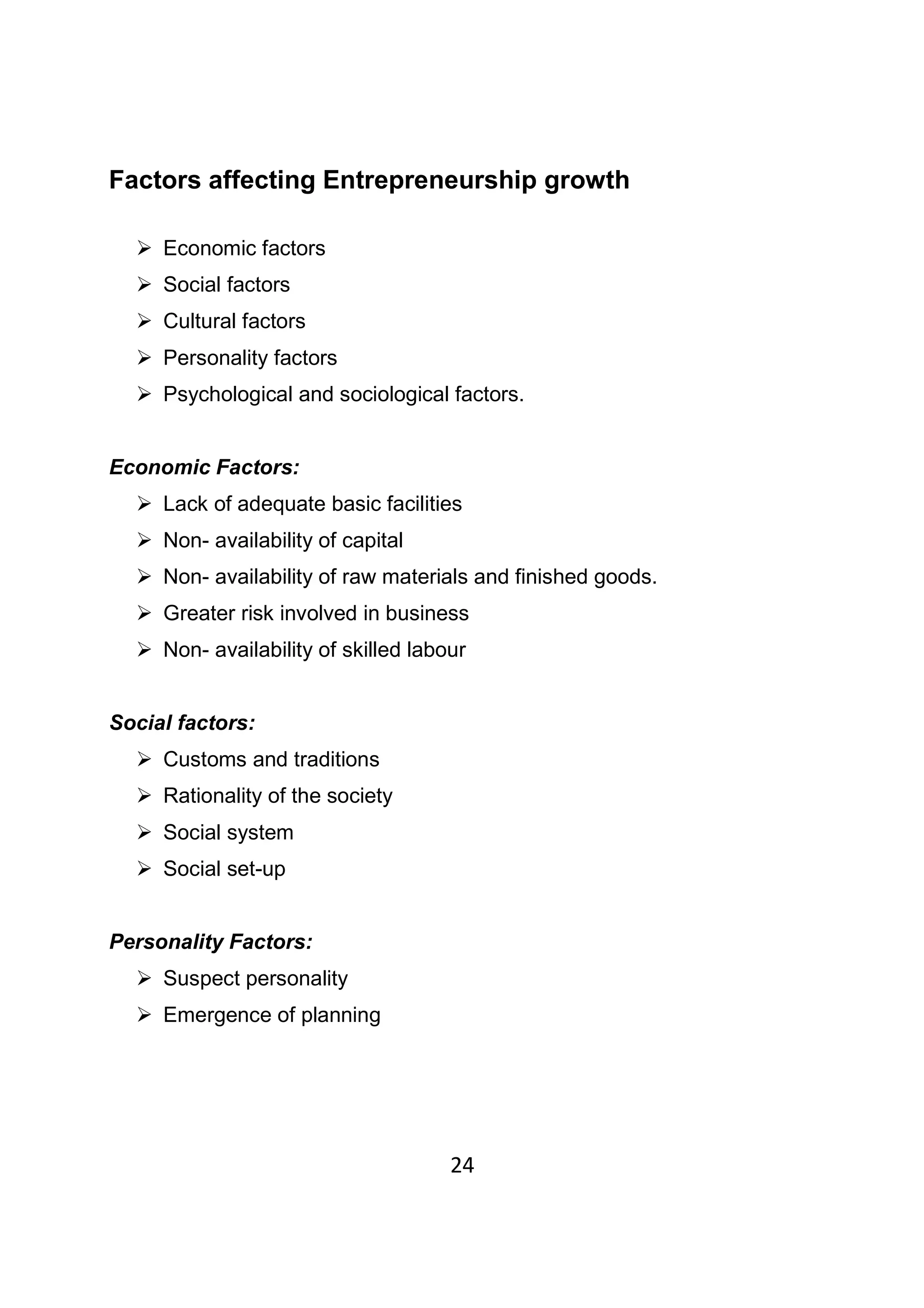
![27
official GDP was estimated to increase from 18.1% in 1989 to 20.3% in
1994 and 1995 and to 22.8% in 2000-01. Likewise, about 70% of
nonagricultural workforce is informally employed. If agricultural employment
is included, this proportion rises to over 90% Informality thus remains a
pervasive characteristic of the Indian labor markets. Consider another
indicator related impacts of entrepreneurship--poverty reduction. During
2000–2007, 41.6% of the population in the country lived on less than
US$1.25 a day and 75.6% lived on less than US$2 a day. The traditional
sector is economically disadvantaged and there is thus very little progress
in poverty reduction.
Lack of trickledown effect and signs of oligarchic capitalism:
The benefits of economic growth are disproportionately distributed to the
wealthiest and have failed to trickle down to the poor. About 10 families
control more than 80% of the stock in the country’s largest corporations.
According to the ADB, large Indian companies have won most of lucrative
government contracts, hold power over the country's natural resources and
have “privileged access to land”. An indiatimes.com article quoted an
expert on entrepreneurship in India: Entrepreneurship in India was
restricted to the privileged few that were traditionally rich. Entrepreneurship
was only transferred to the second generation [of the same family]. India
obviously has some elements of a market economy and political
democracy. The country, however, lacks a true democratic market system.
A report from the ADB suggested that Indian economy has many
characteristics of oligarchic capitalism and there is a possibility that this
form of capitalism would further consolidate in the country, which can slow](https://image.slidesharecdn.com/shadabdissertation-140711134720-phpapp02/75/Support-system-and-its-role-in-entrepreneurial-development-in-India-27-2048.jpg)
![37
of the compounds; it writes software, but rarely owns the result. [It has]
flourished, but mostly on the back of other countries' technology.
Physical infrastructures:
A lack of well-developed physical infrastructures has been a barrier
hindering entrepreneurship. Most roads are narrow. In 2007, there were
only 1,500 trucks and one-third of produces were reported to be rotted
before reaching customers. The global financial crisis further hindered
India’s infrastructure development. In the late 2008, reports indicated that
about half of India's planned highway-improvement projects, which were
valued at over US$6 billion, could be delayed by two years. According to
the Planning Commission, inefficient power supply has hindered
entrepreneurial activities, employment creation and poverty reduction. As of
2008, half of India’s population or about 500 million people, lacked access
to electricity.
Entrepreneurial capabilities:
There have been some measures to develop entrepreneurial capabilities.
India has around 40 incubators mentoring between four and 20 start-ups
each. In 2009, India ranked 134th in the human development index. Adult
literacy rates during 1999–2007 were 54.5% for females and 76.9% for
males. Although English is an official language in India, only a small
proportion of graduates meet the standard required to interact with
foreigners. This goes contrary to the widely held belief that India's huge
English-speaking population will give it an edge over 11, China and other
rising nations in doing business with Western corporations. Customers’](https://image.slidesharecdn.com/shadabdissertation-140711134720-phpapp02/75/Support-system-and-its-role-in-entrepreneurial-development-in-India-37-2048.jpg)
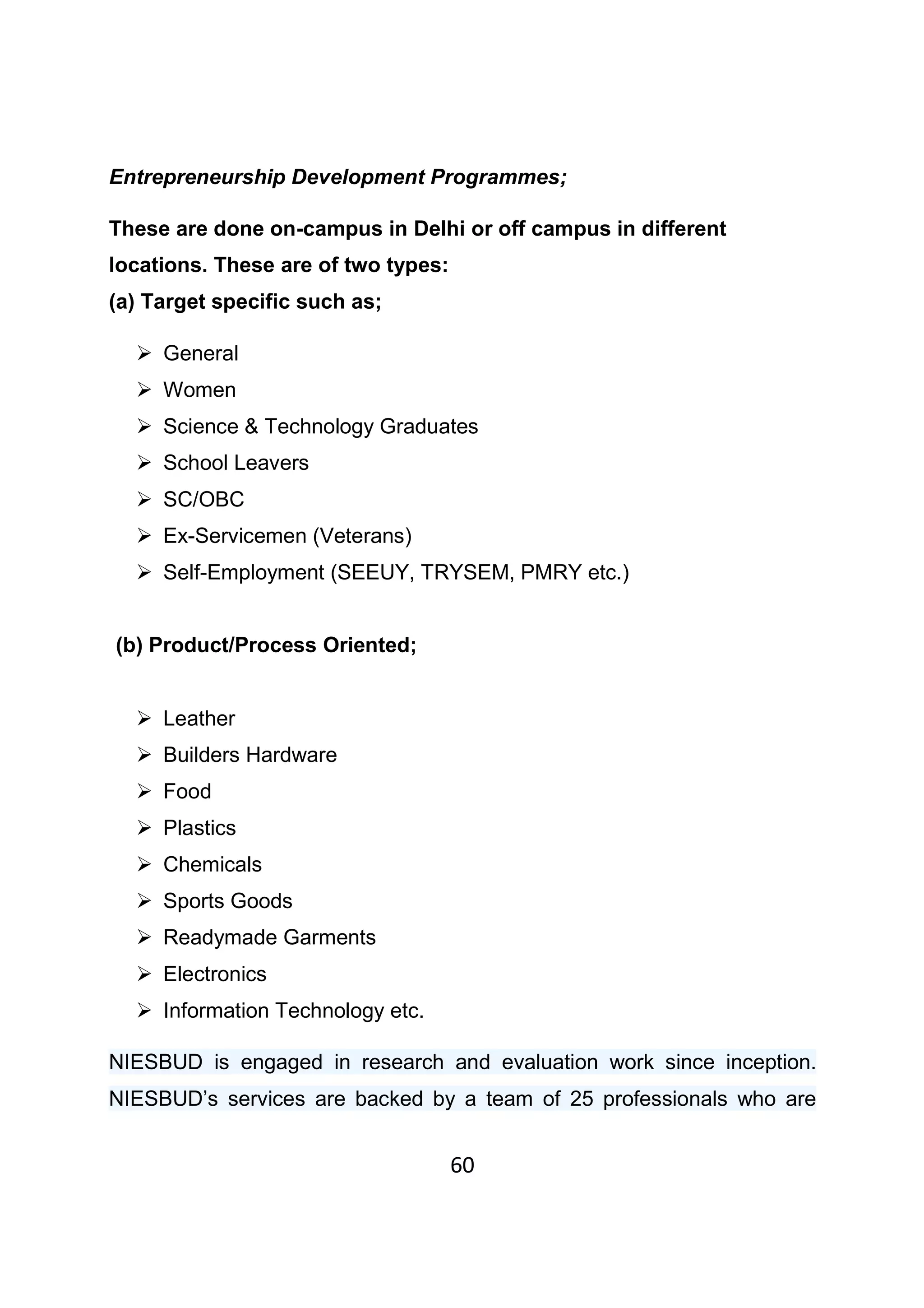
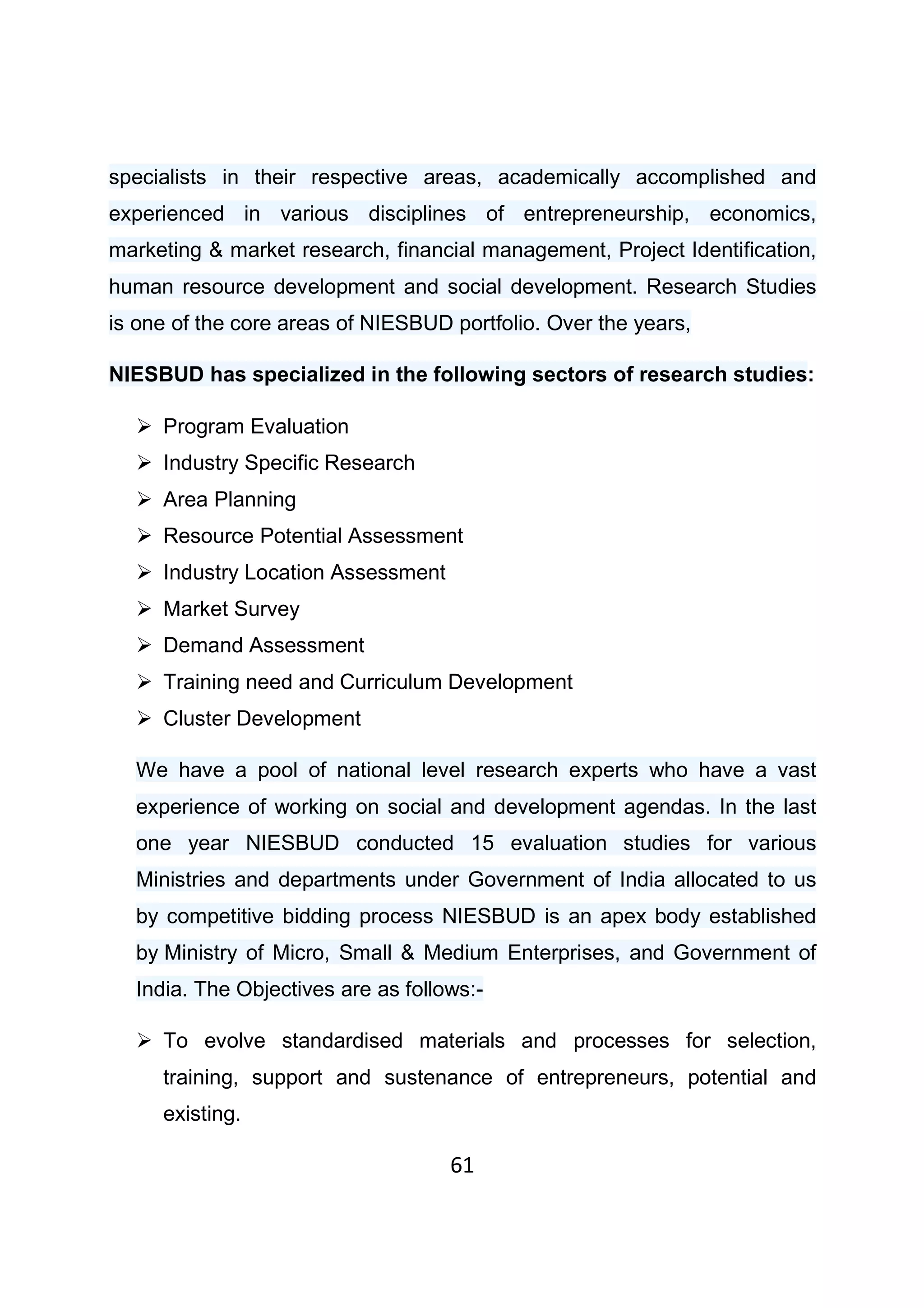
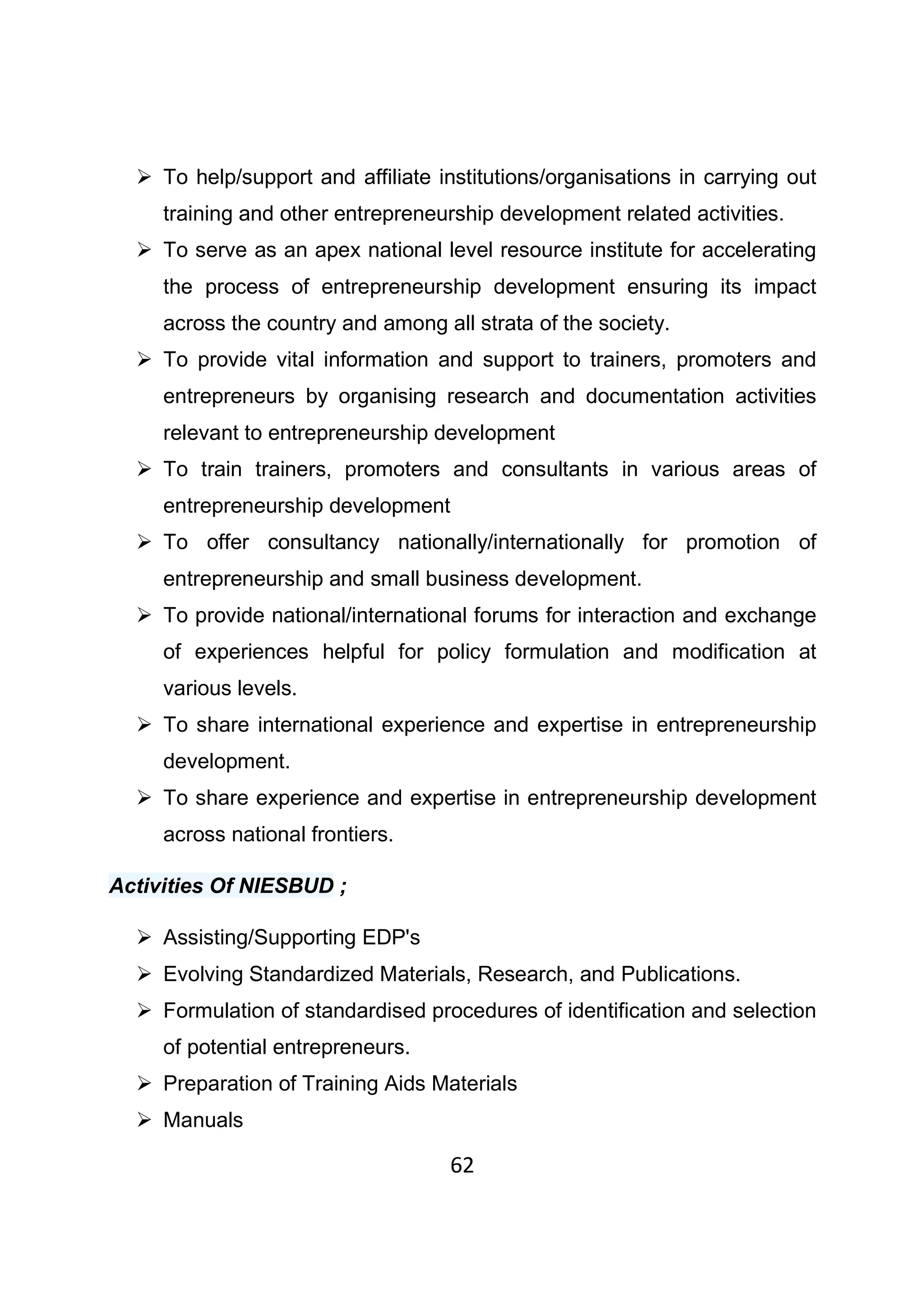
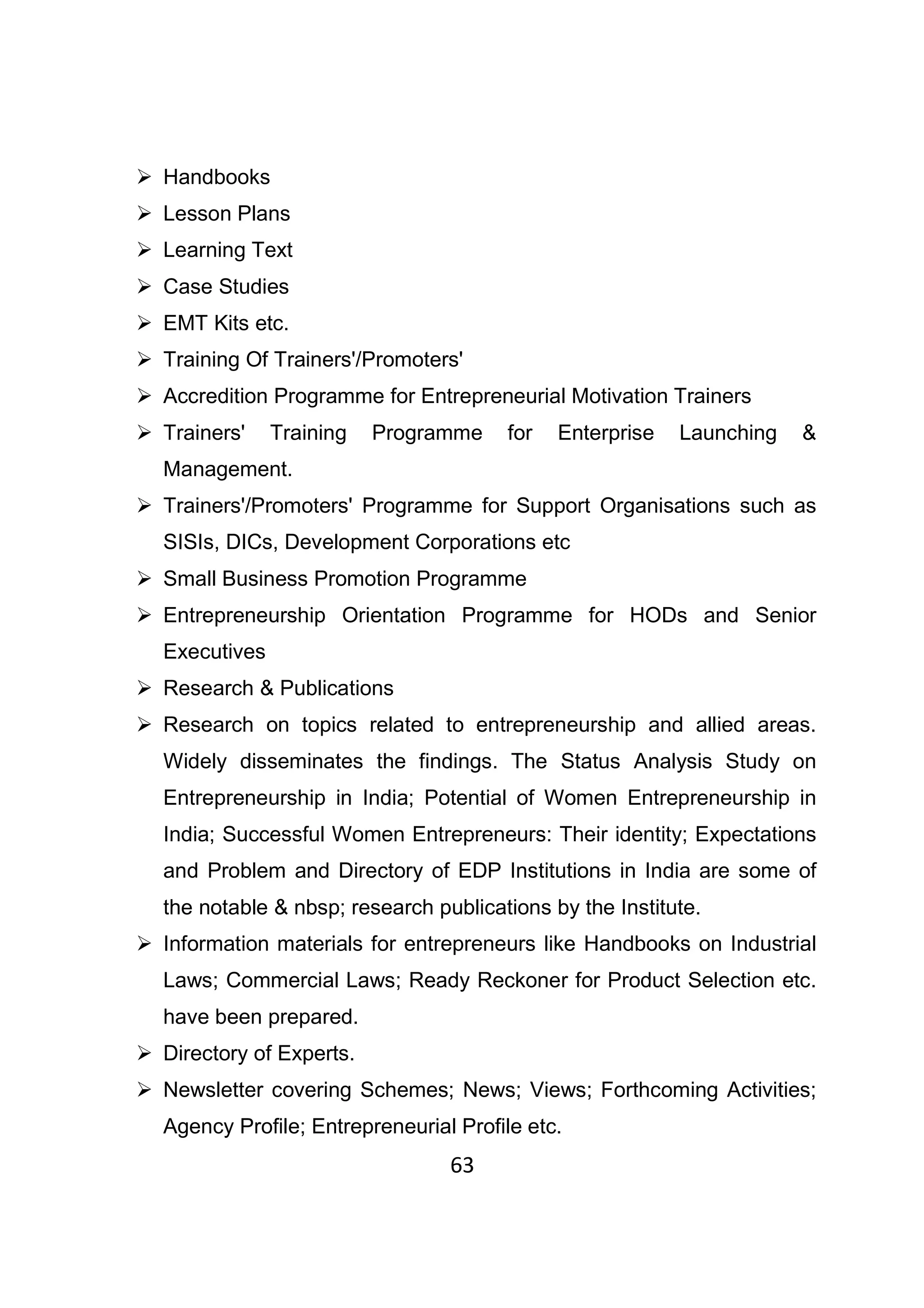

![84
It provides training facilities to the institutions working the field of rural
up-liftment.
It regulates the cooperative banks and the RRB’s.
NABARD's refinance is available to State Co-operative Agriculture and
Rural Development Banks (SCARDBs), State Co-operative Banks (SCBs),
Regional Rural Banks (RRBs), Commercial Banks (CBs) and other
financial institutions approved by RBI. While the ultimate beneficiaries of
investment credit can be individuals, partnership concerns, companies,
State-owned corporations or co-operative societies, production credit is
generally given to individuals. NABARD has its head office at Mumbai,
India. NABARD operates throughout the country through its 28 Regional
Offices and one Sub-office, located in the capitals of all the states/union
territories. Each Regional Office [RO] has a Chief General Manager
[CGMs] as its head, and the Head office has several Top executives like
the Executive Directors [ED], Managing Directors [MD], and the
Chairperson. It has 336 District Offices across the country, one Sub-office
at Port Blair and one special cell at Srinagar. It also has 6 training
establishments. NABARD is also known for its 'SHG Bank Linkage
Programme' which encourages India's banks to lend to self-help
groups (SHGs). Because SHGs are composed mainly of poor women, this
has evolved into an important Indian tool for microfinance. As of March
2006 2.2 million SHGs representing 33 million members had to been linked
to credit through this programme. NABARD also has a portfolio of Natural
Resource Management Programmes involving diverse fields like
Watershed Development, Tribal Development and Farm Innovation through
dedicated funds set up for the purpose.](https://image.slidesharecdn.com/shadabdissertation-140711134720-phpapp02/75/Support-system-and-its-role-in-entrepreneurial-development-in-India-84-2048.jpg)
![85
INDUSTRIAL DEVELOPMENT BANK OF INDIA (IDBI):
Is an Indian financial service company headquartered Mumbai, India. RBI
categorized IDBI as an "other public sector bank". It was established in
1964 by an Act of Parliament to provide credit and other facilities for the
development of the fledgling Indian industry.[2]
It is currently 10th largest
development bank in the world in terms of reach with 1514 ATMs, 923
branches including one overseas branch at DIFC, Dubai and 621 centres
including two overseas centres at Singapore & Beijing. Some of the
institutions built by IDBI are the Securities and Exchange Board of
India (SEBI), National Stock Exchange of India (NSE), the National
Securities Depository Limited (NSDL), the Stock Holding Corporation of
India Limited (SHCIL), the Credit Analysis & Research Ltd, the Exim Bank
(India) (Exim Bank), the Small Industries Development Bank of India
(SIDBI), the Entrepreneurship Development Institute of India, and IDBI
BANK, which is owned by the Indian Government. IDBI Bank is on a par
with nationalized banks and the SBI Group as far as government ownership
is concerned. It is one among the 26 commercial banks owned by the
Government of India. The Bank has an aggregate balance sheet size of
Rs. 2, 53,378 crore as on March 31, 2011. IDBI Bank's operations during
the financial year ended March 31.
ROLE OF IDBI:
In order to increase its customer base, the Industrial Development Bank of
India offers a number of customized and innovative banking services. The
services are meant to offer cent percent satisfaction to the customers.
Some of the well known services offered by the bank are:](https://image.slidesharecdn.com/shadabdissertation-140711134720-phpapp02/75/Support-system-and-its-role-in-entrepreneurial-development-in-India-85-2048.jpg)