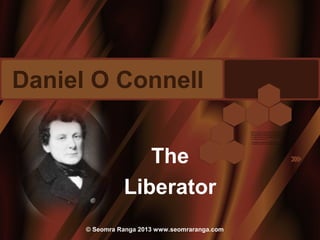
Daniel O Connell


                   The
                Liberator
      © Seomra Ranga 2013 www.seomraranga.com
Daniel O’ Connell Timeline
•   1775 Born in Cahirciveen, Co. Kerry
•   1791 Went to France
•   1798 Became a Barrister
•   1800 Act of Union Passed
•   1823 Catholic Association Established
•   1828 Elected MP for Co. Clare
•   1829 Catholic Emancipation Granted
•   1840 O’Connell establishes the Repeal
    Movement
            © Seomra Ranga 2013 www.seomraranga.com
Daniel O’ Connell Timeline
• 1841 O’ Connell become the first Catholic
  Mayor of Dublin since the Reformation
• 1843 Monster Clontarf Meeting banned
• 1845 The Great Famine commences in
  Ireland
• 1847 O’ Connell dies in Genoa, Italy


           © Seomra Ranga 2013 www.seomraranga.com
Daniel O’ Connell - Background
• Born in Cahirciveen in
  Co. Kerry in 1775
• A Catholic
• First went to a Hedge
  School and later to a
  school in Cork
• Sent to France to study
  Law. (Saw some of the
  bloody events of the
  French Revolution)


            © Seomra Ranga 2013 www.seomraranga.com
Daniel O’ Connell - Background
                             • Became a
                               successful Lawyer
                             • Fought for Catholic
                               Emancipation (the
                               removal of the Penal
                               Laws against
                               Catholics)
                             • Became known as
                               The Liberator

       © Seomra Ranga 2013 www.seomraranga.com
Penal Laws
• Laws passed towards the end of the 17th
  century
• Known as the "Penal Laws" as they "penalised"
  or punished Catholics
• Designed to ensure that Catholics remained
  poor, ignorant and without spiritual guidance
• The laws were grouped under the headings of
  education, religion, property and civil life


           © Seomra Ranga 2013 www.seomraranga.com
1800 Act of Union
• After 1798 Rebellion, Britain was worried about
  further rebellion in Ireland
• In 1800, the Act of Union was passed, joining
  the Irish and British parliaments
• Irish people now had no say in the making of
  any laws used in Ireland
• Daniel O Connell decided to fight to repeal the
  Act of Union


            © Seomra Ranga 2013 www.seomraranga.com
Catholic Emancipation
• O’ Connell decided to firstly fight for Catholic
  Emancipation
• This meant the removal of all Penal Laws
  against Catholics
• He wanted Catholics to be allowed to vote, sit in
  parliament, represent people in all courts, hold
  high positions in the Civil Service and hold high
  positions in the Army
• He believed in only peaceful means to achieve
  his aims
            © Seomra Ranga 2013 www.seomraranga.com
“NO POLITICAL
CHANGE
WHATSOEVER IS
WORTH THE SHEDDING
OF A SINGLE DROP OF
HUMAN BLOOD”.
                                - Daniel O’ Connell


 © Seomra Ranga 2013 www.seomraranga.com
The Catholic Association
• In 1823, O’Connell founded the Catholic
  Association to campaign for Catholic
  Emancipation
• He started the Catholic Rent – one penny per
  month to support the campaign
• The Association became very popular, also
  getting support from the clergy


           © Seomra Ranga 2013 www.seomraranga.com
1828 By-Election
• Catholics were allowed to vote, but not allowed
  to sit in Parliament
• Voting was not in secret so tenants usually
  voted the way their landlord wanted them to
• In a By-Election in Clare in 1828, O’ Connell
  stood for election and managed to persuade
  tenants to vote for him
• The election went on for five days and O’
  Connell easily won, becoming MP (Member of
  Parliament) for Co. Clare
            © Seomra Ranga 2013 www.seomraranga.com
1829 Catholic Emancipation
• But O’ Connell was a Catholic and could not
  enter Parliament in London
• Irish people became angry that their MP was
  forced to remain outside Parliament
• The Government in Britain was afraid of another
  rebellion in Ireland
• In 1829, the Government granted Catholic
  Emancipation
• O’ Connell famously became known as “The
  Liberator”
           © Seomra Ranga 2013 www.seomraranga.com
The Repeal Association
• Next, O’Connell turned his attention to the repeal
  (abolition) of the Act of Union
• In 1840 he founded a new organisation called
  The Repeal Association
• He wanted the British Government to restore the
  Irish Parliament in Dublin
• He again wanted to achieve this by peaceful
  means


            © Seomra Ranga 2013 www.seomraranga.com
The Repeal Association
• He began to hold huge open-air meetings
  around the country which became known as
  Monster Meetings
• In October 1843, O’Connell planned a Monster
  Meeting at Clontarf, Dublin
• A huge crowd was expected
• The government in London became alarmed
  and banned the meeting
• In order to avoid bloodshed, O’Connell cancelled
  the meeting
           © Seomra Ranga 2013 www.seomraranga.com
The Repeal Association
• This disappointed many people and O’Connell
  lost much of his popularity
• Shortly afterwards, O’Connell was arrested and
  sentenced to one year in jail
• He was released after three months
• On his release from jail, O’Connell continued his
  campaign but without success
• In 1845, the potato crop failed and people were
  more concerned about getting food

            © Seomra Ranga 2013 www.seomraranga.com
Daniel O’ Connell – Final days
• By 1847, O’ Connell had more or less left public
  life
• He was in poor health
• He decided to go on a pilgrimage to Rome
• On his way there, he stopped off in Genoa, Italy,
  where he died on May 15th, 1847
• In his will, he asked that his heart be buried in
  Rome and that his body be buried in Glasnevin
  Cemetery in Dublin

            © Seomra Ranga 2013 www.seomraranga.com
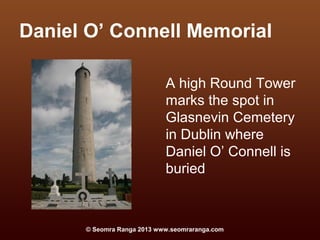
Daniel O’ Connell Memorial

                            A high Round Tower
                            marks the spot in
                            Glasnevin Cemetery
                            in Dublin where
                            Daniel O’ Connell is
                            buried


      © Seomra Ranga 2013 www.seomraranga.com
Daniel O’ Connell Statue

O’ Connell Street in
Dublin is named after
Daniel O’ Connell
and a statue of him
is prominently placed
in the centre of the
street


         © Seomra Ranga 2013 www.seomraranga.com

Daniel O' Connell

  • 1.
    Daniel O Connell The Liberator © Seomra Ranga 2013 www.seomraranga.com
  • 2.
    Daniel O’ ConnellTimeline • 1775 Born in Cahirciveen, Co. Kerry • 1791 Went to France • 1798 Became a Barrister • 1800 Act of Union Passed • 1823 Catholic Association Established • 1828 Elected MP for Co. Clare • 1829 Catholic Emancipation Granted • 1840 O’Connell establishes the Repeal Movement © Seomra Ranga 2013 www.seomraranga.com
  • 3.
    Daniel O’ ConnellTimeline • 1841 O’ Connell become the first Catholic Mayor of Dublin since the Reformation • 1843 Monster Clontarf Meeting banned • 1845 The Great Famine commences in Ireland • 1847 O’ Connell dies in Genoa, Italy © Seomra Ranga 2013 www.seomraranga.com
  • 4.
    Daniel O’ Connell- Background • Born in Cahirciveen in Co. Kerry in 1775 • A Catholic • First went to a Hedge School and later to a school in Cork • Sent to France to study Law. (Saw some of the bloody events of the French Revolution) © Seomra Ranga 2013 www.seomraranga.com
  • 5.
    Daniel O’ Connell- Background • Became a successful Lawyer • Fought for Catholic Emancipation (the removal of the Penal Laws against Catholics) • Became known as The Liberator © Seomra Ranga 2013 www.seomraranga.com
  • 6.
    Penal Laws • Lawspassed towards the end of the 17th century • Known as the "Penal Laws" as they "penalised" or punished Catholics • Designed to ensure that Catholics remained poor, ignorant and without spiritual guidance • The laws were grouped under the headings of education, religion, property and civil life © Seomra Ranga 2013 www.seomraranga.com
  • 7.
    1800 Act ofUnion • After 1798 Rebellion, Britain was worried about further rebellion in Ireland • In 1800, the Act of Union was passed, joining the Irish and British parliaments • Irish people now had no say in the making of any laws used in Ireland • Daniel O Connell decided to fight to repeal the Act of Union © Seomra Ranga 2013 www.seomraranga.com
  • 8.
    Catholic Emancipation • O’Connell decided to firstly fight for Catholic Emancipation • This meant the removal of all Penal Laws against Catholics • He wanted Catholics to be allowed to vote, sit in parliament, represent people in all courts, hold high positions in the Civil Service and hold high positions in the Army • He believed in only peaceful means to achieve his aims © Seomra Ranga 2013 www.seomraranga.com
  • 9.
    “NO POLITICAL CHANGE WHATSOEVER IS WORTHTHE SHEDDING OF A SINGLE DROP OF HUMAN BLOOD”. - Daniel O’ Connell © Seomra Ranga 2013 www.seomraranga.com
  • 10.
    The Catholic Association •In 1823, O’Connell founded the Catholic Association to campaign for Catholic Emancipation • He started the Catholic Rent – one penny per month to support the campaign • The Association became very popular, also getting support from the clergy © Seomra Ranga 2013 www.seomraranga.com
  • 11.
    1828 By-Election • Catholicswere allowed to vote, but not allowed to sit in Parliament • Voting was not in secret so tenants usually voted the way their landlord wanted them to • In a By-Election in Clare in 1828, O’ Connell stood for election and managed to persuade tenants to vote for him • The election went on for five days and O’ Connell easily won, becoming MP (Member of Parliament) for Co. Clare © Seomra Ranga 2013 www.seomraranga.com
  • 12.
    1829 Catholic Emancipation •But O’ Connell was a Catholic and could not enter Parliament in London • Irish people became angry that their MP was forced to remain outside Parliament • The Government in Britain was afraid of another rebellion in Ireland • In 1829, the Government granted Catholic Emancipation • O’ Connell famously became known as “The Liberator” © Seomra Ranga 2013 www.seomraranga.com
  • 13.
    The Repeal Association •Next, O’Connell turned his attention to the repeal (abolition) of the Act of Union • In 1840 he founded a new organisation called The Repeal Association • He wanted the British Government to restore the Irish Parliament in Dublin • He again wanted to achieve this by peaceful means © Seomra Ranga 2013 www.seomraranga.com
  • 14.
    The Repeal Association •He began to hold huge open-air meetings around the country which became known as Monster Meetings • In October 1843, O’Connell planned a Monster Meeting at Clontarf, Dublin • A huge crowd was expected • The government in London became alarmed and banned the meeting • In order to avoid bloodshed, O’Connell cancelled the meeting © Seomra Ranga 2013 www.seomraranga.com
  • 15.
    The Repeal Association •This disappointed many people and O’Connell lost much of his popularity • Shortly afterwards, O’Connell was arrested and sentenced to one year in jail • He was released after three months • On his release from jail, O’Connell continued his campaign but without success • In 1845, the potato crop failed and people were more concerned about getting food © Seomra Ranga 2013 www.seomraranga.com
  • 16.
    Daniel O’ Connell– Final days • By 1847, O’ Connell had more or less left public life • He was in poor health • He decided to go on a pilgrimage to Rome • On his way there, he stopped off in Genoa, Italy, where he died on May 15th, 1847 • In his will, he asked that his heart be buried in Rome and that his body be buried in Glasnevin Cemetery in Dublin © Seomra Ranga 2013 www.seomraranga.com
  • 17.
    Daniel O’ ConnellMemorial A high Round Tower marks the spot in Glasnevin Cemetery in Dublin where Daniel O’ Connell is buried © Seomra Ranga 2013 www.seomraranga.com
  • 18.
    Daniel O’ ConnellStatue O’ Connell Street in Dublin is named after Daniel O’ Connell and a statue of him is prominently placed in the centre of the street © Seomra Ranga 2013 www.seomraranga.com