OWASP Taiwan Day 2017
Client Side Security And Testing Tools
(Evolution of)
david.cervigni@mindedsecurity.com
About me
 10+ yeas of development
 Software Security Enthusiast
 Securing SDLC
 Secure coding trainer/reviewer
david.cervigni@mindedsecurity.com
JS Security, topics:
• Evolution of client technologies (security)
• Why is always important
• Why is always difficult
• Techniques and tools to avoid vulnerabilities
Client security is vast
XSS is always dangerous!
• XSRF protection bypass
• Cookies/session stealing
• Defacement
• Password/credential stealing
• Enumeration
…
Attacker OWNS our website,
and still:
Consequences:
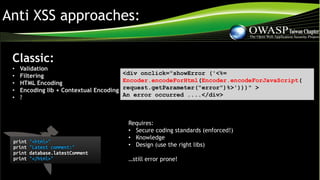
Anti XSS approaches:
Classic:
• Validation
• Filtering
• HTML Encoding
• Encoding lib + Contextual Encoding
• ?
<div onclick="showError ('<%=
Encoder.encodeForHtml(Encoder.encodeForJavaScript(
request.getParameter("error")%>')))" >
An error occurred ....</div>
Requires:
• Secure coding standards (enforced!)
• Knowledge
• Design (use the right libs)
…still error prone!
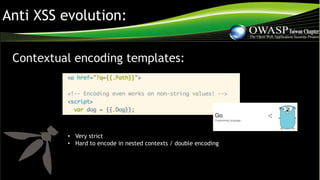
Anti XSS evolution:
Contextual encoding templates:
• Very strict
• Hard to encode in nested contexts / double encoding
Anti XSS evolution/2:
Mitigations:
• CPC: Content Security Policy
• ECMAScript security features (e.g. strict mode)
• Sandboxing JS (Google CAJA, sanitizer libraries)
• Anti XSS browser features WAF
Requires:
• Secure Application Design
• Third parties JS libraries compatibility?
• Legacy systems?
…still not fully secure (evasion)
So…Problem Solved?
Sources:
https://snyk.io/blog/xss-attacks-the-next-wave/
https://nvd.nist.gov/vuln/detail/CVE-2017-1160
“DOM-Based XSS is notoriously hard to
detect, as the server never gets a chance
to see the attack taking place.[…]”
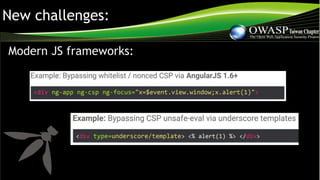
New challenges:
Modern JS frameworks:
*Source: https://2017.appsec.eu/slides-and-videos
"Don’t trust the DOM: Bypassing XSS mitigations via Script
gadgets "
XSS Mitigation bypass
On:
Angular (1.x), Polymer (1.x), React, jQuery, jQuery UI, jQuery Mobile, Vue, Aurelia,
Underscore / Backbone, Knockout, Ember, Closure Library, Ractive.js, Dojo Toolkit,
RequireJS, Bootstrap…
• SPA: Single Page Applications
• Mainly HTML & JavaScript (not anymore flash)
• Frameworks: Angular, React…
• Third party libraries (JQuery and others)
• High degree of integration: portals/services
Why is always more important?
• Big codebases
• JavaScript is not easy to read: manual review
• Developing and Quality Assure for JavaScript and client components is
DIFFICULT, time consuming and error prone.
• Classic security tools use SCA (Static Code Analysis) that leads to :
1. Too many false positives
2. Too many false negatives
Why is always more difficult?
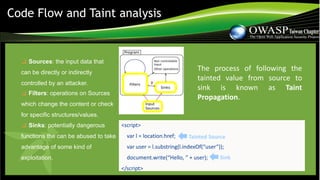
❑ Sources: the input data that
can be directly or indirectly
controlled by an attacker.
❑ Filters: operations on Sources
which change the content or check
for specific structures/values.
❑ Sinks: potentially dangerous
functions the can be abused to take
advantage of some kind of
exploitation.
Code Flow and Taint analysis
<script>
var l = location.href;
var user = l.substring(l.indexOf(“user”));
document.write(“Hello, ” + user);
</script>
Tainted Source
Sink
The process of following the
tainted value from source to
sink is known as Taint
Propagation.
Tools for JS Code analysis
SCA, static code analysis:
• Heavy
• Difficult
• Lower accuracy (false positives)
• Adaptability (false negatives…needs custom rules)
• Broad language support
Dynamic code analysis/IAST:
• Requires instrumentation
• More accurate
• Fuzzing capabilities!
SDLC
and
Automation (CI)
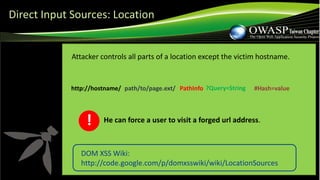
DOM XSS Wiki:
http://code.google.com/p/domxsswiki/wiki/LocationSources
Attacker controls all parts of a location except the victim hostname.
path/to/page.ext/ PathInfo ?Query=String #Hash=valuehttp://hostname/
He can force a user to visit a forged url address.!
Direct Input Sources: Location
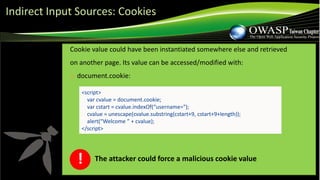
Cookie value could have been instantiated somewhere else and retrieved
on another page. Its value can be accessed/modified with:
❑ document.cookie:
<script>
var cvalue = document.cookie;
var cstart = cvalue.indexOf(“username=");
cvalue = unescape(cvalue.substring(cstart+9, cstart+9+length));
alert(“Welcome ” + cvalue);
</script>
The attacker could force a malicious cookie value!
Indirect Input Sources: Cookies
DEMO,
Q/A,
THANKS!
AND NOW…
Tools for JS Code analysis

JavaScript security and tools evolution at 2017 OWASP Taiwan Week

  • 1.
    OWASP Taiwan Day2017 Client Side Security And Testing Tools (Evolution of) david.cervigni@mindedsecurity.com
  • 2.
    About me  10+yeas of development  Software Security Enthusiast  Securing SDLC  Secure coding trainer/reviewer david.cervigni@mindedsecurity.com
  • 3.
    JS Security, topics: •Evolution of client technologies (security) • Why is always important • Why is always difficult • Techniques and tools to avoid vulnerabilities
  • 4.
  • 5.
    XSS is alwaysdangerous! • XSRF protection bypass • Cookies/session stealing • Defacement • Password/credential stealing • Enumeration … Attacker OWNS our website, and still: Consequences:
  • 6.
    Anti XSS approaches: Classic: •Validation • Filtering • HTML Encoding • Encoding lib + Contextual Encoding • ? <div onclick="showError ('<%= Encoder.encodeForHtml(Encoder.encodeForJavaScript( request.getParameter("error")%>')))" > An error occurred ....</div> Requires: • Secure coding standards (enforced!) • Knowledge • Design (use the right libs) …still error prone!
  • 7.
    Anti XSS evolution: Contextualencoding templates: • Very strict • Hard to encode in nested contexts / double encoding
  • 8.
    Anti XSS evolution/2: Mitigations: •CPC: Content Security Policy • ECMAScript security features (e.g. strict mode) • Sandboxing JS (Google CAJA, sanitizer libraries) • Anti XSS browser features WAF Requires: • Secure Application Design • Third parties JS libraries compatibility? • Legacy systems? …still not fully secure (evasion)
  • 9.
    So…Problem Solved? Sources: https://snyk.io/blog/xss-attacks-the-next-wave/ https://nvd.nist.gov/vuln/detail/CVE-2017-1160 “DOM-Based XSSis notoriously hard to detect, as the server never gets a chance to see the attack taking place.[…]”
  • 10.
  • 11.
    *Source: https://2017.appsec.eu/slides-and-videos "Don’t trustthe DOM: Bypassing XSS mitigations via Script gadgets " XSS Mitigation bypass On: Angular (1.x), Polymer (1.x), React, jQuery, jQuery UI, jQuery Mobile, Vue, Aurelia, Underscore / Backbone, Knockout, Ember, Closure Library, Ractive.js, Dojo Toolkit, RequireJS, Bootstrap…
  • 12.
    • SPA: SinglePage Applications • Mainly HTML & JavaScript (not anymore flash) • Frameworks: Angular, React… • Third party libraries (JQuery and others) • High degree of integration: portals/services Why is always more important?
  • 13.
    • Big codebases •JavaScript is not easy to read: manual review • Developing and Quality Assure for JavaScript and client components is DIFFICULT, time consuming and error prone. • Classic security tools use SCA (Static Code Analysis) that leads to : 1. Too many false positives 2. Too many false negatives Why is always more difficult?
  • 14.
    ❑ Sources: theinput data that can be directly or indirectly controlled by an attacker. ❑ Filters: operations on Sources which change the content or check for specific structures/values. ❑ Sinks: potentially dangerous functions the can be abused to take advantage of some kind of exploitation. Code Flow and Taint analysis <script> var l = location.href; var user = l.substring(l.indexOf(“user”)); document.write(“Hello, ” + user); </script> Tainted Source Sink The process of following the tainted value from source to sink is known as Taint Propagation.
  • 15.
    Tools for JSCode analysis SCA, static code analysis: • Heavy • Difficult • Lower accuracy (false positives) • Adaptability (false negatives…needs custom rules) • Broad language support Dynamic code analysis/IAST: • Requires instrumentation • More accurate • Fuzzing capabilities! SDLC and Automation (CI)
  • 16.
    DOM XSS Wiki: http://code.google.com/p/domxsswiki/wiki/LocationSources Attackercontrols all parts of a location except the victim hostname. path/to/page.ext/ PathInfo ?Query=String #Hash=valuehttp://hostname/ He can force a user to visit a forged url address.! Direct Input Sources: Location
  • 17.
    Cookie value couldhave been instantiated somewhere else and retrieved on another page. Its value can be accessed/modified with: ❑ document.cookie: <script> var cvalue = document.cookie; var cstart = cvalue.indexOf(“username="); cvalue = unescape(cvalue.substring(cstart+9, cstart+9+length)); alert(“Welcome ” + cvalue); </script> The attacker could force a malicious cookie value! Indirect Input Sources: Cookies
  • 18.
  • 19.
    Tools for JSCode analysis

Editor's Notes

  • #5 From OWASP WEBSITE: IT shows howm many test we need to do on the client side, almost all of them are causes and consequences of Javascript Execution