DESIGN
      A
   SECURE
PROGRAMMING
  LANGUAGE
Overview
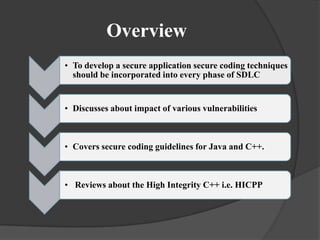
• To develop a secure application secure coding techniques
  should be incorporated into every phase of SDLC


• Discusses about impact of various vulnerabilities


• Covers secure coding guidelines for Java and C++.


• Reviews about the High Integrity C++ i.e. HICPP
Vulnerabilities

Buffer Overflow
• A buffer overflow occurs when a program allows
  input to write data beyond allocated memory


Integer Overflow
• An integer overflow takes place when the integer
  variable tries to store a larger value than the valid
  range as a result of an arithmetic operation
Vulnerabilities

Command Injection
• Takes place when malicious data is embedded into
  input and is passed to the shell


Improper error handling
• When a programmer fails to implement proper error
  handling, the application might leak information
Secure Software Development

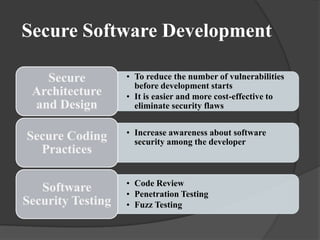
   Secure          • To reduce the number of vulnerabilities
                     before development starts
 Architecture      • It is easier and more cost-effective to
 and Design          eliminate security flaws


                   • Increase awareness about software
Secure Coding        security among the developer
  Practices

                   • Code Review
   Software        • Penetration Testing
Security Testing   • Fuzz Testing
General Secure Coding Guidelines

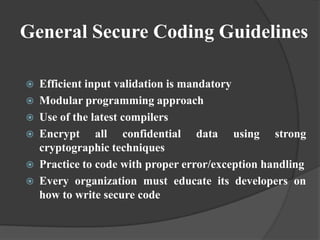
   Efficient input validation is mandatory
   Modular programming approach
   Use of the latest compilers
   Encrypt all confidential data using strong
    cryptographic techniques
   Practice to code with proper error/exception handling
   Every organization must educate its developers on
    how to write secure code
Programming Language-Specific
        Guidelines

       • Secure Coding Practices in
         Java


       • Secure Coding Practices In
         C/ C++
Secure Coding Practices in Java

   Understand the effect of a superclass on a
    subclass
   Use public static fields for defining a constant
   Use try catch statements for exception handling
   An instance of a non-final class is fully
    initialized
   Be cautious when dealing with multiple threads
Secure Coding Practices in C/C++

   Use pointers safely
   Watch out for memory leaks
   Run a ‘Garbage Collector’ to free the memory
   Securely delete sensitive data from memory by
    declaring the variable as volatile
   Allocate memory dynamically
High Integrity C++

 Define the set of rules and guidelines for the production of
  C++ code
 It provide the restrictions necessary to make C++
  suitable.
   exploring C++ use for high integrity and safety critical
    applications
   Enforce the best and secure practice in C++ development.
Conclusion
Provides a practical and effective set of secure
coding guidelines


     Secure SDLC that considers security at every
     stage of development contributes to early
     identification of potential vulnerabilities


          Discusses the about the concept of HICPP
          which is more secure than C++.
References
[1]. Kevin Soo Hoo, Andrew W. Sudbury and Andrew R. Jaquith,
    ‘Tangible ROI through Secure Software Engineering’, 2006.
[2]. Michael Howard, David LeBlanc and John Viega, ‘19 Deadly Sins
    of Software Security’, 2005.
[3]. Andrew van der Stock, Jeff Williams, Dave Wichers ‘OWASP top
    10: The 10 most critical web application security vulnerabilities’,
    2007.
[4]. Noopur Davis, ‘Secure Software Development Life Cycle
    Processes: A technology Scouting Report’,2006.
[5]. Michael Howard, Steve Lipner , ‘The Security Development Life
    Cycle’, 2006.
References
[6]. Sun Microsystems, Inc., ‘Secure Coding Guidelines for the Java
    Programming Language, version 2.0’, 2007
[7]. Mark G. Graff, Kenneth R. van Wyk, ‘Secure Coding Principles,
    and Practices’, 2003.
[8]. Dave Dyer, ‘Can Assure save Java from the perils of
    multithreading’, 1998
[9]. Flight Lieutenant Derek W. Reinhardt, ‘Use of the C++
    Programming Language in Safety Critical Systems’, 2004
[10]. Trupti Shiralkar and Brenda Grove,’ Guidelines for Secure
    Coding’, 2009
Secure programming language basis

Secure programming language basis

  • 1.
    DESIGN A SECURE PROGRAMMING LANGUAGE
  • 2.
    Overview • To developa secure application secure coding techniques should be incorporated into every phase of SDLC • Discusses about impact of various vulnerabilities • Covers secure coding guidelines for Java and C++. • Reviews about the High Integrity C++ i.e. HICPP
  • 3.
    Vulnerabilities Buffer Overflow • Abuffer overflow occurs when a program allows input to write data beyond allocated memory Integer Overflow • An integer overflow takes place when the integer variable tries to store a larger value than the valid range as a result of an arithmetic operation
  • 4.
    Vulnerabilities Command Injection • Takesplace when malicious data is embedded into input and is passed to the shell Improper error handling • When a programmer fails to implement proper error handling, the application might leak information
  • 5.
    Secure Software Development Secure • To reduce the number of vulnerabilities before development starts Architecture • It is easier and more cost-effective to and Design eliminate security flaws • Increase awareness about software Secure Coding security among the developer Practices • Code Review Software • Penetration Testing Security Testing • Fuzz Testing
  • 6.
    General Secure CodingGuidelines  Efficient input validation is mandatory  Modular programming approach  Use of the latest compilers  Encrypt all confidential data using strong cryptographic techniques  Practice to code with proper error/exception handling  Every organization must educate its developers on how to write secure code
  • 7.
    Programming Language-Specific Guidelines • Secure Coding Practices in Java • Secure Coding Practices In C/ C++
  • 8.
    Secure Coding Practicesin Java  Understand the effect of a superclass on a subclass  Use public static fields for defining a constant  Use try catch statements for exception handling  An instance of a non-final class is fully initialized  Be cautious when dealing with multiple threads
  • 9.
    Secure Coding Practicesin C/C++  Use pointers safely  Watch out for memory leaks  Run a ‘Garbage Collector’ to free the memory  Securely delete sensitive data from memory by declaring the variable as volatile  Allocate memory dynamically
  • 10.
    High Integrity C++ Define the set of rules and guidelines for the production of C++ code  It provide the restrictions necessary to make C++ suitable.  exploring C++ use for high integrity and safety critical applications  Enforce the best and secure practice in C++ development.
  • 11.
    Conclusion Provides a practicaland effective set of secure coding guidelines Secure SDLC that considers security at every stage of development contributes to early identification of potential vulnerabilities Discusses the about the concept of HICPP which is more secure than C++.
  • 12.
    References [1]. Kevin SooHoo, Andrew W. Sudbury and Andrew R. Jaquith, ‘Tangible ROI through Secure Software Engineering’, 2006. [2]. Michael Howard, David LeBlanc and John Viega, ‘19 Deadly Sins of Software Security’, 2005. [3]. Andrew van der Stock, Jeff Williams, Dave Wichers ‘OWASP top 10: The 10 most critical web application security vulnerabilities’, 2007. [4]. Noopur Davis, ‘Secure Software Development Life Cycle Processes: A technology Scouting Report’,2006. [5]. Michael Howard, Steve Lipner , ‘The Security Development Life Cycle’, 2006.
  • 13.
    References [6]. Sun Microsystems,Inc., ‘Secure Coding Guidelines for the Java Programming Language, version 2.0’, 2007 [7]. Mark G. Graff, Kenneth R. van Wyk, ‘Secure Coding Principles, and Practices’, 2003. [8]. Dave Dyer, ‘Can Assure save Java from the perils of multithreading’, 1998 [9]. Flight Lieutenant Derek W. Reinhardt, ‘Use of the C++ Programming Language in Safety Critical Systems’, 2004 [10]. Trupti Shiralkar and Brenda Grove,’ Guidelines for Secure Coding’, 2009