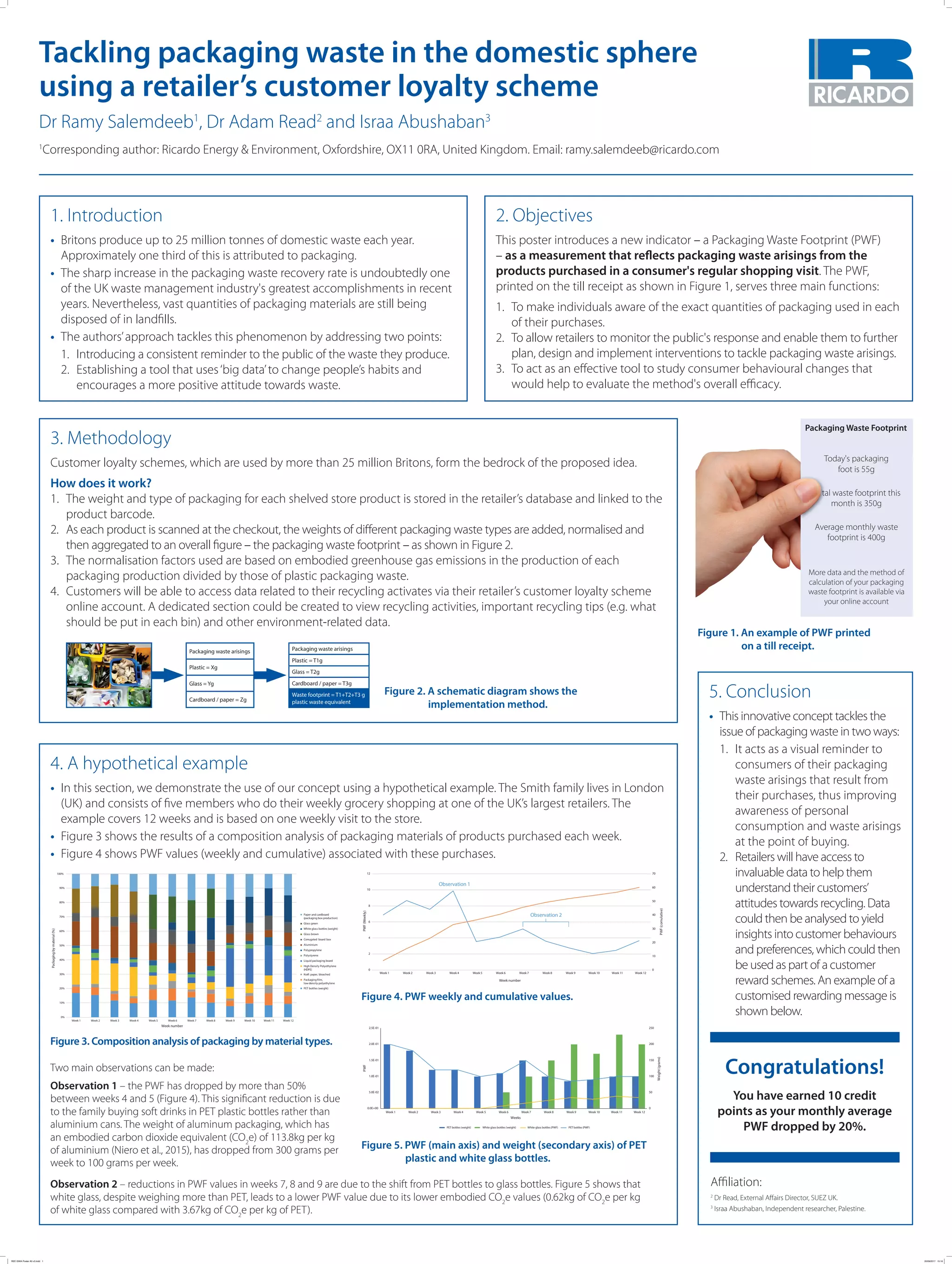
3. Methodology
Customer loyalty schemes, which are used by more than 25 million Britons, form the bedrock of the proposed idea.
How does it work?
1.	 The weight and type of packaging for each shelved store product is stored in the retailer’s database and linked to the
product barcode.
2.	 As each product is scanned at the checkout, the weights of different packaging waste types are added, normalised and
then aggregated to an overall figure – the packaging waste footprint – as shown in Figure 2.
3.	 The normalisation factors used are based on embodied greenhouse gas emissions in the production of each
packaging production divided by those of plastic packaging waste.
4.	 Customers will be able to access data related to their recycling activates via their retailer’s customer loyalty scheme
online account. A dedicated section could be created to view recycling activities, important recycling tips (e.g. what
should be put in each bin) and other environment-related data.
Tackling packaging waste in the domestic sphere
using a retailer’s customer loyalty scheme
Dr Ramy Salemdeeb1
, Dr Adam Read2
and Israa Abushaban3
1
Corresponding author: Ricardo Energy & Environment, Oxfordshire, OX11 0RA, United Kingdom. Email: ramy.salemdeeb@ricardo.com
1. Introduction
•	 Britons produce up to 25 million tonnes of domestic waste each year.
Approximately one third of this is attributed to packaging.
•	 The sharp increase in the packaging waste recovery rate is undoubtedly one
of the UK waste management industry's greatest accomplishments in recent
years. Nevertheless, vast quantities of packaging materials are still being
disposed of in landfills.
•	 The authors’approach tackles this phenomenon by addressing two points:
1.	 Introducing a consistent reminder to the public of the waste they produce.
2.	 Establishing a tool that uses‘big data’to change people’s habits and
encourages a more positive attitude towards waste.
4. A hypothetical example
•	 In this section, we demonstrate the use of our concept using a hypothetical example. The Smith family lives in London
(UK) and consists of five members who do their weekly grocery shopping at one of the UK’s largest retailers. The
example covers 12 weeks and is based on one weekly visit to the store.
•	 Figure 3 shows the results of a composition analysis of packaging materials of products purchased each week.
•	 Figure 4 shows PWF values (weekly and cumulative) associated with these purchases.
5. Conclusion
•	 This innovative concept tackles the
issue of packaging waste in two ways:
1.	 It acts as a visual reminder to
consumers of their packaging
waste arisings that result from
their purchases, thus improving
awareness of personal
consumption and waste arisings
at the point of buying.
2.	 Retailers will have access to
invaluable data to help them
understand their customers’
attitudes towards recycling. Data
could then be analysed to yield
insights into customer behaviours
and preferences, which could then
be used as part of a customer
reward schemes. An example of a
customised rewarding message is
shown below.
Figure 1. An example of PWF printed
	 on a till receipt.
Figure 2. A schematic diagram shows the 							
	 implementation method.
Figure 3. Composition analysis of packaging by material types.
Packaging Waste Footprint
Today's packaging
foot is 55g
tal waste footprint this
month is 350g
Average monthly waste
footprint is 400g
More data and the method of
calculation of your packaging
waste footprint is available via
your online account
2. Objectives
This poster introduces a new indicator – a Packaging Waste Footprint (PWF)
– as a measurement that reflects packaging waste arisings from the
products purchased in a consumer's regular shopping visit. The PWF,
printed on the till receipt as shown in Figure 1, serves three main functions:
1.	 To make individuals aware of the exact quantities of packaging used in each
of their purchases.
2.	 To allow retailers to monitor the public's response and enable them to further
plan, design and implement interventions to tackle packaging waste arisings.
3.	 To act as an effective tool to study consumer behavioural changes that
would help to evaluate the method's overall efficacy.
Two main observations can be made:
Observation 1 – the PWF has dropped by more than 50%
between weeks 4 and 5 (Figure 4). This significant reduction is due
to the family buying soft drinks in PET plastic bottles rather than
aluminium cans. The weight of aluminum packaging, which has
an embodied carbon dioxide equivalent (CO2
e) of 113.8kg per kg
of aluminium (Niero et al., 2015), has dropped from 300 grams per
week to 100 grams per week.
Observation 2 – reductions in PWF values in weeks 7, 8 and 9 are due to the shift from PET bottles to glass bottles. Figure 5 shows that
white glass, despite weighing more than PET, leads to a lower PWF value due to its lower embodied CO2
e values (0.62kg of CO2
e per kg
of white glass compared with 3.67kg of CO2
e per kg of PET).
Affiliation:
2
Dr Read, External Affairs Director, SUEZ UK.
3
Israa Abushaban, Independent researcher, Palestine.
Congratulations!
You have earned 10 credit
points as your monthly average
PWF dropped by 20%.
Packaging waste arisings
Plastic = Xg
Glass = Yg
Cardboard / paper = Zg
Packaging waste arisings
Plastic = T1g
Glass = T2g
Cardboard / paper = T3g
Waste footprint = T1+T2+T3 g
plastic waste equivalent
Figure 4. PWF weekly and cumulative values.
Figure 5. PWF (main axis) and weight (secondary axis) of PET 		
	 plastic and white glass bottles.
0%
10%
20%
30%
40%
50%
60%
70%
80%
90%
100%
Week 1 Week 2 Week 3 Week 4 Week 5 Week 6 Week 7 Week 8 Week 9 Week 10 Week 11 Week 12
Packagingbymaterial(%)
Week number
Paper and cardboard
(packaging box production)
Glass green
White glass bottles (weight)
Glass brown
Corrugated board box
Aluminium
Polypropylene
Polystyrene
Liquid packaging board
High Densily Polyethylene
(HDPE)
Kraft paper, bleached
Packaging film,
low density polyethylene
PET bottles (weight)
0
10
20
30
40
50
60
70
0
2
4
6
8
10
12
Week 1 Week 2 Week 3 Week 4
Observation 1
Observation 2
Week 5 Week 6 Week 7 Week 8 Week 9 Week 10 Week 11 Week 12
PWF(comulative)
PWF(Weekly)
Week number
0
50
100
150
200
250
0.0E+00
5.0E-02
1.0E-01
1.5E-01
2.0E-01
2.5E-01
Week 1 Week 2 Week 3 Week 4 Week 5 Week 6 Week 7 Week 8 Week 9 Week 10 Week 11 Week 12
Weight(grams)
PWF
Weeks
PET bottles (weight) White glass bottles (weight) White glass bottles (PWF) PET bottles (PWF)
REE ISWA Poster A0 v3.indd 1 20/09/2017 15:16

Tackling packaging waste in the domestic sphere using a retailer’s customer loyalty scheme

  • 1.
    3. Methodology Customer loyaltyschemes, which are used by more than 25 million Britons, form the bedrock of the proposed idea. How does it work? 1. The weight and type of packaging for each shelved store product is stored in the retailer’s database and linked to the product barcode. 2. As each product is scanned at the checkout, the weights of different packaging waste types are added, normalised and then aggregated to an overall figure – the packaging waste footprint – as shown in Figure 2. 3. The normalisation factors used are based on embodied greenhouse gas emissions in the production of each packaging production divided by those of plastic packaging waste. 4. Customers will be able to access data related to their recycling activates via their retailer’s customer loyalty scheme online account. A dedicated section could be created to view recycling activities, important recycling tips (e.g. what should be put in each bin) and other environment-related data. Tackling packaging waste in the domestic sphere using a retailer’s customer loyalty scheme Dr Ramy Salemdeeb1 , Dr Adam Read2 and Israa Abushaban3 1 Corresponding author: Ricardo Energy & Environment, Oxfordshire, OX11 0RA, United Kingdom. Email: ramy.salemdeeb@ricardo.com 1. Introduction • Britons produce up to 25 million tonnes of domestic waste each year. Approximately one third of this is attributed to packaging. • The sharp increase in the packaging waste recovery rate is undoubtedly one of the UK waste management industry's greatest accomplishments in recent years. Nevertheless, vast quantities of packaging materials are still being disposed of in landfills. • The authors’approach tackles this phenomenon by addressing two points: 1. Introducing a consistent reminder to the public of the waste they produce. 2. Establishing a tool that uses‘big data’to change people’s habits and encourages a more positive attitude towards waste. 4. A hypothetical example • In this section, we demonstrate the use of our concept using a hypothetical example. The Smith family lives in London (UK) and consists of five members who do their weekly grocery shopping at one of the UK’s largest retailers. The example covers 12 weeks and is based on one weekly visit to the store. • Figure 3 shows the results of a composition analysis of packaging materials of products purchased each week. • Figure 4 shows PWF values (weekly and cumulative) associated with these purchases. 5. Conclusion • This innovative concept tackles the issue of packaging waste in two ways: 1. It acts as a visual reminder to consumers of their packaging waste arisings that result from their purchases, thus improving awareness of personal consumption and waste arisings at the point of buying. 2. Retailers will have access to invaluable data to help them understand their customers’ attitudes towards recycling. Data could then be analysed to yield insights into customer behaviours and preferences, which could then be used as part of a customer reward schemes. An example of a customised rewarding message is shown below. Figure 1. An example of PWF printed on a till receipt. Figure 2. A schematic diagram shows the implementation method. Figure 3. Composition analysis of packaging by material types. Packaging Waste Footprint Today's packaging foot is 55g tal waste footprint this month is 350g Average monthly waste footprint is 400g More data and the method of calculation of your packaging waste footprint is available via your online account 2. Objectives This poster introduces a new indicator – a Packaging Waste Footprint (PWF) – as a measurement that reflects packaging waste arisings from the products purchased in a consumer's regular shopping visit. The PWF, printed on the till receipt as shown in Figure 1, serves three main functions: 1. To make individuals aware of the exact quantities of packaging used in each of their purchases. 2. To allow retailers to monitor the public's response and enable them to further plan, design and implement interventions to tackle packaging waste arisings. 3. To act as an effective tool to study consumer behavioural changes that would help to evaluate the method's overall efficacy. Two main observations can be made: Observation 1 – the PWF has dropped by more than 50% between weeks 4 and 5 (Figure 4). This significant reduction is due to the family buying soft drinks in PET plastic bottles rather than aluminium cans. The weight of aluminum packaging, which has an embodied carbon dioxide equivalent (CO2 e) of 113.8kg per kg of aluminium (Niero et al., 2015), has dropped from 300 grams per week to 100 grams per week. Observation 2 – reductions in PWF values in weeks 7, 8 and 9 are due to the shift from PET bottles to glass bottles. Figure 5 shows that white glass, despite weighing more than PET, leads to a lower PWF value due to its lower embodied CO2 e values (0.62kg of CO2 e per kg of white glass compared with 3.67kg of CO2 e per kg of PET). Affiliation: 2 Dr Read, External Affairs Director, SUEZ UK. 3 Israa Abushaban, Independent researcher, Palestine. Congratulations! You have earned 10 credit points as your monthly average PWF dropped by 20%. Packaging waste arisings Plastic = Xg Glass = Yg Cardboard / paper = Zg Packaging waste arisings Plastic = T1g Glass = T2g Cardboard / paper = T3g Waste footprint = T1+T2+T3 g plastic waste equivalent Figure 4. PWF weekly and cumulative values. Figure 5. PWF (main axis) and weight (secondary axis) of PET plastic and white glass bottles. 0% 10% 20% 30% 40% 50% 60% 70% 80% 90% 100% Week 1 Week 2 Week 3 Week 4 Week 5 Week 6 Week 7 Week 8 Week 9 Week 10 Week 11 Week 12 Packagingbymaterial(%) Week number Paper and cardboard (packaging box production) Glass green White glass bottles (weight) Glass brown Corrugated board box Aluminium Polypropylene Polystyrene Liquid packaging board High Densily Polyethylene (HDPE) Kraft paper, bleached Packaging film, low density polyethylene PET bottles (weight) 0 10 20 30 40 50 60 70 0 2 4 6 8 10 12 Week 1 Week 2 Week 3 Week 4 Observation 1 Observation 2 Week 5 Week 6 Week 7 Week 8 Week 9 Week 10 Week 11 Week 12 PWF(comulative) PWF(Weekly) Week number 0 50 100 150 200 250 0.0E+00 5.0E-02 1.0E-01 1.5E-01 2.0E-01 2.5E-01 Week 1 Week 2 Week 3 Week 4 Week 5 Week 6 Week 7 Week 8 Week 9 Week 10 Week 11 Week 12 Weight(grams) PWF Weeks PET bottles (weight) White glass bottles (weight) White glass bottles (PWF) PET bottles (PWF) REE ISWA Poster A0 v3.indd 1 20/09/2017 15:16