Engage
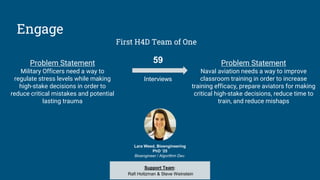
Lara Weed, Bioengineering
PhD ‘25
Bioengineer / Algorithm Dev.
59
Interviews
Support Team:
Rafi Holtzman & Steve Weinstein
Problem Statement
Military Officers need a way to
regulate stress levels while making
high-stake decisions in order to
reduce critical mistakes and potential
lasting trauma
Problem Statement
Naval aviation needs a way to improve
classroom training in order to increase
training efficacy, prepare aviators for making
critical high-stake decisions, reduce time to
train, and reduce mishaps
First H4D Team of One
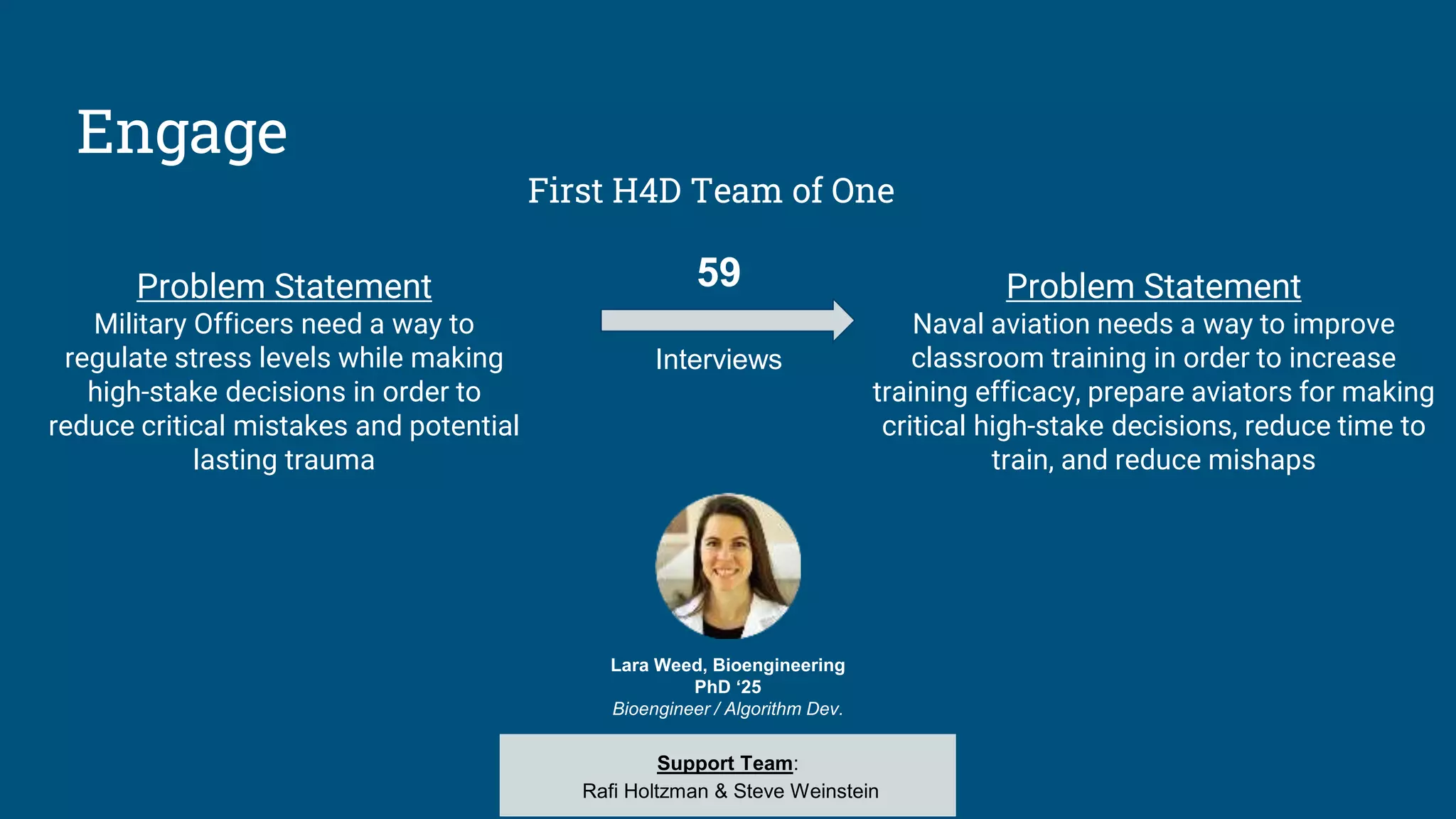
Outcomes of stress
Chronic Stress
●Post-traumatic stress disorder (PTSD)
●Suicidality
Acute Stress
●Decision making errors
MVP: Wearable to detect stress and predict
the risk of PTSD from measures pre/post
deployment
WEEK
1
WEEK
1
NEPTUNE
WEEK
2
WEEK
3
WEEK
1
WEEK
5
WEEK
6
WEEK
7
WEEK
1
WEEK
8
WEEK
9
WEEK
10
WEEK
4
“You may not see people without mTBI in a PTSD population”
“PTSD is hard because there’s a distinction between the DoD and VA”
“Smart to Steer away from PTSD and
suicide”
“VA typically does longer term health
outcomes”
“Still lots of stigma”
Key Learning
Focus on acute stress and decision making due to
easier implementation of wearable solution and the
systemic issues and stigma with seeking help for
chronic stress
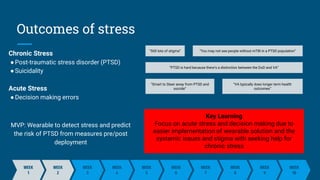
Is stress operationally relevant?
Key Learning
● Everyone is stressed, especially on deployment
● People don’t want to be bothered while their
trying to focus on their job
● Stress doesn’t always have measurable impacts
on an operation
WEEK
1
WEEK
1
NEPTUNE
WEEK
2
WEEK
3
WEEK
1
WEEK
5
WEEK
6
WEEK
7
WEEK
1
WEEK
8
WEEK
9
WEEK
10
WEEK
4
MVP: Wearable to detect stress in real-time and
let commanding officers know when someone
is in the “red zone”
“You don’t need a wearable to tell you that your stressed”
“Every minute that distracts from the operation is a minute wasted”
“Knowing your stressed is irrelevant in the moment”
“People would NOT be okay with their info being sent to their commanding officers”
“We don’t need armchair quarterbacks”
Other Challenges
WEEK
1
WEEK
1
NEPTUNE
WEEK
2
WEEK
3
WEEK
1
WEEK
5
WEEK
6
WEEK
7
WEEK
1
WEEK
8
WEEK
9
WEEK
10
WEEK
4
Key Learning
Discuss core values, roles & responsibilities, decision
making, and expectations at the beginning of any work
agreement
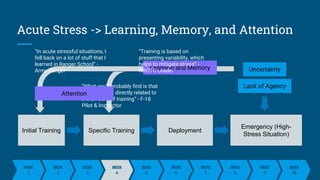
Acute Stress -> Learning, Memory, and Attention
WEEK
1
WEEK
1
NEPTUNE
WEEK
2
WEEK
3
WEEK
1
WEEK
5
WEEK
6
WEEK
7
WEEK
1
WEEK
8
WEEK
9
WEEK
10
WEEK
4
Emergency (High-
Stress Situation)
Initial Training Specific Training Deployment
Uncertainty
Lack of Agency
Learning and Memory
“Training is based on
presenting variability, which
helps to mitigate stress” -
NROTC Leader
“What you’ll probably find is that
stress level is directly related to
the amount of training” - F-18
Pilot & Instructor
“In acute stressful situations, I
fell back on a lot of stuff that I
learned in Ranger School” -
Army Ranger
Attention
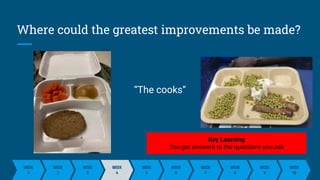
Where could the greatest improvements be made?
“The cooks”
WEEK
1
WEEK
1
NEPTUNE
WEEK
2
WEEK
3
WEEK
1
WEEK
5
WEEK
6
WEEK
7
WEEK
1
WEEK
8
WEEK
9
WEEK
10
WEEK
4
Key Learning
You get answers to the questions you ask
Who makes high-stakes critical decisions with
measurable outcomes?
WEEK
1
WEEK
1
NEPTUNE
WEEK
2
WEEK
3
WEEK
1
WEEK
5
WEEK
6
WEEK
7
WEEK
1
WEEK
8
WEEK
9
WEEK
10
WEEK
4
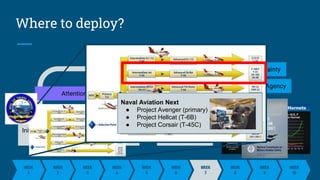
Emergency (High-
Stress Situation)
Initial Training Specific Training Deployment
Uncertainty
Lack of Agency
Learning and Memory
Attention
Naval Aviation Next
● Project Avenger (primary)
● Project Hellcat (T-6B)
● Project Corsair (T-45C)
Where to deploy?
WEEK
5
WEEK
4
WEEK
7
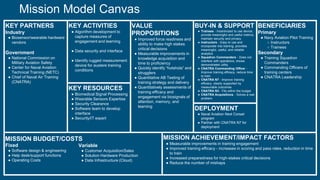
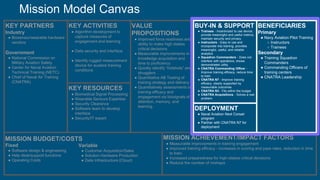
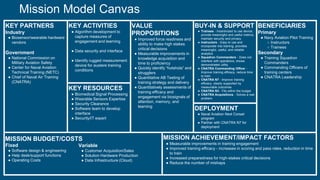
Mission Model Canvas
KEY RESOURCES
● Biomedical Signal Processing
● Wearable Sensors Expertise
● Security Clearance
● Software team to develop
interface
● Security/IT expert
KEY PARTNERS
Industry
● Biosensor/wearable hardware
vendors
Government
● National Commission on
Military Aviation Safety
● Center for Naval Aviation
Technical Training (NETC)
● Chief of Naval Air Training
(CNATRA)
VALUE
PROPOSITIONS
● Improved force readiness and
ability to make high stakes
critical decisions
● Measurable improvements in
knowledge acquisition and
time to proficiency
● Quickly identify “hotshots” and
strugglers
● Quantitative AB Testing of
training strategy and delivery
● Quantitatively assessments of
training efficacy and
engagement via biosignals of
attention, memory, and
learning
KEY ACTIVITIES
● Algorithm development to
capture measures of
engagement and learning
● Data security and interface
● Identify rugged measurement
device for austere training
conditions
MISSION ACHIEVEMENT/IMPACT FACTORS
● Measurable improvements in training engagement
● Improved training efficacy - increases in scoring and pass rates, reduction in time
to train
● Increased preparedness for high-stakes critical decisions
● Reduce the number of mishaps
DEPLOYMENT
● Naval Aviation Next Corsair
program
● Partner with CNATRA N7 for
deployment
BUY-IN & SUPPORT
● Trainees - Incentivized to use device,
provide meaningful and useful metrics,
maintain security and privacy
● Instructors - Easy to use and
incorporate into training, provides
meaningful, useful, and reliable
analytics
● Squadron Commanders - Does not
interfere with operations, shows
demonstrated utility
● CNATRA Commanding Officer -
Improve training efficacy, reduce time
to train
● CNATRA N7 - Improve training
efficacy, clearly supported by
measurable outcomes
● CNATRA N3 - Fits within the budget
● CNATRA Acquisitions - Solves a real
problem
Fixed
● Software design & engineering
● Help desk/support functions
● Operating Costs
BENEFICIARIES
Primary
● Navy Aviation Pilot Training
○ Instructors
○ Trainees
Secondary
● Training Squadron
Commanders
● Commanding Officers of
training centers
● CNATRA Leadership
MISSION BUDGET/COSTS
Variable
● Customer Acquisition/Sales
● Solution Hardware Production
● Data Infrastructure (Cloud)
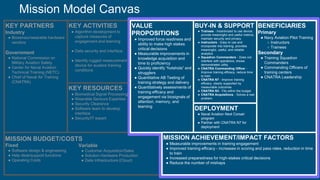
Mission Model Canvas
KEY RESOURCES
● Biomedical Signal Processing
● Wearable Sensors Expertise
● Security Clearance
● Software team to develop
interface
● Security/IT expert
KEY PARTNERS
Industry
● Biosensor/wearable hardware
vendors
Government
● National Commission on
Military Aviation Safety
● Center for Naval Aviation
Technical Training (NETC)
● Chief of Naval Air Training
(CNATRA)
VALUE
PROPOSITIONS
● Improved force readiness and
ability to make high stakes
critical decisions
● Measurable improvements in
knowledge acquisition and
time to proficiency
● Quickly identify “hotshots” and
strugglers
● Quantitative AB Testing of
training strategy and delivery
● Quantitatively assessments of
training efficacy and
engagement via biosignals of
attention, memory, and
learning
KEY ACTIVITIES
● Algorithm development to
capture measures of
engagement and learning
● Data security and interface
● Identify rugged measurement
device for austere training
conditions
MISSION ACHIEVEMENT/IMPACT FACTORS
● Measurable improvements in training engagement
● Improved training efficacy - increases in scoring and pass rates, reduction in time
to train
● Increased preparedness for high-stakes critical decisions
● Reduce the number of mishaps
DEPLOYMENT
● Naval Aviation Next Corsair
program
● Partner with CNATRA N7 for
deployment
BUY-IN & SUPPORT
● Trainees - Incentivized to use device,
provide meaningful and useful metrics,
maintain security and privacy
● Instructors - Easy to use and
incorporate into training, provides
meaningful, useful, and reliable
analytics
● Squadron Commanders - Does not
interfere with operations, shows
demonstrated utility
● CNATRA Commanding Officer -
Improve training efficacy, reduce time
to train
● CNATRA N7 - Improve training
efficacy, clearly supported by
measurable outcomes
● CNATRA N3 - Fits within the budget
● CNATRA Acquisitions - Solves a real
problem
Fixed
● Software design & engineering
● Help desk/support functions
● Operating Costs
BENEFICIARIES
Primary
● Navy Aviation Pilot Training
○ Instructors
○ Trainees
Secondary
● Training Squadron
Commanders
● Commanding Officers of
training centers
● CNATRA Leadership
MISSION BUDGET/COSTS
Variable
● Customer Acquisition/Sales
● Solution Hardware Production
● Data Infrastructure (Cloud)
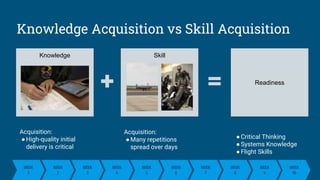
Knowledge Acquisition vs Skill Acquisition
Readiness
Knowledge Skill
Acquisition:
●Many repetitions
spread over days
Acquisition:
●High-quality initial
delivery is critical
●Critical Thinking
●Systems Knowledge
●Flight Skills
WEEK
1
WEEK
1
NEPTUNE
WEEK
2
WEEK
3
WEEK
1
WEEK
5
WEEK
6
WEEK
7
WEEK
1
WEEK
8
WEEK
9
WEEK
10
WEEK
4
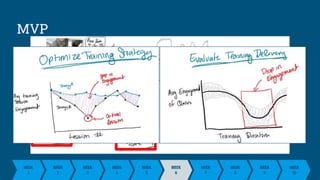
MVP
WEEK
1
WEEK
1
NEPTUNE
WEEK
2
WEEK
3
WEEK
1
WEEK
5
WEEK
6
WEEK
7
WEEK
1
WEEK
8
WEEK
9
WEEK
10
WEEK
4
Mission Model Canvas
KEY RESOURCES
● Biomedical Signal Processing
● Wearable Sensors Expertise
● Security Clearance
● Software team to develop
interface
● Security/IT expert
KEY PARTNERS
Industry
● Biosensor/wearable hardware
vendors
Government
● National Commission on
Military Aviation Safety
● Center for Naval Aviation
Technical Training (NETC)
● Chief of Naval Air Training
(CNATRA)
KEY ACTIVITIES
● Algorithm development to
capture measures of
engagement and learning
● Data security and interface
● Identify rugged measurement
device for austere training
conditions
Fixed
● Software design & engineering
● Help desk/support functions
● Operating Costs
MISSION BUDGET/COSTS
Variable
● Customer Acquisition/Sales
● Solution Hardware Production
● Data Infrastructure (Cloud)
VALUE
PROPOSITIONS
● Improved force readiness and
ability to make high stakes
critical decisions
● Measurable improvements in
knowledge acquisition and
time to proficiency
● Quickly identify “hotshots” and
strugglers
● Quantitative AB Testing of
training strategy and delivery
● Quantitatively assessments of
training efficacy and
engagement via biosignals of
attention, memory, and
learning
BENEFICIARIES
Primary
● Navy Aviation Pilot Training
○ Instructors
○ Trainees
Secondary
● Training Squadron
Commanders
● Commanding Officers of
training centers
● CNATRA Leadership
BUY-IN & SUPPORT
● Trainees - Incentivized to use device,
provide meaningful and useful metrics,
maintain security and privacy
● Instructors - Easy to use and
incorporate into training, provides
meaningful, useful, and reliable
analytics
● Squadron Commanders - Does not
interfere with operations, shows
demonstrated utility
● CNATRA Commanding Officer -
Improve training efficacy, reduce time
to train
● CNATRA N7 - Improve training
efficacy, clearly supported by
measurable outcomes
● CNATRA N3 - Fits within the budget
● CNATRA Acquisitions - Solves a real
problem
DEPLOYMENT
● Naval Aviation Next Corsair
program
● Partner with CNATRA N7 for
deployment
MISSION ACHIEVEMENT/IMPACT FACTORS
● Measurable improvements in training engagement
● Improved training efficacy - increases in scoring and pass rates, reduction in time
to train
● Increased preparedness for high-stakes critical decisions
● Reduce the number of mishaps
Key Activities &
Next Steps
WEEK
1
WEEK
2
WEEK
3
WEEK
5
WEEK
6
WEEK
7
WEEK
1
WEEK
8
WEEK
9
WEEK
10
WEEK
4
Mission Model Canvas
KEY RESOURCES
● Biomedical Signal Processing
● Wearable Sensors Expertise
● Security Clearance
● Software team to develop
interface
● Security/IT expert
KEY PARTNERS
Industry
● Biosensor/wearable hardware
vendors
Government
● National Commission on
Military Aviation Safety
● Center for Naval Aviation
Technical Training (NETC)
● Chief of Naval Air Training
(CNATRA)
VALUE
PROPOSITIONS
● Improved force readiness and
ability to make high stakes
critical decisions
● Measurable improvements in
knowledge acquisition and
time to proficiency
● Quickly identify “hotshots” and
strugglers
● Quantitative AB Testing of
training strategy and delivery
● Quantitatively assessments of
training efficacy and
engagement via biosignals of
attention, memory, and
learning
KEY ACTIVITIES
● Algorithm development to
capture measures of
engagement and learning
● Data security and interface
● Identify rugged measurement
device for austere training
conditions
MISSION ACHIEVEMENT/IMPACT FACTORS
● Measurable improvements in training engagement
● Improved training efficacy - increases in scoring and pass rates, reduction in time
to train
● Increased preparedness for high-stakes critical decisions
● Reduce the number of mishaps
DEPLOYMENT
● Naval Aviation Next Corsair
program
● Partner with CNATRA N7 for
deployment
BUY-IN & SUPPORT
● Trainees - Incentivized to use device,
provide meaningful and useful metrics,
maintain security and privacy
● Instructors - Easy to use and
incorporate into training, provides
meaningful, useful, and reliable
analytics
● Squadron Commanders - Does not
interfere with operations, shows
demonstrated utility
● CNATRA Commanding Officer -
Improve training efficacy, reduce time
to train
● CNATRA N7 - Improve training
efficacy, clearly supported by
measurable outcomes
● CNATRA N3 - Fits within the budget
● CNATRA Acquisitions - Solves a real
problem
Fixed
● Software design & engineering
● Help desk/support functions
● Operating Costs
BENEFICIARIES
Primary
● Navy Aviation Pilot Training
○ Instructors
○ Trainees
Secondary
● Training Squadron
Commanders
● Commanding Officers of
training centers
● CNATRA Leadership
MISSION BUDGET/COSTS
Variable
● Customer Acquisition/Sales
● Solution Hardware Production
● Data Infrastructure (Cloud)
Thank You
Rafi Holtzone
Steve Weinstein
Jeff Decker
Pete Newell
Steve Blank
Joe Felter
H4D TAs
59 Interviewees
Friends & Family
Backup Slides
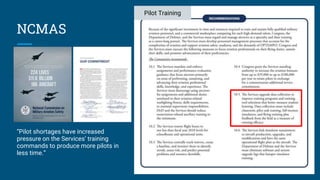
NCMAS
“Pilot shortages have increased
pressure on the Services’ training
commands to produce more pilots in
less time.”
Pilot Training
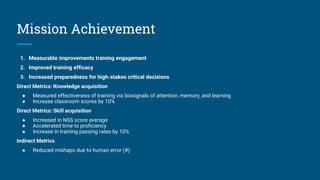
Mission Achievement
1. Measurable improvements training engagement
2. Improved training efficacy
3. Increased preparedness for high-stakes critical decisions
Direct Metrics: Knowledge acquisition
● Measured effectiveness of training via biosignals of attention, memory, and learning
● Increase classroom scores by 10%
Direct Metrics: Skill acquisition
● Increased in NSS score average
● Accelerated time to proficiency
● Increase in training passing rates by 10%
Indirect Metrics
● Reduced mishaps due to human error (#)
Products
& Services
Wearable sensor to
measure and
enhance learning,
memory, and
attention during
training.
● Leverage physiological signal to determine
ability to retain information and training
design and delivery factors that can
influence it
● Quantification of engagement and
retention of learning to determine for rapid
iteration over training strategies and
delivery
● More optimized training enables greater
retention and focus on acquisition of
critical skills
Customer
Jobs
● Poor delivery of material can impact training
experience, scoring, pass/fail rates, and info
retention and result in dismissal from position
● Slow feedback loop on training delivery and
effectiveness
● Trainees may not always be in the
best state for retention due to the
training strategy employed
Customer Segment: Aviation Pilot Instructors
Gains
Pains
Gain Creators
Pain
Relievers
● Easier to teach to highly optimized training
delivery and strategy
● Higher levels of engagement, increased retention of
training, and greater likelihood of trainees passing
● Increased trainee preparedness for high stakes
decision making
● Quantitative assessment of delivery from
instructor via learning, memory, and
attention of students as a tool to optimize
learning
● Quick feedback to instructors on the
effectiveness of their delivery
● A B testing of training strategies to optimize
effectiveness
Develop and maintain
effective and engaging
training to prepare for
trainees for the demands
of the job
Value Proposition Canvas
Products
& Services
Wearable sensor to
measure and
enhance learning,
memory, and
attention during
training.
● Leverage physiological signal to determine
ability to retain information and training
design and delivery factors that can
influence it
● Quantification of engagement and
retention of learning to determine for rapid
iteration over training strategies and
delivery
● Greater retention of training and focus on
acquisition of critical skills
Customer
Jobs
● Failing out due to insufficient or incompatible
instruction
● Struggling to pay attention and learn during
certain trainings
● Poor instruction
● Trainees may not always be in the
best state for retention due to the
training strategy employed
Customer Segment: Aviation Pilot Trainees
Gains
Pains
Gain Creators
Pain
Relievers
● Optimization of training delivery and strategy
● Higher levels of engagement, increased retention
of training, and greater likelihood of passing
● Increased preparedness for high stakes decision
making and reduced likelihood of mishaps
● Quantitative assessment of effective
training delivery from instructor via
learning, memory, and attention of
students
● Quick feedback to instructors on the
effectiveness of their delivery
● A B testing of training strategies to
optimize effectiveness
Maintain engagement
and attention to get the
most out of training and
prepare for job demands
Value Proposition Canvas
Quotes
“People would NOT be okay with their info
being sent to their commanding officers”
“Money Talks, prevention walks”
“PTSD is hard because there’s a distinction
between the DoD and VA”
“Smart to Steer away from PTSD and suicide”
“Feedback is critically important”
“Peel the onion”
“Every minute that distracts from the
operation is a minute wasted”
“There are no routine emergencies but there are
routines for emergencies”
“Knowing your stressed is irrelevant in the
moment”
“We don’t need armchair quarterbacks”
“Training is based on presenting variability,
which helps to mitigate stress”
“Training yesterday’s techniques
for tomorrow's problems”
“When you get to the part that requires more
thinking outside of the box, that’s what gets you”
What type of training would you choose? “The cooks”
“What you’ll probably find is that stress level
is directly related to the amount of training”
“Data to decision”
“We’re tired of holding back the
hotshots”
“No real word outcomes pretty
much at all”
“There’s not a lot of measurement
currently”
“Ground school is forever”
“Certainly a personal thing that I
would want”
“Time to train is a huge metric in
Naval Aviation”
“You see mishaps when a pilot doesn’t understand
the automation”
“The Navy’s not going to adjust for
one little snowflake”
“Makes a lot of sense”
“There’s a lot left on the table” (of
classroom training)
“All of the tactical learning
happens in the debrief”
“Skills are durable but knowledge
is not”
“First 2-3 weeks of school is death
by powerpoint”
“May be able to get the most bang
for your buck in FRS”
“Holy sh*t this is cool”
“You may not see people without mTBI in a
PTSD population
“VA typically does longer term health
outcomes”
Stress Management and Measurable Outcomes
Is stress operationally relevant?
“In acute stressful situations, I fell back on a
lot of stuff that I learned in Ranger School”
Don’t Tell My Commander
Stress is a symptom - Not a root cause
Naval Aviation Training and Outcomes
“Still lots of stigma”
Where could the greatest improvements to training be
made?
Mission Achievement
MVP
“In acute stressful situations, I fell back on a lot of stuff that I learned in
Ranger School” - LTC Army with 10 years in infantry
Training

Engage H4D 2021 Lessons Learned

  • 1.
    Engage Lara Weed, Bioengineering PhD‘25 Bioengineer / Algorithm Dev. 59 Interviews Support Team: Rafi Holtzman & Steve Weinstein Problem Statement Military Officers need a way to regulate stress levels while making high-stake decisions in order to reduce critical mistakes and potential lasting trauma Problem Statement Naval aviation needs a way to improve classroom training in order to increase training efficacy, prepare aviators for making critical high-stake decisions, reduce time to train, and reduce mishaps First H4D Team of One
  • 2.
    Outcomes of stress ChronicStress ●Post-traumatic stress disorder (PTSD) ●Suicidality Acute Stress ●Decision making errors MVP: Wearable to detect stress and predict the risk of PTSD from measures pre/post deployment WEEK 1 WEEK 1 NEPTUNE WEEK 2 WEEK 3 WEEK 1 WEEK 5 WEEK 6 WEEK 7 WEEK 1 WEEK 8 WEEK 9 WEEK 10 WEEK 4 “You may not see people without mTBI in a PTSD population” “PTSD is hard because there’s a distinction between the DoD and VA” “Smart to Steer away from PTSD and suicide” “VA typically does longer term health outcomes” “Still lots of stigma” Key Learning Focus on acute stress and decision making due to easier implementation of wearable solution and the systemic issues and stigma with seeking help for chronic stress
  • 3.
    Is stress operationallyrelevant? Key Learning ● Everyone is stressed, especially on deployment ● People don’t want to be bothered while their trying to focus on their job ● Stress doesn’t always have measurable impacts on an operation WEEK 1 WEEK 1 NEPTUNE WEEK 2 WEEK 3 WEEK 1 WEEK 5 WEEK 6 WEEK 7 WEEK 1 WEEK 8 WEEK 9 WEEK 10 WEEK 4 MVP: Wearable to detect stress in real-time and let commanding officers know when someone is in the “red zone” “You don’t need a wearable to tell you that your stressed” “Every minute that distracts from the operation is a minute wasted” “Knowing your stressed is irrelevant in the moment” “People would NOT be okay with their info being sent to their commanding officers” “We don’t need armchair quarterbacks”
  • 4.
    Other Challenges WEEK 1 WEEK 1 NEPTUNE WEEK 2 WEEK 3 WEEK 1 WEEK 5 WEEK 6 WEEK 7 WEEK 1 WEEK 8 WEEK 9 WEEK 10 WEEK 4 Key Learning Discusscore values, roles & responsibilities, decision making, and expectations at the beginning of any work agreement
  • 5.
    Acute Stress ->Learning, Memory, and Attention WEEK 1 WEEK 1 NEPTUNE WEEK 2 WEEK 3 WEEK 1 WEEK 5 WEEK 6 WEEK 7 WEEK 1 WEEK 8 WEEK 9 WEEK 10 WEEK 4 Emergency (High- Stress Situation) Initial Training Specific Training Deployment Uncertainty Lack of Agency Learning and Memory “Training is based on presenting variability, which helps to mitigate stress” - NROTC Leader “What you’ll probably find is that stress level is directly related to the amount of training” - F-18 Pilot & Instructor “In acute stressful situations, I fell back on a lot of stuff that I learned in Ranger School” - Army Ranger Attention
  • 6.
    Where could thegreatest improvements be made? “The cooks” WEEK 1 WEEK 1 NEPTUNE WEEK 2 WEEK 3 WEEK 1 WEEK 5 WEEK 6 WEEK 7 WEEK 1 WEEK 8 WEEK 9 WEEK 10 WEEK 4 Key Learning You get answers to the questions you ask
  • 7.
    Who makes high-stakescritical decisions with measurable outcomes? WEEK 1 WEEK 1 NEPTUNE WEEK 2 WEEK 3 WEEK 1 WEEK 5 WEEK 6 WEEK 7 WEEK 1 WEEK 8 WEEK 9 WEEK 10 WEEK 4 Emergency (High- Stress Situation) Initial Training Specific Training Deployment Uncertainty Lack of Agency Learning and Memory Attention Naval Aviation Next ● Project Avenger (primary) ● Project Hellcat (T-6B) ● Project Corsair (T-45C) Where to deploy? WEEK 5 WEEK 4 WEEK 7
  • 8.
    Mission Model Canvas KEYRESOURCES ● Biomedical Signal Processing ● Wearable Sensors Expertise ● Security Clearance ● Software team to develop interface ● Security/IT expert KEY PARTNERS Industry ● Biosensor/wearable hardware vendors Government ● National Commission on Military Aviation Safety ● Center for Naval Aviation Technical Training (NETC) ● Chief of Naval Air Training (CNATRA) VALUE PROPOSITIONS ● Improved force readiness and ability to make high stakes critical decisions ● Measurable improvements in knowledge acquisition and time to proficiency ● Quickly identify “hotshots” and strugglers ● Quantitative AB Testing of training strategy and delivery ● Quantitatively assessments of training efficacy and engagement via biosignals of attention, memory, and learning KEY ACTIVITIES ● Algorithm development to capture measures of engagement and learning ● Data security and interface ● Identify rugged measurement device for austere training conditions MISSION ACHIEVEMENT/IMPACT FACTORS ● Measurable improvements in training engagement ● Improved training efficacy - increases in scoring and pass rates, reduction in time to train ● Increased preparedness for high-stakes critical decisions ● Reduce the number of mishaps DEPLOYMENT ● Naval Aviation Next Corsair program ● Partner with CNATRA N7 for deployment BUY-IN & SUPPORT ● Trainees - Incentivized to use device, provide meaningful and useful metrics, maintain security and privacy ● Instructors - Easy to use and incorporate into training, provides meaningful, useful, and reliable analytics ● Squadron Commanders - Does not interfere with operations, shows demonstrated utility ● CNATRA Commanding Officer - Improve training efficacy, reduce time to train ● CNATRA N7 - Improve training efficacy, clearly supported by measurable outcomes ● CNATRA N3 - Fits within the budget ● CNATRA Acquisitions - Solves a real problem Fixed ● Software design & engineering ● Help desk/support functions ● Operating Costs BENEFICIARIES Primary ● Navy Aviation Pilot Training ○ Instructors ○ Trainees Secondary ● Training Squadron Commanders ● Commanding Officers of training centers ● CNATRA Leadership MISSION BUDGET/COSTS Variable ● Customer Acquisition/Sales ● Solution Hardware Production ● Data Infrastructure (Cloud)
  • 9.
    Mission Model Canvas KEYRESOURCES ● Biomedical Signal Processing ● Wearable Sensors Expertise ● Security Clearance ● Software team to develop interface ● Security/IT expert KEY PARTNERS Industry ● Biosensor/wearable hardware vendors Government ● National Commission on Military Aviation Safety ● Center for Naval Aviation Technical Training (NETC) ● Chief of Naval Air Training (CNATRA) VALUE PROPOSITIONS ● Improved force readiness and ability to make high stakes critical decisions ● Measurable improvements in knowledge acquisition and time to proficiency ● Quickly identify “hotshots” and strugglers ● Quantitative AB Testing of training strategy and delivery ● Quantitatively assessments of training efficacy and engagement via biosignals of attention, memory, and learning KEY ACTIVITIES ● Algorithm development to capture measures of engagement and learning ● Data security and interface ● Identify rugged measurement device for austere training conditions MISSION ACHIEVEMENT/IMPACT FACTORS ● Measurable improvements in training engagement ● Improved training efficacy - increases in scoring and pass rates, reduction in time to train ● Increased preparedness for high-stakes critical decisions ● Reduce the number of mishaps DEPLOYMENT ● Naval Aviation Next Corsair program ● Partner with CNATRA N7 for deployment BUY-IN & SUPPORT ● Trainees - Incentivized to use device, provide meaningful and useful metrics, maintain security and privacy ● Instructors - Easy to use and incorporate into training, provides meaningful, useful, and reliable analytics ● Squadron Commanders - Does not interfere with operations, shows demonstrated utility ● CNATRA Commanding Officer - Improve training efficacy, reduce time to train ● CNATRA N7 - Improve training efficacy, clearly supported by measurable outcomes ● CNATRA N3 - Fits within the budget ● CNATRA Acquisitions - Solves a real problem Fixed ● Software design & engineering ● Help desk/support functions ● Operating Costs BENEFICIARIES Primary ● Navy Aviation Pilot Training ○ Instructors ○ Trainees Secondary ● Training Squadron Commanders ● Commanding Officers of training centers ● CNATRA Leadership MISSION BUDGET/COSTS Variable ● Customer Acquisition/Sales ● Solution Hardware Production ● Data Infrastructure (Cloud)
  • 10.
    Knowledge Acquisition vsSkill Acquisition Readiness Knowledge Skill Acquisition: ●Many repetitions spread over days Acquisition: ●High-quality initial delivery is critical ●Critical Thinking ●Systems Knowledge ●Flight Skills WEEK 1 WEEK 1 NEPTUNE WEEK 2 WEEK 3 WEEK 1 WEEK 5 WEEK 6 WEEK 7 WEEK 1 WEEK 8 WEEK 9 WEEK 10 WEEK 4
  • 11.
  • 12.
    Mission Model Canvas KEYRESOURCES ● Biomedical Signal Processing ● Wearable Sensors Expertise ● Security Clearance ● Software team to develop interface ● Security/IT expert KEY PARTNERS Industry ● Biosensor/wearable hardware vendors Government ● National Commission on Military Aviation Safety ● Center for Naval Aviation Technical Training (NETC) ● Chief of Naval Air Training (CNATRA) KEY ACTIVITIES ● Algorithm development to capture measures of engagement and learning ● Data security and interface ● Identify rugged measurement device for austere training conditions Fixed ● Software design & engineering ● Help desk/support functions ● Operating Costs MISSION BUDGET/COSTS Variable ● Customer Acquisition/Sales ● Solution Hardware Production ● Data Infrastructure (Cloud) VALUE PROPOSITIONS ● Improved force readiness and ability to make high stakes critical decisions ● Measurable improvements in knowledge acquisition and time to proficiency ● Quickly identify “hotshots” and strugglers ● Quantitative AB Testing of training strategy and delivery ● Quantitatively assessments of training efficacy and engagement via biosignals of attention, memory, and learning BENEFICIARIES Primary ● Navy Aviation Pilot Training ○ Instructors ○ Trainees Secondary ● Training Squadron Commanders ● Commanding Officers of training centers ● CNATRA Leadership BUY-IN & SUPPORT ● Trainees - Incentivized to use device, provide meaningful and useful metrics, maintain security and privacy ● Instructors - Easy to use and incorporate into training, provides meaningful, useful, and reliable analytics ● Squadron Commanders - Does not interfere with operations, shows demonstrated utility ● CNATRA Commanding Officer - Improve training efficacy, reduce time to train ● CNATRA N7 - Improve training efficacy, clearly supported by measurable outcomes ● CNATRA N3 - Fits within the budget ● CNATRA Acquisitions - Solves a real problem DEPLOYMENT ● Naval Aviation Next Corsair program ● Partner with CNATRA N7 for deployment MISSION ACHIEVEMENT/IMPACT FACTORS ● Measurable improvements in training engagement ● Improved training efficacy - increases in scoring and pass rates, reduction in time to train ● Increased preparedness for high-stakes critical decisions ● Reduce the number of mishaps
  • 13.
    Key Activities & NextSteps WEEK 1 WEEK 2 WEEK 3 WEEK 5 WEEK 6 WEEK 7 WEEK 1 WEEK 8 WEEK 9 WEEK 10 WEEK 4
  • 14.
    Mission Model Canvas KEYRESOURCES ● Biomedical Signal Processing ● Wearable Sensors Expertise ● Security Clearance ● Software team to develop interface ● Security/IT expert KEY PARTNERS Industry ● Biosensor/wearable hardware vendors Government ● National Commission on Military Aviation Safety ● Center for Naval Aviation Technical Training (NETC) ● Chief of Naval Air Training (CNATRA) VALUE PROPOSITIONS ● Improved force readiness and ability to make high stakes critical decisions ● Measurable improvements in knowledge acquisition and time to proficiency ● Quickly identify “hotshots” and strugglers ● Quantitative AB Testing of training strategy and delivery ● Quantitatively assessments of training efficacy and engagement via biosignals of attention, memory, and learning KEY ACTIVITIES ● Algorithm development to capture measures of engagement and learning ● Data security and interface ● Identify rugged measurement device for austere training conditions MISSION ACHIEVEMENT/IMPACT FACTORS ● Measurable improvements in training engagement ● Improved training efficacy - increases in scoring and pass rates, reduction in time to train ● Increased preparedness for high-stakes critical decisions ● Reduce the number of mishaps DEPLOYMENT ● Naval Aviation Next Corsair program ● Partner with CNATRA N7 for deployment BUY-IN & SUPPORT ● Trainees - Incentivized to use device, provide meaningful and useful metrics, maintain security and privacy ● Instructors - Easy to use and incorporate into training, provides meaningful, useful, and reliable analytics ● Squadron Commanders - Does not interfere with operations, shows demonstrated utility ● CNATRA Commanding Officer - Improve training efficacy, reduce time to train ● CNATRA N7 - Improve training efficacy, clearly supported by measurable outcomes ● CNATRA N3 - Fits within the budget ● CNATRA Acquisitions - Solves a real problem Fixed ● Software design & engineering ● Help desk/support functions ● Operating Costs BENEFICIARIES Primary ● Navy Aviation Pilot Training ○ Instructors ○ Trainees Secondary ● Training Squadron Commanders ● Commanding Officers of training centers ● CNATRA Leadership MISSION BUDGET/COSTS Variable ● Customer Acquisition/Sales ● Solution Hardware Production ● Data Infrastructure (Cloud)
  • 15.
    Thank You Rafi Holtzone SteveWeinstein Jeff Decker Pete Newell Steve Blank Joe Felter H4D TAs 59 Interviewees Friends & Family
  • 16.
  • 17.
    NCMAS “Pilot shortages haveincreased pressure on the Services’ training commands to produce more pilots in less time.” Pilot Training
  • 18.
    Mission Achievement 1. Measurableimprovements training engagement 2. Improved training efficacy 3. Increased preparedness for high-stakes critical decisions Direct Metrics: Knowledge acquisition ● Measured effectiveness of training via biosignals of attention, memory, and learning ● Increase classroom scores by 10% Direct Metrics: Skill acquisition ● Increased in NSS score average ● Accelerated time to proficiency ● Increase in training passing rates by 10% Indirect Metrics ● Reduced mishaps due to human error (#)
  • 19.
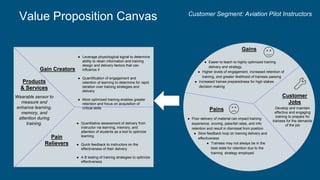
    Products & Services Wearable sensorto measure and enhance learning, memory, and attention during training. ● Leverage physiological signal to determine ability to retain information and training design and delivery factors that can influence it ● Quantification of engagement and retention of learning to determine for rapid iteration over training strategies and delivery ● More optimized training enables greater retention and focus on acquisition of critical skills Customer Jobs ● Poor delivery of material can impact training experience, scoring, pass/fail rates, and info retention and result in dismissal from position ● Slow feedback loop on training delivery and effectiveness ● Trainees may not always be in the best state for retention due to the training strategy employed Customer Segment: Aviation Pilot Instructors Gains Pains Gain Creators Pain Relievers ● Easier to teach to highly optimized training delivery and strategy ● Higher levels of engagement, increased retention of training, and greater likelihood of trainees passing ● Increased trainee preparedness for high stakes decision making ● Quantitative assessment of delivery from instructor via learning, memory, and attention of students as a tool to optimize learning ● Quick feedback to instructors on the effectiveness of their delivery ● A B testing of training strategies to optimize effectiveness Develop and maintain effective and engaging training to prepare for trainees for the demands of the job Value Proposition Canvas
  • 20.
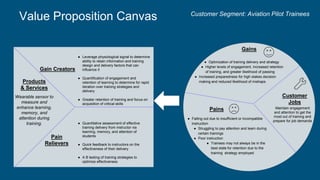
    Products & Services Wearable sensorto measure and enhance learning, memory, and attention during training. ● Leverage physiological signal to determine ability to retain information and training design and delivery factors that can influence it ● Quantification of engagement and retention of learning to determine for rapid iteration over training strategies and delivery ● Greater retention of training and focus on acquisition of critical skills Customer Jobs ● Failing out due to insufficient or incompatible instruction ● Struggling to pay attention and learn during certain trainings ● Poor instruction ● Trainees may not always be in the best state for retention due to the training strategy employed Customer Segment: Aviation Pilot Trainees Gains Pains Gain Creators Pain Relievers ● Optimization of training delivery and strategy ● Higher levels of engagement, increased retention of training, and greater likelihood of passing ● Increased preparedness for high stakes decision making and reduced likelihood of mishaps ● Quantitative assessment of effective training delivery from instructor via learning, memory, and attention of students ● Quick feedback to instructors on the effectiveness of their delivery ● A B testing of training strategies to optimize effectiveness Maintain engagement and attention to get the most out of training and prepare for job demands Value Proposition Canvas
  • 21.
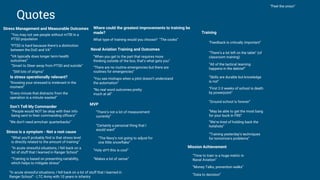
    Quotes “People would NOTbe okay with their info being sent to their commanding officers” “Money Talks, prevention walks” “PTSD is hard because there’s a distinction between the DoD and VA” “Smart to Steer away from PTSD and suicide” “Feedback is critically important” “Peel the onion” “Every minute that distracts from the operation is a minute wasted” “There are no routine emergencies but there are routines for emergencies” “Knowing your stressed is irrelevant in the moment” “We don’t need armchair quarterbacks” “Training is based on presenting variability, which helps to mitigate stress” “Training yesterday’s techniques for tomorrow's problems” “When you get to the part that requires more thinking outside of the box, that’s what gets you” What type of training would you choose? “The cooks” “What you’ll probably find is that stress level is directly related to the amount of training” “Data to decision” “We’re tired of holding back the hotshots” “No real word outcomes pretty much at all” “There’s not a lot of measurement currently” “Ground school is forever” “Certainly a personal thing that I would want” “Time to train is a huge metric in Naval Aviation” “You see mishaps when a pilot doesn’t understand the automation” “The Navy’s not going to adjust for one little snowflake” “Makes a lot of sense” “There’s a lot left on the table” (of classroom training) “All of the tactical learning happens in the debrief” “Skills are durable but knowledge is not” “First 2-3 weeks of school is death by powerpoint” “May be able to get the most bang for your buck in FRS” “Holy sh*t this is cool” “You may not see people without mTBI in a PTSD population “VA typically does longer term health outcomes” Stress Management and Measurable Outcomes Is stress operationally relevant? “In acute stressful situations, I fell back on a lot of stuff that I learned in Ranger School” Don’t Tell My Commander Stress is a symptom - Not a root cause Naval Aviation Training and Outcomes “Still lots of stigma” Where could the greatest improvements to training be made? Mission Achievement MVP “In acute stressful situations, I fell back on a lot of stuff that I learned in Ranger School” - LTC Army with 10 years in infantry Training