Differential Equations
with Engineering
Applications
Introduction:
Definition:
A Differential Equation is an equation that relates one or more
unknown functions and their derivatives.
Examples:
dy/dx = 3x2
dy/dx + 3y = 6x + 11
d2y/dx – 3dy/dx + 2y = 24e-2x
Differential Equations are important for engineers
to model physical problems using mathematical
equations, and then solve these equations so that
the behavior of the systems concerned can be
studied.
Importance of Differential Equations:
1. Ordinary Differential Equations
2. Partial Differential Equations
3. Linear Differential Equations
4. Non-Linear Differential Equations
5. Homogenous Differential Equations
6. Non-Homogenous Differential Equations
Types of Differential Equations:
Application of Differential Equations in Engineering:
Differential equations play a important role in modeling and analyzing
physical phenomena in engineering. Here some of engineering concepts that
uses differential equations
1. Fluid dynamics
2. Mechanical systems
3. Heat transfer
4. Aerodynamics
Fluid dynamics:
Fluid dynamics is a branch of physics that deals with the study of
fluids,
including liquids, gases and plasmas and their behavior under
various conditions.
One of the fundamental tools used in fluid mechanics is differential
equations. These equations are used to describe the motion of fluids
and the forces acting on them.
In engineering, fluid dynamics plays a crucial role in the design and
analyze wide range of systems such as pipelines, turbines, heat
exchangers, aerodynamic structures, etc….
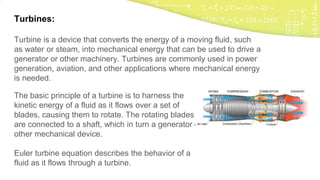
The basic principle of a turbine is to harness the
kinetic energy of a fluid as it flows over a set of
blades, causing them to rotate. The rotating blades
are connected to a shaft, which in turn a generator or
other mechanical device.
Euler turbine equation describes the behavior of a
fluid as it flows through a turbine.
Turbines:
Turbine is a device that converts the energy of a moving fluid, such
as water or steam, into mechanical energy that can be used to drive a
generator or other machinery. Turbines are commonly used in power
generation, aviation, and other applications where mechanical energy
is needed.
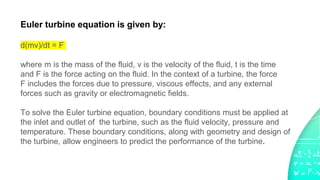
Euler turbine equation is given by:
d(mv)/dt = F
where m is the mass of the fluid, v is the velocity of the fluid, t is the time
and F is the force acting on the fluid. In the context of a turbine, the force
F includes the forces due to pressure, viscous effects, and any external
forces such as gravity or electromagnetic fields.
To solve the Euler turbine equation, boundary conditions must be applied at
the inlet and outlet of the turbine, such as the fluid velocity, pressure and
temperature. These boundary conditions, along with geometry and design of
the turbine, allow engineers to predict the performance of the turbine.
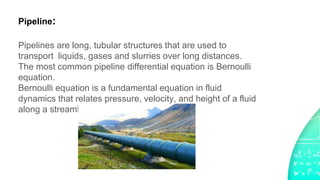
Pipeline:
Pipelines are long, tubular structures that are used to
transport liquids, gases and slurries over long distances.
The most common pipeline differential equation is Bernoulli
equation.
Bernoulli equation is a fundamental equation in fluid
dynamics that relates pressure, velocity, and height of a fluid
along a streamline in a fluid flow.
P1 + 1/2pv1
2 +pgh1 = P2 + 1/2pv2
2 + pgh2
Where P1,P2 are pressures, v1 and v2 are the velocities, h1 and h2 are the heights above the
reference point, and p is the density of the fluid.
Assuming that the fluid is incompressible, the mass flow rate through the pipeline is constant
and can be expressed as
pAv = constant
where A is the cross-sectional area of the pipeline and v is the velocity of the fluid.
Differentiating this equation with respect to distance x along the pipeline yields
pA dv/dx + v dp/dx A
where dp/dx A is the change in cross-sectional area with respect to distance x.
Combining this equation with the Bernoulli equation and solving for v yields the Bernoulli
differential equation for pipeline flow.
dv/dx + f(v) = 0
f(v) is a function of the fluid properties and the geometry of the pipeline
The Beronulli differential equation for pipeline flow is a first order ordinary differential equation.
.
Bernoulli equation:
Mechanical Systems:
A mechanical system is a collection of mechanical components that work
together to perform a specific function. Mechanical systems can be modeled
using differential equations to analyze their behavior and predict their
response from different inputs.
Example:
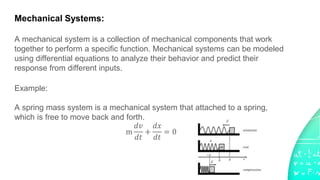
A spring mass system is a mechanical system that attached to a spring,
which is free to move back and forth.
m
𝑑𝑣
𝑑𝑡
+
𝑑𝑥
𝑑𝑡
= 0
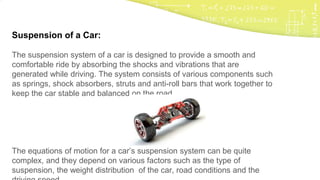
Suspension of a Car:
The suspension system of a car is designed to provide a smooth and
comfortable ride by absorbing the shocks and vibrations that are
generated while driving. The system consists of various components such
as springs, shock absorbers, struts and anti-roll bars that work together to
keep the car stable and balanced on the road.
The equations of motion for a car’s suspension system can be quite
complex, and they depend on various factors such as the type of
suspension, the weight distribution of the car, road conditions and the
The equation for modelling the suspension system is to use a
mass spring damper model, where the car is represented
as a mass that is connected to the wheels through a spring
and a damper. The spring provides the restoring force that
opposes the displacement of the car from its equilibrium
position, while the damper dissipates the energy that is
generated by the vibrations.
The equation of motion for this system can be written as
m(d2y/dt2) + c(dy/dt) +ky = F(t)
where m – mass of the car , y - displacement of the car from
its equilibrium position, c – damping coefficient, k – spring
constant,
F(t) – external force acting on the car
Heat transfer:
Heat transfer is a field of study in engineering that deals with the transfer
of thermal energy between different mediums. The rate of heat transfer is
influenced by a variety of factors including the temperature difference
between the two medium, the material properties of the mediums and the
geometry of the system.
Differential equations are used to describe the behaviour of heat transfer
phenomena. Some of the applications are Boilers, HVAC systems,
etc …
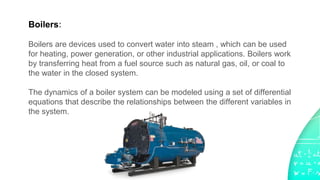
Boilers:
Boilers are devices used to convert water into steam , which can be used
for heating, power generation, or other industrial applications. Boilers work
by transferring heat from a fuel source such as natural gas, oil, or coal to
the water in the closed system.
The dynamics of a boiler system can be modeled using a set of differential
equations that describe the relationships between the different variables in
the system.
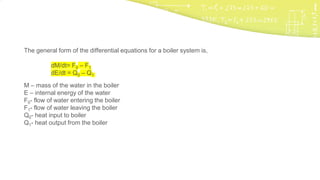
The general form of the differential equations for a boiler system is,
dM/dt= F0 – F1
dE/dt = Q0 – Q1
M – mass of the water in the boiler
E – internal energy of the water
F0- flow of water entering the boiler
F1- flow of water leaving the boiler
Q0- heat input to boiler
Q1- heat output from the boiler
Aerodynamics:
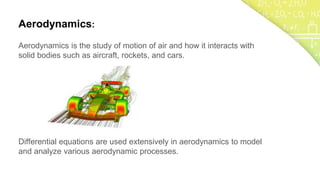
Aerodynamics is the study of motion of air and how it interacts with
solid bodies such as aircraft, rockets, and cars.
Differential equations are used extensively in aerodynamics to model
and analyze various aerodynamic processes.
Design of Race cars:
In motorsports, the goal is to design a car that can achieve the highest
possible speed while maintaining stability and control.
Engineers use aerodynamic principles to design the shape of the car,
including the body, wings, and other components, to reduce drag and
increase downforce.
Downforce is the force that pushes the car down onto the track, increasing
the friction between the tires and the surface, allowing the car to maintain
stability at high speeds. By increasing downforce, engineers can design a
car to maintain stability at high speeds. By increasing downforce,
engineers can design a car that can take corners at higher speeds without
losing control.
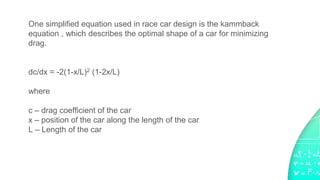
One simplified equation used in race car design is the kammback
equation , which describes the optimal shape of a car for minimizing
drag.
dc/dx = -2(1-x/L)2 (1-2x/L)
where
c – drag coefficient of the car
x – position of the car along the length of the car
L – Length of the car
Overall, differential equations are a
powerful tool that allows engineers to
understand, analyze and optimize
complex systems, making them an
essential part of modern engineering
Conclusion:
Thank you

Differential_Equations_Application.pptx

  • 1.
  • 2.
    Introduction: Definition: A Differential Equationis an equation that relates one or more unknown functions and their derivatives. Examples: dy/dx = 3x2 dy/dx + 3y = 6x + 11 d2y/dx – 3dy/dx + 2y = 24e-2x
  • 3.
    Differential Equations areimportant for engineers to model physical problems using mathematical equations, and then solve these equations so that the behavior of the systems concerned can be studied. Importance of Differential Equations:
  • 4.
    1. Ordinary DifferentialEquations 2. Partial Differential Equations 3. Linear Differential Equations 4. Non-Linear Differential Equations 5. Homogenous Differential Equations 6. Non-Homogenous Differential Equations Types of Differential Equations:
  • 5.
    Application of DifferentialEquations in Engineering: Differential equations play a important role in modeling and analyzing physical phenomena in engineering. Here some of engineering concepts that uses differential equations 1. Fluid dynamics 2. Mechanical systems 3. Heat transfer 4. Aerodynamics
  • 6.
    Fluid dynamics: Fluid dynamicsis a branch of physics that deals with the study of fluids, including liquids, gases and plasmas and their behavior under various conditions. One of the fundamental tools used in fluid mechanics is differential equations. These equations are used to describe the motion of fluids and the forces acting on them. In engineering, fluid dynamics plays a crucial role in the design and analyze wide range of systems such as pipelines, turbines, heat exchangers, aerodynamic structures, etc….
  • 7.
    The basic principleof a turbine is to harness the kinetic energy of a fluid as it flows over a set of blades, causing them to rotate. The rotating blades are connected to a shaft, which in turn a generator or other mechanical device. Euler turbine equation describes the behavior of a fluid as it flows through a turbine. Turbines: Turbine is a device that converts the energy of a moving fluid, such as water or steam, into mechanical energy that can be used to drive a generator or other machinery. Turbines are commonly used in power generation, aviation, and other applications where mechanical energy is needed.
  • 8.
    Euler turbine equationis given by: d(mv)/dt = F where m is the mass of the fluid, v is the velocity of the fluid, t is the time and F is the force acting on the fluid. In the context of a turbine, the force F includes the forces due to pressure, viscous effects, and any external forces such as gravity or electromagnetic fields. To solve the Euler turbine equation, boundary conditions must be applied at the inlet and outlet of the turbine, such as the fluid velocity, pressure and temperature. These boundary conditions, along with geometry and design of the turbine, allow engineers to predict the performance of the turbine.
  • 9.
    Pipeline: Pipelines are long,tubular structures that are used to transport liquids, gases and slurries over long distances. The most common pipeline differential equation is Bernoulli equation. Bernoulli equation is a fundamental equation in fluid dynamics that relates pressure, velocity, and height of a fluid along a streamline in a fluid flow.
  • 10.
    P1 + 1/2pv1 2+pgh1 = P2 + 1/2pv2 2 + pgh2 Where P1,P2 are pressures, v1 and v2 are the velocities, h1 and h2 are the heights above the reference point, and p is the density of the fluid. Assuming that the fluid is incompressible, the mass flow rate through the pipeline is constant and can be expressed as pAv = constant where A is the cross-sectional area of the pipeline and v is the velocity of the fluid. Differentiating this equation with respect to distance x along the pipeline yields pA dv/dx + v dp/dx A where dp/dx A is the change in cross-sectional area with respect to distance x. Combining this equation with the Bernoulli equation and solving for v yields the Bernoulli differential equation for pipeline flow. dv/dx + f(v) = 0 f(v) is a function of the fluid properties and the geometry of the pipeline The Beronulli differential equation for pipeline flow is a first order ordinary differential equation. . Bernoulli equation:
  • 11.
    Mechanical Systems: A mechanicalsystem is a collection of mechanical components that work together to perform a specific function. Mechanical systems can be modeled using differential equations to analyze their behavior and predict their response from different inputs. Example: A spring mass system is a mechanical system that attached to a spring, which is free to move back and forth. m 𝑑𝑣 𝑑𝑡 + 𝑑𝑥 𝑑𝑡 = 0
  • 12.
    Suspension of aCar: The suspension system of a car is designed to provide a smooth and comfortable ride by absorbing the shocks and vibrations that are generated while driving. The system consists of various components such as springs, shock absorbers, struts and anti-roll bars that work together to keep the car stable and balanced on the road. The equations of motion for a car’s suspension system can be quite complex, and they depend on various factors such as the type of suspension, the weight distribution of the car, road conditions and the
  • 13.
    The equation formodelling the suspension system is to use a mass spring damper model, where the car is represented as a mass that is connected to the wheels through a spring and a damper. The spring provides the restoring force that opposes the displacement of the car from its equilibrium position, while the damper dissipates the energy that is generated by the vibrations. The equation of motion for this system can be written as m(d2y/dt2) + c(dy/dt) +ky = F(t) where m – mass of the car , y - displacement of the car from its equilibrium position, c – damping coefficient, k – spring constant, F(t) – external force acting on the car
  • 14.
    Heat transfer: Heat transferis a field of study in engineering that deals with the transfer of thermal energy between different mediums. The rate of heat transfer is influenced by a variety of factors including the temperature difference between the two medium, the material properties of the mediums and the geometry of the system. Differential equations are used to describe the behaviour of heat transfer phenomena. Some of the applications are Boilers, HVAC systems, etc …
  • 15.
    Boilers: Boilers are devicesused to convert water into steam , which can be used for heating, power generation, or other industrial applications. Boilers work by transferring heat from a fuel source such as natural gas, oil, or coal to the water in the closed system. The dynamics of a boiler system can be modeled using a set of differential equations that describe the relationships between the different variables in the system.
  • 16.
    The general formof the differential equations for a boiler system is, dM/dt= F0 – F1 dE/dt = Q0 – Q1 M – mass of the water in the boiler E – internal energy of the water F0- flow of water entering the boiler F1- flow of water leaving the boiler Q0- heat input to boiler Q1- heat output from the boiler
  • 17.
    Aerodynamics: Aerodynamics is thestudy of motion of air and how it interacts with solid bodies such as aircraft, rockets, and cars. Differential equations are used extensively in aerodynamics to model and analyze various aerodynamic processes.
  • 18.
    Design of Racecars: In motorsports, the goal is to design a car that can achieve the highest possible speed while maintaining stability and control. Engineers use aerodynamic principles to design the shape of the car, including the body, wings, and other components, to reduce drag and increase downforce. Downforce is the force that pushes the car down onto the track, increasing the friction between the tires and the surface, allowing the car to maintain stability at high speeds. By increasing downforce, engineers can design a car to maintain stability at high speeds. By increasing downforce, engineers can design a car that can take corners at higher speeds without losing control.
  • 19.
    One simplified equationused in race car design is the kammback equation , which describes the optimal shape of a car for minimizing drag. dc/dx = -2(1-x/L)2 (1-2x/L) where c – drag coefficient of the car x – position of the car along the length of the car L – Length of the car
  • 20.
    Overall, differential equationsare a powerful tool that allows engineers to understand, analyze and optimize complex systems, making them an essential part of modern engineering Conclusion: Thank you