BASIC CONCEPTS OF
NETWORK
RAUNAK , 7A CAIE
GLENDALE ACADEMY,HYDERABAD
Defination
DEFINTION:
A computer network is defined as
the interconnection of two or more
computers. It is done to enable the
computers to communicate and
share available resources.
Applications
APPLICATIONS:
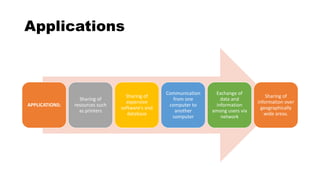
Sharing of
resources such
as printers
Sharing of
expensive
software's and
database
Communication
from one
computer to
another
computer
Exchange of
data and
information
among users via
network
Sharing of
information over
geographically
wide areas.
Use of Computer Network
•Sharing information — i.e. data communication
• Do you prefer these?
• Or this?
Use of Computer Network
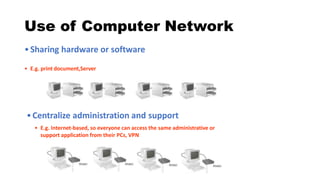
•Sharing hardware or software
• E.g. print document,Server
•Centralize administration and support
• E.g. Internet-based, so everyone can access the same administrative or
support application from their PCs, VPN
Advantages of Computer Network
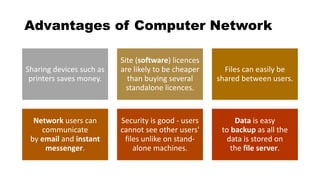
Sharing devices such as
printers saves money.
Site (software) licences
are likely to be cheaper
than buying several
standalone licences.
Files can easily be
shared between users.
Network users can
communicate
by email and instant
messenger.
Security is good - users
cannot see other users'
files unlike on stand-
alone machines.
Data is easy
to backup as all the
data is stored on
the file server.
Dis-Advantages of Computer Network
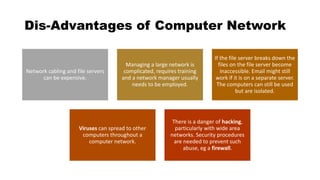
Network cabling and file servers
can be expensive.
Managing a large network is
complicated, requires training
and a network manager usually
needs to be employed.
If the file server breaks down the
files on the file server become
inaccessible. Email might still
work if it is on a separate server.
The computers can still be used
but are isolated.
Viruses can spread to other
computers throughout a
computer network.
There is a danger of hacking,
particularly with wide area
networks. Security procedures
are needed to prevent such
abuse, eg a firewall.
Components of Network
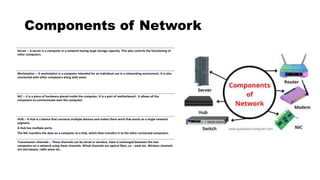
Server :- A server is a computer in a network having large storage capacity. This also controls the functioning of
other computers.
Workstation :- A workstation is a computer intended for an individual use in a networking enviroment. It is also
connected with other computers along with sever.
NIC :- it is a piece of hardware placed inside the computer. It is a part of motherboard . It allows all the
computers to communicate over the computer.
HUB :- A Hub is a device that connects multiple devices and makes them work that works as a single network
segment.
A Hub has multiple ports.
The NIC transfers the data on a computer to a Hub, which then transfers it to the other connected computers.
Transmission channels :- These channels can be wired or wireless. Data is exchanged between the two
computers on a network using these channels. Wired channels are optical fibre, co – axial etc. Wireless channels
are microwave, radio wave etc.
Types of Network
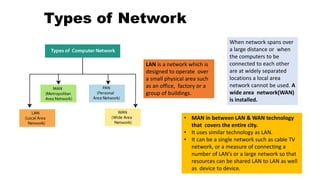
LAN is a network which is
designed to operate over
a small physical area such
as an office, factory or a
group of buildings.
When network spans over
a large distance or when
the computers to be
connected to each other
are at widely separated
locations a local area
network cannot be used. A
wide area network(WAN)
is installed.
• MAN in between LAN & WAN technology
that covers the entire city.
• It uses similar technology as LAN.
• It can be a single network such as cable TV
network, or a measure of connecting a
number of LAN’s or a large network so that
resources can be shared LAN to LAN as well
as device to device.
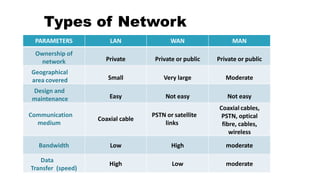
Types of Network
PARAMETERS LAN WAN MAN
Ownership of
network Private Private or public Private or public
Geographical
area covered Small Very large Moderate
Design and
maintenance Easy Not easy Not easy
Communication
medium
Coaxial cable
PSTN or satellite
links
Coaxial cables,
PSTN, optical
fibre, cables,
wireless
Bandwidth Low High moderate
Data
Transfer (speed)
High Low moderate
Network Topology
The physical arrangement of cables, computers
and other peripheral devices to form a network
is known as topology
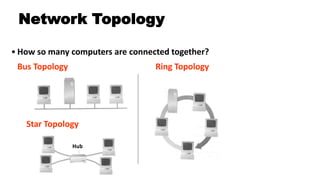
Network Topology
• How so many computers are connected together?
Bus Topology Ring Topology
Star Topology
Hub
Network Topology
• Bus Topology
• Simple and low-cost
• A single cable called a trunk (backbone, segment)
• Only one computer can send messages at a time
• Passive topology - computer only listen for, not regenerate data
• Star Topology
• Each computer has a cable connected to a single point
• More cabling, hence higher cost
• All signals transmission through the hub; if down, entire network down
• Depending on the intelligence of hub, two or more computers may send message at the same time
Network Topology
• Ring Topology
• Every computer serves as a repeater to boost signals
• Typical way to send data:
• Token passing
• only the computer who gets the token can send data
• Disadvantages
• Difficult to add computers
• More expensive
• If one computer fails, whole network fails
Basics of Computer Network

Basics of Computer Network

  • 1.
    BASIC CONCEPTS OF NETWORK RAUNAK, 7A CAIE GLENDALE ACADEMY,HYDERABAD
  • 2.
    Defination DEFINTION: A computer networkis defined as the interconnection of two or more computers. It is done to enable the computers to communicate and share available resources.
  • 3.
    Applications APPLICATIONS: Sharing of resources such asprinters Sharing of expensive software's and database Communication from one computer to another computer Exchange of data and information among users via network Sharing of information over geographically wide areas.
  • 4.
    Use of ComputerNetwork •Sharing information — i.e. data communication • Do you prefer these? • Or this?
  • 5.
    Use of ComputerNetwork •Sharing hardware or software • E.g. print document,Server •Centralize administration and support • E.g. Internet-based, so everyone can access the same administrative or support application from their PCs, VPN
  • 6.
    Advantages of ComputerNetwork Sharing devices such as printers saves money. Site (software) licences are likely to be cheaper than buying several standalone licences. Files can easily be shared between users. Network users can communicate by email and instant messenger. Security is good - users cannot see other users' files unlike on stand- alone machines. Data is easy to backup as all the data is stored on the file server.
  • 7.
    Dis-Advantages of ComputerNetwork Network cabling and file servers can be expensive. Managing a large network is complicated, requires training and a network manager usually needs to be employed. If the file server breaks down the files on the file server become inaccessible. Email might still work if it is on a separate server. The computers can still be used but are isolated. Viruses can spread to other computers throughout a computer network. There is a danger of hacking, particularly with wide area networks. Security procedures are needed to prevent such abuse, eg a firewall.
  • 8.
    Components of Network Server:- A server is a computer in a network having large storage capacity. This also controls the functioning of other computers. Workstation :- A workstation is a computer intended for an individual use in a networking enviroment. It is also connected with other computers along with sever. NIC :- it is a piece of hardware placed inside the computer. It is a part of motherboard . It allows all the computers to communicate over the computer. HUB :- A Hub is a device that connects multiple devices and makes them work that works as a single network segment. A Hub has multiple ports. The NIC transfers the data on a computer to a Hub, which then transfers it to the other connected computers. Transmission channels :- These channels can be wired or wireless. Data is exchanged between the two computers on a network using these channels. Wired channels are optical fibre, co – axial etc. Wireless channels are microwave, radio wave etc.
  • 9.
    Types of Network LANis a network which is designed to operate over a small physical area such as an office, factory or a group of buildings. When network spans over a large distance or when the computers to be connected to each other are at widely separated locations a local area network cannot be used. A wide area network(WAN) is installed. • MAN in between LAN & WAN technology that covers the entire city. • It uses similar technology as LAN. • It can be a single network such as cable TV network, or a measure of connecting a number of LAN’s or a large network so that resources can be shared LAN to LAN as well as device to device.
  • 10.
    Types of Network PARAMETERSLAN WAN MAN Ownership of network Private Private or public Private or public Geographical area covered Small Very large Moderate Design and maintenance Easy Not easy Not easy Communication medium Coaxial cable PSTN or satellite links Coaxial cables, PSTN, optical fibre, cables, wireless Bandwidth Low High moderate Data Transfer (speed) High Low moderate
  • 11.
    Network Topology The physicalarrangement of cables, computers and other peripheral devices to form a network is known as topology
  • 12.
    Network Topology • Howso many computers are connected together? Bus Topology Ring Topology Star Topology Hub
  • 13.
    Network Topology • BusTopology • Simple and low-cost • A single cable called a trunk (backbone, segment) • Only one computer can send messages at a time • Passive topology - computer only listen for, not regenerate data • Star Topology • Each computer has a cable connected to a single point • More cabling, hence higher cost • All signals transmission through the hub; if down, entire network down • Depending on the intelligence of hub, two or more computers may send message at the same time
  • 14.
    Network Topology • RingTopology • Every computer serves as a repeater to boost signals • Typical way to send data: • Token passing • only the computer who gets the token can send data • Disadvantages • Difficult to add computers • More expensive • If one computer fails, whole network fails