Value Chain and Value System

                       By group :- 2
             Sandeep Lunked 130/08
              Mahendra Pratap Singh
                       Sudeep Tyagi
                             Ashish
Value Chain framework is a model
that views firms by sets of activities
that firms use to create value and
competitive advantage.
Value Chain
• Models the firm as a chain of value-creating
  activities.

• Its ultimate goal is to maximize value creation
  while minimizing costs.

• The value chain framework is a powerful
  analysis tool for strategic planning.
The concept of Value Chain popularized by Michael Porter (Harvard University)
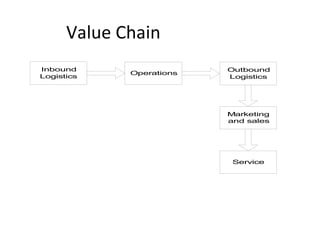
Value Chain
Inbound                   Outbound
             Operations
Logistics                 Logistics


                          Marketing
                          and sales


                           Service
The value chain categorizes the generic value-adding activities of an
  organization.

    – It describes the activities within and around an organization.

    – Relates them to an analysis of the competitive strength of
      the organization.

    – It evaluates which value each particular activity adds to the
      organizations products or services

    – Only systematic things and activities will make customers
      willing to a pay a price for the product.

    – Operational Effectiveness as a tool for Competitive
      Advantage.
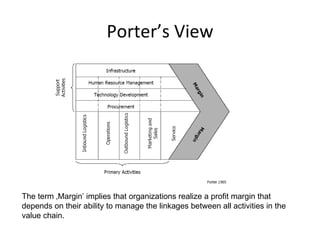
Porter’s View


The term ‚Margin’ implies that organizations realize a profit margin that
depends on their ability to manage the linkages between all activities in the
value chain.
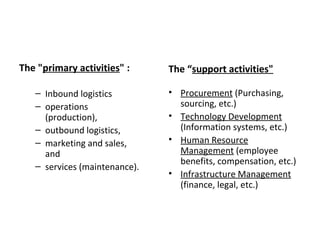
The "primary activities" :     The “support activities"

   – Inbound logistics         • Procurement (Purchasing,
   – operations                  sourcing, etc.)
     (production),             • Technology Development
   – outbound logistics,         (Information systems, etc.)
   – marketing and sales,      • Human Resource
     and                         Management (employee
                                 benefits, compensation, etc.)
   – services (maintenance).
                               • Infrastructure Management
                                 (finance, legal, etc.)
Value System

A value system includes the value chains of a firm's
  supplier (and their suppliers all the way back), the
  firm itself, the firm distribution channels, and the
  firm's buyers (and presumably extended to the
  buyers of their products, and so on).

Value System can extend beyond the boundaries of an
  enterprise -- Value Systems according to M. Porter.
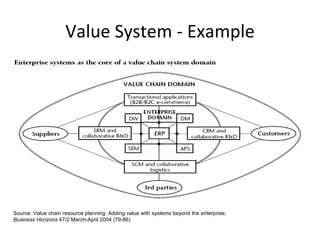
Value System - Example


Source: Value chain resource planning: Adding value with systems beyond the enterprise;
Business Horizons 47/2 March-April 2004 (79-86)
ERP
• Enterprise systems are designed to plan and integrate
  processes, enforce data integrity, and better manage
  resources.

• The best known are Enterprise Resource Planning (ERP)
  systems, which are predominantly intra-firm focused and
  provide, at least in theory, seamless integration of processes
  across functional areas with improved work flow,
  standardization of various business practices, improved order
  management, accurate accounting of inventory, and up-to-
  date operational data.
Supply chain management (SCM) applications developed by
such firms as i2, Manugistics, and ORTEC, have provided
capabilities for firms to manage their fleet resources more
efficiently and develop more appropriate production
schedules, ordering protocols, and postponement
strategies.


Contract monitoring programs, available through CRM and
supplier relationship management (SRM) vendors such as
Oracle, Siebel, RiverOne, and Supplyworks, continuously
monitor the fulfillment of contracts to ensure quality and
long-term reliability.
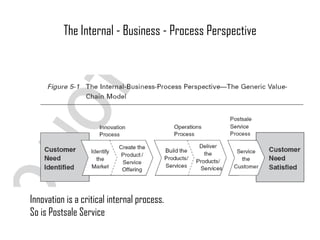
The Internal - Business - Process Perspective

• Each business has a unique set of processes for creating value for
  customers and producing financial results.


• The internal-business-process value Chain encompasses three principal
  business processes:

    – Innovation
    – Operations
    – Postsale service
The Internal - Business - Process Perspective


Innovation is a critical internal process.
So is Postsale Service
Processes
•   Innovation process
     – the business unit researches the emerging or latent needs of
        customers, and then creates the products or services that will meet
        these needs.

•   Operations process,
     – the generic internal value chain, is where existing products and
       services are produced and delivered to customers.

•   Postsale process
     – includes warranty and repair activities, treatment of defects and
       returns, and the processing of payments, such as credit card
       administration
Metrics - Innovation Process

MEASURES FOR PRODUCT DEVELOPMENT


    1.   The percentage of products for which the first design
         of a device fully met the customer’s functional
         specification
    2.   The number of times the design needed to be
         modified, even slightly, before it was released for
         production.
Metrics - Innovation Process
Illustration
  Hewlett-Packard engineers developed a
  metric called break-even time (BET) to
  measure the effectiveness of its product
  development cycle

  BET measures the time from the beginning of product
  development work until the product has been introduced and
  has generated enough profit to pay back the investment
  originally made in its development
Metrics - Postsale Process
• Cycle times from customer request to ultimate resolution of the
  problem
   – measure the speed of response to failures.

• Cost metrics can evaluate the efficiency
   – the cost of resources used for postsale service processes

• Yield
   – Percentage of customer requests handled with a single service
      call, rather than requiring multiple calls to resolve the problem.

• Defects
   – They recorded the percentage of items that could not be
     offered to customers because of quality-related defects.
Thank You

Value Chain and value system

  • 1.
    Value Chain andValue System By group :- 2 Sandeep Lunked 130/08 Mahendra Pratap Singh Sudeep Tyagi Ashish
  • 2.
    Value Chain frameworkis a model that views firms by sets of activities that firms use to create value and competitive advantage.
  • 3.
    Value Chain • Modelsthe firm as a chain of value-creating activities. • Its ultimate goal is to maximize value creation while minimizing costs. • The value chain framework is a powerful analysis tool for strategic planning. The concept of Value Chain popularized by Michael Porter (Harvard University)
  • 4.
    Value Chain Inbound Outbound Operations Logistics Logistics Marketing and sales Service
  • 5.
    The value chaincategorizes the generic value-adding activities of an organization. – It describes the activities within and around an organization. – Relates them to an analysis of the competitive strength of the organization. – It evaluates which value each particular activity adds to the organizations products or services – Only systematic things and activities will make customers willing to a pay a price for the product. – Operational Effectiveness as a tool for Competitive Advantage.
  • 6.
    Porter’s View The term‚Margin’ implies that organizations realize a profit margin that depends on their ability to manage the linkages between all activities in the value chain.
  • 7.
    The "primary activities": The “support activities" – Inbound logistics • Procurement (Purchasing, – operations sourcing, etc.) (production), • Technology Development – outbound logistics, (Information systems, etc.) – marketing and sales, • Human Resource and Management (employee benefits, compensation, etc.) – services (maintenance). • Infrastructure Management (finance, legal, etc.)
  • 8.
    Value System A valuesystem includes the value chains of a firm's supplier (and their suppliers all the way back), the firm itself, the firm distribution channels, and the firm's buyers (and presumably extended to the buyers of their products, and so on). Value System can extend beyond the boundaries of an enterprise -- Value Systems according to M. Porter.
  • 9.
    Value System -Example Source: Value chain resource planning: Adding value with systems beyond the enterprise; Business Horizons 47/2 March-April 2004 (79-86)
  • 10.
    ERP • Enterprise systemsare designed to plan and integrate processes, enforce data integrity, and better manage resources. • The best known are Enterprise Resource Planning (ERP) systems, which are predominantly intra-firm focused and provide, at least in theory, seamless integration of processes across functional areas with improved work flow, standardization of various business practices, improved order management, accurate accounting of inventory, and up-to- date operational data.
  • 11.
    Supply chain management(SCM) applications developed by such firms as i2, Manugistics, and ORTEC, have provided capabilities for firms to manage their fleet resources more efficiently and develop more appropriate production schedules, ordering protocols, and postponement strategies. Contract monitoring programs, available through CRM and supplier relationship management (SRM) vendors such as Oracle, Siebel, RiverOne, and Supplyworks, continuously monitor the fulfillment of contracts to ensure quality and long-term reliability.
  • 12.
    The Internal -Business - Process Perspective • Each business has a unique set of processes for creating value for customers and producing financial results. • The internal-business-process value Chain encompasses three principal business processes: – Innovation – Operations – Postsale service
  • 13.
    The Internal -Business - Process Perspective Innovation is a critical internal process. So is Postsale Service
  • 14.
    Processes • Innovation process – the business unit researches the emerging or latent needs of customers, and then creates the products or services that will meet these needs. • Operations process, – the generic internal value chain, is where existing products and services are produced and delivered to customers. • Postsale process – includes warranty and repair activities, treatment of defects and returns, and the processing of payments, such as credit card administration
  • 15.
    Metrics - InnovationProcess MEASURES FOR PRODUCT DEVELOPMENT 1. The percentage of products for which the first design of a device fully met the customer’s functional specification 2. The number of times the design needed to be modified, even slightly, before it was released for production.
  • 16.
    Metrics - InnovationProcess Illustration Hewlett-Packard engineers developed a metric called break-even time (BET) to measure the effectiveness of its product development cycle BET measures the time from the beginning of product development work until the product has been introduced and has generated enough profit to pay back the investment originally made in its development
  • 17.
    Metrics - PostsaleProcess • Cycle times from customer request to ultimate resolution of the problem – measure the speed of response to failures. • Cost metrics can evaluate the efficiency – the cost of resources used for postsale service processes • Yield – Percentage of customer requests handled with a single service call, rather than requiring multiple calls to resolve the problem. • Defects – They recorded the percentage of items that could not be offered to customers because of quality-related defects.
  • 18.