Learning for Test Prioritization
An Industrial Case Study
Benjamin Busjaeger
Salesforce
Tao Xie
University of Illinois,
Urbana-Champaign
ACM SIGSOFT FSE 2016
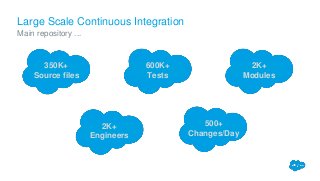
Large Scale Continuous Integration
2K+
Modules
600K+
Tests
2K+
Engineers
500+
Changes/Day
Main repository ...
350K+
Source files
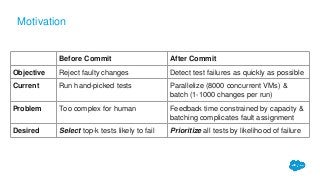
Motivation
Before Commit After Commit
Objective Reject faulty changes Detect test failures as quickly as possible
Current Run hand-picked tests Parallelize (8000 concurrent VMs) &
batch (1-1000 changes per run)
Problem Too complex for human Feedback time constrained by capacity &
batching complicates fault assignment
Desired Select top-k tests likely to fail Prioritize all tests by likelihood of failure
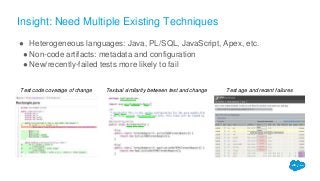
Insight: Need Multiple Existing Techniques
● Heterogeneous languages: Java, PL/SQL, JavaScript, Apex, etc.
●Non-code artifacts: metadata and configuration
●New/recently-failed tests more likely to fail
Test code coverage of change Textual similarity between test and change Test age and recent failures
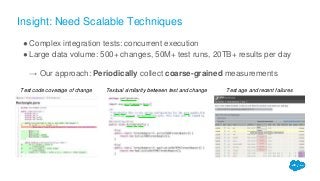
Insight: Need Scalable Techniques
●Complex integration tests: concurrent execution
●Large data volume: 500+ changes, 50M+ test runs, 20TB+ results per day
→ Our approach: Periodically collect coarse-grained measurements
Test code coverage of change Textual similarity between test and change Test age and recent failures
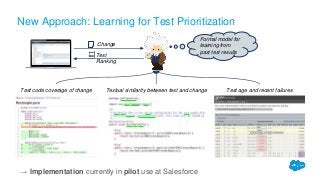
Formal model for
learning from
past test results
New Approach: Learning for Test Prioritization
Test code coverage of change Textual similarity between test and change Test age and recent failures
Change
Test
Ranking
→ Implementation currently in pilot use at Salesforce
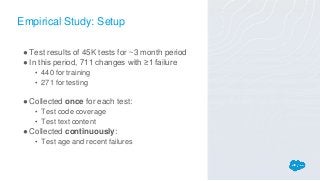
Empirical Study: Setup
●Test results of 45K tests for ~3 month period
●In this period, 711 changes with ≥1 failure
• 440 for training
• 271 for testing
●Collected once for each test:
• Test code coverage
• Test text content
●Collected continuously:
• Test age and recent failures
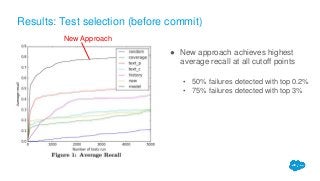
● New approach achieves highest
average recall at all cutoff points
• 50% failures detected with top 0.2%
• 75% failures detected with top 3%
Results: Test selection (before commit)
New Approach
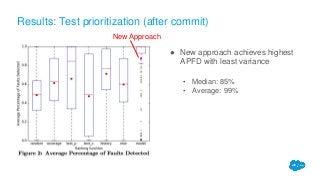
● New approach achieves highest
APFD with least variance
• Median: 85%
• Average: 99%
Results: Test prioritization (after commit)
New Approach
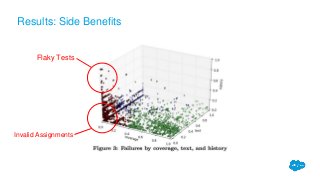
Results: Side Benefits
Invalid Assignments
Flaky Tests
Summary
● Main insights gained in conducting test prioritization in industry
● Novel learning-based approach to test prioritization
● Implementation currently in pilot use at Salesforce
● Empirical evaluation using a large Salesforce dataset
● Ongoing work: add features, word2vec, deep learning, cost-aware
Thank you
Q&A
Summary
● Main insights gained in conducting test prioritization in industry
● Novel learning-based approach to test prioritization
● Implementation currently in pilot use at Salesforce
● Empirical evaluation using a large Salesforce dataset
● Ongoing work: add features, word2vec/deep learning, cost-aware

Learning for Testing Prioritization- an industrial case study

  • 1.
    Learning for TestPrioritization An Industrial Case Study Benjamin Busjaeger Salesforce Tao Xie University of Illinois, Urbana-Champaign ACM SIGSOFT FSE 2016
  • 2.
    Large Scale ContinuousIntegration 2K+ Modules 600K+ Tests 2K+ Engineers 500+ Changes/Day Main repository ... 350K+ Source files
  • 3.
    Motivation Before Commit AfterCommit Objective Reject faulty changes Detect test failures as quickly as possible Current Run hand-picked tests Parallelize (8000 concurrent VMs) & batch (1-1000 changes per run) Problem Too complex for human Feedback time constrained by capacity & batching complicates fault assignment Desired Select top-k tests likely to fail Prioritize all tests by likelihood of failure
  • 4.
    Insight: Need MultipleExisting Techniques ● Heterogeneous languages: Java, PL/SQL, JavaScript, Apex, etc. ●Non-code artifacts: metadata and configuration ●New/recently-failed tests more likely to fail Test code coverage of change Textual similarity between test and change Test age and recent failures
  • 5.
    Insight: Need ScalableTechniques ●Complex integration tests: concurrent execution ●Large data volume: 500+ changes, 50M+ test runs, 20TB+ results per day → Our approach: Periodically collect coarse-grained measurements Test code coverage of change Textual similarity between test and change Test age and recent failures
  • 6.
    Formal model for learningfrom past test results New Approach: Learning for Test Prioritization Test code coverage of change Textual similarity between test and change Test age and recent failures Change Test Ranking → Implementation currently in pilot use at Salesforce
  • 7.
    Empirical Study: Setup ●Testresults of 45K tests for ~3 month period ●In this period, 711 changes with ≥1 failure • 440 for training • 271 for testing ●Collected once for each test: • Test code coverage • Test text content ●Collected continuously: • Test age and recent failures
  • 8.
    ● New approachachieves highest average recall at all cutoff points • 50% failures detected with top 0.2% • 75% failures detected with top 3% Results: Test selection (before commit) New Approach
  • 9.
    ● New approachachieves highest APFD with least variance • Median: 85% • Average: 99% Results: Test prioritization (after commit) New Approach
  • 10.
    Results: Side Benefits InvalidAssignments Flaky Tests
  • 11.
    Summary ● Main insightsgained in conducting test prioritization in industry ● Novel learning-based approach to test prioritization ● Implementation currently in pilot use at Salesforce ● Empirical evaluation using a large Salesforce dataset ● Ongoing work: add features, word2vec, deep learning, cost-aware
  • 12.
  • 13.
    Summary ● Main insightsgained in conducting test prioritization in industry ● Novel learning-based approach to test prioritization ● Implementation currently in pilot use at Salesforce ● Empirical evaluation using a large Salesforce dataset ● Ongoing work: add features, word2vec/deep learning, cost-aware

Editor's Notes

  • #6 coverage: periodically collected (slightly out-of-date), dynamic instrumentation (JaCoCo, no rebuild), approximate proximity