SAFE LIFTING
RESPONSIBILITIES OF RIGGER 
• To Qualify as a slinger / Bansk man, the person should 
be medically and physically fit (have a good eye sight, hearing) 
• Have been trained in the safe use of lifting equipment. 
Ability to select and use the lifting tackles as per load configuration. 
• To be able to provide necessary signals for crane operators. 
• To locate load in away, to ensure safety of load and working personnel. 
• To understand his companies, rules and regulation, color coding and 
certification of lifting tackle. 
• To be able to communicate with radio where the crane operator 
Is out of range.
Definition of Rigging 
• Rigging is part of the lifting operation which forms 
the link between the crane and the load. 
• Safe working load (SWL) is the load that can safely 
be lifted provided your lifting equipment is in good 
condition and has three(3) items marked on it i.e. 
• S.W.L. or WLL 
• Identification No. 
• Color code 
If does not have these (3) items marked on it, 
Change it for items that do have these (3) 
items marked on it.
SWL 
Identification No. 
Sling Marking 
current Color code
Hardware Application 
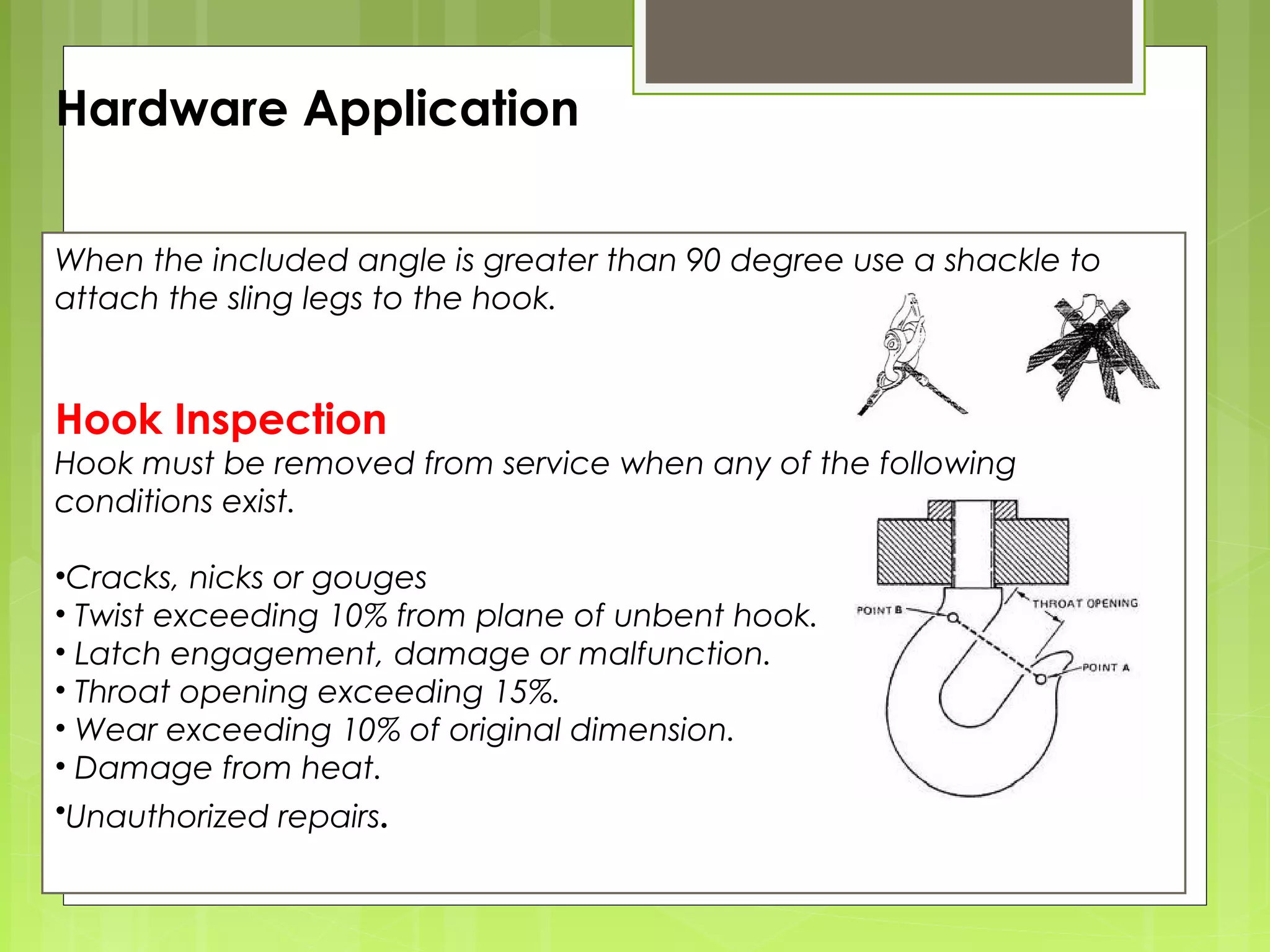
When the included angle is greater than 90 degree use a shackle to 
attach the sling legs to the hook. 
Hook Inspection 
Hook must be removed from service when any of the following 
conditions exist. 
•Cracks, nicks or gouges 
• Twist exceeding 10% from plane of unbent hook. 
• Latch engagement, damage or malfunction. 
• Throat opening exceeding 15%. 
• Wear exceeding 10% of original dimension. 
• Damage from heat. 
•Unauthorized repairs.
Hitches 
1ˣ2 1ˣ1 
1ˣ0.75
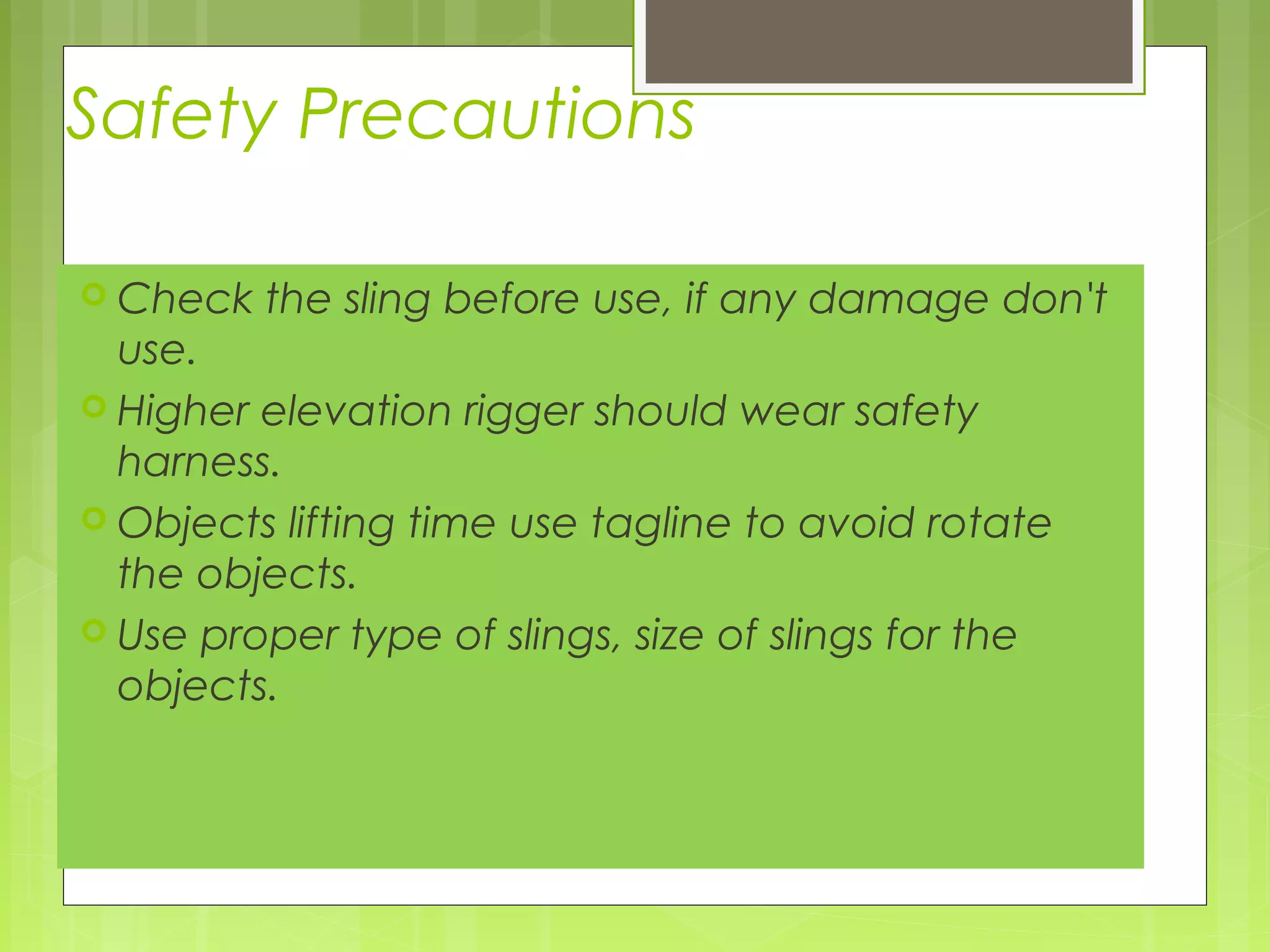
Safety Precautions 
 Check the sling before use, if any damage don't 
use. 
 Higher elevation rigger should wear safety 
harness. 
 Objects lifting time use tagline to avoid rotate 
the objects. 
 Use proper type of slings, size of slings for the 
objects.
Shackle Application 
Shackle Application 
Never replace a shackle pin with a bolt. the strength of 
an ordinary bolt is much less than that of a shackle pin. 
Hardware Shackles Inspection 
 Absence of capacity or identifying marks. 
 Bent or distorted pin and/ or body. 
 Nicks, gouges or cracks. 
 Heat or chemical damage. 
 Body spread. 
 Reduction in diameter of pin and/ or body greater than 10% .
Sling Inspection 
Rigging equipment shall not be loaded in excess 
of its indicated recommended safe load, and 
shall be inspected prior to each lifting operation. 
In case of wire slings, the working load shall be 
based on the size and load chart, as marking is 
not practical.
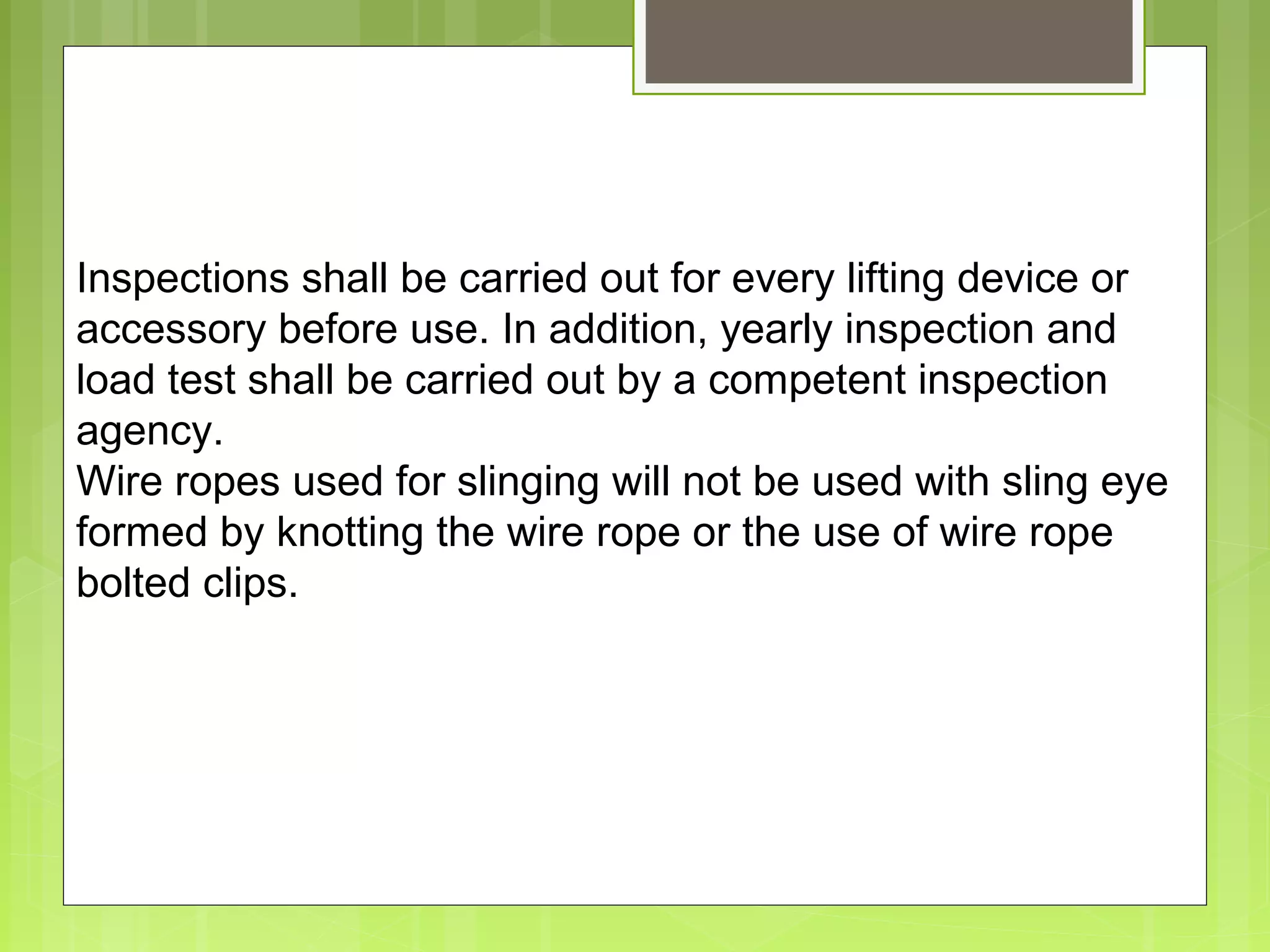
Inspections shall be carried out for every lifting device or 
accessory before use. In addition, yearly inspection and 
load test shall be carried out by a competent inspection 
agency. 
Wire ropes used for slinging will not be used with sling eye 
formed by knotting the wire rope or the use of wire rope 
bolted clips.
Crane Application 
Wind speed for mobile crane, 
Maximum from 32 / 35 km/h
Thank you

Presentation of Rigger

  • 1.
  • 2.
    RESPONSIBILITIES OF RIGGER • To Qualify as a slinger / Bansk man, the person should be medically and physically fit (have a good eye sight, hearing) • Have been trained in the safe use of lifting equipment. Ability to select and use the lifting tackles as per load configuration. • To be able to provide necessary signals for crane operators. • To locate load in away, to ensure safety of load and working personnel. • To understand his companies, rules and regulation, color coding and certification of lifting tackle. • To be able to communicate with radio where the crane operator Is out of range.
  • 3.
    Definition of Rigging • Rigging is part of the lifting operation which forms the link between the crane and the load. • Safe working load (SWL) is the load that can safely be lifted provided your lifting equipment is in good condition and has three(3) items marked on it i.e. • S.W.L. or WLL • Identification No. • Color code If does not have these (3) items marked on it, Change it for items that do have these (3) items marked on it.
  • 4.
    SWL Identification No. Sling Marking current Color code
  • 5.
    Hardware Application Whenthe included angle is greater than 90 degree use a shackle to attach the sling legs to the hook. Hook Inspection Hook must be removed from service when any of the following conditions exist. •Cracks, nicks or gouges • Twist exceeding 10% from plane of unbent hook. • Latch engagement, damage or malfunction. • Throat opening exceeding 15%. • Wear exceeding 10% of original dimension. • Damage from heat. •Unauthorized repairs.
  • 6.
  • 7.
    Safety Precautions Check the sling before use, if any damage don't use.  Higher elevation rigger should wear safety harness.  Objects lifting time use tagline to avoid rotate the objects.  Use proper type of slings, size of slings for the objects.
  • 8.
    Shackle Application ShackleApplication Never replace a shackle pin with a bolt. the strength of an ordinary bolt is much less than that of a shackle pin. Hardware Shackles Inspection  Absence of capacity or identifying marks.  Bent or distorted pin and/ or body.  Nicks, gouges or cracks.  Heat or chemical damage.  Body spread.  Reduction in diameter of pin and/ or body greater than 10% .
  • 9.
    Sling Inspection Riggingequipment shall not be loaded in excess of its indicated recommended safe load, and shall be inspected prior to each lifting operation. In case of wire slings, the working load shall be based on the size and load chart, as marking is not practical.
  • 10.
    Inspections shall becarried out for every lifting device or accessory before use. In addition, yearly inspection and load test shall be carried out by a competent inspection agency. Wire ropes used for slinging will not be used with sling eye formed by knotting the wire rope or the use of wire rope bolted clips.
  • 11.
    Crane Application Windspeed for mobile crane, Maximum from 32 / 35 km/h
  • 12.