Protected
Characteristics
1
Introduction
The Equality Act 2010 harmonises and replaces previous legislation (such as the Race Relations Act 1976
and the Disability Discrimination Act 1995) – and ensures consistency both in what you need to do to
make your workplace a fair environment , and your obligations to comply with the law.
The Equality Act covers the same groups that were effectively protected by existing equality legislation.
These are now called protected characteristics:
• Age
• Disability
• Gender Reassignment
• Race
• Religion or Belief
• Sex
• Sexual Orientation
• Marriage and Civil Partnership
• Pregnancy and Maternity
However, there are very significant modifications, extensions and brand new definitions that you must
bring into practice within your organisation immediately or face breaking the equality law. The next few
slides will expand upon these changes.
2
Age
• The Act protects people of all ages and
continues to allow employers to have a
default retirement age (DRA) of 65 (but look
out for our article on potential future changes
to the DRA in the November issue of Equality
Law Brief).
3
Disability
• The Act has made it easier for a person to show that they are disabled and protected from disability
discrimination. Under the Act, a person is disabled if they have a physical or mental impairment
which has a substantial and long-term adverse effect on their ability to carry out normal day-to-day
activities, which would include matters such as using a telephone, reading a book or using public
transport. The previous requirement that the employee's impairment effects a specific function
(mobility, manual dexterity, etc.) will no longer exist. This means that many more employees may
be able to establish that they are disabled for the purposes of the Equality Act.
• What does not change is that, as things stand now, the Act puts you under a positive duty as an
employer to make reasonable adjustments for your employees, to help them overcome
disadvantage resulting from an impairment (e.g. by providing assistive technologies to visually
impaired employees use computers effectively).
• The Act includes a new statutory protection from discrimination arising from disability. This states
that it is discrimination to treat a disabled person unfavourably because of something connected
with their disability (e.g. a tendency to make spelling mistakes arising from dyslexia). This type of
discrimination is unlawful where the employer or other person acting for the employer knows, or
could reasonably be expected to know, that the person has a disability.
• Additionally, indirect discrimination now covers disabled people. This means that a job applicant or
employee could claim that a particular rule or requirement you have in place disadvantages
disabled people.
• The Act also includes a new provision which makes it unlawful, for employers to ask about a
candidate's health before offering them work
4
Gender
Reassignment
• The Act provides protection for transsexual people. A transsexual
person is someone whom proposes to, starts or has completed a
process to change his or her gender. The Act no longer requires a
person to be under medical supervision to be protected – so a
woman who decides to live permanently as a man but does not
undergo any medical procedures would be covered. Transgender
people who are not transsexual, because they do not intend to live
permanently in the gender opposite to their birth sex, are not
protected by the Act.
• It is discrimination to treat transsexual people less favourably for
being absent at work because they propose to undergo, are
undergoing or have undergone gender reassignment than they
would be treated if they were absent because they were ill or
injured. Medical procedures for gender reassignment such as
hormone treatment, should not be treated as a 'lifestyle' choice.
5
Marriage and Civil
Partnership
• The Act protects employees who are married
or in a civil partnership against discrimination.
6
Pregnancy and
Maternity
• A woman is protected against discrimination on
the grounds of pregnancy and maternity during
the period of her pregnancy and any statutory
maternity leave to which she is entitled. During
this period, pregnancy and maternity
discrimination cannot be treated as sex
discrimination.
• You must not take into account an employee's
period of absence due to pregnancy-related
illness when making a decision about her
employment.
7
Race
• For the purposes of the Act, 'race' includes
colour, nationality and ethnic or national
origins. A racial group can be made up of two
or more different racial groups (e.g. Black
Britons).
8
Religion or Belief
• In the Equality Act, religion includes any religion. It also
includes a lack of religion, in other words employees or
jobseekers are protected if they do not follow a certain
religion or have no religion at all. Additionally, a religion
must have a clear structure and belief system. Belief means
any religious or philosophical belief or lack of such belief. To
be protected, a belief must satisfy various criteria, including
that it is a weighty and substantial aspect of human life and
behaviour. Denominations or sects within a religion can be
considered a protected religion or religious belief.
Humanism is a protected philosophical belief.
• Discrimination because of religion or belief can occur even
where both the discriminator and recipient are of the same
religion or belief.
9
Sex
• The Act protects bisexual, gay, heterosexual
and lesbian people.
10
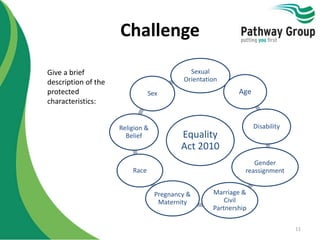
Challenge
Equality
Act 2010
Sexual
Orientation
Age
Disability
Gender
reassignment
Marriage &
Civil
Partnership
Pregnancy &
Maternity
Race
Religion &
Belief
Sex
11
Give a brief
description of the
protected
characteristics:
Challenge
Give a brief description of the protected characteristics:
1.
2.
3.
4.
5.
6.
7.
8.
9.
12

Protected characteristics - Equality Act 2010

  • 1.
  • 2.
    Introduction The Equality Act2010 harmonises and replaces previous legislation (such as the Race Relations Act 1976 and the Disability Discrimination Act 1995) – and ensures consistency both in what you need to do to make your workplace a fair environment , and your obligations to comply with the law. The Equality Act covers the same groups that were effectively protected by existing equality legislation. These are now called protected characteristics: • Age • Disability • Gender Reassignment • Race • Religion or Belief • Sex • Sexual Orientation • Marriage and Civil Partnership • Pregnancy and Maternity However, there are very significant modifications, extensions and brand new definitions that you must bring into practice within your organisation immediately or face breaking the equality law. The next few slides will expand upon these changes. 2
  • 3.
    Age • The Actprotects people of all ages and continues to allow employers to have a default retirement age (DRA) of 65 (but look out for our article on potential future changes to the DRA in the November issue of Equality Law Brief). 3
  • 4.
    Disability • The Acthas made it easier for a person to show that they are disabled and protected from disability discrimination. Under the Act, a person is disabled if they have a physical or mental impairment which has a substantial and long-term adverse effect on their ability to carry out normal day-to-day activities, which would include matters such as using a telephone, reading a book or using public transport. The previous requirement that the employee's impairment effects a specific function (mobility, manual dexterity, etc.) will no longer exist. This means that many more employees may be able to establish that they are disabled for the purposes of the Equality Act. • What does not change is that, as things stand now, the Act puts you under a positive duty as an employer to make reasonable adjustments for your employees, to help them overcome disadvantage resulting from an impairment (e.g. by providing assistive technologies to visually impaired employees use computers effectively). • The Act includes a new statutory protection from discrimination arising from disability. This states that it is discrimination to treat a disabled person unfavourably because of something connected with their disability (e.g. a tendency to make spelling mistakes arising from dyslexia). This type of discrimination is unlawful where the employer or other person acting for the employer knows, or could reasonably be expected to know, that the person has a disability. • Additionally, indirect discrimination now covers disabled people. This means that a job applicant or employee could claim that a particular rule or requirement you have in place disadvantages disabled people. • The Act also includes a new provision which makes it unlawful, for employers to ask about a candidate's health before offering them work 4
  • 5.
    Gender Reassignment • The Actprovides protection for transsexual people. A transsexual person is someone whom proposes to, starts or has completed a process to change his or her gender. The Act no longer requires a person to be under medical supervision to be protected – so a woman who decides to live permanently as a man but does not undergo any medical procedures would be covered. Transgender people who are not transsexual, because they do not intend to live permanently in the gender opposite to their birth sex, are not protected by the Act. • It is discrimination to treat transsexual people less favourably for being absent at work because they propose to undergo, are undergoing or have undergone gender reassignment than they would be treated if they were absent because they were ill or injured. Medical procedures for gender reassignment such as hormone treatment, should not be treated as a 'lifestyle' choice. 5
  • 6.
    Marriage and Civil Partnership •The Act protects employees who are married or in a civil partnership against discrimination. 6
  • 7.
    Pregnancy and Maternity • Awoman is protected against discrimination on the grounds of pregnancy and maternity during the period of her pregnancy and any statutory maternity leave to which she is entitled. During this period, pregnancy and maternity discrimination cannot be treated as sex discrimination. • You must not take into account an employee's period of absence due to pregnancy-related illness when making a decision about her employment. 7
  • 8.
    Race • For thepurposes of the Act, 'race' includes colour, nationality and ethnic or national origins. A racial group can be made up of two or more different racial groups (e.g. Black Britons). 8
  • 9.
    Religion or Belief •In the Equality Act, religion includes any religion. It also includes a lack of religion, in other words employees or jobseekers are protected if they do not follow a certain religion or have no religion at all. Additionally, a religion must have a clear structure and belief system. Belief means any religious or philosophical belief or lack of such belief. To be protected, a belief must satisfy various criteria, including that it is a weighty and substantial aspect of human life and behaviour. Denominations or sects within a religion can be considered a protected religion or religious belief. Humanism is a protected philosophical belief. • Discrimination because of religion or belief can occur even where both the discriminator and recipient are of the same religion or belief. 9
  • 10.
    Sex • The Actprotects bisexual, gay, heterosexual and lesbian people. 10
  • 11.
    Challenge Equality Act 2010 Sexual Orientation Age Disability Gender reassignment Marriage & Civil Partnership Pregnancy& Maternity Race Religion & Belief Sex 11 Give a brief description of the protected characteristics:
  • 12.
    Challenge Give a briefdescription of the protected characteristics: 1. 2. 3. 4. 5. 6. 7. 8. 9. 12